Asset Securitization
Securitization
• Securitization is “the issuance of marketable
securities backed by the expected cash flows
from specific assets (receivables)”
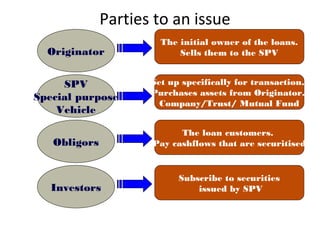
Parties to an issue
Originator
The initial owner of the loans.
Sells them to the SPV
Obligors
The loan customers.
Pay cashflows that are securitised
SPV
Special purpose
Vehicle
Set up specifically for transaction.
Purchases assets from Originator.
Company/Trust/ Mutual Fund
Investors
Subscribe to securities
issued by SPV
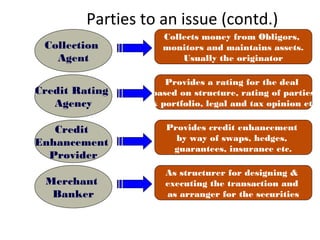
Parties to an issue (contd.)
Collection
Agent
Collects money from Obligors,
monitors and maintains assets.
Usually the originator
Credit
Enhancement
Provider
Provides credit enhancement
by way of swaps, hedges,
guarantees, insurance etc.
Merchant
Banker
As structurer for designing &
executing the transaction and
as arranger for the securities
Credit Rating
Agency
Provides a rating for the deal
based on structure, rating of parties
& portfolio, legal and tax opinion etc
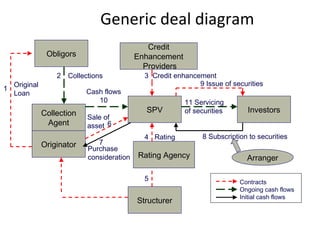
Generic deal diagram
SPV Investors
Originator
Obligors
Credit
Enhancement
Providers
Rating Agency
Structurer
9 Issue of securities
Collections Credit enhancement
Rating 8 Subscription to securities
Cash flows
10 11 Servicing
of securities
Contracts
Ongoing cash flows
Initial cash flows
Collection
Agent
Original
Loan
Sale of
asset
Purchase
consideration Arranger
1
2 3
4
5
6
7
Why securitize assets?
• More efficient financing
• Improved balance sheet structure
• Better risk management
What type of assets can be securitized?
• Any type of asset with a reasonably
predictable stream of future cash flows can be
securitized.
• Assets that are easiest to securitize are those:
that occur in large pools; for which past
experience can be used to predict default
rates; for which documentation is
standardized; and for which ownership is
transferable.
Types of Securitization
• MBS (Mortgage based securitization )
• ABS (Asset based securitization)
What is required for a successful asset
securitization?
• Robust financial infrastructure
– The Legal Environment
– The Accounting Environment
– The Regulatory Environment
– The Taxation Environment
– Back-office Systems
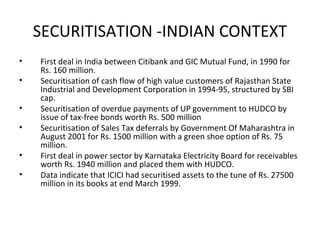
SECURITISATION -INDIAN CONTEXT
• First deal in India between Citibank and GIC Mutual Fund, in 1990 for
Rs. 160 million.
• Securitisation of cash flow of high value customers of Rajasthan State
Industrial and Development Corporation in 1994-95, structured by SBI
cap.
• Securitisation of overdue payments of UP government to HUDCO by
issue of tax-free bonds worth Rs. 500 million
• Securitisation of Sales Tax deferrals by Government Of Maharashtra in
August 2001 for Rs. 1500 million with a green shoe option of Rs. 75
million.
• First deal in power sector by Karnataka Electricity Board for receivables
worth Rs. 1940 million and placed them with HUDCO.
• Data indicate that ICICI had securitised assets to the tune of Rs. 27500
million in its books at end March 1999.
Some of the companies that have been Involved
in this are
– Ashok Leyland finance
– Cholamandalam investment & finance
– Esanda finance
– Sakthi finance
– Tata finance
– SRF finance
MBS - A Win-Win for All
• Originators
– Churn higher returns on lower capital base
• Investors
– Can invest in low-risk rated home loans paper without
hassles of origination/ servicing
• Financial system as a whole
– Expertise of Specialists helps maintain quality of
underlying assets and reduces ALM mismatches
• Home Loan Customers
– Access to cheaper funds
MORTGAGE BACKED SECURITIES IN
INDIA
• The beginning of Mortgage Backed Securities
(MBS) in India was made in August 2000,
• when National Housing Board (NHB) issued
the first MBS with issue size of INR 59.7
crores, originated by HDFC Ltd.
The US secondary mortgages market
• The US secondary mortgages market is
considered to be the world’s most developed
mortgage securitisation market.
• The mortgage originators are commercial banks,
thrifts, mortgage banks, and mortgage brokers.
• The main secondary market conduits are Fannie
Mae, Ginnie Mae and Freddie Mae.
• Some private investment banks also act as
conduits in the secondary mortgages market, but
to a limited extent.
• The investors in the secondary mortgages market
are the pension funds, the life insurance
companies, the commercial banks, the thrifts,
and Fannie Mae.
INSTITUTION FRAMEWORK FOR THE
SECONDARY MORTGAGES MARKET IN THE US
• The housing and mortgages industry in US is
overseen by U.S. Department of Housing and
Urban Development (HUD).
• It also sets goals for government owned
Ginnie Mae, and Government Sponsored
Enterprises (GSE) like Fannie Mae and Freddie
Mac.
• The Secretary of HUD is the mission regulator
for Fannie Mae and Freddie Mac with
oversight authority to ensure that both GSEs
comply with the public purposes set forth in
their charters.
• The secretary is charged with the general
regulatory authority over GSEs in all areas
other than the GSEs financial safety and
soundness.
• The financial safety and soundness of GSEs is
regulated by an independent office of HUD,
the Office of Federal Housing Enterprise
Oversight (OFHEO).
• It regulates both the GSEs for safety and
soundness, by ensuring that they are
adequately capitalized and operating their
businesses in a financially sound manner.
Institutional Framework in India
• Under the present institutional framework
National housing Board (NHB) is the apex level
financial institution for the housing sector in the
country
• and performs the role of promotion and
development, regulation and supervision,
financing, development of secondary mortgages
market through securitization of housing loans,
and promotion of rural housing.
• Most securitisations in India adopt a trust
structure – with the underlying assets being
transferred by way of a sale to a trustee, who
holds it in trust for the investors.
• The trustee typically issues PTCs. A PTC is a
certificate of proportional beneficial interest.
• Beneficial property and legal property is distinct
in law – the issuance of the PTCs does not imply
transfer of property by the SPV but certification
of beneficial interest.
Stamp duty
• Stamp duty arises from the fact that a transfer of
“actionable claims” (which term includes most receivables)
will require a written instrument, and such instrument is
treated as a “conveyance” in law, meaning a document
whereby legal interest is conveyed in property.
• A conveyance is a stampable document, and most states
impose stamp duties ranging between 3% to 15-16% on the
value of the property being transferred in a conveyance.
• Since this would completely rule out any securitisation
transaction, several states have relaxed their duties
applicable on securitisation transactions – mostly to
provide for 0.1% duty on the value of receivables being
transferred.
Taxation
• The tax laws have no specific provision dealing
with securitisation.
• Hence, the market practice is entirely based
on generic tax principles, and since these were
never crafted for securitisations, experts’
opinions differ.
• The generic tax rule is that a trustee is liable
to tax in a representative capacity on behalf of
the beneficiaries
• – therefore, there is a prima facie taxation of
the SPV as a representative of all end
investors.
• However, the representative tax is not
applicable in case of non-discretionary trusts
where the share of the beneficiaries is
ascertainable.
• The share of the beneficiaries is ascertainable
in all securitisations – through the amount of
PTCs held by the investors.
• The market believes, though with no reliable
precedent, that there will be no tax at the SPV
level and the investors will be taxed on their
share of income.
• The scenario is, however, far from clear and
the current thinking may be short lived.
Questions for Revision
• What is securitization ? What are the
advantages of securitization ?
• Describe the structure of the securitization
process ?
• Write a short note on
– Securitization in India.
– Securitization in the US.
The End

Securitization

  • 1.
  • 2.
    Securitization • Securitization is“the issuance of marketable securities backed by the expected cash flows from specific assets (receivables)”
  • 3.
    Parties to anissue Originator The initial owner of the loans. Sells them to the SPV Obligors The loan customers. Pay cashflows that are securitised SPV Special purpose Vehicle Set up specifically for transaction. Purchases assets from Originator. Company/Trust/ Mutual Fund Investors Subscribe to securities issued by SPV
  • 4.
    Parties to anissue (contd.) Collection Agent Collects money from Obligors, monitors and maintains assets. Usually the originator Credit Enhancement Provider Provides credit enhancement by way of swaps, hedges, guarantees, insurance etc. Merchant Banker As structurer for designing & executing the transaction and as arranger for the securities Credit Rating Agency Provides a rating for the deal based on structure, rating of parties & portfolio, legal and tax opinion etc
  • 5.
    Generic deal diagram SPVInvestors Originator Obligors Credit Enhancement Providers Rating Agency Structurer 9 Issue of securities Collections Credit enhancement Rating 8 Subscription to securities Cash flows 10 11 Servicing of securities Contracts Ongoing cash flows Initial cash flows Collection Agent Original Loan Sale of asset Purchase consideration Arranger 1 2 3 4 5 6 7
  • 6.
    Why securitize assets? •More efficient financing • Improved balance sheet structure • Better risk management
  • 7.
    What type ofassets can be securitized? • Any type of asset with a reasonably predictable stream of future cash flows can be securitized. • Assets that are easiest to securitize are those: that occur in large pools; for which past experience can be used to predict default rates; for which documentation is standardized; and for which ownership is transferable.
  • 8.
    Types of Securitization •MBS (Mortgage based securitization ) • ABS (Asset based securitization)
  • 9.
    What is requiredfor a successful asset securitization? • Robust financial infrastructure – The Legal Environment – The Accounting Environment – The Regulatory Environment – The Taxation Environment – Back-office Systems
  • 10.
    SECURITISATION -INDIAN CONTEXT •First deal in India between Citibank and GIC Mutual Fund, in 1990 for Rs. 160 million. • Securitisation of cash flow of high value customers of Rajasthan State Industrial and Development Corporation in 1994-95, structured by SBI cap. • Securitisation of overdue payments of UP government to HUDCO by issue of tax-free bonds worth Rs. 500 million • Securitisation of Sales Tax deferrals by Government Of Maharashtra in August 2001 for Rs. 1500 million with a green shoe option of Rs. 75 million. • First deal in power sector by Karnataka Electricity Board for receivables worth Rs. 1940 million and placed them with HUDCO. • Data indicate that ICICI had securitised assets to the tune of Rs. 27500 million in its books at end March 1999.
  • 11.
    Some of thecompanies that have been Involved in this are – Ashok Leyland finance – Cholamandalam investment & finance – Esanda finance – Sakthi finance – Tata finance – SRF finance
  • 12.
    MBS - AWin-Win for All • Originators – Churn higher returns on lower capital base • Investors – Can invest in low-risk rated home loans paper without hassles of origination/ servicing • Financial system as a whole – Expertise of Specialists helps maintain quality of underlying assets and reduces ALM mismatches • Home Loan Customers – Access to cheaper funds
  • 13.
    MORTGAGE BACKED SECURITIESIN INDIA • The beginning of Mortgage Backed Securities (MBS) in India was made in August 2000, • when National Housing Board (NHB) issued the first MBS with issue size of INR 59.7 crores, originated by HDFC Ltd.
  • 14.
    The US secondarymortgages market • The US secondary mortgages market is considered to be the world’s most developed mortgage securitisation market.
  • 15.
    • The mortgageoriginators are commercial banks, thrifts, mortgage banks, and mortgage brokers. • The main secondary market conduits are Fannie Mae, Ginnie Mae and Freddie Mae. • Some private investment banks also act as conduits in the secondary mortgages market, but to a limited extent. • The investors in the secondary mortgages market are the pension funds, the life insurance companies, the commercial banks, the thrifts, and Fannie Mae.
  • 16.
    INSTITUTION FRAMEWORK FORTHE SECONDARY MORTGAGES MARKET IN THE US • The housing and mortgages industry in US is overseen by U.S. Department of Housing and Urban Development (HUD). • It also sets goals for government owned Ginnie Mae, and Government Sponsored Enterprises (GSE) like Fannie Mae and Freddie Mac.
  • 17.
    • The Secretaryof HUD is the mission regulator for Fannie Mae and Freddie Mac with oversight authority to ensure that both GSEs comply with the public purposes set forth in their charters. • The secretary is charged with the general regulatory authority over GSEs in all areas other than the GSEs financial safety and soundness.
  • 18.
    • The financialsafety and soundness of GSEs is regulated by an independent office of HUD, the Office of Federal Housing Enterprise Oversight (OFHEO). • It regulates both the GSEs for safety and soundness, by ensuring that they are adequately capitalized and operating their businesses in a financially sound manner.
  • 19.
    Institutional Framework inIndia • Under the present institutional framework National housing Board (NHB) is the apex level financial institution for the housing sector in the country • and performs the role of promotion and development, regulation and supervision, financing, development of secondary mortgages market through securitization of housing loans, and promotion of rural housing.
  • 20.
    • Most securitisationsin India adopt a trust structure – with the underlying assets being transferred by way of a sale to a trustee, who holds it in trust for the investors. • The trustee typically issues PTCs. A PTC is a certificate of proportional beneficial interest. • Beneficial property and legal property is distinct in law – the issuance of the PTCs does not imply transfer of property by the SPV but certification of beneficial interest.
  • 21.
    Stamp duty • Stampduty arises from the fact that a transfer of “actionable claims” (which term includes most receivables) will require a written instrument, and such instrument is treated as a “conveyance” in law, meaning a document whereby legal interest is conveyed in property. • A conveyance is a stampable document, and most states impose stamp duties ranging between 3% to 15-16% on the value of the property being transferred in a conveyance. • Since this would completely rule out any securitisation transaction, several states have relaxed their duties applicable on securitisation transactions – mostly to provide for 0.1% duty on the value of receivables being transferred.
  • 22.
    Taxation • The taxlaws have no specific provision dealing with securitisation. • Hence, the market practice is entirely based on generic tax principles, and since these were never crafted for securitisations, experts’ opinions differ.
  • 23.
    • The generictax rule is that a trustee is liable to tax in a representative capacity on behalf of the beneficiaries • – therefore, there is a prima facie taxation of the SPV as a representative of all end investors.
  • 24.
    • However, therepresentative tax is not applicable in case of non-discretionary trusts where the share of the beneficiaries is ascertainable. • The share of the beneficiaries is ascertainable in all securitisations – through the amount of PTCs held by the investors.
  • 25.
    • The marketbelieves, though with no reliable precedent, that there will be no tax at the SPV level and the investors will be taxed on their share of income. • The scenario is, however, far from clear and the current thinking may be short lived.
  • 26.
    Questions for Revision •What is securitization ? What are the advantages of securitization ? • Describe the structure of the securitization process ? • Write a short note on – Securitization in India. – Securitization in the US.
  • 27.