













SECURITIZATION, HOW IT
EFFECTS YOU, IN SOUTH
AFRICA
ROLE PLAYERS:
1. Borrower-
1. Home Loans
2. Motor Vehicle
3. Credit Cards, etc.,
2. Financiers:
1. Banks –
2. Mortgage Originators
3. Aggregator
4. Securities Dealer
5. Investor
6. Legal
1. Advocates
2. Lawyers
7. Judiciary
1. Judges
2. Magistrates
8. Sherriff
COMMUNITY LIFE
ASSUMPTION -NEW HOME OWNER
Steps
1.Look for House
2.Make Offer
3.Approach Bank
4.Mortgage Granted
5.Take Occupation
6.Pay Rent
HOME BUYERS LOOKING FOR MORTGAGES
Before you have even
bought your loan it has
been packaged and sold
into securitisation
Bank Loans Adviser
Estate Agent takes you to Bank
Special Purpose Investors
Bank is a money making
Factory, which is illegal by
law, as only the
government can make
money
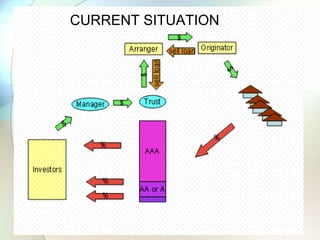
CURRENT SITUATION
• Company Retrenches you
• Your Business folds
• Cant pay premiums
• Get into Arrears
• Bank Issues Summons
• Bank Takes Judgment
• Bank Attaches House
• Sherriff sell house at sale of Execution
• Balance outstanding, Bank still owed monies
• Send Sheriff to Repossess your other belongings for
next 30 years
How did this Happen?
• Retrenchment or loss of employment
• Business goes Insolvent
• Gambled or took a risk
• Death or disablement of Bond payer - Uninsured
Alternatives Considered To Rescue
the Situation
• Try to borrow more money
• Sell House before sale of execution
• Put under Debt Counseling
• Gamble
• Rob a bank – This happens
• Suicide – This is a reality
TAKE YOUR HOUSE
BACK
STOP THE BANKS
THEIR LAWYERS AND
THE SHERIFF
PLEASE RESEARCH THE FOLLOWING WORDS:
1. Home Loans
2. Mortgage Originator
3. Aggregator
4. Securities Dealer
5. Investor
6. Securitization (2001 to 2008 non SA)
7. Special Purpose Vehicle
8. Special Purpose Investor
RULES:
a) Rule 14
b) 18(6) The person claiming he has been injured
must prove injury and
c) 18(12) If a party fails to comply then
d) Rule 30A
e) Rule 32
f) Rule 35
g) Rule 37
h) In Duplum Rule – Duplication of Payment of
Interest
i) Par Dilictum Rule – Dirty Hands Rule
j) No Locus Standi – Cannot represent
k) Section 86 of NCA
l) Section 129 and 130 of NCA
m) Promissory Note
PLEASE RESEARCH THE FOLLOWING WORDS:
Securitization in South Africa
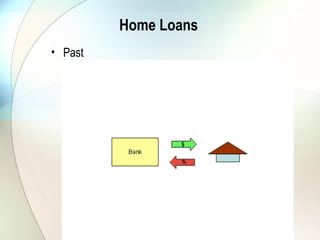
Home Loans
• Past
Securitization
• Securitisation is the generic term for any kind of Asset- or
Receivable-Securitisation. It is derived from the word
security, because usually illiquid and sometimes even
intangible assets that generate a constant cash flow are
formed into a tradable security and are floated on the debt
market.
• Securitisation is the conversion of a pool of assets with a
regular and predictable cash income, such as mortgage
repayments or credit card receivables into a security or
marketable instrument. In very basic terms, securitisation
enables a company (in most cases a bank) to “sell” a large
number of its assets
Securitization continued
• (e.g. mortgage loans), which would otherwise not be
attractive as individual purchases, to a specially formed
company - the Special Purpose Vehicle (“SPV”). The SPV
funds the purchase by issuing debt securities in the capital
markets, and the cash flows derived from the asset (such as
the mortgage or credit card repayments) will serve as
principal and interest payment obligations under the
marketable securities. Hence the issued securities are called
Asset-Backed Securities (“ABS”).
• Securitisation is the generic term for any kind of
Asset- or Receivable-Securitisation. It is derived from
the word security, because usually illiquid and
sometimes even intangible assets that generate a
constant cash flow are formed into a tradable security
and are floated on the debt market.
Securitization continued
The Bottom Line
• In a matter of weeks, maybe a month, from the time a
mortgage is originated it can become part of a CMO, ABS or
CDO deal. Few borrowers realize the extent to which their
mortgage is sliced, diced and traded. The end user of a
mortgage might be a hedge fund that makes directional
interest rate bets or uses leveraged positions to exploit small
relational pricing irregularities, or it might be the central bank of
a foreign country that likes the credit rating of an agency MBS.
On the other hand, it could be an insurance company based in
Brussels, that likes the duration and convexity profile of a
certain tranche in an ABS, CMO or CDO deal. The secondary
mortgage market is huge, liquid and complex with several
institutions that all take a slice of the mortgage pie.
Special Purpose Vehicle
• 'special purpose institution' means a company incorporated or a trust created society
for the purpose of the implementation of a securitisation scheme;
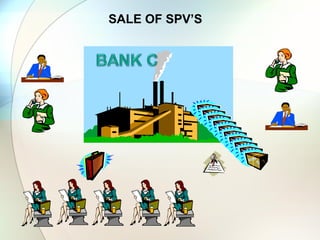
• In terms of securitisation schemes, the sale of the bank’s assets to the SPV (as a
going concern) appears to be a sale of income generating assets, and therefore a
sale of part of the business of the seller. This sale may therefore constitute a merger
as contemplated in section 12 of the Act. The SPV will, as a result of the sale of the
concerned assets, acquire control over a part of the business of the seller, which it
did not have prior to the transaction. Where the threshold requirements are met,
notification of these transactions would be required. The indication that the SPV has
no assets except those acquired as a result of the transaction will be considered in
the calculation of the annual turnover or asset values of the firms to the transaction
for the purpose of determining the threshold.
• This approach would be a significant step in line with the international trend to
exempt these transactions from merger notification. However, the Commission
reserves the right to review such transactions, particularly if any competition or
public interest concerns arise.
1. The Mortgage Originator
• The mortgage originator is the first company involved in the
secondary mortgage market. Mortgage originators consist of
banks, mortgage bankers and mortgage brokers. One
distinction to note is that banks and mortgage bankers use
their own funds to close mortgages and mortgage brokers do
not. Mortgage brokers act as independent agents for banks
or mortgage bankers. While banks use their traditional
sources of funding to close loans, mortgage bankers
typically use what is known as a warehouse line of credit to
fund loans. Most banks, and nearly all mortgage bankers,
quickly sell newly originated mortgages into the secondary
market.
2. The Aggregator
• Aggregators are the next company in the line of
secondary mortgage market participants. Aggregators
are large mortgage originators with ties to Wall Street
firms and government-sponsored enterprises (GSEs),
like Fannie Mae and Freddie Mac. Aggregators
purchase newly originated mortgages from smaller
originators, and along with their own originations, form
pools of mortgages that they either securitize into
private label mortgage-backed securities (by working
with Wall Street firms) or form agency MBSs (by
working through GSEs). (To learn more about GSEs,
see Profit From Mortgage Debt With MBS.)
3. Securities Dealers
• After an MBS has been formed (and sometimes before it is
formed, depending upon the type of the MBS), it is sold to a
securities dealer. Most Wall Street brokerage firms have
MBS trading desks. Dealers do all kinds of creative things
with MBS and mortgage whole loans. The end goal is to
sell securities to investors. Dealers frequently use MBSs to
structure CMO, ABS and CDO deals. These deals can be
structured to have different and somewhat definite
prepayment characteristics and enhanced credit ratings
compared to the underlying MBS or whole loans. Dealers
make a spread in the price at which they buy and sell MBS,
and look to make arbitrage profits in the way they structure
CMO, ABS and CDO deals.
4. Investors
• Investors are the end users of mortgages. Foreign
governments, pension funds, insurance companies, banks,
GSEs and hedge funds are all big investors in mortgages.
MBS, CMOs, ABS and CDOs offer investors a wide range of
potential yields based on varying credit quality and interest
rate risks.
Foreign governments, pension funds, insurance companies
and banks typically invest in high-credit rated mortgage
products. Certain tranches of the various structured mortgage
deals are sought after by these investors for
their prepayment and interest rate risk profiles. Hedge funds
are typically big investors in low-credit rated mortgage
products and structured mortgage products that have
greater interest rate risk.
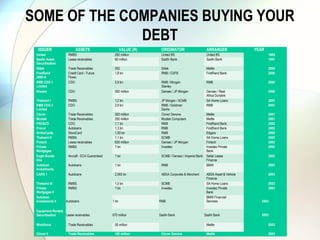
ISSUER ASSETS VALUE (R) ORIGINATOR ARRANGER YEAR
United RMBS 250 million United BS United BS 1989
Sasfin Asset
Securitisation
Lease receivables 60 million Sasfin Bank Sasfin Bank 1991
Siltek Trade Receivables 250 Siltek Mettle 2000
FirstRand
2000-A
Credit Card - Future
Flows
1,8 bn RMB / CSFB FirstRand Bank 2000
RMB CDO 1
Limited
CDO 3,9 bn RMB / Morgan
Stanley
RMB 2000
Kiwane CDO 500 million Gensec / JP Morgan Gensec / Real
Africa Durolink
2000
Thekwini I RMBS 1,2 bn JP Morgan / SCMB SA Home Loans 2001
RMB CDO 2
Limited
CDO 2,9 bn RMB / Goldman
Sachs
RMB 2001
Clover Trade Receivables 300 million Clover Danone Mettle 2001
Mustek Trade Receivables 250 million Mustek Computers Mettle 2001
FRESCO CDO 1,1 bn RMB FirstRand Bank 2002
Procul Autoloans 1,3 bn RMB FirstRand Bank 2002
OntheCards StoreCard 1,93 bn RMB Edgars 2002
Thekwini II RMBS 1,1 bn SCMB SA Home Loans 2002
Fintech Lease receivables 630 million Gensec / JP Morgan Fintech 2002
Private
Mortgages
RMBS 1 bn Investec Investec Private
Bank
2002
Eagle Bonds
One
Aircraft - ECA Guaranteed 1 bn SCMB / Gensec / Imperial Bank Safair Lease
Finance
2003
Autoloan
Investments
Autoloans 1 bn RMB BMW 2003
CARS 1 Autoloans 2,955 bn ABSA Corporate & Merchant ABSA Asset & Vehicle
Finance
2003
Thekwini III RMBS 1,5 bn SCMB SA Home Loans 2003
Private
Mortgages II
RMBS 1 bn Investec Investec Private
Bank
2003
Autoloan
Investments II Autoloans 1 bn RMB
BMW Financial
Services
 
2003
Equipment Rentals
Securitisation Lease receivables 670 million Sasfin Bank Sasfin Bank
 
2003
Workforce Trade Receivables 50 million Mettle 2003
Clover II Trade Receivables 100 million Clover Danone Mettle 2003
SOME OF THE COMPANIES BUYING YOUR
DEBT
CURRENT SITUATION
This means
• Banks are Committing Fraud:
1. Do not have our permission to sell your debt
2. Lawyers have no locus standi, they do not represent the party
owning the debt
3. There is no contract between you and this debt collector, but
they will make it sound like you still owe the original creditor,
and they are just collecting on behalf of them no locus standi
4. They have Dirty Hands and thus the Par Dilictum Rule applies
• The Banks are Stealing From Us:
1. My understanding is that when a debt collector (or anyone) buys
your debt from the original creditor, that debt is settled. This is
coming from the SA Reserve Bank - NewERA has written
confirmation from the South African Reserve Bank that, once a
bank sells a loan into a securitisation pool, they lose the legal
right to that asset
2. Not giving us the profit from the sale
3. Taking a monthly installment even though debt paid - In Duplum
rule
4. Claiming twice on a debt –It is illegal for banks to claim more
than double the amount loaned from any borrower (the in
duplum rule).
This means
Current Situation
• YOUR BOND IS SETTLED
• BANK HAS BEEN PAID BY AN INVESTOR
• YOU HAVE NO DEBT
THEREFORE
YOUR DEBT HAS BEEN PAID
HERE IS OUR STORY IN A BRIEF OUTLINE
1. We have been battling ABSA since 2009. Their strategy to try and win by
getting default Judgement. They do not want to go to trial. So if they lose at
summary Judgement, they withdraw the case and reissue to go for
summary Judgement again.
a. There have been 3 Cases since 2009
a. Case 1 Case No. 747/09
b. Case 2 Case No. 2019/12
c. Case 3 Case No. 810/2013
1. ABSA Withdrew the first two cases without serving notice on our Attorney of
Record at the time. They Sent a registered slip, so they say to my
daughters, yet cant produce slip, no slip, no signatures. This was not done
by following correct court procedure
2. On Withdrawing the two of the cases, they did so without tendering costs,
which is also contrary to court procedure and court rules.
5. The Banks legal team are not supposed to put information in
there documents that they know to be wrong, yet their Advocate
and lawyers, who know and admit this is securitisation, do not
care. They Perjure themselves the on behalf of Banks by saying
a fire destroyed all the documents and copies, including
microfilm, yet we have a securitisation letter from ABSA saying
it was securitised. Why did their legal team not request the
following as we did in our rule 45
a. Proof of Fire
b. Witness Reports
c. Photos of fire
d. Safety Officer Report
e. Police Report
f. Fire station report
g. Auditors Report
h. NCR Report
i. This is a Breach of Archiving’s and Record Keeping Act
6. The ABSA Manger who signed our certificate, which
in itself is not a correctly provided certificate, as it
does not comply to GAAP principles and the
affidavit supplied by the manager has no standing
1. Juristic entities, like that of ABSA, whom
authorise employees to dispense and swear to
the correctness of averments in an affidavit are
to state how it obtained such authority.
2. Sworn Affidavit Invalid. The State President
has, in terms of section 10 of the Justice of the
Peace and Commissioners of Oaths Act, 1963
(Act 16 of 1963)
7. They are basing their claim on a liquid document, which
the court rules say they must provide, but they have
stated in their court papers they don’t have them, and
that they were burnt in a fire.
a. Legislation
i. Rule 14
ii. Rule 18 of the Uniform Rules of Court
iii.Rule 32
b. Case Law
i. In the matter of FirstRand Bank Ltd v Beyer 2011
(1) SA 196 (GNP)
7. They have admitted to selling it into securitisation, and
therefore have, as per the banking act and securitisation
legislation lost ownership of the so called “asset”. Hence
their need to say lost in a fire, which is perjury
9. Their attitude is extremely Vexatious, wanting to win at all costs
a. They are constantly withdrawing and reissuing summonses
b. Keep going for default judgement, then withdrawing when
they loose and reissuing
c. By not tendering costs when withdrawing
d. Not withdrawing procedurally and correctly
e. There is Legislation against this type of attitude
Securitisation and its effects in sa

Securitisation and its effects in sa

  • 1.
    SECURITIZATION, HOW IT EFFECTSYOU, IN SOUTH AFRICA
  • 2.
    ROLE PLAYERS: 1. Borrower- 1.Home Loans 2. Motor Vehicle 3. Credit Cards, etc., 2. Financiers: 1. Banks – 2. Mortgage Originators 3. Aggregator 4. Securities Dealer 5. Investor 6. Legal 1. Advocates 2. Lawyers 7. Judiciary 1. Judges 2. Magistrates 8. Sherriff
  • 3.
  • 4.
    ASSUMPTION -NEW HOMEOWNER Steps 1.Look for House 2.Make Offer 3.Approach Bank 4.Mortgage Granted 5.Take Occupation 6.Pay Rent
  • 5.
    HOME BUYERS LOOKINGFOR MORTGAGES Before you have even bought your loan it has been packaged and sold into securitisation Bank Loans Adviser Estate Agent takes you to Bank Special Purpose Investors Bank is a money making Factory, which is illegal by law, as only the government can make money
  • 6.
    CURRENT SITUATION • CompanyRetrenches you • Your Business folds • Cant pay premiums • Get into Arrears • Bank Issues Summons • Bank Takes Judgment • Bank Attaches House • Sherriff sell house at sale of Execution • Balance outstanding, Bank still owed monies • Send Sheriff to Repossess your other belongings for next 30 years
  • 8.
    How did thisHappen? • Retrenchment or loss of employment • Business goes Insolvent • Gambled or took a risk • Death or disablement of Bond payer - Uninsured
  • 9.
    Alternatives Considered ToRescue the Situation • Try to borrow more money • Sell House before sale of execution • Put under Debt Counseling • Gamble • Rob a bank – This happens • Suicide – This is a reality
  • 10.
    TAKE YOUR HOUSE BACK STOPTHE BANKS THEIR LAWYERS AND THE SHERIFF
  • 11.
    PLEASE RESEARCH THEFOLLOWING WORDS: 1. Home Loans 2. Mortgage Originator 3. Aggregator 4. Securities Dealer 5. Investor 6. Securitization (2001 to 2008 non SA) 7. Special Purpose Vehicle 8. Special Purpose Investor
  • 12.
    RULES: a) Rule 14 b)18(6) The person claiming he has been injured must prove injury and c) 18(12) If a party fails to comply then d) Rule 30A e) Rule 32 f) Rule 35 g) Rule 37 h) In Duplum Rule – Duplication of Payment of Interest i) Par Dilictum Rule – Dirty Hands Rule j) No Locus Standi – Cannot represent k) Section 86 of NCA l) Section 129 and 130 of NCA m) Promissory Note PLEASE RESEARCH THE FOLLOWING WORDS:
  • 14.
  • 15.
  • 16.
    Securitization • Securitisation isthe generic term for any kind of Asset- or Receivable-Securitisation. It is derived from the word security, because usually illiquid and sometimes even intangible assets that generate a constant cash flow are formed into a tradable security and are floated on the debt market. • Securitisation is the conversion of a pool of assets with a regular and predictable cash income, such as mortgage repayments or credit card receivables into a security or marketable instrument. In very basic terms, securitisation enables a company (in most cases a bank) to “sell” a large number of its assets
  • 17.
    Securitization continued • (e.g.mortgage loans), which would otherwise not be attractive as individual purchases, to a specially formed company - the Special Purpose Vehicle (“SPV”). The SPV funds the purchase by issuing debt securities in the capital markets, and the cash flows derived from the asset (such as the mortgage or credit card repayments) will serve as principal and interest payment obligations under the marketable securities. Hence the issued securities are called Asset-Backed Securities (“ABS”).
  • 18.
    • Securitisation isthe generic term for any kind of Asset- or Receivable-Securitisation. It is derived from the word security, because usually illiquid and sometimes even intangible assets that generate a constant cash flow are formed into a tradable security and are floated on the debt market. Securitization continued
  • 19.
    The Bottom Line •In a matter of weeks, maybe a month, from the time a mortgage is originated it can become part of a CMO, ABS or CDO deal. Few borrowers realize the extent to which their mortgage is sliced, diced and traded. The end user of a mortgage might be a hedge fund that makes directional interest rate bets or uses leveraged positions to exploit small relational pricing irregularities, or it might be the central bank of a foreign country that likes the credit rating of an agency MBS. On the other hand, it could be an insurance company based in Brussels, that likes the duration and convexity profile of a certain tranche in an ABS, CMO or CDO deal. The secondary mortgage market is huge, liquid and complex with several institutions that all take a slice of the mortgage pie.
  • 20.
    Special Purpose Vehicle •'special purpose institution' means a company incorporated or a trust created society for the purpose of the implementation of a securitisation scheme; • In terms of securitisation schemes, the sale of the bank’s assets to the SPV (as a going concern) appears to be a sale of income generating assets, and therefore a sale of part of the business of the seller. This sale may therefore constitute a merger as contemplated in section 12 of the Act. The SPV will, as a result of the sale of the concerned assets, acquire control over a part of the business of the seller, which it did not have prior to the transaction. Where the threshold requirements are met, notification of these transactions would be required. The indication that the SPV has no assets except those acquired as a result of the transaction will be considered in the calculation of the annual turnover or asset values of the firms to the transaction for the purpose of determining the threshold. • This approach would be a significant step in line with the international trend to exempt these transactions from merger notification. However, the Commission reserves the right to review such transactions, particularly if any competition or public interest concerns arise.
  • 21.
    1. The MortgageOriginator • The mortgage originator is the first company involved in the secondary mortgage market. Mortgage originators consist of banks, mortgage bankers and mortgage brokers. One distinction to note is that banks and mortgage bankers use their own funds to close mortgages and mortgage brokers do not. Mortgage brokers act as independent agents for banks or mortgage bankers. While banks use their traditional sources of funding to close loans, mortgage bankers typically use what is known as a warehouse line of credit to fund loans. Most banks, and nearly all mortgage bankers, quickly sell newly originated mortgages into the secondary market.
  • 22.
    2. The Aggregator •Aggregators are the next company in the line of secondary mortgage market participants. Aggregators are large mortgage originators with ties to Wall Street firms and government-sponsored enterprises (GSEs), like Fannie Mae and Freddie Mac. Aggregators purchase newly originated mortgages from smaller originators, and along with their own originations, form pools of mortgages that they either securitize into private label mortgage-backed securities (by working with Wall Street firms) or form agency MBSs (by working through GSEs). (To learn more about GSEs, see Profit From Mortgage Debt With MBS.)
  • 23.
    3. Securities Dealers •After an MBS has been formed (and sometimes before it is formed, depending upon the type of the MBS), it is sold to a securities dealer. Most Wall Street brokerage firms have MBS trading desks. Dealers do all kinds of creative things with MBS and mortgage whole loans. The end goal is to sell securities to investors. Dealers frequently use MBSs to structure CMO, ABS and CDO deals. These deals can be structured to have different and somewhat definite prepayment characteristics and enhanced credit ratings compared to the underlying MBS or whole loans. Dealers make a spread in the price at which they buy and sell MBS, and look to make arbitrage profits in the way they structure CMO, ABS and CDO deals.
  • 24.
    4. Investors • Investorsare the end users of mortgages. Foreign governments, pension funds, insurance companies, banks, GSEs and hedge funds are all big investors in mortgages. MBS, CMOs, ABS and CDOs offer investors a wide range of potential yields based on varying credit quality and interest rate risks. Foreign governments, pension funds, insurance companies and banks typically invest in high-credit rated mortgage products. Certain tranches of the various structured mortgage deals are sought after by these investors for their prepayment and interest rate risk profiles. Hedge funds are typically big investors in low-credit rated mortgage products and structured mortgage products that have greater interest rate risk.
  • 26.
    ISSUER ASSETS VALUE(R) ORIGINATOR ARRANGER YEAR United RMBS 250 million United BS United BS 1989 Sasfin Asset Securitisation Lease receivables 60 million Sasfin Bank Sasfin Bank 1991 Siltek Trade Receivables 250 Siltek Mettle 2000 FirstRand 2000-A Credit Card - Future Flows 1,8 bn RMB / CSFB FirstRand Bank 2000 RMB CDO 1 Limited CDO 3,9 bn RMB / Morgan Stanley RMB 2000 Kiwane CDO 500 million Gensec / JP Morgan Gensec / Real Africa Durolink 2000 Thekwini I RMBS 1,2 bn JP Morgan / SCMB SA Home Loans 2001 RMB CDO 2 Limited CDO 2,9 bn RMB / Goldman Sachs RMB 2001 Clover Trade Receivables 300 million Clover Danone Mettle 2001 Mustek Trade Receivables 250 million Mustek Computers Mettle 2001 FRESCO CDO 1,1 bn RMB FirstRand Bank 2002 Procul Autoloans 1,3 bn RMB FirstRand Bank 2002 OntheCards StoreCard 1,93 bn RMB Edgars 2002 Thekwini II RMBS 1,1 bn SCMB SA Home Loans 2002 Fintech Lease receivables 630 million Gensec / JP Morgan Fintech 2002 Private Mortgages RMBS 1 bn Investec Investec Private Bank 2002 Eagle Bonds One Aircraft - ECA Guaranteed 1 bn SCMB / Gensec / Imperial Bank Safair Lease Finance 2003 Autoloan Investments Autoloans 1 bn RMB BMW 2003 CARS 1 Autoloans 2,955 bn ABSA Corporate & Merchant ABSA Asset & Vehicle Finance 2003 Thekwini III RMBS 1,5 bn SCMB SA Home Loans 2003 Private Mortgages II RMBS 1 bn Investec Investec Private Bank 2003 Autoloan Investments II Autoloans 1 bn RMB BMW Financial Services   2003 Equipment Rentals Securitisation Lease receivables 670 million Sasfin Bank Sasfin Bank   2003 Workforce Trade Receivables 50 million Mettle 2003 Clover II Trade Receivables 100 million Clover Danone Mettle 2003 SOME OF THE COMPANIES BUYING YOUR DEBT
  • 27.
  • 28.
    This means • Banksare Committing Fraud: 1. Do not have our permission to sell your debt 2. Lawyers have no locus standi, they do not represent the party owning the debt 3. There is no contract between you and this debt collector, but they will make it sound like you still owe the original creditor, and they are just collecting on behalf of them no locus standi 4. They have Dirty Hands and thus the Par Dilictum Rule applies
  • 29.
    • The Banksare Stealing From Us: 1. My understanding is that when a debt collector (or anyone) buys your debt from the original creditor, that debt is settled. This is coming from the SA Reserve Bank - NewERA has written confirmation from the South African Reserve Bank that, once a bank sells a loan into a securitisation pool, they lose the legal right to that asset 2. Not giving us the profit from the sale 3. Taking a monthly installment even though debt paid - In Duplum rule 4. Claiming twice on a debt –It is illegal for banks to claim more than double the amount loaned from any borrower (the in duplum rule). This means
  • 30.
    Current Situation • YOURBOND IS SETTLED • BANK HAS BEEN PAID BY AN INVESTOR
  • 32.
    • YOU HAVENO DEBT THEREFORE
  • 33.
    YOUR DEBT HASBEEN PAID
  • 34.
    HERE IS OURSTORY IN A BRIEF OUTLINE 1. We have been battling ABSA since 2009. Their strategy to try and win by getting default Judgement. They do not want to go to trial. So if they lose at summary Judgement, they withdraw the case and reissue to go for summary Judgement again. a. There have been 3 Cases since 2009 a. Case 1 Case No. 747/09 b. Case 2 Case No. 2019/12 c. Case 3 Case No. 810/2013 1. ABSA Withdrew the first two cases without serving notice on our Attorney of Record at the time. They Sent a registered slip, so they say to my daughters, yet cant produce slip, no slip, no signatures. This was not done by following correct court procedure 2. On Withdrawing the two of the cases, they did so without tendering costs, which is also contrary to court procedure and court rules.
  • 35.
    5. The Bankslegal team are not supposed to put information in there documents that they know to be wrong, yet their Advocate and lawyers, who know and admit this is securitisation, do not care. They Perjure themselves the on behalf of Banks by saying a fire destroyed all the documents and copies, including microfilm, yet we have a securitisation letter from ABSA saying it was securitised. Why did their legal team not request the following as we did in our rule 45 a. Proof of Fire b. Witness Reports c. Photos of fire d. Safety Officer Report e. Police Report f. Fire station report g. Auditors Report h. NCR Report i. This is a Breach of Archiving’s and Record Keeping Act
  • 36.
    6. The ABSAManger who signed our certificate, which in itself is not a correctly provided certificate, as it does not comply to GAAP principles and the affidavit supplied by the manager has no standing 1. Juristic entities, like that of ABSA, whom authorise employees to dispense and swear to the correctness of averments in an affidavit are to state how it obtained such authority. 2. Sworn Affidavit Invalid. The State President has, in terms of section 10 of the Justice of the Peace and Commissioners of Oaths Act, 1963 (Act 16 of 1963)
  • 37.
    7. They arebasing their claim on a liquid document, which the court rules say they must provide, but they have stated in their court papers they don’t have them, and that they were burnt in a fire. a. Legislation i. Rule 14 ii. Rule 18 of the Uniform Rules of Court iii.Rule 32 b. Case Law i. In the matter of FirstRand Bank Ltd v Beyer 2011 (1) SA 196 (GNP) 7. They have admitted to selling it into securitisation, and therefore have, as per the banking act and securitisation legislation lost ownership of the so called “asset”. Hence their need to say lost in a fire, which is perjury
  • 38.
    9. Their attitudeis extremely Vexatious, wanting to win at all costs a. They are constantly withdrawing and reissuing summonses b. Keep going for default judgement, then withdrawing when they loose and reissuing c. By not tendering costs when withdrawing d. Not withdrawing procedurally and correctly e. There is Legislation against this type of attitude