 What



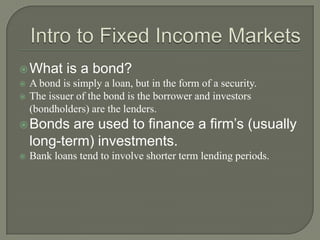
is a bond?

A bond is simply a loan, but in the form of a security.
The issuer of the bond is the borrower and investors
(bondholders) are the lenders.

are used to finance a firm’s (usually
long-term) investments.

 Bonds


Bank loans tend to involve shorter term lending periods.
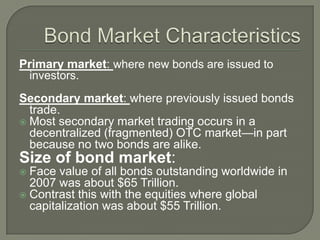
Primary market: where new bonds are issued to
investors.
Secondary market: where previously issued bonds
trade.
 Most secondary market trading occurs in a
decentralized (fragmented) OTC market—in part
because no two bonds are alike.

Size of bond market:
Face value of all bonds outstanding worldwide in
2007 was about $65 Trillion.
 Contrast this with the equities where global
capitalization was about $55 Trillion.

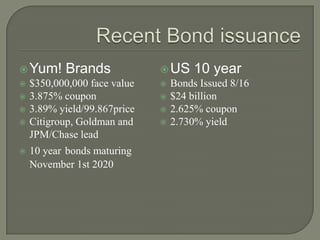
 Yum!







Brands

$350,000,000 face value
3.875% coupon
3.89% yield/99.867price
Citigroup, Goldman and
JPM/Chase lead
10 year bonds maturing
November 1st 2020

 US





10 year

Bonds Issued 8/16
$24 billion
2.625% coupon
2.730% yield
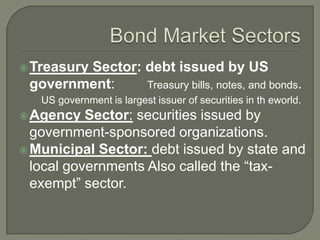
 Treasury

Sector: debt issued by US
government:
Treasury bills, notes, and bonds.
US government is largest issuer of securities in th eworld.

 Agency

Sector: securities issued by
government-sponsored organizations.
 Municipal Sector: debt issued by state and
local governments Also called the ―taxexempt‖ sector.
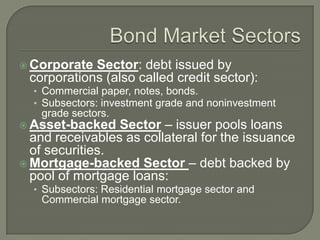
 Corporate

Sector: debt issued by
corporations (also called credit sector):
• Commercial paper, notes, bonds.
• Subsectors: investment grade and noninvestment

grade sectors.

Sector – issuer pools loans
and receivables as collateral for the issuance
of securities.
 Mortgage-backed Sector – debt backed by
pool of mortgage loans:
 Asset-backed

• Subsectors: Residential mortgage sector and

Commercial mortgage sector.
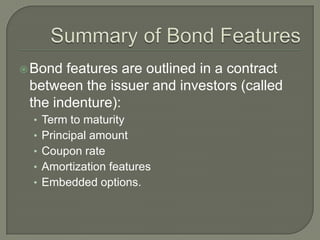
 Bond

features are outlined in a contract
between the issuer and investors (called
the indenture):
• Term to maturity

• Principal amount
• Coupon rate
• Amortization features
• Embedded options.
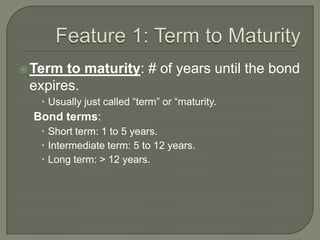
 Term

to maturity: # of years until the bond
expires.
 Usually just called ―term‖ or ―maturity.

Bond terms:
 Short term: 1 to 5 years.
 Intermediate term: 5 to 12 years.
 Long term: > 12 years.
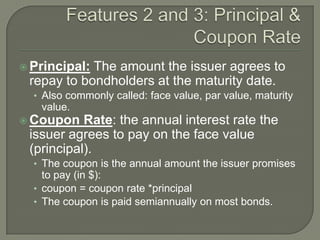
 Principal:

The amount the issuer agrees to
repay to bondholders at the maturity date.
• Also commonly called: face value, par value, maturity

value.
 Coupon

Rate: the annual interest rate the
issuer agrees to pay on the face value
(principal).
• The coupon is the annual amount the issuer promises

to pay (in $):
• coupon = coupon rate *principal
• The coupon is paid semiannually on most bonds.
 Some

bonds pay no coupons (zerocoupon bonds).
Zeros are sold at a substantial discount to
face value and redeemed at face value at
expiration.
All interest is therefore received at
expiration.
 Some bonds have floating coupons
The coupon resets periodically, according
to some formula
 The

coupon for a floater is determined
by the following general formula:
• Floater coupon = floating reference rate + fixed

margin


The principal on a bond can be paid
two ways:
• Paid all at once at expiration (―bullet‖ maturity).
• Paid little-by-little over the life of the bond

according to a schedule (amortizing).
 One

advantage of a bond that amortizes
principal is that the issuer won’t have to
fund a big “balloon payment” at
expiration.
 Options

are actions that can be taken by
either the issuer or the investor.

 The

most common is a call provision: Grants
issuer the right to retire bonds (fully or
partially) prior to maturity.

 Put

provision: Enables the bondholder to sell
the issue back to issuer at par value prior to
expiration.
bond – gives bondholders
the right to exchange the bond for a
specified number of shares of common
stock.

 Convertible

• This is advantageous to investors if firm’s stock

price goes up.

bond – allows
bondholders to exchange the bond for a
specified number of shares of common
stock of another firm.

 Exchangeable
 Interest-rate

Risks - Associated with Bond
Investing , thereby reducing a bond’s price
(also called market risk).
• The major risk faced by bond investors.

risk – the risk that the interest
rate at which intermediate cash flows can be
reinvested will fall.

 Reinvestment

risk – the risk the issuer may ―call‖ or
retire all or part of the issue before the
maturity date.

 Call
risk – risk that issuer will fail to satisfy
the terms of the bond.

 Credit

Default risk: Risk the issuer does not repay part or
all of its financial obligation.
2. Credit spread risk: Risk that an issuer’s obligation
will decline due to an increase in the credit spread
(the part of the risk premium or yield spread
attributable to default risk).
3. Credit deterioration risk: Risk that the credit quality
of the issuer decreases (closely related to credit
spread risk).
1.
risk – the risk that the purchasing
power of a bond’s cash flows may decline.

 Inflation

• Floating rate bonds have a lower level of inflation

risk than coupon bonds.

rate risk – if a bond is
denominated in a foreign currency (e.g.,
the euro), the value of the cash flows in
US$ will be uncertain.

 Exchange
risk – the risk that the bond
cannot be sold with ease at (or near) its
current value.

 Liquidity

• Unimportant for investors holding a bond to

maturity.
• Liquidity can be measured by the bid-ask spread.
• The wider the spread the less liquid a bond is.
Sometimes called marketability risk.
risk – the value of embedded options
is determined partly by the volatility of interest
rates

 Volatility

• The price of a bond with embedded options will

change as interest rate volatility changes.

risk – The bond market has been a
hotbed of financial innovation.

 Risk

• The risk/return characteristics of innovative securities

are not always understood. Risk risk is ―not knowing
what the risk of a security is.‖
THANK YOU

Bond market in india

  • 2.
     What   is abond? A bond is simply a loan, but in the form of a security. The issuer of the bond is the borrower and investors (bondholders) are the lenders. are used to finance a firm’s (usually long-term) investments.  Bonds  Bank loans tend to involve shorter term lending periods.
  • 3.
    Primary market: wherenew bonds are issued to investors. Secondary market: where previously issued bonds trade.  Most secondary market trading occurs in a decentralized (fragmented) OTC market—in part because no two bonds are alike. Size of bond market: Face value of all bonds outstanding worldwide in 2007 was about $65 Trillion.  Contrast this with the equities where global capitalization was about $55 Trillion. 
  • 4.
     Yum!      Brands $350,000,000 facevalue 3.875% coupon 3.89% yield/99.867price Citigroup, Goldman and JPM/Chase lead 10 year bonds maturing November 1st 2020  US     10 year Bonds Issued 8/16 $24 billion 2.625% coupon 2.730% yield
  • 5.
     Treasury Sector: debtissued by US government: Treasury bills, notes, and bonds. US government is largest issuer of securities in th eworld.  Agency Sector: securities issued by government-sponsored organizations.  Municipal Sector: debt issued by state and local governments Also called the ―taxexempt‖ sector.
  • 6.
     Corporate Sector: debtissued by corporations (also called credit sector): • Commercial paper, notes, bonds. • Subsectors: investment grade and noninvestment grade sectors. Sector – issuer pools loans and receivables as collateral for the issuance of securities.  Mortgage-backed Sector – debt backed by pool of mortgage loans:  Asset-backed • Subsectors: Residential mortgage sector and Commercial mortgage sector.
  • 7.
     Bond features areoutlined in a contract between the issuer and investors (called the indenture): • Term to maturity • Principal amount • Coupon rate • Amortization features • Embedded options.
  • 8.
     Term to maturity:# of years until the bond expires.  Usually just called ―term‖ or ―maturity. Bond terms:  Short term: 1 to 5 years.  Intermediate term: 5 to 12 years.  Long term: > 12 years.
  • 9.
     Principal: The amountthe issuer agrees to repay to bondholders at the maturity date. • Also commonly called: face value, par value, maturity value.  Coupon Rate: the annual interest rate the issuer agrees to pay on the face value (principal). • The coupon is the annual amount the issuer promises to pay (in $): • coupon = coupon rate *principal • The coupon is paid semiannually on most bonds.
  • 10.
     Some bonds payno coupons (zerocoupon bonds). Zeros are sold at a substantial discount to face value and redeemed at face value at expiration. All interest is therefore received at expiration.  Some bonds have floating coupons The coupon resets periodically, according to some formula
  • 11.
     The coupon fora floater is determined by the following general formula: • Floater coupon = floating reference rate + fixed margin
  • 12.
     The principal ona bond can be paid two ways: • Paid all at once at expiration (―bullet‖ maturity). • Paid little-by-little over the life of the bond according to a schedule (amortizing).  One advantage of a bond that amortizes principal is that the issuer won’t have to fund a big “balloon payment” at expiration.
  • 13.
     Options are actionsthat can be taken by either the issuer or the investor.  The most common is a call provision: Grants issuer the right to retire bonds (fully or partially) prior to maturity.  Put provision: Enables the bondholder to sell the issue back to issuer at par value prior to expiration.
  • 14.
    bond – givesbondholders the right to exchange the bond for a specified number of shares of common stock.  Convertible • This is advantageous to investors if firm’s stock price goes up. bond – allows bondholders to exchange the bond for a specified number of shares of common stock of another firm.  Exchangeable
  • 15.
     Interest-rate Risks -Associated with Bond Investing , thereby reducing a bond’s price (also called market risk). • The major risk faced by bond investors. risk – the risk that the interest rate at which intermediate cash flows can be reinvested will fall.  Reinvestment risk – the risk the issuer may ―call‖ or retire all or part of the issue before the maturity date.  Call
  • 16.
    risk – riskthat issuer will fail to satisfy the terms of the bond.  Credit Default risk: Risk the issuer does not repay part or all of its financial obligation. 2. Credit spread risk: Risk that an issuer’s obligation will decline due to an increase in the credit spread (the part of the risk premium or yield spread attributable to default risk). 3. Credit deterioration risk: Risk that the credit quality of the issuer decreases (closely related to credit spread risk). 1.
  • 17.
    risk – therisk that the purchasing power of a bond’s cash flows may decline.  Inflation • Floating rate bonds have a lower level of inflation risk than coupon bonds. rate risk – if a bond is denominated in a foreign currency (e.g., the euro), the value of the cash flows in US$ will be uncertain.  Exchange
  • 18.
    risk – therisk that the bond cannot be sold with ease at (or near) its current value.  Liquidity • Unimportant for investors holding a bond to maturity. • Liquidity can be measured by the bid-ask spread. • The wider the spread the less liquid a bond is. Sometimes called marketability risk.
  • 19.
    risk – thevalue of embedded options is determined partly by the volatility of interest rates  Volatility • The price of a bond with embedded options will change as interest rate volatility changes. risk – The bond market has been a hotbed of financial innovation.  Risk • The risk/return characteristics of innovative securities are not always understood. Risk risk is ―not knowing what the risk of a security is.‖
  • 20.