AND FINANCE
EMERGING
TECHNOLOGIES
T E C H N O L O G Y
When something is important
enough, you do it even if the
odds are not in your favour –
Elon Musk
B Y
V I K R A M S I N G H
S A N K H A L A
F I N A N C E
For the past few years, finance
has been shaken by
technological innovation like
never before – The Economist
E M E R G I N G T E C H N O L O G I E S A N D F I N A N C E
.
A PRESENTATION ON
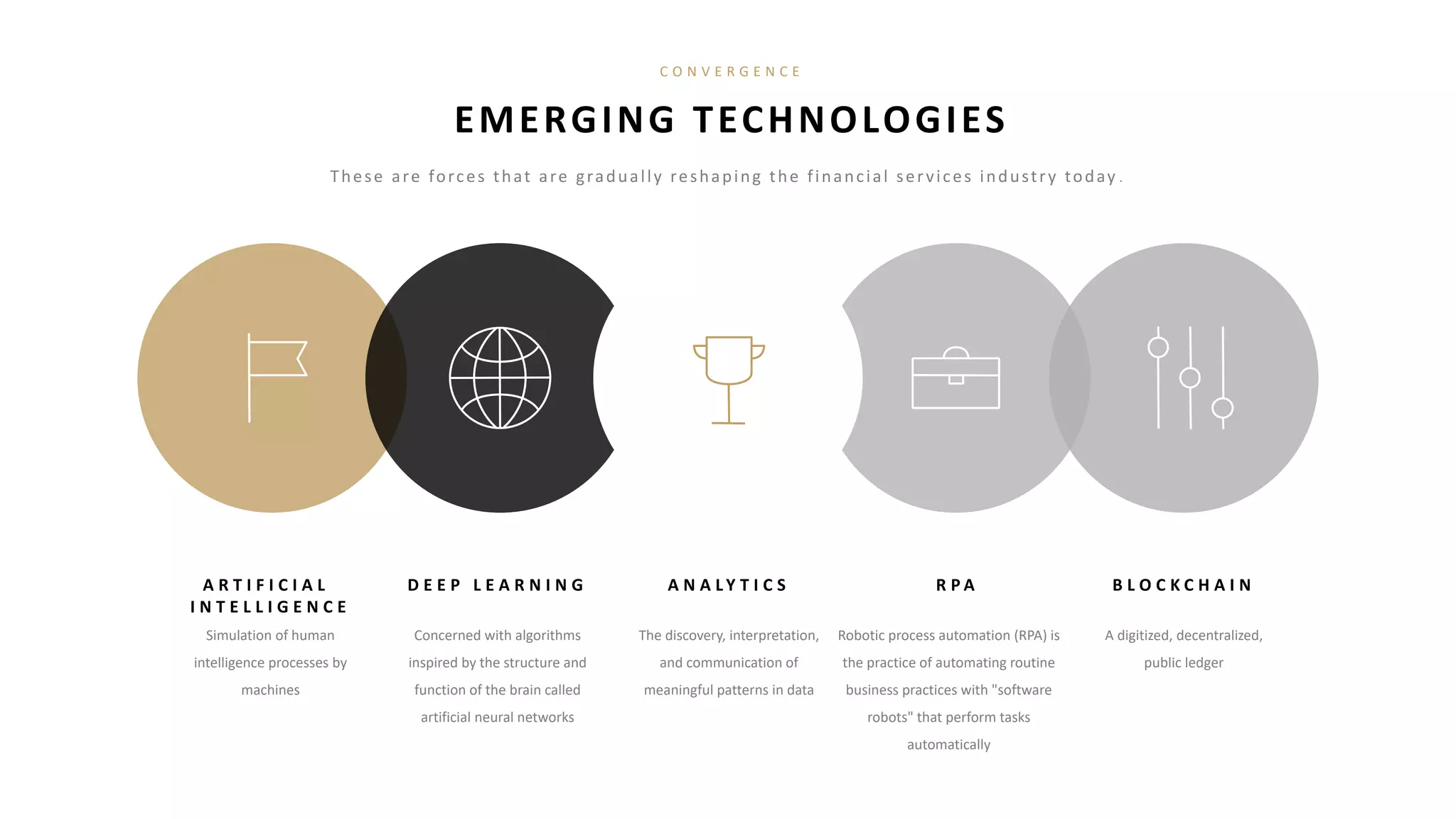
A R T I F I C I A L
I N T E L L I G E N C E
Simulation of human
intelligence processes by
machines
D E E P L E A R N I N G
Concerned with algorithms
inspired by the structure and
function of the brain called
artificial neural networks
A N A L Y T I C S
The discovery, interpretation,
and communication of
meaningful patterns in data
R P A
Robotic process automation (RPA) is
the practice of automating routine
business practices with "software
robots" that perform tasks
automatically
B L O C K C H A I N
A digitized, decentralized,
public ledger
EMERGING TECHNOLOGIES
C O N V E R G E N C E
These are forces that are gradually reshaping the financial services industry today .
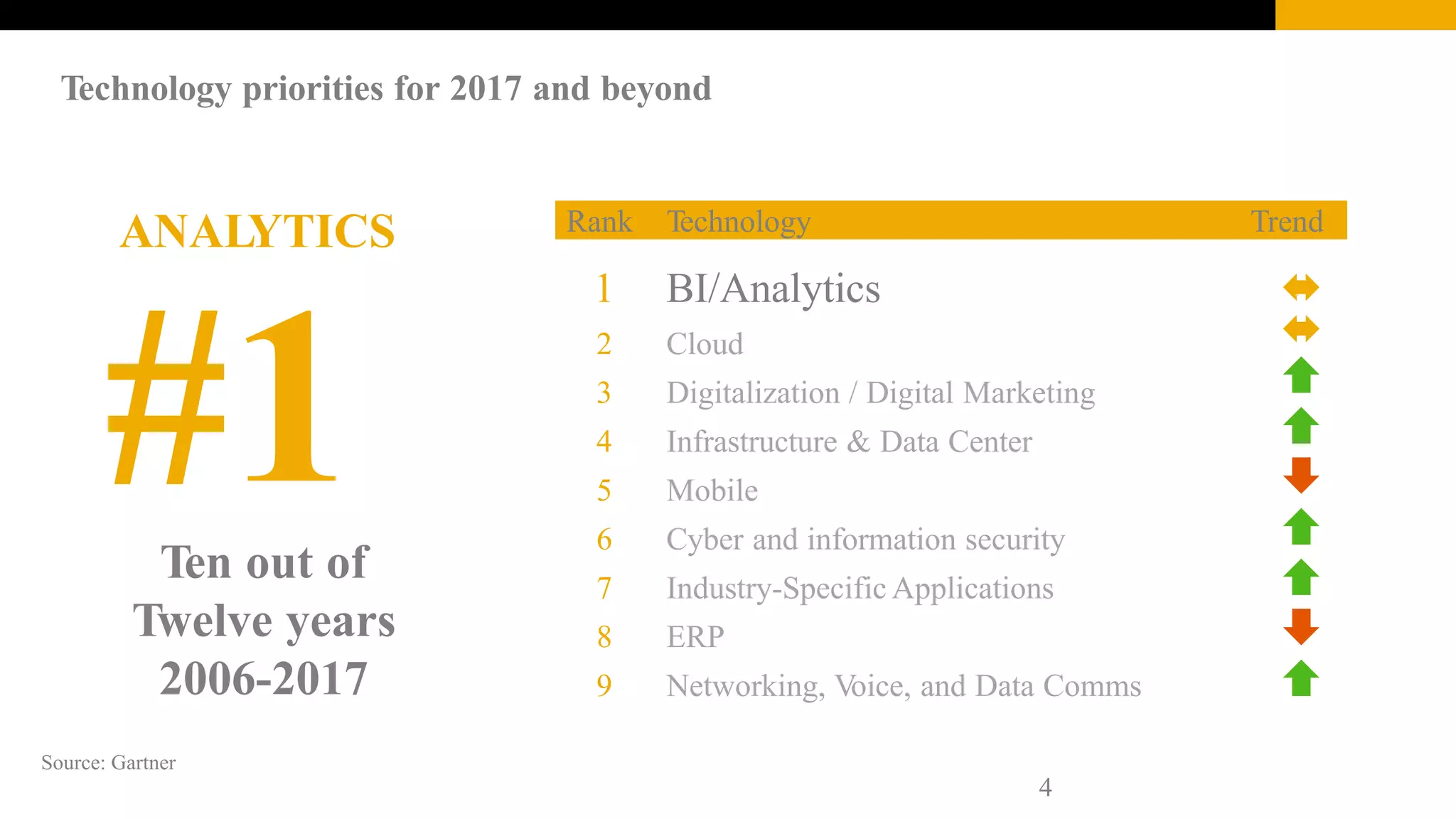
Technology priorities for 2017 and beyond
Rank Technology Trend
1 BI/Analytics
2 Cloud
3 Digitalization / Digital Marketing
4 Infrastructure & Data Center
5 Mobile
6 Cyber and information security
7 Industry-Specific Applications
8 ERP
9 Networking, Voice, and Data Comms
ANALYTICS
Ten out of
Twelve years
2006-2017
Source: Gartner
4
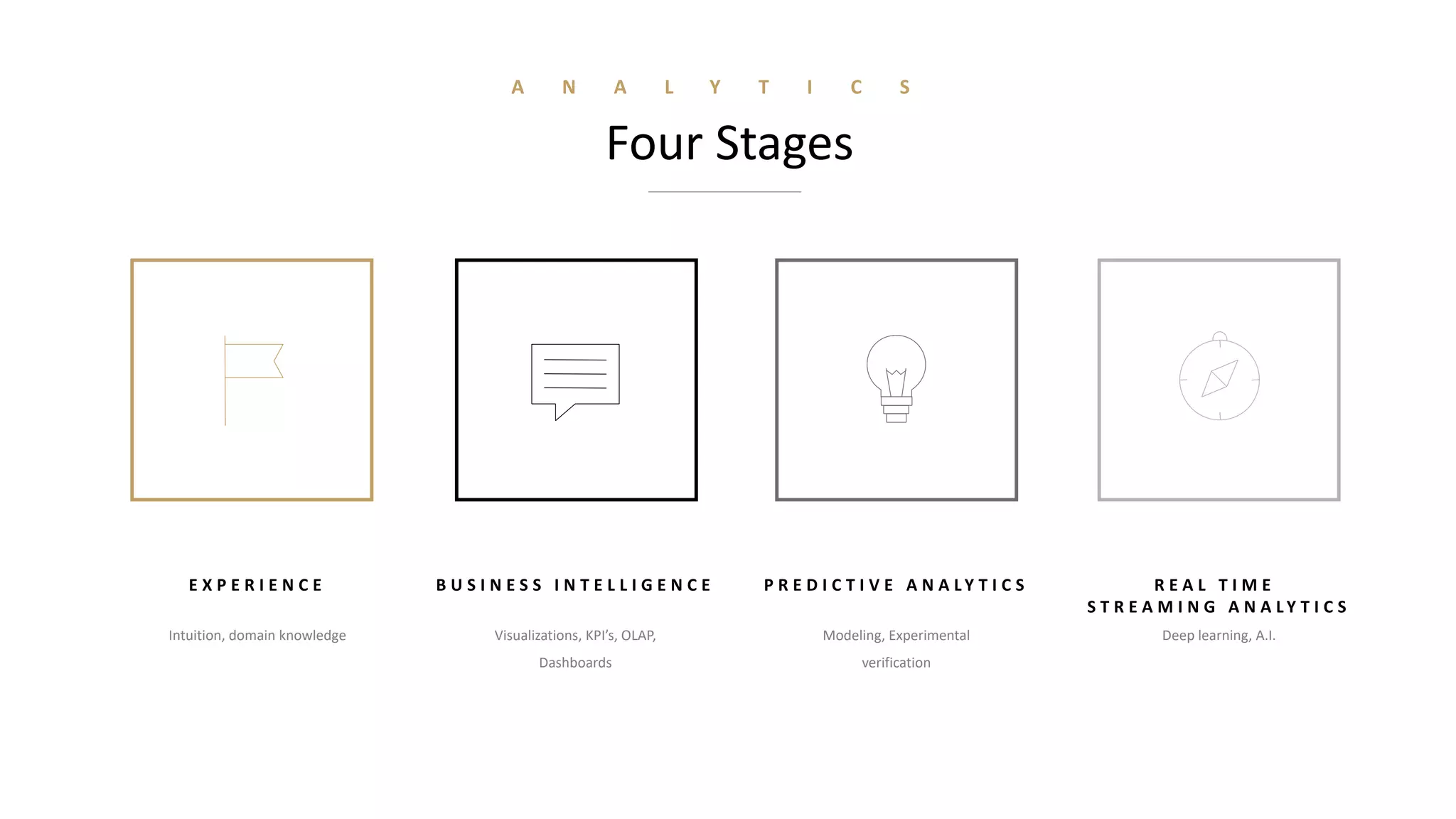
A N A L Y T I C S
Four Stages
E X P E R I E N C E

Intuition, domain knowledge
B U S I N E S S I N T E L L I G E N C E
Visualizations, KPI’s, OLAP,
Dashboards
P R E D I C T I V E A N A L Y T I C S
Modeling, Experimental
verification
R E A L T I M E
S T R E A M I N G A N A L Y T I C S
Deep learning, A.I.
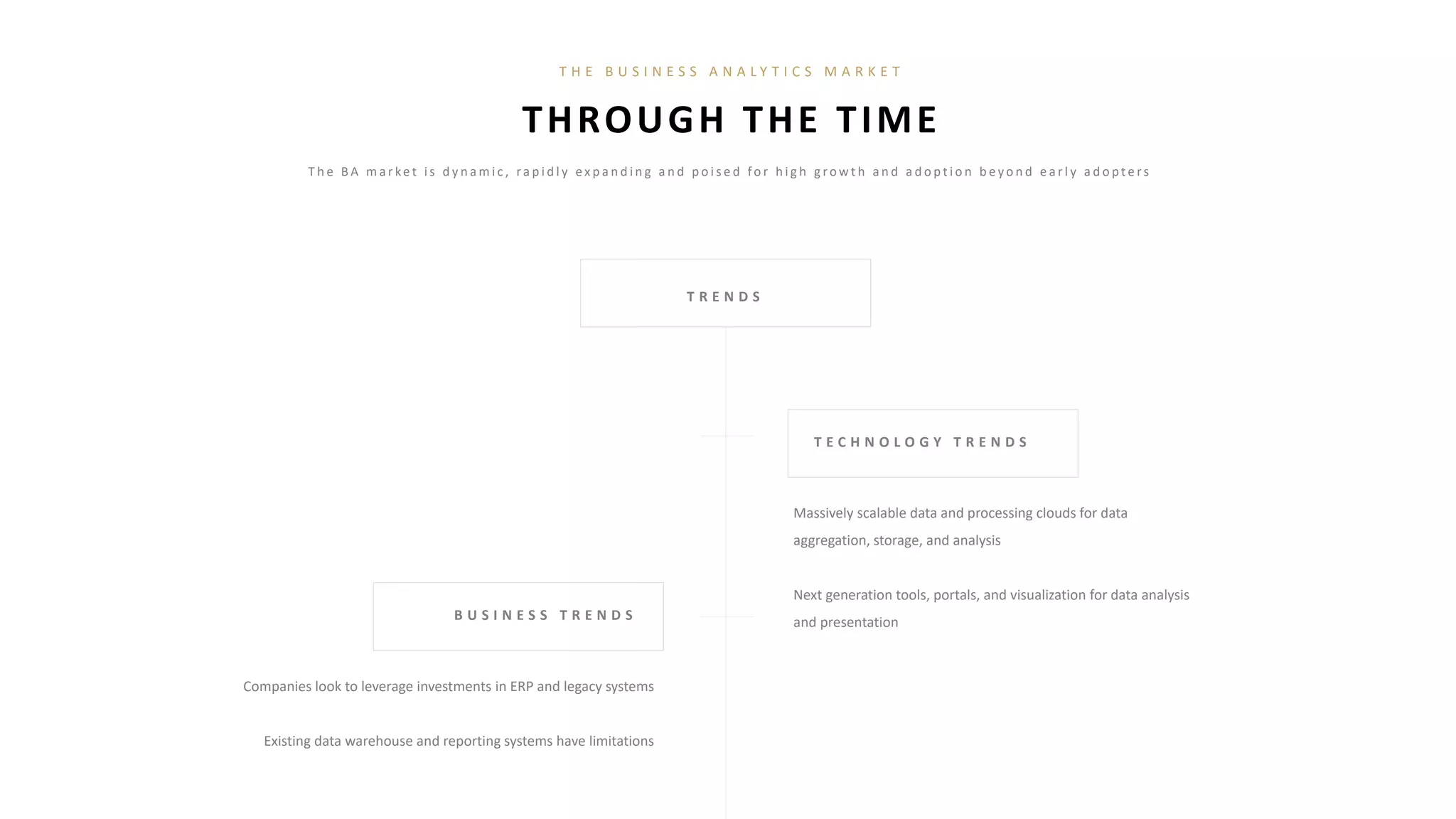
B U S I N E S S T R E N D S
T E C H N O L O G Y T R E N D S
T R E N D S
Massively scalable data and processing clouds for data
aggregation, storage, and analysis
Next generation tools, portals, and visualization for data analysis
and presentation
Companies look to leverage investments in ERP and legacy systems
Existing data warehouse and reporting systems have limitations
THROUGH THE TIME
T H E B U S I N E S S A N A L Y T I C S M A R K E T
T h e B A m a r ke t i s d y n a m i c , ra p i d l y e x p a n d i n g a n d p o i s e d fo r h i g h g ro w t h a n d a d o p t i o n b e y o n d e a r l y a d o p t e rs
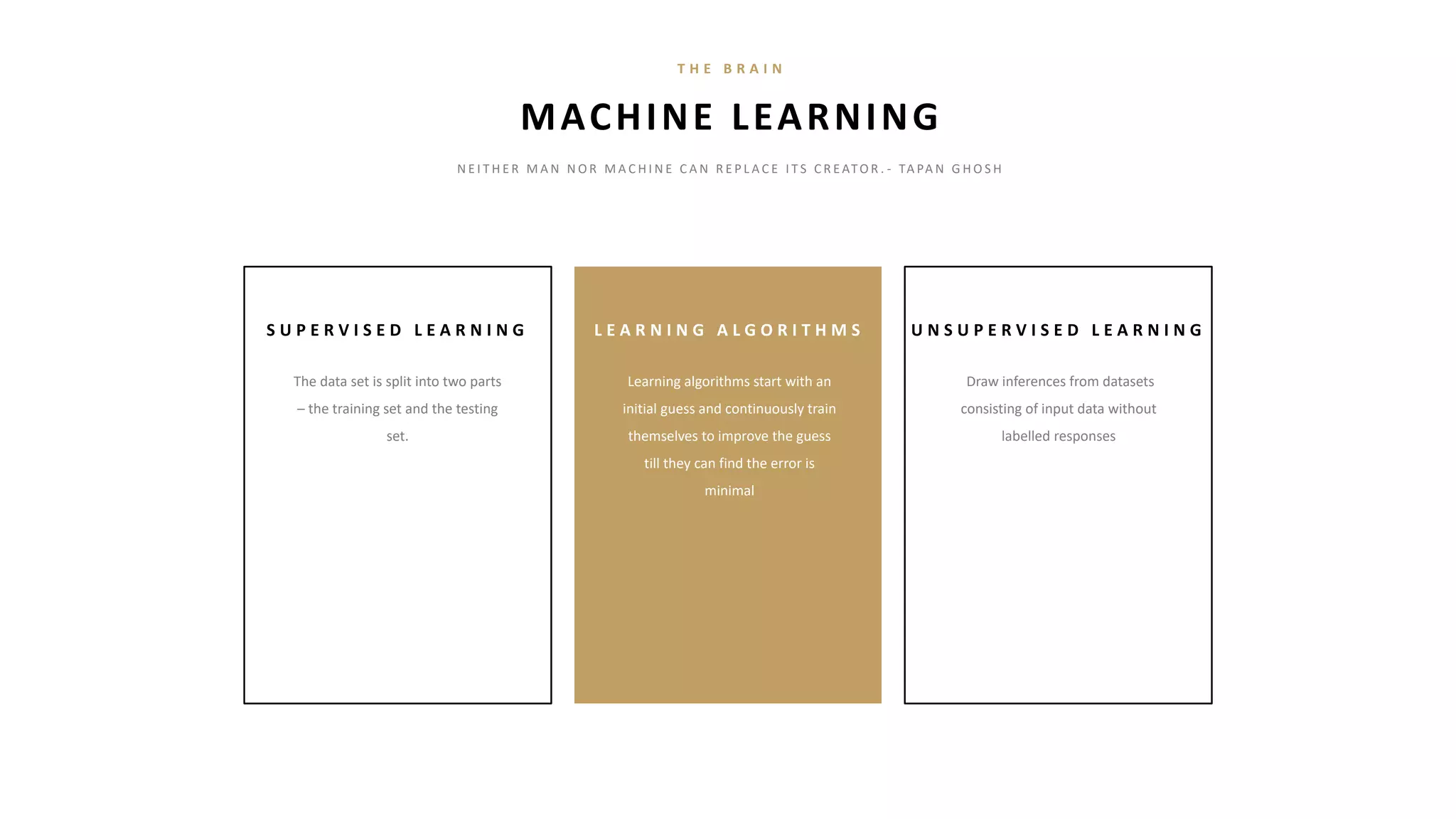
S U P E R V I S E D L E A R N I N G
The data set is split into two parts
– the training set and the testing
set.
L E A R N I N G A L G O R I T H M S
Learning algorithms start with an
initial guess and continuously train
themselves to improve the guess
till they can find the error is
minimal
U N S U P E R V I S E D L E A R N I N G
Draw inferences from datasets
consisting of input data without
labelled responses
MACHINE LEARNING
T H E B R A I N
N E I T H E R M A N N O R M A C H I N E C A N R E P L A C E I T S C R E ATO R . - TA PA N G H O S H
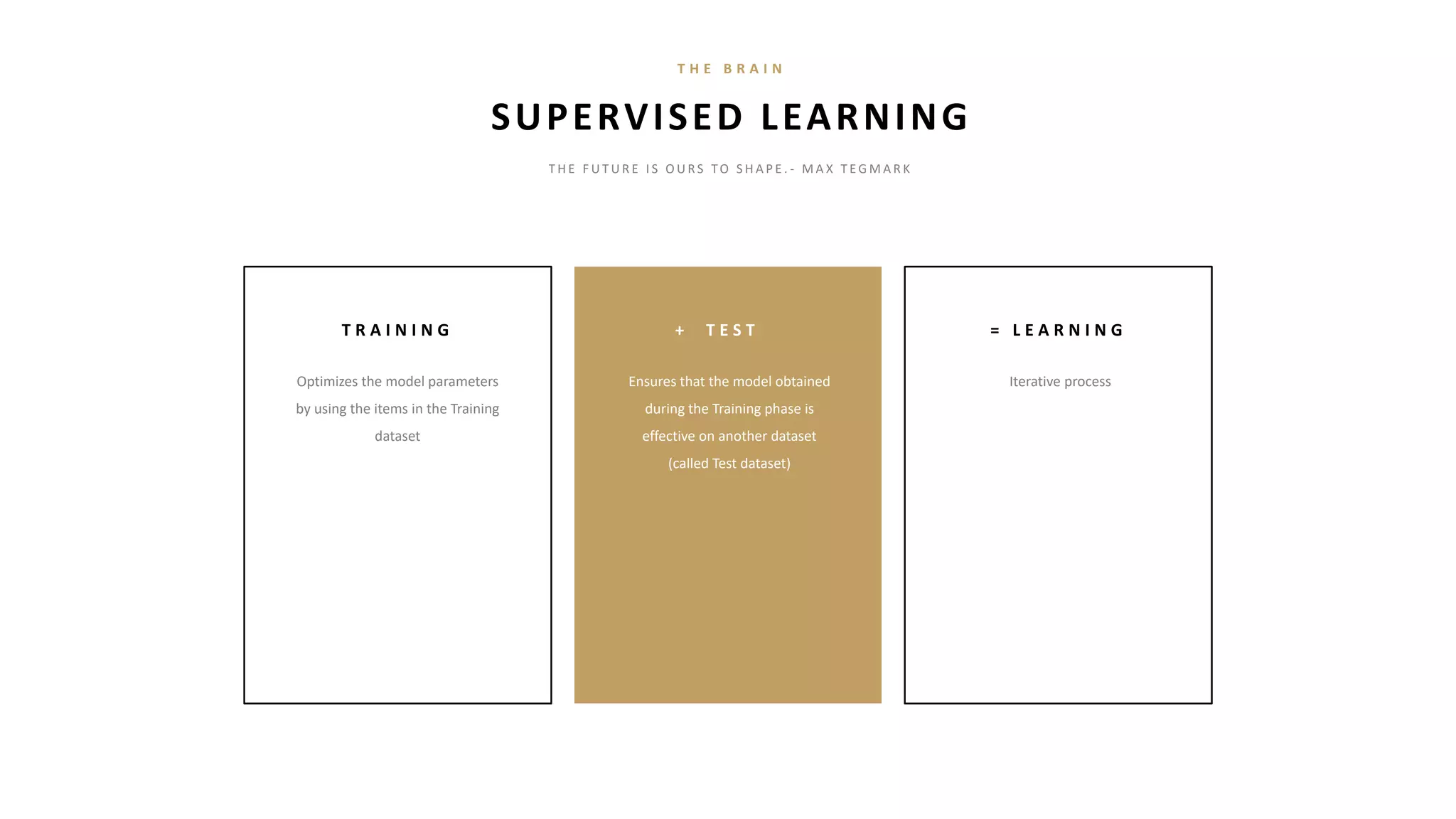
T R A I N I N G
Optimizes the model parameters
by using the items in the Training
dataset
+ T E S T
Ensures that the model obtained
during the Training phase is
effective on another dataset
(called Test dataset)
= L E A R N I N G
Iterative process
SUPERVISED LEARNING
T H E B R A I N
T H E F U T U R E I S O U RS TO S H A P E . - M A X T E G M A R K
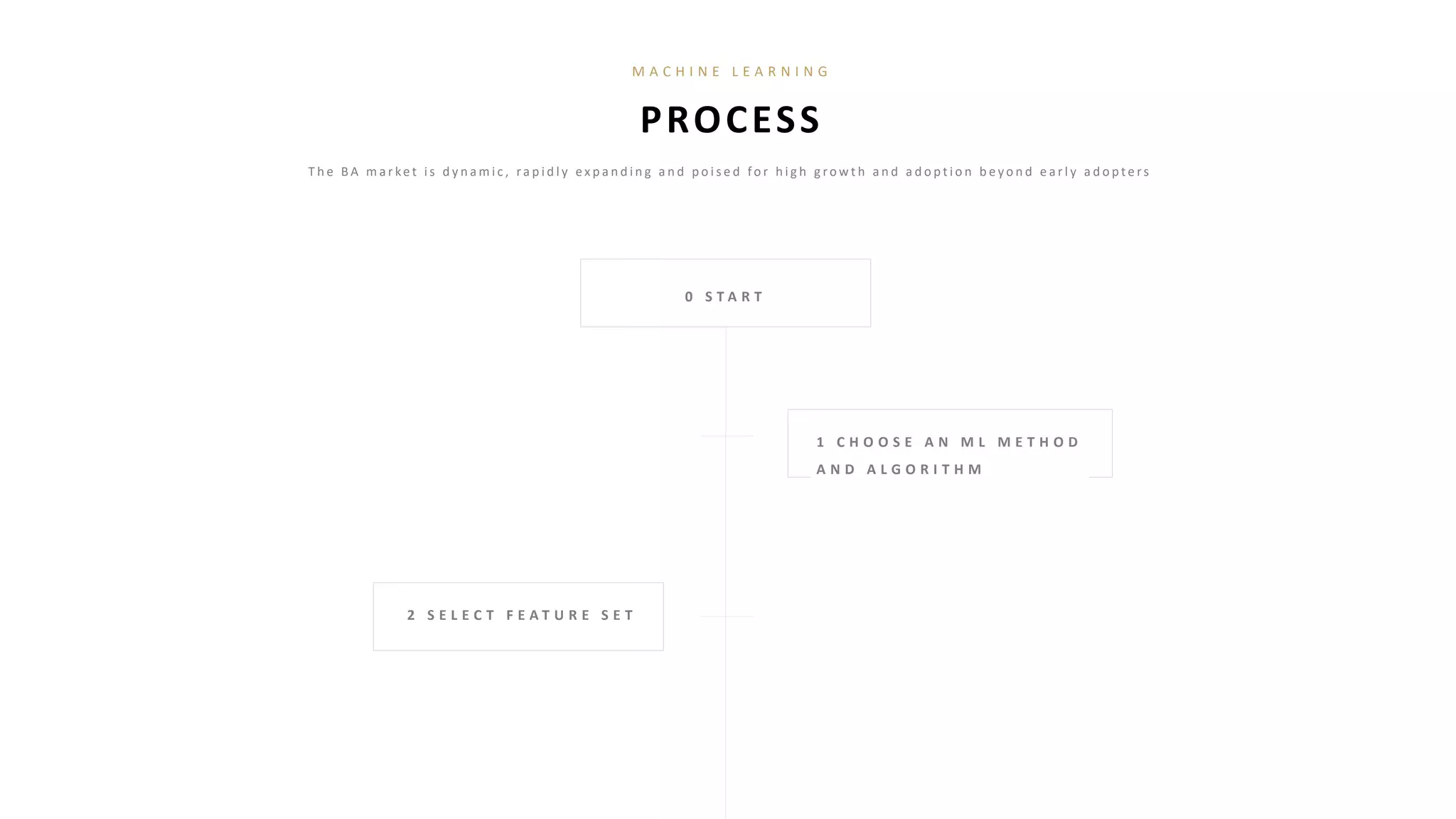
2 S E L E C T F E A T U R E S E T
1 C H O O S E A N M L M E T H O D
A N D A L G O R I T H M
0 S T A R T
PROCESS
M A C H I N E L E A R N I N G
T h e B A m a r ke t i s d y n a m i c , ra p i d l y e x p a n d i n g a n d p o i s e d fo r h i g h g ro w t h a n d a d o p t i o n b e y o n d e a r l y a d o p t e rs
3 S P L I T D A T A I N T O
T R A I N I N G S E T A N D
T E S T S E T
4 A D J U S T T H E M O D E L T I L L Y O U
G E T A C C E P T A B L E
E F F E C T I V E N E S S I N D I C A T O R S
5 A p p l y t h e m o d e l t o t h e
t e s t s e t , c h e c k t h e
e f f e c t i v e n e s s i n d i c a t o r s
ARTIFICIAL NEURAL
NETWORKS
D E E P L E A R N I N G
Neural networks follow a dynamic
computational structure, and do not abide
by a simple process to derive a desired
output. The basis for these networks
originated from the biological neuron and
neural structures – every neuron takes in
multiple unique inputs and produces one
output.
The very heart of the first Deep Learning
algorithms is a neural network with multiple
hidden layers and a final output layer (usually
logistic regression). In lieu of standard training,
there are 2 steps:
1. Individually trains every single hidden layer,
starting from the one after the input layer and so
that the output of a trained layer becomes the
input of the following layer.
2. Supervised training of the network as a whole,
or just of the output layer.
DEEP LEARNING
H O W I T W O R K S
I N F O R M AT I O N W A N T S T O
B E F R E E
Data mining is the process of discovering patterns in
large data sets involving methods at the intersection of
machine learning, statistics, and database systems. It is
an essential process where intelligent methods are
applied to extract data patterns.
DATA MINING
I F W E H A V E D A T A L E T S G O B Y D A T A . I F A L L W E H A V E I S O P I N I O N S , L E T S G O W I T H M I N E
Measures of Central Tendency and Dispersion
ā–Ŗ Mean, Median, Mode, Quartiles, Percentiles, Standard
deviation and Variance
ā–Ŗ Range, Mean /median absolute deviation
ā–Ŗ Coefficient of variation, Frequency Distribution
Sampling Techniques
ā–Ŗ Simple random sampling, Stratified sampling, Cluster
sampling, Systematic sampling
Hypothesis Testing
ā–Ŗ z test, t test, F test, Chi-square test
Correlation
Regression
ā–Ŗ Simple Linear regression, Multiple regression
ā–Ŗ Non-linear regression, Logistic regression
Forecasting
ā–Ŗ Time series: Moving average, Auto regressive method,
Exponential smoothing
Optimization
ā–Ŗ Linear programming, Integer programming
Data Mining/Machine Learning/Text Mining
ā–Ŗ Decision tree, Random Forest
ā–Ŗ Support vector machine, Stochastic gradient descent, Neural
network, Cluster analysis
ā–Ŗ NaĆÆve Bayes, Apriori, k-Nearest Neighbors (kNN),
Expectation Maximization (EM), AdaBoost
Simulation
Commonly used Statistical/Machine Learning Functions
ā–Ŗ Allows businesses a better understanding of data.
ā–Ŗ Allows businesses to deal with the uncertainties of
the business.
ā–Ŗ Allows managers to make sound judgments,
knowing their decisions are based on data and not
on assumptions.
ā–Ŗ Statistical functions help businesses to plan better
and make predictions about the road ahead.
ā–Ŗ Marketing is an important part of any business and
statistical functions help to market products and
services effectively
ā–Ŗ Predictive Models based on appropriate Machine
Learning models provide deep insights and help
gain a competitive advantage.
ā–Ŗ Market Sentiments is provided using the Brand
Sentiment Analysis Tool that mine the social network
and provide signals that otherwise gets lost in a
traditional communication environment.
B L O C K C H A I N
Algorithms that enable the creation of distributed
ledgers are powerful, disruptive innovations that could
transform the delivery of public and private services
and enhance productivity through a wide range of
applications.
C R Y P T O C U R R E N C Y
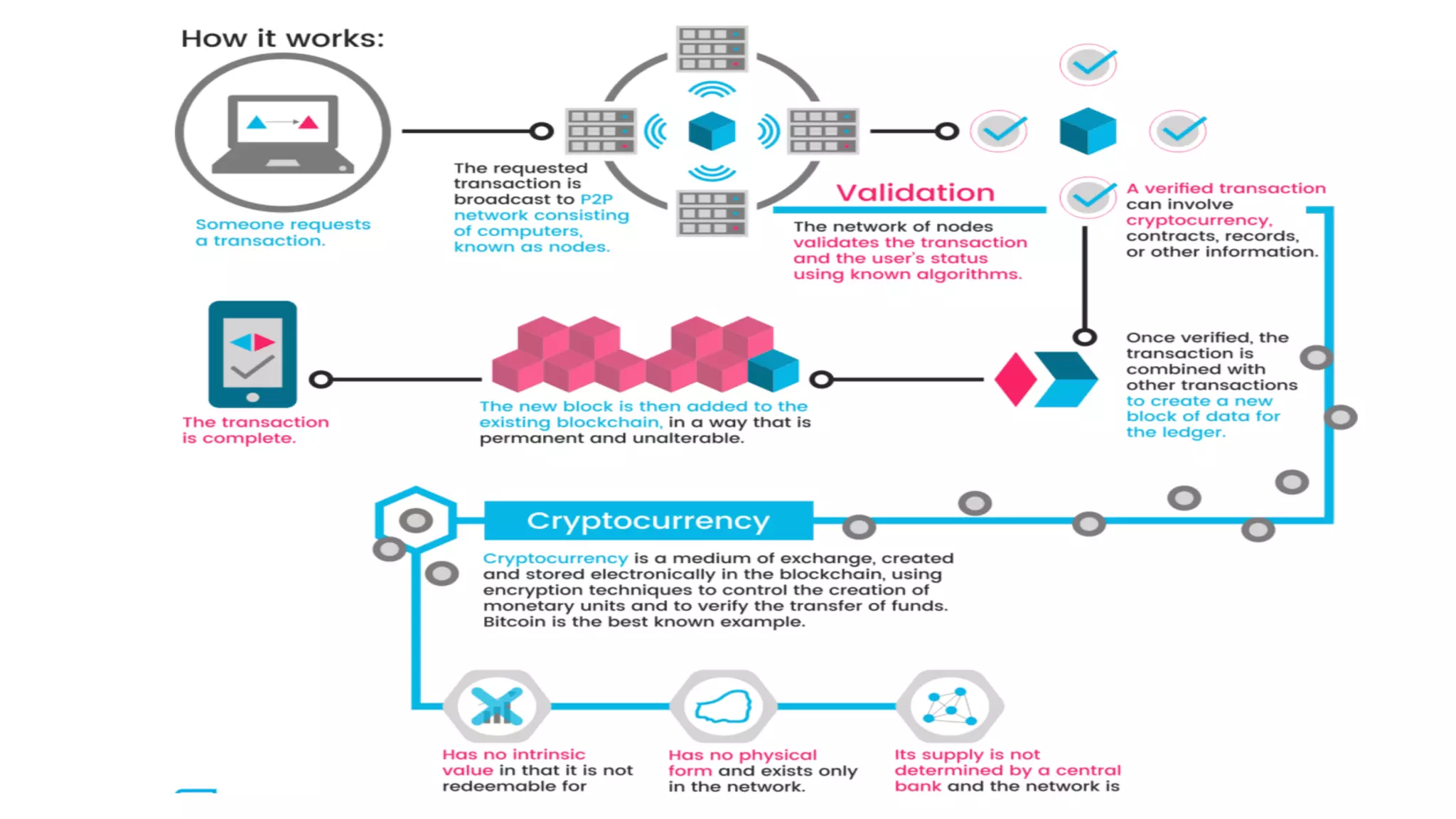
Cryptocurrencies are applications of Blockchain. Digital
currencies such as Bitcoin rely on the underlying
technology called a block chain. This records every
transaction made in identical copies of a digital ledger
that is shared among users
DISTRIBUTED LEDGER
TECHNOLOGIES
T H E N E X T R E V O L U T I O N
R E C O N C I L I AT I O N
Sharing and Verification
through Cryptography
R E P L I C AT I O N
if one ledger is
compromised, the
remainder are not.
G R A N U L A R A C C E S S
C O N T R O L
ā€˜Keys’ and Signatures
to control who can do
what inside the shared
ledger.
G R A N U L A R
T R A N S PA R E N C Y
A N D P R I VA C Y
Many parties can verify
every record.
S H A R E D L E D G E R S H A R E D L E D G E R S H A R E D L E D G E R S H A R E D L E D G E R
Blockchain is a system
designed for optimal fault
tolerance in Distributed
Systems. Blockchain
technology offers a
solution to many digital
identity issues, where
identity can be uniquely
authenticated in an
irrefutable, immutable,
and secure manner
Financial institutions,
regulators, central banks
and governments are now
exploring the possibilities
of using this ā€˜shared
ledger’ approach to
streamline a plethora of
different services, both in
government and the
wider economy.
Blockchain technologies
makes tracking and
managing digital identities
both secure and efficient,
resulting in seamless sign-
ons and reduced fraud.
Blockchain technologies
makes tracking and
managing digital identities
both secure and efficient,
resulting in seamless sign-
ons and reduced fraud.
BLOCKCHAIN
W H AT A R E T H E A P P L I C AT I O N S
O F
W H E N
We achieve state replication if all the nodes of a
distributed system agree on a sequence of
Transactions. That is – They record the same set of
transactions in the same order.
C O N S E N S U S
Participants must reach a consensus on a unique block
of transactions to be appended to the chain. This
achieved by means of a consensus algorithm.
STATE REPLICATION
W H A T I S S T A T E R E P L I C A T I O N
BLOCKCHAIN
T H R E E G E N E R A T I O N S O F B L O C K C H A I N
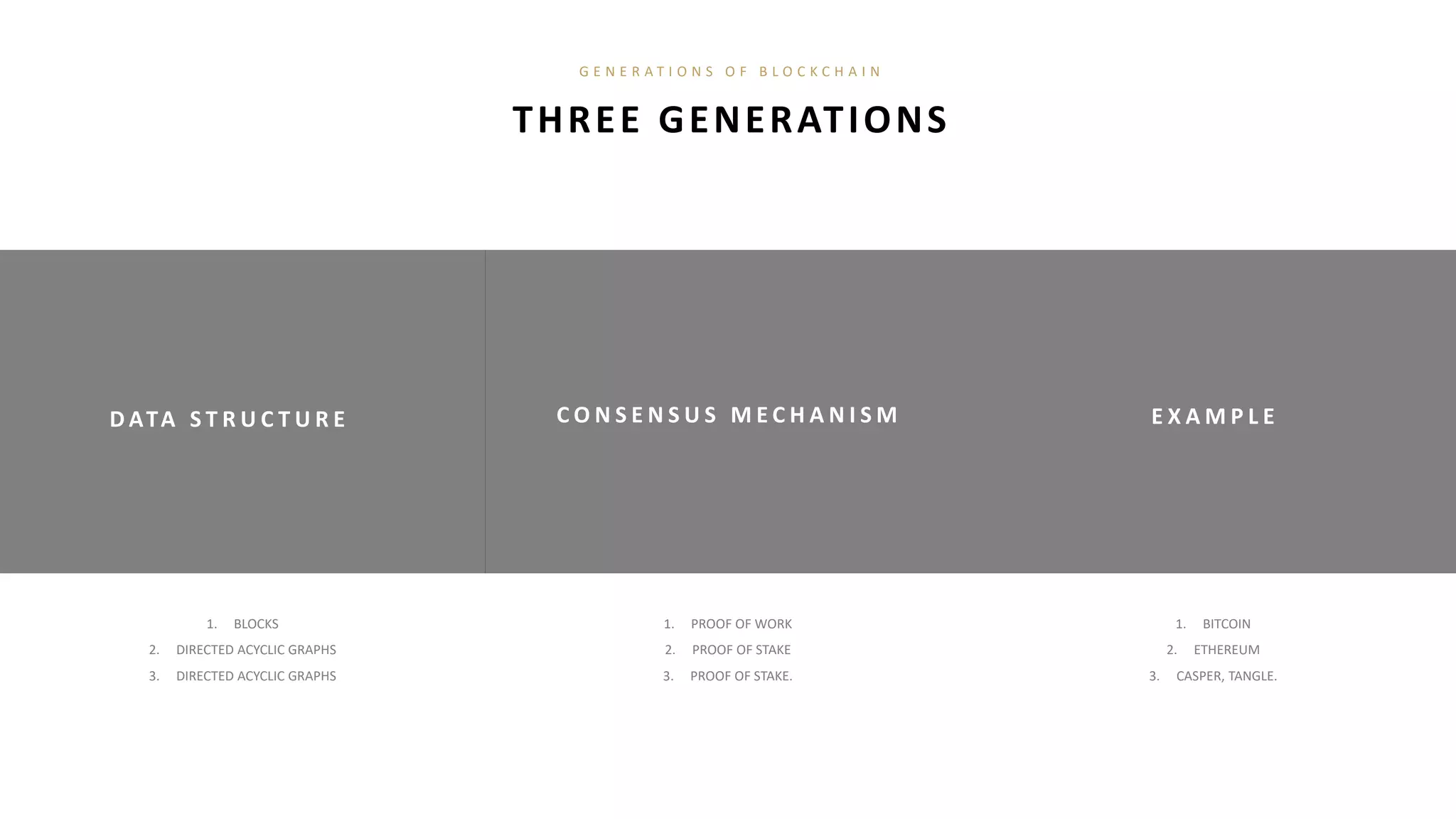
D ATA S T R U C T U R E C O N S E N S U S M E C H A N I S M E X A M P L E
THREE GENERATIONS
G E N E R A T I O N S O F B L O C K C H A I N
1. BLOCKS
2. DIRECTED ACYCLIC GRAPHS
3. DIRECTED ACYCLIC GRAPHS
1. PROOF OF WORK
2. PROOF OF STAKE
3. PROOF OF STAKE.
1. BITCOIN
2. ETHEREUM
3. CASPER, TANGLE.
THE FINANCIAL DISRUPTION
B L O C K C H A I N
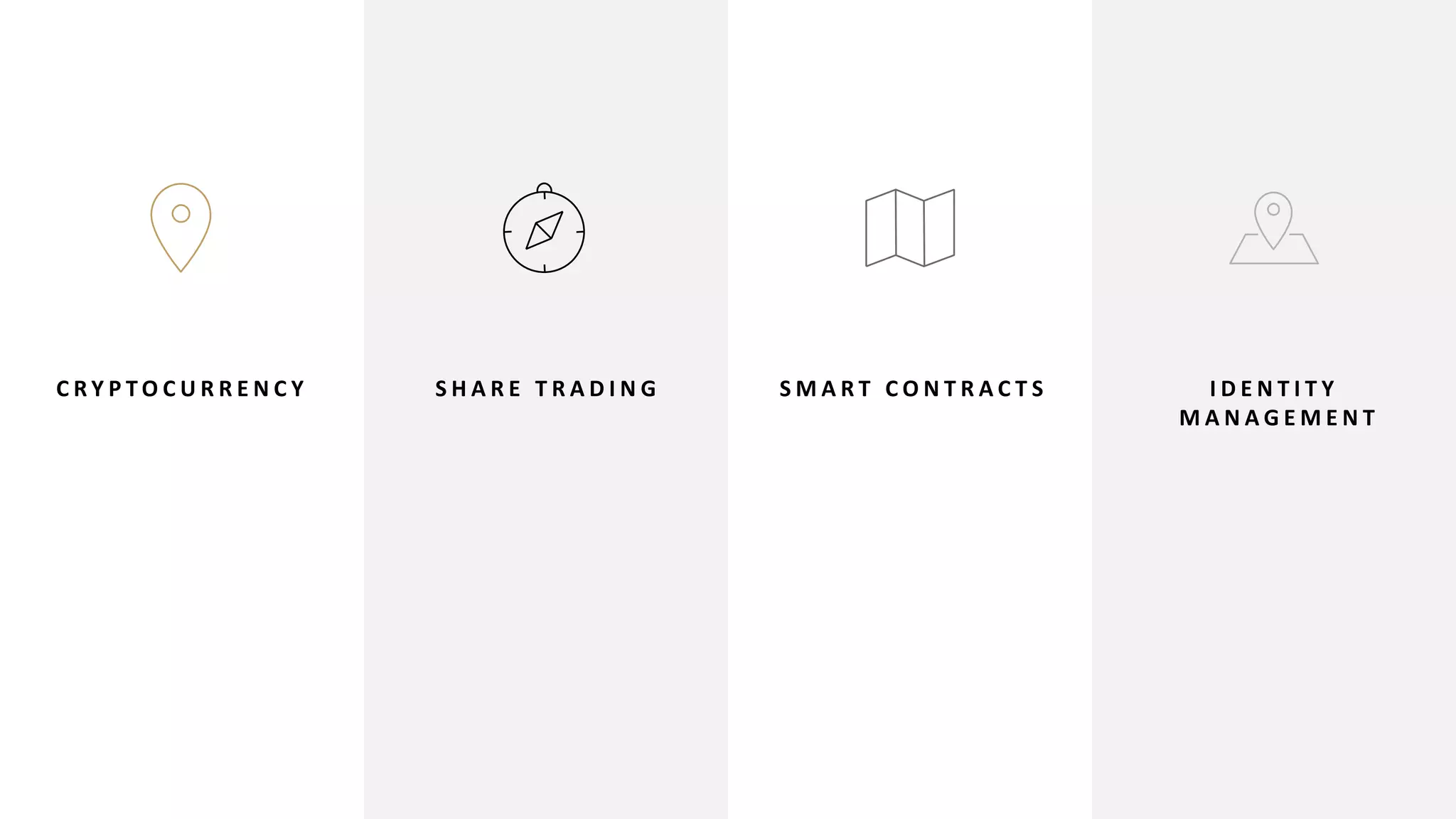
C R Y P T O C U R R E N C Y S H A R E T R A D I N G S M A R T C O N T R A C T S I D E N T I T Y
M A N A G E M E N T
C R Y P T O
A DIGITAL ASSET
CRYPTOCURRENCY
B L O C K C H A I N
P O S I T I O N
The Universe is all of time
and space and its
contents. It includes
planets.
D I R E C T I O N
The Universe is all of time
and space and its
contents. It includes
planets.
M A P
The Universe is all of time
and space and its
contents. It includes
planets.
L O C AT I O N
The Universe is all of time
and space and its
contents. It includes
planets.
L E A R N M O R E L E A R N M O R E L E A R N M O R E L E A R N M O R E
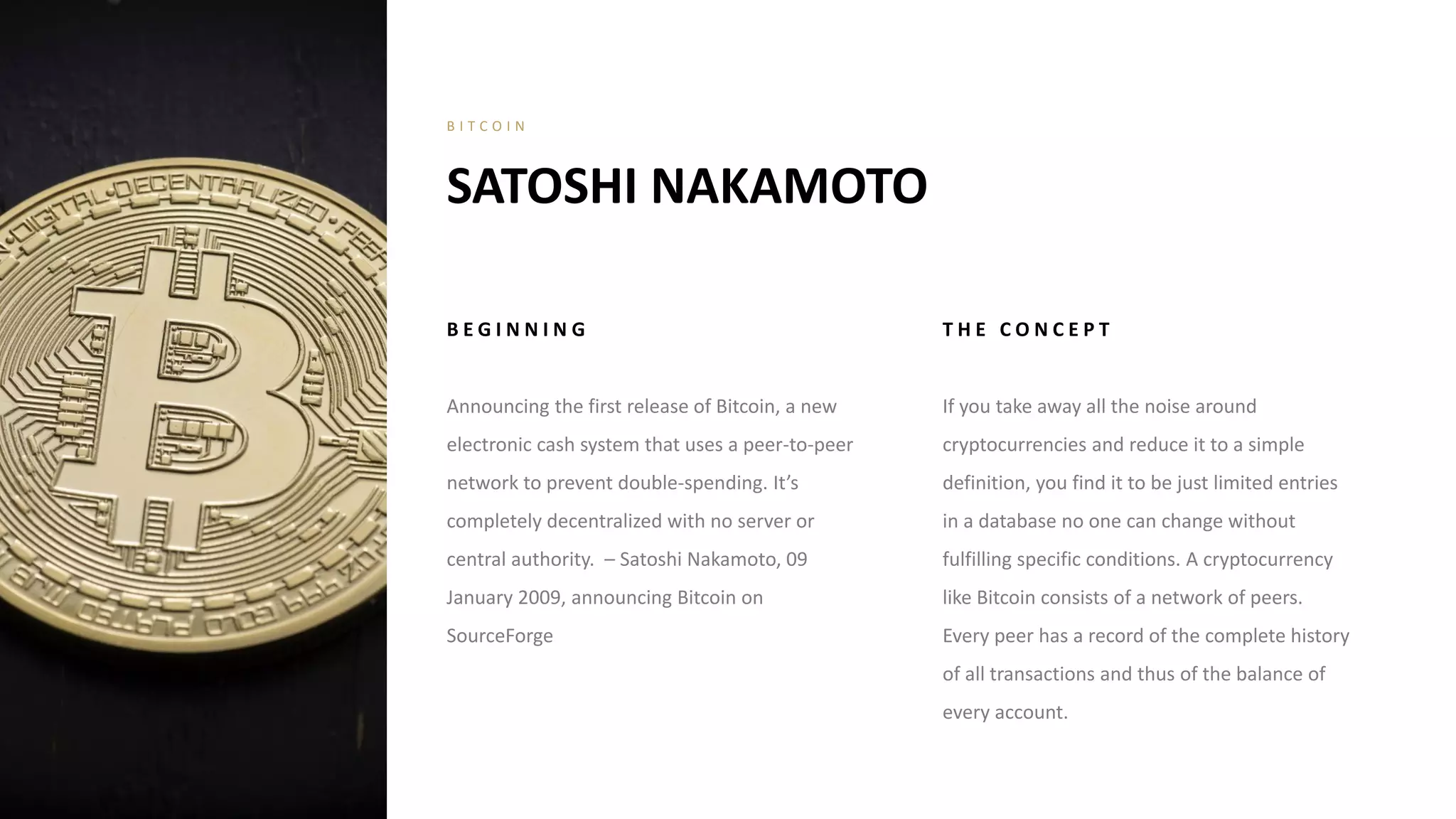
B E G I N N I N G
Announcing the first release of Bitcoin, a new
electronic cash system that uses a peer-to-peer
network to prevent double-spending. It’s
completely decentralized with no server or
central authority. – Satoshi Nakamoto, 09
January 2009, announcing Bitcoin on
SourceForge
T H E C O N C E P T
If you take away all the noise around
cryptocurrencies and reduce it to a simple
definition, you find it to be just limited entries
in a database no one can change without
fulfilling specific conditions. A cryptocurrency
like Bitcoin consists of a network of peers.
Every peer has a record of the complete history
of all transactions and thus of the balance of
every account.
SATOSHI NAKAMOTO
B I T C O I N
S M A R T C O N T R A C T S
THE NEXT BIG
THING IS
HERE!
T H E N E X T G E N E R AT I O N
I N T E R N E T
When you send and share information on the Internet,
you’re not sending an original but a copy. There may be
distributed applications/social networks where people
don’t push their data through a centralized
intermediary but control, move and allocate it to
certain situations
G O V E R N M E N T
It can help build accountable governments through
transparency, smart contracts and revitalized models of
democracy. Within the decade, every single financial
asset, which is really just a contract ‒ a stock is a
contract, a bond is a contract of paper ‒ those
contracts will all move to a blockchain-based format.
ABOUT US AND OUR
FUTURE
B L O C K C H A I N
R P A
ROBOTIC PROCESS
AUTOMATION
Robotic process automation (RPA) is the use
of software with artificial intelligence (AI)
and machine learning capabilities to handle
high-volume, repeatable tasks that
previously required humans to perform.
W H AT R PA D O E S
RPA speeds up and executes with perfect
accuracy processes in the fields of
banking & finance, insurance, healthcare,
manufacturing, telecom and many more.
Typically, one software robot can replace
and outperform 3 workers.
B E N E F I T S
RPA introduces a highly flexible and scalable
virtual workforce with reduced induction
time. Every robot’s activity can be logged and
interpreted through customized reporting
tools. Improved governance and compliance
can be easily achieved as requirements are
set in the automation rules.
THE FUTURE OF JOBS
A U T O M AT I O N
Algorithmic trading (automated trading, black-box trading, or
simply algo-trading) is the process of using computers programmed
to follow a defined set of instructions for placing a trade in order to
generate profits at a speed and frequency that is impossible for a
human trader.
ALGORITHMIC
TRADING.
T H E S T O C K M A R K E T
H OW T R A D I N G I N T H E E XC H A N G E S I S C H A N G I N G
A B E T T E R T O M O R R O W
C O M P L E X A L G O R I T H M S
Algorithmic utilizes advanced and complex
mathematical models and formulas to make high-speed
decisions and transactions in the financial markets.
Algorithmic trading involves the use of fast computer
programs and complex algorithms to create and
determine trading strategies for optimal returns.
P O P U L A R T R A D I N G
S T R AT E G I E S
The use of algorithmic trading is most commonly used
by large institutional investors due to the large amount
of shares they purchase every day.
ABOUT US AND OUR
FUTURE
A L G O R I T H M I C T R A D I N G
Arbitrage is the difference of market prices
between two different entities. When this
occurs, the stocks traded on the markets
either lag behind or get ahead of the futures,
providing an opportunity for arbitrage. High-
speed algorithmic trading can track these
movements and profit from the price
differences.
ARBITRAGE
A L G O R I T H M I C T R A D I N G
The index funds of mutual and Pension funds are regularly
adjusted to match the new prices of the fund's underlying
assets. Before this happens, preprogramed trading
instructions are triggered by algorithmic trading-supported
strategies, which can transfer profits from investors to
algorithmic traders.
TRADING BEFORE INDEX
FUND REBALANCING
A L G O R I T H M I C T R A D I N G
Mean reversion is mathematical method that computes the
average of a security's temporary high and low prices. Algorithmic
trading computes this average and the potential profit from the
movement of the security's price as it either goes away from or
goes toward the mean price.
MEAN REVERSION
A L G O R I T H M I C T R A D I N G
S T O C H A S T I C P R O C E S S E S
SCALPING
Scalpers profit from trading the bid-ask spread as
fast as possible numerous times a day. Price
movements must be less than the security's spread.
These movements happen within minutes or less,
thus the need for quick decisions, which can be
optimized by algorithmic trading formulas.
A L G O R I T H M I C T R A D I N G
H I G H
FREQUENCY
TRADING
High frequency trading is an automated
trading platform used by large
investment banks, hedge funds and
institutional investors which utilizes
powerful computers to transact a large
number of orders at extremely high
speeds.
HFT IS A KIND OF ALGORITHMIC TRADING
High Frequency Trading (HFT) involves algorithmic
trading on much shorter timescales, where signals
are processed and orders are executed within
microseconds.
D I F F E R E N C E B E T W E E N
HFT AND ALGO
TRADING
THANK YOU
V I K R A M S I N G H S A N K H A L A
+91 9819543261
VIKRAMSANKHALA@GMAIL.COM

Vikram emerging technologies

  • 1.
  • 2.
    T E CH N O L O G Y When something is important enough, you do it even if the odds are not in your favour – Elon Musk B Y V I K R A M S I N G H S A N K H A L A F I N A N C E For the past few years, finance has been shaken by technological innovation like never before – The Economist E M E R G I N G T E C H N O L O G I E S A N D F I N A N C E . A PRESENTATION ON
  • 3.
    A R TI F I C I A L I N T E L L I G E N C E Simulation of human intelligence processes by machines D E E P L E A R N I N G Concerned with algorithms inspired by the structure and function of the brain called artificial neural networks A N A L Y T I C S The discovery, interpretation, and communication of meaningful patterns in data R P A Robotic process automation (RPA) is the practice of automating routine business practices with "software robots" that perform tasks automatically B L O C K C H A I N A digitized, decentralized, public ledger EMERGING TECHNOLOGIES C O N V E R G E N C E These are forces that are gradually reshaping the financial services industry today .
  • 4.
    Technology priorities for2017 and beyond Rank Technology Trend 1 BI/Analytics 2 Cloud 3 Digitalization / Digital Marketing 4 Infrastructure & Data Center 5 Mobile 6 Cyber and information security 7 Industry-Specific Applications 8 ERP 9 Networking, Voice, and Data Comms ANALYTICS Ten out of Twelve years 2006-2017 Source: Gartner 4
  • 5.
    A N AL Y T I C S Four Stages E X P E R I E N C E Intuition, domain knowledge B U S I N E S S I N T E L L I G E N C E Visualizations, KPI’s, OLAP, Dashboards P R E D I C T I V E A N A L Y T I C S Modeling, Experimental verification R E A L T I M E S T R E A M I N G A N A L Y T I C S Deep learning, A.I.
  • 6.
    B U SI N E S S T R E N D S T E C H N O L O G Y T R E N D S T R E N D S Massively scalable data and processing clouds for data aggregation, storage, and analysis Next generation tools, portals, and visualization for data analysis and presentation Companies look to leverage investments in ERP and legacy systems Existing data warehouse and reporting systems have limitations THROUGH THE TIME T H E B U S I N E S S A N A L Y T I C S M A R K E T T h e B A m a r ke t i s d y n a m i c , ra p i d l y e x p a n d i n g a n d p o i s e d fo r h i g h g ro w t h a n d a d o p t i o n b e y o n d e a r l y a d o p t e rs
  • 7.
    S U PE R V I S E D L E A R N I N G The data set is split into two parts – the training set and the testing set. L E A R N I N G A L G O R I T H M S Learning algorithms start with an initial guess and continuously train themselves to improve the guess till they can find the error is minimal U N S U P E R V I S E D L E A R N I N G Draw inferences from datasets consisting of input data without labelled responses MACHINE LEARNING T H E B R A I N N E I T H E R M A N N O R M A C H I N E C A N R E P L A C E I T S C R E ATO R . - TA PA N G H O S H
  • 8.
    T R AI N I N G Optimizes the model parameters by using the items in the Training dataset + T E S T Ensures that the model obtained during the Training phase is effective on another dataset (called Test dataset) = L E A R N I N G Iterative process SUPERVISED LEARNING T H E B R A I N T H E F U T U R E I S O U RS TO S H A P E . - M A X T E G M A R K
  • 9.
    2 S EL E C T F E A T U R E S E T 1 C H O O S E A N M L M E T H O D A N D A L G O R I T H M 0 S T A R T PROCESS M A C H I N E L E A R N I N G T h e B A m a r ke t i s d y n a m i c , ra p i d l y e x p a n d i n g a n d p o i s e d fo r h i g h g ro w t h a n d a d o p t i o n b e y o n d e a r l y a d o p t e rs
  • 10.
    3 S PL I T D A T A I N T O T R A I N I N G S E T A N D T E S T S E T 4 A D J U S T T H E M O D E L T I L L Y O U G E T A C C E P T A B L E E F F E C T I V E N E S S I N D I C A T O R S 5 A p p l y t h e m o d e l t o t h e t e s t s e t , c h e c k t h e e f f e c t i v e n e s s i n d i c a t o r s
  • 11.
    ARTIFICIAL NEURAL NETWORKS D EE P L E A R N I N G Neural networks follow a dynamic computational structure, and do not abide by a simple process to derive a desired output. The basis for these networks originated from the biological neuron and neural structures – every neuron takes in multiple unique inputs and produces one output.
  • 12.
    The very heartof the first Deep Learning algorithms is a neural network with multiple hidden layers and a final output layer (usually logistic regression). In lieu of standard training, there are 2 steps: 1. Individually trains every single hidden layer, starting from the one after the input layer and so that the output of a trained layer becomes the input of the following layer. 2. Supervised training of the network as a whole, or just of the output layer. DEEP LEARNING H O W I T W O R K S
  • 13.
    I N FO R M AT I O N W A N T S T O B E F R E E Data mining is the process of discovering patterns in large data sets involving methods at the intersection of machine learning, statistics, and database systems. It is an essential process where intelligent methods are applied to extract data patterns. DATA MINING I F W E H A V E D A T A L E T S G O B Y D A T A . I F A L L W E H A V E I S O P I N I O N S , L E T S G O W I T H M I N E
  • 14.
    Measures of CentralTendency and Dispersion ā–Ŗ Mean, Median, Mode, Quartiles, Percentiles, Standard deviation and Variance ā–Ŗ Range, Mean /median absolute deviation ā–Ŗ Coefficient of variation, Frequency Distribution Sampling Techniques ā–Ŗ Simple random sampling, Stratified sampling, Cluster sampling, Systematic sampling Hypothesis Testing ā–Ŗ z test, t test, F test, Chi-square test Correlation Regression ā–Ŗ Simple Linear regression, Multiple regression ā–Ŗ Non-linear regression, Logistic regression Forecasting ā–Ŗ Time series: Moving average, Auto regressive method, Exponential smoothing Optimization ā–Ŗ Linear programming, Integer programming Data Mining/Machine Learning/Text Mining ā–Ŗ Decision tree, Random Forest ā–Ŗ Support vector machine, Stochastic gradient descent, Neural network, Cluster analysis ā–Ŗ NaĆÆve Bayes, Apriori, k-Nearest Neighbors (kNN), Expectation Maximization (EM), AdaBoost Simulation Commonly used Statistical/Machine Learning Functions ā–Ŗ Allows businesses a better understanding of data. ā–Ŗ Allows businesses to deal with the uncertainties of the business. ā–Ŗ Allows managers to make sound judgments, knowing their decisions are based on data and not on assumptions. ā–Ŗ Statistical functions help businesses to plan better and make predictions about the road ahead. ā–Ŗ Marketing is an important part of any business and statistical functions help to market products and services effectively ā–Ŗ Predictive Models based on appropriate Machine Learning models provide deep insights and help gain a competitive advantage. ā–Ŗ Market Sentiments is provided using the Brand Sentiment Analysis Tool that mine the social network and provide signals that otherwise gets lost in a traditional communication environment.
  • 15.
    B L OC K C H A I N Algorithms that enable the creation of distributed ledgers are powerful, disruptive innovations that could transform the delivery of public and private services and enhance productivity through a wide range of applications. C R Y P T O C U R R E N C Y Cryptocurrencies are applications of Blockchain. Digital currencies such as Bitcoin rely on the underlying technology called a block chain. This records every transaction made in identical copies of a digital ledger that is shared among users DISTRIBUTED LEDGER TECHNOLOGIES T H E N E X T R E V O L U T I O N
  • 16.
    R E CO N C I L I AT I O N Sharing and Verification through Cryptography R E P L I C AT I O N if one ledger is compromised, the remainder are not. G R A N U L A R A C C E S S C O N T R O L ā€˜Keys’ and Signatures to control who can do what inside the shared ledger. G R A N U L A R T R A N S PA R E N C Y A N D P R I VA C Y Many parties can verify every record. S H A R E D L E D G E R S H A R E D L E D G E R S H A R E D L E D G E R S H A R E D L E D G E R
  • 17.
    Blockchain is asystem designed for optimal fault tolerance in Distributed Systems. Blockchain technology offers a solution to many digital identity issues, where identity can be uniquely authenticated in an irrefutable, immutable, and secure manner Financial institutions, regulators, central banks and governments are now exploring the possibilities of using this ā€˜shared ledger’ approach to streamline a plethora of different services, both in government and the wider economy. Blockchain technologies makes tracking and managing digital identities both secure and efficient, resulting in seamless sign- ons and reduced fraud. Blockchain technologies makes tracking and managing digital identities both secure and efficient, resulting in seamless sign- ons and reduced fraud. BLOCKCHAIN W H AT A R E T H E A P P L I C AT I O N S O F
  • 18.
    W H EN We achieve state replication if all the nodes of a distributed system agree on a sequence of Transactions. That is – They record the same set of transactions in the same order. C O N S E N S U S Participants must reach a consensus on a unique block of transactions to be appended to the chain. This achieved by means of a consensus algorithm. STATE REPLICATION W H A T I S S T A T E R E P L I C A T I O N
  • 19.
    BLOCKCHAIN T H RE E G E N E R A T I O N S O F B L O C K C H A I N
  • 20.
    D ATA ST R U C T U R E C O N S E N S U S M E C H A N I S M E X A M P L E THREE GENERATIONS G E N E R A T I O N S O F B L O C K C H A I N 1. BLOCKS 2. DIRECTED ACYCLIC GRAPHS 3. DIRECTED ACYCLIC GRAPHS 1. PROOF OF WORK 2. PROOF OF STAKE 3. PROOF OF STAKE. 1. BITCOIN 2. ETHEREUM 3. CASPER, TANGLE.
  • 21.
    THE FINANCIAL DISRUPTION BL O C K C H A I N
  • 22.
    C R YP T O C U R R E N C Y S H A R E T R A D I N G S M A R T C O N T R A C T S I D E N T I T Y M A N A G E M E N T
  • 23.
    C R YP T O A DIGITAL ASSET CRYPTOCURRENCY B L O C K C H A I N
  • 24.
    P O SI T I O N The Universe is all of time and space and its contents. It includes planets. D I R E C T I O N The Universe is all of time and space and its contents. It includes planets. M A P The Universe is all of time and space and its contents. It includes planets. L O C AT I O N The Universe is all of time and space and its contents. It includes planets. L E A R N M O R E L E A R N M O R E L E A R N M O R E L E A R N M O R E
  • 25.
    B E GI N N I N G Announcing the first release of Bitcoin, a new electronic cash system that uses a peer-to-peer network to prevent double-spending. It’s completely decentralized with no server or central authority. – Satoshi Nakamoto, 09 January 2009, announcing Bitcoin on SourceForge T H E C O N C E P T If you take away all the noise around cryptocurrencies and reduce it to a simple definition, you find it to be just limited entries in a database no one can change without fulfilling specific conditions. A cryptocurrency like Bitcoin consists of a network of peers. Every peer has a record of the complete history of all transactions and thus of the balance of every account. SATOSHI NAKAMOTO B I T C O I N
  • 27.
    S M AR T C O N T R A C T S THE NEXT BIG THING IS HERE!
  • 28.
    T H EN E X T G E N E R AT I O N I N T E R N E T When you send and share information on the Internet, you’re not sending an original but a copy. There may be distributed applications/social networks where people don’t push their data through a centralized intermediary but control, move and allocate it to certain situations G O V E R N M E N T It can help build accountable governments through transparency, smart contracts and revitalized models of democracy. Within the decade, every single financial asset, which is really just a contract ‒ a stock is a contract, a bond is a contract of paper ‒ those contracts will all move to a blockchain-based format. ABOUT US AND OUR FUTURE B L O C K C H A I N
  • 29.
    R P A ROBOTICPROCESS AUTOMATION Robotic process automation (RPA) is the use of software with artificial intelligence (AI) and machine learning capabilities to handle high-volume, repeatable tasks that previously required humans to perform.
  • 30.
    W H ATR PA D O E S RPA speeds up and executes with perfect accuracy processes in the fields of banking & finance, insurance, healthcare, manufacturing, telecom and many more. Typically, one software robot can replace and outperform 3 workers. B E N E F I T S RPA introduces a highly flexible and scalable virtual workforce with reduced induction time. Every robot’s activity can be logged and interpreted through customized reporting tools. Improved governance and compliance can be easily achieved as requirements are set in the automation rules. THE FUTURE OF JOBS A U T O M AT I O N
  • 31.
    Algorithmic trading (automatedtrading, black-box trading, or simply algo-trading) is the process of using computers programmed to follow a defined set of instructions for placing a trade in order to generate profits at a speed and frequency that is impossible for a human trader. ALGORITHMIC TRADING. T H E S T O C K M A R K E T H OW T R A D I N G I N T H E E XC H A N G E S I S C H A N G I N G A B E T T E R T O M O R R O W
  • 32.
    C O MP L E X A L G O R I T H M S Algorithmic utilizes advanced and complex mathematical models and formulas to make high-speed decisions and transactions in the financial markets. Algorithmic trading involves the use of fast computer programs and complex algorithms to create and determine trading strategies for optimal returns. P O P U L A R T R A D I N G S T R AT E G I E S The use of algorithmic trading is most commonly used by large institutional investors due to the large amount of shares they purchase every day. ABOUT US AND OUR FUTURE A L G O R I T H M I C T R A D I N G
  • 33.
    Arbitrage is thedifference of market prices between two different entities. When this occurs, the stocks traded on the markets either lag behind or get ahead of the futures, providing an opportunity for arbitrage. High- speed algorithmic trading can track these movements and profit from the price differences. ARBITRAGE A L G O R I T H M I C T R A D I N G
  • 34.
    The index fundsof mutual and Pension funds are regularly adjusted to match the new prices of the fund's underlying assets. Before this happens, preprogramed trading instructions are triggered by algorithmic trading-supported strategies, which can transfer profits from investors to algorithmic traders. TRADING BEFORE INDEX FUND REBALANCING A L G O R I T H M I C T R A D I N G
  • 35.
    Mean reversion ismathematical method that computes the average of a security's temporary high and low prices. Algorithmic trading computes this average and the potential profit from the movement of the security's price as it either goes away from or goes toward the mean price. MEAN REVERSION A L G O R I T H M I C T R A D I N G S T O C H A S T I C P R O C E S S E S
  • 36.
    SCALPING Scalpers profit fromtrading the bid-ask spread as fast as possible numerous times a day. Price movements must be less than the security's spread. These movements happen within minutes or less, thus the need for quick decisions, which can be optimized by algorithmic trading formulas. A L G O R I T H M I C T R A D I N G
  • 37.
    H I GH FREQUENCY TRADING High frequency trading is an automated trading platform used by large investment banks, hedge funds and institutional investors which utilizes powerful computers to transact a large number of orders at extremely high speeds.
  • 38.
    HFT IS AKIND OF ALGORITHMIC TRADING High Frequency Trading (HFT) involves algorithmic trading on much shorter timescales, where signals are processed and orders are executed within microseconds. D I F F E R E N C E B E T W E E N HFT AND ALGO TRADING
  • 39.
    THANK YOU V IK R A M S I N G H S A N K H A L A +91 9819543261 VIKRAMSANKHALA@GMAIL.COM