11
HILDEGARD E. PEPLAU’SHILDEGARD E. PEPLAU’S
THEORY OF INTERPERSONALTHEORY OF INTERPERSONAL
RELATIONSRELATIONS
Prof.VIJAYREDDYProf.VIJAYREDDY
PhD Scholar, M.Sc (N),PGDHA,PGCDE.PhD Scholar, M.Sc (N),PGDHA,PGCDE.
INDIA.INDIA.
22
How do you perceive your
understanding of the Interpersonal
Relation Theory
A. 30% or less
B. More than 30%
C. More than 50%
D. More than 70%
E. More than 90%
33
About the AuthorAbout the Author
• Born in 1909
• Graduated in 1931 from Diploma nursing
program
• BA in interpersonal psychology in 1943
• MA in psychiatric nursing 1947
• Ed.D in curriculum development 1953
• Certification in psychoanalysis for teachers
44
• Worked as president of ANA and Director of
advanced program in psychiatric nursing
• Worked with WHO, NIMH
• World war II – Army nurse corps in
psychiatric hospital
• First published nursing theorist in a century
since Nightingale
• Died in 1999
55
Contribution and achievementContribution and achievement
• Created the nursing middle range theory of
Interpersonal Relations
• Created nursing curriculum including nurse
patient interaction through process recording
• Transformed nursing from a group of skilled
workers to a profession
• Published book on Interpersonal Relations in
1952
66
• Contributed to mental health reform and laws
• Known as mother of psychiatric nursing
• Professor emeritus
• Ambassador for psychiatric education in
nursing
• Inspired generation of students
• Had powerful vision to move nursing forward
to a profession of respect
• Left a legacy of dignified and healing
relationship with patients
77
Development of the theoryDevelopment of the theory
• Work of Sullivan’s theory of Interpersonal
relations
• Concepts from other disciplines ( work of
Freud, Maslow, psychoanalytic model)
• Observation of existing nursing practice
88
• Analysis of interaction of students with
patients
• Study of nurse patient interaction
through process recording
• Experience in psychiatric field
• Own concept, values and beliefs about
nursing
99
Interpersonal RelationsInterpersonal Relations
TheoryTheory
Basic elements
• The patient
• The nurse
• The interaction between the patient
and the nurse
1010
DefinitionsDefinitions
Client/Patient
• Person, couple, groups or community
deserving of humane care with dignity,
privacy and ethics
Environment-
• Physiological, psychological and social
fluidity that may be illness, maintaining
or health promoting
1111
Health –
• Forward movement of personality and other
ongoing human process in the direction of
creative, constructive, personal and
community living
Nurse –
• The medium of the art of nursing, a
maturing force. The unique blend of ideals,
values, integrity, commitment to the well
being of others
1212
Nursing –
• Is an interpersonal process involving
interaction between two or more
persons with a common goal
• Nurse patient interaction is a
therapeutic process. It is a healing art
1313
AssumptionsAssumptions
• The kind of nurse each person becomes makes a
difference in what each client will learn as she or
he is nursed throughout his or her experiences
with illness
• Fostering personality development in the
direction of maturity is a function of nursing and
nursing education. It requires the use of
principles and method to deal with every day
interpersonal problem or difficulties
1414
• Since illness provides opportunity for
learning and growth, nursing can assist
clients to develop competencies through
nurse client interaction
• Nursing can take as its unique focus the
reactions of clients to the circumstance of
their illness or health problems
1515
• All human behavior is purposeful and goal
seeking in terms of feelings of satisfaction
• The interaction of nurse and client is fruitful
when a method of communication that identifies
and uses common meanings is at work in the
situation
• Difficulties in interpersonal relations occur in
varying intensities throughout the life of
everyone
1616
• Patient is able to participate in an
interpersonal relationship
• Interpersonal relations will enhance self
maturity and/or self fulfillment
1717
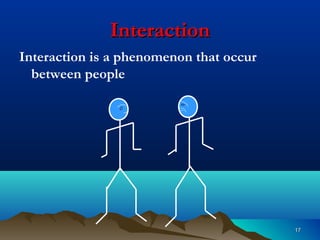
InteractionInteraction
Interaction is a phenomenon that occur
between people
1818
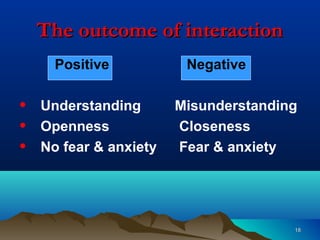
The outcome of interactionThe outcome of interaction
Positive Negative
• Understanding Misunderstanding
• Openness Closeness
• No fear & anxiety Fear & anxiety
1919
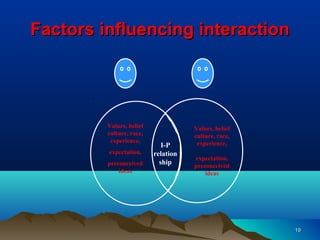
Factors influencing interactionFactors influencing interaction
Values, belief
culture, race,
experience,
expectation,
preconceived
ideas
Values, belief
culture, race,
experience,
expectation,
preconceived
ideas
I-P
relation
ship
2020
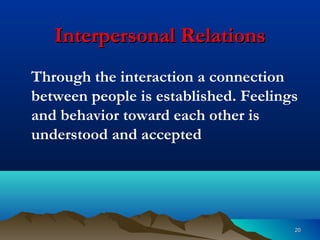
Interpersonal RelationsInterpersonal Relations
Through the interaction a connection
between people is established. Feelings
and behavior toward each other is
understood and accepted
2121
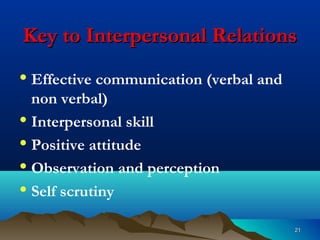
Key to Interpersonal RelationsKey to Interpersonal Relations
• Effective communication (verbal and
non verbal)
• Interpersonal skill
• Positive attitude
• Observation and perception
• Self scrutiny
2222
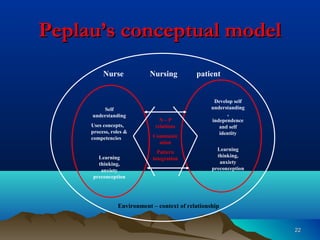
Peplau’s conceptual modelPeplau’s conceptual model
Nurse Nursing patient
Self
understanding
Uses concepts,
process, roles &
competencies
Learning
thinking,
anxiety
preconception
N – P
relations
Communic
ation
Pattern
integration
Develop self
understanding
,
independence
and self
identity
Learning
thinking,
anxiety
preconception
Environment – context of relationship
2323
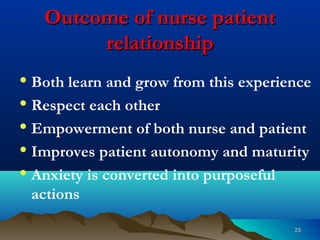
Outcome of nurse patientOutcome of nurse patient
relationshiprelationship
• Both learn and grow from this experience
• Respect each other
• Empowerment of both nurse and patient
• Improves patient autonomy and maturity
• Anxiety is converted into purposeful
actions
2424
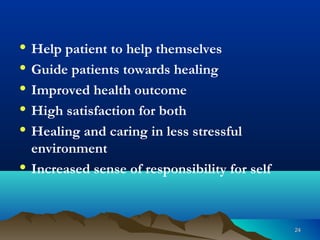
• Help patient to help themselves
• Guide patients towards healing
• Improved health outcome
• High satisfaction for both
• Healing and caring in less stressful
environment
• Increased sense of responsibility for self
2525
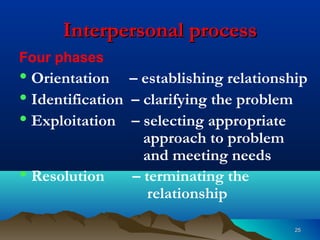
Interpersonal processInterpersonal process
Four phases
• Orientation – establishing relationship
• Identification – clarifying the problem
• Exploitation – selecting appropriate
approach to problem
and meeting needs
• Resolution – terminating the
relationship
2626
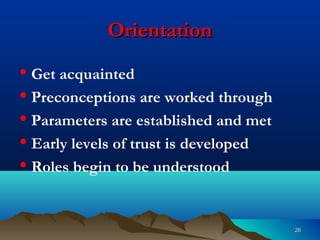
OrientationOrientation
• Get acquainted
• Preconceptions are worked through
• Parameters are established and met
• Early levels of trust is developed
• Roles begin to be understood
2727
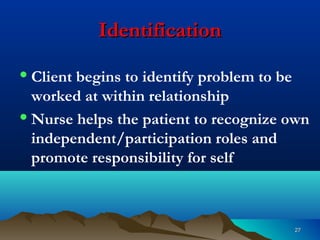
IdentificationIdentification
•Client begins to identify problem to be
worked at within relationship
•Nurse helps the patient to recognize own
independent/participation roles and
promote responsibility for self
2828
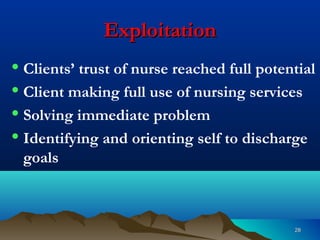
ExploitationExploitation
• Clients’ trust of nurse reached full potential
• Client making full use of nursing services
• Solving immediate problem
• Identifying and orienting self to discharge
goals
2929
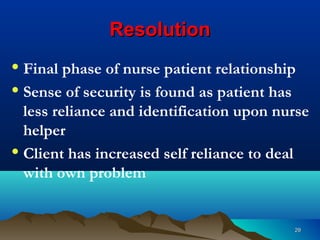
ResolutionResolution
• Final phase of nurse patient relationship
• Sense of security is found as patient has
less reliance and identification upon nurse
helper
• Client has increased self reliance to deal
with own problem
3030
Nurse’s roleNurse’s role
• Stranger
• Resource person
• Teacher
• Leader
• Counselor
• Advocate
• Additional roles
3131
Importance of InterpersonalImportance of Interpersonal
Relation TheoryRelation Theory
• Understanding of one’s own behavior
• Helping others identify felt difficulty
• Application of human relations to
problems at all level of experience
• Applicability in any nurse patient
relationship to meet patient needs
3232
Evaluation of the theoryEvaluation of the theory
• Concepts are clear, consistent and defined
easily understandable
• Simple in nature, logical , systematic way of
viewing nursing
• Consistent with nursing values and mission
• Holistic in nature
3333
• Descriptive middle range theory
• Can be used in any specialty and all
areas of relationship
• Can be learned with practice and easy to
use
• Contributes to nursing process
• Easily accessible to practitioners to
guide and improve practice
3434
Contemporary useContemporary use
• Translated into multiple languages
• Used by psychiatric nurses and advanced
nurse practitioners
• Has stood the test of time
• Used widely around the world
• Integrated to nursing practice and policy
development
• Give reference to research
3535

Peplau's Theory

  • 1.
    11 HILDEGARD E. PEPLAU’SHILDEGARDE. PEPLAU’S THEORY OF INTERPERSONALTHEORY OF INTERPERSONAL RELATIONSRELATIONS Prof.VIJAYREDDYProf.VIJAYREDDY PhD Scholar, M.Sc (N),PGDHA,PGCDE.PhD Scholar, M.Sc (N),PGDHA,PGCDE. INDIA.INDIA.
  • 2.
    22 How do youperceive your understanding of the Interpersonal Relation Theory A. 30% or less B. More than 30% C. More than 50% D. More than 70% E. More than 90%
  • 3.
    33 About the AuthorAboutthe Author • Born in 1909 • Graduated in 1931 from Diploma nursing program • BA in interpersonal psychology in 1943 • MA in psychiatric nursing 1947 • Ed.D in curriculum development 1953 • Certification in psychoanalysis for teachers
  • 4.
    44 • Worked aspresident of ANA and Director of advanced program in psychiatric nursing • Worked with WHO, NIMH • World war II – Army nurse corps in psychiatric hospital • First published nursing theorist in a century since Nightingale • Died in 1999
  • 5.
    55 Contribution and achievementContributionand achievement • Created the nursing middle range theory of Interpersonal Relations • Created nursing curriculum including nurse patient interaction through process recording • Transformed nursing from a group of skilled workers to a profession • Published book on Interpersonal Relations in 1952
  • 6.
    66 • Contributed tomental health reform and laws • Known as mother of psychiatric nursing • Professor emeritus • Ambassador for psychiatric education in nursing • Inspired generation of students • Had powerful vision to move nursing forward to a profession of respect • Left a legacy of dignified and healing relationship with patients
  • 7.
    77 Development of thetheoryDevelopment of the theory • Work of Sullivan’s theory of Interpersonal relations • Concepts from other disciplines ( work of Freud, Maslow, psychoanalytic model) • Observation of existing nursing practice
  • 8.
    88 • Analysis ofinteraction of students with patients • Study of nurse patient interaction through process recording • Experience in psychiatric field • Own concept, values and beliefs about nursing
  • 9.
    99 Interpersonal RelationsInterpersonal Relations TheoryTheory Basicelements • The patient • The nurse • The interaction between the patient and the nurse
  • 10.
    1010 DefinitionsDefinitions Client/Patient • Person, couple,groups or community deserving of humane care with dignity, privacy and ethics Environment- • Physiological, psychological and social fluidity that may be illness, maintaining or health promoting
  • 11.
    1111 Health – • Forwardmovement of personality and other ongoing human process in the direction of creative, constructive, personal and community living Nurse – • The medium of the art of nursing, a maturing force. The unique blend of ideals, values, integrity, commitment to the well being of others
  • 12.
    1212 Nursing – • Isan interpersonal process involving interaction between two or more persons with a common goal • Nurse patient interaction is a therapeutic process. It is a healing art
  • 13.
    1313 AssumptionsAssumptions • The kindof nurse each person becomes makes a difference in what each client will learn as she or he is nursed throughout his or her experiences with illness • Fostering personality development in the direction of maturity is a function of nursing and nursing education. It requires the use of principles and method to deal with every day interpersonal problem or difficulties
  • 14.
    1414 • Since illnessprovides opportunity for learning and growth, nursing can assist clients to develop competencies through nurse client interaction • Nursing can take as its unique focus the reactions of clients to the circumstance of their illness or health problems
  • 15.
    1515 • All humanbehavior is purposeful and goal seeking in terms of feelings of satisfaction • The interaction of nurse and client is fruitful when a method of communication that identifies and uses common meanings is at work in the situation • Difficulties in interpersonal relations occur in varying intensities throughout the life of everyone
  • 16.
    1616 • Patient isable to participate in an interpersonal relationship • Interpersonal relations will enhance self maturity and/or self fulfillment
  • 17.
    1717 InteractionInteraction Interaction is aphenomenon that occur between people
  • 18.
    1818 The outcome ofinteractionThe outcome of interaction Positive Negative • Understanding Misunderstanding • Openness Closeness • No fear & anxiety Fear & anxiety
  • 19.
    1919 Factors influencing interactionFactorsinfluencing interaction Values, belief culture, race, experience, expectation, preconceived ideas Values, belief culture, race, experience, expectation, preconceived ideas I-P relation ship
  • 20.
    2020 Interpersonal RelationsInterpersonal Relations Throughthe interaction a connection between people is established. Feelings and behavior toward each other is understood and accepted
  • 21.
    2121 Key to InterpersonalRelationsKey to Interpersonal Relations • Effective communication (verbal and non verbal) • Interpersonal skill • Positive attitude • Observation and perception • Self scrutiny
  • 22.
    2222 Peplau’s conceptual modelPeplau’sconceptual model Nurse Nursing patient Self understanding Uses concepts, process, roles & competencies Learning thinking, anxiety preconception N – P relations Communic ation Pattern integration Develop self understanding , independence and self identity Learning thinking, anxiety preconception Environment – context of relationship
  • 23.
    2323 Outcome of nursepatientOutcome of nurse patient relationshiprelationship • Both learn and grow from this experience • Respect each other • Empowerment of both nurse and patient • Improves patient autonomy and maturity • Anxiety is converted into purposeful actions
  • 24.
    2424 • Help patientto help themselves • Guide patients towards healing • Improved health outcome • High satisfaction for both • Healing and caring in less stressful environment • Increased sense of responsibility for self
  • 25.
    2525 Interpersonal processInterpersonal process Fourphases • Orientation – establishing relationship • Identification – clarifying the problem • Exploitation – selecting appropriate approach to problem and meeting needs • Resolution – terminating the relationship
  • 26.
    2626 OrientationOrientation • Get acquainted •Preconceptions are worked through • Parameters are established and met • Early levels of trust is developed • Roles begin to be understood
  • 27.
    2727 IdentificationIdentification •Client begins toidentify problem to be worked at within relationship •Nurse helps the patient to recognize own independent/participation roles and promote responsibility for self
  • 28.
    2828 ExploitationExploitation • Clients’ trustof nurse reached full potential • Client making full use of nursing services • Solving immediate problem • Identifying and orienting self to discharge goals
  • 29.
    2929 ResolutionResolution • Final phaseof nurse patient relationship • Sense of security is found as patient has less reliance and identification upon nurse helper • Client has increased self reliance to deal with own problem
  • 30.
    3030 Nurse’s roleNurse’s role •Stranger • Resource person • Teacher • Leader • Counselor • Advocate • Additional roles
  • 31.
    3131 Importance of InterpersonalImportanceof Interpersonal Relation TheoryRelation Theory • Understanding of one’s own behavior • Helping others identify felt difficulty • Application of human relations to problems at all level of experience • Applicability in any nurse patient relationship to meet patient needs
  • 32.
    3232 Evaluation of thetheoryEvaluation of the theory • Concepts are clear, consistent and defined easily understandable • Simple in nature, logical , systematic way of viewing nursing • Consistent with nursing values and mission • Holistic in nature
  • 33.
    3333 • Descriptive middlerange theory • Can be used in any specialty and all areas of relationship • Can be learned with practice and easy to use • Contributes to nursing process • Easily accessible to practitioners to guide and improve practice
  • 34.
    3434 Contemporary useContemporary use •Translated into multiple languages • Used by psychiatric nurses and advanced nurse practitioners • Has stood the test of time • Used widely around the world • Integrated to nursing practice and policy development • Give reference to research
  • 35.