PEPLAU’S THEORY
PRESENTED TO:
DR. BHAGYASHREE JOGDEO
B.V.CON-PUNE
PRESENTED BY:
MS. LOMA R WAGHMARE
F.Y.M.SC(NURSING)
B.V.CON-PUNE
ADVANCE NURSING PRACTICE
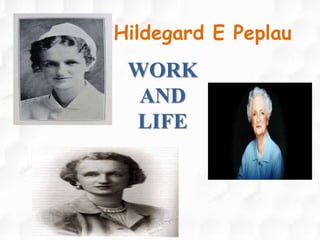
Hildegard E Peplau
WORK
AND
LIFE
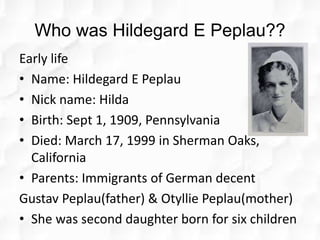
Who was Hildegard E Peplau??
Early life
• Name: Hildegard E Peplau
• Nick name: Hilda
• Birth: Sept 1, 1909, Pennsylvania
• Died: March 17, 1999 in Sherman Oaks,
California
• Parents: Immigrants of German decent
Gustav Peplau(father) & Otyllie Peplau(mother)
• She was second daughter born for six children
Why Nursing……????
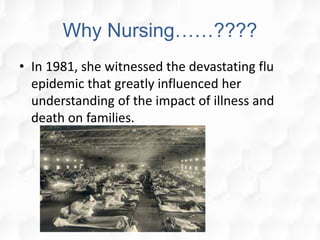
• In 1981, she witnessed the devastating flu
epidemic that greatly influenced her
understanding of the impact of illness and
death on families.
Educational Background
• 1931- Diploma program in Pottstown, Pennsylvania.
• 1943- BA in interpersonal psychology - Bennington
College.
• 1947- MA in psychiatric nursing from Colombia
University New York
• 1953- EdD in curriculum development
• Professor emeritus from Rutgers university
• Started first post baccalaureate program in nursing
Professional Work
• 1952- Published Interpersonal Relations in
Nursing
• 1968- Interpersonal techniques-the crux of
psychiatric nursing
• Worked as executive director and president of
ANA.
• Worked with W.H.O, NIMH and Nurse Corps.
• Theory of interpersonal relations is a middle
range descriptive classification theory.
• Peplau's theory is also referred as psychodynamic
nursing, which is the understanding of ones own
behavior.
MAJOR CONCEPT OF PEPLAU’S
THEORY
• The theory explains the purpose of nursing is
to help others identify their felt difficulties.
• Nurses should apply principles of human
relations to the problems that arise at all
levels of experience.
• Peplau's theory explains the phases of
interpersonal process, roles in nursing
situations and methods for studying nursing as
an interpersonal process
MAJOR CONCEPT OF PEPLAU’S
THEORY
• Nursing is therapeutic in that it is a healing art,
assisting an individual who is sick or in need of health
care.
• Nursing is an interpersonal process because it involves
interaction between two or more individuals with a
common goal.
• The attainment of goal is achieved through the use of a
series of steps following a series of pattern.
• The nurse and patient work together so both become
mature and knowledgeable in the process.
DEFINITION
• Person: A developing organism that tries
to reduce anxiety caused by needs.
• Environment: Existing forces outside the
organism and in the context of culture
DEFINITION
• Health: A word symbol that implies forward
movement of personality and other ongoing
human processes in the direction
of creative, constructive, productive, personal an
d community living.
• Nursing: A significant therapeutic interpersonal
process. It functions cooperatively with other

human process that makes health possible for
individuals in communities.
Peplau’s Seven Role of a Nurse
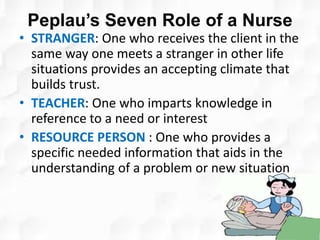
• STRANGER: One who receives the client in the
same way one meets a stranger in other life
situations provides an accepting climate that
builds trust.
• TEACHER: One who imparts knowledge in
reference to a need or interest
• RESOURCE PERSON : One who provides a
specific needed information that aids in the
understanding of a problem or new situation
Peplau’s Seven Role of a Nurse
• COUNSELORS : One helps to understand and
integrate the meaning of current life
circumstances ,provides guidance and
encouragement to make changes
• SURROGATE: One who helps to clarify
domains of dependence interdependence and
independence and acts on client’s behalf as an
advocate.
Peplau’s Seven Role of a Nurse
• LEADER : One who helps client assume
maximum responsibility for meeting
treatment goals in a mutually satisfying way
• TECHNICAL EXPERT: It provides physical care
by display clinical skill and operates
equipment
Additional Roles include:
• Technical expert
• Consultant
• Health teacher
• Tutor
• Socializing agent
• Safety agent
• Manager of environment
• Mediator
• Administrator
• Recorder observer
• Researcher
Lets see an example
• https://www.youtube.com/watch?v=4Qon7n
D3ISY
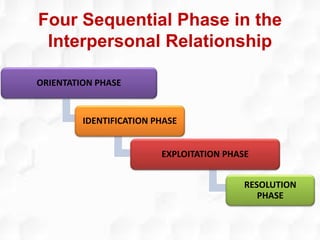
Four Sequential Phase in the
Interpersonal Relationship
ORIENTATION PHASE
IDENTIFICATION PHASE
EXPLOITATION PHASE
RESOLUTION
PHASE
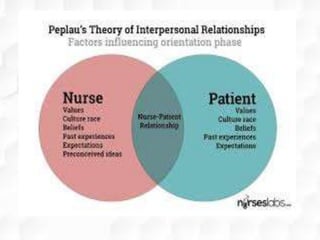
ORIENTAION PHASE
• Problem defining phase
• Starts when client meets nurse as stranger
• Defining problem and deciding type of service
needed
• Client seeks assistance ,conveys needs ,asks
questions, shares preconceptions and
expectations of past experiences
• Nurse responds, explains roles to client, helps to
identify problems and to use available resources
and services
IDENTIFICATION PHASE
• Selection of appropriate professional
assistance
• Patient begins to have a feeling of belonging
and a capability of dealing with the problem
which decreases the feeling of helplessness
and hopelessness
EXPLOITATION PHASE
• Use of professional assistance for problem
solving alternatives
• Advantages of services are used is based on
the needs and interests of the patients
• Individual feels as an integral part of the
helping environment
• They may make minor requests or attention
getting techniques
EXPLOITATION PHASE
• The principles of interview techniques must
be used in order to explore, understand and
adequately deal with the underlying problem
• Patient may fluctuates on independence
• Nurse must be aware about the various
phases of communication
• Nurse aids the patient in exploiting all avenues
of help and progress is made towards the final
step
RESOLUTION PHASE
• Termination of professional relationship
• The patients needs have already been met by the
collaborative effect of patient and nurse
• Now they need to terminate their therapeutic
relationship and dissolve the links between them.
• Sometimes may be difficult for both as
psychological dependence persists
• Patient drifts away and breaks bond with nurse
and healthier emotional balance is demonstrated
and both becomes mature individuals
Interpersonal theory and nursing
process
• Both are sequential and focus on therapeutic
relationship
• Both use problem solving techniques for the
nurse and patient to collaborate on, with the
end purpose of meeting the patients needs
• Both use observation communication and
recording as basic tools utilized by nursing
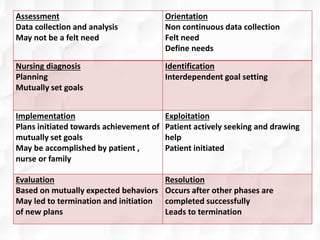
Assessment
Data collection and analysis
May not be a felt need
Orientation
Non continuous data collection
Felt need
Define needs
Nursing diagnosis
Planning
Mutually set goals
Identification
Interdependent goal setting
Implementation
Plans initiated towards achievement of
mutually set goals
May be accomplished by patient ,
nurse or family
Exploitation
Patient actively seeking and drawing
help
Patient initiated
Evaluation
Based on mutually expected behaviors
May led to termination and initiation
of new plans
Resolution
Occurs after other phases are
completed successfully
Leads to termination
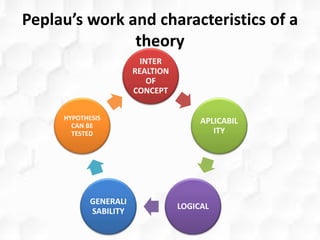
Peplau’s work and characteristics of a
theory
INTER
REALTION
OF
CONCEPT
APLICABIL
ITY
LOGICAL
GENERALI
SABILITY
HYPOTHESIS
CAN BE
TESTED
Application of Theory to Area in
Nursing
Nursing Education
- Has an impact on the Psychiatric nursing
especially in the baccalaureate program in
nursing teaching CARE OF CLIENT WITH
MALADAPTIVE PATTERNSOF BEHAVIOR
Application of Theory to Area in
Nursing
Practice
• Focuses on the interpersonal processes and therapeutic
relationship that develops between the nurse and client.
• It requires that the nurse attends to the interpersonal
processes that occurs between the nurse and the client
• Interpersonal process is maturing force for personality. It
includes the nurse- client relationship, communication,
pattern integration and the role of the nurse.
• Psychodynamic nursing is understanding one’s own behavior
to help others identify felt and perceived difficulties and to
apply principles of human relations to the problems that arise
at all levels of experience
Application of Theory to Area in
Nursing
• Hays .D. (1961). Phases and steps of experimental
teaching to patients of a concept of anxiety:
Findings revealed that when taught by the
experimental method, the patients were able to
apply the concept of anxiety after the group was
terminated.
• Burd .S.F. Develop and test a nursing intervention
framework for working with anxious patients:
Students developed competency in beginning
interpersonal relationship.
Application with example
• The nursing process for Mrs Laxmi using
Peplau’s theory
• Mrs Laxmi with 27 years of age is diagnosed
with Inter vertebral disc prolapse. She is on
traction and complains of pain
Assessment
(Orientation)
Nursing
Diagnosis
Planning
(Identification)
Implementation
(Exploitation)
Evaluation
(Resolution)
Mrs Laxmi is
on pelvic
traction and
she is
restricted to
bed
The need for
bed rest and
restriction was
discussed
Impaired
physical mobility
related to the
presence of
pelvic traction
- Goal setting
was done along
with patient
- Provide active
and passive
exercise to all the
extremities to
improve the
muscle tone and
strength
- Provide articles
near to the
patient and
encourage doing
activities within
limits
Carried out plans
mutually agreed
upon
Provide active and
passive exercise to
all the extremities
Provide articles
within the reach
of the patient
Mrs. Laxmi
was free to
express
problems
regarding
difficulty in
mobilizing
She expressed
satisfaction
when able to
move without
difficulty
Lets see an example
• https://www.youtube.com/watch?v=4Qon7n
D3ISY
Evaluation of the theory
• With the help of the theory of interpersonal
relations, the clients need could be assessed
and identified.
• It helped her to achieve them within her limit.
This theory application helped in providing
comprehensive care to the client.
• Peplau’s theory helped later nursing
theorist and clinicians develop
more therapeutic interventions
regarding the roles that shows the
dynamic character typical in clinical
nursing
• Its phases provide simplicity
regarding the natural progression of
the nurse- patient relationship
which leads to adaptability in any
nurse- patient interaction, thus
provide generalizability.
LIMITATIONS
• Less consideration of personal space and
community social service resources.
• Less emphasis on health promotion and
maintenance.
• Cannot be used in a client who doesn’t have a
felt need eg. For an unconscious patients
• Some areas are not specific enough to
generate hypothesis
To Summarize
• Hildegard E Peplau’s theory of
interpersonal relation is useful to
maintain the nurse patient relation
• The theory has four important phases
including orientation, implementation,
exploitation and resolution phase
• It goes hand in hand with the nursing
process
• There are 7 important role of nurses
according to Peplau’s including stranger,
teacher, resource person counselor,
surrogate, leader and technical expert
• This theory can be applicable in the daily
nursing practice to have good patient
outcome
PEPLAUS THEORY.pptx
PEPLAUS THEORY.pptx

PEPLAUS THEORY.pptx

  • 1.
    PEPLAU’S THEORY PRESENTED TO: DR.BHAGYASHREE JOGDEO B.V.CON-PUNE PRESENTED BY: MS. LOMA R WAGHMARE F.Y.M.SC(NURSING) B.V.CON-PUNE ADVANCE NURSING PRACTICE
  • 2.
  • 3.
    Who was HildegardE Peplau?? Early life • Name: Hildegard E Peplau • Nick name: Hilda • Birth: Sept 1, 1909, Pennsylvania • Died: March 17, 1999 in Sherman Oaks, California • Parents: Immigrants of German decent Gustav Peplau(father) & Otyllie Peplau(mother) • She was second daughter born for six children
  • 4.
    Why Nursing……???? • In1981, she witnessed the devastating flu epidemic that greatly influenced her understanding of the impact of illness and death on families.
  • 5.
    Educational Background • 1931-Diploma program in Pottstown, Pennsylvania. • 1943- BA in interpersonal psychology - Bennington College. • 1947- MA in psychiatric nursing from Colombia University New York • 1953- EdD in curriculum development • Professor emeritus from Rutgers university • Started first post baccalaureate program in nursing
  • 6.
    Professional Work • 1952-Published Interpersonal Relations in Nursing • 1968- Interpersonal techniques-the crux of psychiatric nursing • Worked as executive director and president of ANA. • Worked with W.H.O, NIMH and Nurse Corps. • Theory of interpersonal relations is a middle range descriptive classification theory. • Peplau's theory is also referred as psychodynamic nursing, which is the understanding of ones own behavior.
  • 7.
    MAJOR CONCEPT OFPEPLAU’S THEORY • The theory explains the purpose of nursing is to help others identify their felt difficulties. • Nurses should apply principles of human relations to the problems that arise at all levels of experience. • Peplau's theory explains the phases of interpersonal process, roles in nursing situations and methods for studying nursing as an interpersonal process
  • 8.
    MAJOR CONCEPT OFPEPLAU’S THEORY • Nursing is therapeutic in that it is a healing art, assisting an individual who is sick or in need of health care. • Nursing is an interpersonal process because it involves interaction between two or more individuals with a common goal. • The attainment of goal is achieved through the use of a series of steps following a series of pattern. • The nurse and patient work together so both become mature and knowledgeable in the process.
  • 9.
    DEFINITION • Person: Adeveloping organism that tries to reduce anxiety caused by needs. • Environment: Existing forces outside the organism and in the context of culture
  • 10.
    DEFINITION • Health: Aword symbol that implies forward movement of personality and other ongoing human processes in the direction of creative, constructive, productive, personal an d community living. • Nursing: A significant therapeutic interpersonal process. It functions cooperatively with other human process that makes health possible for individuals in communities.

  • 11.
    Peplau’s Seven Roleof a Nurse • STRANGER: One who receives the client in the same way one meets a stranger in other life situations provides an accepting climate that builds trust. • TEACHER: One who imparts knowledge in reference to a need or interest • RESOURCE PERSON : One who provides a specific needed information that aids in the understanding of a problem or new situation
  • 12.
    Peplau’s Seven Roleof a Nurse • COUNSELORS : One helps to understand and integrate the meaning of current life circumstances ,provides guidance and encouragement to make changes • SURROGATE: One who helps to clarify domains of dependence interdependence and independence and acts on client’s behalf as an advocate.
  • 13.
    Peplau’s Seven Roleof a Nurse • LEADER : One who helps client assume maximum responsibility for meeting treatment goals in a mutually satisfying way • TECHNICAL EXPERT: It provides physical care by display clinical skill and operates equipment
  • 14.
    Additional Roles include: •Technical expert • Consultant • Health teacher • Tutor • Socializing agent • Safety agent • Manager of environment • Mediator • Administrator • Recorder observer • Researcher
  • 15.
    Lets see anexample • https://www.youtube.com/watch?v=4Qon7n D3ISY
  • 16.
    Four Sequential Phasein the Interpersonal Relationship ORIENTATION PHASE IDENTIFICATION PHASE EXPLOITATION PHASE RESOLUTION PHASE
  • 17.
    ORIENTAION PHASE • Problemdefining phase • Starts when client meets nurse as stranger • Defining problem and deciding type of service needed • Client seeks assistance ,conveys needs ,asks questions, shares preconceptions and expectations of past experiences • Nurse responds, explains roles to client, helps to identify problems and to use available resources and services
  • 19.
    IDENTIFICATION PHASE • Selectionof appropriate professional assistance • Patient begins to have a feeling of belonging and a capability of dealing with the problem which decreases the feeling of helplessness and hopelessness
  • 20.
    EXPLOITATION PHASE • Useof professional assistance for problem solving alternatives • Advantages of services are used is based on the needs and interests of the patients • Individual feels as an integral part of the helping environment • They may make minor requests or attention getting techniques
  • 21.
    EXPLOITATION PHASE • Theprinciples of interview techniques must be used in order to explore, understand and adequately deal with the underlying problem • Patient may fluctuates on independence • Nurse must be aware about the various phases of communication • Nurse aids the patient in exploiting all avenues of help and progress is made towards the final step
  • 22.
    RESOLUTION PHASE • Terminationof professional relationship • The patients needs have already been met by the collaborative effect of patient and nurse • Now they need to terminate their therapeutic relationship and dissolve the links between them. • Sometimes may be difficult for both as psychological dependence persists • Patient drifts away and breaks bond with nurse and healthier emotional balance is demonstrated and both becomes mature individuals
  • 23.
    Interpersonal theory andnursing process • Both are sequential and focus on therapeutic relationship • Both use problem solving techniques for the nurse and patient to collaborate on, with the end purpose of meeting the patients needs • Both use observation communication and recording as basic tools utilized by nursing
  • 24.
    Assessment Data collection andanalysis May not be a felt need Orientation Non continuous data collection Felt need Define needs Nursing diagnosis Planning Mutually set goals Identification Interdependent goal setting Implementation Plans initiated towards achievement of mutually set goals May be accomplished by patient , nurse or family Exploitation Patient actively seeking and drawing help Patient initiated Evaluation Based on mutually expected behaviors May led to termination and initiation of new plans Resolution Occurs after other phases are completed successfully Leads to termination
  • 25.
    Peplau’s work andcharacteristics of a theory INTER REALTION OF CONCEPT APLICABIL ITY LOGICAL GENERALI SABILITY HYPOTHESIS CAN BE TESTED
  • 26.
    Application of Theoryto Area in Nursing Nursing Education - Has an impact on the Psychiatric nursing especially in the baccalaureate program in nursing teaching CARE OF CLIENT WITH MALADAPTIVE PATTERNSOF BEHAVIOR
  • 27.
    Application of Theoryto Area in Nursing Practice • Focuses on the interpersonal processes and therapeutic relationship that develops between the nurse and client. • It requires that the nurse attends to the interpersonal processes that occurs between the nurse and the client • Interpersonal process is maturing force for personality. It includes the nurse- client relationship, communication, pattern integration and the role of the nurse. • Psychodynamic nursing is understanding one’s own behavior to help others identify felt and perceived difficulties and to apply principles of human relations to the problems that arise at all levels of experience
  • 28.
    Application of Theoryto Area in Nursing • Hays .D. (1961). Phases and steps of experimental teaching to patients of a concept of anxiety: Findings revealed that when taught by the experimental method, the patients were able to apply the concept of anxiety after the group was terminated. • Burd .S.F. Develop and test a nursing intervention framework for working with anxious patients: Students developed competency in beginning interpersonal relationship.
  • 29.
    Application with example •The nursing process for Mrs Laxmi using Peplau’s theory • Mrs Laxmi with 27 years of age is diagnosed with Inter vertebral disc prolapse. She is on traction and complains of pain
  • 30.
    Assessment (Orientation) Nursing Diagnosis Planning (Identification) Implementation (Exploitation) Evaluation (Resolution) Mrs Laxmi is onpelvic traction and she is restricted to bed The need for bed rest and restriction was discussed Impaired physical mobility related to the presence of pelvic traction - Goal setting was done along with patient - Provide active and passive exercise to all the extremities to improve the muscle tone and strength - Provide articles near to the patient and encourage doing activities within limits Carried out plans mutually agreed upon Provide active and passive exercise to all the extremities Provide articles within the reach of the patient Mrs. Laxmi was free to express problems regarding difficulty in mobilizing She expressed satisfaction when able to move without difficulty
  • 31.
    Lets see anexample • https://www.youtube.com/watch?v=4Qon7n D3ISY
  • 32.
    Evaluation of thetheory • With the help of the theory of interpersonal relations, the clients need could be assessed and identified. • It helped her to achieve them within her limit. This theory application helped in providing comprehensive care to the client.
  • 33.
    • Peplau’s theoryhelped later nursing theorist and clinicians develop more therapeutic interventions regarding the roles that shows the dynamic character typical in clinical nursing • Its phases provide simplicity regarding the natural progression of the nurse- patient relationship which leads to adaptability in any nurse- patient interaction, thus provide generalizability.
  • 34.
    LIMITATIONS • Less considerationof personal space and community social service resources. • Less emphasis on health promotion and maintenance. • Cannot be used in a client who doesn’t have a felt need eg. For an unconscious patients • Some areas are not specific enough to generate hypothesis
  • 35.
    To Summarize • HildegardE Peplau’s theory of interpersonal relation is useful to maintain the nurse patient relation • The theory has four important phases including orientation, implementation, exploitation and resolution phase • It goes hand in hand with the nursing process • There are 7 important role of nurses according to Peplau’s including stranger, teacher, resource person counselor, surrogate, leader and technical expert • This theory can be applicable in the daily nursing practice to have good patient outcome