FOOD
It is the basic requirement of life to survive.
It is made up of various kind of energy rich substances
like carbohydrates, proteins, fats, vitamins and
minerals, which are known as nutrients.
FUNCTIONS OF FOOD
Food provide energy for various metabolic activities.
It helps in growth and development of body.
It helps in the replacement of worn out tissues, repair
of damaged cells and healing of wounds.
It provide protection against diseases.
SOURCES OF FOOD
Cereals
Pulses
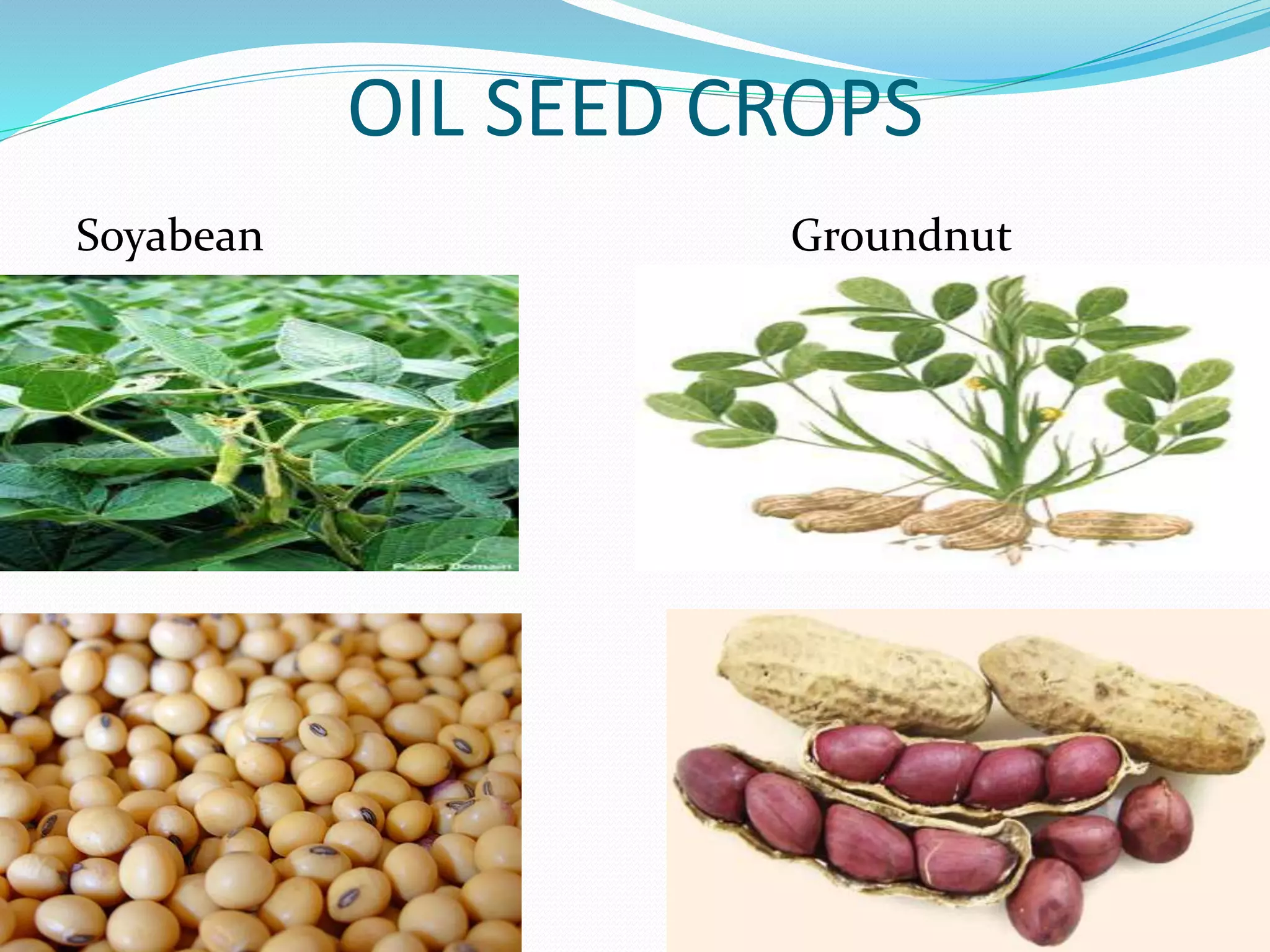
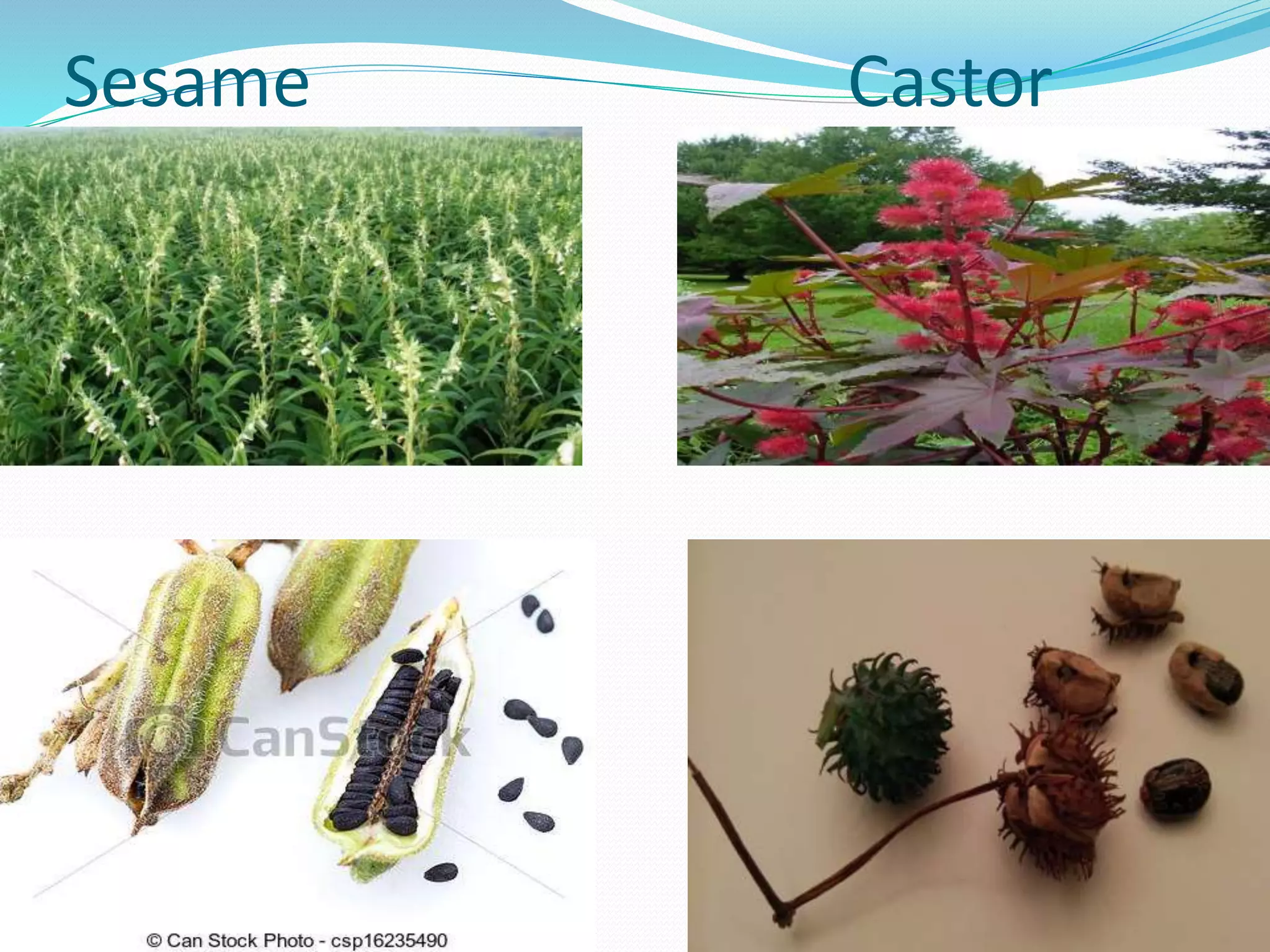
Oil seed crops
Fruits and vegetables
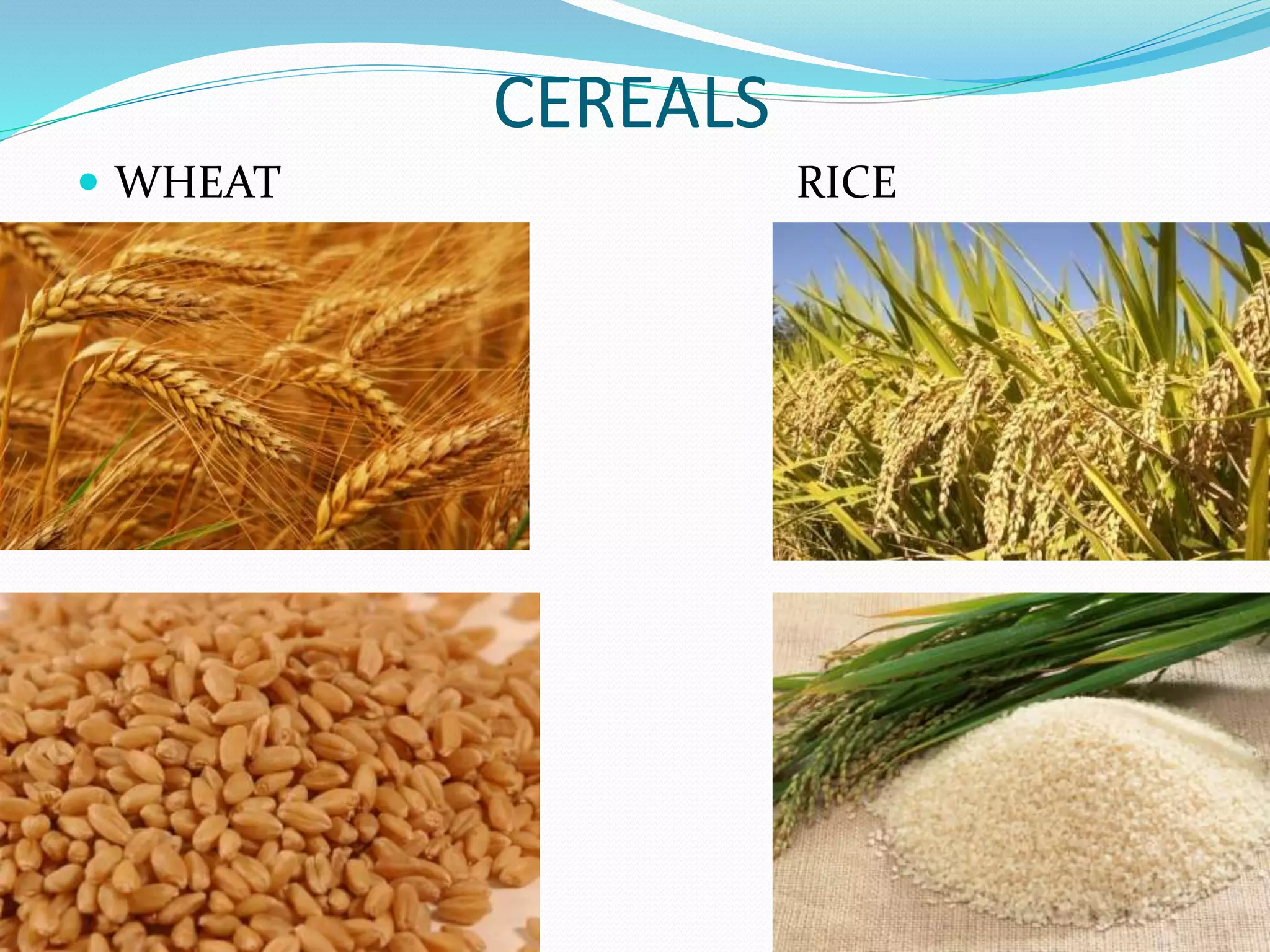
CEREALS
 WHEAT RICE
MAIZE BAJRA

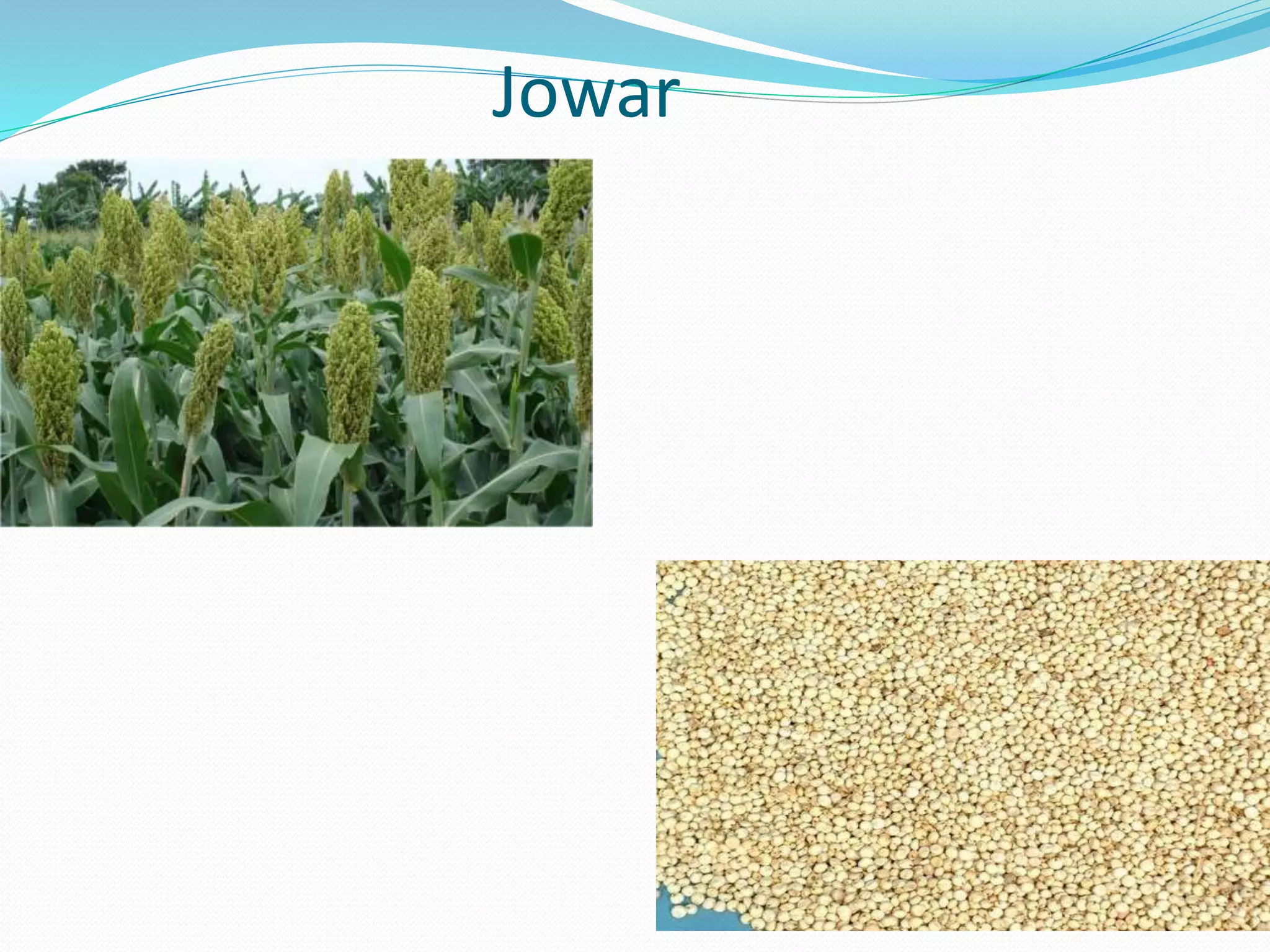
Jowar
PULSES
Pigeon pea (arhar) Urad
Lentil (masoor) Pea
Black gram
OIL SEED CROPS
Soyabean Groundnut
Sunflower Niger
Sesame Castor
Mustard Linseed
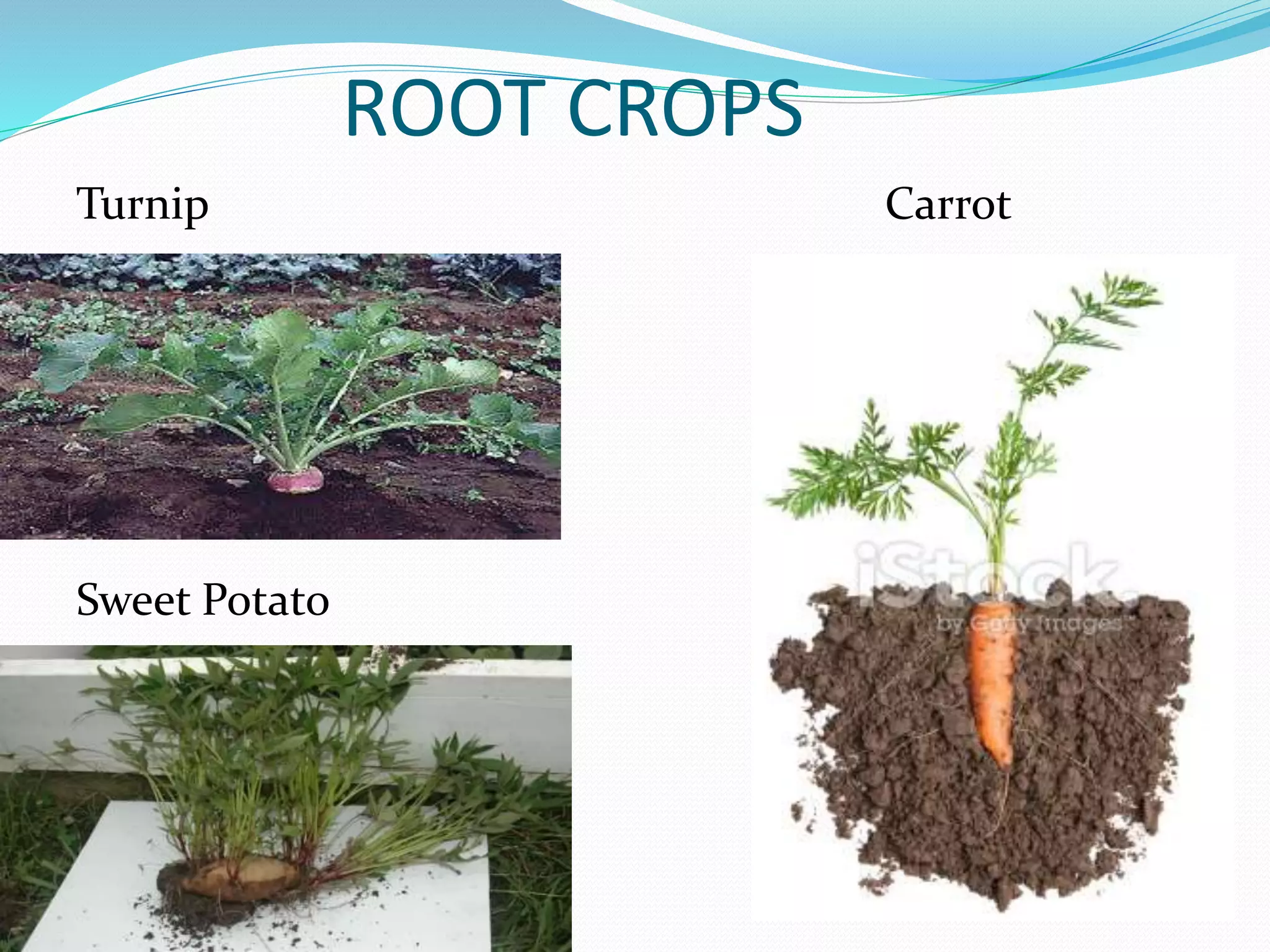
ROOT CROPS
Turnip Carrot
Sweet Potato
SUGAR CROPS
Sugarcane Beet
FIBRE CROPS
Cotton Jute
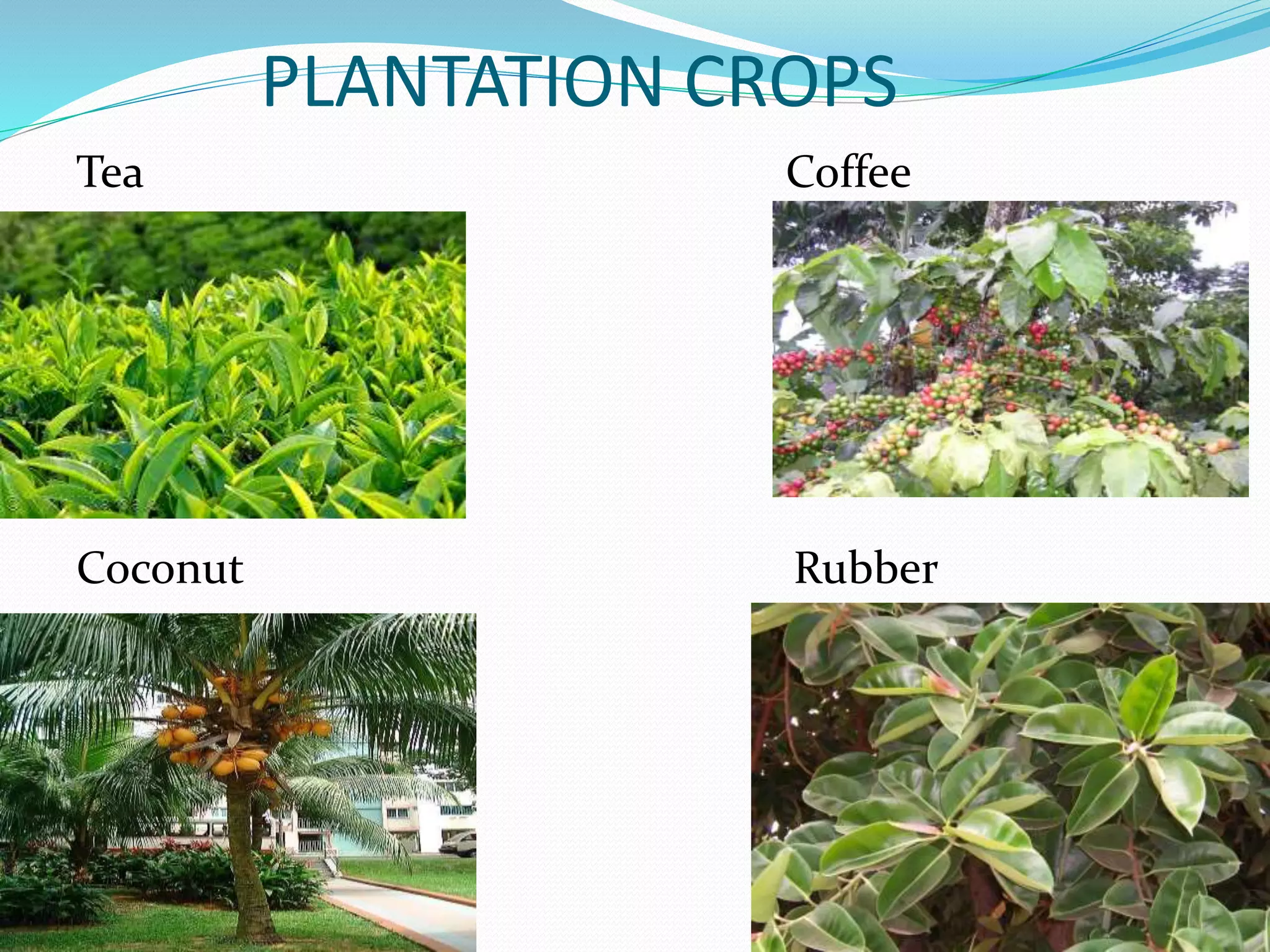
PLANTATION CROPS
Tea Coffee
Coconut Rubber
FODDER CROPS
Berseem Elephant Grass
AGRICULTURE
It is the branch of science which deals with the
productions of plants and raising of animals useful to
man
Involves soil cultivation, breeding and management of
crops and livestock.
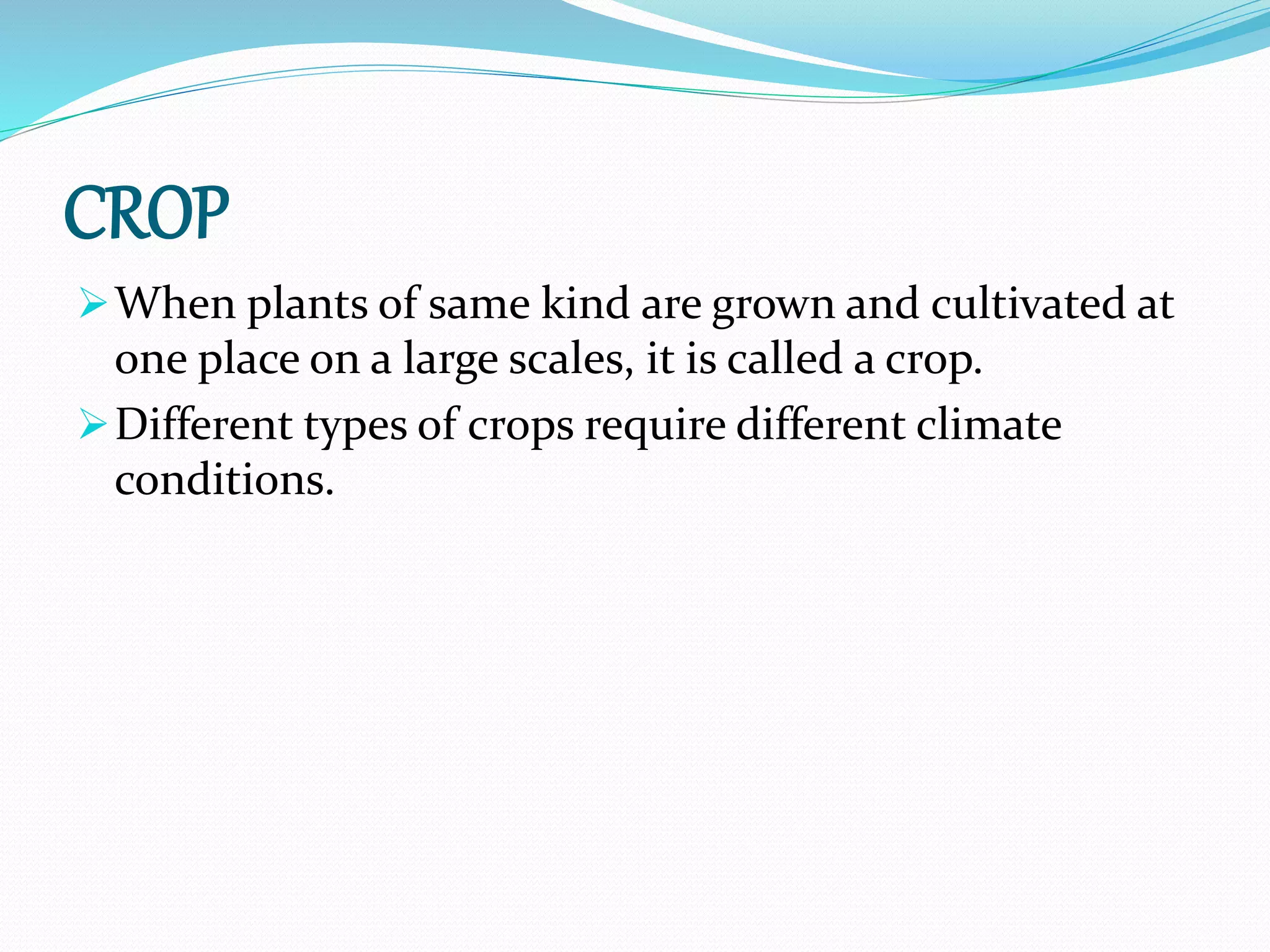
CROP
When plants of same kind are grown and cultivated at
one place on a large scales, it is called a crop.
Different types of crops require different climate
conditions.
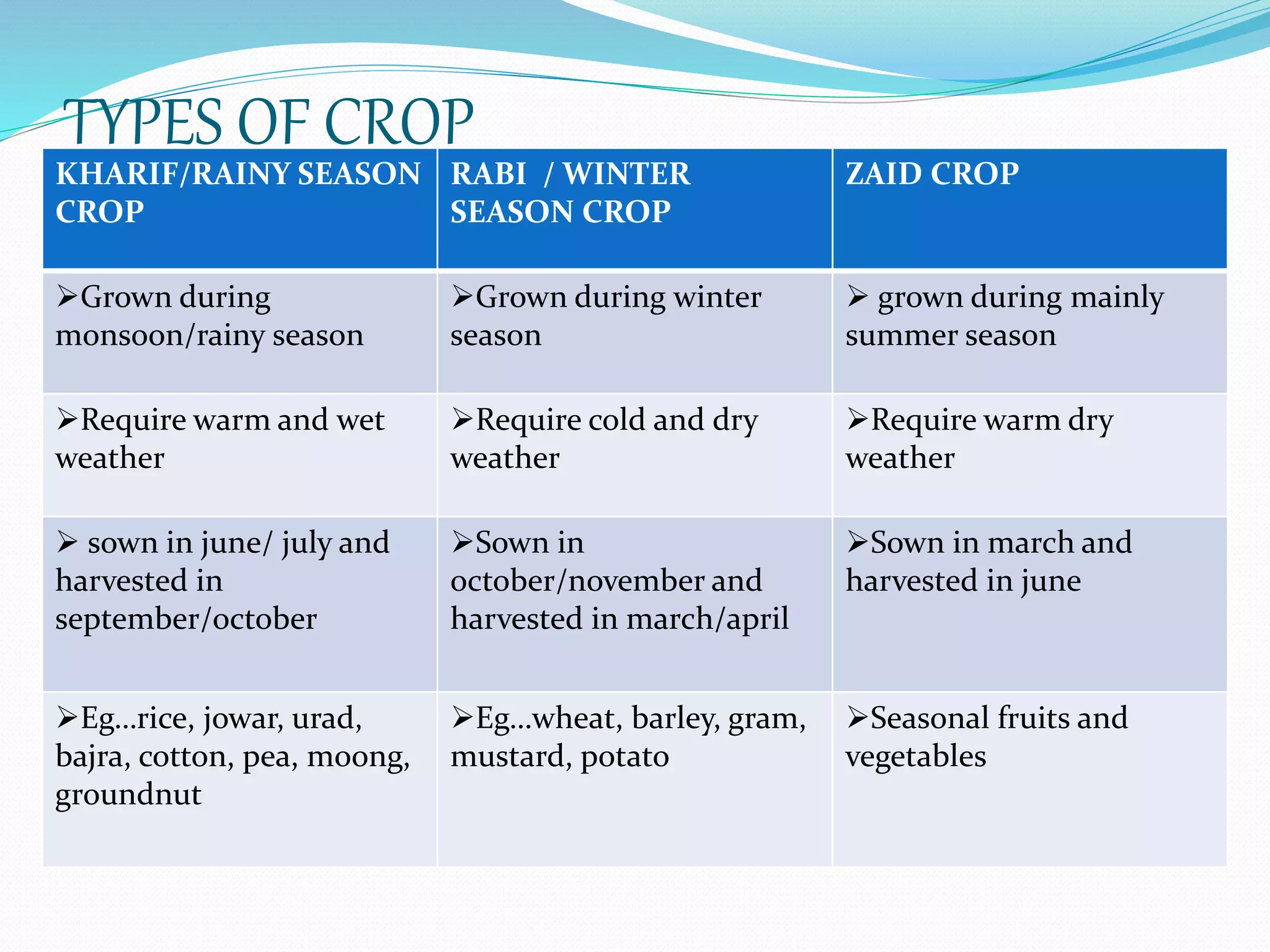
TYPES OF CROP
KHARIF/RAINY SEASON
CROP
RABI / WINTER
SEASON CROP
ZAID CROP
Grown during
monsoon/rainy season
Grown during winter
season
 grown during mainly
summer season
Require warm and wet
weather
Require cold and dry
weather
Require warm dry
weather
 sown in june/ july and
harvested in
september/october
Sown in
october/november and
harvested in march/april
Sown in march and
harvested in june
Eg…rice, jowar, urad,
bajra, cotton, pea, moong,
groundnut
Eg…wheat, barley, gram,
mustard, potato
Seasonal fruits and
vegetables
AGRICULTURE IMPLEMENTS
NAME OF IMPLEMENT USES
 KHURPA FOR WEEDING
 SPADE FOR DIGGING AND BUNDS
FORMATION
 WOODEN PLOUGH FOR TILLING
 SOIL PLANK FOR BREAKING CRUMBS
 SEED DRILL FOR SOWING
 HARROW FOR WEEDING
 SICKLE FOR HARVESTING
 SPRAYER FOR SPRAYING INSECTICIDES
 COMBINE FOR HARVESTING AND THRESHING
Khurpa Spade
Soil Plank Harrow
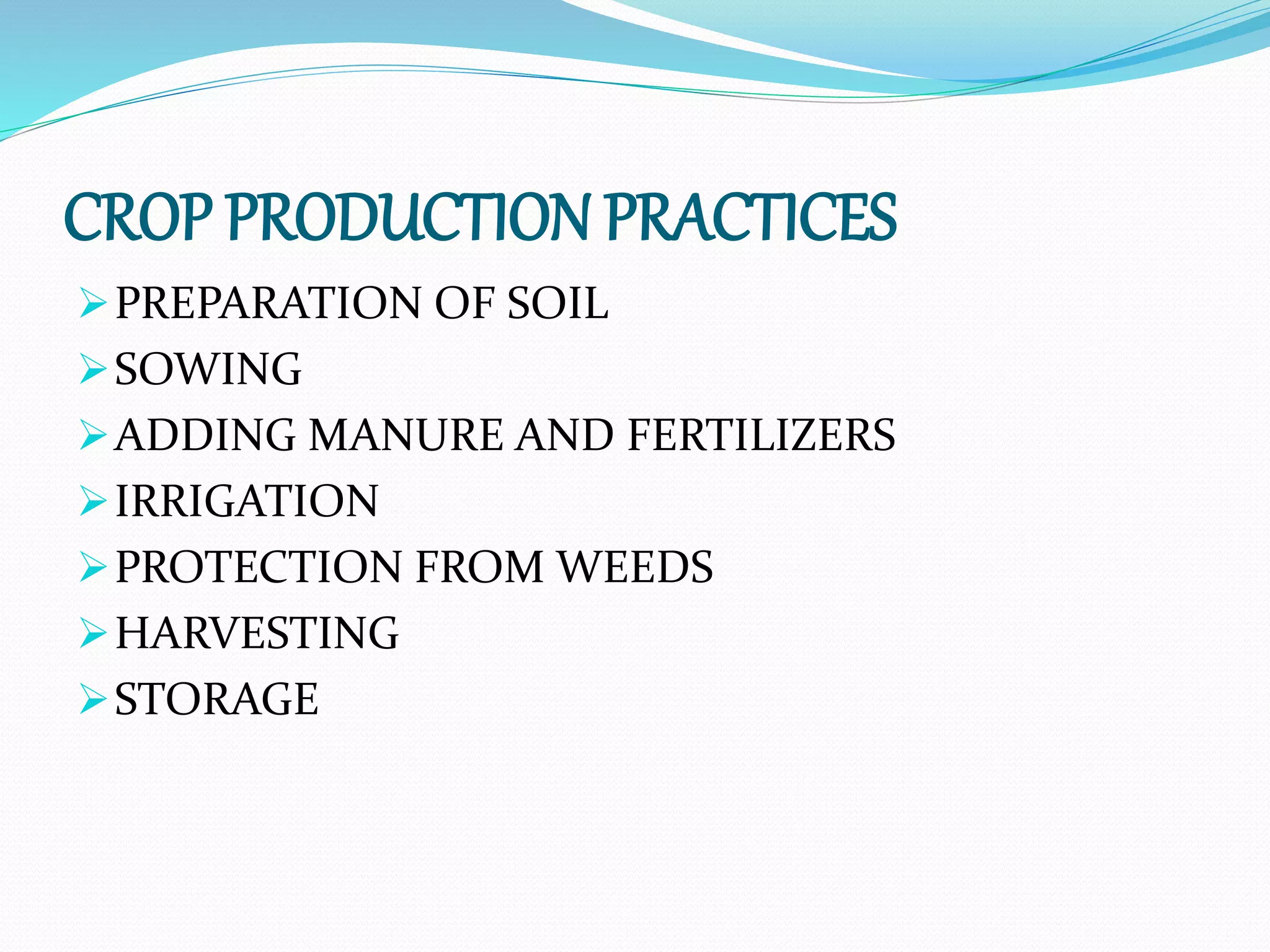
CROP PRODUCTION PRACTICES
PREPARATION OF SOIL
SOWING
ADDING MANURE AND FERTILIZERS
IRRIGATION
PROTECTION FROM WEEDS
HARVESTING
STORAGE
PREPARATION OF SOIL
Includes ploughing and levelling
PLOUGHING / TILLING
process of loosening and turning of soil
 done by using a plough
 ploughs are made of wood or iron
 allows the roots to penetrate deeper easily
 soil is overturned and properly aerated by ploughing
PLOUGH
Wooden Plough Iron Plough
TRADITIONAL PLOUGHING
MODERN PLOUGHING
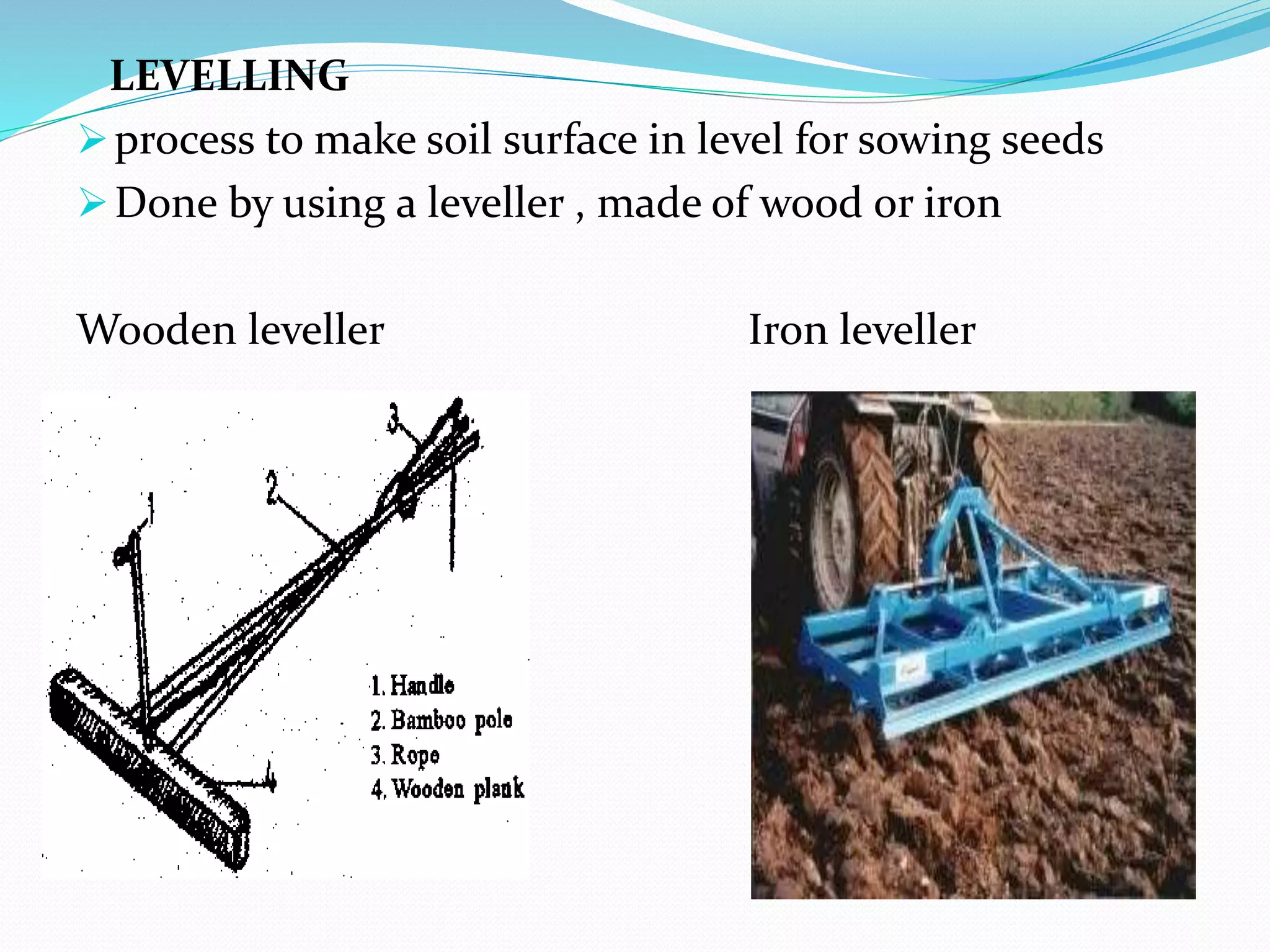
LEVELLING
process to make soil surface in level for sowing seeds
Done by using a leveller , made of wood or iron
Wooden leveller Iron leveller
TRADITIONAL LEVELLING
 MODERN LEVELLING
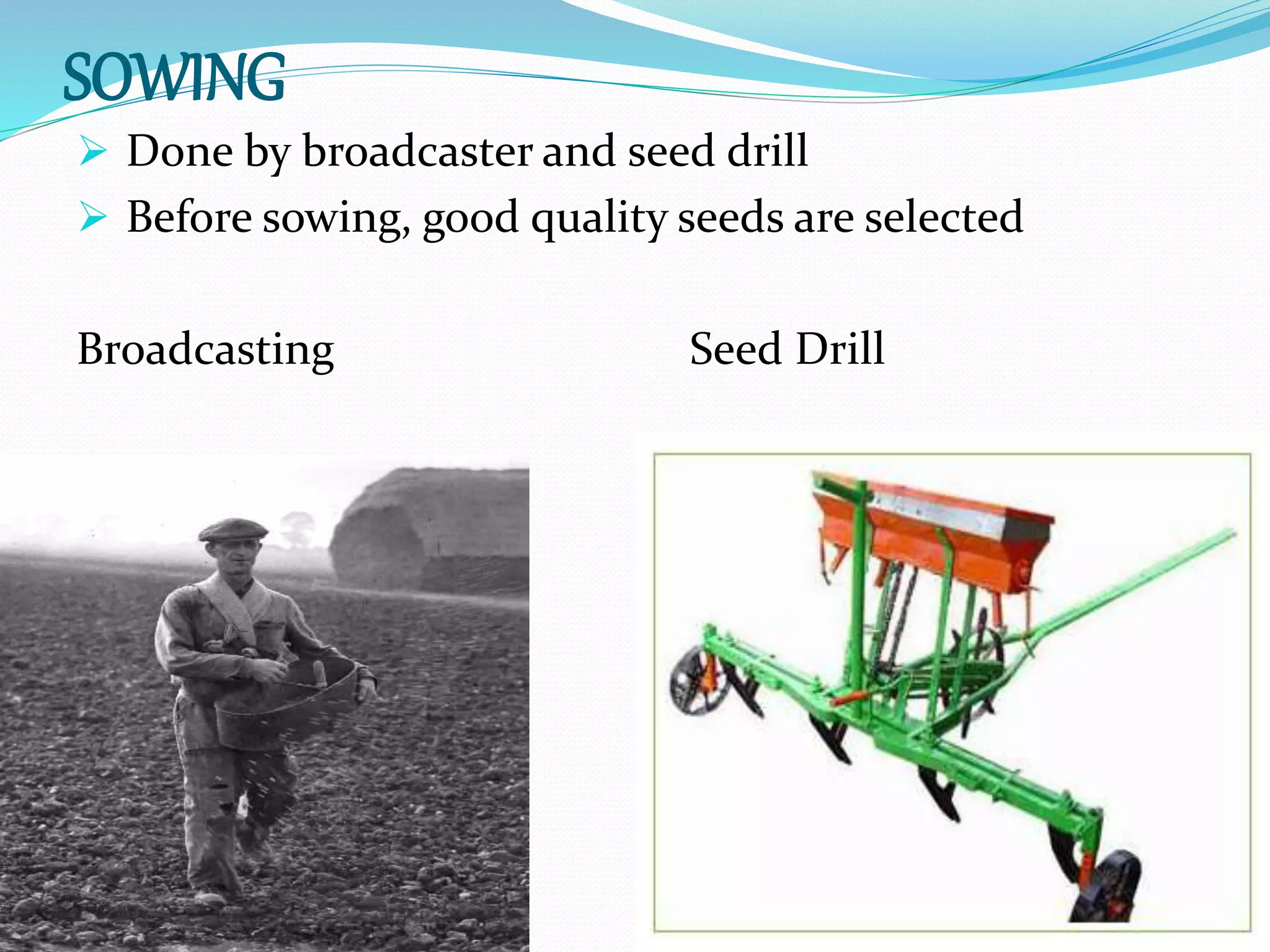
SOWING
 Done by broadcaster and seed drill
 Before sowing, good quality seeds are selected
Broadcasting Seed Drill
 MANUAL SOWING
 SOWING BY SEED DRILL
APPLYING MANURE AND FERTILIZERS
MANURE FERTILIZER
 Organic natural substances , derived
from decomposition of biological
materials.
 organic or inorganic substances.
 contain organic matter in large
quantities.
 organic matter not present.
 contain nutrient in small quantities
& are needed in large quantities.
Contain much higher amount of
nutrients & are required in very small
quantities.
 they are not nutrient specific.  they are nutrient specific.
 they are prepared in fields & villages.  they are manufactured in factories.
 manures are bulky substances. So
these are inconvenient to store, use and
transport
 these are available in concentrated
form . So these are easy to store, use and
transport.
 do not cause pollution  cause water pollution
Manure Manure Spreader
 MANURE SPREADING
Fertilizer Sprayer
FERTILIZERS SPRAYING
IRRIGATION
 Process of supplying water to crop plants growing in
the fields by means of canal, reservoir, wells, tube
wells, etc.
Water provide essential macronutrients to crop ---
hydrogen and oxygen
TYPES OF IRRIGATION
SOIL BASED IRRIGATION
Eg - crop grown in sandy soil require more frequent
irrigation than crop grown in clayey soil
CROP BASED IRRIGATION
Eg – paddy crop is transplanted in standing water
requires more water supply as compared to wheat,
gram, cotton.
METHODS OF IRRIGATION
TRADITIONAL METHODS :-
 Moat (pulley system)
 Chain pump
 Dhekli
 Rahat (level system)
Moat System Chain Pump
Rahat System Dhekli System
 RAHAT SYSTEM
CHAIN PUMP
DHEKLI SYSTEM
MOAT SYSTEM
 MODERN METHODS:-
 Drip Irrigation Method
 Sprinkler System
 Fertigation
Drip Irrigation Sprinkler Irrigation
DRIP IRRIGATION
SPRINKLER IRRIGATION
REMOVAL OF WEEDS
 WEEDS :- undesirable plants with the main crop,
compete with the main crop for water, nutrients,
space, light.
 WEEDING :- removal of weeds.
WEEDING METHODS
METHODS EXAMPLES
BIOLOGICAL METHODS Cassia plant against Parthenium weed
Herbivorous fish in paddy fields
CHEMICAL METHODS 2,4-D, Nitrofen, Atrazine
CULTURAL METHODS Crop rotation, Mixed Cropping,
Intercropping
MECHANICAL METHODS Ploughing, Flooding, Burning
WEEDING IN BANANA CROP
HARVESTING
Cutting of crop after its maturation
Done by sickle or by a machine called harvester
Grains are separated from chaff by a process called
threshing
Threshing is carried out by combine (harvester +
thresher)
SICKLE HARVESTER
COMBINE
MANUAL HARVESTING
 MODERN HARVESTING
STORAGE OF GRAINS
After threshing, grains are dried in sun and then
packed.
Farmers store food grains in jute bags or metallic bins
Large scale storage is done in silos and granaries and
stored in godowns
At domestic level, dried neem leaves are also used
SILOS
FACTORS RESPONSIBLE FOR GRAINS LOSS
DURING STORAGE
BIOTIC (LIVING) FACTORS:- insects, rodents, birds,
mites
ABIOTIC (NON LIVING) FACTORS:- Temperature,
moisture, humidity, material of container
MEASURES TO PREVENT GRAIN LOSS
Drying before storage
Maintenance of hygeine
Plant product treatment
Prophylactic treatment
Improved storage structures
DISEASES OF CROPS
CATEGORY DISEASE CAUSATIVE
AGENT
SYMPTOMS
Seed borne
diseases
Ergot of Bajra Claviceps perpuria Fungus infect
florets and
develops in ovaries,
producing sticky
liquid called honey
dew.
Leaf Spot of Rice Bipolaris oryzae Brown leaf spots
occur which are
small and circular
Ergot of Bajra Leaf Spot of Rice
CATEGORY DISEASE CAUSATIVE
AGENT
SYMPTOMS
Soil borne diseases Tikka disease of
groundnut
Cercosporidium
personatum
Spots are reddish
brown to black on
upper surface and
light brown on the
lower surface of
leaf.
Smut of bajra Tolyposporium sp. In affected ears,
some of grain
become deep
green which
becomes black.
Tikka disease of groundnut Smut of Bajra
CATEGORY DISEASE CAUSATIVE
AGENT
SYMPTOMS
Water borne
disease
Bacterial blight of
rice
Xanthomonas
oryzae
Leaves of young
plant become pale
green , whole leaf
become whitish,
greyish and then
die.
Bacterial Blight of Rice
CATEGORY DISEASE CAUSATIVE
AGENT
SYMPTOMS
Air borne disease Rust of wheat Puccinia triticana Brown pustules on
the stalk and
leaves. These
pustules burst and
release brown
powder which
consist of spores.
Blast of rice Magnaporthe
grisea
White to green
lesions with dark
border appear on
all parts of shoot.
Internodal
infection also
occur which result
in the breakdown
of stem.
Rust of wheat Blast of rice
SUSTAINABLE AGRICULTURE
Agriculture practices that can continue for very long
time without damaging the natural resources
Can be done by:-
Mixed farming
Crop rotation
Mixed cropping
Intercropping
Intercropping
Mixed Cropping
Three Sisters(Bean+Squash+Corn)
The spreading, big-leafed squash shades the ground
conserving moisture, inhibiting weeds and deterring
pests.
The corn acts as a natural beanpole, while the beans
contribute nitrogen to the soil for the other crops to
use. Together, beans and corn provide a complete
protein. In this photo, you can see the light green
leaves of a bean plant growing at the base of the
cornstalk.
Three Sisters
GREEN REVOLUTION
 Started in 1960 by Dr.
M.S. Swaminathan
(father of green
revolution)
 Main aim was to increase
production of wheat by
modern agricultural
practices
 High yield dwarf variety
of wheat “Sharbati
sonara” was developed in
1967.
ANIMAL HUSBANDRY
Science which deals with scientific management of
animals. It includes:-
Breeding
Feeding
Heeding
Weeding
THANKS
Biology Department
Udaipur Study Centre

Crop production ppt