“Enhancing Water Productivity in Rice through
Different Methods of Rice Cultivation”
Shantappa Duttarganvi
Doctoral Research Fellow
WALAMTARI
Introduction
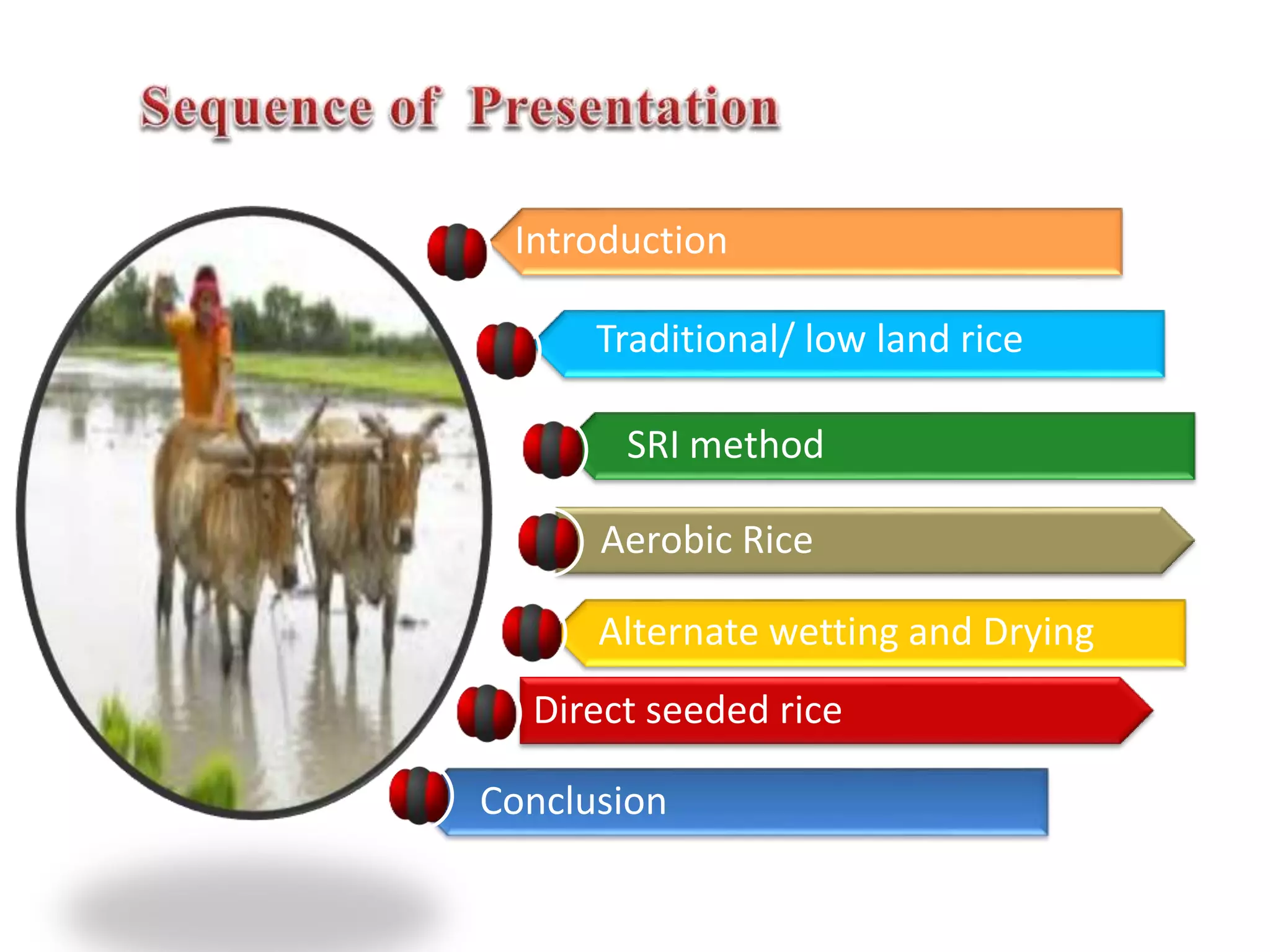
Traditional/ low land rice
SRI method
Aerobic Rice
Alternate wetting and Drying
Direct seeded rice
Conclusion
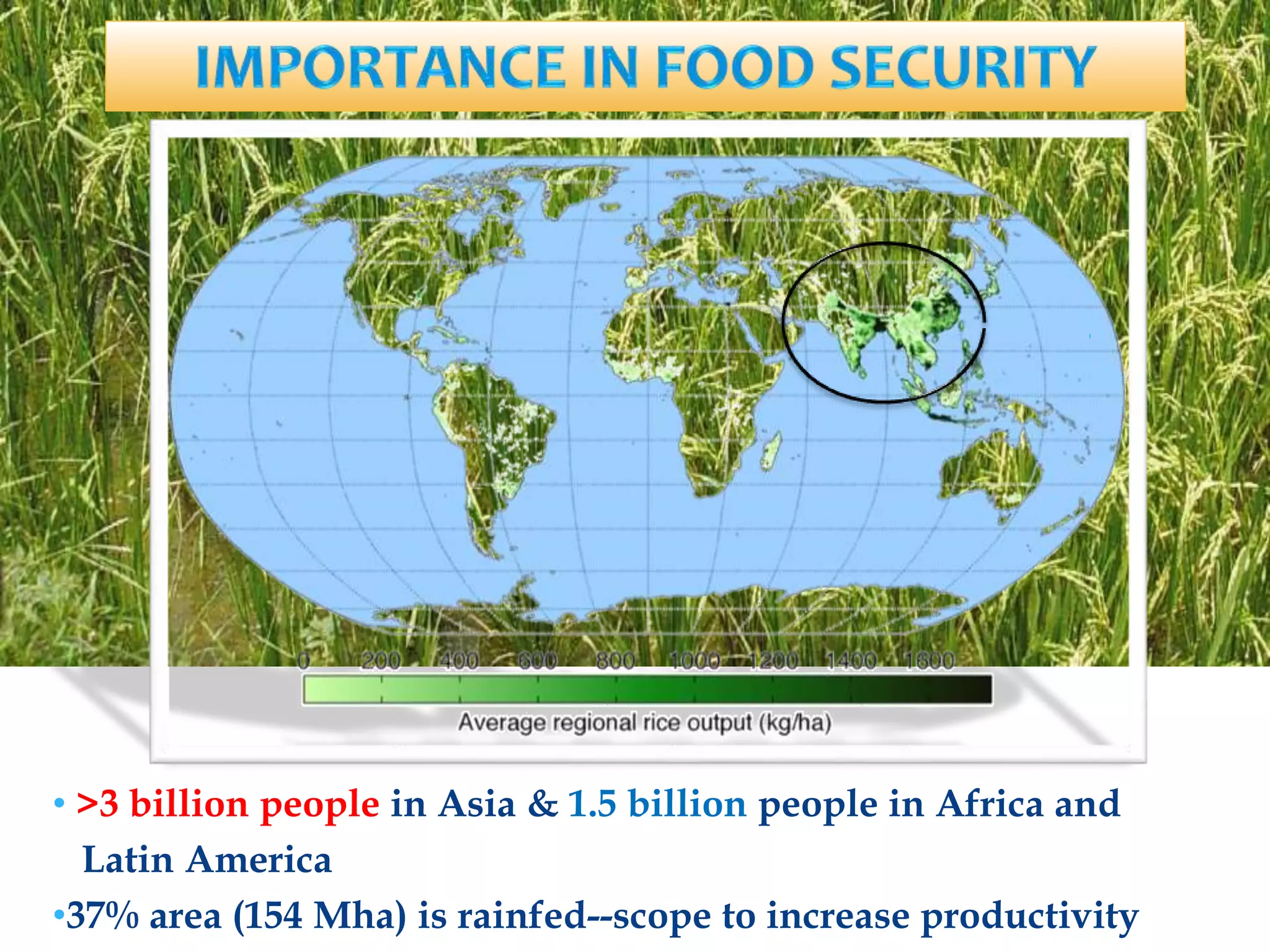
RICE IS LIFE Cultivate more land with less water
Introduction
• >3 billion people in Asia & 1.5 billion people in Africa and
Latin America
•37% area (154 Mha) is rainfed--scope to increase productivity
To meet future food requirements, India need to increase rice
productivity by 3 % per annum
(Thiyagarajan and Selvaraju, 2001)
To produce 1 kg of grain, farmers have to supply 2-3 times more
water in rice fields than other cereals
(Baker et al., 1998)
80% of the freshwater resources are used for irrigation purpose half
of which is used for rice production
(Dawe et al., 1998)
“Despite the constraints of water scarcity, rice production must rise
dramatically over the next generation to meet the food needs “
(Serageldin, 2011)
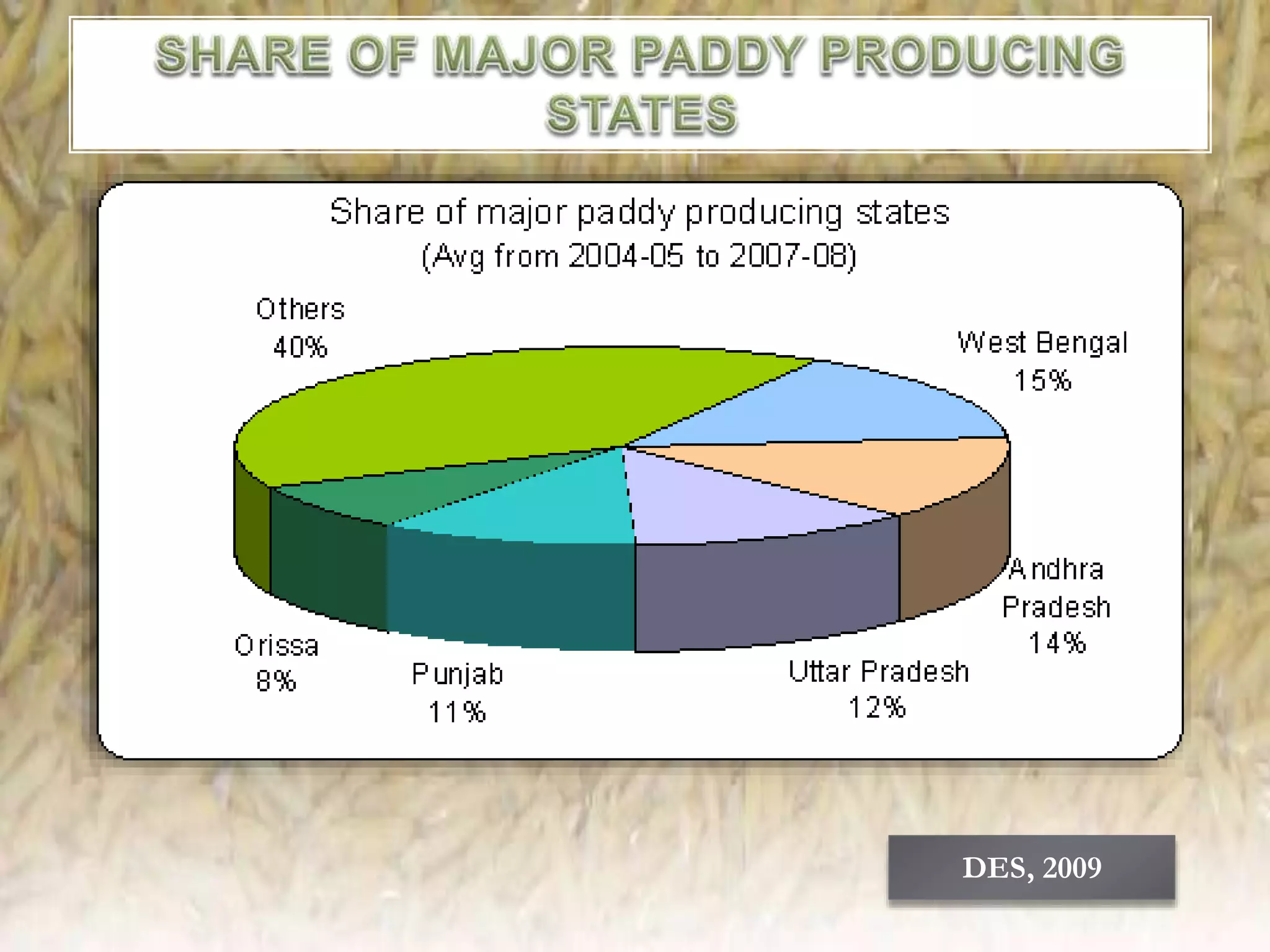
DES, 2009
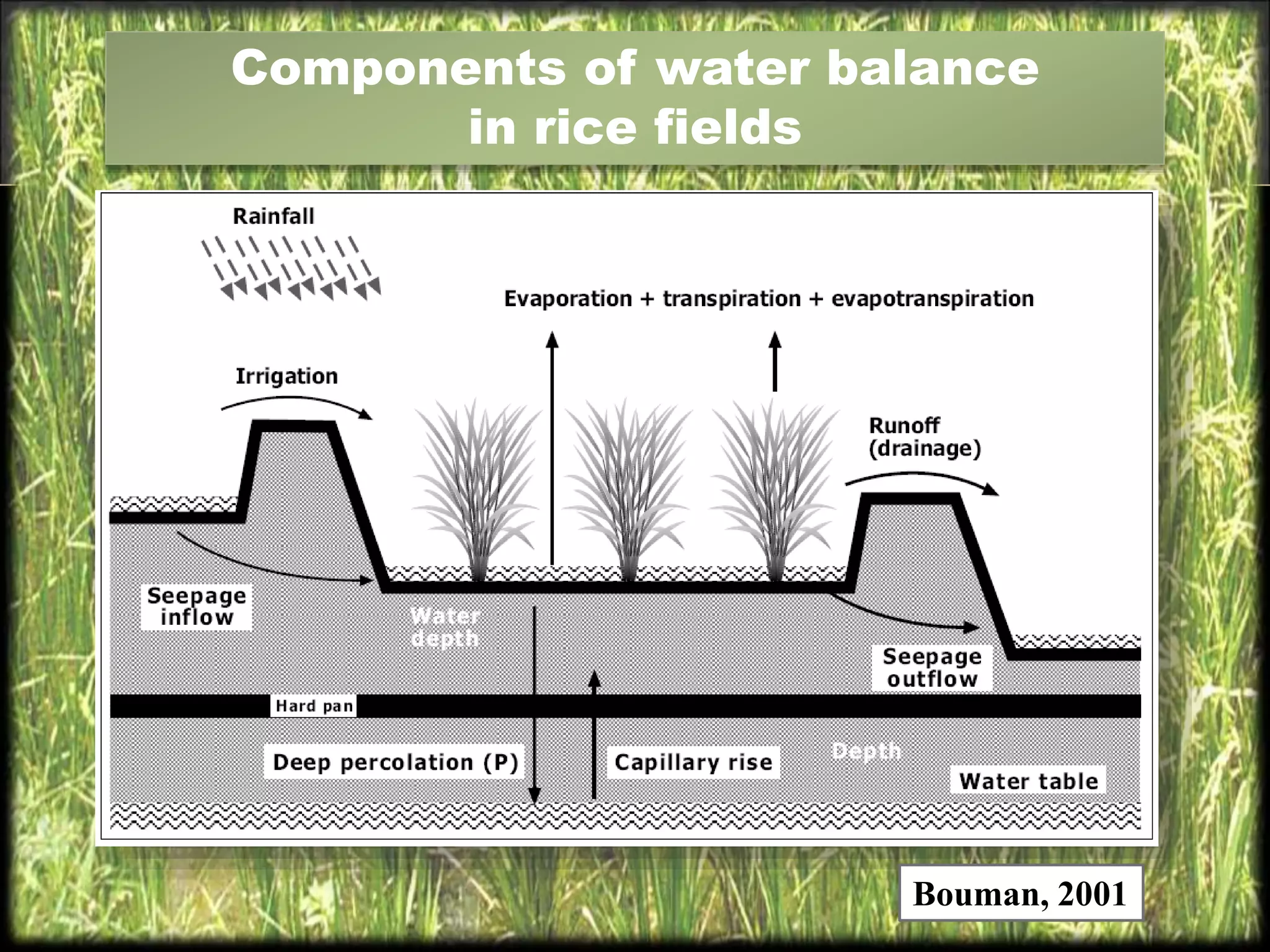
Bouman, 2001
Components of water balance
in rice fields
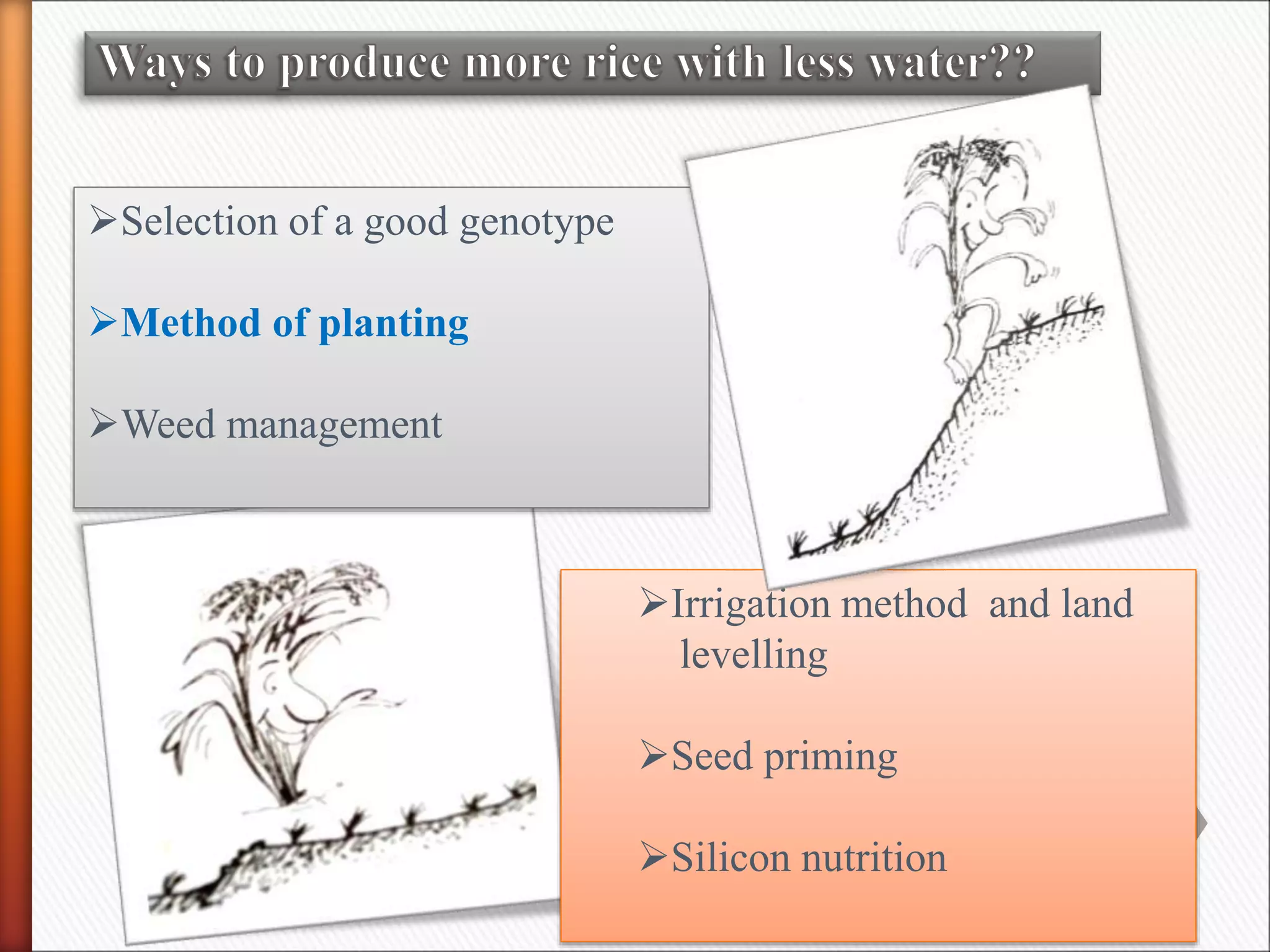
Selection of a good genotype
Method of planting
Weed management
Irrigation method and land
levelling
Seed priming
Silicon nutrition
 Low land rice
 Aerobic rice
 System of rice Intensification (SRI)
 Alternate wetting and drying (AWD)
 Direct seeded rice
 Deep water rice
 Ground cover rice production system
 Raised bed-saturated soil culture method
 Drip irrigation
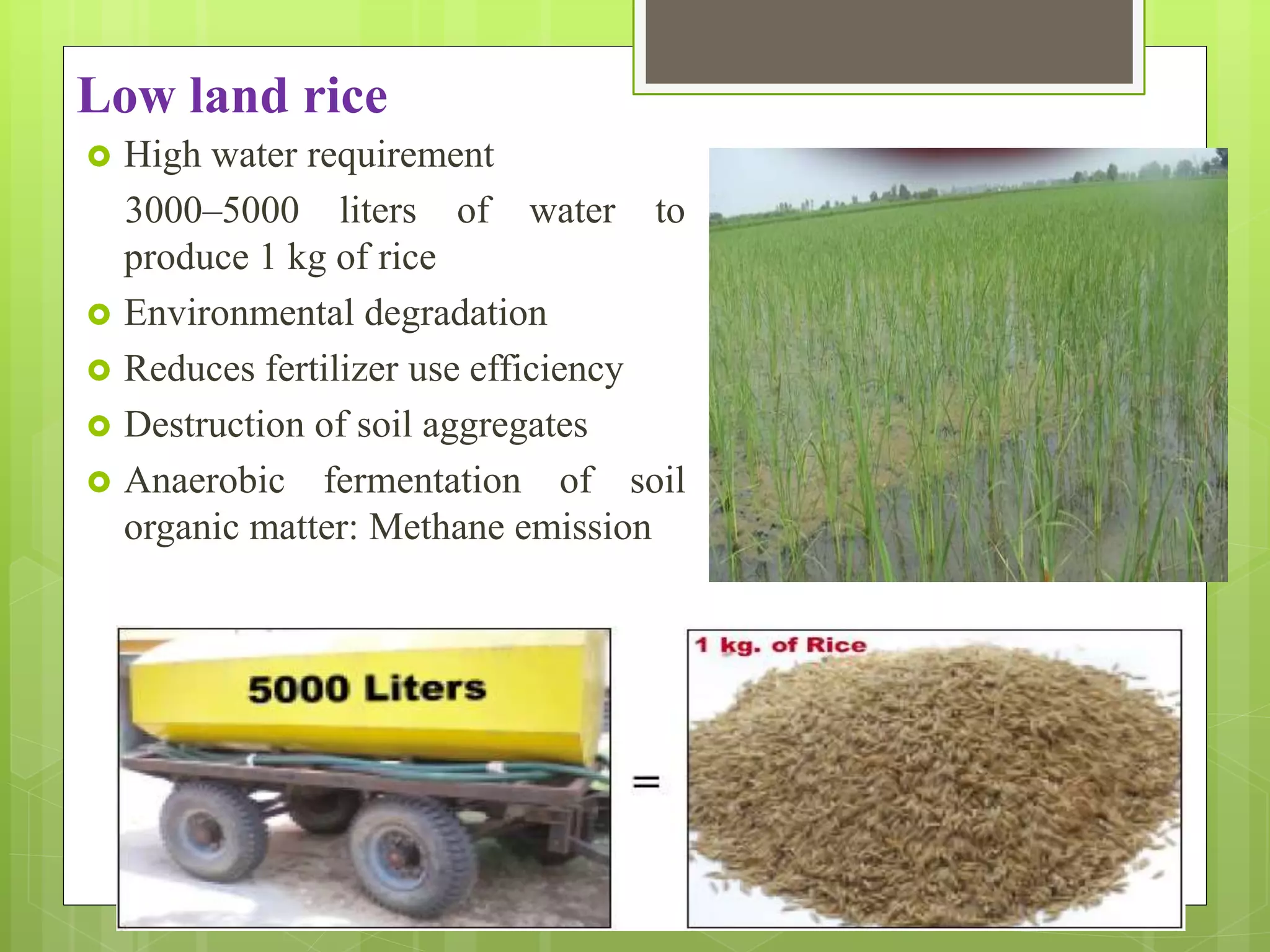
Low land rice
 High water requirement
3000–5000 liters of water to
produce 1 kg of rice
 Environmental degradation
 Reduces fertilizer use efficiency
 Destruction of soil aggregates
 Anaerobic fermentation of soil
organic matter: Methane emission
Ways to improve WUE in conventional
system
 Crack/rat hole ploughing
 Bund lining or reparing breached bunds
 Conoweeding
 Line sowing
 Saturated condition
 Proper land leveling and puddling
 Transplanting young seedlings
Water saving methods
• System of rice Intensification (SRI): 30-40%
• Alternate wetting and drying (AWD): 15-30%
• Aerobic rice: 40-50%
• Direct seeded rice: 75%
• Ground cover rice production system: 50-60%
SYSTEM OF RICE INTENSIFICATION (SRI)
METHOD
• SRI was developed in Madagascar in the early-1980s by Father
Henri de Laulanie
• Formal experimentation started in India 2002-2003
Core principles of SRI
< seed- one seed revolution
< water- Rice is not an aquatic plant
8-12 day old seedlings
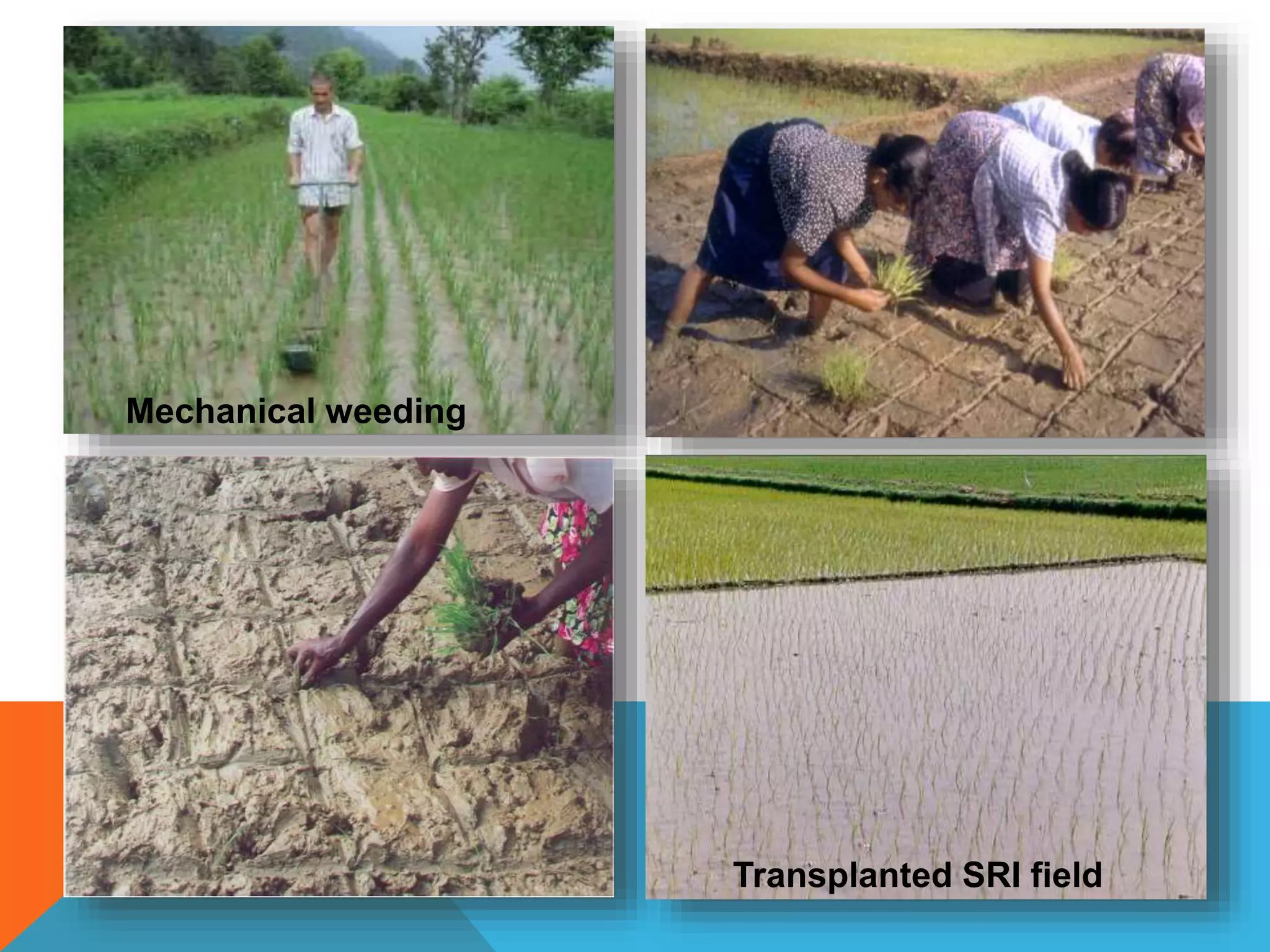
Mechanical weeding
Square planting
Organic source of nutrients
“SRI cuts the water required for irrigated rice by 25-50%. The
combination of water reduction together with other SRI practices
can increase paddy yields by 50-100%”
Norman Uphoff
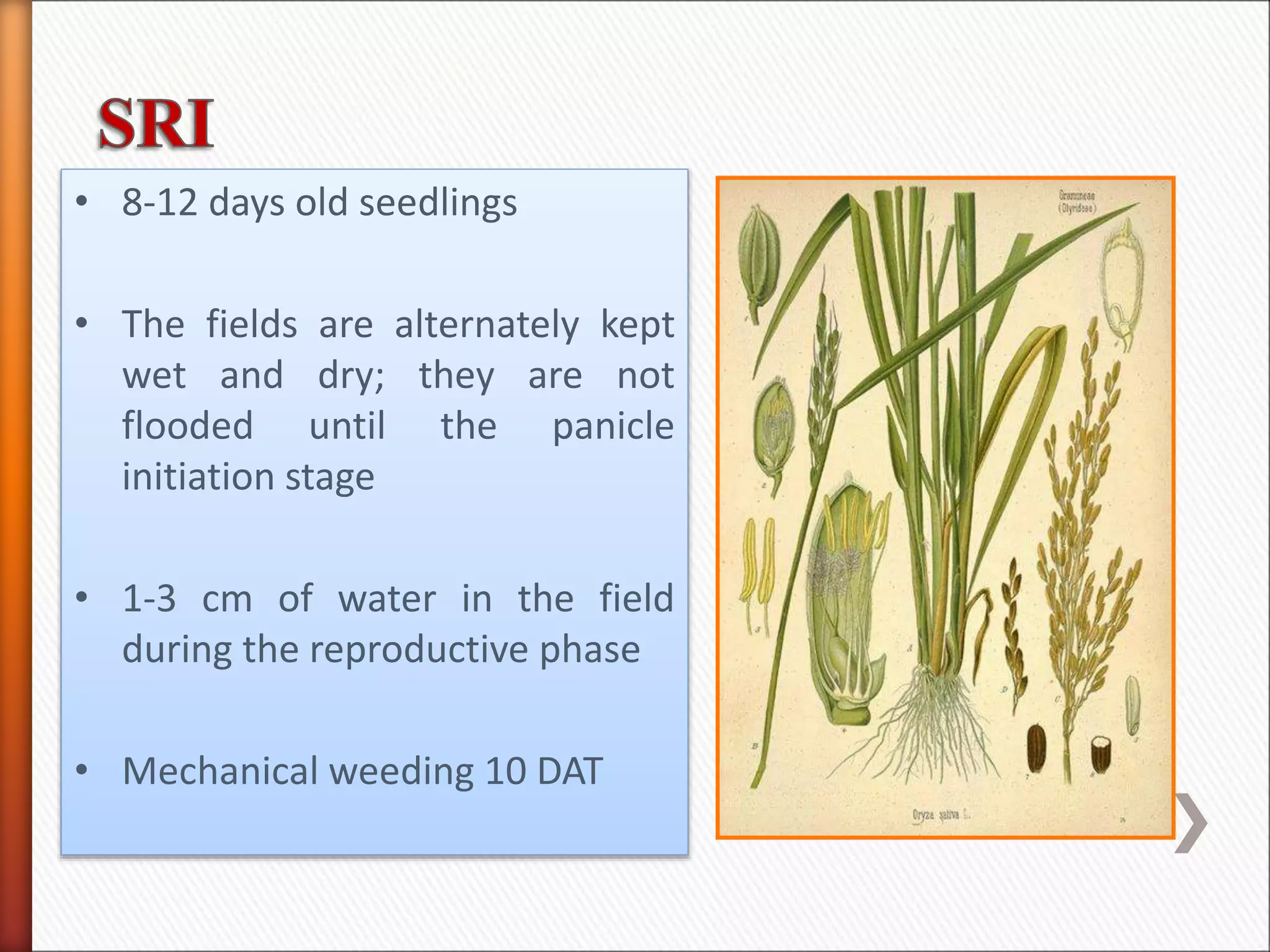
• 8-12 days old seedlings
• The fields are alternately kept
wet and dry; they are not
flooded until the panicle
initiation stage
• 1-3 cm of water in the field
during the reproductive phase
• Mechanical weeding 10 DAT
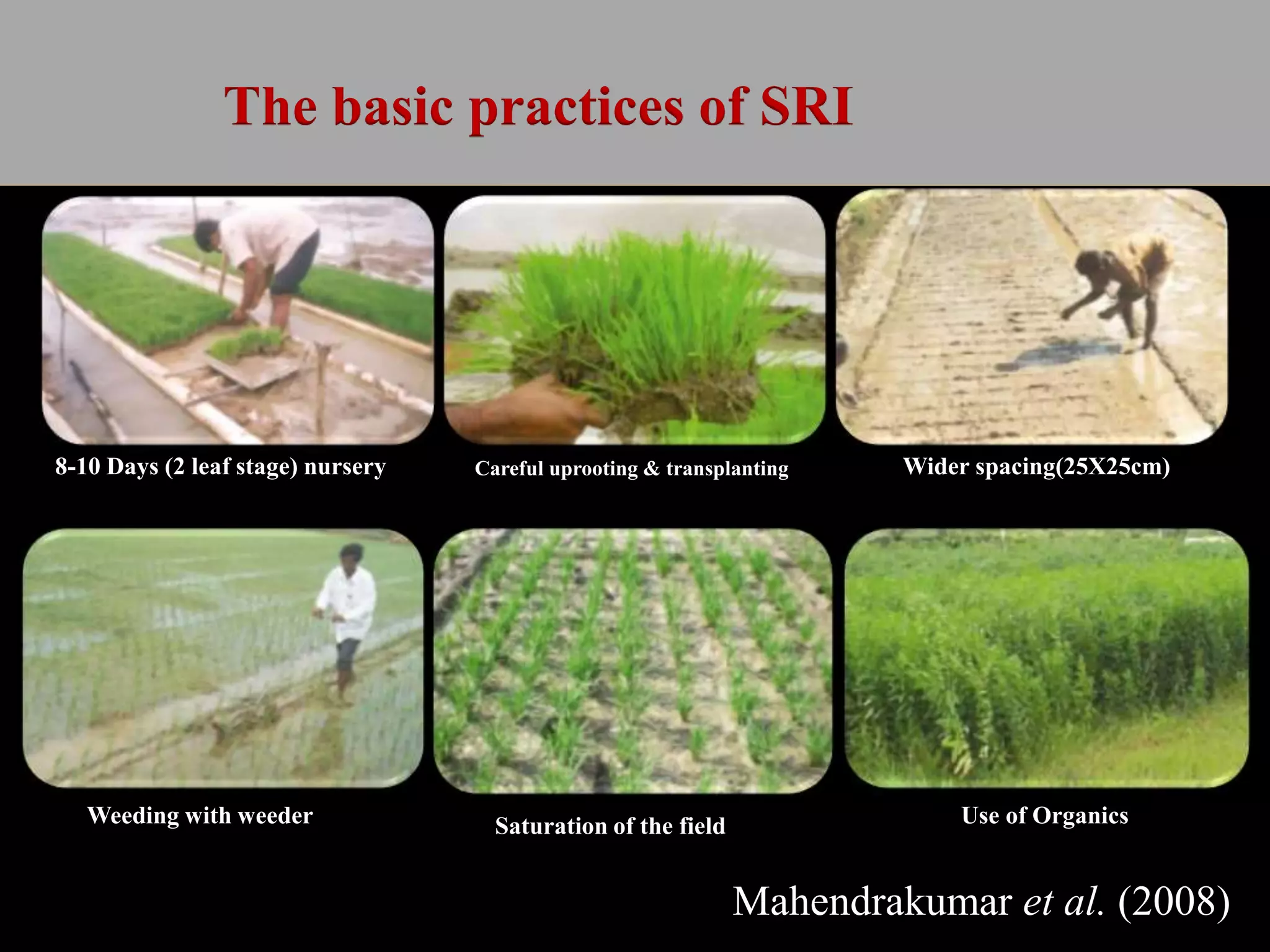
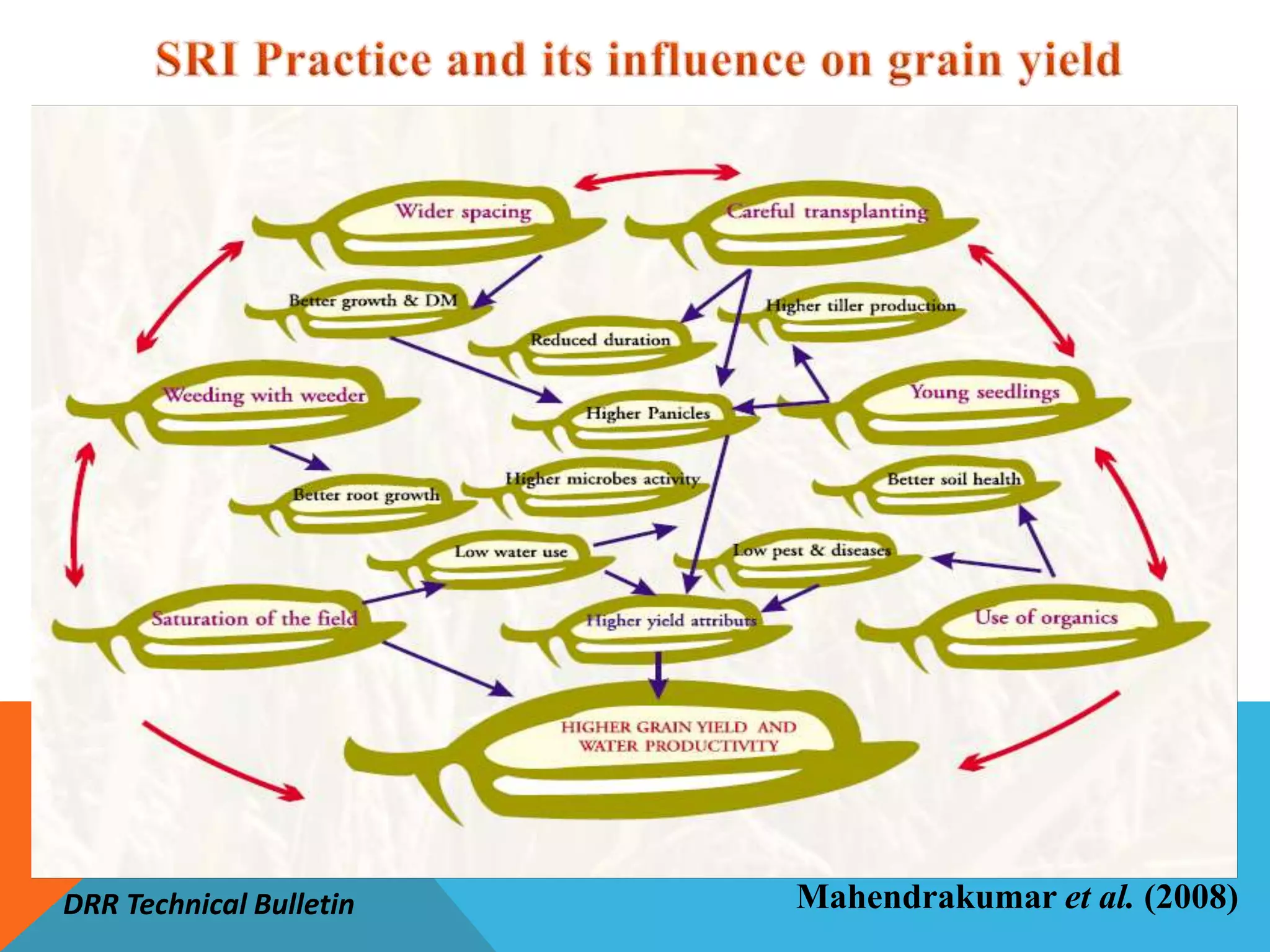
8-10 Days (2 leaf stage) nursery Careful uprooting & transplanting Wider spacing(25X25cm)
Weeding with weeder Saturation of the field Use of Organics
Mahendrakumar et al. (2008)
The basic practices of SRI
Mechanical weeding
Transplanted SRI field
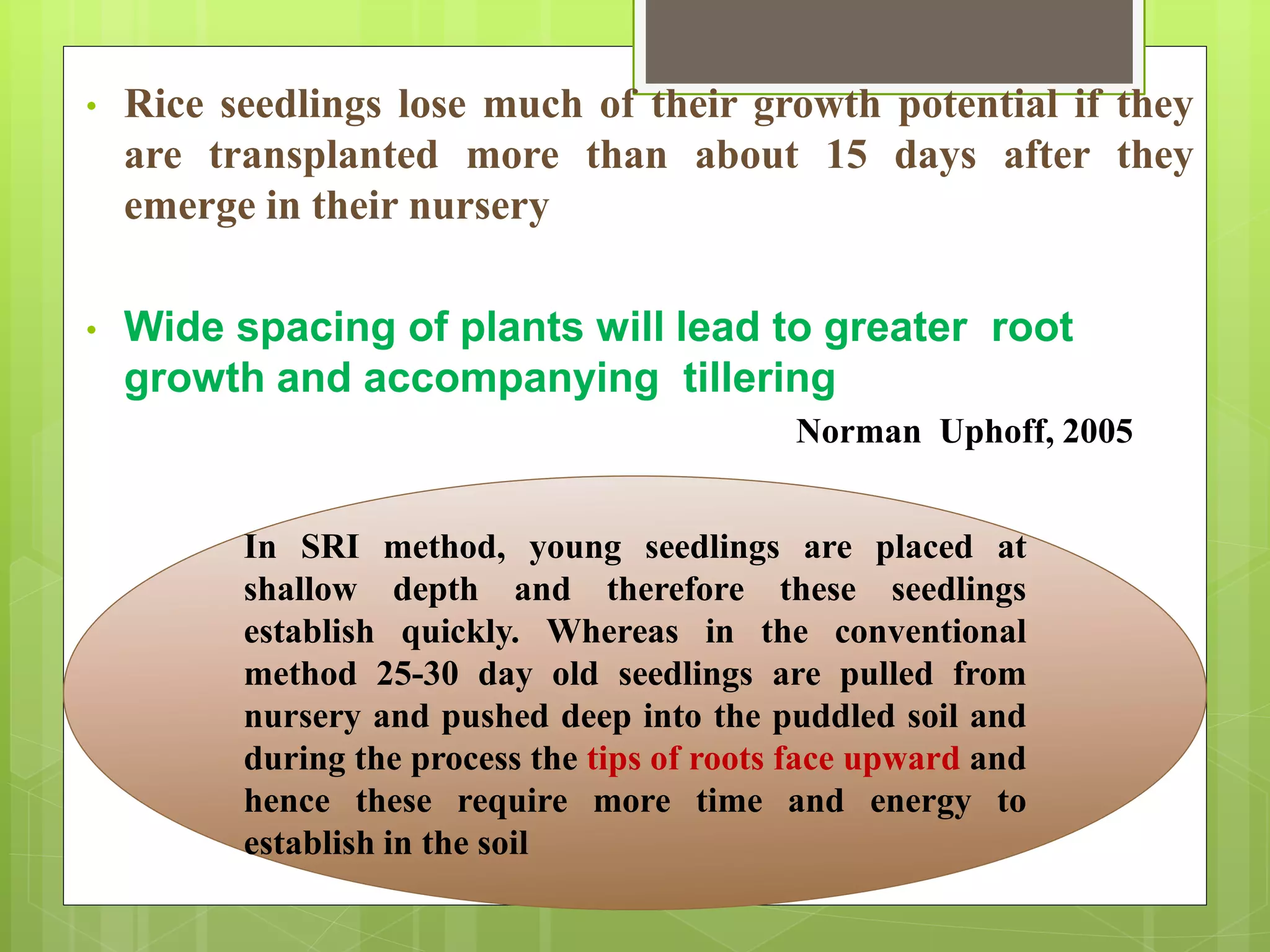
• Rice seedlings lose much of their growth potential if they
are transplanted more than about 15 days after they
emerge in their nursery
• Wide spacing of plants will lead to greater root
growth and accompanying tillering
In SRI method, young seedlings are placed at
shallow depth and therefore these seedlings
establish quickly. Whereas in the conventional
method 25-30 day old seedlings are pulled from
nursery and pushed deep into the puddled soil and
during the process the tips of roots face upward and
hence these require more time and energy to
establish in the soil
Norman Uphoff, 2005
Mahendrakumar et al. (2008)
DRR Technical Bulletin
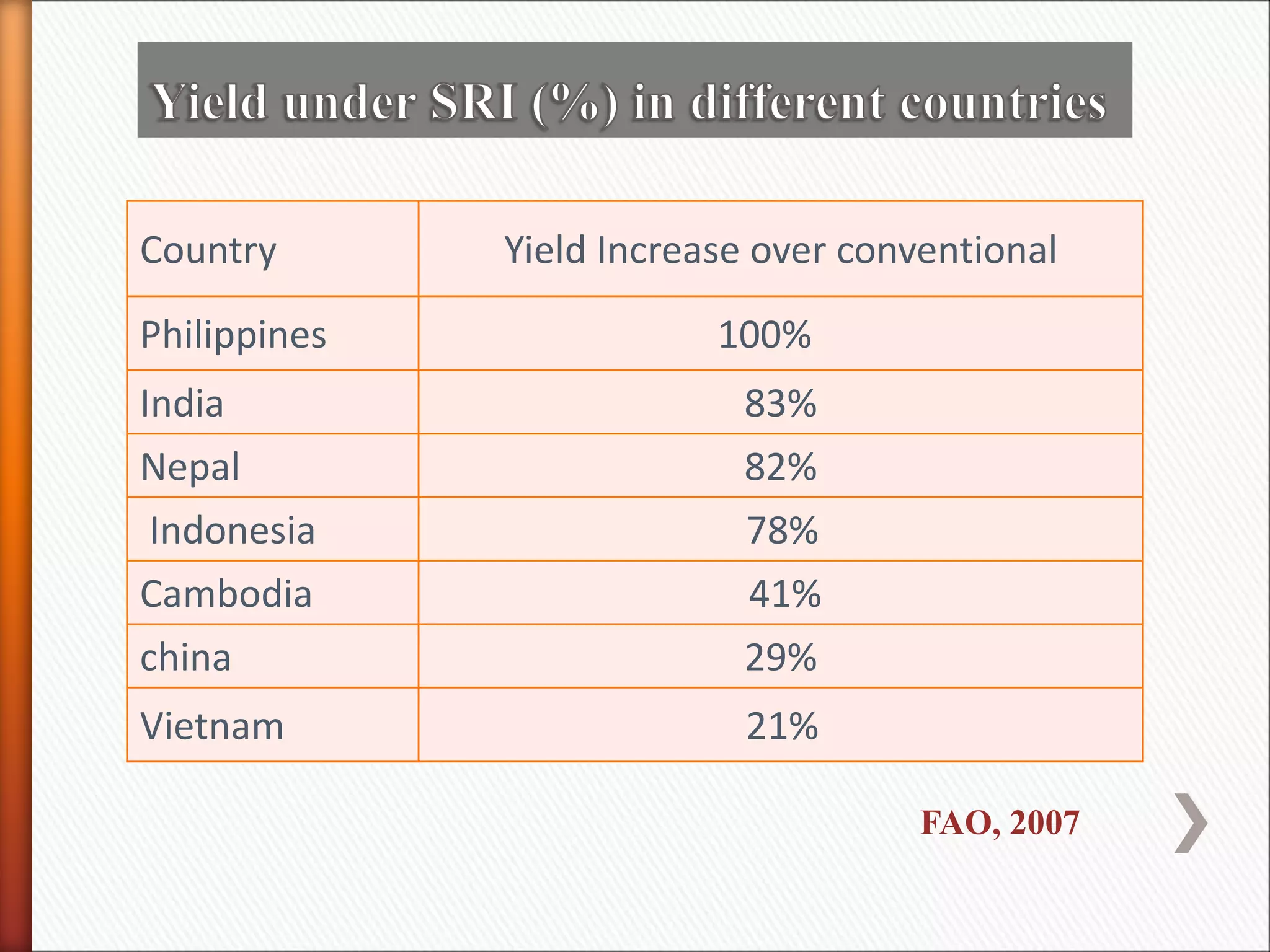
Country Yield Increase over conventional
Philippines 100%
India 83%
Nepal 82%
Indonesia 78%
Cambodia 41%
china 29%
Vietnam 21%
FAO, 2007
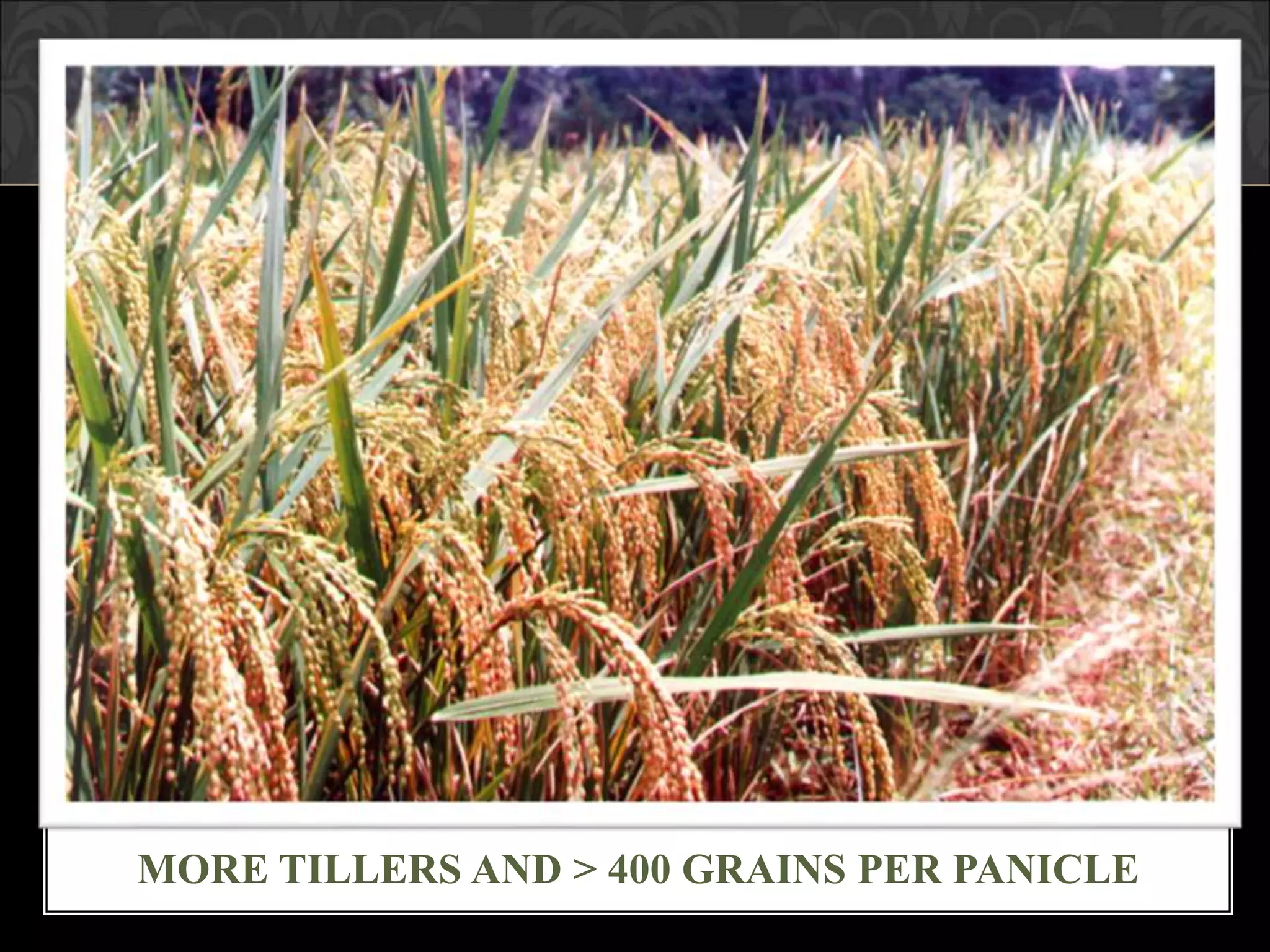
MORE TILLERS AND > 400 GRAINS PER PANICLE
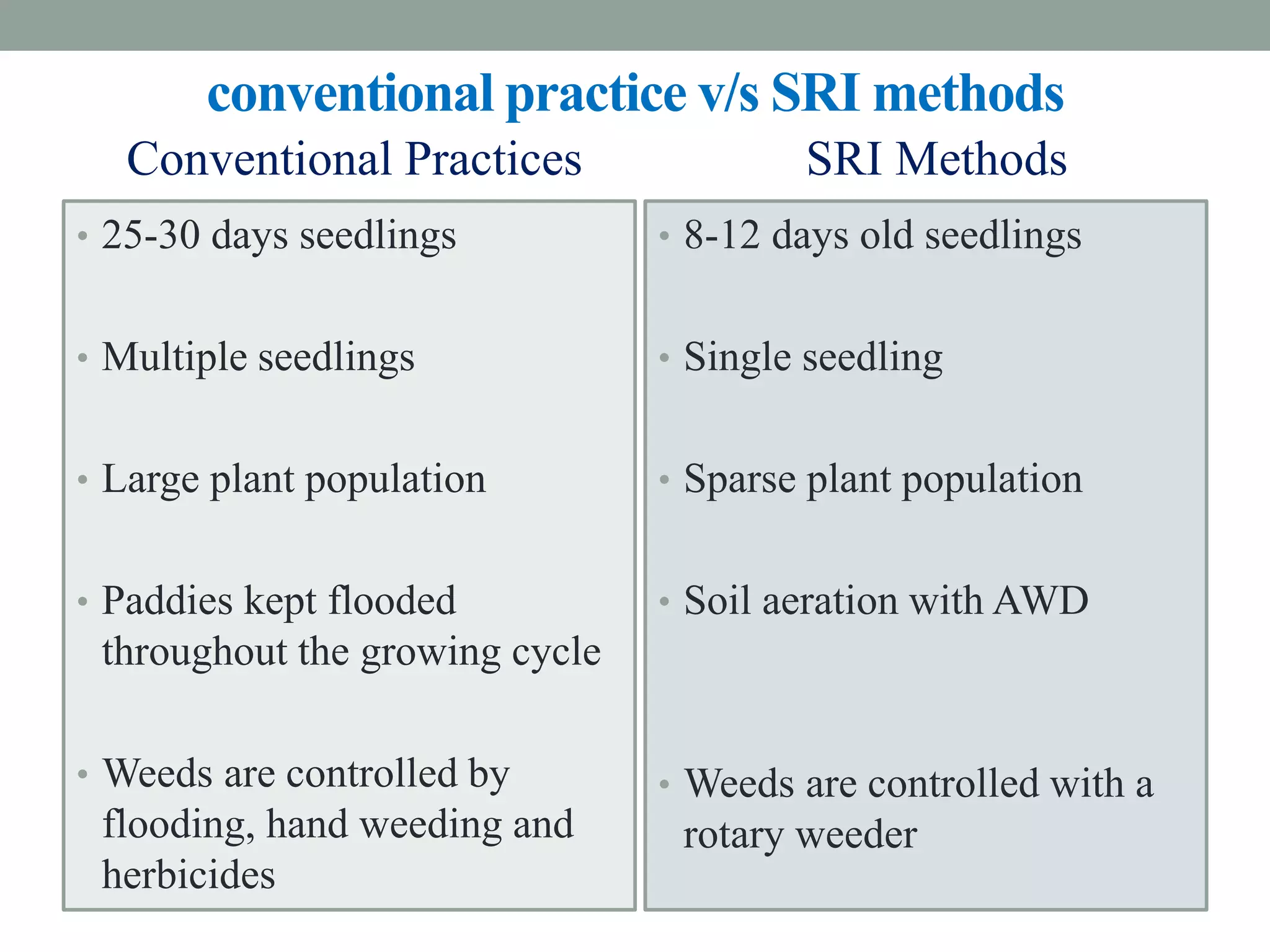
conventional practice v/s SRI methods
Conventional Practices
• 25-30 days seedlings
• Multiple seedlings
• Large plant population
• Paddies kept flooded
throughout the growing cycle
• Weeds are controlled by
flooding, hand weeding and
herbicides
SRI Methods
• 8-12 days old seedlings
• Single seedling
• Sparse plant population
• Soil aeration with AWD
• Weeds are controlled with a
rotary weeder
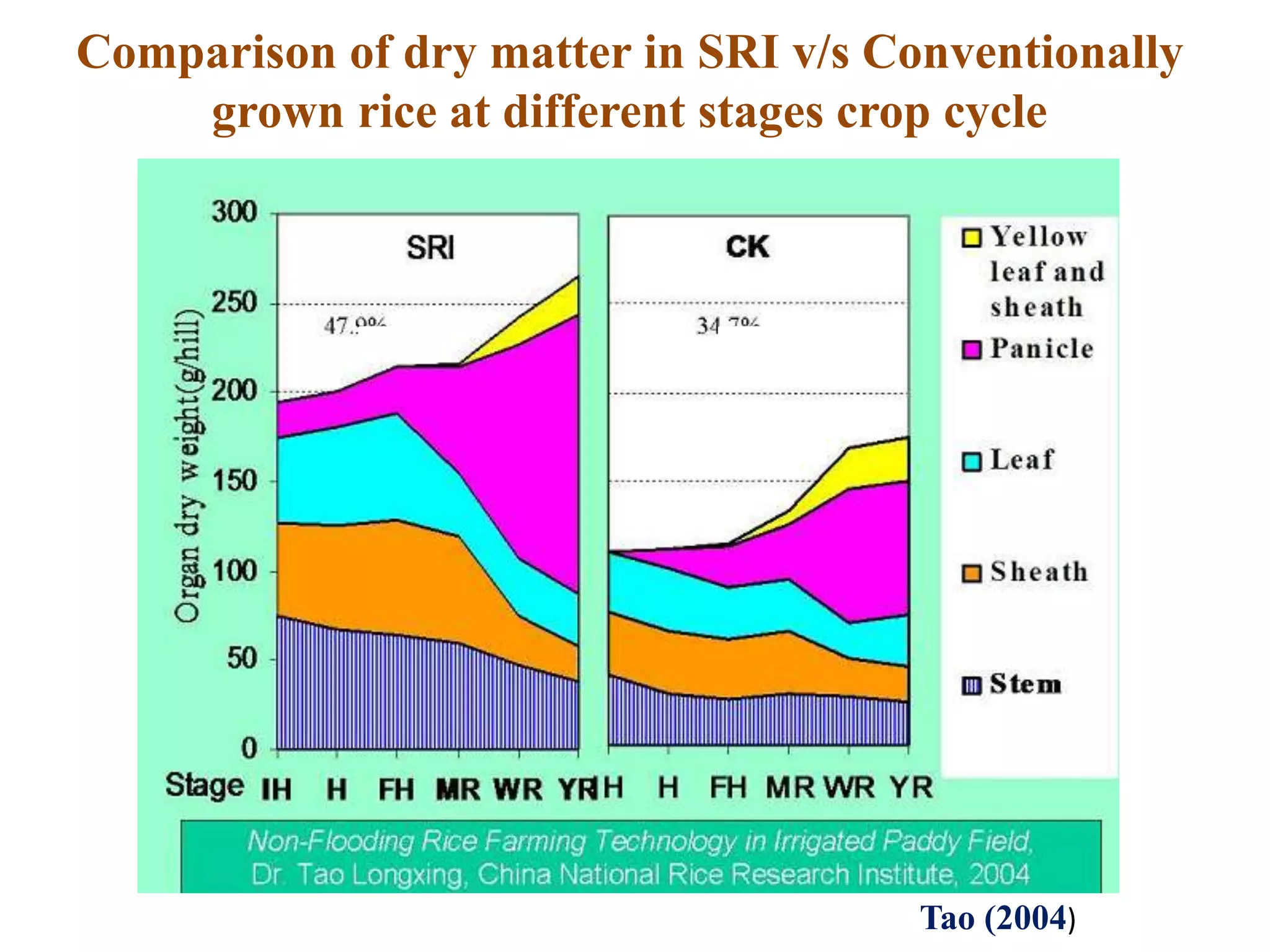
Comparison of dry matter in SRI v/s Conventionally
grown rice at different stages crop cycle
Tao (2004)
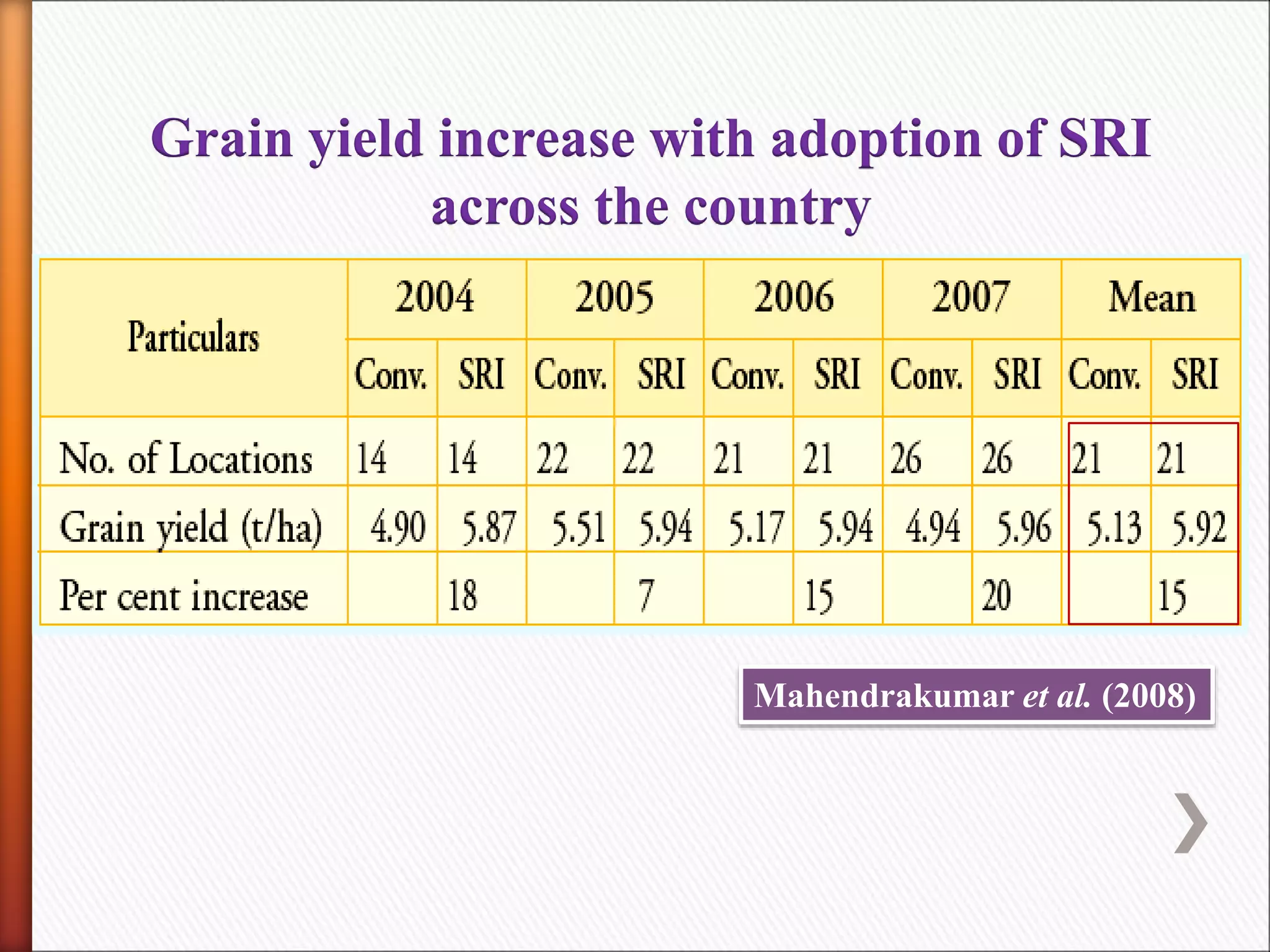
Grain yield increase with adoption of SRI
across the country
Mahendrakumar et al. (2008)
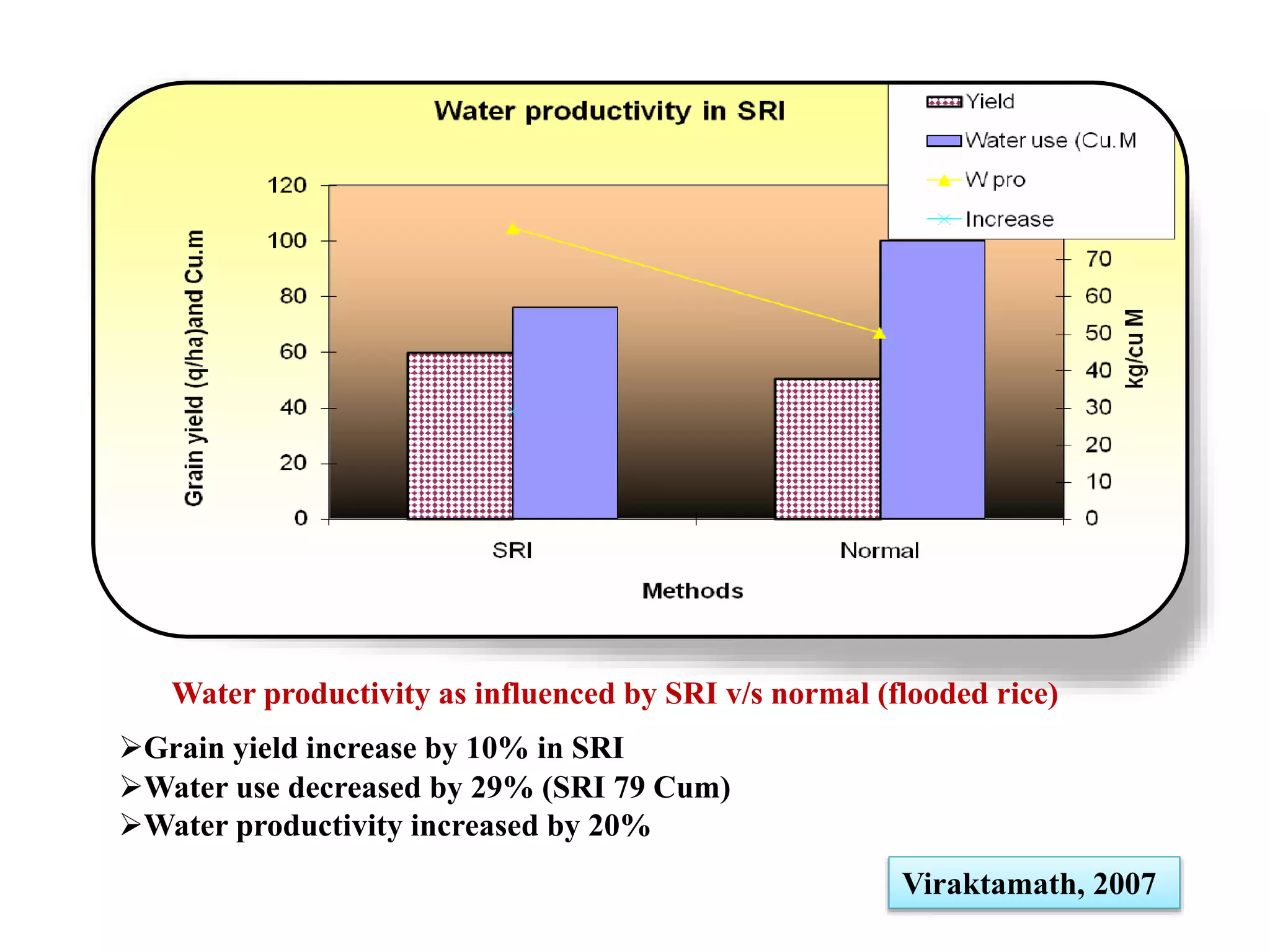
Water productivity as influenced by SRI v/s normal (flooded rice)
Water use decreased by 29% (SRI 79 Cum)
Water productivity increased by 20%
Viraktamath, 2007
Grain yield increase by 10% in SRI
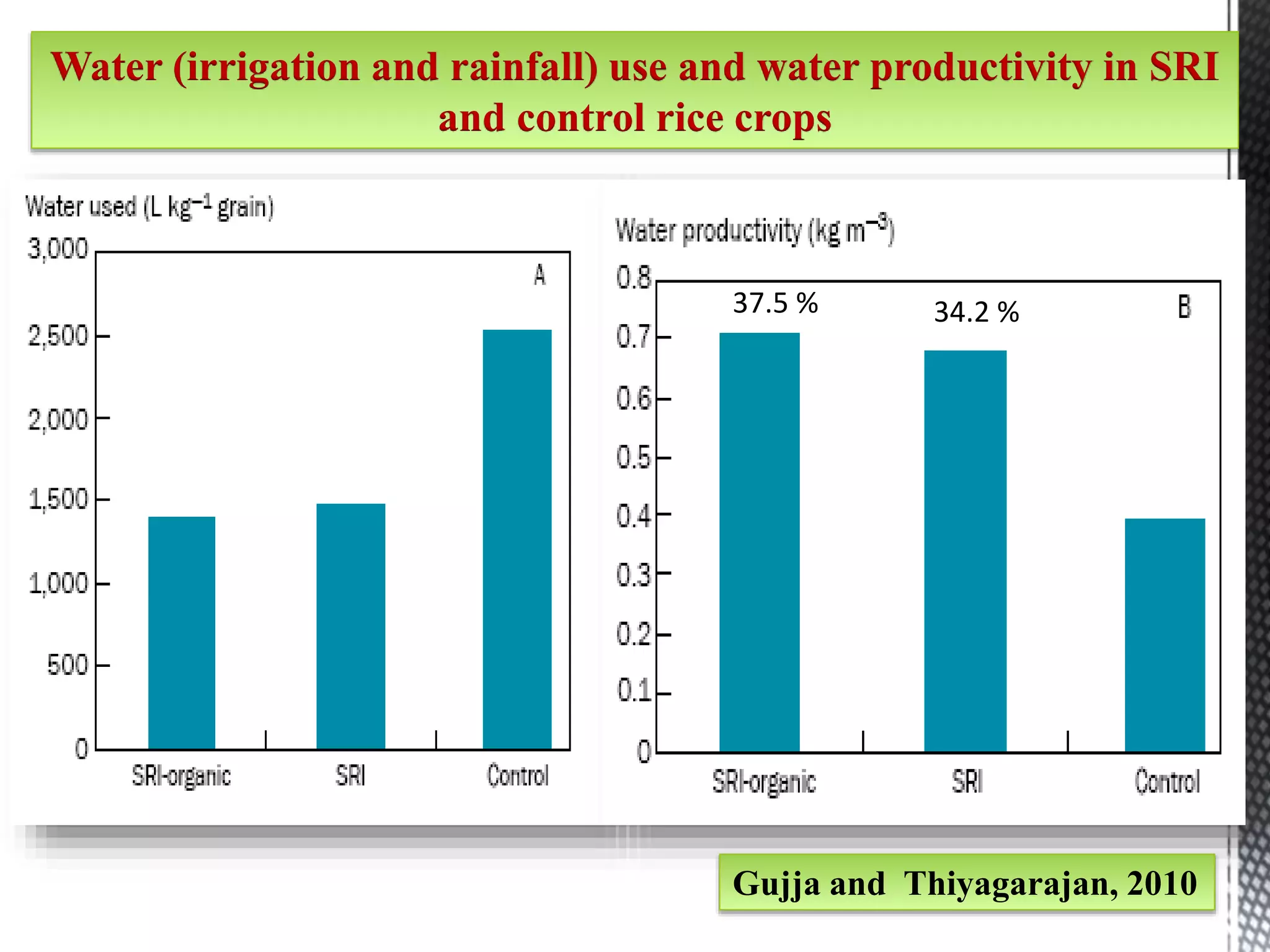
Water (irrigation and rainfall) use and water productivity in SRI
and control rice crops
Gujja and Thiyagarajan, 2010
37.5 % 34.2 %
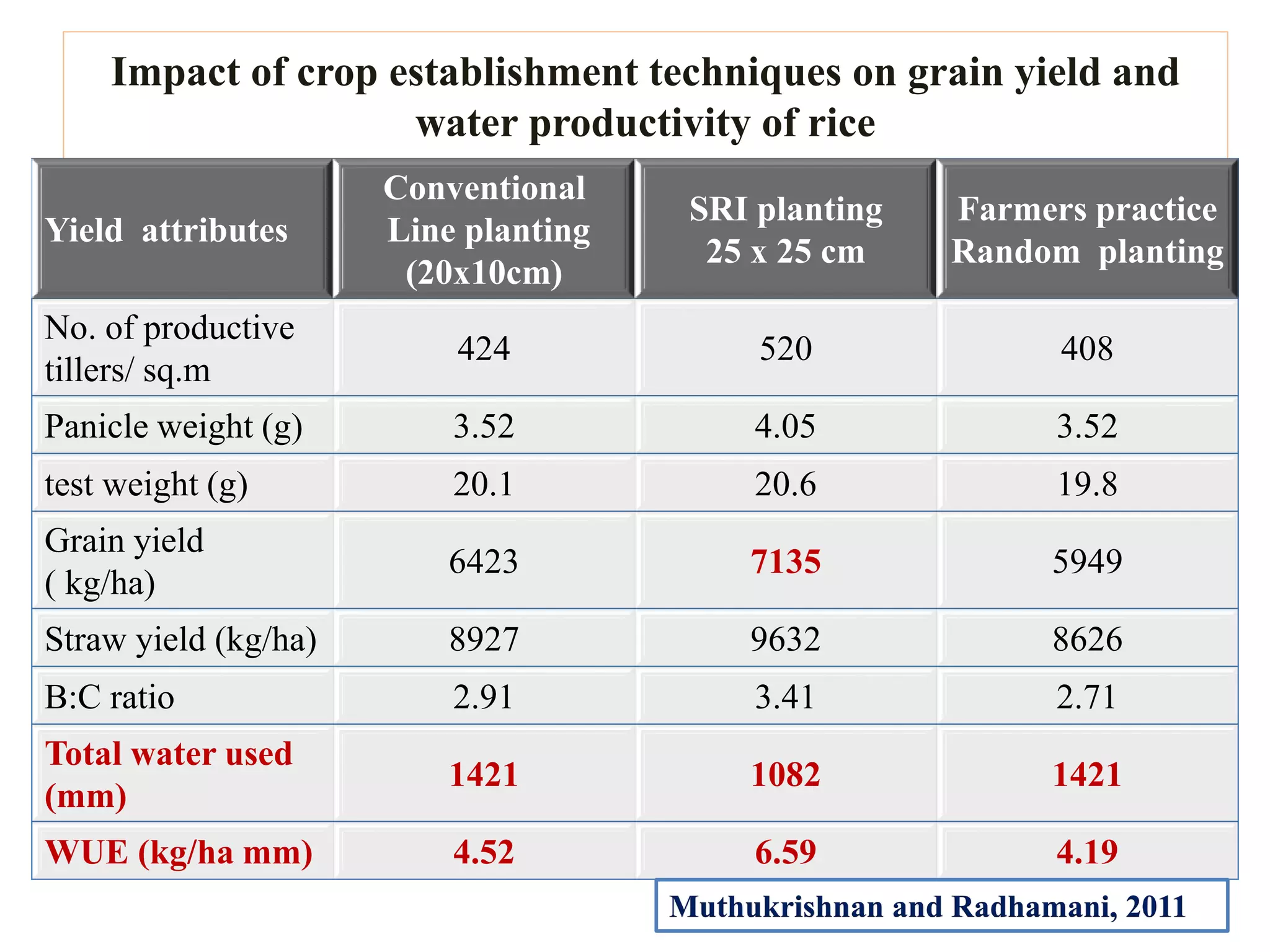
Impact of crop establishment techniques on grain yield and
water productivity of rice
Yield attributes
Conventional
Line planting
(20x10cm)
SRI planting
25 x 25 cm
Farmers practice
Random planting
No. of productive
tillers/ sq.m
424 520 408
Panicle weight (g) 3.52 4.05 3.52
test weight (g) 20.1 20.6 19.8
Grain yield
( kg/ha)
6423 7135 5949
Straw yield (kg/ha) 8927 9632 8626
B:C ratio 2.91 3.41 2.71
Total water used
(mm)
1421 1082 1421
WUE (kg/ha mm) 4.52 6.59 4.19
Muthukrishnan and Radhamani, 2011
Treatment
No. of
tillers/plant
No. of
productive
tiller/plant
Days to
flowering
Seed yield
(t/ha)
Benefit:
cost ratio
germination
Methods of cultivation (C)
C1–SRI 32.40 29.13 102.70 4.07 1.44 98.1
C2-traditional 15.92 8.14 106.70 3.68 1.14 97.3
Sem+ 0.01 1.34 0.40 0.20 0.05 0.5
C.D. @ 5% 0.06 8.15 2.40 0.06 0.15 NS
Spacings (S)
S1- 20x20 15.88 14.84 101.1 2.82 1.21 97.9
S2-30x30 28.33 32.55 101.6 3.41 1.47 97.6
S3-40x40 24.43 29.51 102.0 3.28 1.41 97.6
S.Em.+ 1.10 0.16 0.1 0.10 0.08 0.2
C.D. @ 5% 3.30 0.48 NS 0.33 0.23 NS
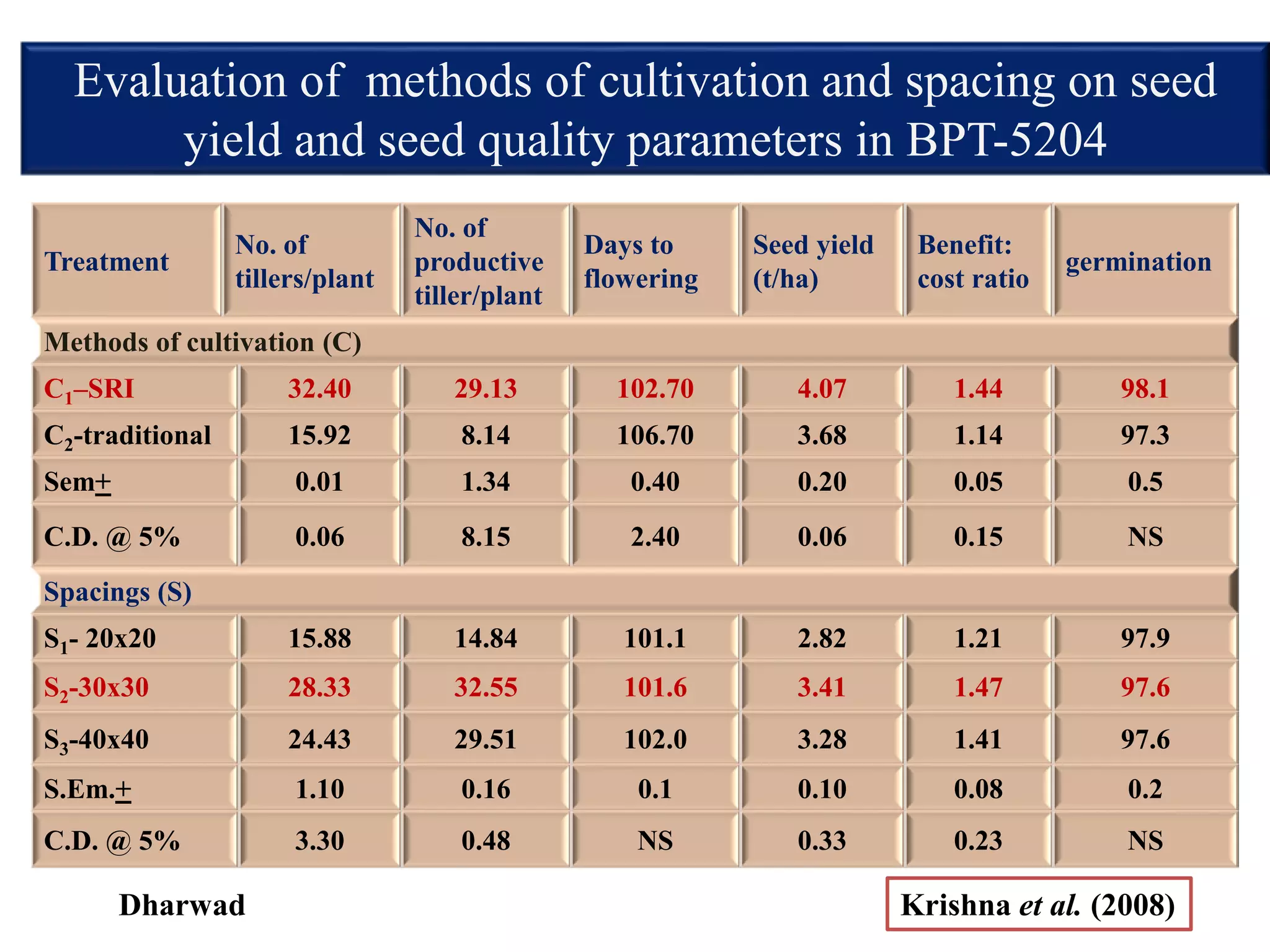
Evaluation of methods of cultivation and spacing on seed
yield and seed quality parameters in BPT-5204
Krishna et al. (2008)
Dharwad
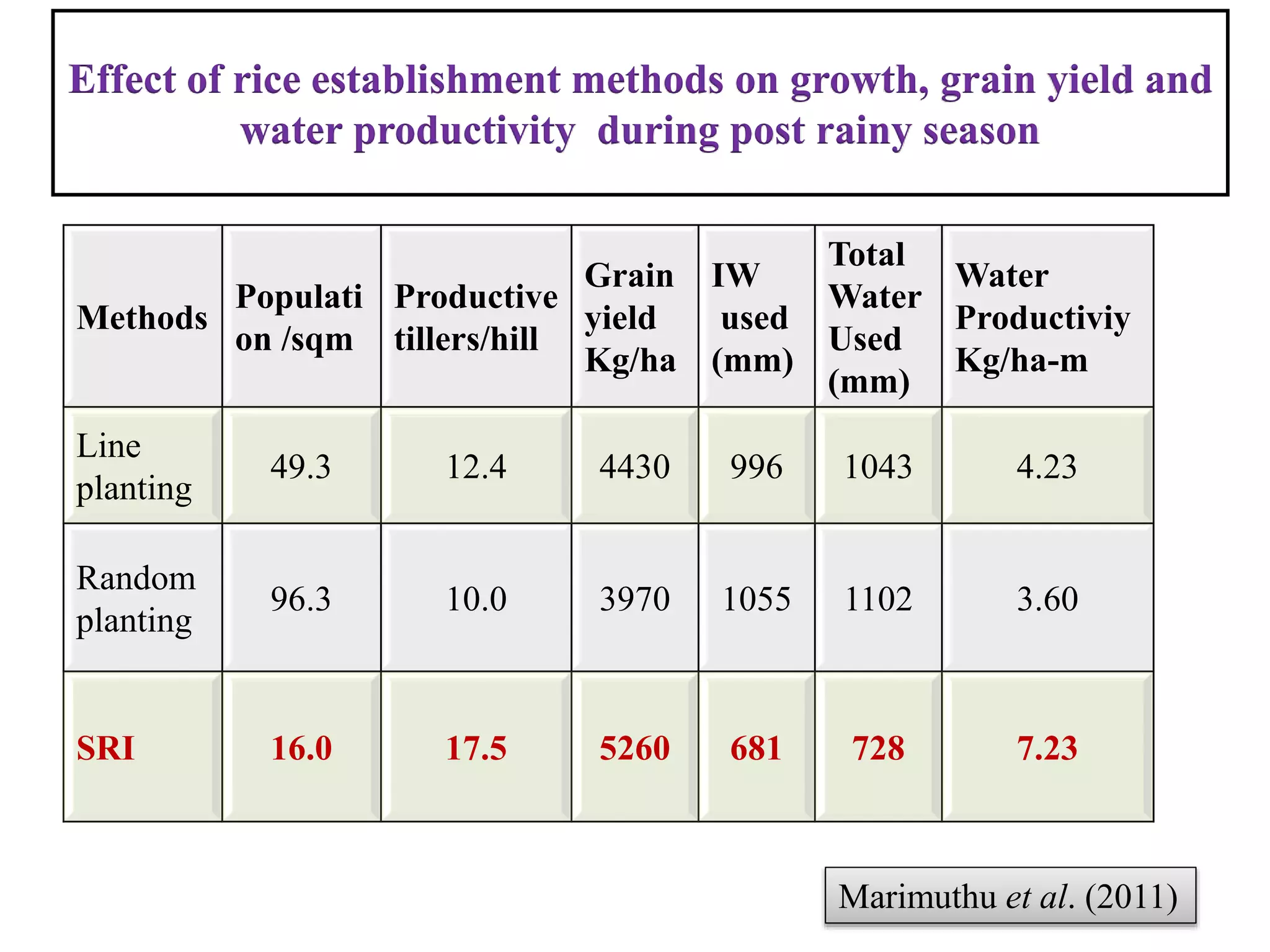
Effect of rice establishment methods on growth, grain yield and
water productivity during post rainy season
Methods
Populati
on /sqm
Productive
tillers/hill
Grain
yield
Kg/ha
IW
used
(mm)
Total
Water
Used
(mm)
Water
Productiviy
Kg/ha-m
Line
planting
49.3 12.4 4430 996 1043 4.23
Random
planting
96.3 10.0 3970 1055 1102 3.60
SRI 16.0 17.5 5260 681 728 7.23
Marimuthu et al. (2011)
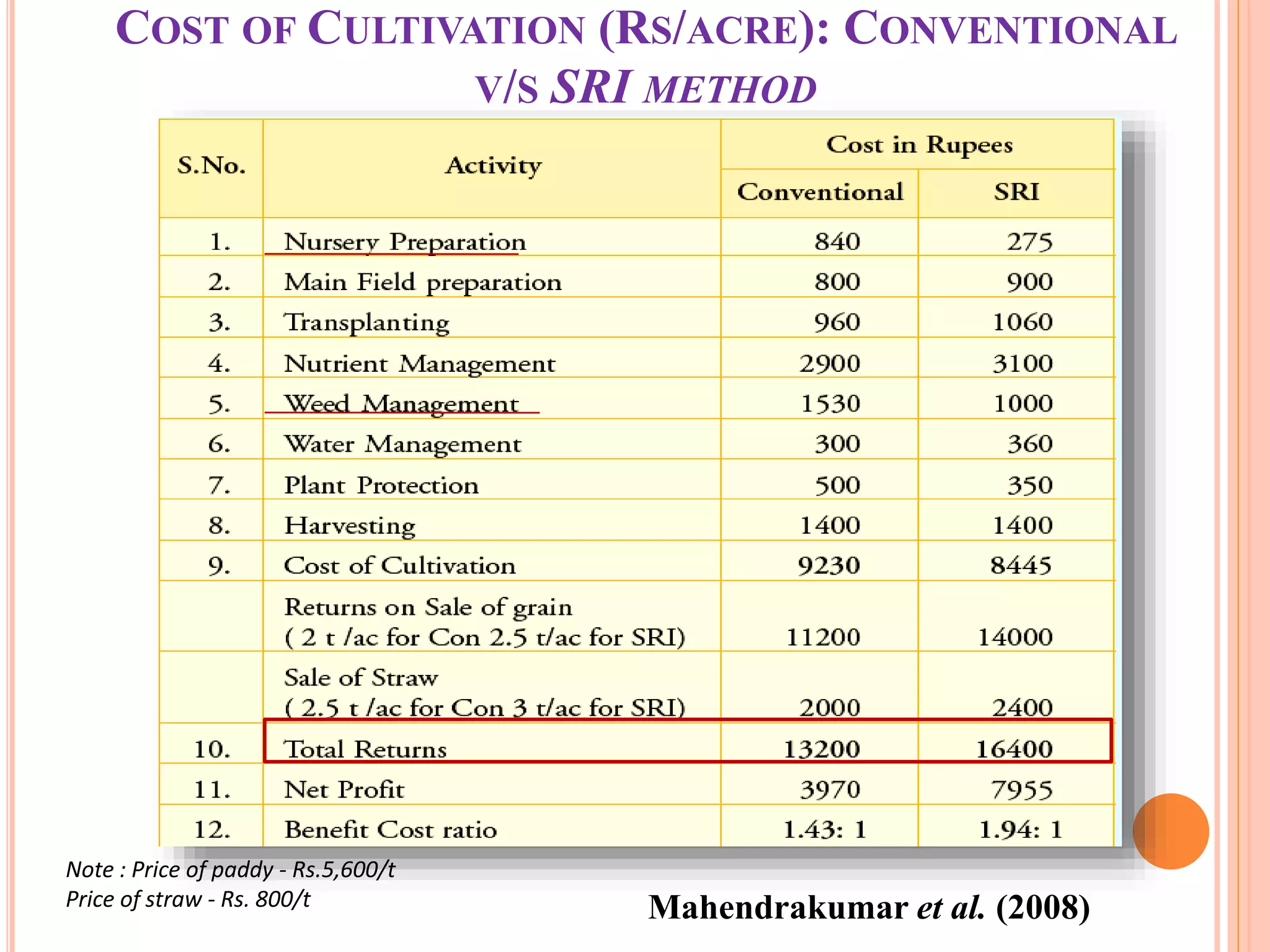
COST OF CULTIVATION (RS/ACRE): CONVENTIONAL
V/S SRI METHOD
Note : Price of paddy - Rs.5,600/t
Price of straw - Rs. 800/t Mahendrakumar et al. (2008)
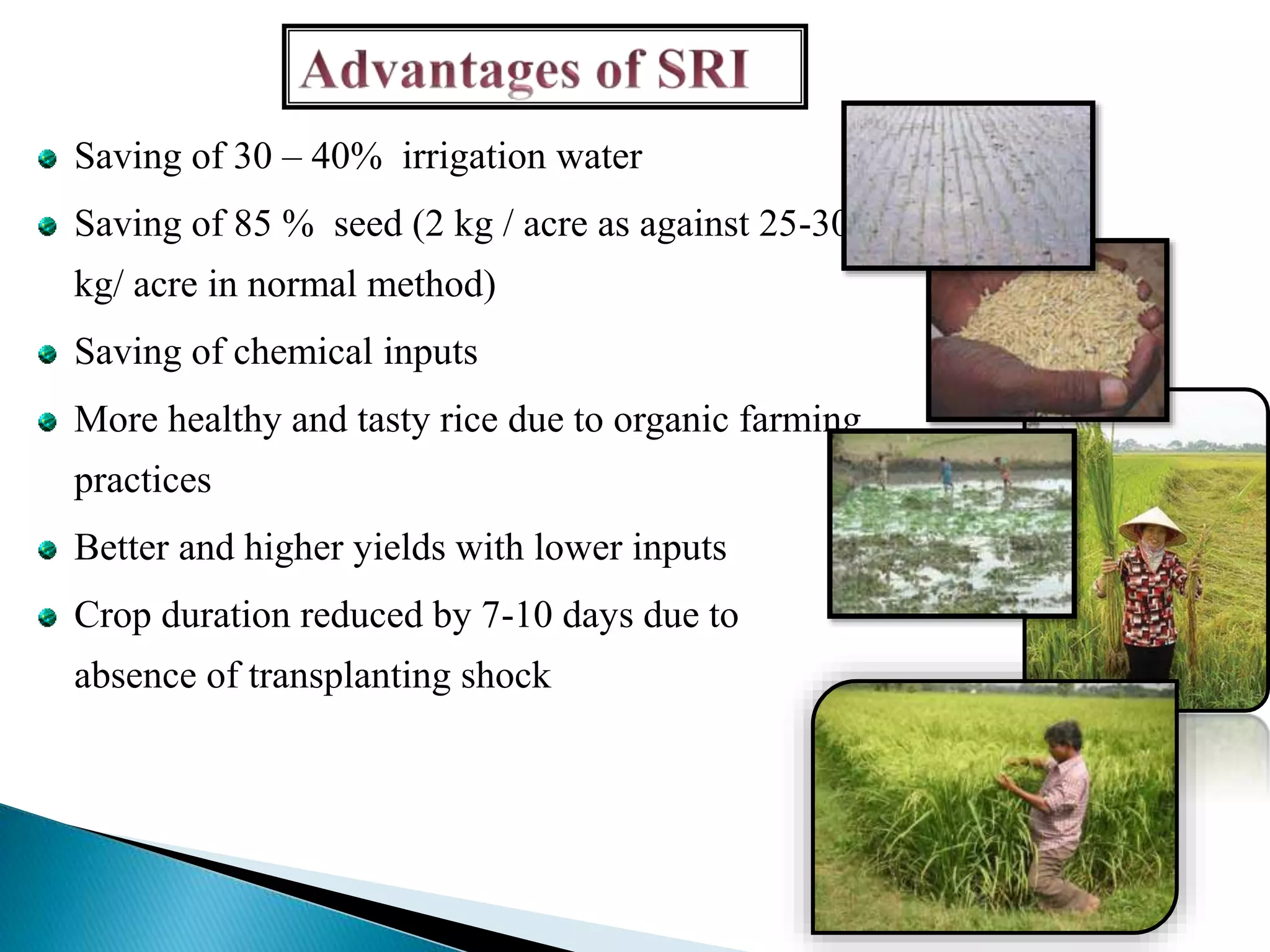
Saving of 30 – 40% irrigation water
Saving of 85 % seed (2 kg / acre as against 25-30
kg/ acre in normal method)
Saving of chemical inputs
More healthy and tasty rice due to organic farming
practices
Better and higher yields with lower inputs
Crop duration reduced by 7-10 days due to
absence of transplanting shock
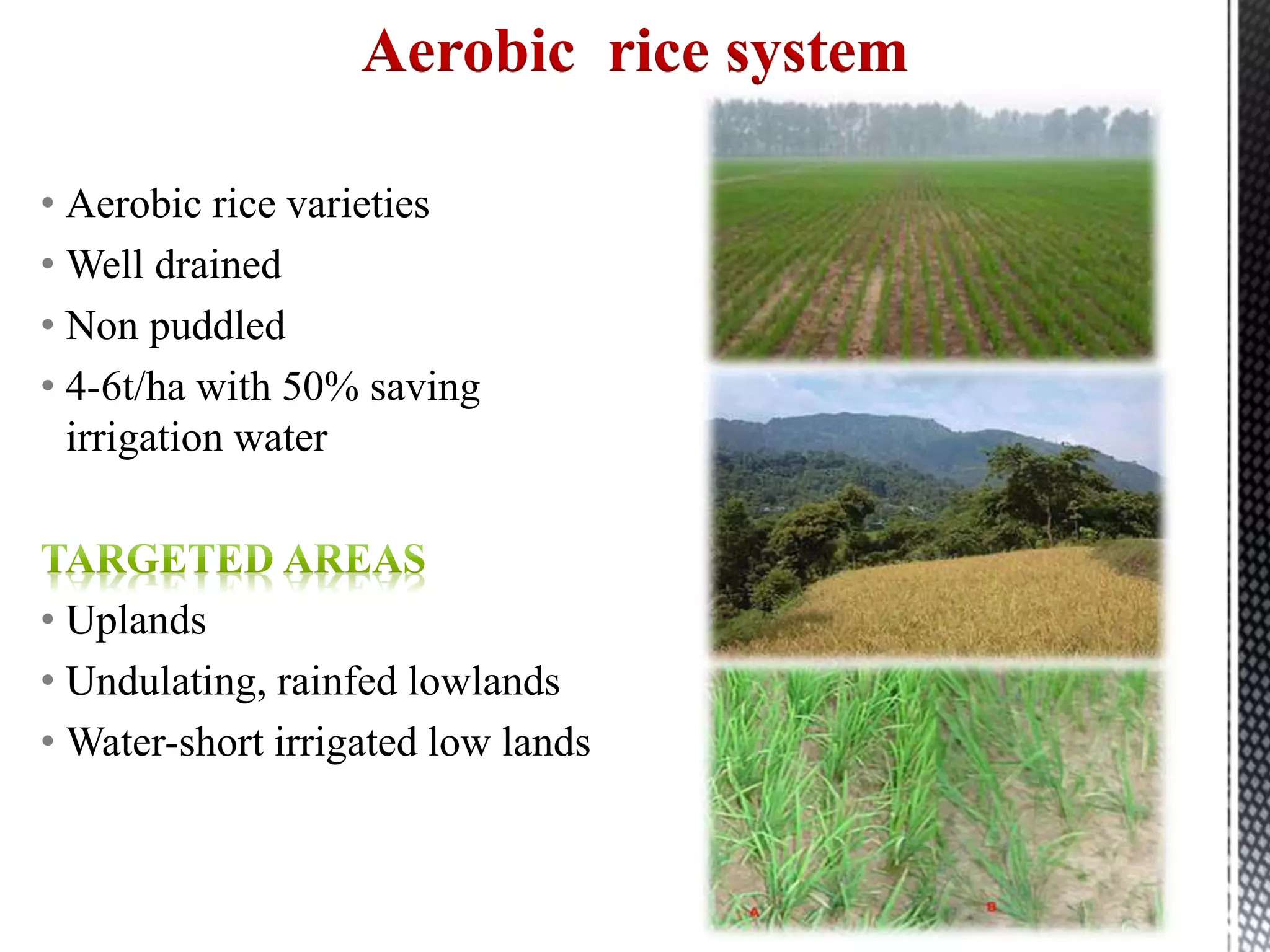
• Aerobic rice varieties
• Well drained
• Non puddled
• 4-6t/ha with 50% saving
irrigation water
• Uplands
• Undulating, rainfed lowlands
• Water-short irrigated low lands
Aerobic rice system
Benefits
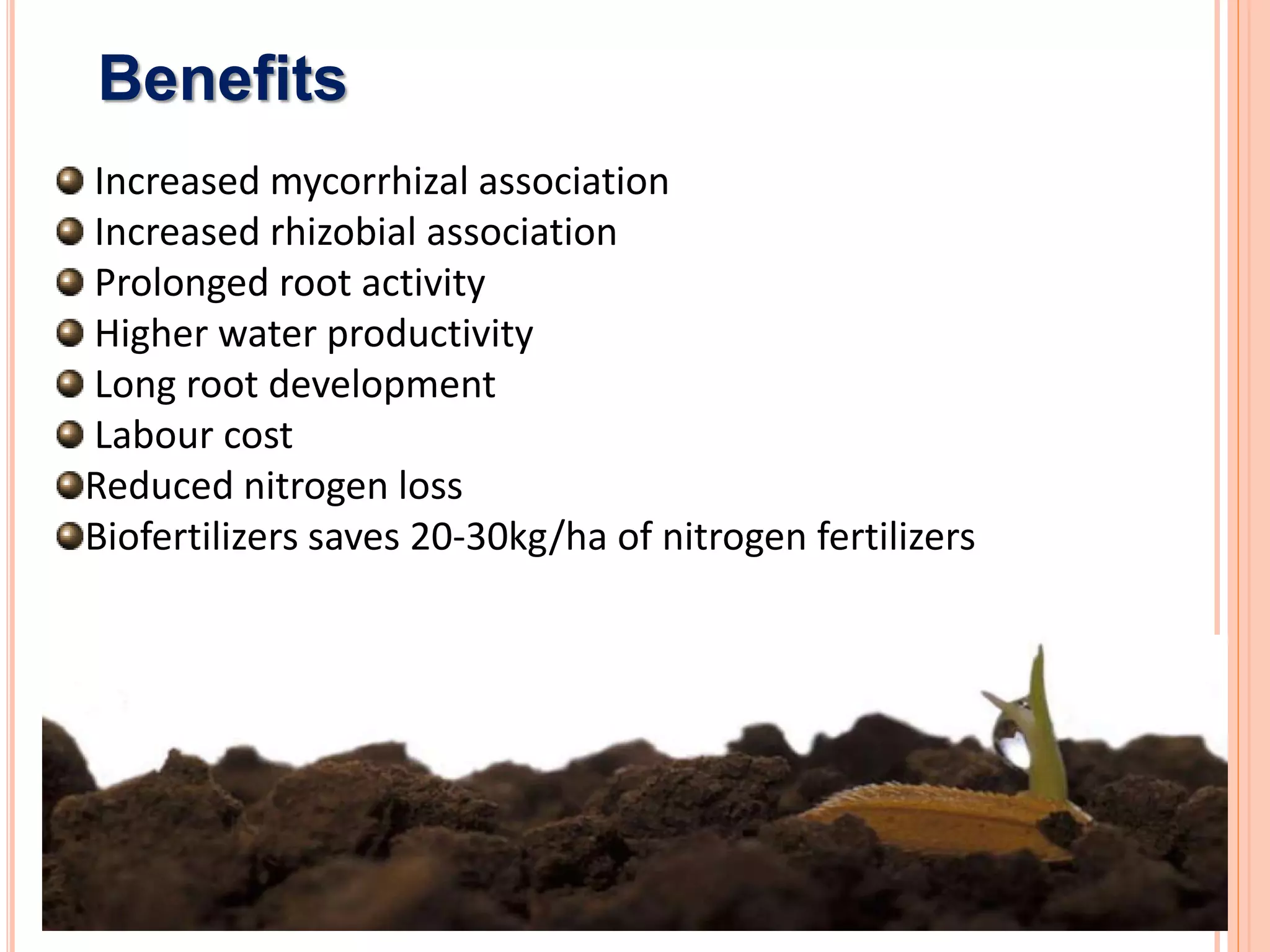
Increased mycorrhizal association
Increased rhizobial association
Prolonged root activity
Higher water productivity
Long root development
Labour cost
Reduced nitrogen loss
Biofertilizers saves 20-30kg/ha of nitrogen fertilizers
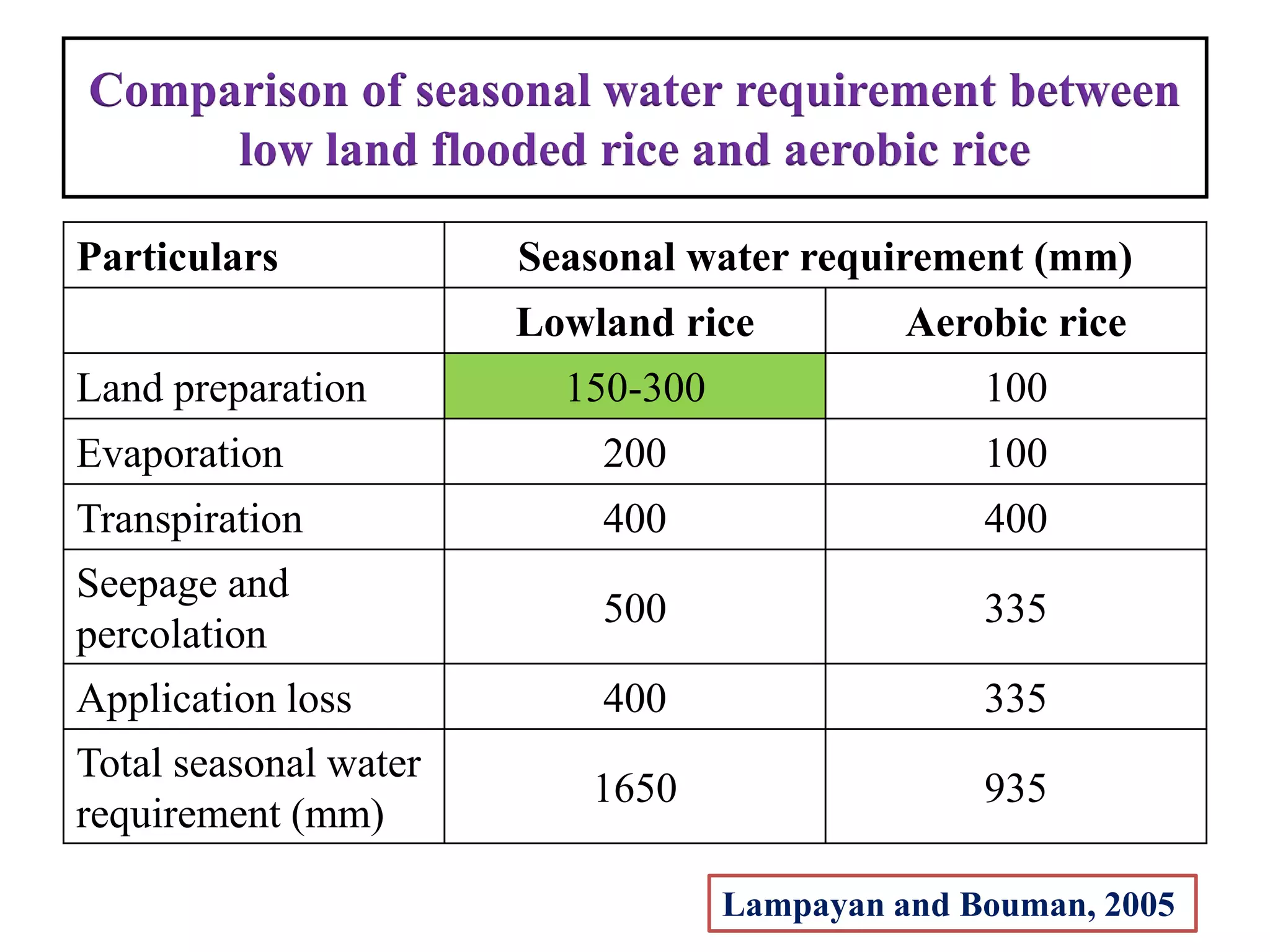
Comparison of seasonal water requirement between
low land flooded rice and aerobic rice
Particulars Seasonal water requirement (mm)
Lowland rice Aerobic rice
Land preparation 150-300 100
Evaporation 200 100
Transpiration 400 400
Seepage and
percolation
500 335
Application loss 400 335
Total seasonal water
requirement (mm)
1650 935
Lampayan and Bouman, 2005
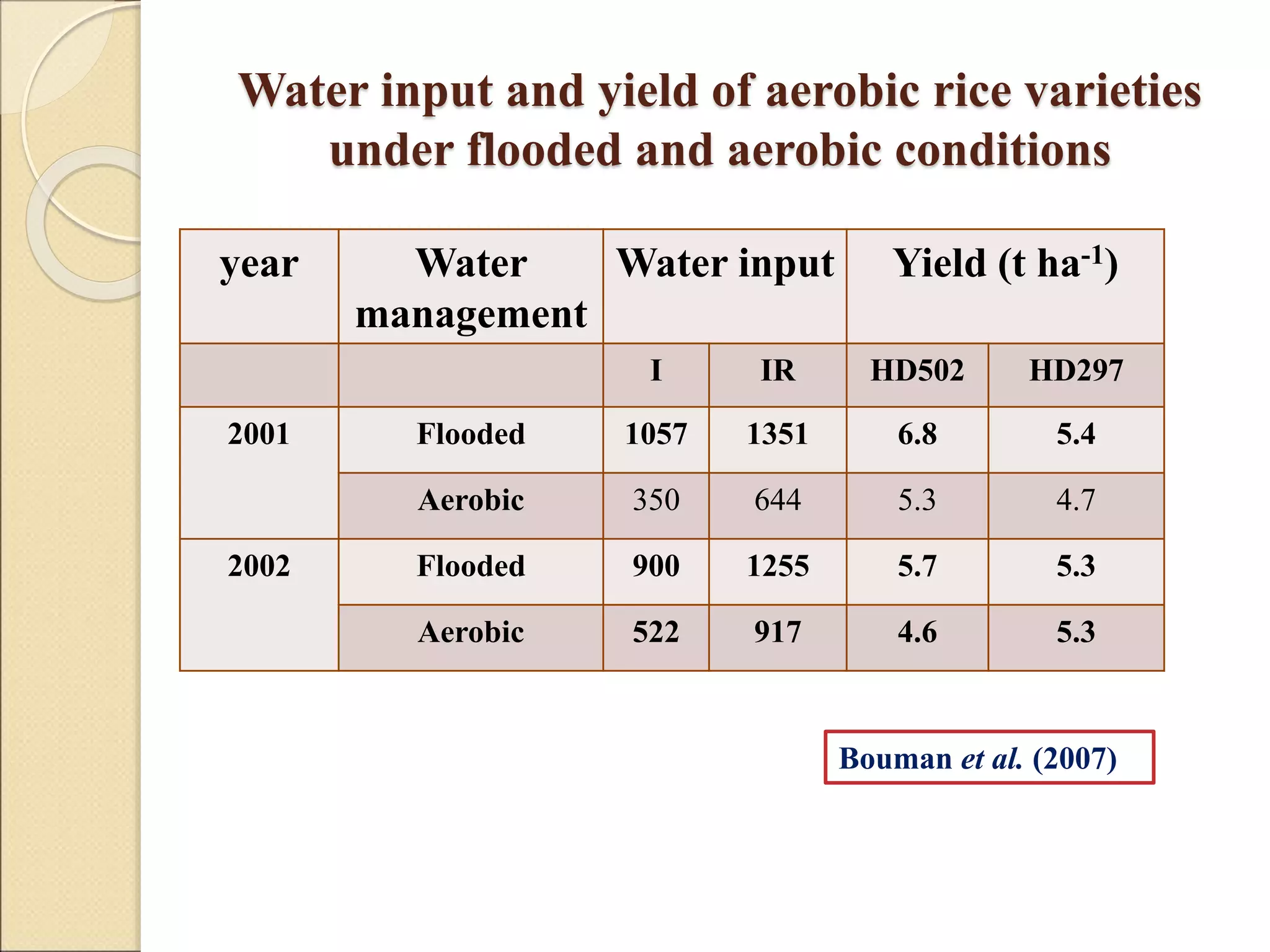
Water input and yield of aerobic rice varieties
under flooded and aerobic conditions
year Water
management
Water input Yield (t ha-1)
I IR HD502 HD297
2001 Flooded 1057 1351 6.8 5.4
Aerobic 350 644 5.3 4.7
2002 Flooded 900 1255 5.7 5.3
Aerobic 522 917 4.6 5.3
Bouman et al. (2007)
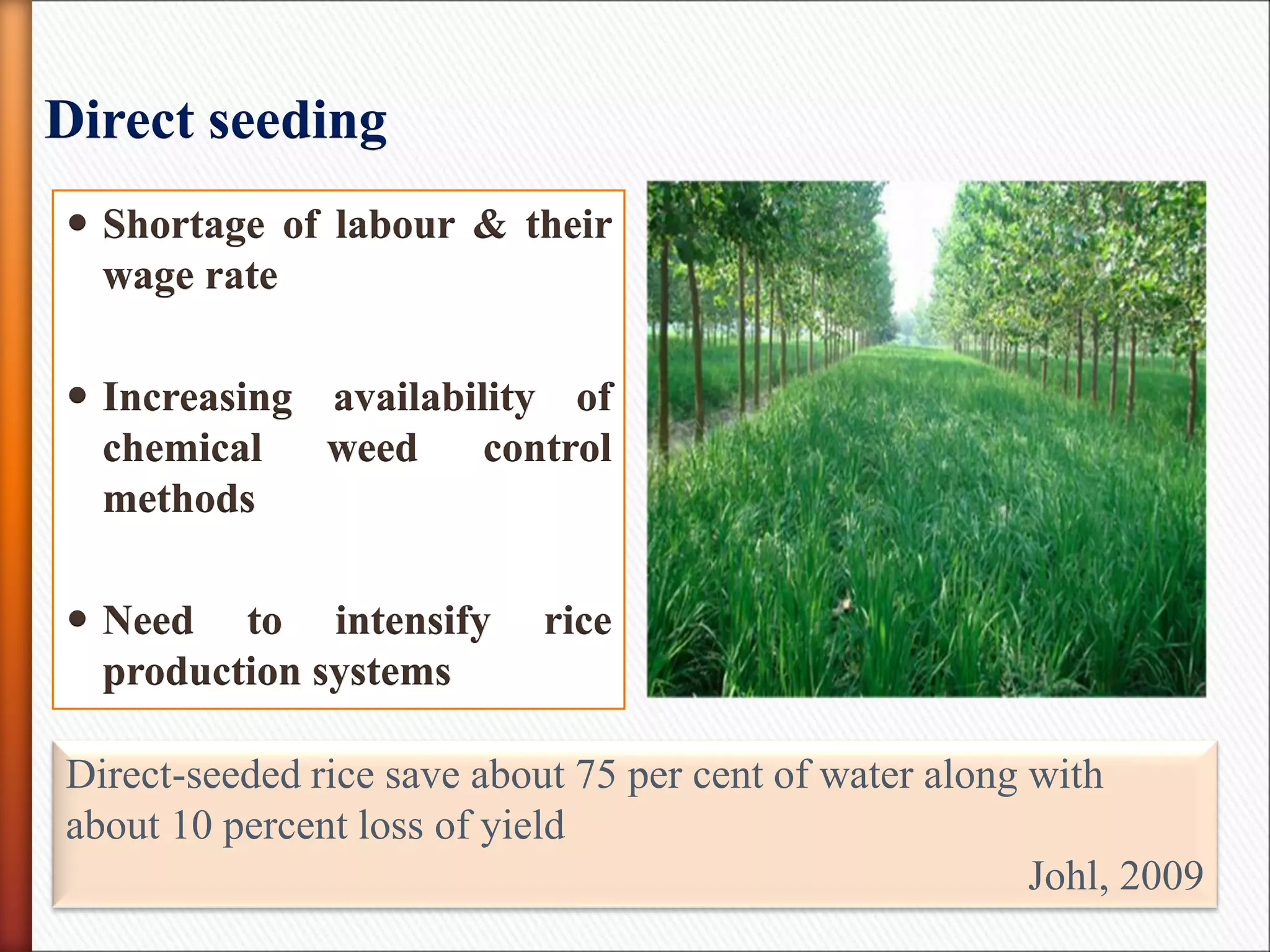
Direct seeding
 Shortage of labour & their
wage rate
 Increasing availability of
chemical weed control
methods
 Need to intensify rice
production systems
Direct-seeded rice save about 75 per cent of water along with
about 10 percent loss of yield
Johl, 2009
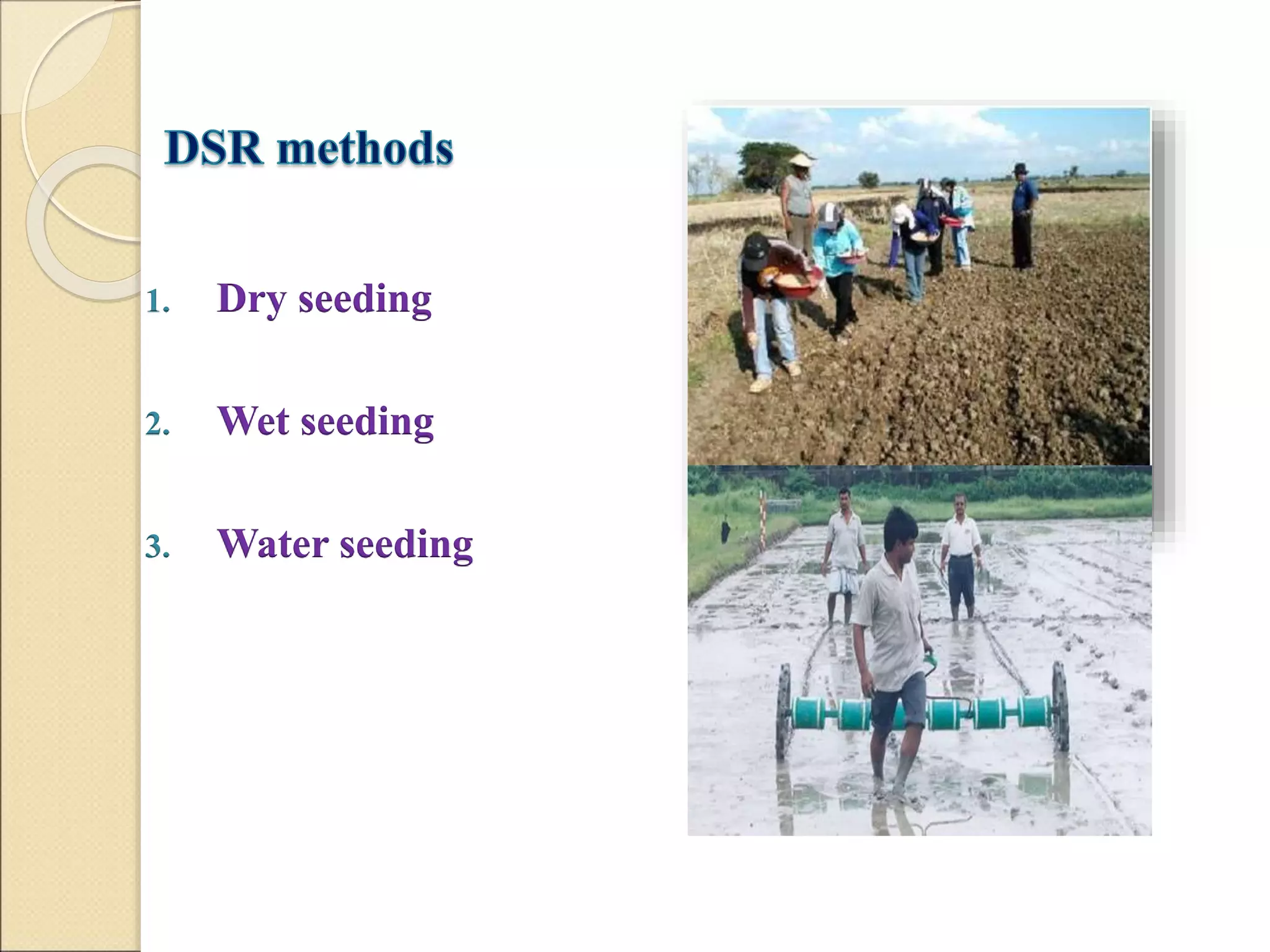
1. Dry seeding
2. Wet seeding
3. Water seeding
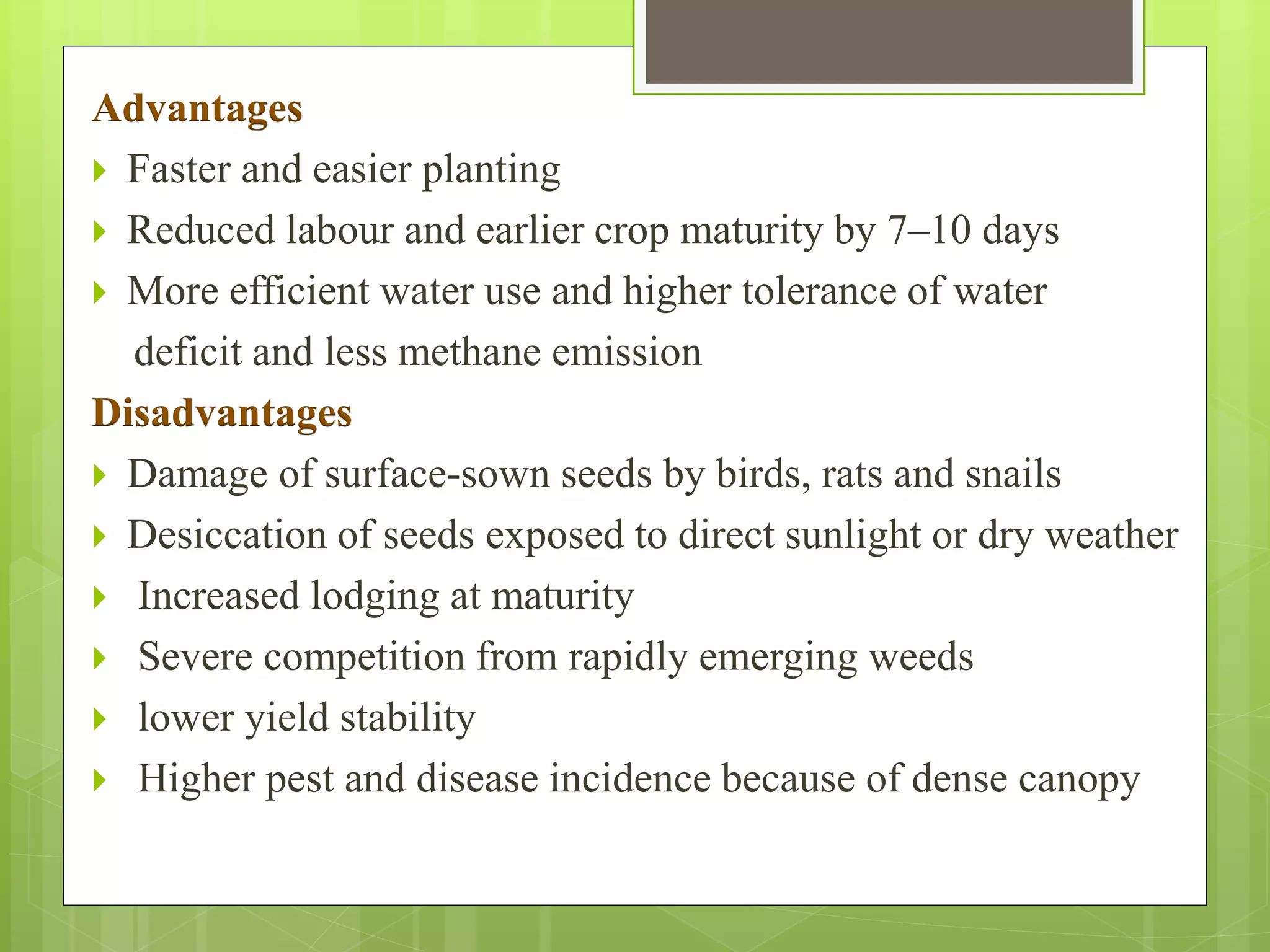
Advantages
 Faster and easier planting
 Reduced labour and earlier crop maturity by 7–10 days
 More efficient water use and higher tolerance of water
deficit and less methane emission
Disadvantages
 Damage of surface-sown seeds by birds, rats and snails
 Desiccation of seeds exposed to direct sunlight or dry weather
 Increased lodging at maturity
 Severe competition from rapidly emerging weeds
 lower yield stability
 Higher pest and disease incidence because of dense canopy
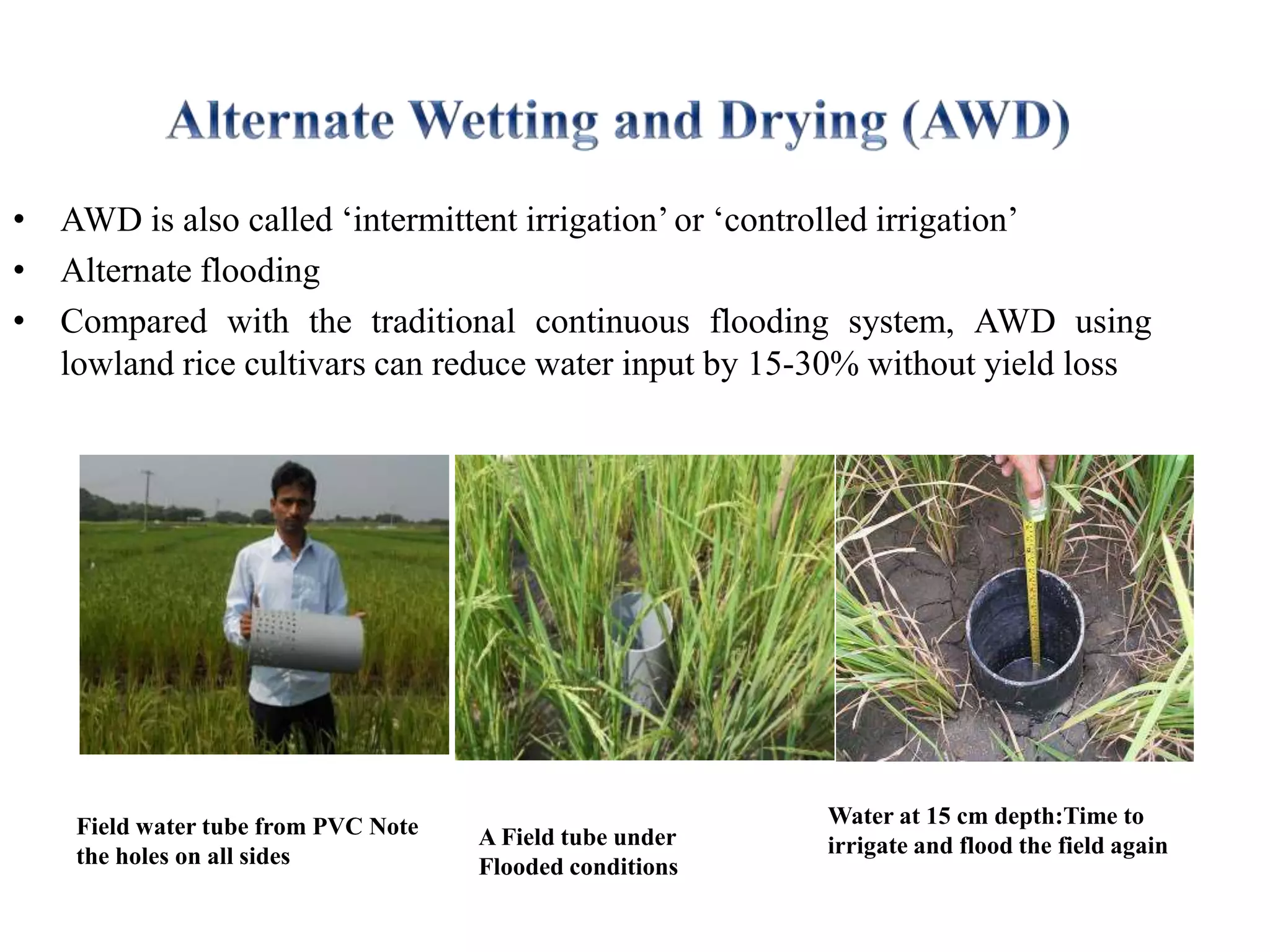
• AWD is also called ‘intermittent irrigation’ or ‘controlled irrigation’
• Alternate flooding
• Compared with the traditional continuous flooding system, AWD using
lowland rice cultivars can reduce water input by 15-30% without yield loss
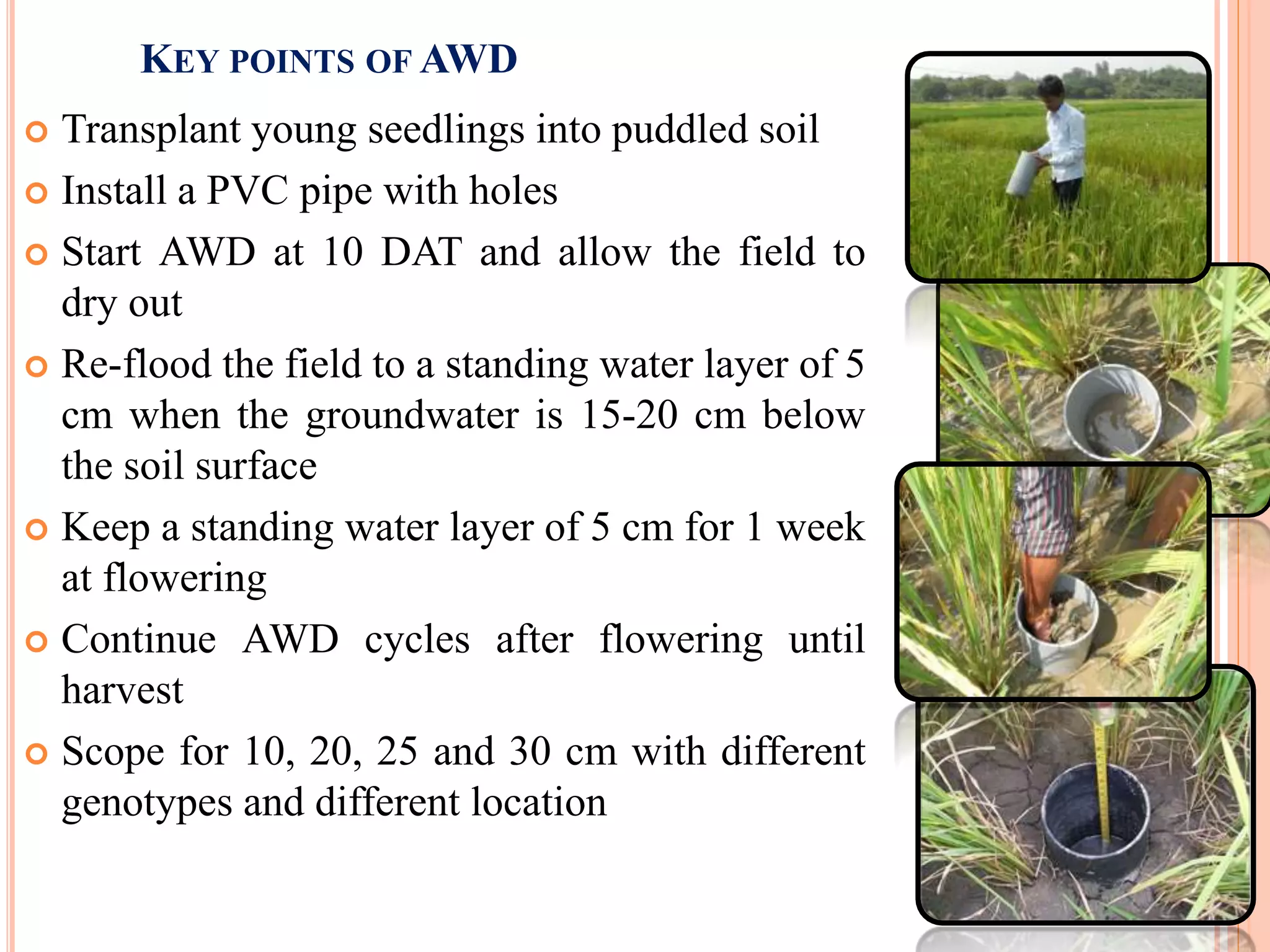
Field water tube from PVC Note
the holes on all sides
A Field tube under
Flooded conditions
Water at 15 cm depth:Time to
irrigate and flood the field again
KEY POINTS OF AWD
 Transplant young seedlings into puddled soil
 Install a PVC pipe with holes
 Start AWD at 10 DAT and allow the field to
dry out
 Re-flood the field to a standing water layer of 5
cm when the groundwater is 15-20 cm below
the soil surface
 Keep a standing water layer of 5 cm for 1 week
at flowering
 Continue AWD cycles after flowering until
harvest
 Scope for 10, 20, 25 and 30 cm with different
genotypes and different location
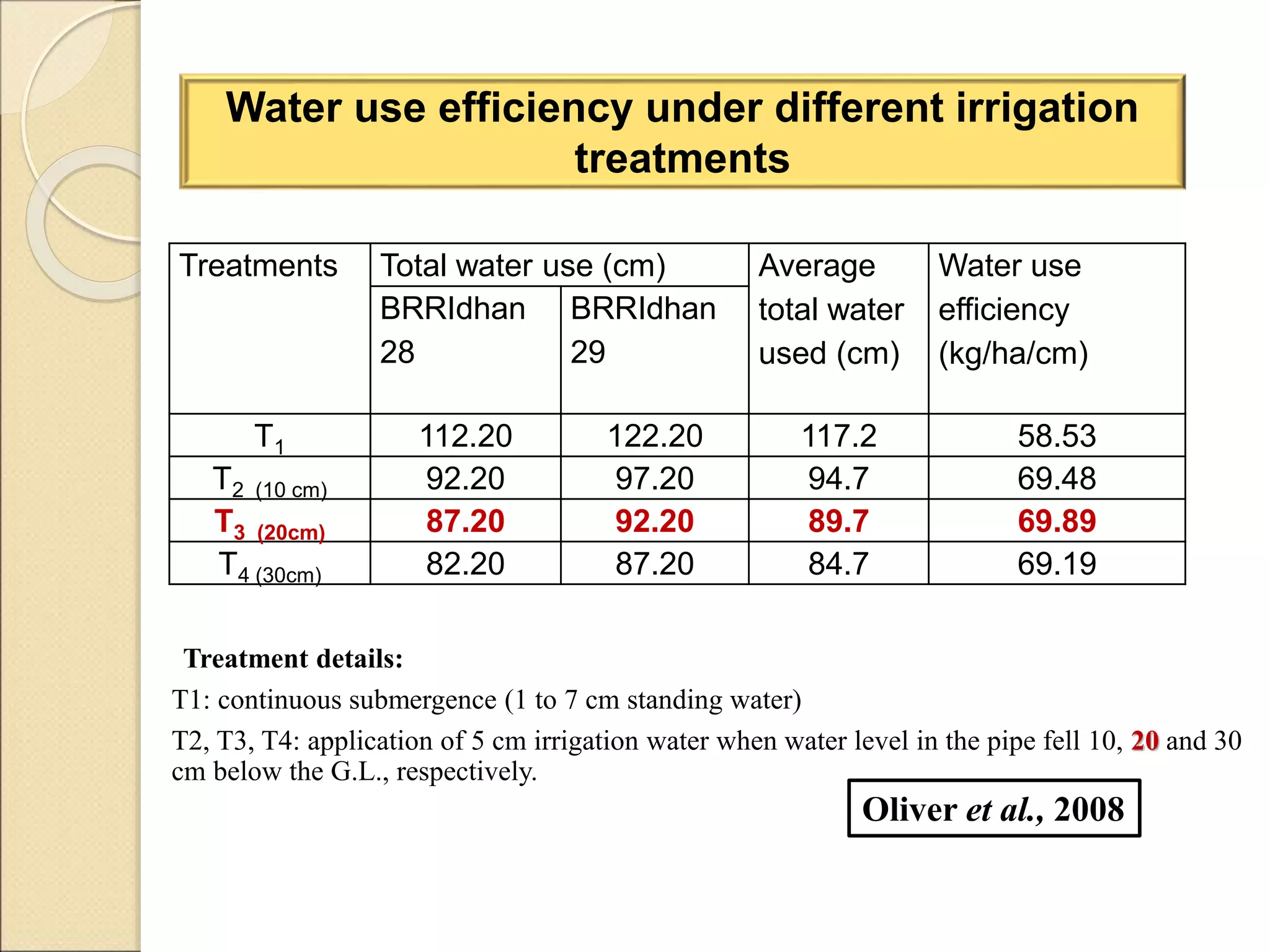
Water use efficiency under different irrigation
treatments
Treatments Total water use (cm) Average
total water
used (cm)
Water use
efficiency
(kg/ha/cm)
BRRIdhan
28
BRRIdhan
29
T1 112.20 122.20 117.2 58.53
T2 (10 cm) 92.20 97.20 94.7 69.48
T3 (20cm) 87.20 92.20 89.7 69.89
T4 (30cm) 82.20 87.20 84.7 69.19
Treatment details:
T1: continuous submergence (1 to 7 cm standing water)
T2, T3, T4: application of 5 cm irrigation water when water level in the pipe fell 10, 20 and 30
cm below the G.L., respectively.
Oliver et al., 2008
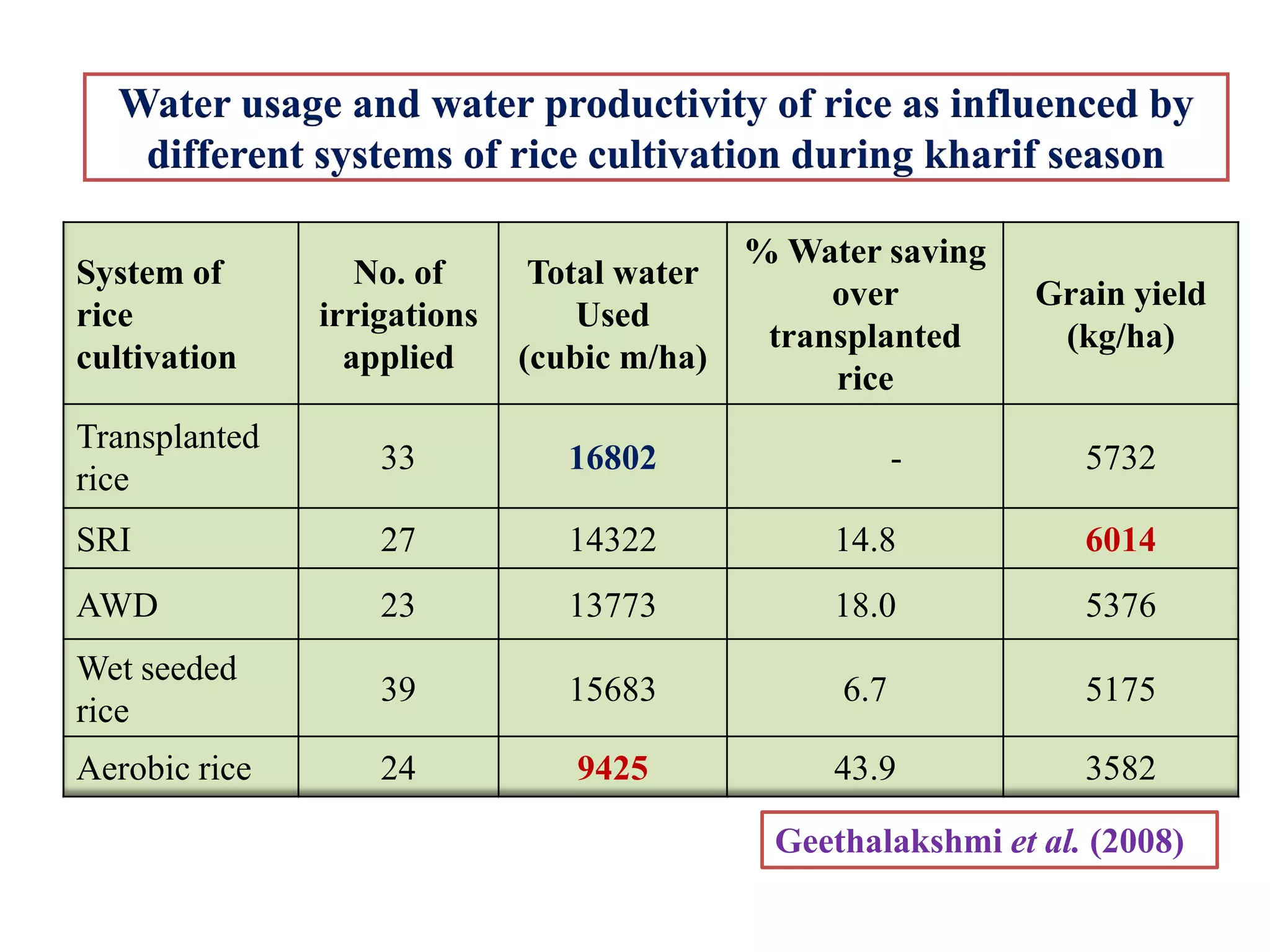
Water usage and water productivity of rice as influenced by
different systems of rice cultivation during kharif season
System of
rice
cultivation
No. of
irrigations
applied
Total water
Used
(cubic m/ha)
% Water saving
over
transplanted
rice
Grain yield
(kg/ha)
Transplanted
rice
33 16802 - 5732
SRI 27 14322 14.8 6014
AWD 23 13773 18.0 5376
Wet seeded
rice
39 15683 6.7 5175
Aerobic rice 24 9425 43.9 3582
Geethalakshmi et al. (2008)
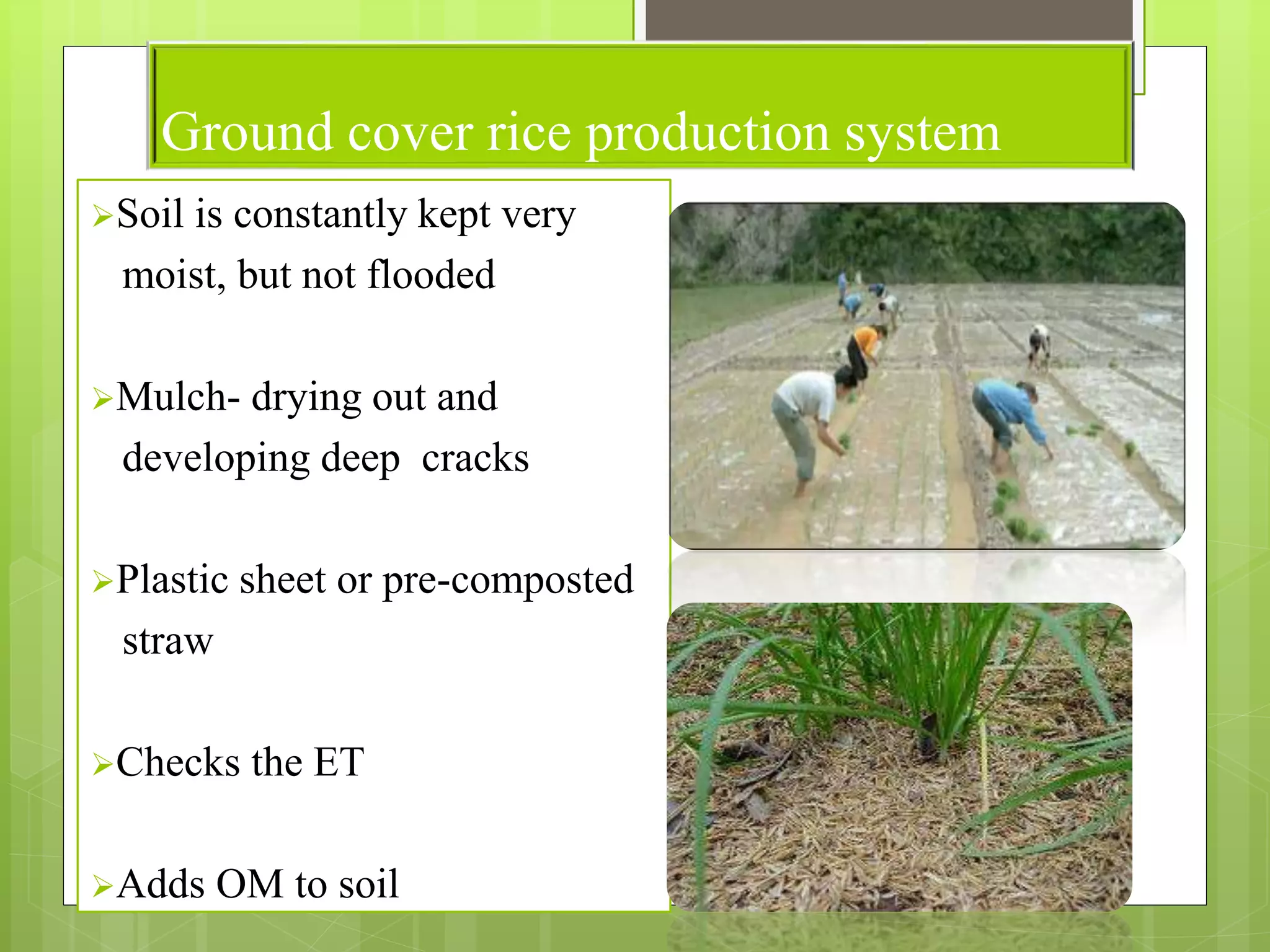
Ground cover rice production system
Soil is constantly kept very
moist, but not flooded
Mulch- drying out and
developing deep cracks
Plastic sheet or pre-composted
straw
Checks the ET
Adds OM to soil
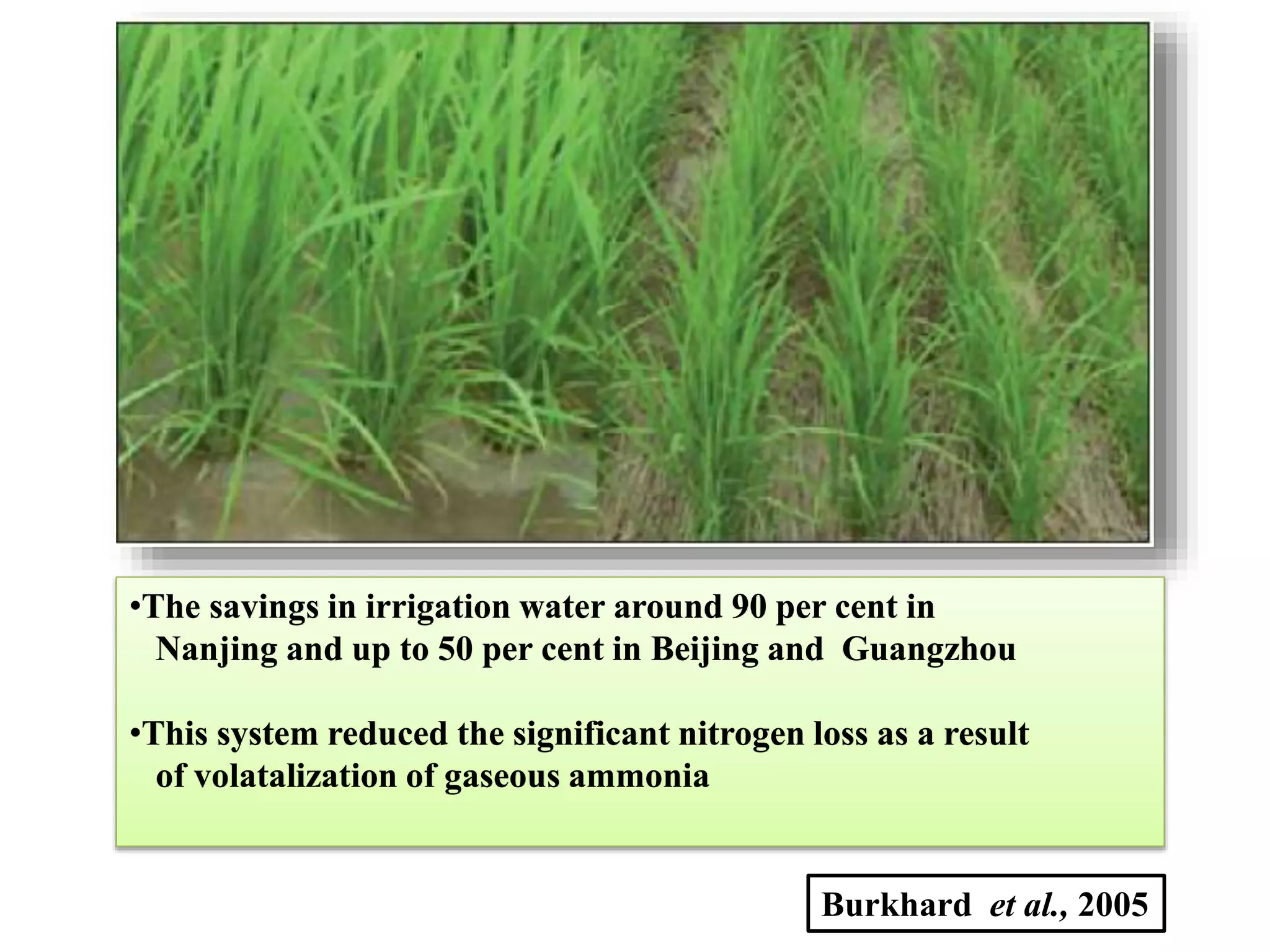
•The savings in irrigation water around 90 per cent in
Nanjing and up to 50 per cent in Beijing and Guangzhou
•This system reduced the significant nitrogen loss as a result
of volatalization of gaseous ammonia
Burkhard et al., 2005
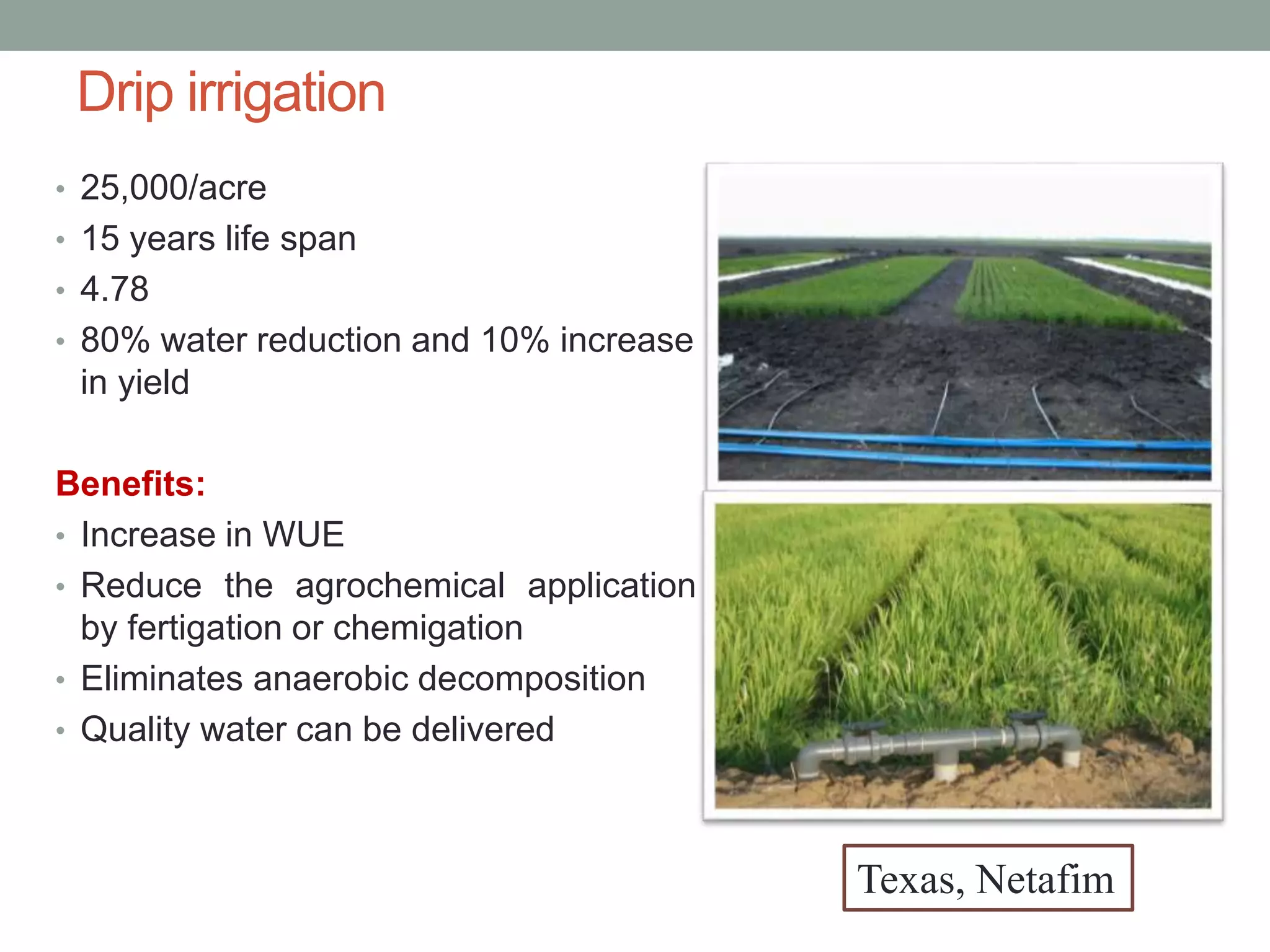
Drip irrigation
• 25,000/acre
• 15 years life span
• 4.78
• 80% water reduction and 10% increase
in yield
Benefits:
• Increase in WUE
• Reduce the agrochemical application
by fertigation or chemigation
• Eliminates anaerobic decomposition
• Quality water can be delivered
Texas, Netafim
..ResAlternate wetting and drying (AWD)--
using less water to grow rice - YouTube.mp4
Future line of work
• Awareness about rice is not aquatic plant
• Standardization of AWD
• Weed management in aerobic and AWD
• Scope for sprinkler and drip irrigation
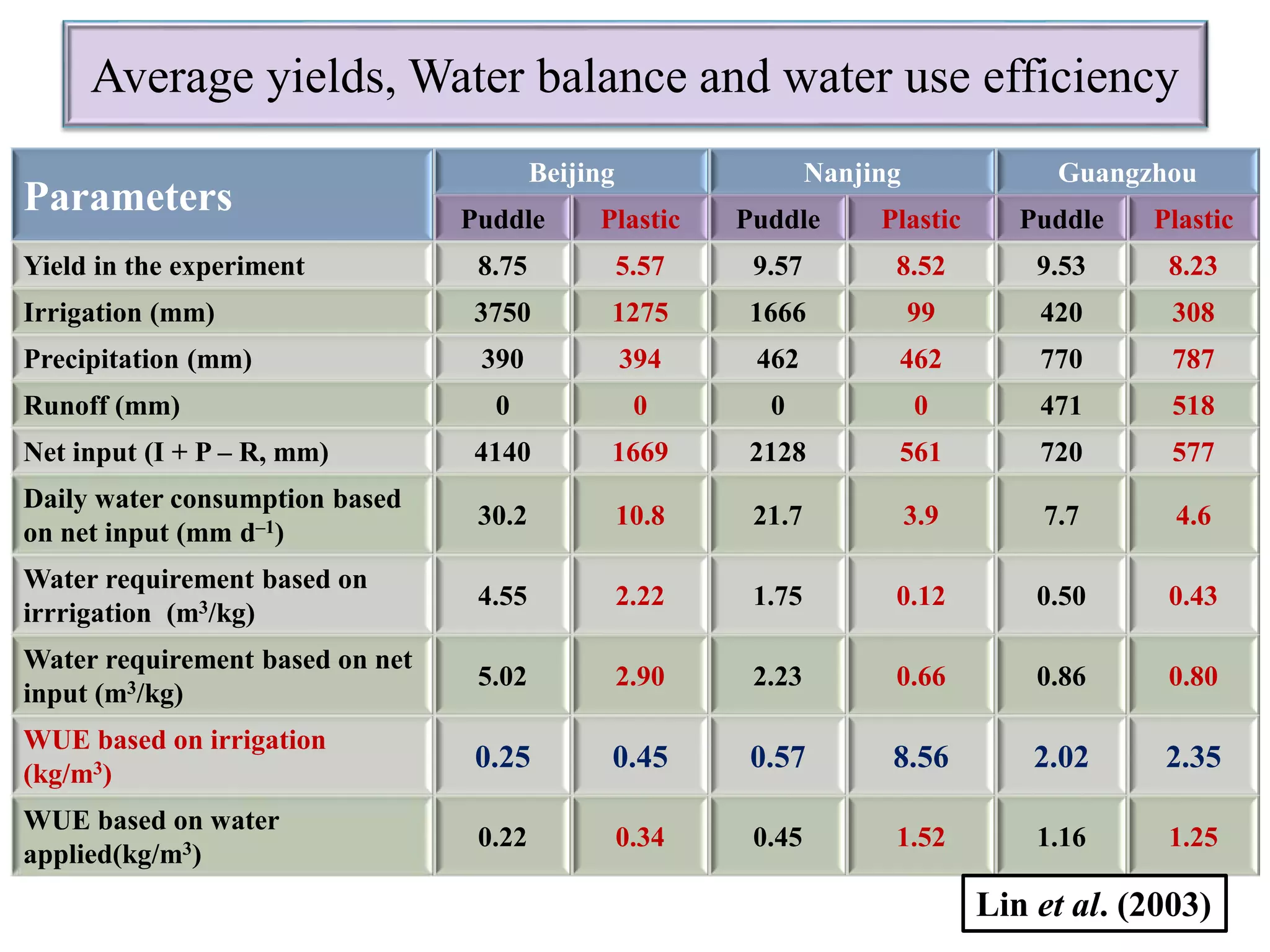
Average yields, Water balance and water use efficiency
Parameters
Beijing Nanjing Guangzhou
Puddle Plastic Puddle Plastic Puddle Plastic
Yield in the experiment 8.75 5.57 9.57 8.52 9.53 8.23
Irrigation (mm) 3750 1275 1666 99 420 308
Precipitation (mm) 390 394 462 462 770 787
Runoff (mm) 0 0 0 0 471 518
Net input (I + P – R, mm) 4140 1669 2128 561 720 577
Daily water consumption based
on net input (mm d–1)
30.2 10.8 21.7 3.9 7.7 4.6
Water requirement based on
irrrigation (m3/kg)
4.55 2.22 1.75 0.12 0.50 0.43
Water requirement based on net
input (m3/kg)
5.02 2.90 2.23 0.66 0.86 0.80
WUE based on irrigation
(kg/m3)
0.25 0.45 0.57 8.56 2.02 2.35
WUE based on water
applied(kg/m3)
0.22 0.34 0.45 1.52 1.16 1.25
Lin et al. (2003)

Water management in rice by different methods of establishment

  • 2.
    “Enhancing Water Productivityin Rice through Different Methods of Rice Cultivation” Shantappa Duttarganvi Doctoral Research Fellow WALAMTARI
  • 3.
    Introduction Traditional/ low landrice SRI method Aerobic Rice Alternate wetting and Drying Direct seeded rice Conclusion
  • 4.
    RICE IS LIFECultivate more land with less water Introduction
  • 5.
    • >3 billionpeople in Asia & 1.5 billion people in Africa and Latin America •37% area (154 Mha) is rainfed--scope to increase productivity
  • 6.
    To meet futurefood requirements, India need to increase rice productivity by 3 % per annum (Thiyagarajan and Selvaraju, 2001) To produce 1 kg of grain, farmers have to supply 2-3 times more water in rice fields than other cereals (Baker et al., 1998) 80% of the freshwater resources are used for irrigation purpose half of which is used for rice production (Dawe et al., 1998) “Despite the constraints of water scarcity, rice production must rise dramatically over the next generation to meet the food needs “ (Serageldin, 2011)
  • 7.
  • 8.
    Bouman, 2001 Components ofwater balance in rice fields
  • 9.
    Selection of agood genotype Method of planting Weed management Irrigation method and land levelling Seed priming Silicon nutrition
  • 10.
     Low landrice  Aerobic rice  System of rice Intensification (SRI)  Alternate wetting and drying (AWD)  Direct seeded rice  Deep water rice  Ground cover rice production system  Raised bed-saturated soil culture method  Drip irrigation
  • 11.
    Low land rice High water requirement 3000–5000 liters of water to produce 1 kg of rice  Environmental degradation  Reduces fertilizer use efficiency  Destruction of soil aggregates  Anaerobic fermentation of soil organic matter: Methane emission
  • 12.
    Ways to improveWUE in conventional system  Crack/rat hole ploughing  Bund lining or reparing breached bunds  Conoweeding  Line sowing  Saturated condition  Proper land leveling and puddling  Transplanting young seedlings
  • 13.
    Water saving methods •System of rice Intensification (SRI): 30-40% • Alternate wetting and drying (AWD): 15-30% • Aerobic rice: 40-50% • Direct seeded rice: 75% • Ground cover rice production system: 50-60%
  • 14.
    SYSTEM OF RICEINTENSIFICATION (SRI) METHOD • SRI was developed in Madagascar in the early-1980s by Father Henri de Laulanie • Formal experimentation started in India 2002-2003 Core principles of SRI < seed- one seed revolution < water- Rice is not an aquatic plant 8-12 day old seedlings Mechanical weeding Square planting Organic source of nutrients “SRI cuts the water required for irrigated rice by 25-50%. The combination of water reduction together with other SRI practices can increase paddy yields by 50-100%” Norman Uphoff
  • 15.
    • 8-12 daysold seedlings • The fields are alternately kept wet and dry; they are not flooded until the panicle initiation stage • 1-3 cm of water in the field during the reproductive phase • Mechanical weeding 10 DAT
  • 16.
    8-10 Days (2leaf stage) nursery Careful uprooting & transplanting Wider spacing(25X25cm) Weeding with weeder Saturation of the field Use of Organics Mahendrakumar et al. (2008) The basic practices of SRI
  • 17.
  • 18.
    • Rice seedlingslose much of their growth potential if they are transplanted more than about 15 days after they emerge in their nursery • Wide spacing of plants will lead to greater root growth and accompanying tillering In SRI method, young seedlings are placed at shallow depth and therefore these seedlings establish quickly. Whereas in the conventional method 25-30 day old seedlings are pulled from nursery and pushed deep into the puddled soil and during the process the tips of roots face upward and hence these require more time and energy to establish in the soil Norman Uphoff, 2005
  • 19.
    Mahendrakumar et al.(2008) DRR Technical Bulletin
  • 20.
    Country Yield Increaseover conventional Philippines 100% India 83% Nepal 82% Indonesia 78% Cambodia 41% china 29% Vietnam 21% FAO, 2007
  • 21.
    MORE TILLERS AND> 400 GRAINS PER PANICLE
  • 22.
    conventional practice v/sSRI methods Conventional Practices • 25-30 days seedlings • Multiple seedlings • Large plant population • Paddies kept flooded throughout the growing cycle • Weeds are controlled by flooding, hand weeding and herbicides SRI Methods • 8-12 days old seedlings • Single seedling • Sparse plant population • Soil aeration with AWD • Weeds are controlled with a rotary weeder
  • 23.
    Comparison of drymatter in SRI v/s Conventionally grown rice at different stages crop cycle Tao (2004)
  • 24.
    Grain yield increasewith adoption of SRI across the country Mahendrakumar et al. (2008)
  • 25.
    Water productivity asinfluenced by SRI v/s normal (flooded rice) Water use decreased by 29% (SRI 79 Cum) Water productivity increased by 20% Viraktamath, 2007 Grain yield increase by 10% in SRI
  • 26.
    Water (irrigation andrainfall) use and water productivity in SRI and control rice crops Gujja and Thiyagarajan, 2010 37.5 % 34.2 %
  • 27.
    Impact of cropestablishment techniques on grain yield and water productivity of rice Yield attributes Conventional Line planting (20x10cm) SRI planting 25 x 25 cm Farmers practice Random planting No. of productive tillers/ sq.m 424 520 408 Panicle weight (g) 3.52 4.05 3.52 test weight (g) 20.1 20.6 19.8 Grain yield ( kg/ha) 6423 7135 5949 Straw yield (kg/ha) 8927 9632 8626 B:C ratio 2.91 3.41 2.71 Total water used (mm) 1421 1082 1421 WUE (kg/ha mm) 4.52 6.59 4.19 Muthukrishnan and Radhamani, 2011
  • 28.
    Treatment No. of tillers/plant No. of productive tiller/plant Daysto flowering Seed yield (t/ha) Benefit: cost ratio germination Methods of cultivation (C) C1–SRI 32.40 29.13 102.70 4.07 1.44 98.1 C2-traditional 15.92 8.14 106.70 3.68 1.14 97.3 Sem+ 0.01 1.34 0.40 0.20 0.05 0.5 C.D. @ 5% 0.06 8.15 2.40 0.06 0.15 NS Spacings (S) S1- 20x20 15.88 14.84 101.1 2.82 1.21 97.9 S2-30x30 28.33 32.55 101.6 3.41 1.47 97.6 S3-40x40 24.43 29.51 102.0 3.28 1.41 97.6 S.Em.+ 1.10 0.16 0.1 0.10 0.08 0.2 C.D. @ 5% 3.30 0.48 NS 0.33 0.23 NS Evaluation of methods of cultivation and spacing on seed yield and seed quality parameters in BPT-5204 Krishna et al. (2008) Dharwad
  • 29.
    Effect of riceestablishment methods on growth, grain yield and water productivity during post rainy season Methods Populati on /sqm Productive tillers/hill Grain yield Kg/ha IW used (mm) Total Water Used (mm) Water Productiviy Kg/ha-m Line planting 49.3 12.4 4430 996 1043 4.23 Random planting 96.3 10.0 3970 1055 1102 3.60 SRI 16.0 17.5 5260 681 728 7.23 Marimuthu et al. (2011)
  • 30.
    COST OF CULTIVATION(RS/ACRE): CONVENTIONAL V/S SRI METHOD Note : Price of paddy - Rs.5,600/t Price of straw - Rs. 800/t Mahendrakumar et al. (2008)
  • 31.
    Saving of 30– 40% irrigation water Saving of 85 % seed (2 kg / acre as against 25-30 kg/ acre in normal method) Saving of chemical inputs More healthy and tasty rice due to organic farming practices Better and higher yields with lower inputs Crop duration reduced by 7-10 days due to absence of transplanting shock
  • 32.
    • Aerobic ricevarieties • Well drained • Non puddled • 4-6t/ha with 50% saving irrigation water • Uplands • Undulating, rainfed lowlands • Water-short irrigated low lands Aerobic rice system
  • 33.
    Benefits Increased mycorrhizal association Increasedrhizobial association Prolonged root activity Higher water productivity Long root development Labour cost Reduced nitrogen loss Biofertilizers saves 20-30kg/ha of nitrogen fertilizers
  • 34.
    Comparison of seasonalwater requirement between low land flooded rice and aerobic rice Particulars Seasonal water requirement (mm) Lowland rice Aerobic rice Land preparation 150-300 100 Evaporation 200 100 Transpiration 400 400 Seepage and percolation 500 335 Application loss 400 335 Total seasonal water requirement (mm) 1650 935 Lampayan and Bouman, 2005
  • 35.
    Water input andyield of aerobic rice varieties under flooded and aerobic conditions year Water management Water input Yield (t ha-1) I IR HD502 HD297 2001 Flooded 1057 1351 6.8 5.4 Aerobic 350 644 5.3 4.7 2002 Flooded 900 1255 5.7 5.3 Aerobic 522 917 4.6 5.3 Bouman et al. (2007)
  • 36.
    Direct seeding  Shortageof labour & their wage rate  Increasing availability of chemical weed control methods  Need to intensify rice production systems Direct-seeded rice save about 75 per cent of water along with about 10 percent loss of yield Johl, 2009
  • 37.
    1. Dry seeding 2.Wet seeding 3. Water seeding
  • 38.
    Advantages  Faster andeasier planting  Reduced labour and earlier crop maturity by 7–10 days  More efficient water use and higher tolerance of water deficit and less methane emission Disadvantages  Damage of surface-sown seeds by birds, rats and snails  Desiccation of seeds exposed to direct sunlight or dry weather  Increased lodging at maturity  Severe competition from rapidly emerging weeds  lower yield stability  Higher pest and disease incidence because of dense canopy
  • 39.
    • AWD isalso called ‘intermittent irrigation’ or ‘controlled irrigation’ • Alternate flooding • Compared with the traditional continuous flooding system, AWD using lowland rice cultivars can reduce water input by 15-30% without yield loss Field water tube from PVC Note the holes on all sides A Field tube under Flooded conditions Water at 15 cm depth:Time to irrigate and flood the field again
  • 40.
    KEY POINTS OFAWD  Transplant young seedlings into puddled soil  Install a PVC pipe with holes  Start AWD at 10 DAT and allow the field to dry out  Re-flood the field to a standing water layer of 5 cm when the groundwater is 15-20 cm below the soil surface  Keep a standing water layer of 5 cm for 1 week at flowering  Continue AWD cycles after flowering until harvest  Scope for 10, 20, 25 and 30 cm with different genotypes and different location
  • 41.
    Water use efficiencyunder different irrigation treatments Treatments Total water use (cm) Average total water used (cm) Water use efficiency (kg/ha/cm) BRRIdhan 28 BRRIdhan 29 T1 112.20 122.20 117.2 58.53 T2 (10 cm) 92.20 97.20 94.7 69.48 T3 (20cm) 87.20 92.20 89.7 69.89 T4 (30cm) 82.20 87.20 84.7 69.19 Treatment details: T1: continuous submergence (1 to 7 cm standing water) T2, T3, T4: application of 5 cm irrigation water when water level in the pipe fell 10, 20 and 30 cm below the G.L., respectively. Oliver et al., 2008
  • 42.
    Water usage andwater productivity of rice as influenced by different systems of rice cultivation during kharif season System of rice cultivation No. of irrigations applied Total water Used (cubic m/ha) % Water saving over transplanted rice Grain yield (kg/ha) Transplanted rice 33 16802 - 5732 SRI 27 14322 14.8 6014 AWD 23 13773 18.0 5376 Wet seeded rice 39 15683 6.7 5175 Aerobic rice 24 9425 43.9 3582 Geethalakshmi et al. (2008)
  • 43.
    Ground cover riceproduction system Soil is constantly kept very moist, but not flooded Mulch- drying out and developing deep cracks Plastic sheet or pre-composted straw Checks the ET Adds OM to soil
  • 44.
    •The savings inirrigation water around 90 per cent in Nanjing and up to 50 per cent in Beijing and Guangzhou •This system reduced the significant nitrogen loss as a result of volatalization of gaseous ammonia Burkhard et al., 2005
  • 45.
    Drip irrigation • 25,000/acre •15 years life span • 4.78 • 80% water reduction and 10% increase in yield Benefits: • Increase in WUE • Reduce the agrochemical application by fertigation or chemigation • Eliminates anaerobic decomposition • Quality water can be delivered Texas, Netafim
  • 46.
    ..ResAlternate wetting anddrying (AWD)-- using less water to grow rice - YouTube.mp4
  • 47.
    Future line ofwork • Awareness about rice is not aquatic plant • Standardization of AWD • Weed management in aerobic and AWD • Scope for sprinkler and drip irrigation
  • 50.
    Average yields, Waterbalance and water use efficiency Parameters Beijing Nanjing Guangzhou Puddle Plastic Puddle Plastic Puddle Plastic Yield in the experiment 8.75 5.57 9.57 8.52 9.53 8.23 Irrigation (mm) 3750 1275 1666 99 420 308 Precipitation (mm) 390 394 462 462 770 787 Runoff (mm) 0 0 0 0 471 518 Net input (I + P – R, mm) 4140 1669 2128 561 720 577 Daily water consumption based on net input (mm d–1) 30.2 10.8 21.7 3.9 7.7 4.6 Water requirement based on irrrigation (m3/kg) 4.55 2.22 1.75 0.12 0.50 0.43 Water requirement based on net input (m3/kg) 5.02 2.90 2.23 0.66 0.86 0.80 WUE based on irrigation (kg/m3) 0.25 0.45 0.57 8.56 2.02 2.35 WUE based on water applied(kg/m3) 0.22 0.34 0.45 1.52 1.16 1.25 Lin et al. (2003)