Made by- Sachin Motwani 1
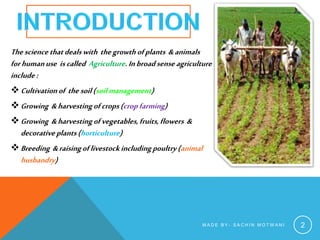
Thesciencethatdealswith thegrowth ofplants &animals
forhumanuse iscalled Agriculture.Inbroadsense agriculture
include:
Cultivationof thesoil(soilmanagement)
Growing &harvestingofcrops(cropfarming)
Growing &harvestingofvegetables,fruits,flowers &
decorativeplants(horticulture)
Breeding &raisingoflivestockincludingpoultry(animal
husbandry)
M A D E B Y - S A C H I N M O T W A N I 2
MEANING OF AGRICULTURE?
Agriculture is a primary
activity & is closely related to
the natural environment . The
term agriculture has been
derived from the Latin word
‘Ager’ meaning field &
‘cultura’ meaning cultivation.
Made by- Sachin Motwani
3
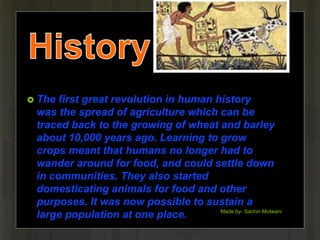
 The first great revolution in human history
was the spread of agriculture which can be
traced back to the growing of wheat and barley
about 10,000 years ago. Learning to grow
crops meant that humans no longer had to
wander around for food, and could settle down
in communities. They also started
domesticating animals for food and other
purposes. It was now possible to sustain a
large population at one place. Made by- Sachin Motwani
4
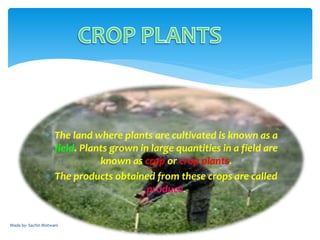
 The land where plants are cultivated is known as a
field. Plants grown in large quantities in a field are
known as crop or crop plants.
 The products obtained from these crops are called
produce.
Made by- Sachin Motwani 5
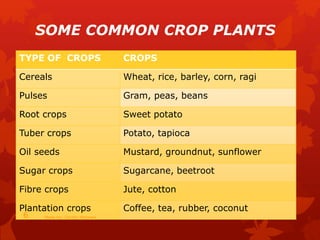
TYPE OF CROPS CROPS
Cereals Wheat, rice, barley, corn, ragi
Pulses Gram, peas, beans
Root crops Sweet potato
Tuber crops Potato, tapioca
Oil seeds Mustard, groundnut, sunflower
Sugar crops Sugarcane, beetroot
Fibre crops Jute, cotton
Plantation crops Coffee, tea, rubber, coconut
SOME COMMON CROP PLANTS
Made by- Sachin Motwani6
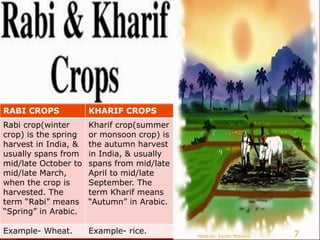
RABI CROPS KHARIF CROPS
Rabi crop(winter
crop) is the spring
harvest in India, &
usually spans from
mid/late October to
mid/late March,
when the crop is
harvested. The
term “Rabi” means
“Spring” in Arabic.
Kharif crop(summer
or monsoon crop) is
the autumn harvest
in India, & usually
spans from mid/late
April to mid/late
September. The
term Kharif means
“Autumn” in Arabic.
Example- Wheat. Example- rice.
Made by- Sachin Motwani 7
Made by- Sachin Motwani
8
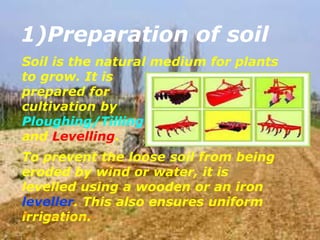
1)Preparation of soil
Soil is the natural medium for plants
to grow. It is
prepared for
cultivation by
Ploughing/Tilling
and Levelling.
To prevent the loose soil from being
eroded by wind or water, it is
levelled using a wooden or an iron
leveller. This also ensures uniform
irrigation.Made by- Sachin Motwani9
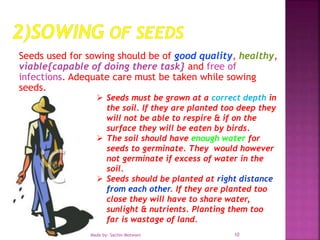
Seeds used for sowing should be of good quality, healthy,
viable{capable of doing there task} and free of
infections. Adequate care must be taken while sowing
seeds.
 Seeds must be grown at a correct depth in
the soil. If they are planted too deep they
will not be able to respire & if on the
surface they will be eaten by birds.
 The soil should have enough water for
seeds to germinate. They would however
not germinate if excess of water in the
soil.
 Seeds should be planted at right distance
from each other. If they are planted too
close they will have to share water,
sunlight & nutrients. Planting them too
far is wastage of land.
Made by- Sachin Motwani 10
3) Manuring
Plants require certain nutrients for their proper growth. Plants
obtain carbon from air, oxygen from air and water and
hydrogen from water. the remaining nutrients are obtained
from the soil.
 The elements in soil get used up when the land is cultivated
for a long time. Fallow is an old method of allowing the soil
to regenerate the lost nutrients by leaving it free .However
this method is not applicable due to high
demand of food.
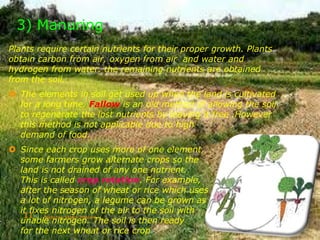
 Since each crop uses more of one element,
some farmers grow alternate crops so the
land is not drained of any one nutrient.
This is called crop rotation. For example,
after the season of wheat or rice which uses
a lot of nitrogen, a legume can be grown as
it fixes nitrogen of the air to the soil with
unable nitrogen. The soil is then ready
for the next wheat or rice crop.
Made by- Sachin Motwani11
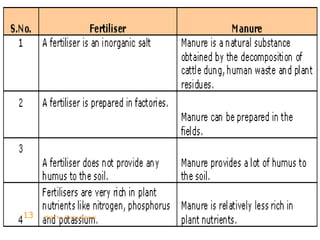
However, the previous methods alone
are not enough to maintain fertility of
the soil and farmers have to add
manures or fertilizers from time to
time .There are two ways of doing
this:-
 Organic method which involves using
organic manures.
 Inorganic method which involves
using fertilizers made by humans.
Made by- Sachin Motwani12
Made by- Sachin Motwani13
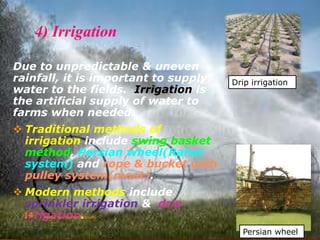
4) Irrigation
Due to unpredictable & uneven
rainfall, it is important to supply
water to the fields. Irrigation is
the artificial supply of water to
farms when needed.
 Traditional methods of
irrigation include swing basket
method, Persian wheel(Rahat
system) and rope & bucket with
pulley system(moat).
 Modern methods include
sprinkler irrigation & drip
irrigation.
Drip irrigation
Persian wheel
Made by- Sachin Motwani14
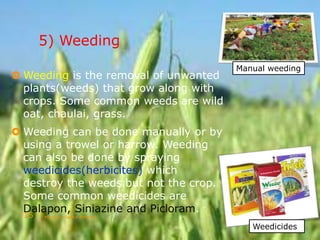
5) Weeding
 Weeding is the removal of unwanted
plants(weeds) that grow along with
crops. Some common weeds are wild
oat, chaulai, grass.
 Weeding can be done manually or by
using a trowel or harrow. Weeding
can also be done by spraying
weedicides(herbicites) which
destroy the weeds but not the crop.
Some common weedicides are
Dalapon, Siniazine and Picloram.
Manual weeding
Weedicides
Made by- Sachin Motwani15
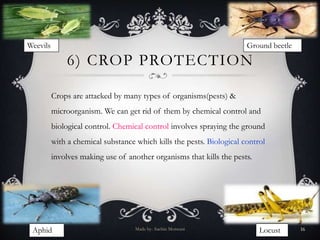
6) CROP PROTECTION
Crops are attacked by many types of organisms(pests) &
microorganism. We can get rid of them by chemical control and
biological control. Chemical control involves spraying the ground
with a chemical substance which kills the pests. Biological control
involves making use of another organisms that kills the pests.
Weevils Ground beetle
Aphid LocustMade by- Sachin Motwani 16
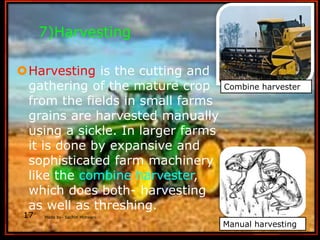
7)Harvesting
Harvesting is the cutting and
gathering of the mature crop
from the fields in small farms
grains are harvested manually
using a sickle. In larger farms
it is done by expansive and
sophisticated farm machinery
like the combine harvester,
which does both- harvesting
as well as threshing.
Combine harvester
Manual harvesting
Made by- Sachin Motwani17
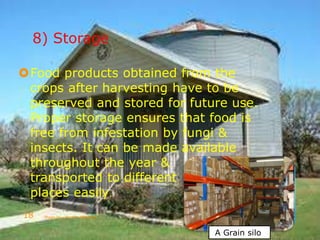
8) Storage
Food products obtained from the
crops after harvesting have to be
preserved and stored for future use.
Proper storage ensures that food is
free from infestation by fungi &
insects. It can be made available
throughout the year &
transported to different
places easily.
A Grain silo
Made by- Sachin Motwani18
Made by- Sachin Motwani19
Made by- Sachin Motwani
20

Agriculture

  • 1.
    Made by- SachinMotwani 1
  • 2.
    Thesciencethatdealswith thegrowth ofplants&animals forhumanuse iscalled Agriculture.Inbroadsense agriculture include: Cultivationof thesoil(soilmanagement) Growing &harvestingofcrops(cropfarming) Growing &harvestingofvegetables,fruits,flowers & decorativeplants(horticulture) Breeding &raisingoflivestockincludingpoultry(animal husbandry) M A D E B Y - S A C H I N M O T W A N I 2
  • 3.
    MEANING OF AGRICULTURE? Agricultureis a primary activity & is closely related to the natural environment . The term agriculture has been derived from the Latin word ‘Ager’ meaning field & ‘cultura’ meaning cultivation. Made by- Sachin Motwani 3
  • 4.
     The firstgreat revolution in human history was the spread of agriculture which can be traced back to the growing of wheat and barley about 10,000 years ago. Learning to grow crops meant that humans no longer had to wander around for food, and could settle down in communities. They also started domesticating animals for food and other purposes. It was now possible to sustain a large population at one place. Made by- Sachin Motwani 4
  • 5.
     The landwhere plants are cultivated is known as a field. Plants grown in large quantities in a field are known as crop or crop plants.  The products obtained from these crops are called produce. Made by- Sachin Motwani 5
  • 6.
    TYPE OF CROPSCROPS Cereals Wheat, rice, barley, corn, ragi Pulses Gram, peas, beans Root crops Sweet potato Tuber crops Potato, tapioca Oil seeds Mustard, groundnut, sunflower Sugar crops Sugarcane, beetroot Fibre crops Jute, cotton Plantation crops Coffee, tea, rubber, coconut SOME COMMON CROP PLANTS Made by- Sachin Motwani6
  • 7.
    RABI CROPS KHARIFCROPS Rabi crop(winter crop) is the spring harvest in India, & usually spans from mid/late October to mid/late March, when the crop is harvested. The term “Rabi” means “Spring” in Arabic. Kharif crop(summer or monsoon crop) is the autumn harvest in India, & usually spans from mid/late April to mid/late September. The term Kharif means “Autumn” in Arabic. Example- Wheat. Example- rice. Made by- Sachin Motwani 7
  • 8.
    Made by- SachinMotwani 8
  • 9.
    1)Preparation of soil Soilis the natural medium for plants to grow. It is prepared for cultivation by Ploughing/Tilling and Levelling. To prevent the loose soil from being eroded by wind or water, it is levelled using a wooden or an iron leveller. This also ensures uniform irrigation.Made by- Sachin Motwani9
  • 10.
    Seeds used forsowing should be of good quality, healthy, viable{capable of doing there task} and free of infections. Adequate care must be taken while sowing seeds.  Seeds must be grown at a correct depth in the soil. If they are planted too deep they will not be able to respire & if on the surface they will be eaten by birds.  The soil should have enough water for seeds to germinate. They would however not germinate if excess of water in the soil.  Seeds should be planted at right distance from each other. If they are planted too close they will have to share water, sunlight & nutrients. Planting them too far is wastage of land. Made by- Sachin Motwani 10
  • 11.
    3) Manuring Plants requirecertain nutrients for their proper growth. Plants obtain carbon from air, oxygen from air and water and hydrogen from water. the remaining nutrients are obtained from the soil.  The elements in soil get used up when the land is cultivated for a long time. Fallow is an old method of allowing the soil to regenerate the lost nutrients by leaving it free .However this method is not applicable due to high demand of food.  Since each crop uses more of one element, some farmers grow alternate crops so the land is not drained of any one nutrient. This is called crop rotation. For example, after the season of wheat or rice which uses a lot of nitrogen, a legume can be grown as it fixes nitrogen of the air to the soil with unable nitrogen. The soil is then ready for the next wheat or rice crop. Made by- Sachin Motwani11
  • 12.
    However, the previousmethods alone are not enough to maintain fertility of the soil and farmers have to add manures or fertilizers from time to time .There are two ways of doing this:-  Organic method which involves using organic manures.  Inorganic method which involves using fertilizers made by humans. Made by- Sachin Motwani12
  • 13.
    Made by- SachinMotwani13
  • 14.
    4) Irrigation Due tounpredictable & uneven rainfall, it is important to supply water to the fields. Irrigation is the artificial supply of water to farms when needed.  Traditional methods of irrigation include swing basket method, Persian wheel(Rahat system) and rope & bucket with pulley system(moat).  Modern methods include sprinkler irrigation & drip irrigation. Drip irrigation Persian wheel Made by- Sachin Motwani14
  • 15.
    5) Weeding  Weedingis the removal of unwanted plants(weeds) that grow along with crops. Some common weeds are wild oat, chaulai, grass.  Weeding can be done manually or by using a trowel or harrow. Weeding can also be done by spraying weedicides(herbicites) which destroy the weeds but not the crop. Some common weedicides are Dalapon, Siniazine and Picloram. Manual weeding Weedicides Made by- Sachin Motwani15
  • 16.
    6) CROP PROTECTION Cropsare attacked by many types of organisms(pests) & microorganism. We can get rid of them by chemical control and biological control. Chemical control involves spraying the ground with a chemical substance which kills the pests. Biological control involves making use of another organisms that kills the pests. Weevils Ground beetle Aphid LocustMade by- Sachin Motwani 16
  • 17.
    7)Harvesting Harvesting is thecutting and gathering of the mature crop from the fields in small farms grains are harvested manually using a sickle. In larger farms it is done by expansive and sophisticated farm machinery like the combine harvester, which does both- harvesting as well as threshing. Combine harvester Manual harvesting Made by- Sachin Motwani17
  • 18.
    8) Storage Food productsobtained from the crops after harvesting have to be preserved and stored for future use. Proper storage ensures that food is free from infestation by fungi & insects. It can be made available throughout the year & transported to different places easily. A Grain silo Made by- Sachin Motwani18
  • 19.
    Made by- SachinMotwani19
  • 20.
    Made by- SachinMotwani 20