Silica Fumes
. By
Moiz Tariq
Context
• Silica fume
 What is silica fume.
 How does silica fumes works in concrete ?
 Advantages of silica fumes.
 Uses of silica fumes.
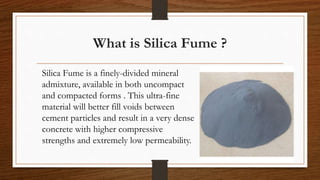
What is Silica Fume ?
Silica Fume is a finely-divided mineral
admixture, available in both uncompact
and compacted forms . This ultra-fine
material will better fill voids between
cement particles and result in a very dense
concrete with higher compressive
strengths and extremely low permeability.
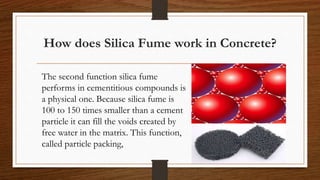
How does Silica Fume work in Concrete?
The second function silica fume
performs in cementitious compounds is
a physical one. Because silica fume is
100 to 150 times smaller than a cement
particle it can fill the voids created by
free water in the matrix. This function,
called particle packing,
Advantages of Silica Fume
• Lowers concrete permeability.
• Significantly increases concrete durability.
• Increases ultimate strength gain.
• Beneficial in all types of high strength concrete applications.
• Improves bond strength to steel.
• Significantly reduces alkali-silica reactivity.
• Provides excellent resistance to sulphate or seawater attack.
• Reduces steel corrosion.
• Improves freeze/thaw durability of concrete.
Uses of Silica Fume
For production of high strength concrete, corrosion-
resistant concrete, abrasion-resistant concrete, and
low permeability concrete. Used to make sewer and
manhole repair products. Reduces rebound in
shotcrete application.
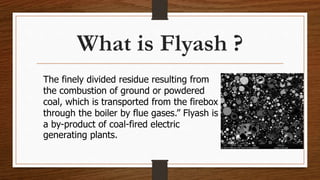
What is Flyash ?
The finely divided residue resulting from
the combustion of ground or powdered
coal, which is transported from the firebox
through the boiler by flue gases.” Flyash is
a by-product of coal-fired electric
generating plants.
Use of Flyash
Flyash will typically
require an air
entraining agent to
be added.
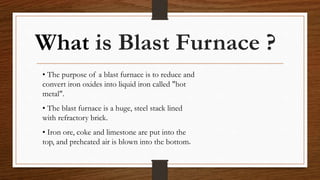
What is Blast Furnace ?
• The purpose of a blast furnace is to reduce and
convert iron oxides into liquid iron called "hot
metal".
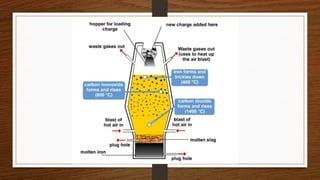
• The blast furnace is a huge, steel stack lined
with refractory brick.
• Iron ore, coke and limestone are put into the
top, and preheated air is blown into the bottom.
Silica fumes
Silica fumes

Silica fumes

  • 1.
  • 2.
    Context • Silica fume What is silica fume.  How does silica fumes works in concrete ?  Advantages of silica fumes.  Uses of silica fumes.
  • 3.
    What is SilicaFume ? Silica Fume is a finely-divided mineral admixture, available in both uncompact and compacted forms . This ultra-fine material will better fill voids between cement particles and result in a very dense concrete with higher compressive strengths and extremely low permeability.
  • 4.
    How does SilicaFume work in Concrete? The second function silica fume performs in cementitious compounds is a physical one. Because silica fume is 100 to 150 times smaller than a cement particle it can fill the voids created by free water in the matrix. This function, called particle packing,
  • 5.
    Advantages of SilicaFume • Lowers concrete permeability. • Significantly increases concrete durability. • Increases ultimate strength gain. • Beneficial in all types of high strength concrete applications. • Improves bond strength to steel. • Significantly reduces alkali-silica reactivity. • Provides excellent resistance to sulphate or seawater attack. • Reduces steel corrosion. • Improves freeze/thaw durability of concrete.
  • 6.
    Uses of SilicaFume For production of high strength concrete, corrosion- resistant concrete, abrasion-resistant concrete, and low permeability concrete. Used to make sewer and manhole repair products. Reduces rebound in shotcrete application.
  • 7.
    What is Flyash? The finely divided residue resulting from the combustion of ground or powdered coal, which is transported from the firebox through the boiler by flue gases.” Flyash is a by-product of coal-fired electric generating plants.
  • 8.
    Use of Flyash Flyashwill typically require an air entraining agent to be added.
  • 9.
    What is BlastFurnace ? • The purpose of a blast furnace is to reduce and convert iron oxides into liquid iron called "hot metal". • The blast furnace is a huge, steel stack lined with refractory brick. • Iron ore, coke and limestone are put into the top, and preheated air is blown into the bottom.