Integrating Simulation Training in a Nursing Theory Course  Marycarol Rossignol DNSc, RN Associate Professor College of Nursing
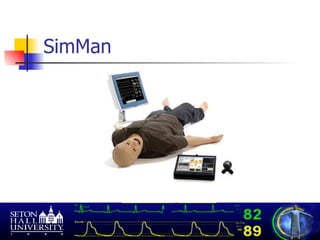
What is SimMan ® ? human simulator computer controlled manikin that displays physiologic data, such as heart rate, blood pressure, respiratory rate, prerecorded sounds supports clinical decision making activities preset scenarios available or ability to generate scenarios
SimMan
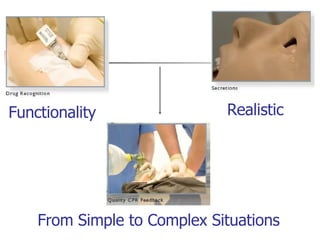
Functionality Realistic From Simple to Complex Situations
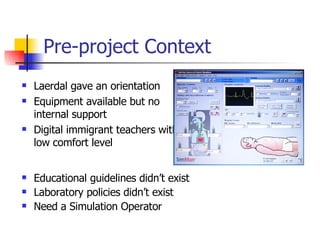
Pre-project Context Laerdal gave an orientation Equipment available but no internal support Digital immigrant teachers with low comfort level Educational guidelines didn’t exist Laboratory policies didn’t exist Need a Simulation Operator
Preproject Summary sporadic use lack of coordination lack of confidence
In-Class Attempt Failed! too many students scenario too complex students became upset inadequate supervision  decorum was inappropriate students lacked basic preparation for simulation training
Fig Proposal pilot scenarios in a nursing theory class (face-to-face class) work with TLTC to iron out logistics develop a student orientation program to simulation training in general prepare and implement clear expectations, policies, assignment guidelines
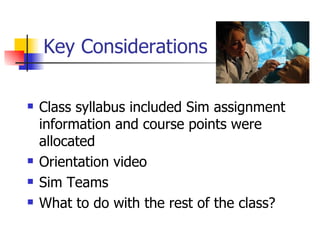
Key Considerations Class syllabus included Sim assignment information and course points were allocated Orientation video Sim Teams What to do with the rest of the class?
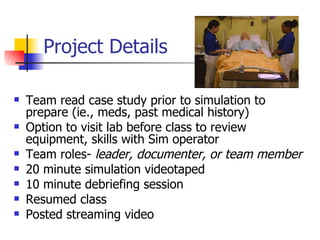
Project Details Team read case study prior to simulation to prepare (ie., meds, past medical history) Option to visit lab before class to review equipment, skills with Sim operator Team roles-  leader, documenter, or team member   20 minute simulation videotaped 10 minute debriefing session Resumed class Posted streaming video
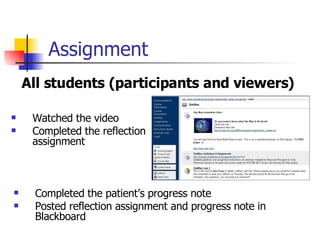
Watched the video Completed the reflection assignment Assignment Completed the patient’s progress note Posted reflection assignment and progress note in Blackboard All students (participants and viewers)
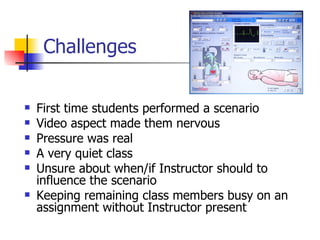
Challenges First time students performed a scenario Video aspect made them nervous Pressure was real A very quiet class Unsure about when/if Instructor should to influence the scenario Keeping remaining class members busy on an assignment without Instructor present
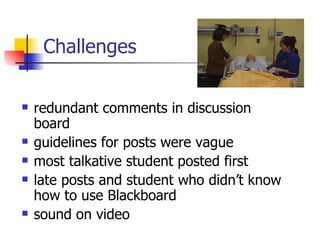
Challenges redundant comments in discussion board  guidelines for posts were vague most talkative student posted first late posts and student who didn’t know how to use Blackboard sound on video
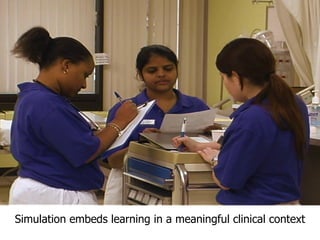
Simulation embeds learning in a meaningful clinical context
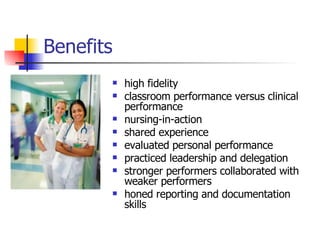
Benefits high fidelity classroom performance versus clinical performance nursing-in-action shared experience evaluated personal performance practiced leadership and delegation stronger performers collaborated with weaker performers honed reporting and documentation skills
What students said … “ I learned that my strengths were communicating with my team effectively and completing multiple tasks in a short period of time. For weakness, I realize I need to be more confident with doing assessments and not to be afraid to contribute opinions or strategies regarding patient treatment.”
What students said … “ I need to be more assertive on what I am doing, i am doing ok with meds preparation and calculation .” “ That I need to better prepare for next time.”  “ I doubt myself a lot.”  “ I think that my strengths are in assessment and performing procedures. My weakness may be in prioritizing some of the procedures that needs to be done.”
What students said … “ Being the team leader, I have to say one of my strengths was being able to be an appropriate leader and delegate the work to my team members as well as participating in the care myself. I noticed, however, that I was doing most of the talking during the video, and I could have let one of my team members talk as well.
Thank you TLTC especially Heidi Trotta,  Michael Soupios, and Karla Braithwaite

Simulation Nursing

  • 1.
    Integrating Simulation Trainingin a Nursing Theory Course Marycarol Rossignol DNSc, RN Associate Professor College of Nursing
  • 2.
    What is SimMan® ? human simulator computer controlled manikin that displays physiologic data, such as heart rate, blood pressure, respiratory rate, prerecorded sounds supports clinical decision making activities preset scenarios available or ability to generate scenarios
  • 3.
  • 4.
    Functionality Realistic FromSimple to Complex Situations
  • 5.
    Pre-project Context Laerdalgave an orientation Equipment available but no internal support Digital immigrant teachers with low comfort level Educational guidelines didn’t exist Laboratory policies didn’t exist Need a Simulation Operator
  • 6.
    Preproject Summary sporadicuse lack of coordination lack of confidence
  • 7.
    In-Class Attempt Failed!too many students scenario too complex students became upset inadequate supervision decorum was inappropriate students lacked basic preparation for simulation training
  • 8.
    Fig Proposal pilotscenarios in a nursing theory class (face-to-face class) work with TLTC to iron out logistics develop a student orientation program to simulation training in general prepare and implement clear expectations, policies, assignment guidelines
  • 9.
    Key Considerations Classsyllabus included Sim assignment information and course points were allocated Orientation video Sim Teams What to do with the rest of the class?
  • 10.
    Project Details Teamread case study prior to simulation to prepare (ie., meds, past medical history) Option to visit lab before class to review equipment, skills with Sim operator Team roles- leader, documenter, or team member 20 minute simulation videotaped 10 minute debriefing session Resumed class Posted streaming video
  • 11.
    Watched the videoCompleted the reflection assignment Assignment Completed the patient’s progress note Posted reflection assignment and progress note in Blackboard All students (participants and viewers)
  • 12.
    Challenges First timestudents performed a scenario Video aspect made them nervous Pressure was real A very quiet class Unsure about when/if Instructor should to influence the scenario Keeping remaining class members busy on an assignment without Instructor present
  • 13.
    Challenges redundant commentsin discussion board guidelines for posts were vague most talkative student posted first late posts and student who didn’t know how to use Blackboard sound on video
  • 14.
    Simulation embeds learningin a meaningful clinical context
  • 15.
    Benefits high fidelityclassroom performance versus clinical performance nursing-in-action shared experience evaluated personal performance practiced leadership and delegation stronger performers collaborated with weaker performers honed reporting and documentation skills
  • 16.
    What students said… “ I learned that my strengths were communicating with my team effectively and completing multiple tasks in a short period of time. For weakness, I realize I need to be more confident with doing assessments and not to be afraid to contribute opinions or strategies regarding patient treatment.”
  • 17.
    What students said… “ I need to be more assertive on what I am doing, i am doing ok with meds preparation and calculation .” “ That I need to better prepare for next time.” “ I doubt myself a lot.” “ I think that my strengths are in assessment and performing procedures. My weakness may be in prioritizing some of the procedures that needs to be done.”
  • 18.
    What students said… “ Being the team leader, I have to say one of my strengths was being able to be an appropriate leader and delegate the work to my team members as well as participating in the care myself. I noticed, however, that I was doing most of the talking during the video, and I could have let one of my team members talk as well.
  • 19.
    Thank you TLTCespecially Heidi Trotta, Michael Soupios, and Karla Braithwaite