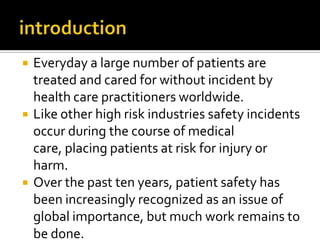
   Everyday a large number of patients are
    treated and cared for without incident by
    health care practitioners worldwide.
   Like other high risk industries safety incidents
    occur during the course of medical
    care, placing patients at risk for injury or
    harm.
   Over the past ten years, patient safety has
    been increasingly recognized as an issue of
    global importance, but much work remains to
    be done.
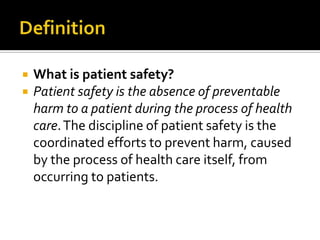
   What is patient safety?
   Patient safety is the absence of preventable
    harm to a patient during the process of health
    care. The discipline of patient safety is the
    coordinated efforts to prevent harm, caused
    by the process of health care itself, from
    occurring to patients.
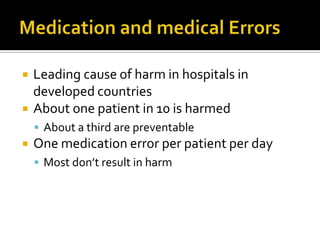
   Leading cause of harm in hospitals in
    developed countries
   About one patient in 10 is harmed
     About a third are preventable
   One medication error per patient per day
     Most don’t result in harm
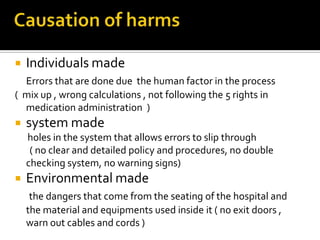
   Individuals made
  Errors that are done due the human factor in the process
( mix up , wrong calculations , not following the 5 rights in
  medication administration )
   system made
    holes in the system that allows errors to slip through
     ( no clear and detailed policy and procedures, no double
    checking system, no warning signs)
   Environmental made
     the dangers that come from the seating of the hospital and
    the material and equipments used inside it ( no exit doors ,
    warn out cables and cords )
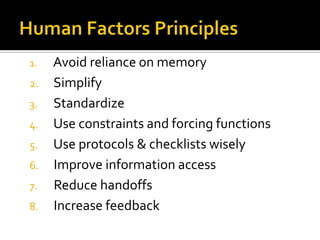
1.   Avoid reliance on memory
2.   Simplify
3.   Standardize
4.   Use constraints and forcing functions
5.   Use protocols & checklists wisely
6.   Improve information access
7.   Reduce handoffs
8.   Increase feedback
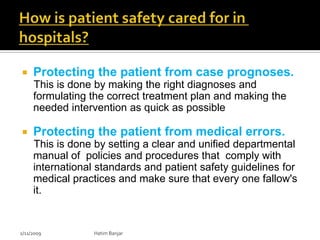
    Protecting the patient from case prognoses.
     This is done by making the right diagnoses and
     formulating the correct treatment plan and making the
     needed intervention as quick as possible

    Protecting the patient from medical errors.
     This is done by setting a clear and unified departmental
     manual of policies and procedures that comply with
     international standards and patient safety guidelines for
     medical practices and make sure that every one fallow's
     it.


2/11/2009         Hatim Banjar
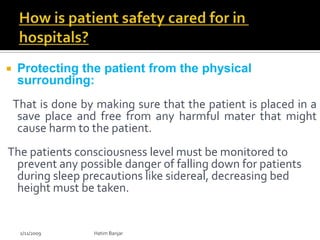
   Protecting the patient from the physical
    surrounding:
    That is done by making sure that the patient is placed in a
     save place and free from any harmful mater that might
     cause harm to the patient.
The patients consciousness level must be monitored to
 prevent any possible danger of falling down for patients
 during sleep precautions like sidereal, decreasing bed
 height must be taken.


     2/11/2009     Hatim Banjar
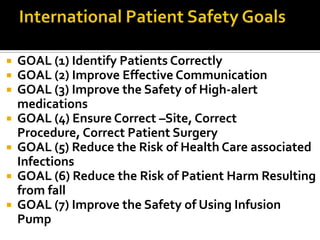
   GOAL (1) Identify Patients Correctly
   GOAL (2) Improve Effective Communication
   GOAL (3) Improve the Safety of High-alert
    medications
   GOAL (4) Ensure Correct –Site, Correct
    Procedure, Correct Patient Surgery
   GOAL (5) Reduce the Risk of Health Care associated
    Infections
   GOAL (6) Reduce the Risk of Patient Harm Resulting
    from fall
   GOAL (7) Improve the Safety of Using Infusion
    Pump
   Blood sample tubes:
   - RED tube for serology (6cc)-
   -GREEN tube for chemistry (5cc)
   - VIOLET tube for hematology (2cc)
   If doctor order- ( hormone or depakin )
    investigation use RED tube.
   (pt,ptt) investigation use BLUE tube.

   Give an example of human performance
    limitation ?
   Give an example of a human factors
    problem?
   Communication problem?
   Latent error in your setting?
   Although many of the patient safety risk factors
    that exist in medical settings also apply to
    mental health settings
   there are unique patient safety issues in mental
    health that are
   different to those in medical care.
   Seclusion and restraint use, self-harming
    behavior and suicide , absconding, and reduced
    capacity for self-advocacy are particularly
    prominent to mental health patients.
   Both the patient population and the
    environment make patient safety in mental
    health unique.
    Protecting the patient from harming himself :
     That is done by monitoring patients with tendency to
     comet suicide or to cause harm to themselves and placing
     them under clues observation, exploring their thought
     content and try to distract them away from such ideas and
     try to occupy their time with different activities and give
     them a since of hope in life and place them in a safe
     environment in the wards away from any external
     stimulators for such ideas and away from any harmful
     object that he might use to cause harm to him self .


2/11/2009         Hatim Banjar
Protecting the patient from being harmed by
                       others:

   That is done by
    monitoring aggressive and provoking behaviors so
    physical contact ( fights) don't happen among
    patients, delusions and wrong beliefs are also monitored
    to prevent patients from causing harm to each other due
    to the delusions or beliefs and in case of any physical
    contact among patients nurses must interfere as quickly
    as possible using the right manner of intervention
   patients of deferent age groups and genders must be
    separated to prevent sexual assault ( male – female )
    ( adult – teenagers - children ) .

    2/11/2009      Hatim Banjar
Patient safety during restrain episodes
That is done by following the correct and safe steps to administer
  restrains :
  never use restrains with out a medical order.
  never use retrains as a punishment method or for personal revenge.
  always tell the patient the reason from restraining him.
  make sure that restrains do not block the blood circulation .
  chick on patient and take vital signs every 15min.
  make sure room temperature is appropriate .
  always restrain the patient in a supine position.
  make sure that the patient's physical needs are met.
  do not apply restrains to cases of resent ophthalmic surgery, spinal
  surgery, harts conditions, chest and respiratory problems.
  the restrain room physical surrounding must be appropriate and equipped
  with a monitoring camera.
  patient should be on monitors through all the restraining time .

   2/11/2009         Hatim Banjar
Patient safety during seclusion episodes

That is done by following the correct safety measures:
  never use seclusion with out a medical order.
  never use seclusion as punishment or for personal revenge.
  always tell the patient the reason of putting him in seclusion.
  chick on patient every 15 min.
  make sure that the room is harm free.
  make sure that the room physical surrounding is appropriate
  and equipped with a monitoring camera.
  make sure that the patient physical needs are met.
  seclusion should not be done to cases in risk of self
  harm, autism, cardiac and respiratory disorders and phobic
  patients.

  2/11/2009      Hatim Banj
 Never face an aggressive P.T on your own.
 Always be calm and use an appropriate voice tone.
 Never turn your back to the patient.
 Always keep eye contact.
 Always keep an arm space between the nurse and
  the patient during confrontation.
 When trying to physically control the patient
  approach him from the back and sides.


2/11/2009    Hatim Banjar
   A patient that had been admitted to an
    addiction treatment facility was recognized
    by one of the employees and that employee
    told his sister about the patient identity.
   Is there a safety risk?
   What kind of risk ?
   How dose it affect the patient?
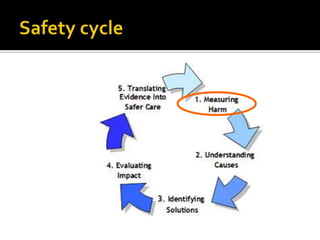
   In easy words clinical risk management is
    identifying the risk factors and sources of
    harm that might cause a threat to patient
    safety in a health service seating and working
    on reducing and eliminating them
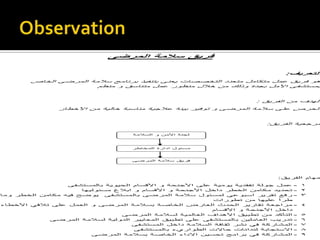
   Observation
   Self-reports
   Physical evidence (document review)
:


:


    :


        :

                -
                -
                -

                -

                -
                -
                -
                -
                -

-
-
-
-
-
-
-
-


-

-
-
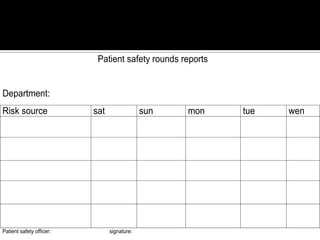
Patient safety rounds reports


Department:
Risk source               sat                sun   mon     tue   wen


Patient safety officer:         signature:
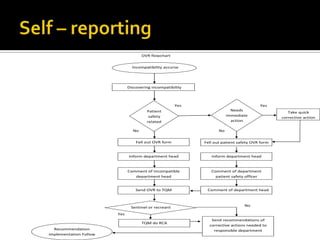
OVR flowchart


                                Incompatibility accurse


                              Discovering incompatibility


                                                      Yes                              Yes
                                       Patient                            Needs
                                                                                                  Take quick
                                        safety                          immediate
                                                                                               corrective action
                                       related                            action

                                No                                 No


                                  Fell out OVR form         Fell out patient safety OVR form


                              Inform department head           Inform department head


                              Comment of incompatible          Comment of department
                                 department head                 patient safety officer


                                  Send OVR to TQM            Comment of department head


                                                                                No
                               Sentinel or recreant
                        Yes
                                                               Send recommendations of
                                     TQM do RCA
                                                              corrective actions needed to
  Recommendation                                                responsible department
implementation Follow
   Error
     The failure of a planned action to be completed as
     intended or use of a wrong inappropriate, or
     incorrect plan to achieve an aim.
   Adverse event
     An injury that was caused by medical
     management or complication instead of the
     underlying disease and that resulted in prolonged
     hospitalization or disability at the time of
     discharge from medical care, or both
   Near miss
     An event that almost happened or an event that
     did happen but no one knows about. If the person
     involved in the near miss does not come forward,
     no one may ever know it occurred.
   Safety culture
    A culture that exhibits the following five high-level
      attributes that health care professionals strive to
      operationalize through the implementation of strong
      safety management systems.
      (1) A culture where all workers (including front-line staff, physicians, and
         administrators) accept responsibility or the safety of themselves, their
         coworkers, patients, and visitors.
      (2) [A culture that] prioritizes safety above financial and operational goals.
      (3) [A culture that] encourages and rewards the identification, communication, and
         resolution of safety issues.
      (4) [A culture that] provides for organizational learning from accidents.
      (5) [A culture that] provides appropriate resources, structure, and accountability to
         maintain effective safety systems.
Patient safety

Patient safety

  • 2.
    Everyday a large number of patients are treated and cared for without incident by health care practitioners worldwide.  Like other high risk industries safety incidents occur during the course of medical care, placing patients at risk for injury or harm.  Over the past ten years, patient safety has been increasingly recognized as an issue of global importance, but much work remains to be done.
  • 3.
    What is patient safety?  Patient safety is the absence of preventable harm to a patient during the process of health care. The discipline of patient safety is the coordinated efforts to prevent harm, caused by the process of health care itself, from occurring to patients.
  • 4.
    Leading cause of harm in hospitals in developed countries  About one patient in 10 is harmed  About a third are preventable  One medication error per patient per day  Most don’t result in harm
  • 5.
    Individuals made Errors that are done due the human factor in the process ( mix up , wrong calculations , not following the 5 rights in medication administration )  system made holes in the system that allows errors to slip through ( no clear and detailed policy and procedures, no double checking system, no warning signs)  Environmental made the dangers that come from the seating of the hospital and the material and equipments used inside it ( no exit doors , warn out cables and cords )
  • 6.
    1. Avoid reliance on memory 2. Simplify 3. Standardize 4. Use constraints and forcing functions 5. Use protocols & checklists wisely 6. Improve information access 7. Reduce handoffs 8. Increase feedback
  • 7.
    Protecting the patient from case prognoses. This is done by making the right diagnoses and formulating the correct treatment plan and making the needed intervention as quick as possible  Protecting the patient from medical errors. This is done by setting a clear and unified departmental manual of policies and procedures that comply with international standards and patient safety guidelines for medical practices and make sure that every one fallow's it. 2/11/2009 Hatim Banjar
  • 8.
    Protecting the patient from the physical surrounding: That is done by making sure that the patient is placed in a save place and free from any harmful mater that might cause harm to the patient. The patients consciousness level must be monitored to prevent any possible danger of falling down for patients during sleep precautions like sidereal, decreasing bed height must be taken. 2/11/2009 Hatim Banjar
  • 9.
    GOAL (1) Identify Patients Correctly  GOAL (2) Improve Effective Communication  GOAL (3) Improve the Safety of High-alert medications  GOAL (4) Ensure Correct –Site, Correct Procedure, Correct Patient Surgery  GOAL (5) Reduce the Risk of Health Care associated Infections  GOAL (6) Reduce the Risk of Patient Harm Resulting from fall  GOAL (7) Improve the Safety of Using Infusion Pump
  • 13.
    Blood sample tubes:  - RED tube for serology (6cc)-  -GREEN tube for chemistry (5cc)  - VIOLET tube for hematology (2cc)  If doctor order- ( hormone or depakin ) investigation use RED tube.  (pt,ptt) investigation use BLUE tube. 
  • 14.
    Give an example of human performance limitation ?  Give an example of a human factors problem?  Communication problem?  Latent error in your setting?
  • 15.
    Although many of the patient safety risk factors that exist in medical settings also apply to mental health settings  there are unique patient safety issues in mental health that are  different to those in medical care.  Seclusion and restraint use, self-harming behavior and suicide , absconding, and reduced capacity for self-advocacy are particularly prominent to mental health patients.  Both the patient population and the environment make patient safety in mental health unique.
  • 16.
    Protecting the patient from harming himself : That is done by monitoring patients with tendency to comet suicide or to cause harm to themselves and placing them under clues observation, exploring their thought content and try to distract them away from such ideas and try to occupy their time with different activities and give them a since of hope in life and place them in a safe environment in the wards away from any external stimulators for such ideas and away from any harmful object that he might use to cause harm to him self . 2/11/2009 Hatim Banjar
  • 17.
    Protecting the patientfrom being harmed by others:  That is done by  monitoring aggressive and provoking behaviors so physical contact ( fights) don't happen among patients, delusions and wrong beliefs are also monitored to prevent patients from causing harm to each other due to the delusions or beliefs and in case of any physical contact among patients nurses must interfere as quickly as possible using the right manner of intervention  patients of deferent age groups and genders must be separated to prevent sexual assault ( male – female ) ( adult – teenagers - children ) . 2/11/2009 Hatim Banjar
  • 18.
    Patient safety duringrestrain episodes That is done by following the correct and safe steps to administer restrains : never use restrains with out a medical order. never use retrains as a punishment method or for personal revenge. always tell the patient the reason from restraining him. make sure that restrains do not block the blood circulation . chick on patient and take vital signs every 15min. make sure room temperature is appropriate . always restrain the patient in a supine position. make sure that the patient's physical needs are met. do not apply restrains to cases of resent ophthalmic surgery, spinal surgery, harts conditions, chest and respiratory problems. the restrain room physical surrounding must be appropriate and equipped with a monitoring camera. patient should be on monitors through all the restraining time . 2/11/2009 Hatim Banjar
  • 19.
    Patient safety duringseclusion episodes That is done by following the correct safety measures: never use seclusion with out a medical order. never use seclusion as punishment or for personal revenge. always tell the patient the reason of putting him in seclusion. chick on patient every 15 min. make sure that the room is harm free. make sure that the room physical surrounding is appropriate and equipped with a monitoring camera. make sure that the patient physical needs are met. seclusion should not be done to cases in risk of self harm, autism, cardiac and respiratory disorders and phobic patients. 2/11/2009 Hatim Banj
  • 20.
     Never facean aggressive P.T on your own.  Always be calm and use an appropriate voice tone.  Never turn your back to the patient.  Always keep eye contact.  Always keep an arm space between the nurse and the patient during confrontation.  When trying to physically control the patient approach him from the back and sides. 2/11/2009 Hatim Banjar
  • 21.
    A patient that had been admitted to an addiction treatment facility was recognized by one of the employees and that employee told his sister about the patient identity.  Is there a safety risk?  What kind of risk ?  How dose it affect the patient?
  • 22.
    In easy words clinical risk management is identifying the risk factors and sources of harm that might cause a threat to patient safety in a health service seating and working on reducing and eliminating them
  • 24.
    Observation  Self-reports  Physical evidence (document review)
  • 25.
    : : : : - - - - - - - - -
  • 26.
  • 27.
    Patient safety roundsreports Department: Risk source sat sun mon tue wen Patient safety officer: signature:
  • 28.
    OVR flowchart Incompatibility accurse Discovering incompatibility Yes Yes Patient Needs Take quick safety immediate corrective action related action No No Fell out OVR form Fell out patient safety OVR form Inform department head Inform department head Comment of incompatible Comment of department department head patient safety officer Send OVR to TQM Comment of department head No Sentinel or recreant Yes Send recommendations of TQM do RCA corrective actions needed to Recommendation responsible department implementation Follow
  • 29.
    Error  The failure of a planned action to be completed as intended or use of a wrong inappropriate, or incorrect plan to achieve an aim.  Adverse event  An injury that was caused by medical management or complication instead of the underlying disease and that resulted in prolonged hospitalization or disability at the time of discharge from medical care, or both
  • 30.
    Near miss  An event that almost happened or an event that did happen but no one knows about. If the person involved in the near miss does not come forward, no one may ever know it occurred.
  • 31.
    Safety culture A culture that exhibits the following five high-level attributes that health care professionals strive to operationalize through the implementation of strong safety management systems. (1) A culture where all workers (including front-line staff, physicians, and administrators) accept responsibility or the safety of themselves, their coworkers, patients, and visitors. (2) [A culture that] prioritizes safety above financial and operational goals. (3) [A culture that] encourages and rewards the identification, communication, and resolution of safety issues. (4) [A culture that] provides for organizational learning from accidents. (5) [A culture that] provides appropriate resources, structure, and accountability to maintain effective safety systems.