BASIC
CINEMATOGRAPHY
Louise Sands 2019
CINEMATOGRAPHY IS EXTENSIVE
• Imagine trying to teach “programming” or “solving
differential equations” or “writing a great novel” in 20
minutes
• This presentation only covers the most cursory aspects
of cinematography
• You need to watch a lot of films
• You need to make a lot of films
• Improve one element with revision
• Greatness takes a career and talent
• Strive for inconspicious and ordinary in your first year,
so that the audience can focus on your film’s content
and not be distracted by amateur style errors
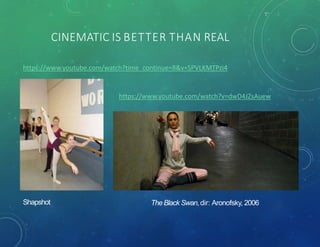
CINEMATIC IS BETTER THAN REAL
TheBlack Swan,dir: Aronofsky, 2006Shapshot
https://www.youtube.com/watch?time_continue=8&v=SPVLKMTPzi4
https://www.youtube.com/watch?v=dwD4JZsAuew
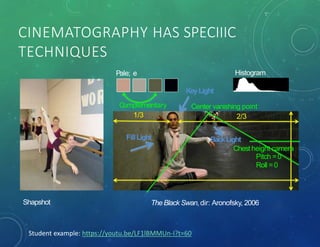
CINEMATOGRAPHY HAS SPECIIIC
TECHNIQUES
TheBlack Swan,dir: Aronofsky, 2006
FillLight BackLight
Pale; e Histogram
Shapshot
Chestheight camera
Pitch =0
Roll =0
KeyLight
Center vanishing point
2/3
Complementary
1/3
Student example: https://youtu.be/LF1lBMMUn-I?t=60
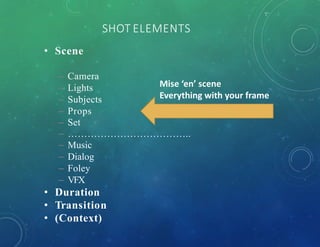
SHOT ELEMENTS
• Scene
– Camera
– Lights
– Subjects
– Props
– Set
– ………………………………..
– Music
– Dialog
– Foley
– VFX
• Duration
• Transition
• (Context)
Mise ‘en’ scene
Everything with your frame
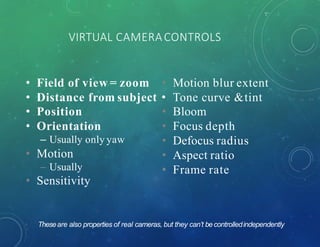
VIRTUAL CAMERACONTROLS
• Position
• Orientation
– Usually only yaw
• Motion
– Usually
• Sensitivity
• Field of view = zoom • Motion blur extent
• Distance from subject • Tone curve &tint
• Bloom
• Focus depth
• Defocus radius
• Aspect ratio
• Frame rate
Theseare also properties of real cameras, but they can’t becontrolledindependently
STANDARD CAMERALOCATIONS
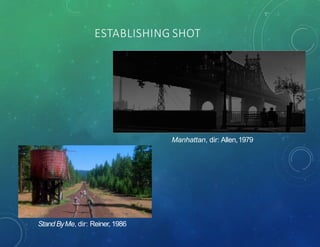
• Establishing shot
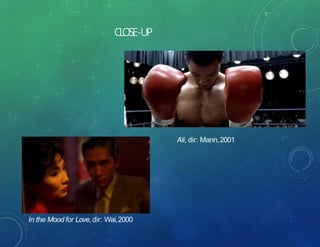
• Close-‐up(“Insert shot”)
• Over-‐the-‐shoulder
• Tracking shot (followcam)
• Crane shot (“3rd person”)
• Point-‐of-‐view(“1st person”)
– Extremely rare!
– Usually preceeded by a reaction shot
CINEMATOGRAPHY SCALES
Framing: Setting an approach or query
within an appropriate context to
achieve a desired result
ESTABLISHING SHOT
Manhattan, dir: Allen,1979
Stand ByMe, dir: Reiner, 1986
CLOSE-UP
Ali, dir: Mann,2001
In the Mood for Love, dir: Wai,2000
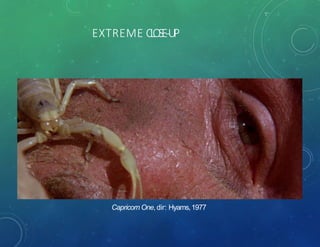
EXTREME CLOSE-‐UP
Capricorn One, dir: Hyams,1977
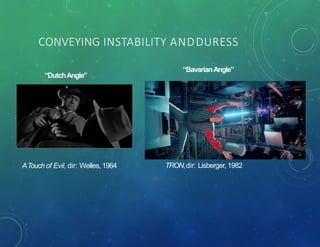
CONVEYING INSTABILITY ANDDURESS
ATouchof Evil, dir: Welles,1964 TRON,dir: Lisberger, 1982
“DutchAngle”
“BavarianAngle”
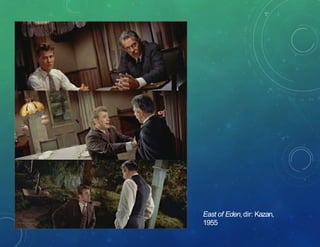
East of Eden,dir: Kazan,
1955
CAMERA MOVEMENT
• Children of Men
• https://www.youtube.com/watch?v=YBzWTIexszQ
• House of Flying Daggers
• https://www.youtube.com/watch?v=Tk9tqFd5sGI
• Fight Club
• https://www.youtube.com/watch?v=J8FRBYOFu2w
• Motivated movement:
https://www.youtube.com/watch?v=GfqD5WqChUY
•
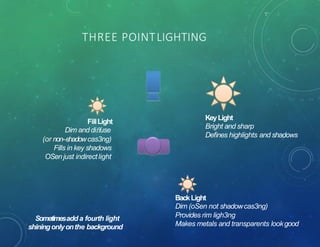
THREE POINTLIGHTING
KeyLight
Bright and sharp
Defines highlights and shadows
BackLight
Dim (oSen not shadowcas3ng)
Provides rim ligh3ng
Makes metals and transparents lookgood
FillLight
Dim and diffuse
(or non-‐shadowcas3ng)
Fills in key shadows
OSenjust indirectlight
Sometimesadda fourth light
shiningonlyonthe background
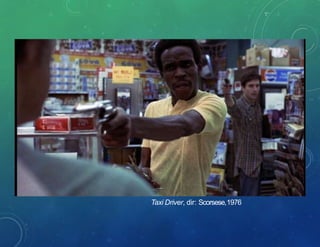
Taxi Driver, dir: Scorsese,1976
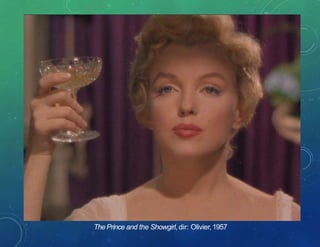
ThePrince and the Showgirl, dir: Olivier,1957
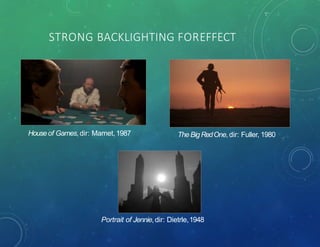
STRONG BACKLIGHTING FOREFFECT
Portrait of Jennie,dir: Dietrle,1948
TheBigRedOne, dir: Fuller, 1980Houseof Games,dir: Mamet,1987
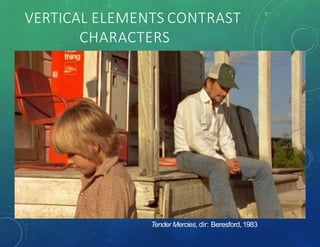
VERTICAL ELEMENTS CONTRAST
CHARACTERS
Tender Mercies, dir: Beresford,1983
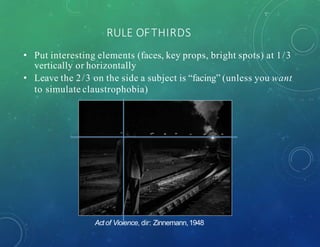
RULE OFTHIRDS
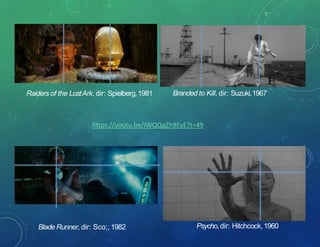
• Put interesting elements (faces, key props, bright spots) at 1/3
vertically or horizontally
• Leave the 2/3 on the side a subject is “facing” (unless you want
to simulate claustrophobia)
Actof Violence, dir: Zinnemann,1948
Raiders of the LostArk, dir: Spielberg,1981
Blade Runner, dir: Sco;, 1982
Branded to Kill, dir: Suzuki,1967
Psycho,dir: Hitchcock,1960
https://youtu.be/iWQQgZh9EyE?t=49
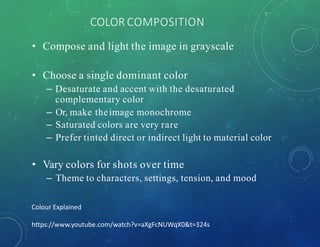
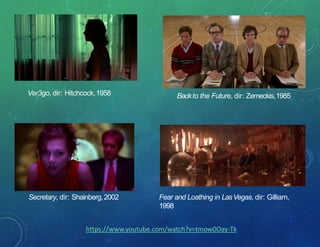
COLOR COMPOSITION
• Compose and light the image in grayscale
• Choose a single dominant color
– Desaturate and accent with the desaturated
complementary color
– Or, make theimage monochrome
– Saturated colors are very rare
– Prefer tinted direct or indirect light to material color
• Vary colors for shots over time
– Theme to characters, settings, tension, and mood
Colour Explained
https://www.youtube.com/watch?v=aXgFcNUWqX0&t=324s
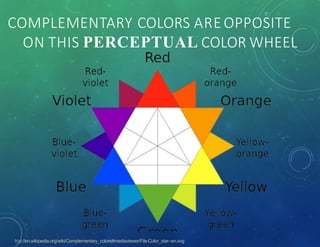
COMPLEMENTARY COLORS AREOPPOSITE
ON THIS PERCEPTUAL COLOR WHEEL
h;p://en.wikipedia.org/wiki/Complementary_colors#mediaviewer/File:Color_star-‐en.svg
Ver3go, dir: Hitchcock,1958 Backto the Future, dir: Zemeckis,1985
Fear and Loathing in LasVegas, dir: Gilliam,
1998
Secretary, dir: Shainberg,2002
https://www.youtube.com/watch?v=tmow0Oay-Tk
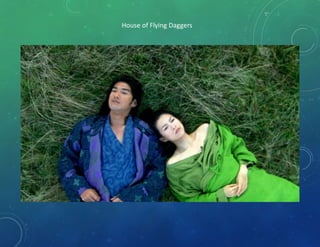
House of Flying Daggers
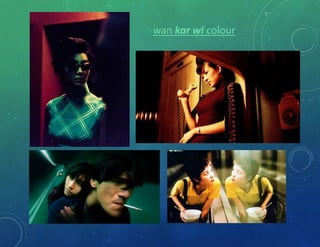
wan kar wi colour
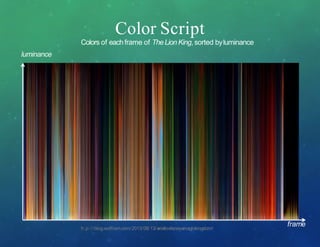
Color Script
Colors of eachframe of TheLion King, sorted byluminance
h;p://blog.wolfram.com/2013/08/13/a-‐visit-‐to-‐disneys-‐magic-‐kingdom/
luminance
frame
TRANSITIONS
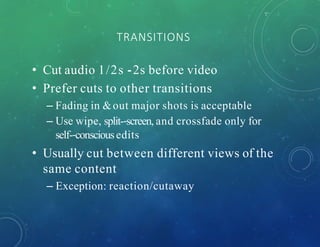
• Cut audio 1/2s -‐2s before video
• Prefer cuts to other transitions
– Fading in &out major shots is acceptable
– Use wipe, split-‐screen, and crossfade only for
self-‐consciousedits
• Usually cut between different views of the
same content
– Exception: reaction/cutaway
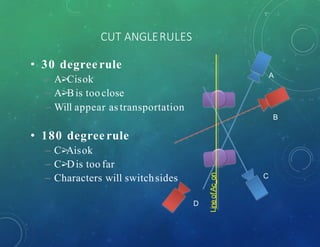
CUT ANGLERULES
• 30 degree rule
– A-‐>Cisok
– A-‐>Bis tooclose
– Will appear as transportation
• 180 degree rule
– C-‐>Aisok
– C-‐>Dis too far
– Characters will switchsides
A
C
D
B
LineofAc_on
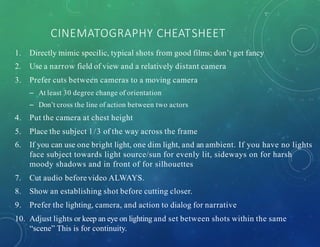
CINEMATOGRAPHY CHEATSHEET
1. Directly mimic speciIic, typical shots from good films; don’t get fancy
2. Use a narrow field of view and a relatively distant camera
3. Prefer cuts between cameras to a moving camera
– At least 30 degree change of orientation
– Don’t cross the line of action between two actors
4. Put the camera at chest height
5. Place the subject 1/3 of the way across the frame
6. If you can use one bright light, one dim light, and an ambient. If you have no lights
face subject towards light source/sun for evenly lit, sideways on for harsh
moody shadows and in front of for silhouettes
7. Cut audio before video ALWAYS.
8. Show an establishing shot before cutting closer.
9. Prefer the lighting, camera, and action to dialog for narrative
10. Adjust lights or keep an eye on lighting and set between shots within the same
“scene” This is for continuity.
REFERENCES
• Haigh-‐Hutchinson,Real-‐Time Cameras, Morgan Kaufmann,2009
• Arijon, Grammar of theFilm Language, Silman-‐JamesPress, 1976
• Masson, CG101: A Computer Graphics Industry Reference, Digital
Fauxtography Inc.,1999
• Malkiewicz, Cinematography, Simon &Schuster, 1992
• Frames captured by@OnePerfectShot

Basics cinematography

  • 1.
  • 2.
    CINEMATOGRAPHY IS EXTENSIVE •Imagine trying to teach “programming” or “solving differential equations” or “writing a great novel” in 20 minutes • This presentation only covers the most cursory aspects of cinematography • You need to watch a lot of films • You need to make a lot of films • Improve one element with revision • Greatness takes a career and talent • Strive for inconspicious and ordinary in your first year, so that the audience can focus on your film’s content and not be distracted by amateur style errors
  • 3.
    CINEMATIC IS BETTERTHAN REAL TheBlack Swan,dir: Aronofsky, 2006Shapshot https://www.youtube.com/watch?time_continue=8&v=SPVLKMTPzi4 https://www.youtube.com/watch?v=dwD4JZsAuew
  • 4.
    CINEMATOGRAPHY HAS SPECIIIC TECHNIQUES TheBlackSwan,dir: Aronofsky, 2006 FillLight BackLight Pale; e Histogram Shapshot Chestheight camera Pitch =0 Roll =0 KeyLight Center vanishing point 2/3 Complementary 1/3 Student example: https://youtu.be/LF1lBMMUn-I?t=60
  • 5.
    SHOT ELEMENTS • Scene –Camera – Lights – Subjects – Props – Set – ……………………………….. – Music – Dialog – Foley – VFX • Duration • Transition • (Context) Mise ‘en’ scene Everything with your frame
  • 6.
    VIRTUAL CAMERACONTROLS • Position •Orientation – Usually only yaw • Motion – Usually • Sensitivity • Field of view = zoom • Motion blur extent • Distance from subject • Tone curve &tint • Bloom • Focus depth • Defocus radius • Aspect ratio • Frame rate Theseare also properties of real cameras, but they can’t becontrolledindependently
  • 7.
    STANDARD CAMERALOCATIONS • Establishingshot • Close-‐up(“Insert shot”) • Over-‐the-‐shoulder • Tracking shot (followcam) • Crane shot (“3rd person”) • Point-‐of-‐view(“1st person”) – Extremely rare! – Usually preceeded by a reaction shot
  • 8.
    CINEMATOGRAPHY SCALES Framing: Settingan approach or query within an appropriate context to achieve a desired result
  • 9.
    ESTABLISHING SHOT Manhattan, dir:Allen,1979 Stand ByMe, dir: Reiner, 1986
  • 10.
    CLOSE-UP Ali, dir: Mann,2001 Inthe Mood for Love, dir: Wai,2000
  • 11.
  • 12.
    CONVEYING INSTABILITY ANDDURESS ATouchofEvil, dir: Welles,1964 TRON,dir: Lisberger, 1982 “DutchAngle” “BavarianAngle”
  • 13.
    East of Eden,dir:Kazan, 1955
  • 14.
    CAMERA MOVEMENT • Childrenof Men • https://www.youtube.com/watch?v=YBzWTIexszQ • House of Flying Daggers • https://www.youtube.com/watch?v=Tk9tqFd5sGI • Fight Club • https://www.youtube.com/watch?v=J8FRBYOFu2w • Motivated movement: https://www.youtube.com/watch?v=GfqD5WqChUY •
  • 15.
    THREE POINTLIGHTING KeyLight Bright andsharp Defines highlights and shadows BackLight Dim (oSen not shadowcas3ng) Provides rim ligh3ng Makes metals and transparents lookgood FillLight Dim and diffuse (or non-‐shadowcas3ng) Fills in key shadows OSenjust indirectlight Sometimesadda fourth light shiningonlyonthe background
  • 16.
    Taxi Driver, dir:Scorsese,1976
  • 17.
    ThePrince and theShowgirl, dir: Olivier,1957
  • 18.
    STRONG BACKLIGHTING FOREFFECT Portraitof Jennie,dir: Dietrle,1948 TheBigRedOne, dir: Fuller, 1980Houseof Games,dir: Mamet,1987
  • 19.
  • 20.
    RULE OFTHIRDS • Putinteresting elements (faces, key props, bright spots) at 1/3 vertically or horizontally • Leave the 2/3 on the side a subject is “facing” (unless you want to simulate claustrophobia) Actof Violence, dir: Zinnemann,1948
  • 21.
    Raiders of theLostArk, dir: Spielberg,1981 Blade Runner, dir: Sco;, 1982 Branded to Kill, dir: Suzuki,1967 Psycho,dir: Hitchcock,1960 https://youtu.be/iWQQgZh9EyE?t=49
  • 22.
    COLOR COMPOSITION • Composeand light the image in grayscale • Choose a single dominant color – Desaturate and accent with the desaturated complementary color – Or, make theimage monochrome – Saturated colors are very rare – Prefer tinted direct or indirect light to material color • Vary colors for shots over time – Theme to characters, settings, tension, and mood Colour Explained https://www.youtube.com/watch?v=aXgFcNUWqX0&t=324s
  • 23.
    COMPLEMENTARY COLORS AREOPPOSITE ONTHIS PERCEPTUAL COLOR WHEEL h;p://en.wikipedia.org/wiki/Complementary_colors#mediaviewer/File:Color_star-‐en.svg
  • 24.
    Ver3go, dir: Hitchcock,1958Backto the Future, dir: Zemeckis,1985 Fear and Loathing in LasVegas, dir: Gilliam, 1998 Secretary, dir: Shainberg,2002 https://www.youtube.com/watch?v=tmow0Oay-Tk
  • 25.
  • 26.
    wan kar wicolour
  • 27.
    Color Script Colors ofeachframe of TheLion King, sorted byluminance h;p://blog.wolfram.com/2013/08/13/a-‐visit-‐to-‐disneys-‐magic-‐kingdom/ luminance frame
  • 28.
    TRANSITIONS • Cut audio1/2s -‐2s before video • Prefer cuts to other transitions – Fading in &out major shots is acceptable – Use wipe, split-‐screen, and crossfade only for self-‐consciousedits • Usually cut between different views of the same content – Exception: reaction/cutaway
  • 29.
    CUT ANGLERULES • 30degree rule – A-‐>Cisok – A-‐>Bis tooclose – Will appear as transportation • 180 degree rule – C-‐>Aisok – C-‐>Dis too far – Characters will switchsides A C D B LineofAc_on
  • 30.
    CINEMATOGRAPHY CHEATSHEET 1. Directlymimic speciIic, typical shots from good films; don’t get fancy 2. Use a narrow field of view and a relatively distant camera 3. Prefer cuts between cameras to a moving camera – At least 30 degree change of orientation – Don’t cross the line of action between two actors 4. Put the camera at chest height 5. Place the subject 1/3 of the way across the frame 6. If you can use one bright light, one dim light, and an ambient. If you have no lights face subject towards light source/sun for evenly lit, sideways on for harsh moody shadows and in front of for silhouettes 7. Cut audio before video ALWAYS. 8. Show an establishing shot before cutting closer. 9. Prefer the lighting, camera, and action to dialog for narrative 10. Adjust lights or keep an eye on lighting and set between shots within the same “scene” This is for continuity.
  • 31.
    REFERENCES • Haigh-‐Hutchinson,Real-‐Time Cameras,Morgan Kaufmann,2009 • Arijon, Grammar of theFilm Language, Silman-‐JamesPress, 1976 • Masson, CG101: A Computer Graphics Industry Reference, Digital Fauxtography Inc.,1999 • Malkiewicz, Cinematography, Simon &Schuster, 1992 • Frames captured by@OnePerfectShot