Film 100: Introduction to Film
Film terminology: ability to understand and apply
basic film terms
Basic elements of film: the building blocks of
cinema
Production process: basics of how films are made
Basic critical analysis: how meaning is constructed
in film, ideology, cultural and historical influences
Writing about film: develop thesis and support it
with examples from the film in question
Elements of Film
Narrative: How story is constructed
Cinematography: Process by which moving images
are recorded on film or video
Mise en scène: All that is included in the frame
Editing: How the various shots (and the sounds) in a
film are put together
Sound: Audio
Writing About Film: Pulling it all together
Accurately describe what you see onscreen using
proper terminology
Critically analyze scenes and explain how various
film elements are used to create meaning
CHAPTER 2: CINEMATOGRAPHY
WHAT IS “CINEMATOGRAPHY”?
CINEMA = FILM
OGRAPHY = a system of rules or laws, or
body of knowledge of a particular subject.
The process by which moving images are
recorded on film including:
Camerawork (movement, angles, etc.)
Lenses
Film Stock
Lighting
Filters
“In-Camera” Special Effects (NOT CGI)
CHAPTER 2: CINEMATOGRAPHY
Today we’re going to look at how various
areas of cinematography work together
to convey visual film narrative, both
structurally and psychologically. We’re
going to do this by looking at how shots
and scenes are made up of specific
decisions about camera DISTANCE,
ANGLES, and MOVEMENT.
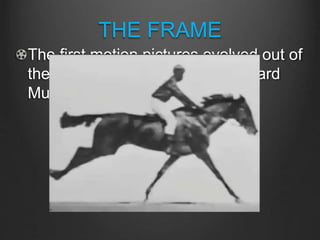
THE FRAME
The first motion pictures evolved out of
the serial photography of Eadweard
Mubridge in 1872 over a bet:
THE FRAME
This is how motion picture cameras
came into being; inventors took that
concept and turned it into “movies”
To record film: the film advances through a
motion picture camera housing, pausing briefly
before the aperture where that section is
exposed to light through the camera lens –
EACH EXPOSURE CONSTITUES A FRAME
THE FRAME
This is how motion picture cameras
came into being; inventors took that
concept and turned into “movies”
To play back film: the process is basically
reversed, with light shining out from WITHIN the
projector, creating the frame rate
Most films are recorded and projected at 24-
frames per second. As a result, modern feature
films may contain over 170,000 frames. Films
are moving toward 48-frames per second
THE HISTORY OF FRAME RATE FOR FILM
THE FRAME
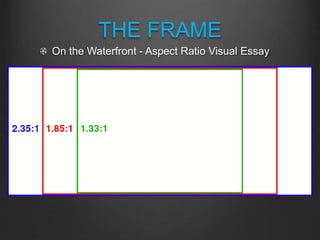
The term “FRAME” also refers to the
rectangular boundary of the cinematic
image as it appears on screen in a
particular ASPECT RATIO
A frame’s boundaries separate ON-
SCREEN SPACE (what we see) from
OFF-SCREEN SPACE (what we don’t
see); deciding what is in “the frame”
and what isn’t (often called “framing”) is
at the heart of filmmaking
THE FRAME
On the Waterfront - Aspect Ratio Visual Essay
THE SHOT
What is a “a shot”?
A SHOT is one uninterrupted run of the camera
resulting in a continuous image; put another way, a
shot consists of the persistent image produced
from the time the camera starts filming until it
stops; these shots are then EDITED together in a
film to make a scene
SEQUENCE SHOTS encompass a sequence of
events instead of editing individual shots together
VIDEO EXAMPLE
GRADUATE EXAMPLES
SHOTS (individual in nature):
SHOTS EDITED together in a film to make a
scene: THE GRADUATE: 9:38 – 12:49 (Benjamin
and Mrs. Robinson have a drink)
SEQUENCE SHOT encompasses a sequence of
events instead of editing individual shots together:
THE GRADUATE: 15:56 – 19:47 (Mr. Robinson
comes home and talks to Ben)
BOTH ARE USED TO
CREATE SCENES!
SCENE
What is a “SCENE”?:
A narrative unit composed of one or more
shots; confined to a single period of time
and typically takes place in one location
CROSS-CUTTING exception =
Scenes that depict two or more actions
occurring at the same time but in different
places; also known as PARALLEL
ACTION
SILENCE OF THE LAMBS example
CAMERA DISTANCE
What is a “CAMERA DISTANCE”?:
The perceived distance between the
camera and the subject; the actual
distance is often impossible to gauge
because of the LENS being used; what
we’re talking about is how far away things
on the screen LOOK to the audience
BASIC TYPES OF
CAMERA DISTANCE SHOTS
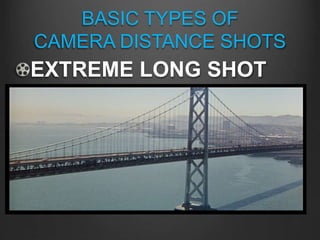
EXTREME LONG SHOT
The camera is perceived to be
a great distance from the
subject
Often also called an
“establishing” shot
8 BASIC TYPES OF
CAMERA DISTANCE SHOTS
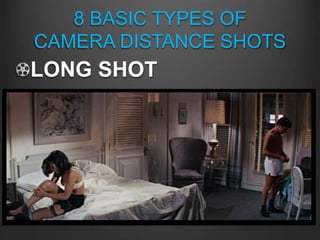
LONG SHOT
Typically when the camera is
perceived to be far away
enough so an entire human
body is visible in the frame and
in which some portion of the
setting is apparent
BASIC TYPES OF
CAMERA DISTANCE SHOTS
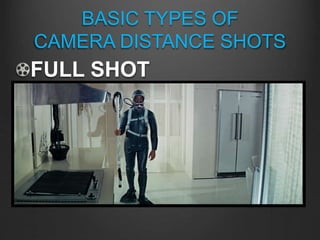
FULL SHOT
Typically when the camera is
perceived to be at a distance
where an entire human body
nearly fills the frame from top
to bottom
BASIC TYPES OF
CAMERA DISTANCE SHOTS
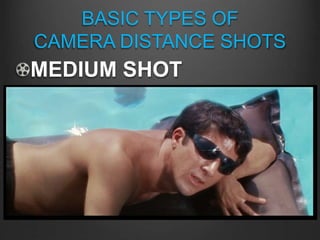
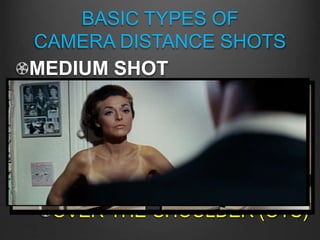
MEDIUM SHOT
Typically when the camera is
perceived to be at a distance
to show the figure from the
waist up (approximately)
Medium approximates HALF
BASIC TYPES OF
CAMERA DISTANCE SHOTS
MEDIUM SHOT
A “medium shot” may also be
designated by the number of main
figures in it or how they’re seen:
TWO-SHOT
THREE-SHOT
OVER-THE-SHOULDER (OTS)
BASIC TYPES OF
CAMERA DISTANCE SHOTS
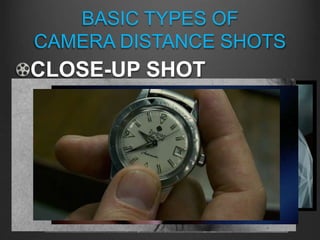
CLOSE-UP SHOT
A “close-up shot” is when the camera is perceived
to be close enough to the subject so it fills the
frame; from shoulders up on a face but the main
subject can be anything
EXTREME CLOSE-UP is when the camera is
perceived to be so close, nothing is visible except
the main subject, whatever it might be
DEPTH OF FIELD
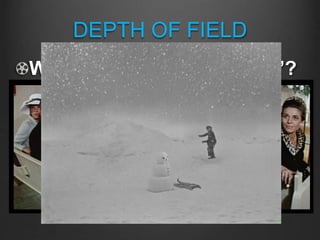
What is “DEPTH OF FIELD”?
DEPTH OF FIELD is the portion of the frame that
is IN FOCUS in the shot
SHALLOW DEPTH OF FIELD = a limited area
of the image is in focus
LARGE DEPTH OF FIELD/DEEP FOCUS = a
large area of the image appears to be in focus
RACK + SOFT FOCUS
What is “RACK FOCUS”?
RACK FOCUS is when the depth of field is
used to direct/manipulate the viewer’s
attention
THE GRADUATE: 01:06:40 – 01:06:57 (Elaine
realizes Benjamin has slept with her mother)
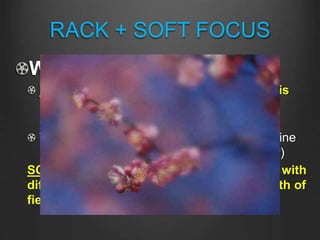
SOFT FOCUS is when the image is blurred with
diffused lighting, filters, and a shallow depth of
field
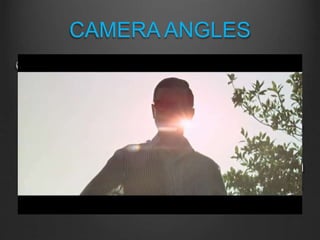
CAMERA ANGLES
What is a “CAMERA ANGLE”?
CAMERA ANGLE is how the
camera is tilted/position
towards its subject; from what
ANGLE is the physical camera
looking at the subject?
CAMERA ANGLES
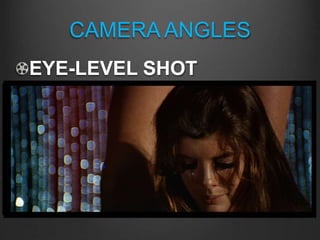
EYE-LEVEL SHOT
Also known as the “straight-on”
shot; level with the subject’s face
with NO ANGLE to the camera’s
position; NEUTRAL and not
adding to the dramatic intensity
of the shot
CAMERA ANGLES
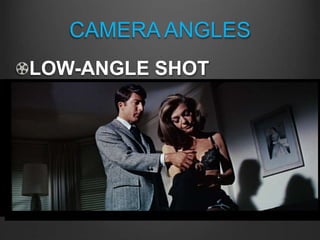
LOW-ANGLE SHOT
The camera is shooting up from
a LOW point; increases the
perceived height of the subject
CAMERA ANGLES
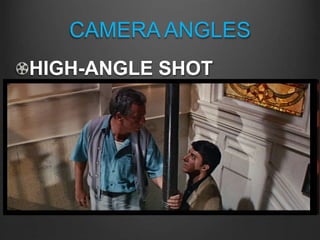
HIGH-ANGLE SHOT
The camera is shooting down
from a HIGH point; tends to
diminish the stature of the
subject and create an impression
of superiority on the part of the
viewer
CAMERA ANGLES
USING ANGLES TO CONVEY
MEANING
In this scene, the director uses
ANGLES to depict the relationship
between Benjamin and his father
The Graduate: 41:00 – 41:55 (Ben
and his father talk while Ben floats
in the pool)
CAMERA ANGLES
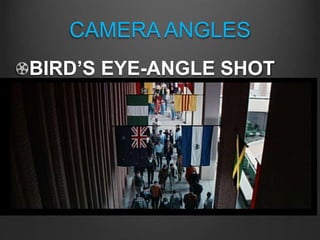
BIRD’S EYE-ANGLE SHOT
Also known as an “AERIAL shot”;
the camera is positioned high
overhead – usually on a crane or
helicopter, or top of building –
and creates a sense of “godlike”
omniscience
CAMERA ANGLES
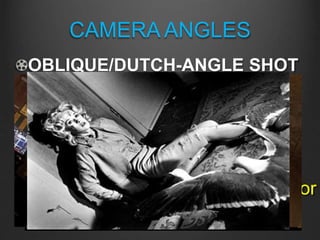
OBLIQUE/DUTCH-ANGLE SHOT
The camera is tilted to one side
so that the horizon line is no
longer horizontal but skewed;
tends to create a sense of
disorientation, chaos, or
confusion for a character, shot, or
scene
CAMERA MOVEMENTS
MOBILE FRAMING
Unlike still photography, cinema
has the ability to employ MOBILE
FRAMING and move the camera
during filming; this makes it
possible to follow the action, as
well as convey emotions or
induce responses in viewers
CAMERA MOVEMENTS
PAN SHOT MOVEMENT
When the camera PANS, the
camera does not actually
change location, but it does
pivot from side to side
horizontally as if on a tripod
VIDEO EXAMPLE
CAMERA MOVEMENTS
TILT SHOT MOVEMENT
When the camera TILTS, the
camera does not actually
change location, but it does
pivot up or down vertically as if
on a tripod
VIDEO EXAMPLE
CAMERA MOVEMENTS
DOLLY/TRACKING SHOT MOVEMENT
This is when the entire camera
moves; typically mounted on a
wheeled platform and guided along
rails; it may move forward or
backward, from side to side, or even
in an arc as it films
THE GRADUATE: 58:36 – 59:40 (Elaine
flees the club, Benjamin follows)
CAMERA MOVEMENTS
DOLLY/TRACKING SHOT
MOVEMENT
DOLLY/TRACKING SHOT
MONTAGE
CAMERA MOVEMENTS
CRANE SHOT MOVEMENT
This is when the camera is attached to
a movable arm that allows the camera
to move in any direction while floating
above the ground
WINGS
CRANE SHOT MONTAGE
CAMERA MOVEMENTS
HANDHELD MOVEMENT
This is achieved just as it sounds,
using just your hands to hold the
camera with no artificial stabilization
so often a jittery, “realistic” feel is
conveyed
THE GRADUATE: 21:38 – 23:25 (Benjamin
enters the pool in scuba gear)
BIRDMAN example
CAMERA MOVEMENTS
STEADICAM MOVEMENT
Allows for greater portability and
ease of camera movement than
a dolly or crane shot
STEADICAM – SCIENCE AT
THE MOVIES
CAMERA MOVEMENTS
ZOOM “MOVEMENT”
While technically not a movement, a ZOOM
shot can sometimes resemble a DOLLY
shot; by zooming IN, part of the image can
be enlarged; by zooming OUT, part of the
image can be made smaller
ZOOM SHOT MONTAGE
ZOOM out in The Graduate:
01:07:10 – 01:07:20 (Mrs. Robinson tells
Benjamin “Goodbye”)
CAMERA MOVEMENTS
DOLLY ZOOM MOVEMENT
This movement combines the DOLLY and
the ZOOM to create a singularly unique
effect; you do this by dollying/moving
backwards while simultaneously zooming in
DOLLY ZOOM MONTAGE
IN-CLASS WORKSHEET
We’ll watch the opening and
ending scenes from THE
GRADUATE and discuss the
various CAMERA DISTANCES,
CAMERA ANGLES, and
CAMERA MOVEMENTS
employed in each
IN-CLASS WORKSHEET
OPENING SCENE/CREDITS:
00:00:00 – 00:02:55
IN-CLASS WORKSHEET
CLOSING SCENE/CREDITS:
01:37:00 – 01:41:19
LOOKING AHEAD
READ CHAPTER THREE: MISE EN SCÈNE
IN-CLASS QUIZ: CHAPTER TWO NEXT WEEK
FILM SCREENING: TBD

WCC FILM 100-CINEMATOGRAPHY

  • 1.
    Film 100: Introductionto Film Film terminology: ability to understand and apply basic film terms Basic elements of film: the building blocks of cinema Production process: basics of how films are made Basic critical analysis: how meaning is constructed in film, ideology, cultural and historical influences Writing about film: develop thesis and support it with examples from the film in question
  • 2.
    Elements of Film Narrative:How story is constructed Cinematography: Process by which moving images are recorded on film or video Mise en scène: All that is included in the frame Editing: How the various shots (and the sounds) in a film are put together Sound: Audio Writing About Film: Pulling it all together Accurately describe what you see onscreen using proper terminology Critically analyze scenes and explain how various film elements are used to create meaning
  • 3.
    CHAPTER 2: CINEMATOGRAPHY WHATIS “CINEMATOGRAPHY”? CINEMA = FILM OGRAPHY = a system of rules or laws, or body of knowledge of a particular subject. The process by which moving images are recorded on film including: Camerawork (movement, angles, etc.) Lenses Film Stock Lighting Filters “In-Camera” Special Effects (NOT CGI)
  • 4.
    CHAPTER 2: CINEMATOGRAPHY Todaywe’re going to look at how various areas of cinematography work together to convey visual film narrative, both structurally and psychologically. We’re going to do this by looking at how shots and scenes are made up of specific decisions about camera DISTANCE, ANGLES, and MOVEMENT.
  • 5.
    THE FRAME The firstmotion pictures evolved out of the serial photography of Eadweard Mubridge in 1872 over a bet:
  • 6.
    THE FRAME This ishow motion picture cameras came into being; inventors took that concept and turned it into “movies” To record film: the film advances through a motion picture camera housing, pausing briefly before the aperture where that section is exposed to light through the camera lens – EACH EXPOSURE CONSTITUES A FRAME
  • 7.
    THE FRAME This ishow motion picture cameras came into being; inventors took that concept and turned into “movies” To play back film: the process is basically reversed, with light shining out from WITHIN the projector, creating the frame rate Most films are recorded and projected at 24- frames per second. As a result, modern feature films may contain over 170,000 frames. Films are moving toward 48-frames per second THE HISTORY OF FRAME RATE FOR FILM
  • 8.
    THE FRAME The term“FRAME” also refers to the rectangular boundary of the cinematic image as it appears on screen in a particular ASPECT RATIO A frame’s boundaries separate ON- SCREEN SPACE (what we see) from OFF-SCREEN SPACE (what we don’t see); deciding what is in “the frame” and what isn’t (often called “framing”) is at the heart of filmmaking
  • 9.
    THE FRAME On theWaterfront - Aspect Ratio Visual Essay
  • 10.
    THE SHOT What isa “a shot”? A SHOT is one uninterrupted run of the camera resulting in a continuous image; put another way, a shot consists of the persistent image produced from the time the camera starts filming until it stops; these shots are then EDITED together in a film to make a scene SEQUENCE SHOTS encompass a sequence of events instead of editing individual shots together VIDEO EXAMPLE
  • 11.
    GRADUATE EXAMPLES SHOTS (individualin nature): SHOTS EDITED together in a film to make a scene: THE GRADUATE: 9:38 – 12:49 (Benjamin and Mrs. Robinson have a drink) SEQUENCE SHOT encompasses a sequence of events instead of editing individual shots together: THE GRADUATE: 15:56 – 19:47 (Mr. Robinson comes home and talks to Ben) BOTH ARE USED TO CREATE SCENES!
  • 12.
    SCENE What is a“SCENE”?: A narrative unit composed of one or more shots; confined to a single period of time and typically takes place in one location CROSS-CUTTING exception = Scenes that depict two or more actions occurring at the same time but in different places; also known as PARALLEL ACTION SILENCE OF THE LAMBS example
  • 13.
    CAMERA DISTANCE What isa “CAMERA DISTANCE”?: The perceived distance between the camera and the subject; the actual distance is often impossible to gauge because of the LENS being used; what we’re talking about is how far away things on the screen LOOK to the audience
  • 14.
    BASIC TYPES OF CAMERADISTANCE SHOTS EXTREME LONG SHOT The camera is perceived to be a great distance from the subject Often also called an “establishing” shot
  • 15.
    8 BASIC TYPESOF CAMERA DISTANCE SHOTS LONG SHOT Typically when the camera is perceived to be far away enough so an entire human body is visible in the frame and in which some portion of the setting is apparent
  • 16.
    BASIC TYPES OF CAMERADISTANCE SHOTS FULL SHOT Typically when the camera is perceived to be at a distance where an entire human body nearly fills the frame from top to bottom
  • 17.
    BASIC TYPES OF CAMERADISTANCE SHOTS MEDIUM SHOT Typically when the camera is perceived to be at a distance to show the figure from the waist up (approximately) Medium approximates HALF
  • 18.
    BASIC TYPES OF CAMERADISTANCE SHOTS MEDIUM SHOT A “medium shot” may also be designated by the number of main figures in it or how they’re seen: TWO-SHOT THREE-SHOT OVER-THE-SHOULDER (OTS)
  • 19.
    BASIC TYPES OF CAMERADISTANCE SHOTS CLOSE-UP SHOT A “close-up shot” is when the camera is perceived to be close enough to the subject so it fills the frame; from shoulders up on a face but the main subject can be anything EXTREME CLOSE-UP is when the camera is perceived to be so close, nothing is visible except the main subject, whatever it might be
  • 20.
    DEPTH OF FIELD Whatis “DEPTH OF FIELD”? DEPTH OF FIELD is the portion of the frame that is IN FOCUS in the shot SHALLOW DEPTH OF FIELD = a limited area of the image is in focus LARGE DEPTH OF FIELD/DEEP FOCUS = a large area of the image appears to be in focus
  • 21.
    RACK + SOFTFOCUS What is “RACK FOCUS”? RACK FOCUS is when the depth of field is used to direct/manipulate the viewer’s attention THE GRADUATE: 01:06:40 – 01:06:57 (Elaine realizes Benjamin has slept with her mother) SOFT FOCUS is when the image is blurred with diffused lighting, filters, and a shallow depth of field
  • 22.
    CAMERA ANGLES What isa “CAMERA ANGLE”? CAMERA ANGLE is how the camera is tilted/position towards its subject; from what ANGLE is the physical camera looking at the subject?
  • 23.
    CAMERA ANGLES EYE-LEVEL SHOT Alsoknown as the “straight-on” shot; level with the subject’s face with NO ANGLE to the camera’s position; NEUTRAL and not adding to the dramatic intensity of the shot
  • 24.
    CAMERA ANGLES LOW-ANGLE SHOT Thecamera is shooting up from a LOW point; increases the perceived height of the subject
  • 25.
    CAMERA ANGLES HIGH-ANGLE SHOT Thecamera is shooting down from a HIGH point; tends to diminish the stature of the subject and create an impression of superiority on the part of the viewer
  • 26.
    CAMERA ANGLES USING ANGLESTO CONVEY MEANING In this scene, the director uses ANGLES to depict the relationship between Benjamin and his father The Graduate: 41:00 – 41:55 (Ben and his father talk while Ben floats in the pool)
  • 27.
    CAMERA ANGLES BIRD’S EYE-ANGLESHOT Also known as an “AERIAL shot”; the camera is positioned high overhead – usually on a crane or helicopter, or top of building – and creates a sense of “godlike” omniscience
  • 28.
    CAMERA ANGLES OBLIQUE/DUTCH-ANGLE SHOT Thecamera is tilted to one side so that the horizon line is no longer horizontal but skewed; tends to create a sense of disorientation, chaos, or confusion for a character, shot, or scene
  • 29.
    CAMERA MOVEMENTS MOBILE FRAMING Unlikestill photography, cinema has the ability to employ MOBILE FRAMING and move the camera during filming; this makes it possible to follow the action, as well as convey emotions or induce responses in viewers
  • 30.
    CAMERA MOVEMENTS PAN SHOTMOVEMENT When the camera PANS, the camera does not actually change location, but it does pivot from side to side horizontally as if on a tripod VIDEO EXAMPLE
  • 31.
    CAMERA MOVEMENTS TILT SHOTMOVEMENT When the camera TILTS, the camera does not actually change location, but it does pivot up or down vertically as if on a tripod VIDEO EXAMPLE
  • 32.
    CAMERA MOVEMENTS DOLLY/TRACKING SHOTMOVEMENT This is when the entire camera moves; typically mounted on a wheeled platform and guided along rails; it may move forward or backward, from side to side, or even in an arc as it films THE GRADUATE: 58:36 – 59:40 (Elaine flees the club, Benjamin follows)
  • 33.
  • 34.
    CAMERA MOVEMENTS CRANE SHOTMOVEMENT This is when the camera is attached to a movable arm that allows the camera to move in any direction while floating above the ground WINGS CRANE SHOT MONTAGE
  • 35.
    CAMERA MOVEMENTS HANDHELD MOVEMENT Thisis achieved just as it sounds, using just your hands to hold the camera with no artificial stabilization so often a jittery, “realistic” feel is conveyed THE GRADUATE: 21:38 – 23:25 (Benjamin enters the pool in scuba gear) BIRDMAN example
  • 36.
    CAMERA MOVEMENTS STEADICAM MOVEMENT Allowsfor greater portability and ease of camera movement than a dolly or crane shot STEADICAM – SCIENCE AT THE MOVIES
  • 37.
    CAMERA MOVEMENTS ZOOM “MOVEMENT” Whiletechnically not a movement, a ZOOM shot can sometimes resemble a DOLLY shot; by zooming IN, part of the image can be enlarged; by zooming OUT, part of the image can be made smaller ZOOM SHOT MONTAGE ZOOM out in The Graduate: 01:07:10 – 01:07:20 (Mrs. Robinson tells Benjamin “Goodbye”)
  • 38.
    CAMERA MOVEMENTS DOLLY ZOOMMOVEMENT This movement combines the DOLLY and the ZOOM to create a singularly unique effect; you do this by dollying/moving backwards while simultaneously zooming in DOLLY ZOOM MONTAGE
  • 39.
    IN-CLASS WORKSHEET We’ll watchthe opening and ending scenes from THE GRADUATE and discuss the various CAMERA DISTANCES, CAMERA ANGLES, and CAMERA MOVEMENTS employed in each
  • 40.
  • 41.
  • 42.
    LOOKING AHEAD READ CHAPTERTHREE: MISE EN SCÈNE IN-CLASS QUIZ: CHAPTER TWO NEXT WEEK FILM SCREENING: TBD