General Notes 
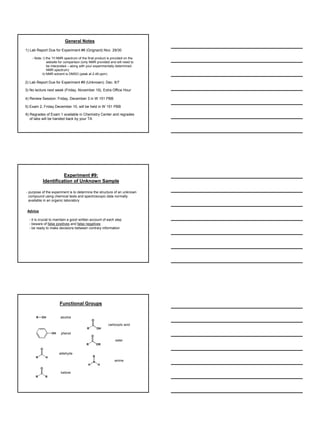
1) Lab Report Due for Experiment #8 (Grignard) Nov. 29/30 
- Note: i) the 1H NMR spectrum of the final product is provided on the 
website for comparison (only NMR provided and will need to 
be interpreted – along with your experimentally determined 
NMR spectrum) 
ii) NMR solvent is DMSO (peak at 2.49 ppm) 
2) Lab Report Due for Experiment #9 (Unknown): Dec. 6/7 
3) No lecture next week (Friday, November 19), Extra Office Hour 
4) Review Session: Friday, December 3 in W 151 PBB 
5) Exam 2, Friday December 10, will be held in W 151 PBB 
6) Regrades of Exam 1 available in Chemistry Center and regrades 
of labs will be handed back by your TA 
Experiment #9: 
Identification of Unknown Sample 
- purpose of the experiment is to determine the structure of an unknown 
compound using chemical tests and spectroscopic data normally 
available in an organic laboratory 
Advice 
- it is crucial to maintain a good written account of each step 
- beware of false positives and false negatives 
- be ready to make decisions between contrary information 
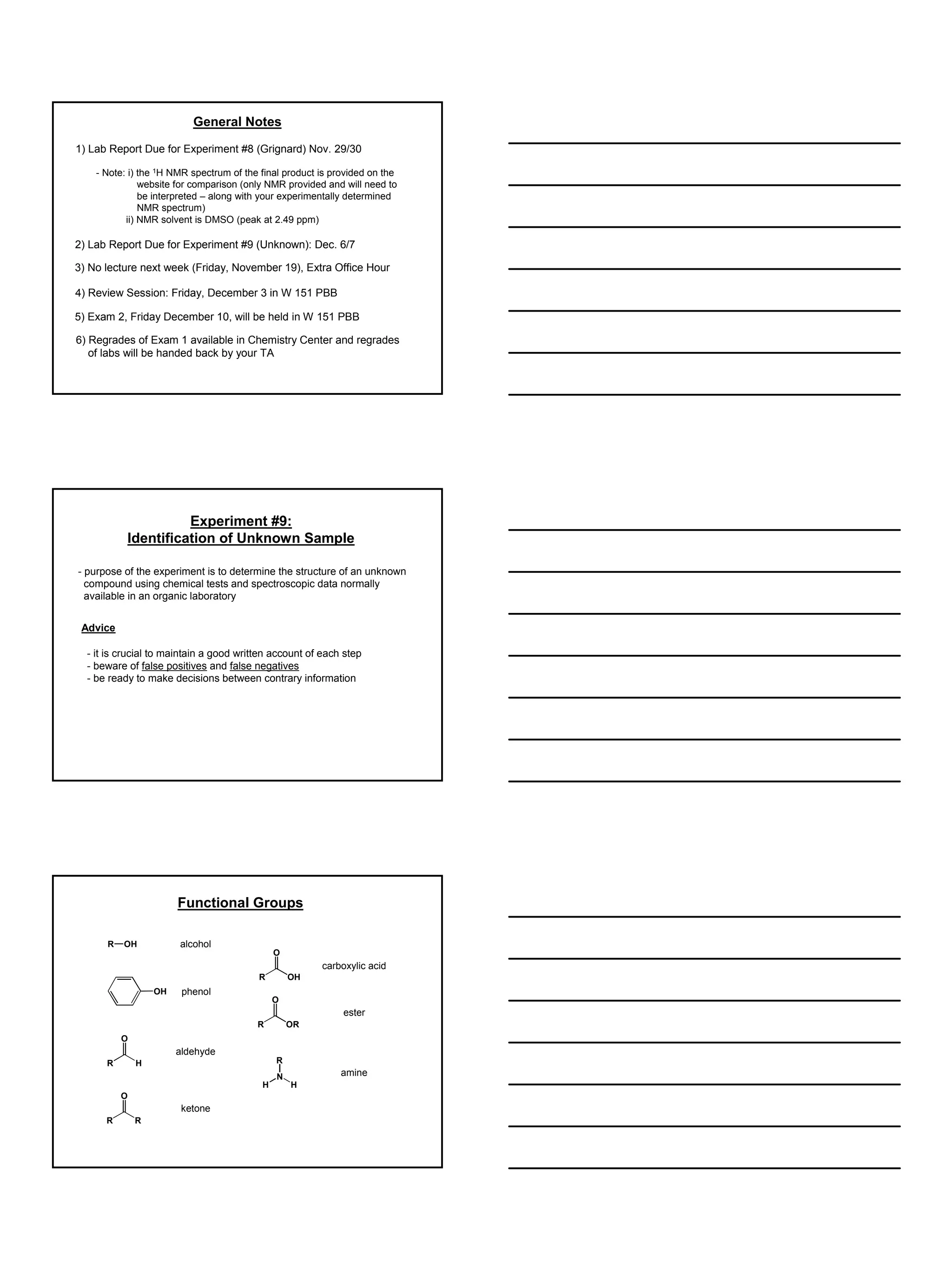
Functional Groups 
R OH 
OH 
O 
R H 
O 
R R 
O 
R OH 
O 
R OR 
R 
N 
H H 
alcohol 
phenol 
aldehyde 
ketone 
carboxylic acid 
ester 
amine
Four General Steps 
1) Characterize/Functional Group Tests 
2) List Possible Structures/Obtain Derivatives 
submit list to TA 
3) Unknown Structure? 
receive list back? 
receive NMR? 
4) Propose Structure for Unknown 
Characterize/Functional Group Tests 
1) Obtain unknown from TA 
2) Note appearance (solid, liquid, color, crystalline, etc.) 
3) Determine solubility (organic, aqueous, aq. NaHCO3, aq. NaOH, aq. HCl)* 
4) Prepare unknown sample for NMR analysis 
5) Obtain melting point or boiling point (repeat for accuracy) 
6) Burn small amount of sample (aromatic flame test) 
7) Obtain IR [liq.(neat), solid (nujol, CCl4, CHCl3)] 
8) Conduct at least three functional group tests (should run positive controls)* 
Step 1 - Solubility Test 
insoluble 
insoluble 
insoluble 
aliphatic amines 
1° aromatic amines 
soluble 
soluble 
soluble 
insoluble 
soluble 
p H t e s t 
HCl (aq) 
oxygen containing compounds 
alkenes, alkynes, 
activated aromatics 
alkanes, haloalkanes, 
unactivated aromatics 
carboxylic acids, some 
highly acidic phenols 
phenols 
1,3-diketones 
low MW ( < 5 C's) with 
hydrophilic groups 
insoluble 
soluble 
unknown 
water 
NaHCO3 (aq) 
NaOH (aq) 
H2SO4 (con)
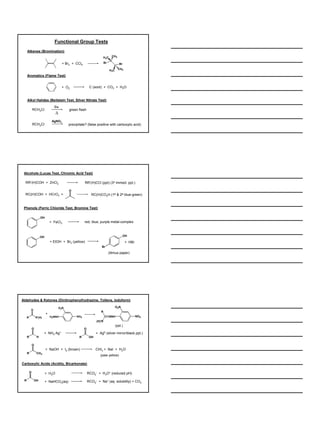
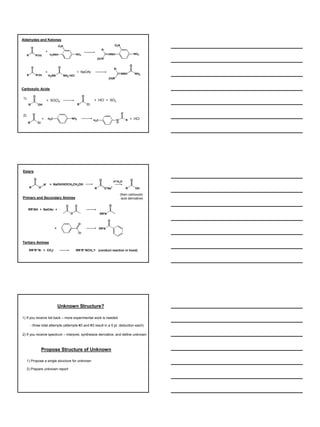
Functional Group Tests 
Alkenes (Bromination) 
Aromatics (Flame Test) 
H3C 
Alkyl Halides (Beilstein Test, Silver Nitrate Test) 
CH3 
Br 
H3C 
Br 
CH3 
+ Br2 + CCl4 
+ O2 C (soot) + CO2 + H2O 
RCH2Cl 
Δ 
green flash 
Cu 
RCH2Cl 
AgNO3 precipitate? (false positive with carboxylic acid) 
Alcohols (Lucas Test, Chromic Acid Test) 
RR’(H)COH + ZnCl2 RR’(H)CCl (ppt) (3o immed. ppt.) 
O 
RC(H)COH + HCrO3 + RC(H)CO2H (1o & 2o blue-green) 
Phenols (Ferric Chloride Test, Bromine Test) 
OH 
OH 
+ FeCl3 red, blue, purple metal-complex 
+ EtOH + Br2 (yellow) 
OH 
Br 
+ HBr 
(litmus paper) 
Aldehydes & Ketones (Dinitrophenylhydrazine, Tollens, Iodoform) 
O 
R R'(H) 
O 
R H 
O 
+ 
NO2 
O2N 
NNH 
R 
(H)'R 
(ppt.) 
+ NH3·Ag+ + Ag0 (silver mirror/black ppt.) 
+ NaOH + I2 (brown) 
R CH3 
NO2 
O2N 
H2NNH 
O 
R OH 
Carboxylic Acids (Acidity, Bicarbonate) 
O 
R OH 
+ H2O 
+ NaHCO3(aq) 
CHI3 + NaI + H2O 
RCO2 
(pale yellow) 
- + H3O+ (reduced pH) 
RCO2 
- + Na+ (aq. solubility) + CO2
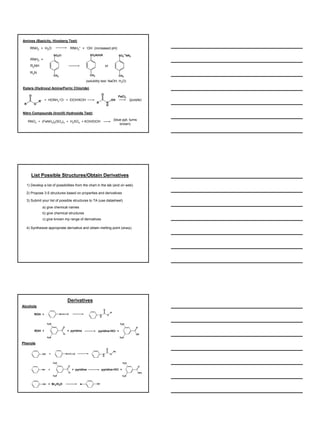
Amines (Basicity, Hinsberg Test) 
RNH2 + H2O RNH3 
+ + -OH (increased pH) 
SO2Cl 
CH3 
RNH2 + 
R2NH 
R3N 
(solubility test: NaOH, H2O) 
Esters (Hydroxyl Amine/Ferric Chloride) 
SO2N(H)R 
CH3 
SO2 
-+NR3 
CH3 
or 
O 
R O 
R' + HONH3 
+Cl- + EtOH/KOH 
O 
R N 
H 
OH 
FeCl3 (purple) 
Nitro Compounds (Iron(II) Hydroxide Test) 
RNO2 + (FeNH4)2(SO4)3 + H2SO4 + KOH/EtOH (blue ppt. turns 
brown) 
List Possible Structures/Obtain Derivatives 
1) Develop a list of possibilities from the chart in the lab (and on web) 
2) Propose 3-5 structures based on properties and derivatives 
3) Submit your list of possible structures to TA (use datasheet) 
a) give chemical names 
b) give chemical structures 
c) give known mp range of derivatives 
4) Synthesize appropriate derivative and obtain melting point (sharp) 
Derivatives 
Alcohols 
Phenols 
N C O NH 
O 
O 
R 
O2N 
O2N 
O 
Cl 
O2N 
O2N 
O 
OR 
OH 
OH 
OH 
O2N 
O2N 
O 
Cl 
Br OH 
O2N 
O2N 
O 
OPh 
NH 
O 
O 
Ph 
N C O 
ROH + 
ROH + + pyridine 
+ 
+ + pyridine pyridine·HCl + 
+ Br2/H2O 
pyridine·HCl +
Aldehydes and Ketones 
O 
R R'(H) NO2 
+ + NaOAc 
Carboxylic Acids 
O2N 
H2NNH 
+ 
O 
R R'(H) 
O 
H2NN NH2 
·HCl 
O 
R OH 
O 
R Cl 
+ SOCl2 
H3C NH2 
O 
R Cl 
+ 
R 
R 
+ HCl + SO2 
+ HCl 
1) 
2) 
NH 
O 
H3C R 
O 
NNH NH2 
(H)R' 
NO2 
O2N 
NNH 
(H)'R 
Esters 
O 
R O 
R' + NaOH/HOCH2CH2OH 
Primary and Secondary Amines 
O 
R O-Na+ 
O 
R OH 
H+/H2O 
O 
O 
O 
O 
Cl 
RR’NH + NaOAc + 
+ 
Tertiary Amines 
RR’R’’N: + CH3I RR’R’’NCH3 
(then carboxylic 
acid derivative) 
O 
RR'N 
RR'N 
O 
+I- (conduct reaction in hood) 
Unknown Structure? 
1) If you receive list back – more experimental work is needed 
- three total attempts (attempts #2 and #3 result in a 5 pt. deduction each) 
2) If you receive spectrum – interpret, synthesize derivative, and define unknown 
Propose Structure of Unknown 
1) Propose a single structure for unknown 
2) Prepare unknown report
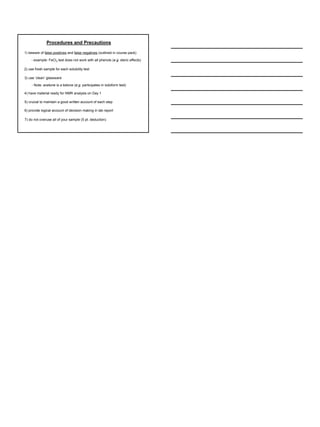
Procedures and Precautions 
1) beware of false positives and false negatives (outlined in course pack) 
- example: FeCl3 test does not work with all phenols (e.g. steric effects) 
2) use fresh sample for each solubility test 
3) use ‘clean’ glassware 
- Note: acetone is a ketone (e.g. participates in iodoform test) 
4) have material ready for NMR analysis on Day 1 
5) crucial to maintain a good written account of each step 
6) provide logical account of decision making in lab report 
7) do not overuse all of your sample (5 pt. deduction)

Functional groups

  • 1.
    General Notes 1)Lab Report Due for Experiment #8 (Grignard) Nov. 29/30 - Note: i) the 1H NMR spectrum of the final product is provided on the website for comparison (only NMR provided and will need to be interpreted – along with your experimentally determined NMR spectrum) ii) NMR solvent is DMSO (peak at 2.49 ppm) 2) Lab Report Due for Experiment #9 (Unknown): Dec. 6/7 3) No lecture next week (Friday, November 19), Extra Office Hour 4) Review Session: Friday, December 3 in W 151 PBB 5) Exam 2, Friday December 10, will be held in W 151 PBB 6) Regrades of Exam 1 available in Chemistry Center and regrades of labs will be handed back by your TA Experiment #9: Identification of Unknown Sample - purpose of the experiment is to determine the structure of an unknown compound using chemical tests and spectroscopic data normally available in an organic laboratory Advice - it is crucial to maintain a good written account of each step - beware of false positives and false negatives - be ready to make decisions between contrary information Functional Groups R OH OH O R H O R R O R OH O R OR R N H H alcohol phenol aldehyde ketone carboxylic acid ester amine
  • 2.
    Four General Steps 1) Characterize/Functional Group Tests 2) List Possible Structures/Obtain Derivatives submit list to TA 3) Unknown Structure? receive list back? receive NMR? 4) Propose Structure for Unknown Characterize/Functional Group Tests 1) Obtain unknown from TA 2) Note appearance (solid, liquid, color, crystalline, etc.) 3) Determine solubility (organic, aqueous, aq. NaHCO3, aq. NaOH, aq. HCl)* 4) Prepare unknown sample for NMR analysis 5) Obtain melting point or boiling point (repeat for accuracy) 6) Burn small amount of sample (aromatic flame test) 7) Obtain IR [liq.(neat), solid (nujol, CCl4, CHCl3)] 8) Conduct at least three functional group tests (should run positive controls)* Step 1 - Solubility Test insoluble insoluble insoluble aliphatic amines 1° aromatic amines soluble soluble soluble insoluble soluble p H t e s t HCl (aq) oxygen containing compounds alkenes, alkynes, activated aromatics alkanes, haloalkanes, unactivated aromatics carboxylic acids, some highly acidic phenols phenols 1,3-diketones low MW ( < 5 C's) with hydrophilic groups insoluble soluble unknown water NaHCO3 (aq) NaOH (aq) H2SO4 (con)
  • 3.
    Functional Group Tests Alkenes (Bromination) Aromatics (Flame Test) H3C Alkyl Halides (Beilstein Test, Silver Nitrate Test) CH3 Br H3C Br CH3 + Br2 + CCl4 + O2 C (soot) + CO2 + H2O RCH2Cl Δ green flash Cu RCH2Cl AgNO3 precipitate? (false positive with carboxylic acid) Alcohols (Lucas Test, Chromic Acid Test) RR’(H)COH + ZnCl2 RR’(H)CCl (ppt) (3o immed. ppt.) O RC(H)COH + HCrO3 + RC(H)CO2H (1o & 2o blue-green) Phenols (Ferric Chloride Test, Bromine Test) OH OH + FeCl3 red, blue, purple metal-complex + EtOH + Br2 (yellow) OH Br + HBr (litmus paper) Aldehydes & Ketones (Dinitrophenylhydrazine, Tollens, Iodoform) O R R'(H) O R H O + NO2 O2N NNH R (H)'R (ppt.) + NH3·Ag+ + Ag0 (silver mirror/black ppt.) + NaOH + I2 (brown) R CH3 NO2 O2N H2NNH O R OH Carboxylic Acids (Acidity, Bicarbonate) O R OH + H2O + NaHCO3(aq) CHI3 + NaI + H2O RCO2 (pale yellow) - + H3O+ (reduced pH) RCO2 - + Na+ (aq. solubility) + CO2
  • 4.
    Amines (Basicity, HinsbergTest) RNH2 + H2O RNH3 + + -OH (increased pH) SO2Cl CH3 RNH2 + R2NH R3N (solubility test: NaOH, H2O) Esters (Hydroxyl Amine/Ferric Chloride) SO2N(H)R CH3 SO2 -+NR3 CH3 or O R O R' + HONH3 +Cl- + EtOH/KOH O R N H OH FeCl3 (purple) Nitro Compounds (Iron(II) Hydroxide Test) RNO2 + (FeNH4)2(SO4)3 + H2SO4 + KOH/EtOH (blue ppt. turns brown) List Possible Structures/Obtain Derivatives 1) Develop a list of possibilities from the chart in the lab (and on web) 2) Propose 3-5 structures based on properties and derivatives 3) Submit your list of possible structures to TA (use datasheet) a) give chemical names b) give chemical structures c) give known mp range of derivatives 4) Synthesize appropriate derivative and obtain melting point (sharp) Derivatives Alcohols Phenols N C O NH O O R O2N O2N O Cl O2N O2N O OR OH OH OH O2N O2N O Cl Br OH O2N O2N O OPh NH O O Ph N C O ROH + ROH + + pyridine + + + pyridine pyridine·HCl + + Br2/H2O pyridine·HCl +
  • 5.
    Aldehydes and Ketones O R R'(H) NO2 + + NaOAc Carboxylic Acids O2N H2NNH + O R R'(H) O H2NN NH2 ·HCl O R OH O R Cl + SOCl2 H3C NH2 O R Cl + R R + HCl + SO2 + HCl 1) 2) NH O H3C R O NNH NH2 (H)R' NO2 O2N NNH (H)'R Esters O R O R' + NaOH/HOCH2CH2OH Primary and Secondary Amines O R O-Na+ O R OH H+/H2O O O O O Cl RR’NH + NaOAc + + Tertiary Amines RR’R’’N: + CH3I RR’R’’NCH3 (then carboxylic acid derivative) O RR'N RR'N O +I- (conduct reaction in hood) Unknown Structure? 1) If you receive list back – more experimental work is needed - three total attempts (attempts #2 and #3 result in a 5 pt. deduction each) 2) If you receive spectrum – interpret, synthesize derivative, and define unknown Propose Structure of Unknown 1) Propose a single structure for unknown 2) Prepare unknown report
  • 6.
    Procedures and Precautions 1) beware of false positives and false negatives (outlined in course pack) - example: FeCl3 test does not work with all phenols (e.g. steric effects) 2) use fresh sample for each solubility test 3) use ‘clean’ glassware - Note: acetone is a ketone (e.g. participates in iodoform test) 4) have material ready for NMR analysis on Day 1 5) crucial to maintain a good written account of each step 6) provide logical account of decision making in lab report 7) do not overuse all of your sample (5 pt. deduction)