ES-362: COMPUTERS IN EDUCATION
Differentiate between linear and branched programme instruction.(500 words)
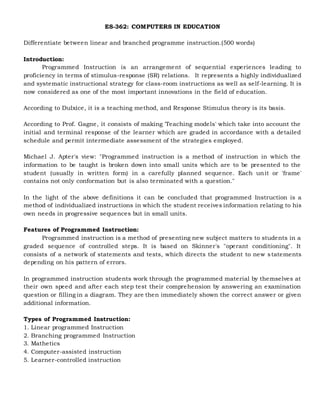
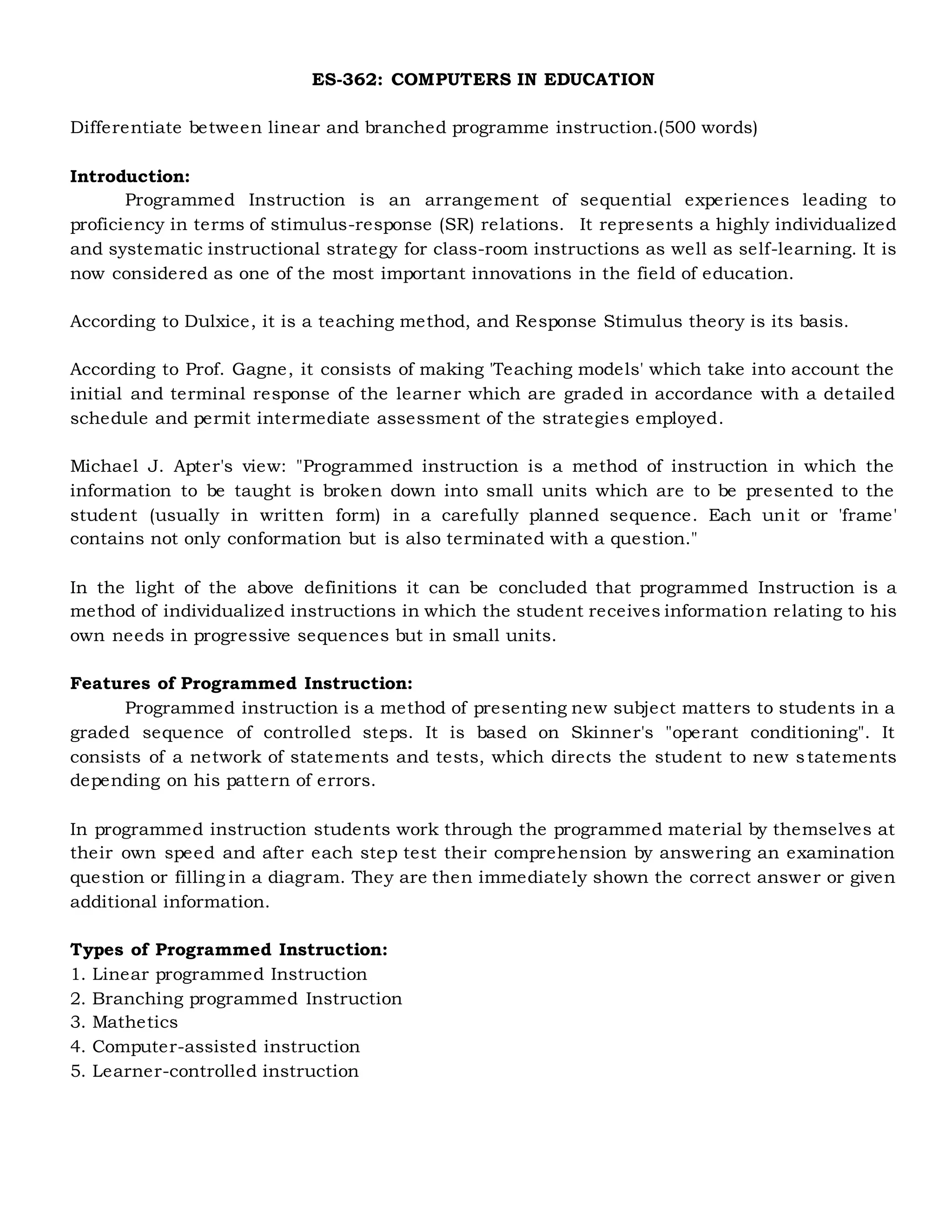
Introduction:
Programmed Instruction is an arrangement of sequential experiences leading to
proficiency in terms of stimulus-response (SR) relations. It represents a highly individualized
and systematic instructional strategy for class-room instructions as well as self-learning. It is
now considered as one of the most important innovations in the field of education.
According to Dulxice, it is a teaching method, and Response Stimulus theory is its basis.
According to Prof. Gagne, it consists of making 'Teaching models' which take into account the
initial and terminal response of the learner which are graded in accordance with a detailed
schedule and permit intermediate assessment of the strategies employed.
Michael J. Apter's view: "Programmed instruction is a method of instruction in which the
information to be taught is broken down into small units which are to be presented to the
student (usually in written form) in a carefully planned sequence. Each unit or 'frame'
contains not only conformation but is also terminated with a question."
In the light of the above definitions it can be concluded that programmed Instruction is a
method of individualized instructions in which the student receives information relating to his
own needs in progressive sequences but in small units.
Features of Programmed Instruction:
Programmed instruction is a method of presenting new subject matters to students in a
graded sequence of controlled steps. It is based on Skinner's "operant conditioning". It
consists of a network of statements and tests, which directs the student to new statements
depending on his pattern of errors.
In programmed instruction students work through the programmed material by themselves at
their own speed and after each step test their comprehension by answering an examination
question or filling in a diagram. They are then immediately shown the correct answer or given
additional information.
Types of Programmed Instruction:
1. Linear programmed Instruction
2. Branching programmed Instruction
3. Mathetics
4. Computer-assisted instruction
5. Learner-controlled instruction
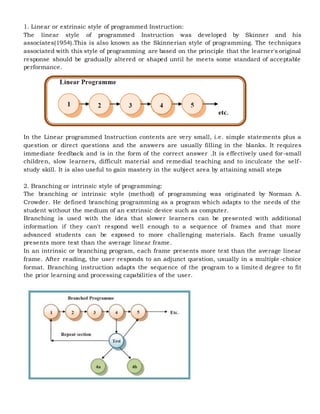
1. Linear or extrinsic style of programmed Instruction:
The linear style of programmed Instruction was developed by Skinner and his
associates(1954).This is also known as the Skinnerian style of programming. The techniques
associated with this style of programming are based on the principle that the learner's original
response should be gradually altered or shaped until he meets some standard of acceptable
performance.
In the Linear programmed Instruction contents are very small, i.e. simple statements plus a
question or direct questions and the answers are usually filling in the blanks. It requires
immediate feedback and is in the form of the correct answer .It is effectively used for-small
children, slow learners, difficult material and remedial teaching and to inculcate the self-
study skill. It is also useful to gain mastery in the subject area by attaining small steps
2. Branching or intrinsic style of programming:
The branching or intrinsic style (method) of programming was originated by Norman A.
Crowder. He defined branching programming as a program which adapts to the needs of the
student without the medium of an extrinsic device such as computer.
Branching is used with the idea that slower learners can be presented with additional
information if they can't respond well enough to a sequence of frames and that more
advanced students can be exposed to more challenging materials. Each frame usually
presents more text than the average linear frame.
In an intrinsic or branching program, each frame presents more text than the average linear
frame. After reading, the user responds to an adjunct question, usually in a multiple -choice
format. Branching instruction adapts the sequence of the program to a limite d degree to fit
the prior learning and processing capabilities of the user.
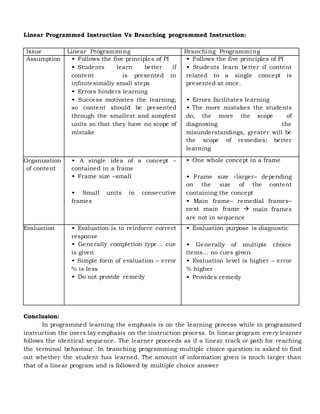
Linear Programmed Instruction Vs Branching programmed Instruction:
Issue Linear Programming Branching Programming
Assumption • Follows the five principles of PI
• Students learn better if
content is presented in
infinitesimally small steps
• Errors hinders learning
• Success motivates the learning;
so content should be presented
through the smallest and simplest
units so that they have no scope of
mistake
• Follows the five principles of PI
• Students learn better if content
related to a single concept is
presented at once.
• Errors facilitates learning
• The more mistakes the students
do, the more the scope of
diagnosing the
misunderstandings, greater will be
the scope of remedies; better
learning
Organization
of content
• A single idea of a concept –
contained in a frame
• Frame size –small
• Small units in consecutive
frames
• One whole concept in a frame
• Frame size –larger– depending
on the size of the content
containing the concept
• Main frame– remedial frames–
next main frame  main frames
are not in sequence
Evaluation • Evaluation is to reinforce correct
response
• Generally completion type… cue
is given
• Simple form of evaluation – error
% is less
• Do not provide remedy
• Evaluation purpose is diagnostic
• Generally of multiple choice
items… no cues given
• Evaluation level is higher – error
% higher
• Provides remedy
Conclusion:
In programmed learning the emphasis is on the learning process while in programmed
instruction the users lay emphasis on the instruction process. In linear program every learner
follows the identical sequence. The learner proceeds as if a linear track or path for reaching
the terminal behaviour. In branching programming multiple choice question is asked to find
out whether the student has learned. The amount of information given is much larger than
that of a linear program and is followed by multiple choice answer

Linear and branched programme instruction

  • 1.
    ES-362: COMPUTERS INEDUCATION Differentiate between linear and branched programme instruction.(500 words) Introduction: Programmed Instruction is an arrangement of sequential experiences leading to proficiency in terms of stimulus-response (SR) relations. It represents a highly individualized and systematic instructional strategy for class-room instructions as well as self-learning. It is now considered as one of the most important innovations in the field of education. According to Dulxice, it is a teaching method, and Response Stimulus theory is its basis. According to Prof. Gagne, it consists of making 'Teaching models' which take into account the initial and terminal response of the learner which are graded in accordance with a detailed schedule and permit intermediate assessment of the strategies employed. Michael J. Apter's view: "Programmed instruction is a method of instruction in which the information to be taught is broken down into small units which are to be presented to the student (usually in written form) in a carefully planned sequence. Each unit or 'frame' contains not only conformation but is also terminated with a question." In the light of the above definitions it can be concluded that programmed Instruction is a method of individualized instructions in which the student receives information relating to his own needs in progressive sequences but in small units. Features of Programmed Instruction: Programmed instruction is a method of presenting new subject matters to students in a graded sequence of controlled steps. It is based on Skinner's "operant conditioning". It consists of a network of statements and tests, which directs the student to new statements depending on his pattern of errors. In programmed instruction students work through the programmed material by themselves at their own speed and after each step test their comprehension by answering an examination question or filling in a diagram. They are then immediately shown the correct answer or given additional information. Types of Programmed Instruction: 1. Linear programmed Instruction 2. Branching programmed Instruction 3. Mathetics 4. Computer-assisted instruction 5. Learner-controlled instruction
  • 2.
    1. Linear orextrinsic style of programmed Instruction: The linear style of programmed Instruction was developed by Skinner and his associates(1954).This is also known as the Skinnerian style of programming. The techniques associated with this style of programming are based on the principle that the learner's original response should be gradually altered or shaped until he meets some standard of acceptable performance. In the Linear programmed Instruction contents are very small, i.e. simple statements plus a question or direct questions and the answers are usually filling in the blanks. It requires immediate feedback and is in the form of the correct answer .It is effectively used for-small children, slow learners, difficult material and remedial teaching and to inculcate the self- study skill. It is also useful to gain mastery in the subject area by attaining small steps 2. Branching or intrinsic style of programming: The branching or intrinsic style (method) of programming was originated by Norman A. Crowder. He defined branching programming as a program which adapts to the needs of the student without the medium of an extrinsic device such as computer. Branching is used with the idea that slower learners can be presented with additional information if they can't respond well enough to a sequence of frames and that more advanced students can be exposed to more challenging materials. Each frame usually presents more text than the average linear frame. In an intrinsic or branching program, each frame presents more text than the average linear frame. After reading, the user responds to an adjunct question, usually in a multiple -choice format. Branching instruction adapts the sequence of the program to a limite d degree to fit the prior learning and processing capabilities of the user.
  • 3.
    Linear Programmed InstructionVs Branching programmed Instruction: Issue Linear Programming Branching Programming Assumption • Follows the five principles of PI • Students learn better if content is presented in infinitesimally small steps • Errors hinders learning • Success motivates the learning; so content should be presented through the smallest and simplest units so that they have no scope of mistake • Follows the five principles of PI • Students learn better if content related to a single concept is presented at once. • Errors facilitates learning • The more mistakes the students do, the more the scope of diagnosing the misunderstandings, greater will be the scope of remedies; better learning Organization of content • A single idea of a concept – contained in a frame • Frame size –small • Small units in consecutive frames • One whole concept in a frame • Frame size –larger– depending on the size of the content containing the concept • Main frame– remedial frames– next main frame  main frames are not in sequence Evaluation • Evaluation is to reinforce correct response • Generally completion type… cue is given • Simple form of evaluation – error % is less • Do not provide remedy • Evaluation purpose is diagnostic • Generally of multiple choice items… no cues given • Evaluation level is higher – error % higher • Provides remedy Conclusion: In programmed learning the emphasis is on the learning process while in programmed instruction the users lay emphasis on the instruction process. In linear program every learner follows the identical sequence. The learner proceeds as if a linear track or path for reaching the terminal behaviour. In branching programming multiple choice question is asked to find out whether the student has learned. The amount of information given is much larger than that of a linear program and is followed by multiple choice answer