PERMEABILITY
PERMEABILITY
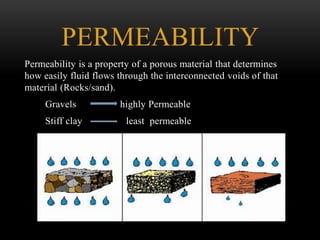
Permeability is a property of a porous material that determines
how easily fluid flows through the interconnected voids of that
material (Rocks/sand).
Gravels highly Permeable
Stiff clay least permeable
UNITS
Permeability is defined in the units of area open pore space in the
section that faces or is perpendicular to the direction of flow
 Common Units :
The common units of permeability is DARCY (darcy) , after
name of a scientist .
FACTORS AFFECTING
Numerous factors affect the magnitude and the direction of
permeability .
 Textural properties.
• Pore size / grain size
• Grain size distribution
• Shape of grains
• Packing of grains.
 Gas slippage
 Amount, distribution and types of clays
CONTI . . .
 Type and amount of secondary porosity.
 Overburden pressure.
 Reactive fluids.
 High velocity flow effects.
TYPES OF PERMEABILITY
Types of permeability are the Following :
• Absolute permeability.
• Effective Permeability.
Absolute
Permeability
The measurement of
permeability, or ability
to flow or transmit
through a rock,
conducted when a
single fluid or phase is
present in the rock.
EFFECTIVE PERMEABILITY
• The ability to preferentially flow or transmit a particular fluid
when other immiscible fluids are present in the reservoir.
• For Instance: Effective permeability of gas in a gas water
reservoir.
IMPORTANCE OF
PERMEABILITY
The study of permeability is important for :
• Estimating the quantity of underground water.
• Investigating problems involving pumping seepage of water for
underground construction.
• Analyzing the stability of earth dams and earth retaining walls
subjected to seepage forces.
• The adequate permeable soil and water holding capacity result
In the good plant growth.
• Filters made of soils are designed based upon their
permeability.
OPERATIONAL PROCEDURES OF
PERMEABILITY
Coefficient Of permeability :
The coefficient of permeability of a soil describes how easily a
liquid will move through a soil. It is also commonly referred to as
the hydraulic conductivity of a soil. This factor can be affected by
the viscosity, or thickness(fluidity) of a liquid and its density. The
number can also be affected by the void size, or region of non-soil,
void continuity, and soil particle shape and surface roughness. It
is an important factor when determining the rate at which a fluid
will actually flow through a particular type of soil. Coefficient of
permeability depends not only on the properties of soil but also on
the properties of water.
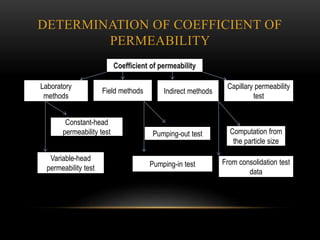
DETERMINATION OF COEFFICIENT OF
PERMEABILITY
Capillary permeability
test
Indirect methodsField methods
Laboratory
methods
Constant-head
permeability test
Variable-head
permeability test
Computation from
the particle size
From consolidation test
data
Pumping-in test
Pumping-out test
CONSTANT HEAD PERMEABILITY TEST
This test is used to determine the coefficient of permeability of a soil.
This is important in examining the movement of contaminants through
soil or when characterizing flow nets.
• quantity of water that flows under the given hydraulic gradient
through a soil sample of known length and cross-sectional area in a
given time.
• Water is allowed to flow through the cylindrical sample of soil under
a constant head.
• For testing of previous, coarse grained soils
K = QL/Aht
K = Coefficient of
permeability
Q = Total quantity of
water
L = Length of the
coarse soil
t = Time
h = Height
VARIABLE-HEAD PERMEABILITY
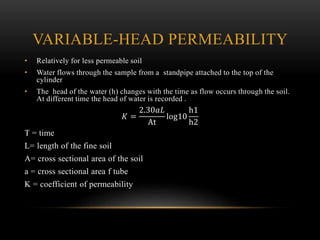
• Relatively for less permeable soil
• Water flows through the sample from a standpipe attached to the top of the
cylinder
• The head of the water (h) changes with the time as flow occurs through the soil.
At different time the head of water is recorded .
𝐾 =
2.30𝑎𝐿
At
log10
h1
h2
T = time
L= length of the fine soil
A= cross sectional area of the soil
a = cross sectional area f tube
K = coefficient of permeability
APPLICATIONS OF PERMEABILITY
It is a very important engineering property.it find its applications in many
aspects .
Some of the applications of permeability are following
• Filtration.
• Water treatments.
• Solving problems involving pumping seepage water from
construction excavation.
• The design of earth dams is very much based upon the permeability
of soil used.
REFERENCES
• K.R. Arora “Soil machenics and foundation engineering “
• Gopal ranjan and A.S.R.Rao “Basic and applied soil
machanics “
• B.C. Punmia “ Soil machanics and foundation “
• T.Willaim lambe (1969) “ Soil machanics “
• Ernst and sohn ( 2002 ) “ Geotechnical engineering
handbook”
Thanks For your
appreciation

PermEability

  • 1.
  • 2.
    PERMEABILITY Permeability is aproperty of a porous material that determines how easily fluid flows through the interconnected voids of that material (Rocks/sand). Gravels highly Permeable Stiff clay least permeable
  • 4.
    UNITS Permeability is definedin the units of area open pore space in the section that faces or is perpendicular to the direction of flow  Common Units : The common units of permeability is DARCY (darcy) , after name of a scientist .
  • 5.
    FACTORS AFFECTING Numerous factorsaffect the magnitude and the direction of permeability .  Textural properties. • Pore size / grain size • Grain size distribution • Shape of grains • Packing of grains.  Gas slippage  Amount, distribution and types of clays
  • 6.
    CONTI . ..  Type and amount of secondary porosity.  Overburden pressure.  Reactive fluids.  High velocity flow effects.
  • 7.
    TYPES OF PERMEABILITY Typesof permeability are the Following : • Absolute permeability. • Effective Permeability.
  • 8.
    Absolute Permeability The measurement of permeability,or ability to flow or transmit through a rock, conducted when a single fluid or phase is present in the rock.
  • 9.
    EFFECTIVE PERMEABILITY • Theability to preferentially flow or transmit a particular fluid when other immiscible fluids are present in the reservoir. • For Instance: Effective permeability of gas in a gas water reservoir.
  • 10.
    IMPORTANCE OF PERMEABILITY The studyof permeability is important for : • Estimating the quantity of underground water. • Investigating problems involving pumping seepage of water for underground construction. • Analyzing the stability of earth dams and earth retaining walls subjected to seepage forces. • The adequate permeable soil and water holding capacity result In the good plant growth. • Filters made of soils are designed based upon their permeability.
  • 11.
    OPERATIONAL PROCEDURES OF PERMEABILITY CoefficientOf permeability : The coefficient of permeability of a soil describes how easily a liquid will move through a soil. It is also commonly referred to as the hydraulic conductivity of a soil. This factor can be affected by the viscosity, or thickness(fluidity) of a liquid and its density. The number can also be affected by the void size, or region of non-soil, void continuity, and soil particle shape and surface roughness. It is an important factor when determining the rate at which a fluid will actually flow through a particular type of soil. Coefficient of permeability depends not only on the properties of soil but also on the properties of water.
  • 12.
    DETERMINATION OF COEFFICIENTOF PERMEABILITY Capillary permeability test Indirect methodsField methods Laboratory methods Constant-head permeability test Variable-head permeability test Computation from the particle size From consolidation test data Pumping-in test Pumping-out test
  • 13.
    CONSTANT HEAD PERMEABILITYTEST This test is used to determine the coefficient of permeability of a soil. This is important in examining the movement of contaminants through soil or when characterizing flow nets. • quantity of water that flows under the given hydraulic gradient through a soil sample of known length and cross-sectional area in a given time. • Water is allowed to flow through the cylindrical sample of soil under a constant head. • For testing of previous, coarse grained soils
  • 14.
    K = QL/Aht K= Coefficient of permeability Q = Total quantity of water L = Length of the coarse soil t = Time h = Height
  • 15.
    VARIABLE-HEAD PERMEABILITY • Relativelyfor less permeable soil • Water flows through the sample from a standpipe attached to the top of the cylinder • The head of the water (h) changes with the time as flow occurs through the soil. At different time the head of water is recorded . 𝐾 = 2.30𝑎𝐿 At log10 h1 h2 T = time L= length of the fine soil A= cross sectional area of the soil a = cross sectional area f tube K = coefficient of permeability
  • 16.
    APPLICATIONS OF PERMEABILITY Itis a very important engineering property.it find its applications in many aspects . Some of the applications of permeability are following • Filtration. • Water treatments. • Solving problems involving pumping seepage water from construction excavation. • The design of earth dams is very much based upon the permeability of soil used.
  • 17.
    REFERENCES • K.R. Arora“Soil machenics and foundation engineering “ • Gopal ranjan and A.S.R.Rao “Basic and applied soil machanics “ • B.C. Punmia “ Soil machanics and foundation “ • T.Willaim lambe (1969) “ Soil machanics “ • Ernst and sohn ( 2002 ) “ Geotechnical engineering handbook”
  • 18.