BLINK REFLEX
Dr.Sujin Koshy
Neuro PG
 The blink reflex is essentially the electrical correlate to
corneal reflex
 It is useful in finding defect anywhere in the reflex arc.
 Afferent: supraorbital branch of the opthalmic division of
Trigeminal nerve.
 Efferent: Motor fibers of facial nerve.
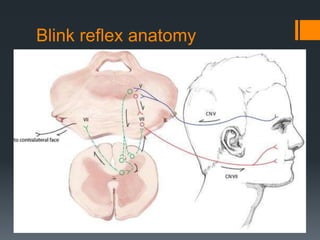
Blink reflex anatomy
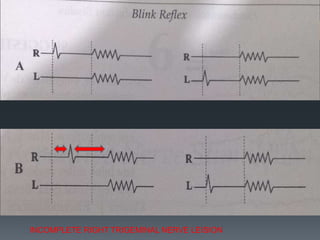
 Two response: Early R1(ipsilateral) and
Late R2 response(bilateral).
R1: disynaptic- Biphasic
R2: multisynaptic- Polyphasic
Procedure
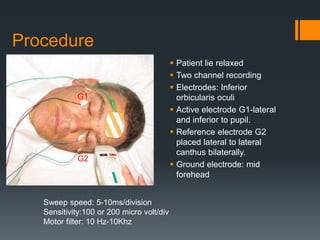
 Patient lie relaxed
 Two channel recording
 Electrodes: Inferior
orbicularis oculi
 Active electrode G1-lateral
and inferior to pupil.
 Reference electrode G2
placed lateral to lateral
canthus bilaterally.
 Ground electrode: mid
forehead
Sweep speed: 5-10ms/division
Sensitivity:100 or 200 micro volt/div
Motor filter: 10 Hz-10Khz
G1
G2
 Electrode is placed on the supra orbital fissure over
medial supra orbital ridge (depression over bony ridge
over eye brow) to stimulate supra orbital nerve branch of
opthalmic disvision of trigeminal nerve.
 Electrical stimulus of 100 micro seconds duration used.
 The current is increased in small increments 3-5 milli ampere
Until supra maximal stimulation is reached.
Typically no more than 15-25 milli ampere
Four to six trials are obtained on rastered tracing and
superimposed
 R1 and R2 latency are measured
 Blink reflex is elicited by stimulation of supraorbital nerve or
infra orbital nerve or by glabellar tap using special reflex
hammer that automatically triggers the oscilloscope sweep
 In normal response electrical stimulation elicits R1 response
on the side ipsilateral to stimulation and R2 responses
bilaterally.
 R 2 latency is the measure of conduction time along the
fastest fibers of afferent pathway of ipsilateral trigeminal
nerve to nucleus of the spinal tract of fifth across multiple
synapses in pons and lateral medulla to both ipsilateral and
contralateral facial n nuclei.
INCOMPLETE RIGHT TRIGEMINAL NERVE LEISION
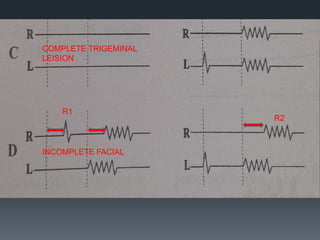
COMPLETE TRIGEMINAL
LEISION
R1
INCOMPLETE FACIAL
R2
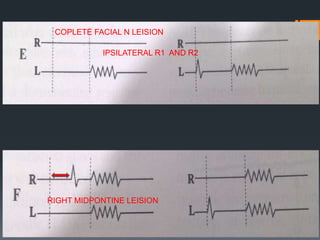
COPLETE FACIAL N LEISION
IPSILATERAL R1 AND R2
RIGHT MIDPONTINE LEISION
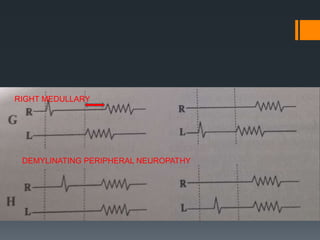
RIGHT MEDULLARY
DEMYLINATING PERIPHERAL NEUROPATHY
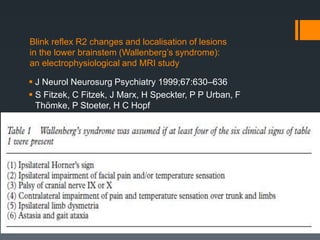
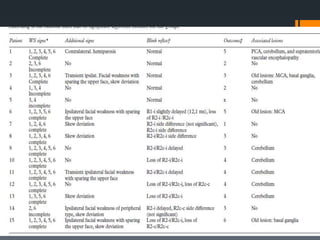
Blink reflex R2 changes and localisation of lesions
in the lower brainstem (Wallenberg’s syndrome):
an electrophysiological and MRI study
 J Neurol Neurosurg Psychiatry 1999;67:630–636
 S Fitzek, C Fitzek, J Marx, H Speckter, P P Urban, F
Thömke, P Stoeter, H C Hopf
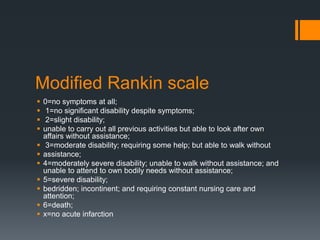
Modified Rankin scale
 0=no symptoms at all;
 1=no significant disability despite symptoms;
 2=slight disability;
 unable to carry out all previous activities but able to look after own
affairs without assistance;
 3=moderate disability; requiring some help; but able to walk without
 assistance;
 4=moderately severe disability; unable to walk without assistance; and
unable to attend to own bodily needs without assistance;
 5=severe disability;
 bedridden; incontinent; and requiring constant nursing care and
attention;
 6=death;
 x=no acute infarction
THANK YOU

Blink reflex 1

  • 1.
  • 2.
     The blinkreflex is essentially the electrical correlate to corneal reflex  It is useful in finding defect anywhere in the reflex arc.  Afferent: supraorbital branch of the opthalmic division of Trigeminal nerve.  Efferent: Motor fibers of facial nerve.
  • 3.
  • 4.
     Two response:Early R1(ipsilateral) and Late R2 response(bilateral). R1: disynaptic- Biphasic R2: multisynaptic- Polyphasic
  • 5.
    Procedure  Patient lierelaxed  Two channel recording  Electrodes: Inferior orbicularis oculi  Active electrode G1-lateral and inferior to pupil.  Reference electrode G2 placed lateral to lateral canthus bilaterally.  Ground electrode: mid forehead Sweep speed: 5-10ms/division Sensitivity:100 or 200 micro volt/div Motor filter: 10 Hz-10Khz G1 G2
  • 6.
     Electrode isplaced on the supra orbital fissure over medial supra orbital ridge (depression over bony ridge over eye brow) to stimulate supra orbital nerve branch of opthalmic disvision of trigeminal nerve.  Electrical stimulus of 100 micro seconds duration used.
  • 7.
     The currentis increased in small increments 3-5 milli ampere Until supra maximal stimulation is reached. Typically no more than 15-25 milli ampere Four to six trials are obtained on rastered tracing and superimposed
  • 8.
     R1 andR2 latency are measured
  • 9.
     Blink reflexis elicited by stimulation of supraorbital nerve or infra orbital nerve or by glabellar tap using special reflex hammer that automatically triggers the oscilloscope sweep  In normal response electrical stimulation elicits R1 response on the side ipsilateral to stimulation and R2 responses bilaterally.
  • 10.
     R 2latency is the measure of conduction time along the fastest fibers of afferent pathway of ipsilateral trigeminal nerve to nucleus of the spinal tract of fifth across multiple synapses in pons and lateral medulla to both ipsilateral and contralateral facial n nuclei.
  • 11.
  • 12.
  • 13.
    COPLETE FACIAL NLEISION IPSILATERAL R1 AND R2 RIGHT MIDPONTINE LEISION
  • 14.
  • 15.
    Blink reflex R2changes and localisation of lesions in the lower brainstem (Wallenberg’s syndrome): an electrophysiological and MRI study  J Neurol Neurosurg Psychiatry 1999;67:630–636  S Fitzek, C Fitzek, J Marx, H Speckter, P P Urban, F Thömke, P Stoeter, H C Hopf
  • 17.
    Modified Rankin scale 0=no symptoms at all;  1=no significant disability despite symptoms;  2=slight disability;  unable to carry out all previous activities but able to look after own affairs without assistance;  3=moderate disability; requiring some help; but able to walk without  assistance;  4=moderately severe disability; unable to walk without assistance; and unable to attend to own bodily needs without assistance;  5=severe disability;  bedridden; incontinent; and requiring constant nursing care and attention;  6=death;  x=no acute infarction
  • 18.