BRAINSTEM AUDITORY
EVOKED RESPONSE
MEENAKSHY SUDEEP
BSc NEUROTECHNOLOGY
HISTORY
• 1967, Sohmer and Feinmesser were the first to
publish ABRs recorded with surface electrodes in
humans which showed that cochlear potentials
could be obtained non-invasively
• 1971, Jewett and Williston gave a clear description
of the human ABR and correctly interpreted the later
waves as arriving from the brainstem
• 1977, Selters and Brackman published landmark
findings on prolonged interpeak latencies in tumor
cases
• 1974, Hecox and Galambos showed that ABR
could be used for threshold estimation in adults
and infants
• 1975, Starr and Anchor were the first to report
effect on ABR of CNS pathology in the brain stem
BAEP
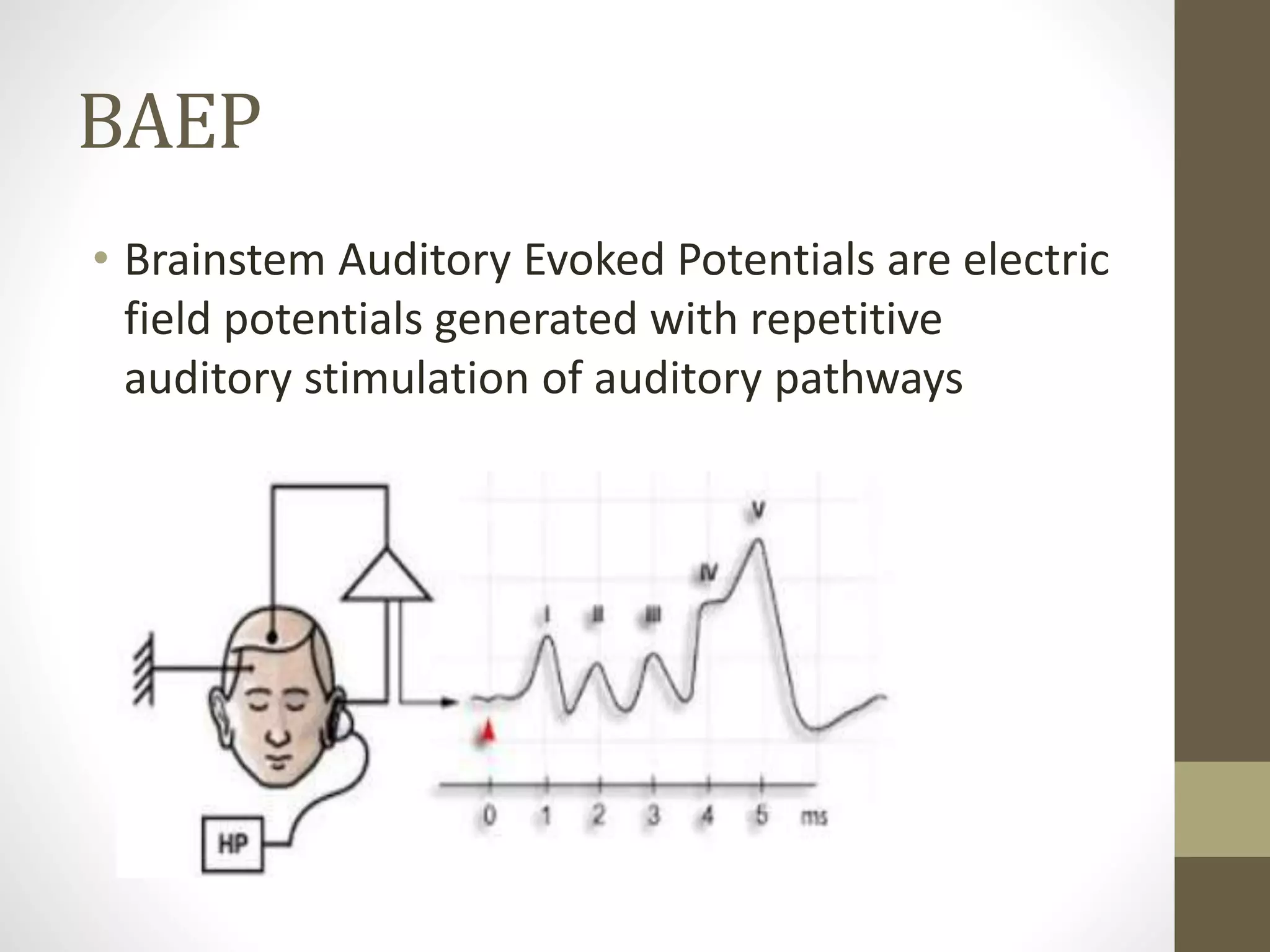
• Brainstem Auditory Evoked Potentials are electric
field potentials generated with repetitive
auditory stimulation of auditory pathways
BAEP
• Brainstem auditory evoked potentials (BAEPs)
reflect neuronal activity in the auditory nerve,
cochlear nucleus, superior olive, and inferior
colliculus of the brainstem
• These potentials are recorded from ear and
vertex in response to brief auditory stimulation
• BAEP comprise five or more waves within 10ms
stimulus
BAEP
• Short Latency Response < 10mS
• Middle Latency Response 10 – 100mS
• Long Latency Response >100ms
BAEP: ELECTRODE
PLACEMENT
• RECORDING ELECTRODE: Cz placed at vertex
• REFERENCE ELECTRODE: A1 placed at ipsilateral
ear lobule or mastoid process
• GROUND ELECTRODE: A2 p0laced at
contralateral ear lobule
METHOD OF RECORDING
• To elicit and record BAEPs an auditory stimulus is
delivered to the patient via headphones
• Auditory stimulus is a square wave pulse of 0.1
ms duration
• The pulse can move earphone diaphragm either
towards or away from the ear
• The earphone movement towards the ear is
called condensation phase stimulus
• The stimulus away from patients ear is called
rarefaction stimulus
• Intensity of stimulation in stimulating ear rangs
from 70 to 100 dB
• As one ear is stimulated with clicks, the other is
masked with white noise, typically 30 to 50 dB
• This method helps to prevent the undesired
coactivation of the contralateral ear caused by
bony conduction from the ipsilateral stimulated
ear
• Atleast 2000 trials are averaged to get a good
quality recording. 2 to 3 repetitions are done
and superimposed to check for reproducibility
BAEP waveform
INTERPRETATION OF RESULT
• When interpreting the ABR, we look at
AMPLITUDE (the number of neurons firing)
LATENCY (the speed of transmission)
INTERPEAK LATENCY (the time between peaks)
INTERAURAL LATENCY (the difference in wave V
latency between ears
• Wave I should be observed but will only be
present ipsilaterally
• Wave III and V should be detactable in all healthy
individuals
• Wave VI and VII appear variably after wave v
MEASUREMENT AND
NORMAL VALUES OF BAEP
• The following parameters are measured foe the
analysis of BAEP
 absolute latency and amplitude
Interpeak latencies
Amplitude ratio of wave v to I or waves IV-V
complex and I
Inter ear interpeak difference
NORMAL VALUES
ABNORMAL BAEP
• BAEP abormalities may include one or more of
the following
Absence of waveform
Abnormal absolute or interpeak latencies
Amplitude ratio abnormality
Right to left assymetry
CLINICAL
NEUROPHYSIOLOGICAL
CORRELATIONS
• BAEP has been studied in numerous neurological
disorders
• The most important clinical applications are
CEREBELLOPONTINE ANGLE TUMOR
INTRINSIC BRAIN TUMOR
MULTIPLE SCLEROSIS
COMA
STROKE
PATIENT RELATED
VARIABLES AFFECTING BAEP
• Age
• Gender
• Level of arousal
• Body postion
• Temperature
• Pre existing hearing loss
References
• Text book of clinical neurophysiology by UK
Mishra and J kalitha
• Google images
THANK YOU…..

Brainstem auditory evoked response

  • 1.
  • 2.
    HISTORY • 1967, Sohmerand Feinmesser were the first to publish ABRs recorded with surface electrodes in humans which showed that cochlear potentials could be obtained non-invasively • 1971, Jewett and Williston gave a clear description of the human ABR and correctly interpreted the later waves as arriving from the brainstem • 1977, Selters and Brackman published landmark findings on prolonged interpeak latencies in tumor cases
  • 3.
    • 1974, Hecoxand Galambos showed that ABR could be used for threshold estimation in adults and infants • 1975, Starr and Anchor were the first to report effect on ABR of CNS pathology in the brain stem
  • 4.
    BAEP • Brainstem AuditoryEvoked Potentials are electric field potentials generated with repetitive auditory stimulation of auditory pathways
  • 5.
    BAEP • Brainstem auditoryevoked potentials (BAEPs) reflect neuronal activity in the auditory nerve, cochlear nucleus, superior olive, and inferior colliculus of the brainstem • These potentials are recorded from ear and vertex in response to brief auditory stimulation • BAEP comprise five or more waves within 10ms stimulus
  • 7.
    BAEP • Short LatencyResponse < 10mS • Middle Latency Response 10 – 100mS • Long Latency Response >100ms
  • 8.
    BAEP: ELECTRODE PLACEMENT • RECORDINGELECTRODE: Cz placed at vertex • REFERENCE ELECTRODE: A1 placed at ipsilateral ear lobule or mastoid process • GROUND ELECTRODE: A2 p0laced at contralateral ear lobule
  • 9.
    METHOD OF RECORDING •To elicit and record BAEPs an auditory stimulus is delivered to the patient via headphones • Auditory stimulus is a square wave pulse of 0.1 ms duration • The pulse can move earphone diaphragm either towards or away from the ear • The earphone movement towards the ear is called condensation phase stimulus • The stimulus away from patients ear is called rarefaction stimulus
  • 10.
    • Intensity ofstimulation in stimulating ear rangs from 70 to 100 dB • As one ear is stimulated with clicks, the other is masked with white noise, typically 30 to 50 dB • This method helps to prevent the undesired coactivation of the contralateral ear caused by bony conduction from the ipsilateral stimulated ear • Atleast 2000 trials are averaged to get a good quality recording. 2 to 3 repetitions are done and superimposed to check for reproducibility
  • 11.
  • 13.
    INTERPRETATION OF RESULT •When interpreting the ABR, we look at AMPLITUDE (the number of neurons firing) LATENCY (the speed of transmission) INTERPEAK LATENCY (the time between peaks) INTERAURAL LATENCY (the difference in wave V latency between ears
  • 14.
    • Wave Ishould be observed but will only be present ipsilaterally • Wave III and V should be detactable in all healthy individuals • Wave VI and VII appear variably after wave v
  • 15.
    MEASUREMENT AND NORMAL VALUESOF BAEP • The following parameters are measured foe the analysis of BAEP  absolute latency and amplitude Interpeak latencies Amplitude ratio of wave v to I or waves IV-V complex and I Inter ear interpeak difference
  • 16.
  • 17.
    ABNORMAL BAEP • BAEPabormalities may include one or more of the following Absence of waveform Abnormal absolute or interpeak latencies Amplitude ratio abnormality Right to left assymetry
  • 18.
    CLINICAL NEUROPHYSIOLOGICAL CORRELATIONS • BAEP hasbeen studied in numerous neurological disorders • The most important clinical applications are CEREBELLOPONTINE ANGLE TUMOR INTRINSIC BRAIN TUMOR MULTIPLE SCLEROSIS COMA STROKE
  • 19.
    PATIENT RELATED VARIABLES AFFECTINGBAEP • Age • Gender • Level of arousal • Body postion • Temperature • Pre existing hearing loss
  • 20.
    References • Text bookof clinical neurophysiology by UK Mishra and J kalitha • Google images
  • 21.