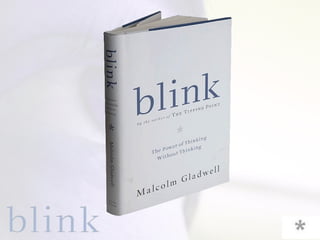
Haste Makes Waste
Stop and Think
Don’t Judge a Book by its Cover
Look Before You Leap
Why then, in Malcolm Gladwell’s “blink” do we meet…
A psychologist who can predict within a few minutes whether a couple’s marriage will last more than 15 years…
A tennis coach who knows when a player will double-fault before the racket even makes contact with the ball…
Art historians who can recognize whether million dollar pieces are a fake with only a glance…
The Purpose of ‘blink’ Convince you that decisions made very quickly can be every bit as good as decisions made cautiously and deliberately Explain when you should trust your instincts and when to be wary of them Prove snap judgments and first impressions can be educated and controlled
The Case of the Kouros In 1993 an art dealer approaches the Getty Museum with a rare sculpture valued at over $10 million dollars The Getty issues a 14 month examination to determine its authenticity using electron microscopes, microprobes, mass spectrometry, x-ray diffraction, and fluorescence Sculpture is purchased for $10 million
The Case of the Kouros Over the next several years experts receive feeling of disappointment, shock, queasiness, and even nausea when they first view it No one has a scientific explanation Slowly the case for the authenticity of the kouros falls apart, until its eventually proven fake
Good to a Fault Live or taped, pro or amateur, male or female; Vic Braden could predict a double fault with amazing accuracy During testing he could predict 94% of the double faults in a live match Braden spent hours and days trying to figure out ‘how’ he knew, never finding an explanation
Why were a group of experts able to be more effective in 2 seconds of observation than 14 months of scientific evaluation?
In the 2 seconds before a serve, how could Braden predict a double fault with such amazing accuracy?
Blink attempts to explain those 2 seconds…
Iowa Gambling Experiment
How long will it take the average person to figure out the game?
Iowa Gambling Experiment On Average… 50 cards for us to realize there is a difference between the decks 80 cards for us to understand and explain the difference
How long will it take for the unconscious brain to figure out the game?
Iowa Gambling Experiment Iowa Scientists used a machine that measure the activity of the sweat glands below the skin of the palm of your hands Gamblers started generating activity in response to the red decks after only 10 cards. More importantly, they began favoring the blue decks long before their conscious brain knew what was going on.
Jam Experts? Consumer Reports put together a panel of food experts and had them rank 44 exotic jams from best to worse Same jams were giving to two different sets of college students Group 1:  Rank the jams based on first impression Group 2:  Rank according to a complicated list of criteria and explain their decisions
Jam Experts? Group One:  Correlation between college students and experts was .55 (considered a incredibly high rating) Group Two:  Correlation between college students and experts was .11 (considered equivalent to chance)
Conscious vs. Unconscious The Conscious Mind Located on the left side of the brain Calculated, Direct, Logical Can only process 9 items at one time Sleeps when we sleep Represents 10% of our total brain capacity
Conscious vs. Unconscious The Unconscious Mind Located on the right side of the brain Associated with our nervous system, heart rate, homeostasis, memories, experience Stays awake when we sleep Represents 90% of our total brain capacity
Conscious vs. Unconscious The conscious brain cannot explain the unconscious brain Experts could not explain what “looked” wrong about the kouros Braden could not explain his double fault accuracy Gamblers couldn’t explain why they favored the blue deck after 10 cards
Explaining the Unconscious Explanations not only are inaccurate, but also hurt the unconscious brain’s ability When college students were asked to explain on why they liked each exotic jam, correlations dropped from .55 to .11
Imagine an inverted pyramid with a $1 bill underneath it.  How do you remove the bill without disturbing the pyramid?
Explaining the Unconscious Those who were asked to catalog their reasoning, ideas, and thought process solved this problem 30% less than people who were just allowed to “think” or “thin-slice” The solution is to burn the dollar bill
The unconscious is so mysterious that some of the greatest athletes in the world have trouble explaining why they are so effective…
Has anyone played tennis or baseball on a semi-competitive basis?
Explaining the Unconscious We as humans have a storytelling problem Digital imaging can show movements to 1/8 th  of a degree Hands don’t roll over the ball until well after the ball strikes the racket Humanly impossible to track the ball right onto the bat  The unconscious is a “locked vault” difficult to explain with the conscious
Case Studies in a ‘blink’? If the unconscious is proven to be more effective than the conscious, and explaining our thoughts actually hurts our ability to solve insight problems, then...?
The “Dark Side” of ‘blink’ IAT Test https://implicit.harvard.edu/implicit/demo/selectatest.jsp
The “Dark Side” of ‘blink’ Everyone has some type of preference for age, weight, skin tone, religion, race These preferences are made from our experiences, associations, education, etc. The conscious is much easier to fake then the unconscious
Adaptive Errors Errors in preference have caused… The United States to elect President Warren Harding in 1921, because he ‘looked’ like a presidential candidate Fortune 500 companies to hire CEO’s, 33% of which were over 6’2” tall, while the only 3.9% of American adult males are over 6’2”. (an inch of height is worth $769 a year)
Adaptive Errors A study of car salesmen in Chicago showed the following… Car Salesmen offered a group of identical buyers the following price: White men: $725 above invoice White women: $935 above invoice Black women: $1,195 above invoice Black men: $1,687 above invoice
How would our own unconscious preferences affect a strategic management decision?
How do we overcome these unconscious preferences if we are unable to “look inside” the vault to see them?
Primed for Action Assemble each of the following 5 word sets into a sentence using 4 words… him was worries she always from are Florida oranges temperature shoes give replace old the be will sweat lonely they sky the seamless gray is should now withdraw forgetfully we us bingo sing play let sunlight makes temperature wrinkle raisins
Primed for Action Assemble each of the following 5 word sets into a sentence using 4 words… him was  worried   she always from are  Florida  oranges temperature shoes give replace  old   the be will sweat  lonely  they sky the seamless  gray  is should now withdraw  forgetfully  we us  bingo  sing play let sunlight makes temperature  wrinkle  raisins
Primed for Action Study created by Psychologist John Bargh Same experiment done with two groups, using words such as “aggressive”, “rude”, “bold”, “bother”, and “intrude” vs. “respect”, “patiently”, “polite”, “courteous” Subjects were then asked to wait at a window for the results of the testing Can you guess what happened?
Primed for Action The people primed to be rude interrupted, on average, after only 5 minutes of waiting The people primed to be polite, NEVER interrupted
Primed for Action IAT has been proven time and time again to be unchangeable despite your conscious beliefs What if you were asked to look at pictures of Martin Luther King Jr., Malcolm X, or Nelson Mandela before you took the Race Association test?  Or read about successful female business women before the career/gender test?
Primed for Action We can change our first impressions, or alter the way we “thin-slice” by changing the experiences that shape those impressions This can be changed in the short term through “priming” or in the long term through cumulative experience Experience soaks into our unconscious and changes the way we view the world
So how do we change our strategic management decision preferences or bias?
Trained to ‘blink’ Think about the art experts and the tennis pro…what made their decisions so effective? One:  They understood, accepted, and relied on “thin-slicing” Two:  They had no natural preference or bias that needed correction Three : Their decisions were made in areas of expertise and passion
Coke/Pepsi Challenge
Trained to ‘blink’ Similar food and beverage are compared on a DOD scale (degree of difference) Wise and Lay’s Salt and Vinegar chips have a DOD of 8 Pepsi and Coke have a DOD of 4  Just over 33% of testers can pass the triangle test (roughly equal to chance) Any trained food taster can pass the test 100% of the time
Strategic Management Case Studies are the “training” of our adaptive unconscious to make sound decisions.
Steps to Improvement Step 1:  Acknowledge that the adaptive unconscious exists and holds great power Step 2:  Understand your natural preferences Step 3:  Use priming to change those preferences or at least compensate for them  Step 4:  Increase experience, education, and practice to sharpen “thin-slicing”
Thank You!!!
Discussion Questions Do you think you could hire someone by ‘thin-slicing’ the candidate during a brief interview?  How effective would it be? Would you introduce priming in the work environment to help improve customer service? If a male CEO receives respect from his subordinates because of his stature, is our bias for tall male CEO’s wrong?

"Blink" Presentation

  • 1.
  • 2.
  • 3.
  • 4.
    Don’t Judge aBook by its Cover
  • 5.
  • 6.
    Why then, inMalcolm Gladwell’s “blink” do we meet…
  • 7.
    A psychologist whocan predict within a few minutes whether a couple’s marriage will last more than 15 years…
  • 8.
    A tennis coachwho knows when a player will double-fault before the racket even makes contact with the ball…
  • 9.
    Art historians whocan recognize whether million dollar pieces are a fake with only a glance…
  • 10.
    The Purpose of‘blink’ Convince you that decisions made very quickly can be every bit as good as decisions made cautiously and deliberately Explain when you should trust your instincts and when to be wary of them Prove snap judgments and first impressions can be educated and controlled
  • 11.
    The Case ofthe Kouros In 1993 an art dealer approaches the Getty Museum with a rare sculpture valued at over $10 million dollars The Getty issues a 14 month examination to determine its authenticity using electron microscopes, microprobes, mass spectrometry, x-ray diffraction, and fluorescence Sculpture is purchased for $10 million
  • 12.
    The Case ofthe Kouros Over the next several years experts receive feeling of disappointment, shock, queasiness, and even nausea when they first view it No one has a scientific explanation Slowly the case for the authenticity of the kouros falls apart, until its eventually proven fake
  • 13.
    Good to aFault Live or taped, pro or amateur, male or female; Vic Braden could predict a double fault with amazing accuracy During testing he could predict 94% of the double faults in a live match Braden spent hours and days trying to figure out ‘how’ he knew, never finding an explanation
  • 14.
    Why were agroup of experts able to be more effective in 2 seconds of observation than 14 months of scientific evaluation?
  • 15.
    In the 2seconds before a serve, how could Braden predict a double fault with such amazing accuracy?
  • 16.
    Blink attempts toexplain those 2 seconds…
  • 17.
  • 18.
    How long willit take the average person to figure out the game?
  • 19.
    Iowa Gambling ExperimentOn Average… 50 cards for us to realize there is a difference between the decks 80 cards for us to understand and explain the difference
  • 20.
    How long willit take for the unconscious brain to figure out the game?
  • 21.
    Iowa Gambling ExperimentIowa Scientists used a machine that measure the activity of the sweat glands below the skin of the palm of your hands Gamblers started generating activity in response to the red decks after only 10 cards. More importantly, they began favoring the blue decks long before their conscious brain knew what was going on.
  • 22.
    Jam Experts? ConsumerReports put together a panel of food experts and had them rank 44 exotic jams from best to worse Same jams were giving to two different sets of college students Group 1: Rank the jams based on first impression Group 2: Rank according to a complicated list of criteria and explain their decisions
  • 23.
    Jam Experts? GroupOne: Correlation between college students and experts was .55 (considered a incredibly high rating) Group Two: Correlation between college students and experts was .11 (considered equivalent to chance)
  • 24.
    Conscious vs. UnconsciousThe Conscious Mind Located on the left side of the brain Calculated, Direct, Logical Can only process 9 items at one time Sleeps when we sleep Represents 10% of our total brain capacity
  • 25.
    Conscious vs. UnconsciousThe Unconscious Mind Located on the right side of the brain Associated with our nervous system, heart rate, homeostasis, memories, experience Stays awake when we sleep Represents 90% of our total brain capacity
  • 26.
    Conscious vs. UnconsciousThe conscious brain cannot explain the unconscious brain Experts could not explain what “looked” wrong about the kouros Braden could not explain his double fault accuracy Gamblers couldn’t explain why they favored the blue deck after 10 cards
  • 27.
    Explaining the UnconsciousExplanations not only are inaccurate, but also hurt the unconscious brain’s ability When college students were asked to explain on why they liked each exotic jam, correlations dropped from .55 to .11
  • 28.
    Imagine an invertedpyramid with a $1 bill underneath it. How do you remove the bill without disturbing the pyramid?
  • 29.
    Explaining the UnconsciousThose who were asked to catalog their reasoning, ideas, and thought process solved this problem 30% less than people who were just allowed to “think” or “thin-slice” The solution is to burn the dollar bill
  • 30.
    The unconscious isso mysterious that some of the greatest athletes in the world have trouble explaining why they are so effective…
  • 31.
    Has anyone playedtennis or baseball on a semi-competitive basis?
  • 32.
    Explaining the UnconsciousWe as humans have a storytelling problem Digital imaging can show movements to 1/8 th of a degree Hands don’t roll over the ball until well after the ball strikes the racket Humanly impossible to track the ball right onto the bat The unconscious is a “locked vault” difficult to explain with the conscious
  • 33.
    Case Studies ina ‘blink’? If the unconscious is proven to be more effective than the conscious, and explaining our thoughts actually hurts our ability to solve insight problems, then...?
  • 34.
    The “Dark Side”of ‘blink’ IAT Test https://implicit.harvard.edu/implicit/demo/selectatest.jsp
  • 35.
    The “Dark Side”of ‘blink’ Everyone has some type of preference for age, weight, skin tone, religion, race These preferences are made from our experiences, associations, education, etc. The conscious is much easier to fake then the unconscious
  • 36.
    Adaptive Errors Errorsin preference have caused… The United States to elect President Warren Harding in 1921, because he ‘looked’ like a presidential candidate Fortune 500 companies to hire CEO’s, 33% of which were over 6’2” tall, while the only 3.9% of American adult males are over 6’2”. (an inch of height is worth $769 a year)
  • 37.
    Adaptive Errors Astudy of car salesmen in Chicago showed the following… Car Salesmen offered a group of identical buyers the following price: White men: $725 above invoice White women: $935 above invoice Black women: $1,195 above invoice Black men: $1,687 above invoice
  • 38.
    How would ourown unconscious preferences affect a strategic management decision?
  • 39.
    How do weovercome these unconscious preferences if we are unable to “look inside” the vault to see them?
  • 40.
    Primed for ActionAssemble each of the following 5 word sets into a sentence using 4 words… him was worries she always from are Florida oranges temperature shoes give replace old the be will sweat lonely they sky the seamless gray is should now withdraw forgetfully we us bingo sing play let sunlight makes temperature wrinkle raisins
  • 41.
    Primed for ActionAssemble each of the following 5 word sets into a sentence using 4 words… him was worried she always from are Florida oranges temperature shoes give replace old the be will sweat lonely they sky the seamless gray is should now withdraw forgetfully we us bingo sing play let sunlight makes temperature wrinkle raisins
  • 42.
    Primed for ActionStudy created by Psychologist John Bargh Same experiment done with two groups, using words such as “aggressive”, “rude”, “bold”, “bother”, and “intrude” vs. “respect”, “patiently”, “polite”, “courteous” Subjects were then asked to wait at a window for the results of the testing Can you guess what happened?
  • 43.
    Primed for ActionThe people primed to be rude interrupted, on average, after only 5 minutes of waiting The people primed to be polite, NEVER interrupted
  • 44.
    Primed for ActionIAT has been proven time and time again to be unchangeable despite your conscious beliefs What if you were asked to look at pictures of Martin Luther King Jr., Malcolm X, or Nelson Mandela before you took the Race Association test? Or read about successful female business women before the career/gender test?
  • 45.
    Primed for ActionWe can change our first impressions, or alter the way we “thin-slice” by changing the experiences that shape those impressions This can be changed in the short term through “priming” or in the long term through cumulative experience Experience soaks into our unconscious and changes the way we view the world
  • 46.
    So how dowe change our strategic management decision preferences or bias?
  • 47.
    Trained to ‘blink’Think about the art experts and the tennis pro…what made their decisions so effective? One: They understood, accepted, and relied on “thin-slicing” Two: They had no natural preference or bias that needed correction Three : Their decisions were made in areas of expertise and passion
  • 48.
  • 49.
    Trained to ‘blink’Similar food and beverage are compared on a DOD scale (degree of difference) Wise and Lay’s Salt and Vinegar chips have a DOD of 8 Pepsi and Coke have a DOD of 4 Just over 33% of testers can pass the triangle test (roughly equal to chance) Any trained food taster can pass the test 100% of the time
  • 50.
    Strategic Management CaseStudies are the “training” of our adaptive unconscious to make sound decisions.
  • 51.
    Steps to ImprovementStep 1: Acknowledge that the adaptive unconscious exists and holds great power Step 2: Understand your natural preferences Step 3: Use priming to change those preferences or at least compensate for them Step 4: Increase experience, education, and practice to sharpen “thin-slicing”
  • 52.
  • 53.
    Discussion Questions Doyou think you could hire someone by ‘thin-slicing’ the candidate during a brief interview? How effective would it be? Would you introduce priming in the work environment to help improve customer service? If a male CEO receives respect from his subordinates because of his stature, is our bias for tall male CEO’s wrong?