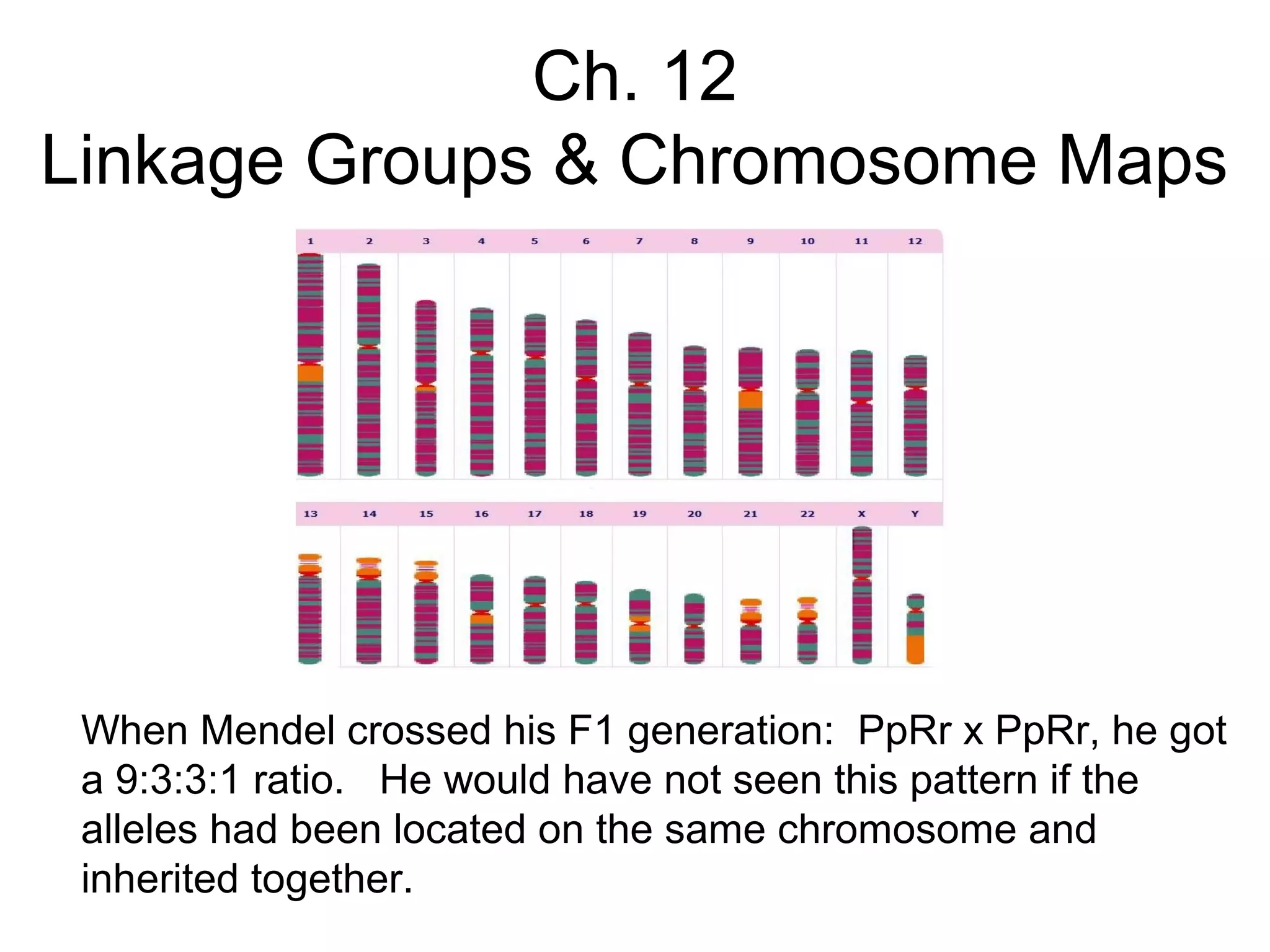
Ch. 12
Linkage Groups & Chromosome Maps
When Mendel crossed his F1 generation: PpRr x PpRr, he got
a 9:3:3:1 ratio. He would have not seen this pattern if the
alleles had been located on the same chromosome and
inherited together.
Objectives
1. Define and explain how we get parental and recombinant
types
2. Create a chromosome map based on crossing
over/recombinant types data
Chromosome Theory of Inheritance
1. Genes have specific
locations on chromosomes
2. Genes on homologous
chromosomes segregate
away from each other
during meiosis
3. Each gene pair segregates
independently of other gene
pairs
Thomas Hunt Morgan studied fruit flies and
found that in some crosses, expected
outcomes weren't happening. Further
experiments confirmed that alleles located
on the same chromosome are often
inherited together. (i.e. they DON’T follow the
law of independent assortment)
A common cross used to demonstrate linkage groups is the
cross of a heterozygote wild type vestigial wings/ black body with
a recessive mutant.
What is up with all those letters?
or just use the old fashioned way
A a B b x a a b b
Because these alleles are found on the same chromosome, a
Punnett square would show them inherited together. There are
two possible arrangements for the heterozygote (AaBb) in the
above cross.
If the dominant alleles AB
are on the same
chromosome, it is called a
CIS arrangement
If the dominant alleles
are on different
chromosomes (Ab) then
it is called TRANS
Consider a cross with a parent that has the CIS arrangement to
one that is a mutant for both traits (aabb)
a
b
a
b
A
B
a
b X
50% wild
50%
mutants
Thomas Hunt did not observe a perfect 1:1 (or 50/50) ratio.
Instead, his results looked like this….
Expected Observed
Wild Type 50 40
Mutant 50 40
Vestigial wings, Wild 0 10
Black body, Wild 0 10
Question: How would you explain these results?
Answer: The two offspring that did not look like either parent are
called recombinants. They are a result of a CROSS-OVER that
occurred during meiosis
The alleles switched position.
Parental and Recombinant Types
Parental Types – offspring
have the same phenotype as
one of the two parents
Recombinant Types –
offspring with a new
combination of phenotypes
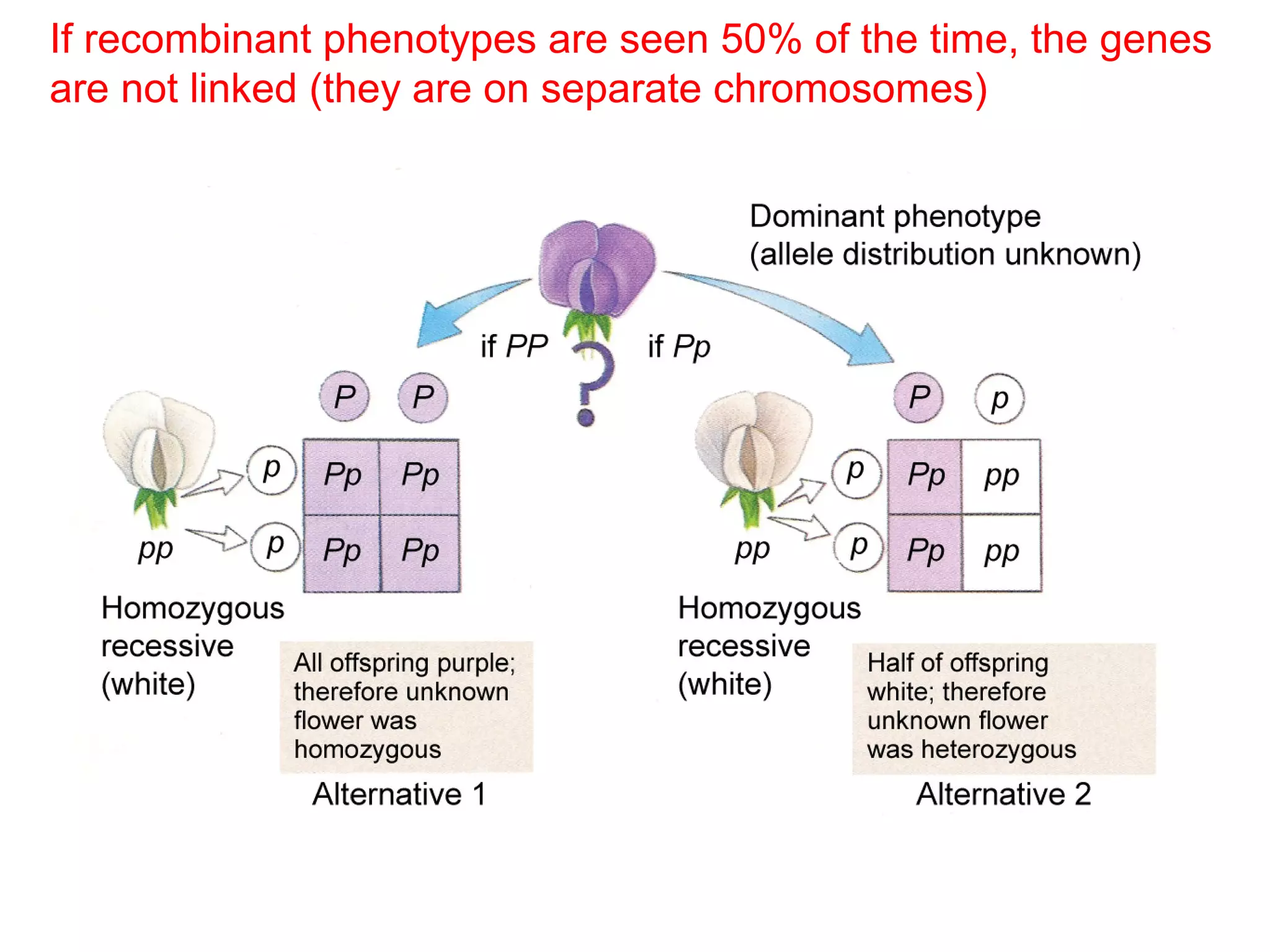
If recombinant phenotypes are seen 50% of the time, the genes
are not linked (they are on separate chromosomes)
If some other pattern appears (less than 50%), the
genes are linked
How often you see recombinants (the result of crossing over
that “unlinked” the genes) allows you to calculate the distance
between any 2 genes on a chromosome
1. What is a parental type?
2. What is a recombinant type?
3. How do we get recombinant types?
4. How do we get parental types?
Practice Questions (assume no crossing over occurs)
1. A dumpy winged (dd) fruit fly with long aristae (AA) is crossed
with a long winged (Dd) short aristae (aa). Show the cross and
the phenotypic proportions.
2. A fruit fly with short legs (ll) and vestigial wings (ww) is crossed
with one that is heterozygous for both traits. Assuming the
dominant alleles are on separate chromosomes, show the cross
and the expected phenotypic proportions.
3. In fruit flies, red eyes is a dominant allele located on the X
chromosome. The recessive condition results in white eyes. The
tan body trait is also X-linked and is dominant to yellow bodies. A
female who is heterozygous both traits with the dominant alleles
located on the same chromosome is crossed with a white eyed,
yellow bodied male. Show the cross and the phenotypic proportions
(Don't forget these traits are X-linked!)
4. Chromosome Map Problem
In pea plants, flower color and pollen shape are located on the same chromosome. A plant
with purple flowers and long pollen (AaBb) is crossed with one that is recessive for both traits
(aabb).
The results are as follows:
Results
Purple, long 47
Red, round 47
Purple, round 3
Red, Long 3
a) Are the chromosomes of the AaBb parent in the cis or trans position? Sketch the punnett square showing the
expected offspring.
b) How far apart are the two alleles?
116
In minions, the phenotype for number of eyes is
governed by two alleles – one eye = (E) and two
eyes = (e). Two heterozygous minions mate to
produce 465 offspring.
Calculate how many of these offspring are expected
to have two eyes. Round your response to the
nearest whole number.
In corn, purple kernels (R) are dominant to yellow
kernels (r). Cobs from the offspring of a cross between
a purple plant and yellow plant were used in a lab. A
student counts 329 purple and 299 yellow kernels on
one cob.
Calculate the chi-squared value for the null hypothesis
that the purple parent was heterozygous for purple
kernels. Give your answer to the nearest tenth.
A plant geneticist is investigating the inheritance of genes for bitter
taste (S) and explosive rind (e) in watermelon. Explosive rind is
recessive and causes watermelons to burst when cut. Non-bitter
watermelons are a result of the recessive genotype (ss). The
geneticist wishes to determine if the genes assort independently. She
performs a testcross between a bitter/nonexplosive hybrid and a plant
homozygous recessive for both traits. The following offspring are
produced:
bitter/non-explosive – 88
bitter/explosive – 68
non-bitter/non-explosive – 62
non-bitter/explosive – 81
Calculate the chi-squared value for the null hypothesis that the two
genes assort independently. Give your answer to the nearest tenth.
Are these genes linked? How do you know?
In DNA, A pairs with ___ and G pairs with ___
So…if the genome of a fruit fly contains 2378
thymine nucleotides, how many adenine, guanine,
and cytosine nucleotides would you expect if there
are 4000 base pairs?
2738 adenine
1622 cytosine
1622 guanine
Are these genes linked?
How do you know?
Is the student correct?

AP Biology Ch 12 gene linkage groups and chromosome maps

  • 1.
    Ch. 12 Linkage Groups& Chromosome Maps When Mendel crossed his F1 generation: PpRr x PpRr, he got a 9:3:3:1 ratio. He would have not seen this pattern if the alleles had been located on the same chromosome and inherited together.
  • 2.
    Objectives 1. Define andexplain how we get parental and recombinant types 2. Create a chromosome map based on crossing over/recombinant types data
  • 3.
    Chromosome Theory ofInheritance 1. Genes have specific locations on chromosomes 2. Genes on homologous chromosomes segregate away from each other during meiosis 3. Each gene pair segregates independently of other gene pairs
  • 4.
    Thomas Hunt Morganstudied fruit flies and found that in some crosses, expected outcomes weren't happening. Further experiments confirmed that alleles located on the same chromosome are often inherited together. (i.e. they DON’T follow the law of independent assortment) A common cross used to demonstrate linkage groups is the cross of a heterozygote wild type vestigial wings/ black body with a recessive mutant.
  • 5.
    What is upwith all those letters? or just use the old fashioned way A a B b x a a b b
  • 6.
    Because these allelesare found on the same chromosome, a Punnett square would show them inherited together. There are two possible arrangements for the heterozygote (AaBb) in the above cross. If the dominant alleles AB are on the same chromosome, it is called a CIS arrangement If the dominant alleles are on different chromosomes (Ab) then it is called TRANS
  • 7.
    Consider a crosswith a parent that has the CIS arrangement to one that is a mutant for both traits (aabb) a b a b A B a b X 50% wild 50% mutants
  • 8.
    Thomas Hunt didnot observe a perfect 1:1 (or 50/50) ratio. Instead, his results looked like this…. Expected Observed Wild Type 50 40 Mutant 50 40 Vestigial wings, Wild 0 10 Black body, Wild 0 10 Question: How would you explain these results?
  • 9.
    Answer: The twooffspring that did not look like either parent are called recombinants. They are a result of a CROSS-OVER that occurred during meiosis The alleles switched position.
  • 10.
    Parental and RecombinantTypes Parental Types – offspring have the same phenotype as one of the two parents Recombinant Types – offspring with a new combination of phenotypes
  • 11.
    If recombinant phenotypesare seen 50% of the time, the genes are not linked (they are on separate chromosomes)
  • 12.
    If some otherpattern appears (less than 50%), the genes are linked How often you see recombinants (the result of crossing over that “unlinked” the genes) allows you to calculate the distance between any 2 genes on a chromosome
  • 13.
    1. What isa parental type? 2. What is a recombinant type? 3. How do we get recombinant types? 4. How do we get parental types?
  • 14.
    Practice Questions (assumeno crossing over occurs) 1. A dumpy winged (dd) fruit fly with long aristae (AA) is crossed with a long winged (Dd) short aristae (aa). Show the cross and the phenotypic proportions.
  • 15.
    2. A fruitfly with short legs (ll) and vestigial wings (ww) is crossed with one that is heterozygous for both traits. Assuming the dominant alleles are on separate chromosomes, show the cross and the expected phenotypic proportions.
  • 16.
    3. In fruitflies, red eyes is a dominant allele located on the X chromosome. The recessive condition results in white eyes. The tan body trait is also X-linked and is dominant to yellow bodies. A female who is heterozygous both traits with the dominant alleles located on the same chromosome is crossed with a white eyed, yellow bodied male. Show the cross and the phenotypic proportions (Don't forget these traits are X-linked!)
  • 17.
    4. Chromosome MapProblem In pea plants, flower color and pollen shape are located on the same chromosome. A plant with purple flowers and long pollen (AaBb) is crossed with one that is recessive for both traits (aabb). The results are as follows: Results Purple, long 47 Red, round 47 Purple, round 3 Red, Long 3 a) Are the chromosomes of the AaBb parent in the cis or trans position? Sketch the punnett square showing the expected offspring. b) How far apart are the two alleles?
  • 18.
    116 In minions, thephenotype for number of eyes is governed by two alleles – one eye = (E) and two eyes = (e). Two heterozygous minions mate to produce 465 offspring. Calculate how many of these offspring are expected to have two eyes. Round your response to the nearest whole number.
  • 20.
    In corn, purplekernels (R) are dominant to yellow kernels (r). Cobs from the offspring of a cross between a purple plant and yellow plant were used in a lab. A student counts 329 purple and 299 yellow kernels on one cob. Calculate the chi-squared value for the null hypothesis that the purple parent was heterozygous for purple kernels. Give your answer to the nearest tenth.
  • 21.
    A plant geneticistis investigating the inheritance of genes for bitter taste (S) and explosive rind (e) in watermelon. Explosive rind is recessive and causes watermelons to burst when cut. Non-bitter watermelons are a result of the recessive genotype (ss). The geneticist wishes to determine if the genes assort independently. She performs a testcross between a bitter/nonexplosive hybrid and a plant homozygous recessive for both traits. The following offspring are produced: bitter/non-explosive – 88 bitter/explosive – 68 non-bitter/non-explosive – 62 non-bitter/explosive – 81 Calculate the chi-squared value for the null hypothesis that the two genes assort independently. Give your answer to the nearest tenth. Are these genes linked? How do you know?
  • 23.
    In DNA, Apairs with ___ and G pairs with ___ So…if the genome of a fruit fly contains 2378 thymine nucleotides, how many adenine, guanine, and cytosine nucleotides would you expect if there are 4000 base pairs? 2738 adenine 1622 cytosine 1622 guanine
  • 24.
    Are these geneslinked? How do you know?
  • 25.