
More of Mendel
What we know…Inheritance of biological characteristics is determined by genesPrinciple of DominanceWhen there are two or more alleles for a gene, some are dominant while others are recessiveLaw of SegregationIn sexually reproducing organisms, adult cells have two copies of each gene—one from each parent; these genes segregate when GAMETES are formed
Does the segregation of 1 pair of alleles affect the segregation of another pair of alleles?
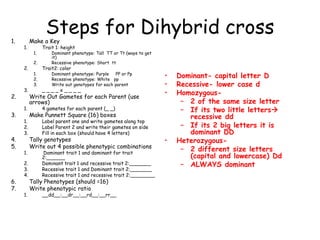
Let’s look at Pea shape and pea colorRound (R) vs. wrinkled (r)Yellow (Y) vs. green (y)Remember, there are 4 possible gametesIf a parent is homozygous dominant (true-breeding dominant) for both shape and color, what will all possible gametes be?If a parent is homozygous recessive (true-breeding recessive) for both shape and color, what will all possible gametes be?
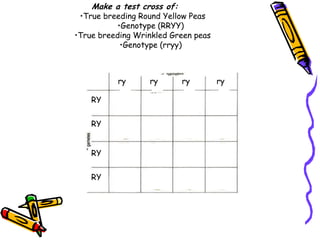
Make a test cross of:True breeding Round Yellow Peas
Genotype (RRYY)
True breeding Wrinkled Green peas
Genotype (rryy)ryryryryRYRYRYRY
What is the phenotype of the F1 offspring?What is the genotype of the F1 offspring?
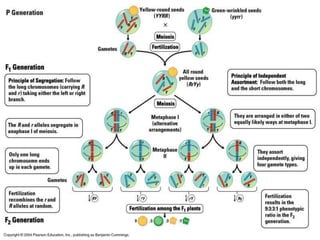
What this first cross told us…All F1 offspring were heterozygous for seed shape (round) and seed color (yellow) RrYyThe F1 plant was made from fusing a gamete carrying RY and a gamete carrying ryWill the dominant alleles stay together or separate when making the F2 offspring?
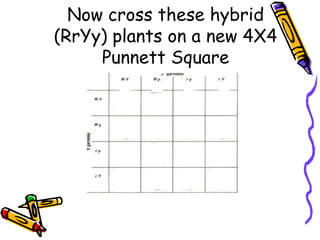
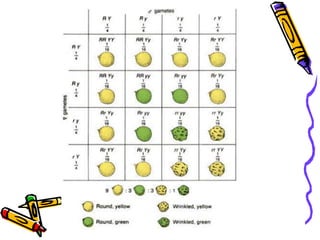
Now cross these hybrid  (RrYy) plants on a new 4X4 Punnett Square
What does the F2 cross tell us?Are there combinations of alleles that we did not see in either of the parents?This means that the alleles for seed color separated independently than the alleles for seed shapeGenes that segregate separately do NOT influence each other’s inheritance
Principle of Independent AssortmentGenes for different traits can segregate independently during the formation of gametes.  This principle helps account for many genetic variations in plants, animals and other organisms.
Mendel’s 4 Principle’sInheritance of biological characteristics is determined by genesPrinciple of DominanceLaw of SegregationPrinciple of Independent Assortment
Exceptions to MendelGenetics more complicatedSome alleles are neither dominant nor recessiveMany traits are controlled by multiple alleles or multiple genes
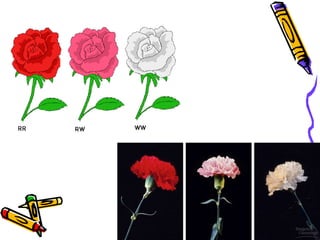
Incomplete DominanceWhen red flowered (CRCR) plants were crossed with white flowered (CWCW) plants they made…pink flowers (CRCW)Which allele is dominant?neitherIncomplete dominance:Case in which one allele is not dominant over anotherThe heterozygous phenotype is somewhere between the two homozygous phenotypes
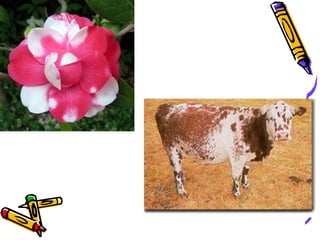
CodominanceBoth alleles contribute to the phenotypeChickensAllele for black feathers is codominant with allele for white feathersChicken looks speckled with black and white feathersNot like the blending of dominant phenotypes…BOTH dominant phenotypes show upIn humansGene for protein that controls cholesterol levels in the bloodPeople with heterozygous form make both types of protien
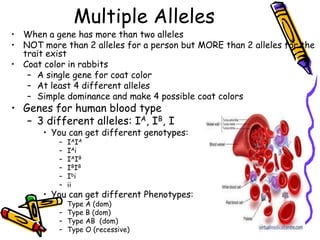
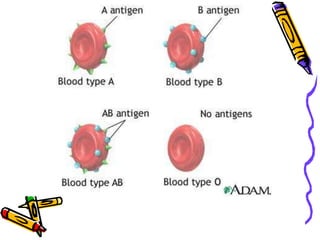
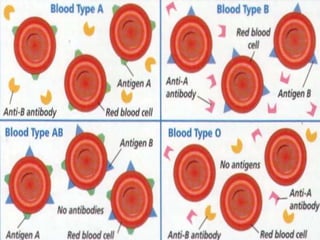
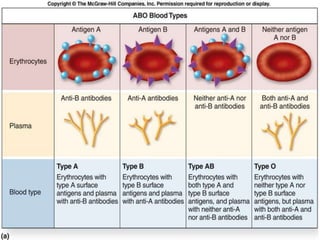
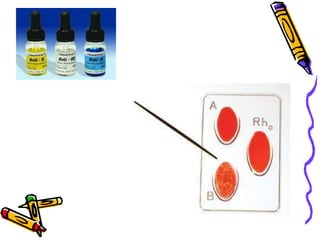
Multiple AllelesWhen a gene has more than two allelesNOT more than 2 alleles for a person but MORE than 2 alleles for the trait existCoat color in rabbitsA single gene for coat colorAt least 4 different allelesSimple dominance and make 4 possible coat colorsGenes for human blood type3 different alleles: IA, IB, IYou can get different genotypes:IAIAIAiIAIBIBIBIbiiiYou can get different Phenotypes:Type A (dom)Type B (dom)Type AB  (dom)Type O (recessive)
Polygenic Traits“Poly” many“-genic” genesTraits controlled by two or more genesSeveral genes interact to produce a traitWide range of phenotypesSkin colorFour different genesFruit Fly eye colorThree genes make the reddish brown pigment
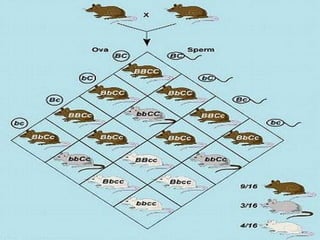
EpistasisWhen the expression of one gene effects the expression of another geneEx. Fur color in mice…controlled by 2 separate genesGene 1Brown fur pigment (BB or Bb) is dominant over gray fur pigment (bb)Gene 2Coat Pigment depositing gene Dominant gene (CC or Cc) means fur will get pigment and this is determined by gene oneRecessive gene (cc) means that no pigment will be deposited on fur…whether the they have the gene for black or brown furThe gene for Pigment Deposition is the EPISTATIC gene because it alters the Phenotypic rationSd
HomeworkComplete a Dihybrid cross for 2 mice that are heterozygous for both Brown fur (Bb) and Pigment deposition (Pp)Predict your phenotypic ratio…What are you final phenotypic ratios?Write a paragraph explaining your results.
Genes and the EnvironmentGenes provide the plan for developmentHow the plan unfolds depends on the environmentExample:Sunflower has genes for height and color of flowersBut these traits are also influenced by climate, soil conditions and water availability
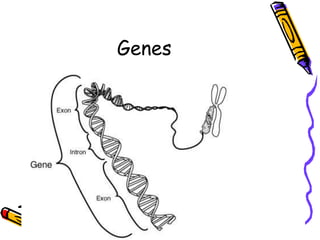
Genes
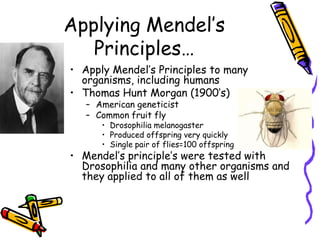
Applying Mendel’s Principles…Apply Mendel’s Principles to many organisms, including humansThomas Hunt Morgan (1900’s)American geneticistCommon fruit flyDrosophiliamelanogasterProduced offspring very quicklySingle pair of flies=100 offspringMendel’s principle’s were tested with Drosophilia and many other organisms and they applied to all of them as well
Would genes on the same chromosome be inherited together?Thomas noticed that almost every single time he crossed two flies that each had red eyes and mini wings, the offspring almost always inherited BOTH red eyes and mini wingsThis went against Mendel’s Principle of Independent Assortment…(review!)
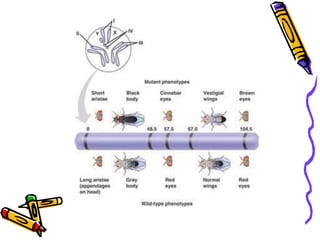
Gene LinkageThomas Hunt Morgan gave us the answer1910 PRINCIPLE of LINKAGE50 Drosophilia genesSeemed to contradict Principle of Independent Assortment b/c certain genes were always inherited togetherHe grouped the fly’s genes into linkage groups
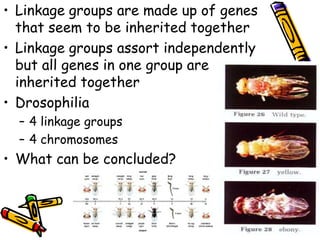
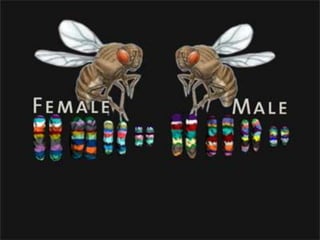
Linkage groups are made up of genes that seem to be inherited togetherLinkage groups assort independently but all genes in one group are inherited togetherDrosophilia4 linkage groups4 chromosomesWhat can be concluded?
ConclusionsEach chromosome is actually a group of linked genesMendel’s Principle of Independent Assortment holds true but an adjustment needs to be made…IT IS THE CHROMOSOMES THAT ASSORT INDEPENDENTLY, NOT THE INDIVIDUAL GENES
How Mendel missed it…What 7 genes did he study?6 of the 7 genes were on different chromosomesTwo genes were on the same chromosome but they were so far apart on the same chromosome that they assorted independently
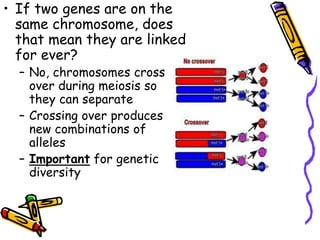
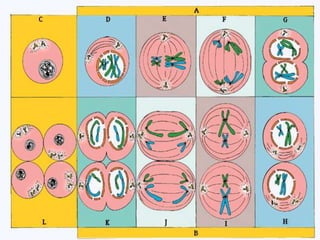
If two genes are on the same chromosome, does that mean they are linked for ever?No, chromosomes cross over during meiosis so they can separateCrossing over produces new combinations of allelesImportant for genetic diversity
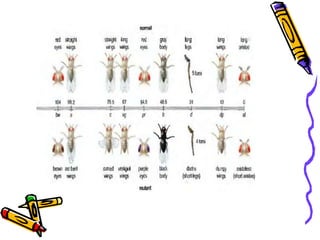
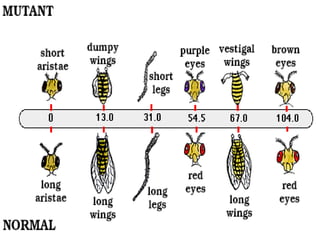
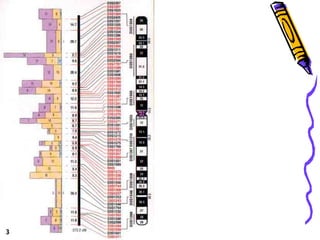
Lucky StudentAlfred Sturtevant 1911Columbia UniversityWorked in Morgan’s LabHypothesisIf two genes are farther apart on a chromosome, the they are more likely to be separated during meiosisExperimentMeasured the rate at which linked genes were separated and recombined to make a “map” of distances between genesConclusionRecombination rates could be used to make gene mapsGene maps showed the location of a gene on a chromosome
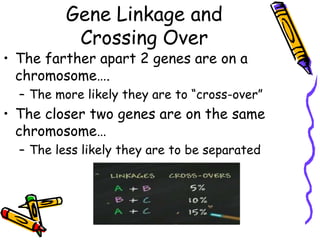
Gene Linkage and Crossing OverThe farther apart 2 genes are on a chromosome….The more likely they are to “cross-over”The closer two genes are on the same chromosome…The less likely they are to be separated

Mendel 2 revised

  • 1.
  • 2.
    What we know…Inheritanceof biological characteristics is determined by genesPrinciple of DominanceWhen there are two or more alleles for a gene, some are dominant while others are recessiveLaw of SegregationIn sexually reproducing organisms, adult cells have two copies of each gene—one from each parent; these genes segregate when GAMETES are formed
  • 3.
    Does the segregationof 1 pair of alleles affect the segregation of another pair of alleles?
  • 4.
    Let’s look atPea shape and pea colorRound (R) vs. wrinkled (r)Yellow (Y) vs. green (y)Remember, there are 4 possible gametesIf a parent is homozygous dominant (true-breeding dominant) for both shape and color, what will all possible gametes be?If a parent is homozygous recessive (true-breeding recessive) for both shape and color, what will all possible gametes be?
  • 5.
    Make a testcross of:True breeding Round Yellow Peas
  • 6.
  • 7.
  • 8.
  • 9.
    What is thephenotype of the F1 offspring?What is the genotype of the F1 offspring?
  • 10.
    What this firstcross told us…All F1 offspring were heterozygous for seed shape (round) and seed color (yellow) RrYyThe F1 plant was made from fusing a gamete carrying RY and a gamete carrying ryWill the dominant alleles stay together or separate when making the F2 offspring?
  • 11.
    Now cross thesehybrid (RrYy) plants on a new 4X4 Punnett Square
  • 13.
    What does theF2 cross tell us?Are there combinations of alleles that we did not see in either of the parents?This means that the alleles for seed color separated independently than the alleles for seed shapeGenes that segregate separately do NOT influence each other’s inheritance
  • 14.
    Principle of IndependentAssortmentGenes for different traits can segregate independently during the formation of gametes. This principle helps account for many genetic variations in plants, animals and other organisms.
  • 15.
    Mendel’s 4 Principle’sInheritanceof biological characteristics is determined by genesPrinciple of DominanceLaw of SegregationPrinciple of Independent Assortment
  • 16.
    Exceptions to MendelGeneticsmore complicatedSome alleles are neither dominant nor recessiveMany traits are controlled by multiple alleles or multiple genes
  • 17.
    Incomplete DominanceWhen redflowered (CRCR) plants were crossed with white flowered (CWCW) plants they made…pink flowers (CRCW)Which allele is dominant?neitherIncomplete dominance:Case in which one allele is not dominant over anotherThe heterozygous phenotype is somewhere between the two homozygous phenotypes
  • 19.
    CodominanceBoth alleles contributeto the phenotypeChickensAllele for black feathers is codominant with allele for white feathersChicken looks speckled with black and white feathersNot like the blending of dominant phenotypes…BOTH dominant phenotypes show upIn humansGene for protein that controls cholesterol levels in the bloodPeople with heterozygous form make both types of protien
  • 21.
    Multiple AllelesWhen agene has more than two allelesNOT more than 2 alleles for a person but MORE than 2 alleles for the trait existCoat color in rabbitsA single gene for coat colorAt least 4 different allelesSimple dominance and make 4 possible coat colorsGenes for human blood type3 different alleles: IA, IB, IYou can get different genotypes:IAIAIAiIAIBIBIBIbiiiYou can get different Phenotypes:Type A (dom)Type B (dom)Type AB (dom)Type O (recessive)
  • 26.
    Polygenic Traits“Poly” many“-genic”genesTraits controlled by two or more genesSeveral genes interact to produce a traitWide range of phenotypesSkin colorFour different genesFruit Fly eye colorThree genes make the reddish brown pigment
  • 27.
    EpistasisWhen the expressionof one gene effects the expression of another geneEx. Fur color in mice…controlled by 2 separate genesGene 1Brown fur pigment (BB or Bb) is dominant over gray fur pigment (bb)Gene 2Coat Pigment depositing gene Dominant gene (CC or Cc) means fur will get pigment and this is determined by gene oneRecessive gene (cc) means that no pigment will be deposited on fur…whether the they have the gene for black or brown furThe gene for Pigment Deposition is the EPISTATIC gene because it alters the Phenotypic rationSd
  • 28.
    HomeworkComplete a Dihybridcross for 2 mice that are heterozygous for both Brown fur (Bb) and Pigment deposition (Pp)Predict your phenotypic ratio…What are you final phenotypic ratios?Write a paragraph explaining your results.
  • 30.
    Genes and theEnvironmentGenes provide the plan for developmentHow the plan unfolds depends on the environmentExample:Sunflower has genes for height and color of flowersBut these traits are also influenced by climate, soil conditions and water availability
  • 32.
  • 33.
    Applying Mendel’s Principles…ApplyMendel’s Principles to many organisms, including humansThomas Hunt Morgan (1900’s)American geneticistCommon fruit flyDrosophiliamelanogasterProduced offspring very quicklySingle pair of flies=100 offspringMendel’s principle’s were tested with Drosophilia and many other organisms and they applied to all of them as well
  • 34.
    Would genes onthe same chromosome be inherited together?Thomas noticed that almost every single time he crossed two flies that each had red eyes and mini wings, the offspring almost always inherited BOTH red eyes and mini wingsThis went against Mendel’s Principle of Independent Assortment…(review!)
  • 35.
    Gene LinkageThomas HuntMorgan gave us the answer1910 PRINCIPLE of LINKAGE50 Drosophilia genesSeemed to contradict Principle of Independent Assortment b/c certain genes were always inherited togetherHe grouped the fly’s genes into linkage groups
  • 36.
    Linkage groups aremade up of genes that seem to be inherited togetherLinkage groups assort independently but all genes in one group are inherited togetherDrosophilia4 linkage groups4 chromosomesWhat can be concluded?
  • 38.
    ConclusionsEach chromosome isactually a group of linked genesMendel’s Principle of Independent Assortment holds true but an adjustment needs to be made…IT IS THE CHROMOSOMES THAT ASSORT INDEPENDENTLY, NOT THE INDIVIDUAL GENES
  • 41.
    How Mendel missedit…What 7 genes did he study?6 of the 7 genes were on different chromosomesTwo genes were on the same chromosome but they were so far apart on the same chromosome that they assorted independently
  • 42.
    If two genesare on the same chromosome, does that mean they are linked for ever?No, chromosomes cross over during meiosis so they can separateCrossing over produces new combinations of allelesImportant for genetic diversity
  • 43.
    Lucky StudentAlfred Sturtevant1911Columbia UniversityWorked in Morgan’s LabHypothesisIf two genes are farther apart on a chromosome, the they are more likely to be separated during meiosisExperimentMeasured the rate at which linked genes were separated and recombined to make a “map” of distances between genesConclusionRecombination rates could be used to make gene mapsGene maps showed the location of a gene on a chromosome
  • 44.
    Gene Linkage andCrossing OverThe farther apart 2 genes are on a chromosome….The more likely they are to “cross-over”The closer two genes are on the same chromosome…The less likely they are to be separated