Cell Division
The Basics
Who: Mitosis
What: Cell division
When: New cells are needed
Where: Somatic cells (body cells)
Why: Growth
The Basics
Who: Somatic cells (Normal cells like in your toes)
What: Cellular reproduction for growth, the cell cycle
Where: Happens in somatic cells, regular body cells like in
your toes
Why: For growth (baby to adult) and to replace damaged
cells (heal a cut)
How: Duplicate cell parts making an exact copy of
cell; one "mother" cell becomes two identical "daughter"
cells.
Remember: Toes as is mi-toes-is (mitosis)
Mitosis
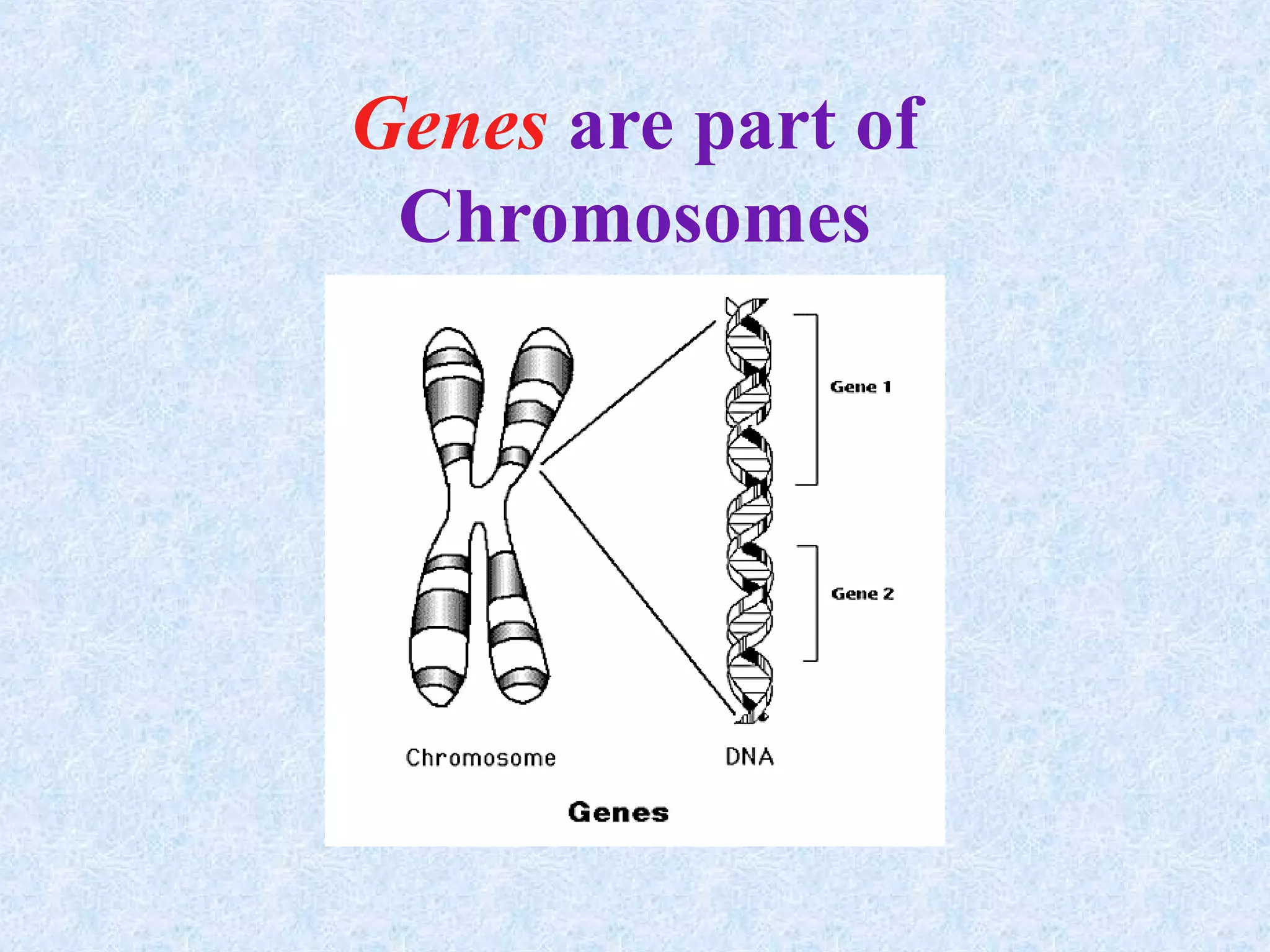
Mitosis & Chromosomes
Mitosis is the duplication of chromosomes
Chromosomes
are made of
DNA
Genes are part of
Chromosomes
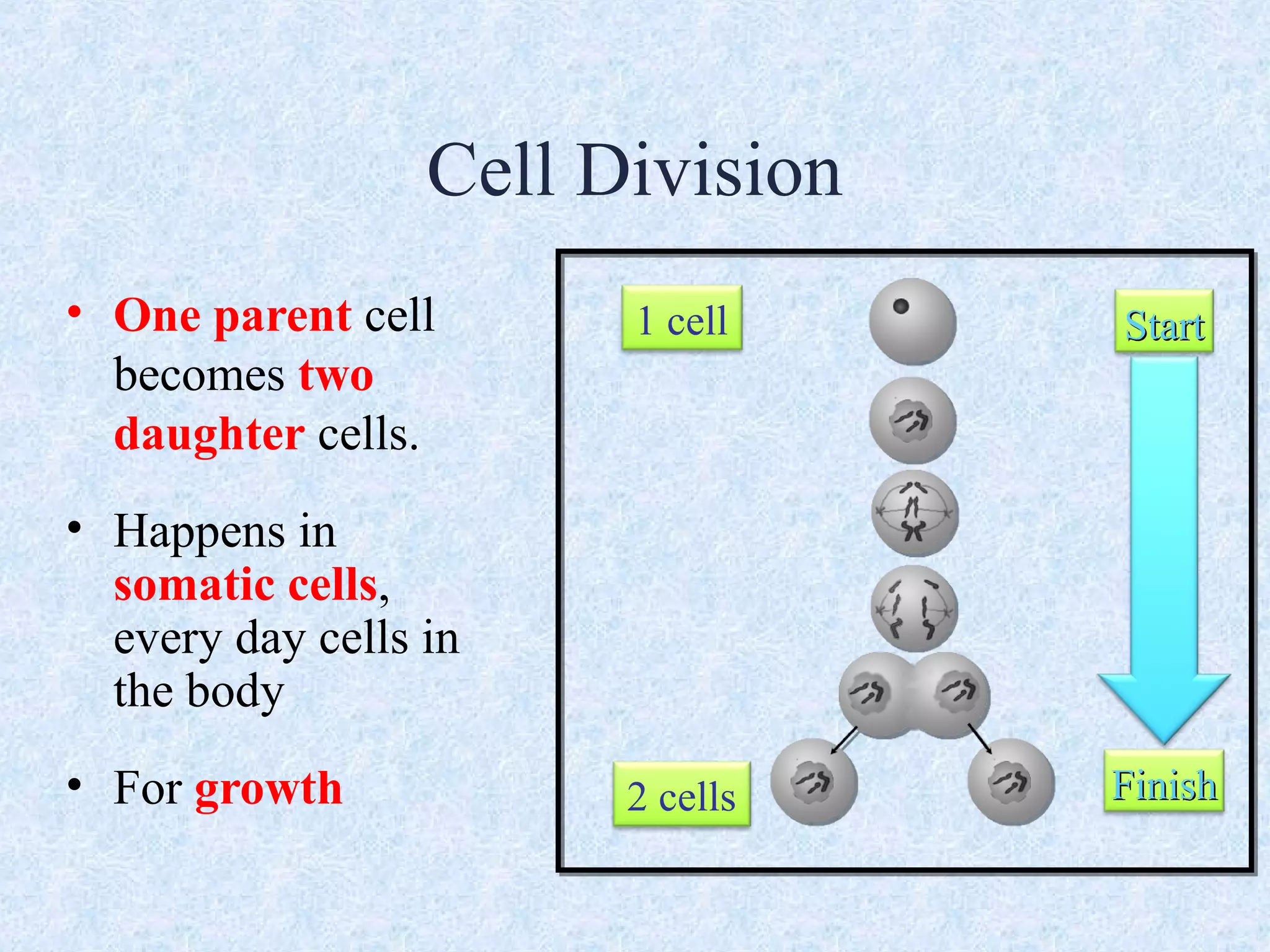
Cell Division
• One parent cell
becomes two
daughter cells.
• Happens in
somatic cells,
every day cells in
the body
• For growth
StartStart
FinishFinish
1 cell
2 cells
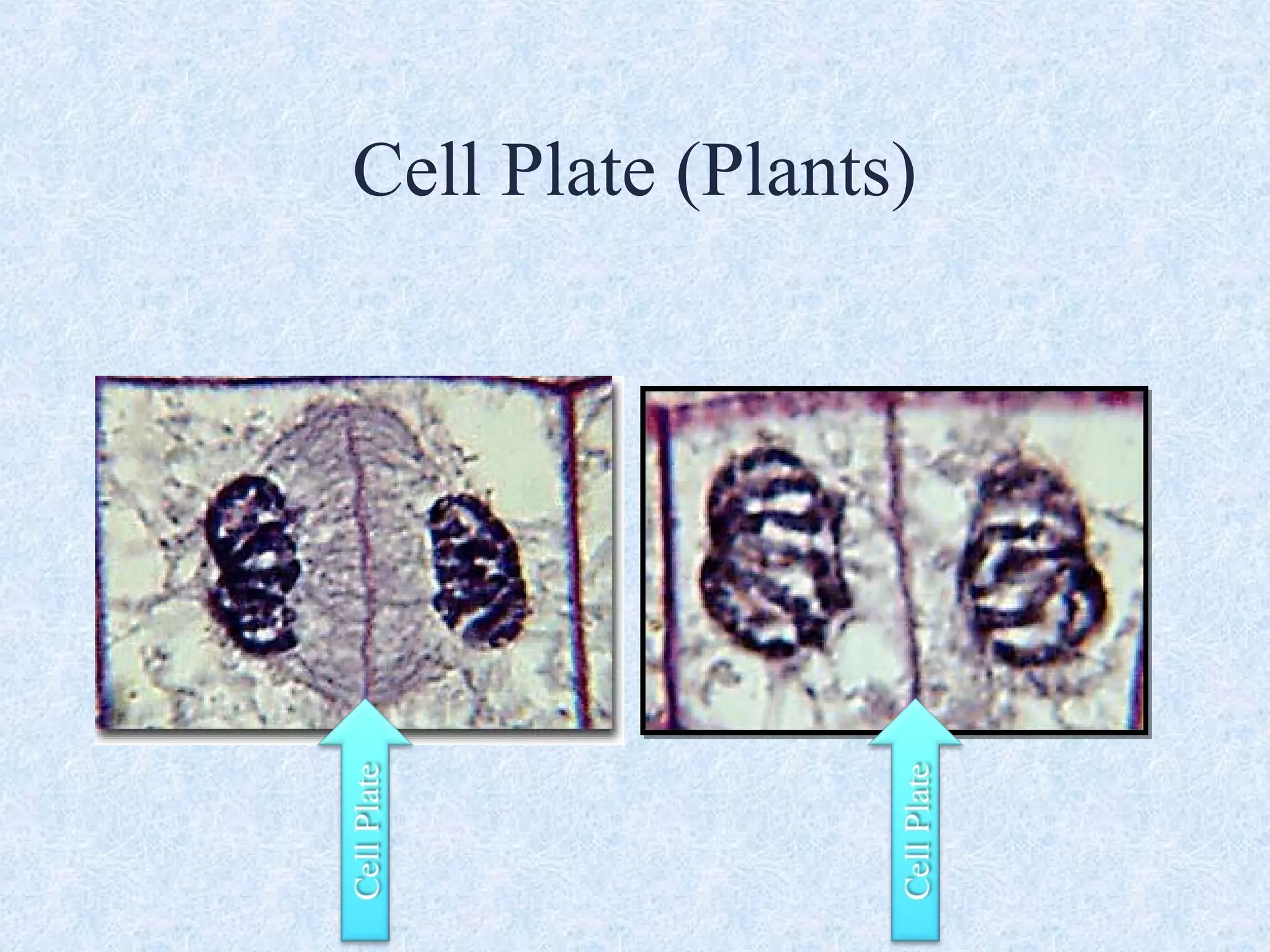
Cell Plate (Plants)
Mitosis in an animal cell
• 1 cell to 4 cells
Uneven Division
Division of cytoplasm is
not always even
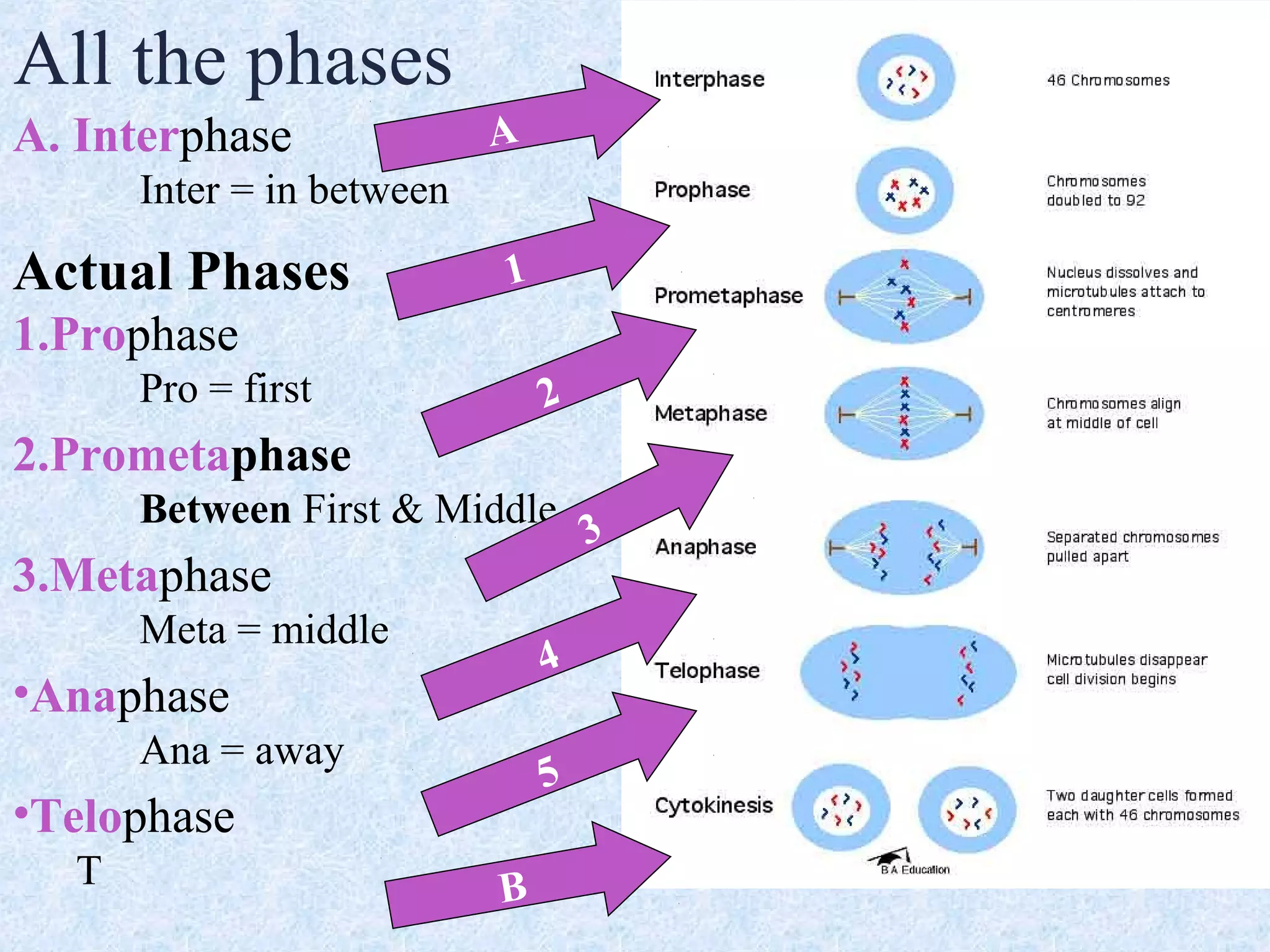
The Phases
There are five phases
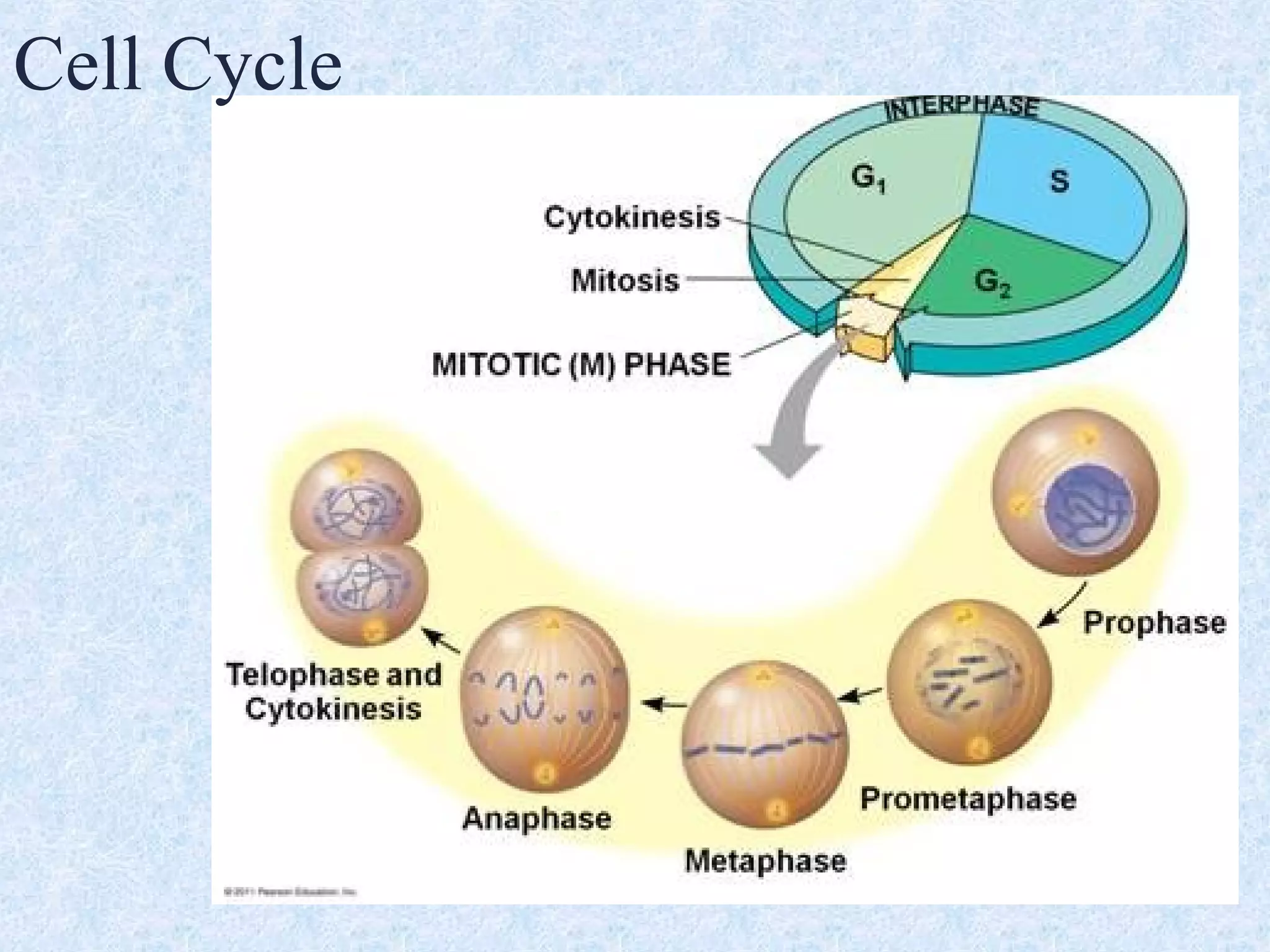
Cell Cycle
A. Interphase
Inter = in between
Actual Phases
1.Prophase
Pro = first
2.Prometaphase
Between First & Middle
3.Metaphase
Meta = middle
•Anaphase
Ana = away
•Telophase
T
All the phases
1
2
3
4
A
5
B
Mitosis
with
emphasis
on
metaphase
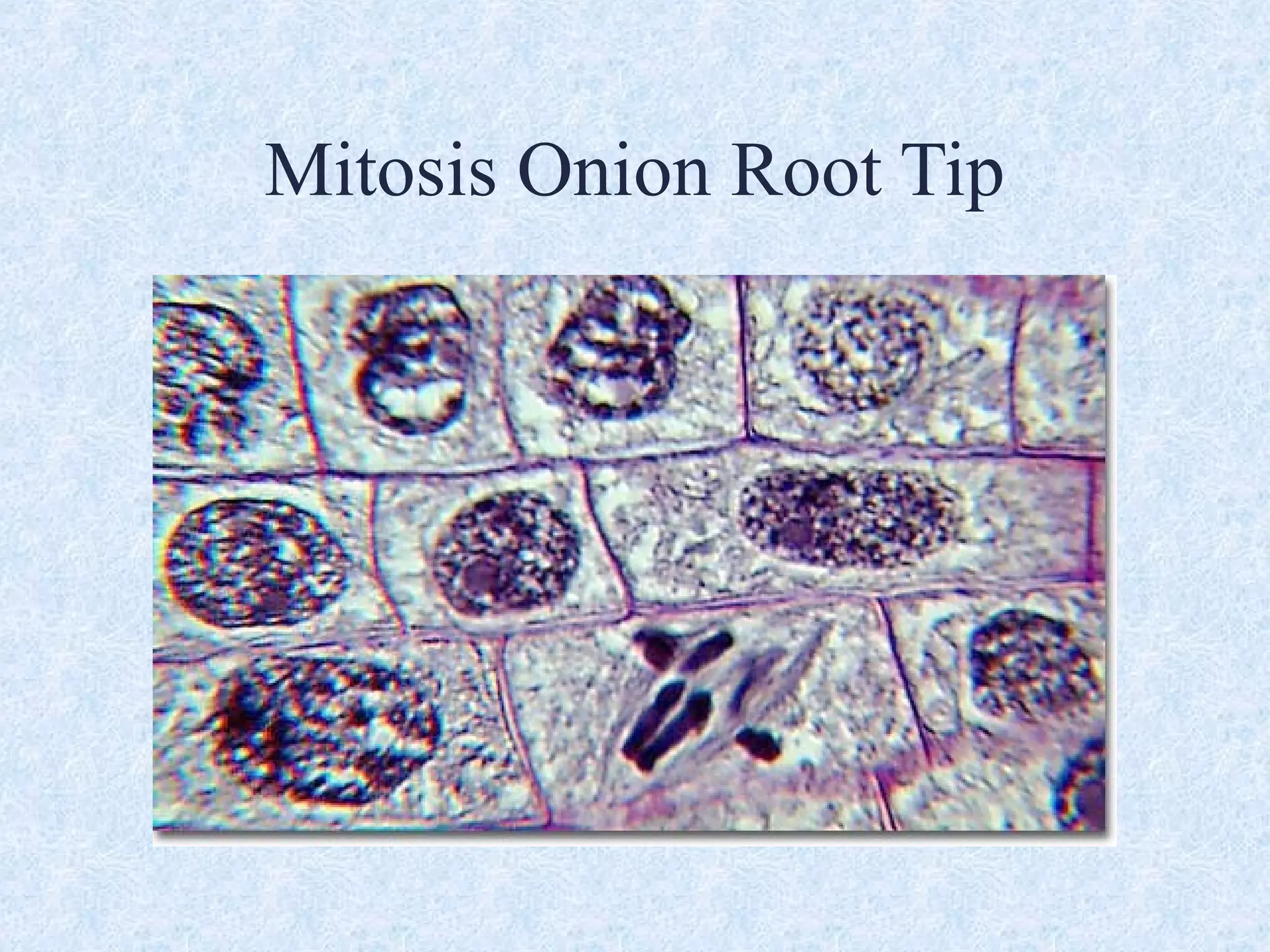
Mitosis Onion Root Tip
Interphase
• Interphase is
NOT a part of
mitosis.
• Interphase the
cell grows
before the DNA
is duplicated,
then DNA is
duplicated, and
lastly, prepares
for division.
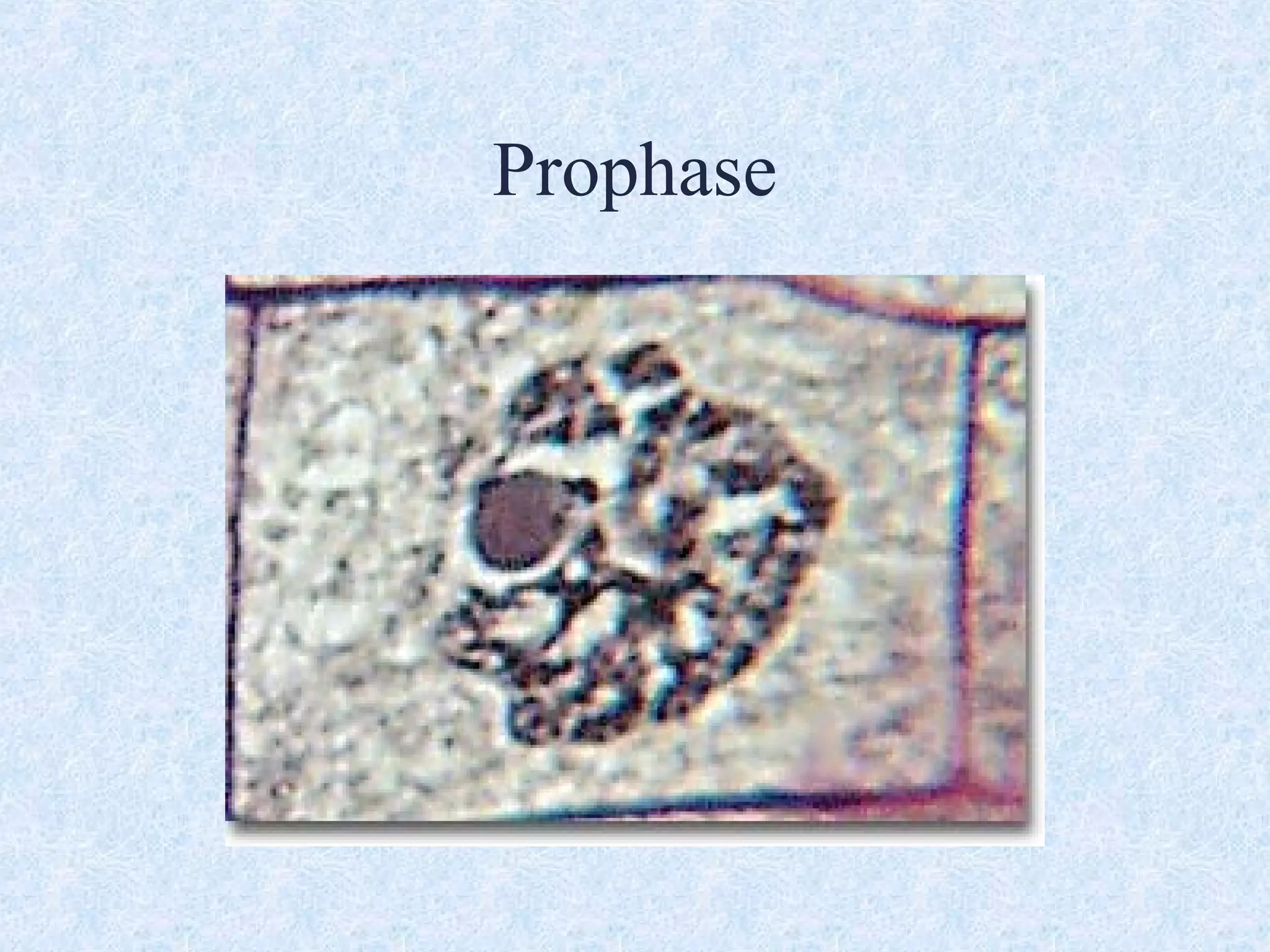
Prophase
• During
prophase, the
DNA and
proteins start to
condense.
• The microtubles
are assembled
start moving to
one of the two
centriole pairs
toward the
opposite end of
the cell.
Dark region
= condensing
chromatin
Onion root
tip image
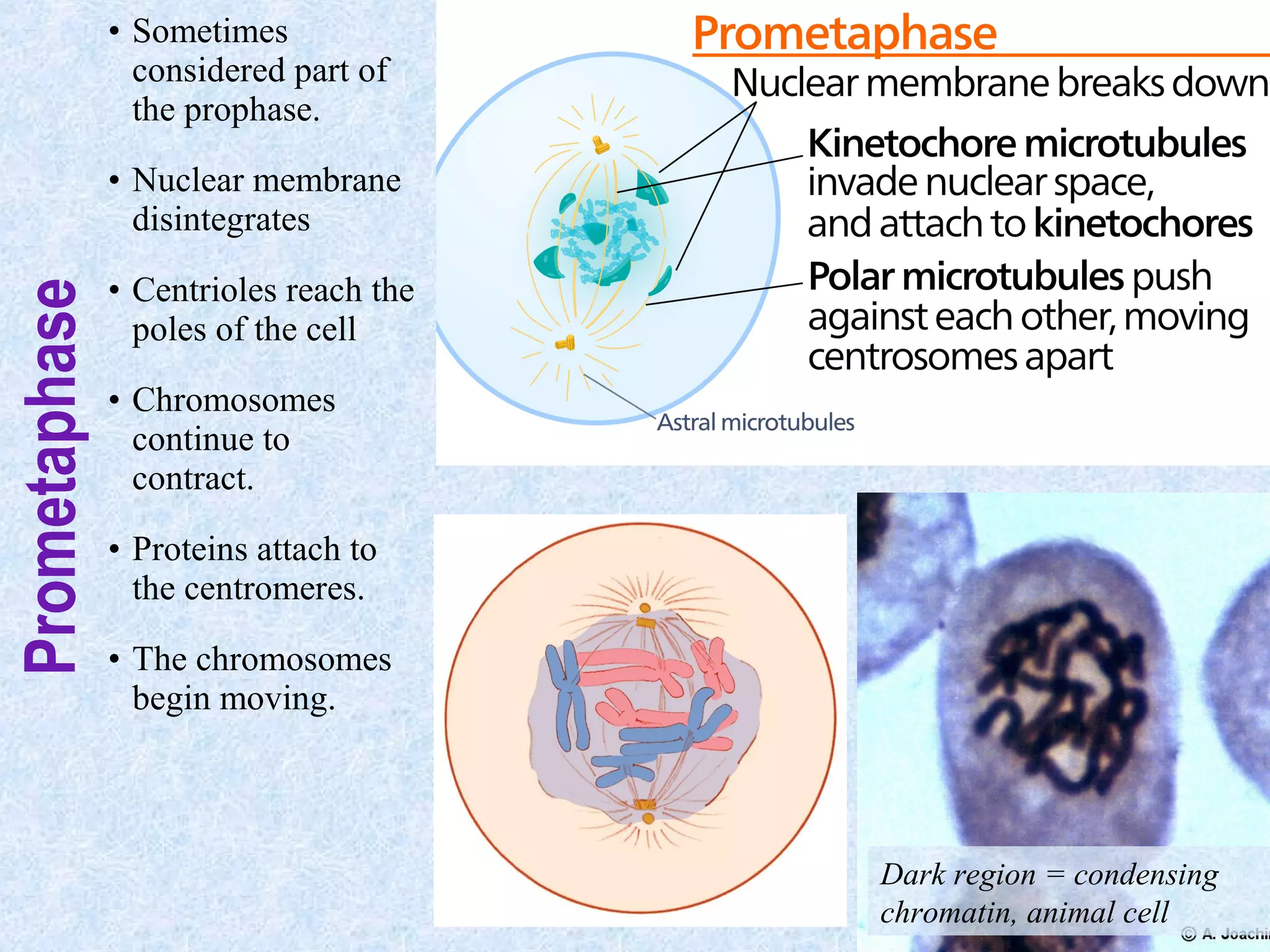
Prometaphase • Sometimes
considered part of
the prophase.
• Nuclear membrane
disintegrates
• Centrioles reach the
poles of the cell
• Chromosomes
continue to
contract.
• Proteins attach to
the centromeres.
• The chromosomes
begin moving.
Dark region = condensing
chromatin, animal cell
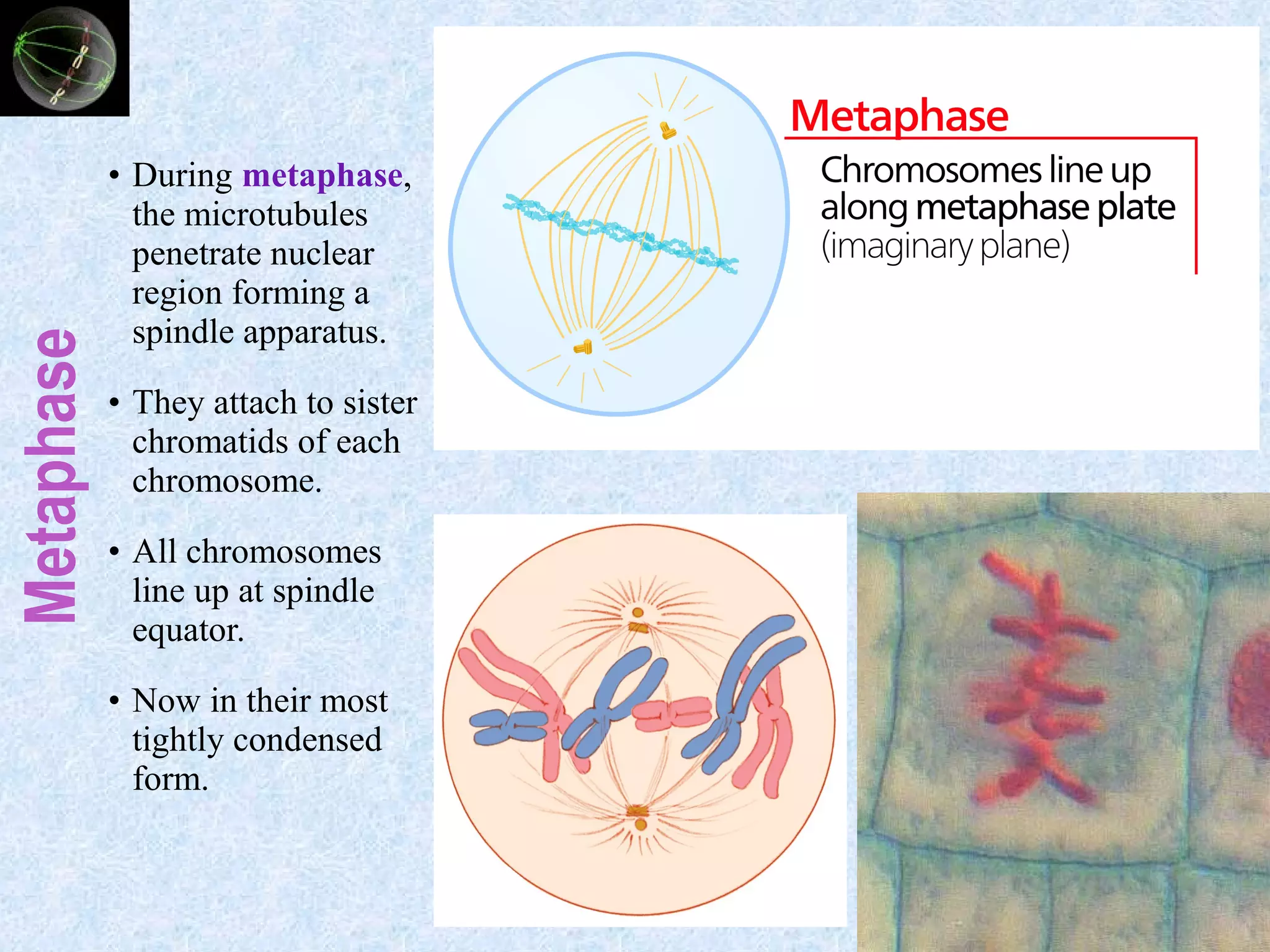
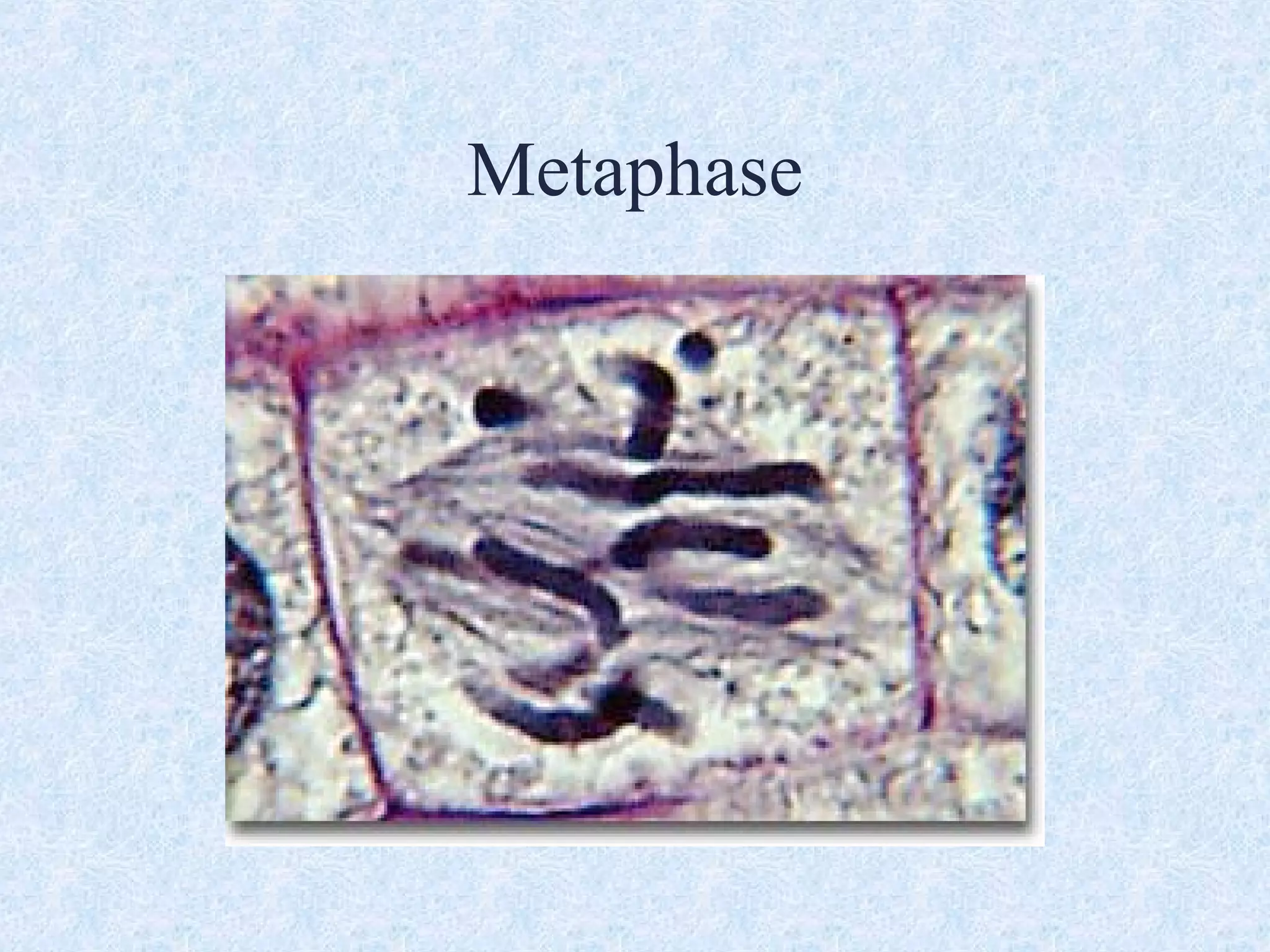
Metaphase
• During metaphase,
the microtubules
penetrate nuclear
region forming a
spindle apparatus.
• They attach to sister
chromatids of each
chromosome.
• All chromosomes
line up at spindle
equator.
• Now in their most
tightly condensed
form.
Anaphase
• During
anaphase,
attachments
between the two
sister chromatids
of each
chromosome
break.
• Now separate
chromosomes
move to
opposite spindle
poles.
Mid Anaphase
Onion root tip
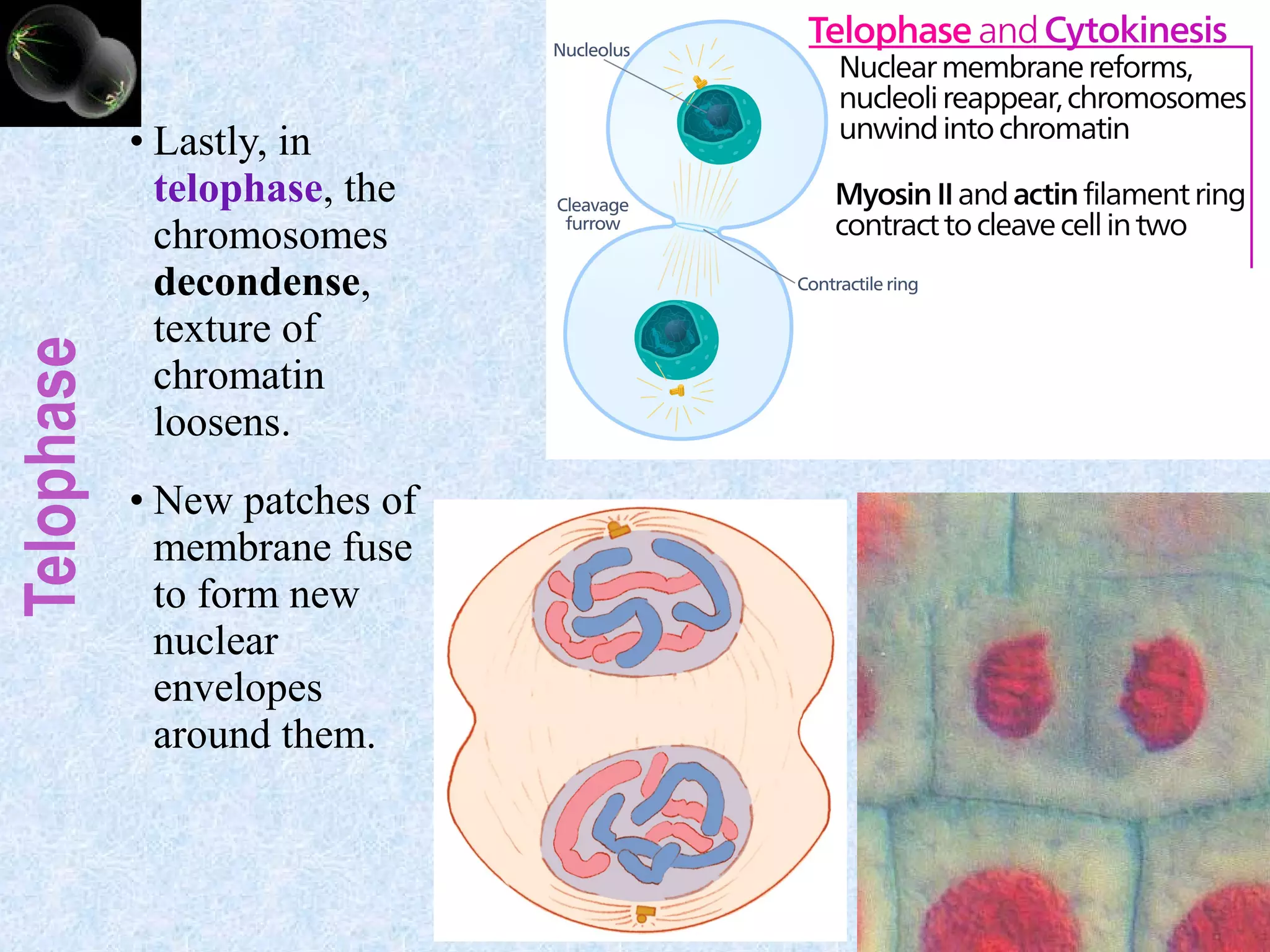
Telophase
• Lastly, in
telophase, the
chromosomes
decondense,
texture of
chromatin
loosens.
• New patches of
membrane fuse
to form new
nuclear
envelopes
around them.
Cytokinesis & Daughter Cells
Animal cells.
•Pinching of cytoplasm into
two cells.
Plant cells
•Cell plate forms between
the two ā€œnewā€ cells.
After cytokinesis
•Cells now in interphase
Called daughter cells.
•Cells diploid, two each
type of chromosome – same
as parent cell's nucleus.
Mitosis on the run
Stages
1. Interphase
Thecell isengagedinmetabolicactivityandpreparingformitosis(thenextfourphasesthatleaduptoandinclude nucleardivision).
Chromosomesarenotclearlydiscernedinthenucleus,althougha darkspotcalledthenucleolusmaybevisible.Thecellmaycontaina pairofcentrioles(or
microtubule organizingcentersinplants)bothofwhichareorganizational sitesformicrotubules.Thisisthe longest stage.
2. Prophase
Chromatin in the nucleus begins to condense and becomes
visible in the light microscope as chromosomes. The nucleolus
disappears. Centrioles begin moving to opposite ends of the cell and
fibers extend from the centromeres. Some fibers cross the cell to form the
mitotic spindle.
3.
Stages
3. Prometaphase
Sometimes considered part of the prophase. When the nuclear membrane
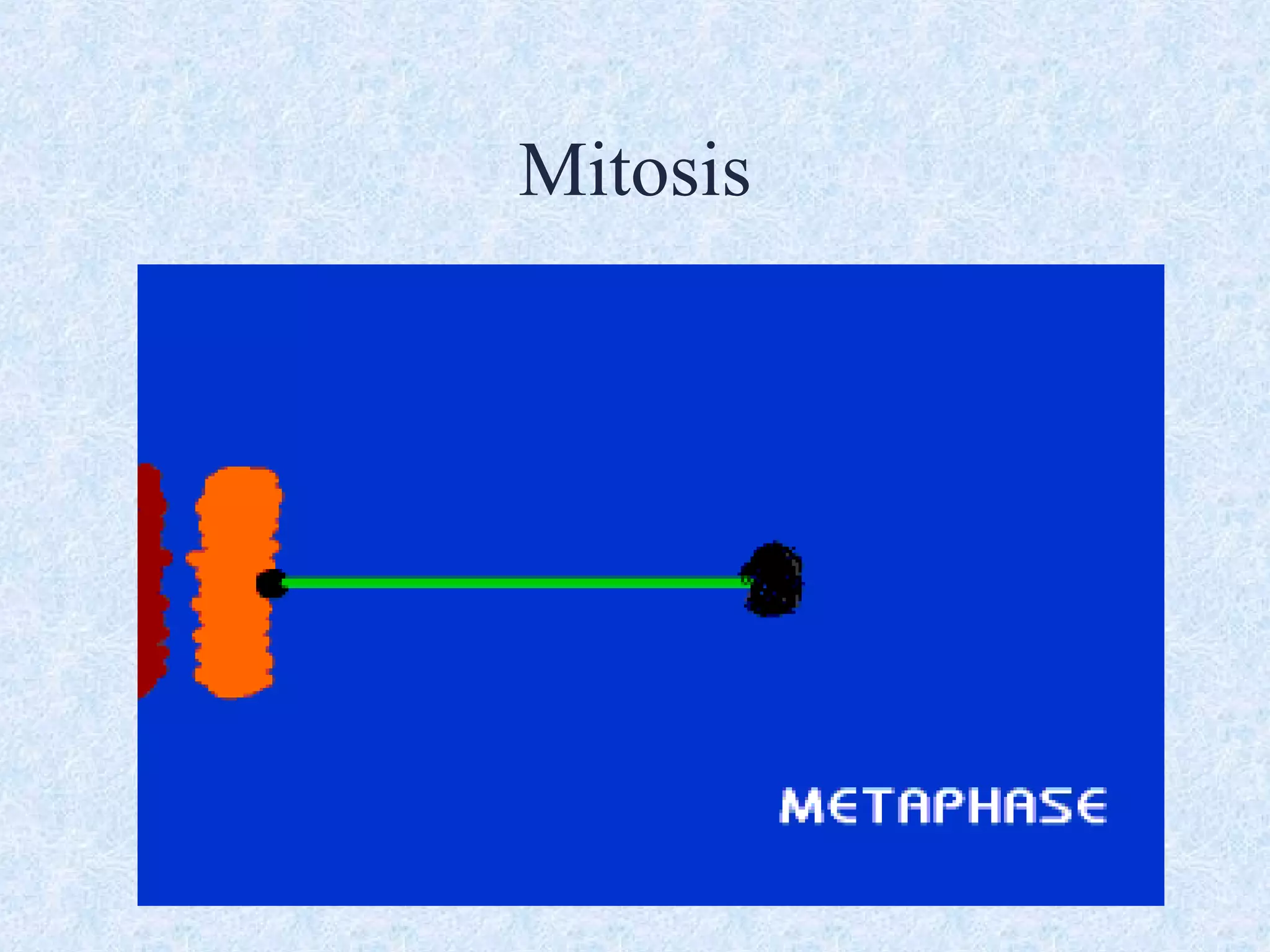
disintegrates, the centrioles reach the poles of the cell, and the
chromosomes continue to contract. Proteins attach to the centromeres.
The chromosomes begin moving.
4. Metaphase
Spindle fibers align the chromosomes along the middle of the
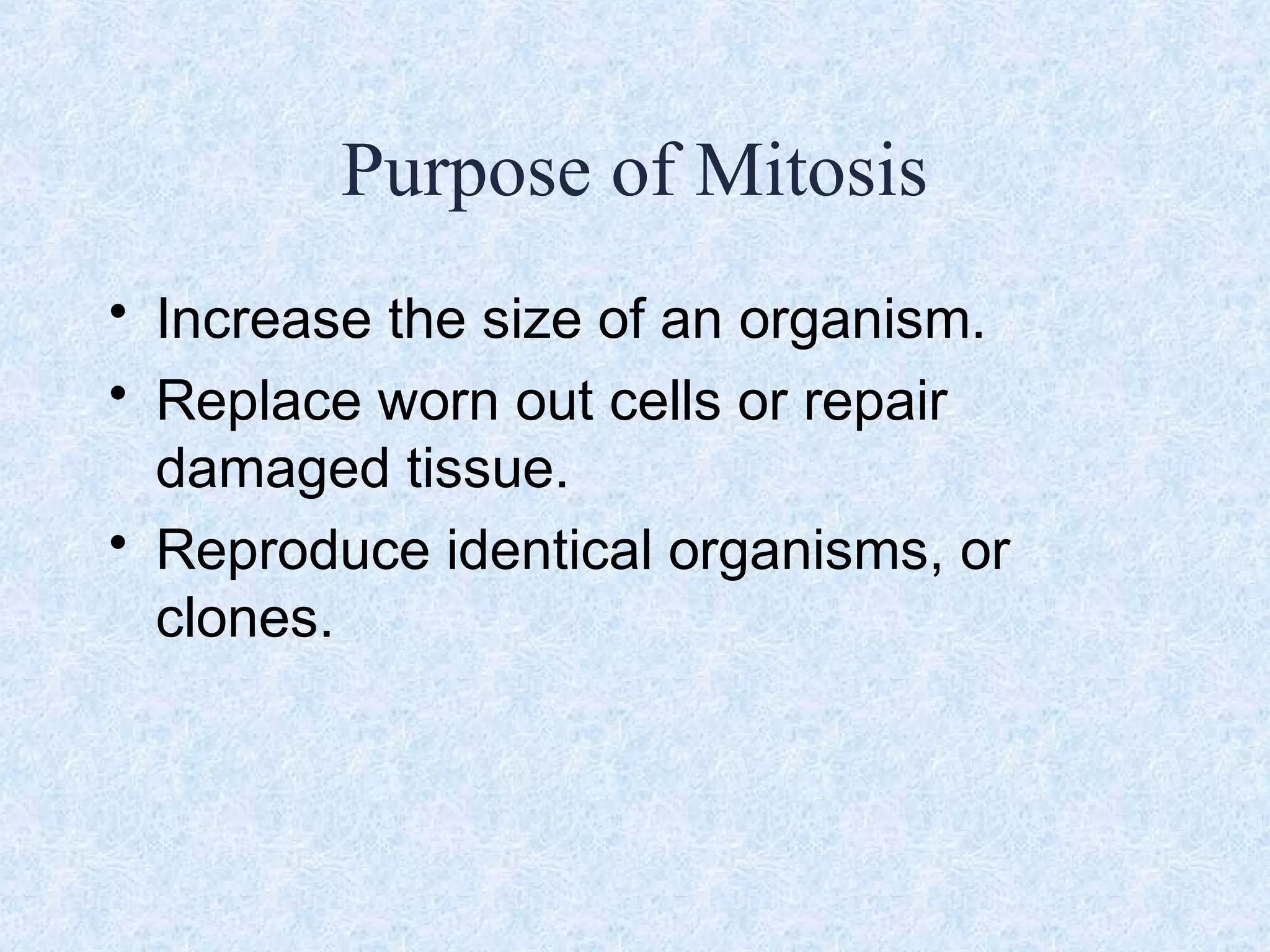
cell nucleus. This line is referred to as the metaphase plate. This
organization helps to ensure that in the next phase, when the
chromosomes are separated, each new nucleus will receive one copy of
each chromosome
Stages
5. Anaphase
The paired chromosomes separate at the kinetochores and move to opposite
sides of the cell. Motion results from a combination of kinetochore
movement along the spindle microtubules and through the physical
interaction of polar microtubules.
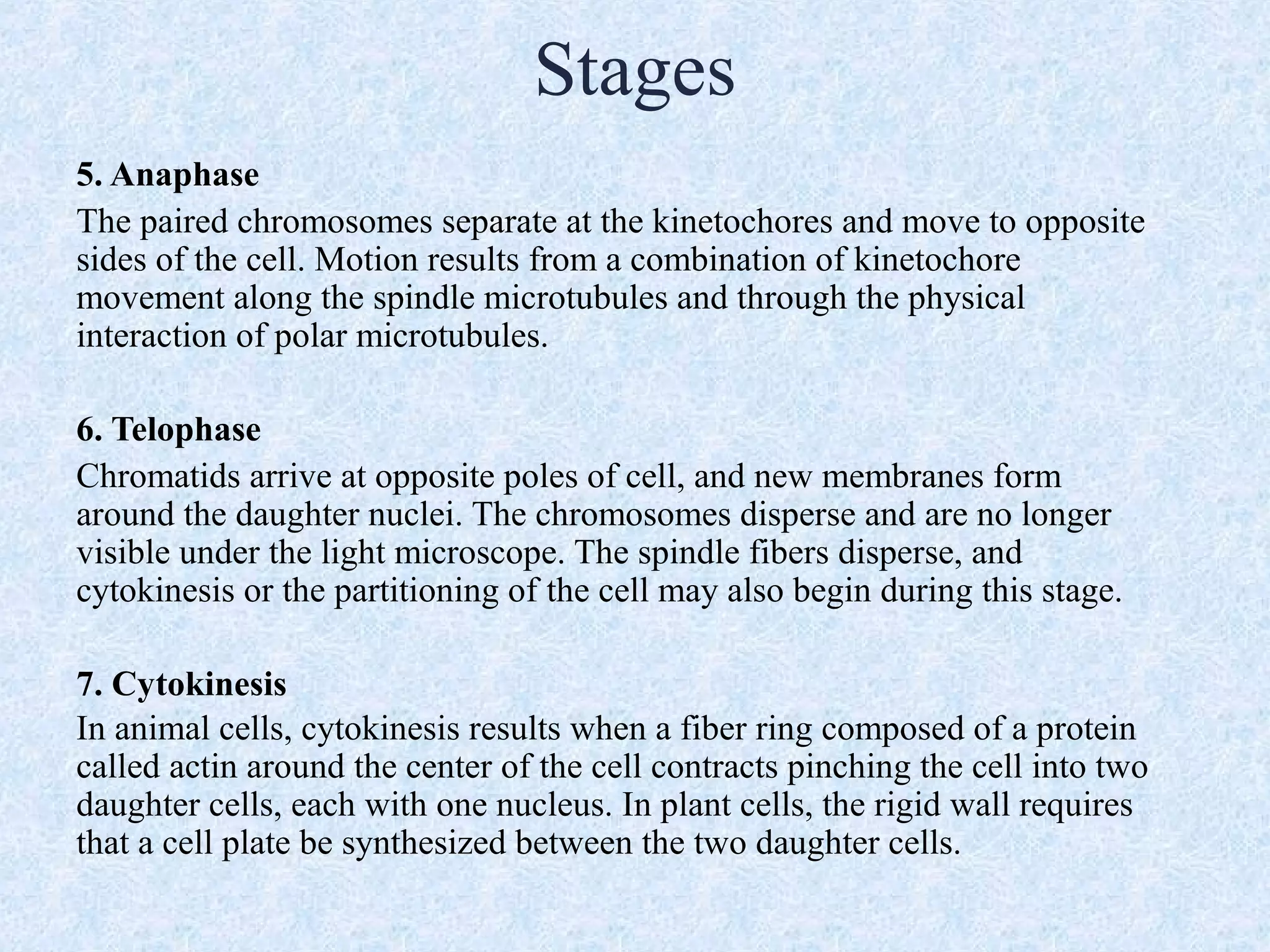
6. Telophase
Chromatids arrive at opposite poles of cell, and new membranes form
around the daughter nuclei. The chromosomes disperse and are no longer
visible under the light microscope. The spindle fibers disperse, and
cytokinesis or the partitioning of the cell may also begin during this stage.
7. Cytokinesis
In animal cells, cytokinesis results when a fiber ring composed of a protein
called actin around the center of the cell contracts pinching the cell into two
daughter cells, each with one nucleus. In plant cells, the rigid wall requires
that a cell plate be synthesized between the two daughter cells.
Interphase
Prophase
Prometaphase
Metaphase
Early Anaphase
Late Anaphase
Telophase
Daughter Cells
Mitosis
Can you identify the stages?
1. Are these
plant or
animal
cells?
2. How can
you tell?
3
4
5
Can you identify the stages?
6. Are these
plant or
animal
cells?
7. How can
you tell?
8
10
9
Purpose of Mitosis
• Increase the size of an organism.
• Replace worn out cells or repair
damaged tissue.
• Reproduce identical organisms, or
clones.
Comparing Mitosis & Meiosis
• Mitosis
– Happens in somatic
cells, every day cells
in the body
– For growth
– Think: toestoes as is mi-as is mi-
toestoes-is-is
• Meiosis
– Happens in sex cells
(pre-embryonic cells)
– For sexual
reproduction
– Think: e as in sex as
in meiosis
Bibliography
•Bio Review Cell Division
http://library.thinkquest.org/28751/review/division/4.html
•Access Excellence at the National Health Museum About Biotech
http://www.accessexcellence.org/AB/GG/meiosis.html
•About http://biology.about.com/cs/celldivision/
ā€¢ā€œThe Cell Cycle & Mitosis Tutorialā€ The Biology Project University of
Arizona http://www.biology.arizona.edu/cell_bio/tutorials/cell_cycle/cells3.html
• Mitosis http://www.stanford.edu/group/Urchin/mitosis.htm
•eMuseum Minnesota State University
http://www.anthro.mankato.msus.edu/biology/evolution/genetics/cellsmitosismeosis
.html
•Molecular Expressions
http://micro.magnet.fsu.edu/micro/gallery/mitosis/mitosis.html
•Universlity of North Carolina at Charlotte
http://www.bioweb.uncc.edu/biol1110/Stages.htm

2015 Mitosis

  • 1.
  • 2.
    The Basics Who: Mitosis What:Cell division When: New cells are needed Where: Somatic cells (body cells) Why: Growth
  • 3.
    The Basics Who: Somaticcells (Normal cells like in your toes) What: Cellular reproduction for growth, the cell cycle Where: Happens in somatic cells, regular body cells like in your toes Why: For growth (baby to adult) and to replace damaged cells (heal a cut) How: Duplicate cell parts making an exact copy of cell; one "mother" cell becomes two identical "daughter" cells. Remember: Toes as is mi-toes-is (mitosis)
  • 4.
  • 5.
    Mitosis & Chromosomes Mitosisis the duplication of chromosomes
  • 6.
  • 7.
    Genes are partof Chromosomes
  • 8.
    Cell Division • Oneparent cell becomes two daughter cells. • Happens in somatic cells, every day cells in the body • For growth StartStart FinishFinish 1 cell 2 cells
  • 9.
  • 10.
    Mitosis in ananimal cell • 1 cell to 4 cells
  • 11.
    Uneven Division Division ofcytoplasm is not always even
  • 12.
  • 13.
  • 14.
    A. Interphase Inter =in between Actual Phases 1.Prophase Pro = first 2.Prometaphase Between First & Middle 3.Metaphase Meta = middle •Anaphase Ana = away •Telophase T All the phases 1 2 3 4 A 5 B
  • 15.
  • 16.
  • 17.
    Interphase • Interphase is NOTa part of mitosis. • Interphase the cell grows before the DNA is duplicated, then DNA is duplicated, and lastly, prepares for division.
  • 18.
    Prophase • During prophase, the DNAand proteins start to condense. • The microtubles are assembled start moving to one of the two centriole pairs toward the opposite end of the cell. Dark region = condensing chromatin Onion root tip image
  • 19.
    Prometaphase • Sometimes consideredpart of the prophase. • Nuclear membrane disintegrates • Centrioles reach the poles of the cell • Chromosomes continue to contract. • Proteins attach to the centromeres. • The chromosomes begin moving. Dark region = condensing chromatin, animal cell
  • 20.
    Metaphase • During metaphase, themicrotubules penetrate nuclear region forming a spindle apparatus. • They attach to sister chromatids of each chromosome. • All chromosomes line up at spindle equator. • Now in their most tightly condensed form.
  • 21.
    Anaphase • During anaphase, attachments between thetwo sister chromatids of each chromosome break. • Now separate chromosomes move to opposite spindle poles. Mid Anaphase Onion root tip
  • 22.
    Telophase • Lastly, in telophase,the chromosomes decondense, texture of chromatin loosens. • New patches of membrane fuse to form new nuclear envelopes around them.
  • 23.
    Cytokinesis & DaughterCells Animal cells. •Pinching of cytoplasm into two cells. Plant cells •Cell plate forms between the two ā€œnewā€ cells. After cytokinesis •Cells now in interphase Called daughter cells. •Cells diploid, two each type of chromosome – same as parent cell's nucleus.
  • 24.
  • 25.
    Stages 1. Interphase Thecell isengagedinmetabolicactivityandpreparingformitosis(thenextfourphasesthatleaduptoandincludenucleardivision). Chromosomesarenotclearlydiscernedinthenucleus,althougha darkspotcalledthenucleolusmaybevisible.Thecellmaycontaina pairofcentrioles(or microtubule organizingcentersinplants)bothofwhichareorganizational sitesformicrotubules.Thisisthe longest stage. 2. Prophase Chromatin in the nucleus begins to condense and becomes visible in the light microscope as chromosomes. The nucleolus disappears. Centrioles begin moving to opposite ends of the cell and fibers extend from the centromeres. Some fibers cross the cell to form the mitotic spindle. 3.
  • 26.
    Stages 3. Prometaphase Sometimes consideredpart of the prophase. When the nuclear membrane disintegrates, the centrioles reach the poles of the cell, and the chromosomes continue to contract. Proteins attach to the centromeres. The chromosomes begin moving. 4. Metaphase Spindle fibers align the chromosomes along the middle of the cell nucleus. This line is referred to as the metaphase plate. This organization helps to ensure that in the next phase, when the chromosomes are separated, each new nucleus will receive one copy of each chromosome
  • 27.
    Stages 5. Anaphase The pairedchromosomes separate at the kinetochores and move to opposite sides of the cell. Motion results from a combination of kinetochore movement along the spindle microtubules and through the physical interaction of polar microtubules. 6. Telophase Chromatids arrive at opposite poles of cell, and new membranes form around the daughter nuclei. The chromosomes disperse and are no longer visible under the light microscope. The spindle fibers disperse, and cytokinesis or the partitioning of the cell may also begin during this stage. 7. Cytokinesis In animal cells, cytokinesis results when a fiber ring composed of a protein called actin around the center of the cell contracts pinching the cell into two daughter cells, each with one nucleus. In plant cells, the rigid wall requires that a cell plate be synthesized between the two daughter cells.
  • 28.
  • 29.
  • 30.
  • 31.
  • 32.
  • 33.
  • 34.
  • 35.
  • 36.
  • 37.
    Can you identifythe stages? 1. Are these plant or animal cells? 2. How can you tell? 3 4 5
  • 38.
    Can you identifythe stages? 6. Are these plant or animal cells? 7. How can you tell? 8 10 9
  • 39.
    Purpose of Mitosis •Increase the size of an organism. • Replace worn out cells or repair damaged tissue. • Reproduce identical organisms, or clones.
  • 40.
    Comparing Mitosis &Meiosis • Mitosis – Happens in somatic cells, every day cells in the body – For growth – Think: toestoes as is mi-as is mi- toestoes-is-is • Meiosis – Happens in sex cells (pre-embryonic cells) – For sexual reproduction – Think: e as in sex as in meiosis
  • 41.
    Bibliography •Bio Review CellDivision http://library.thinkquest.org/28751/review/division/4.html •Access Excellence at the National Health Museum About Biotech http://www.accessexcellence.org/AB/GG/meiosis.html •About http://biology.about.com/cs/celldivision/ ā€¢ā€œThe Cell Cycle & Mitosis Tutorialā€ The Biology Project University of Arizona http://www.biology.arizona.edu/cell_bio/tutorials/cell_cycle/cells3.html • Mitosis http://www.stanford.edu/group/Urchin/mitosis.htm •eMuseum Minnesota State University http://www.anthro.mankato.msus.edu/biology/evolution/genetics/cellsmitosismeosis .html •Molecular Expressions http://micro.magnet.fsu.edu/micro/gallery/mitosis/mitosis.html •Universlity of North Carolina at Charlotte http://www.bioweb.uncc.edu/biol1110/Stages.htm