Receiver Structure
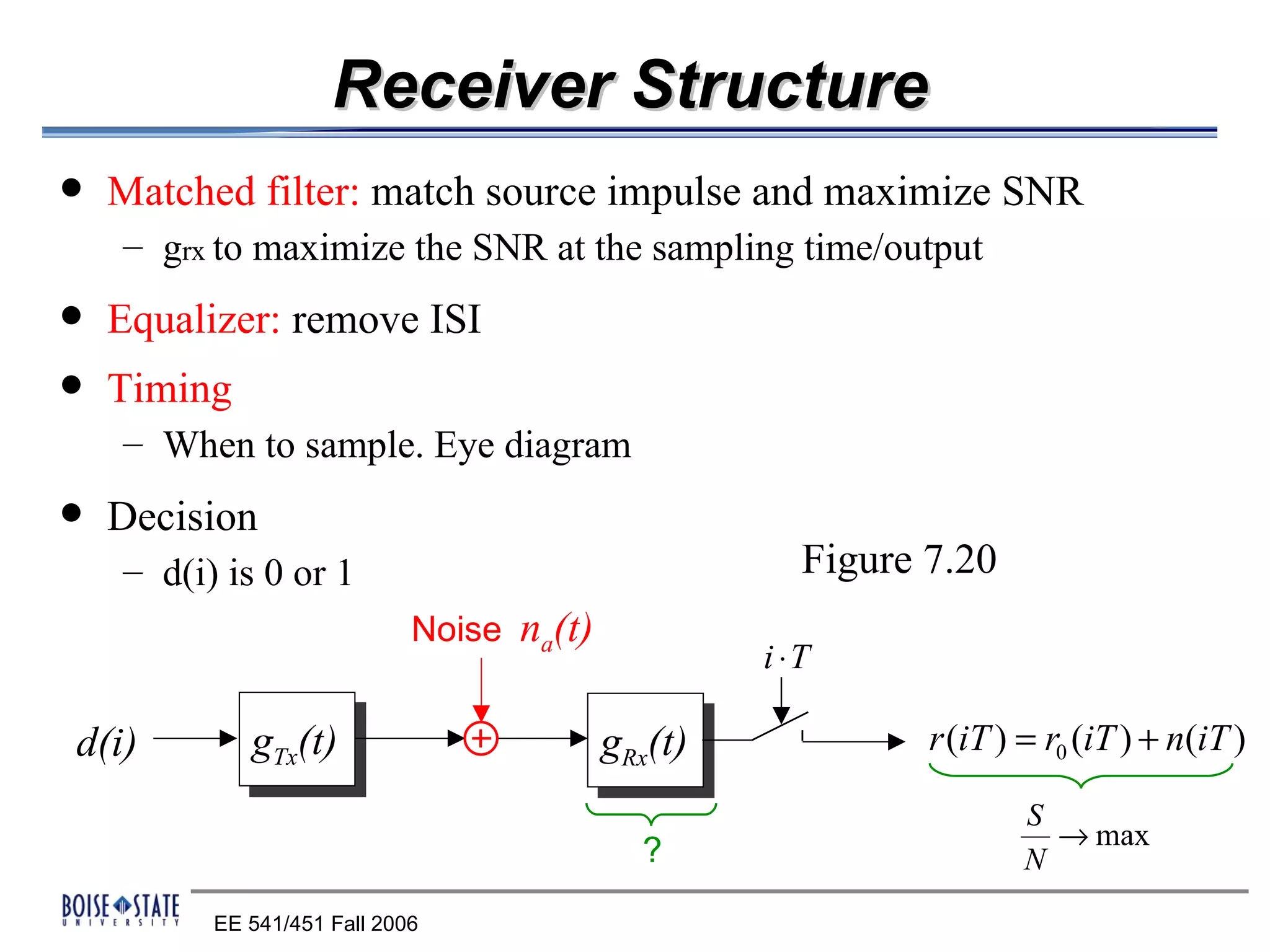
   Matched filter: match source impulse and maximize SNR
    – grx to maximize the SNR at the sampling time/output
   Equalizer: remove ISI
   Timing
    – When to sample. Eye diagram
   Decision
    – d(i) is 0 or 1                                   Figure 7.20
                             Noise na(t)
                                                    i ⋅T

d(i)         gTx(t)                        gRx(t)             r (iT ) = r0 (iT ) + n(iT )

                                                                      S
                                                                        → max
                                             ?                        N
          EE 541/451 Fall 2006
Matched Filter
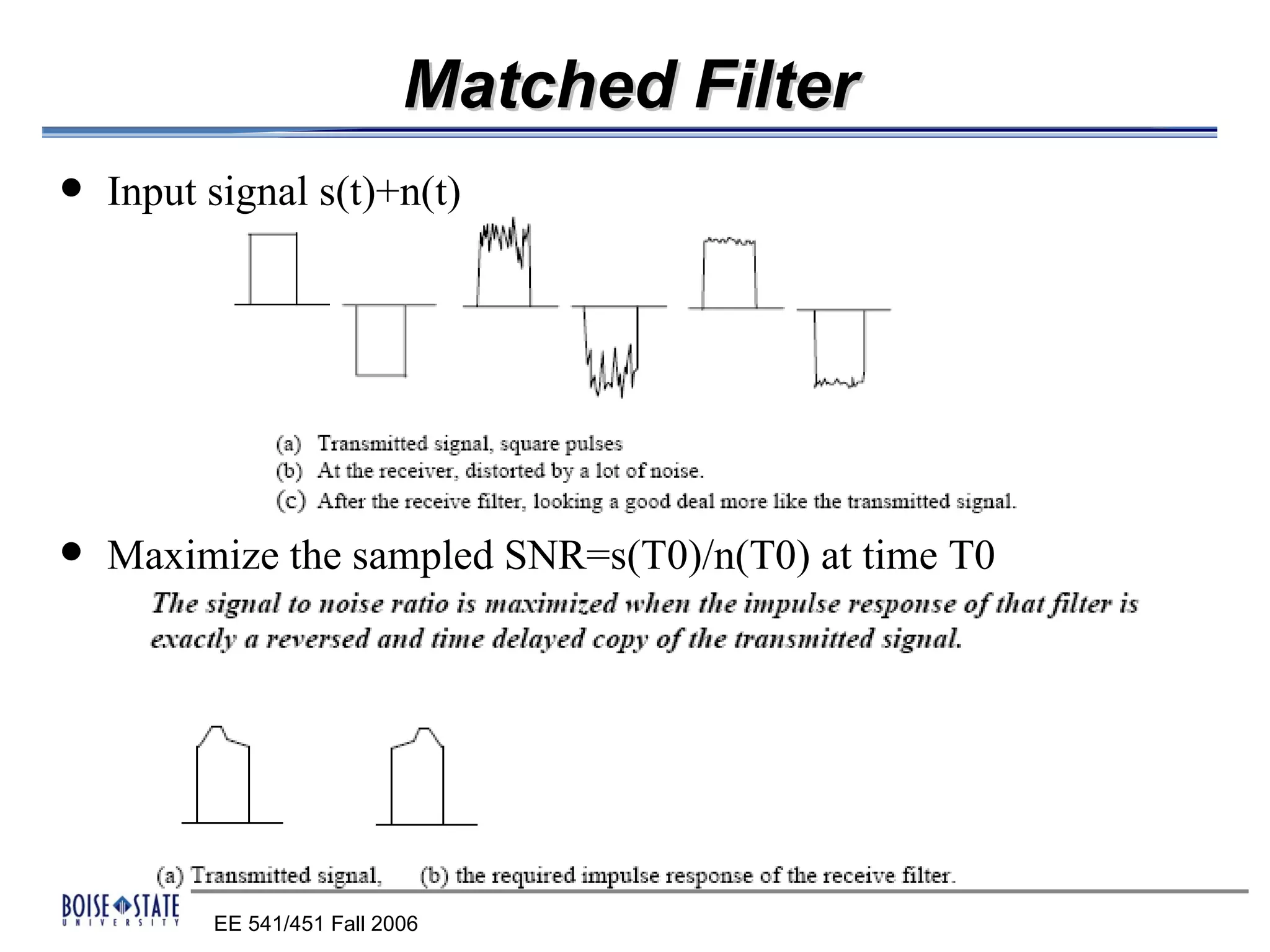
   Input signal s(t)+n(t)


   Maximize the sampled SNR=s(T0)/n(T0) at time T0


          EE 541/451 Fall 2006
Matched filter example
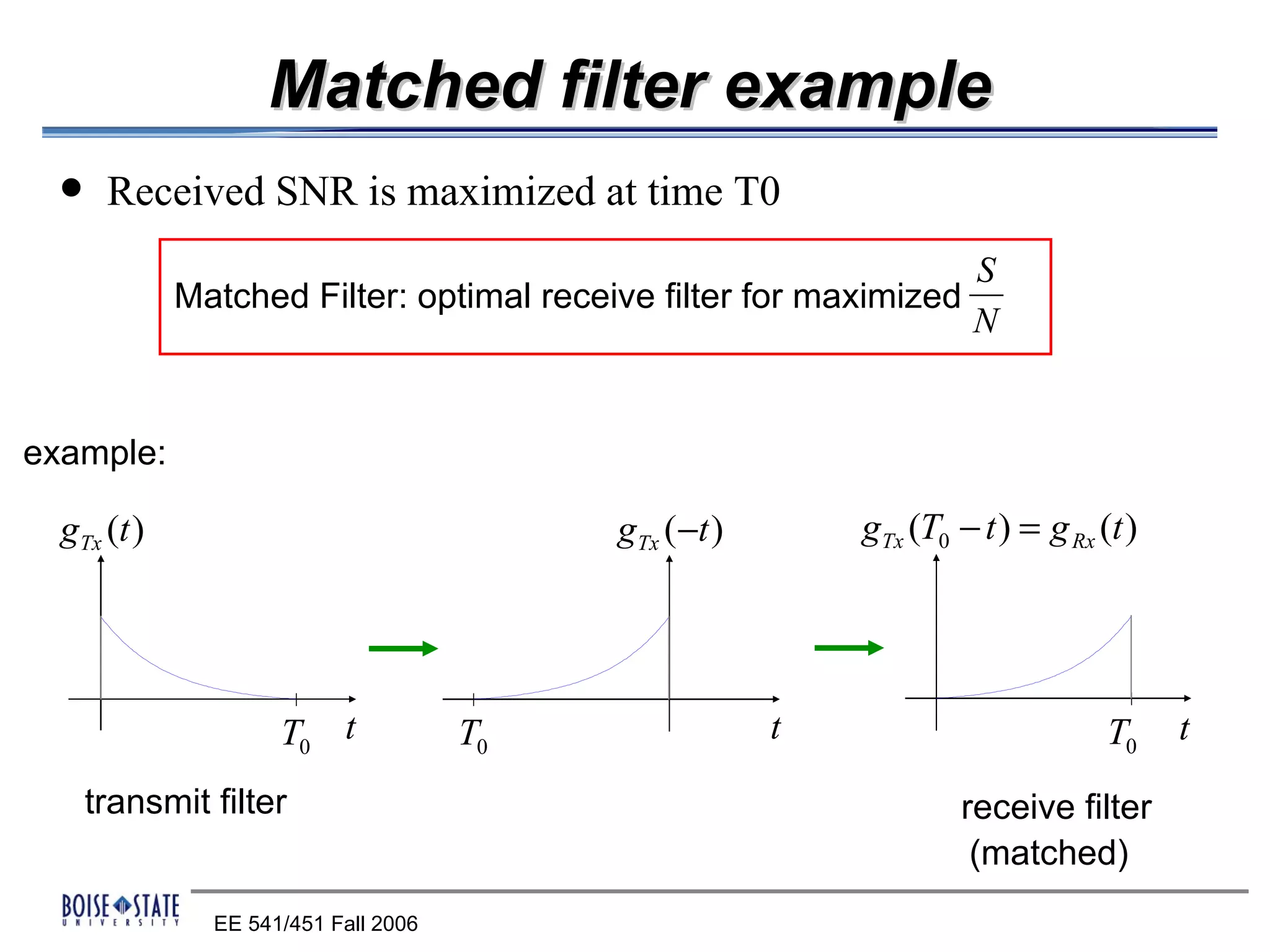
      Received SNR is maximized at time T0
                                                                  S
             Matched Filter: optimal receive filter for maximized
                                                                  N


example:

  gTx (t )                                 gTx (−t )       gTx (T0 − t ) = g Rx (t )


                     T0 t             T0               t                         T0    t
      transmit filter                                              receive filter
                                                                    (matched)
               EE 541/451 Fall 2006
Equalizer
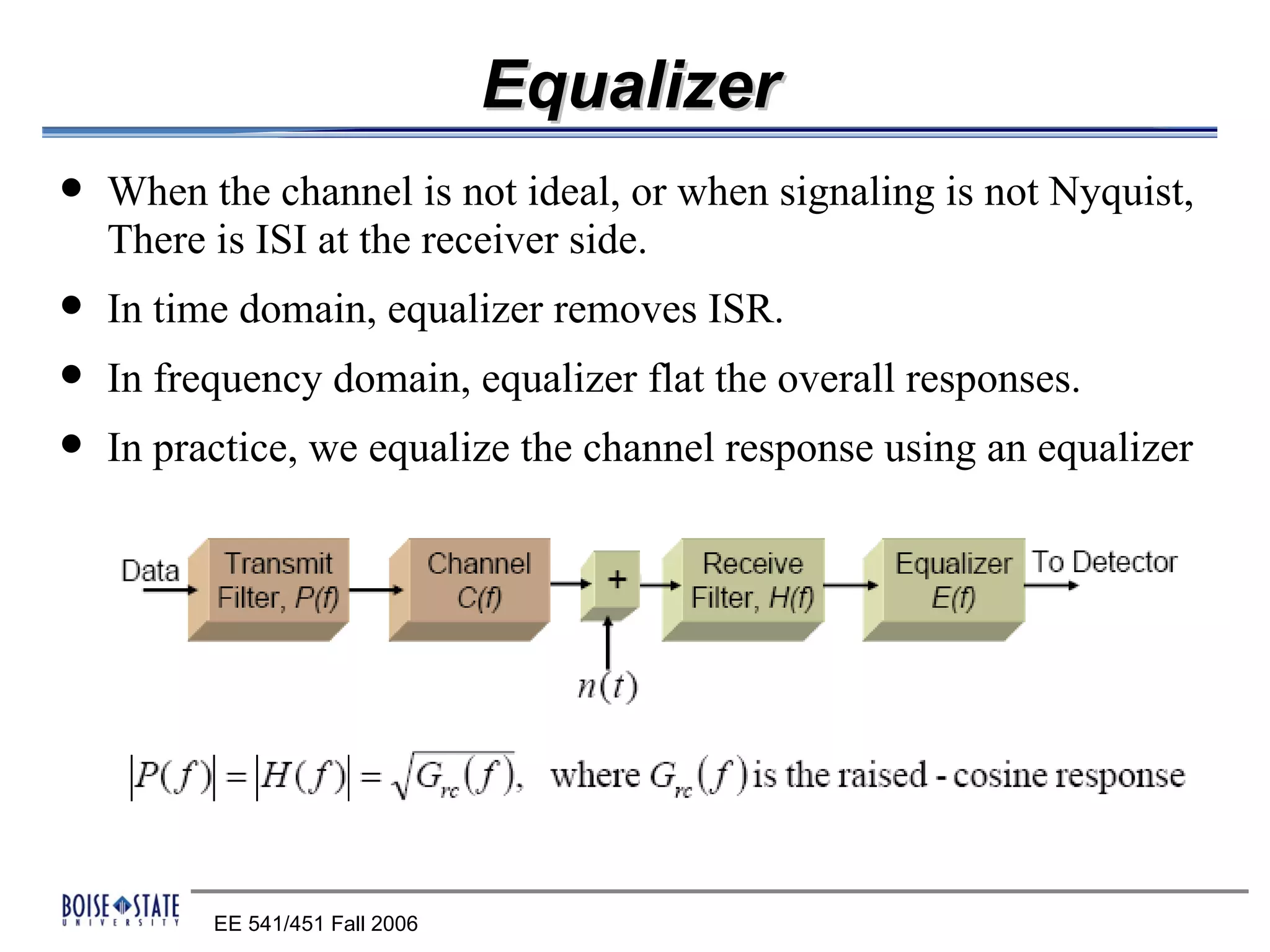
   When the channel is not ideal, or when signaling is not Nyquist,
    There is ISI at the receiver side.
   In time domain, equalizer removes ISR.
   In frequency domain, equalizer flat the overall responses.
   In practice, we equalize the channel response using an equalizer


          EE 541/451 Fall 2006
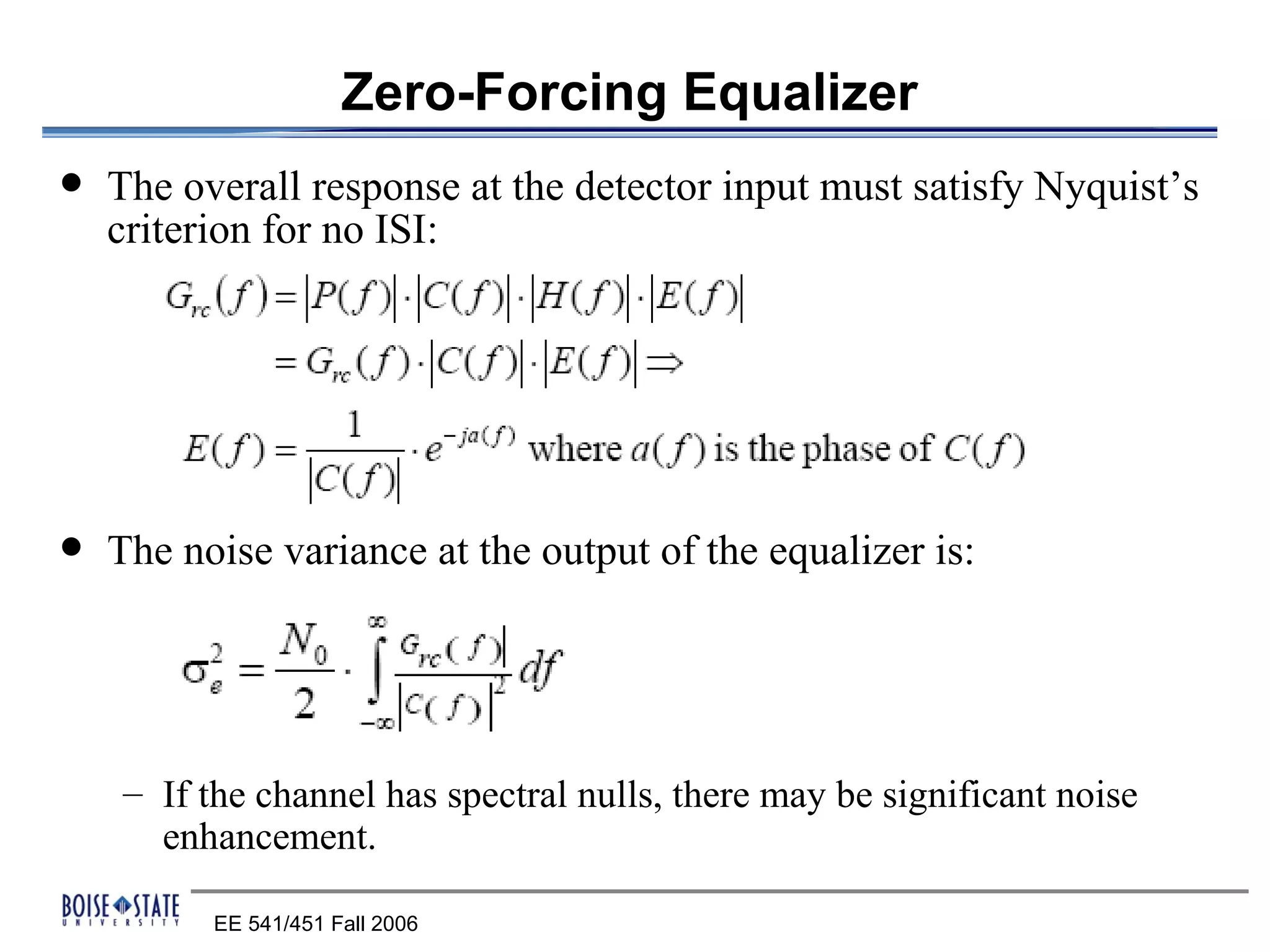
Zero-Forcing Equalizer
   The overall response at the detector input must satisfy Nyquist’s
    criterion for no ISI:


   The noise variance at the output of the equalizer is:


    – If the channel has spectral nulls, there may be significant noise
      enhancement.

          EE 541/451 Fall 2006
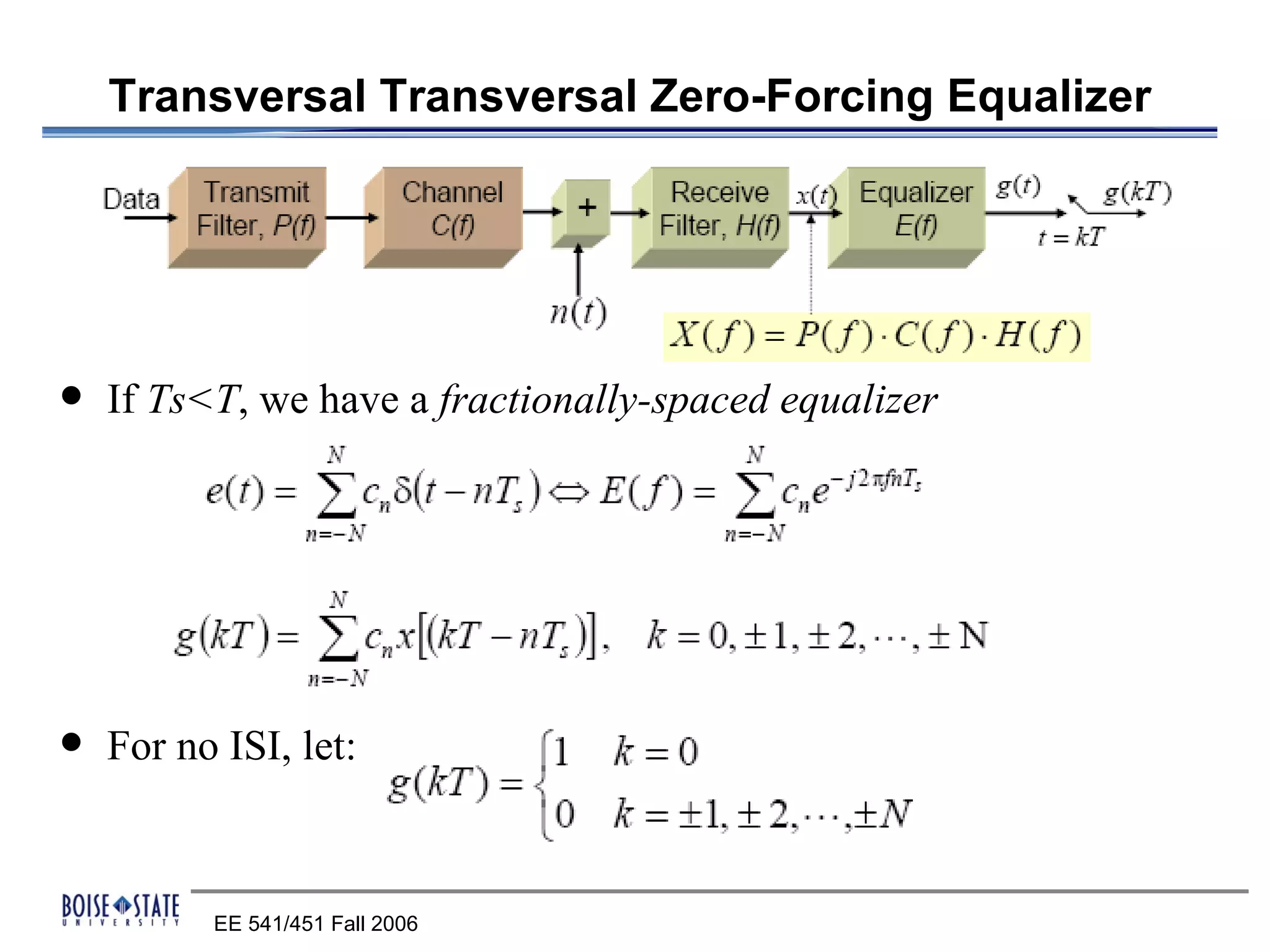
Transversal Transversal Zero-Forcing Equalizer


   If Ts<T, we have a fractionally-spaced equalizer


   For no ISI, let:


          EE 541/451 Fall 2006
Zero-Forcing Equalizer continue
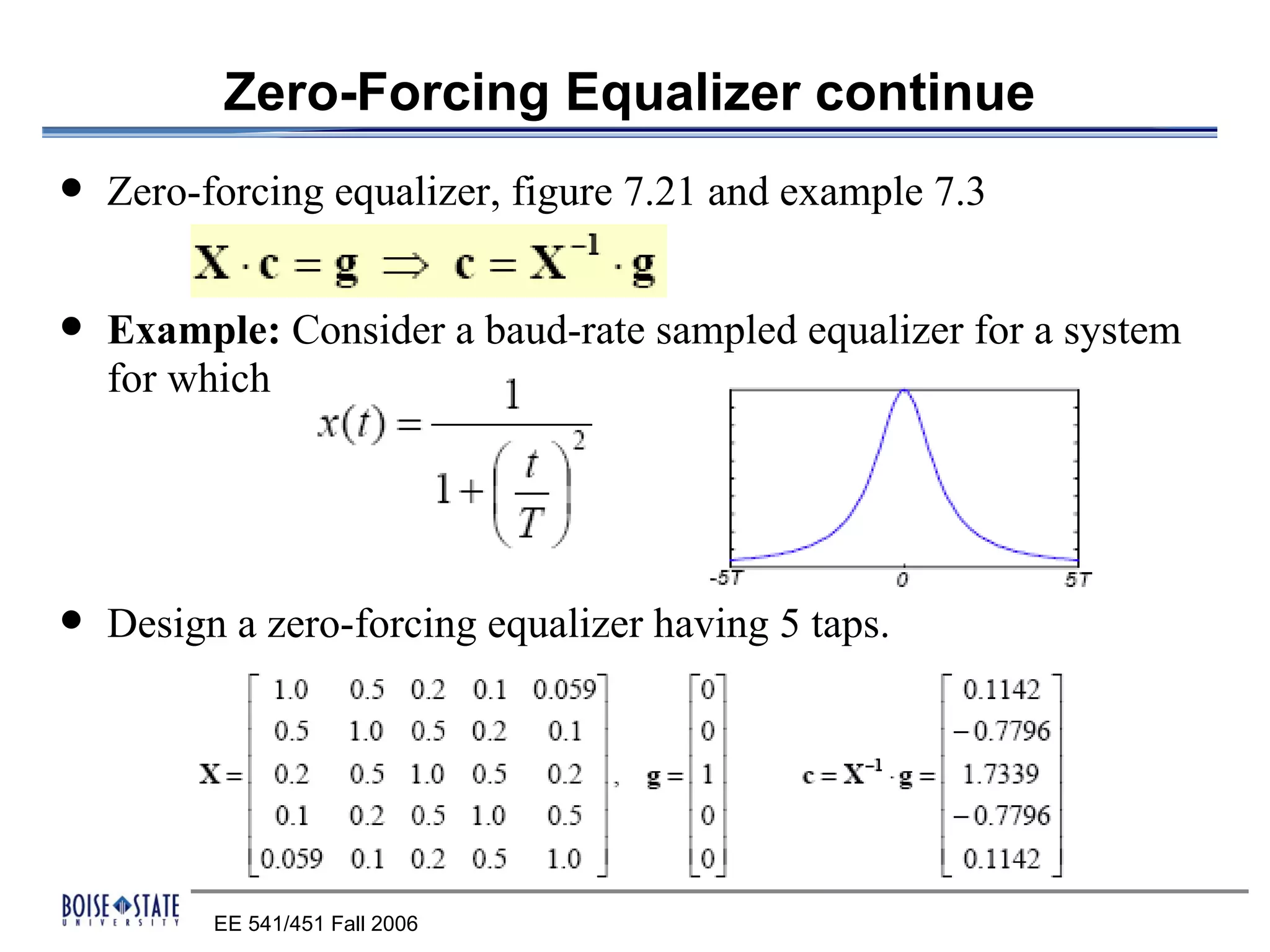
   Zero-forcing equalizer, figure 7.21 and example 7.3


   Example: Consider a baud-rate sampled equalizer for a system
    for which


   Design a zero-forcing equalizer having 5 taps.


          EE 541/451 Fall 2006
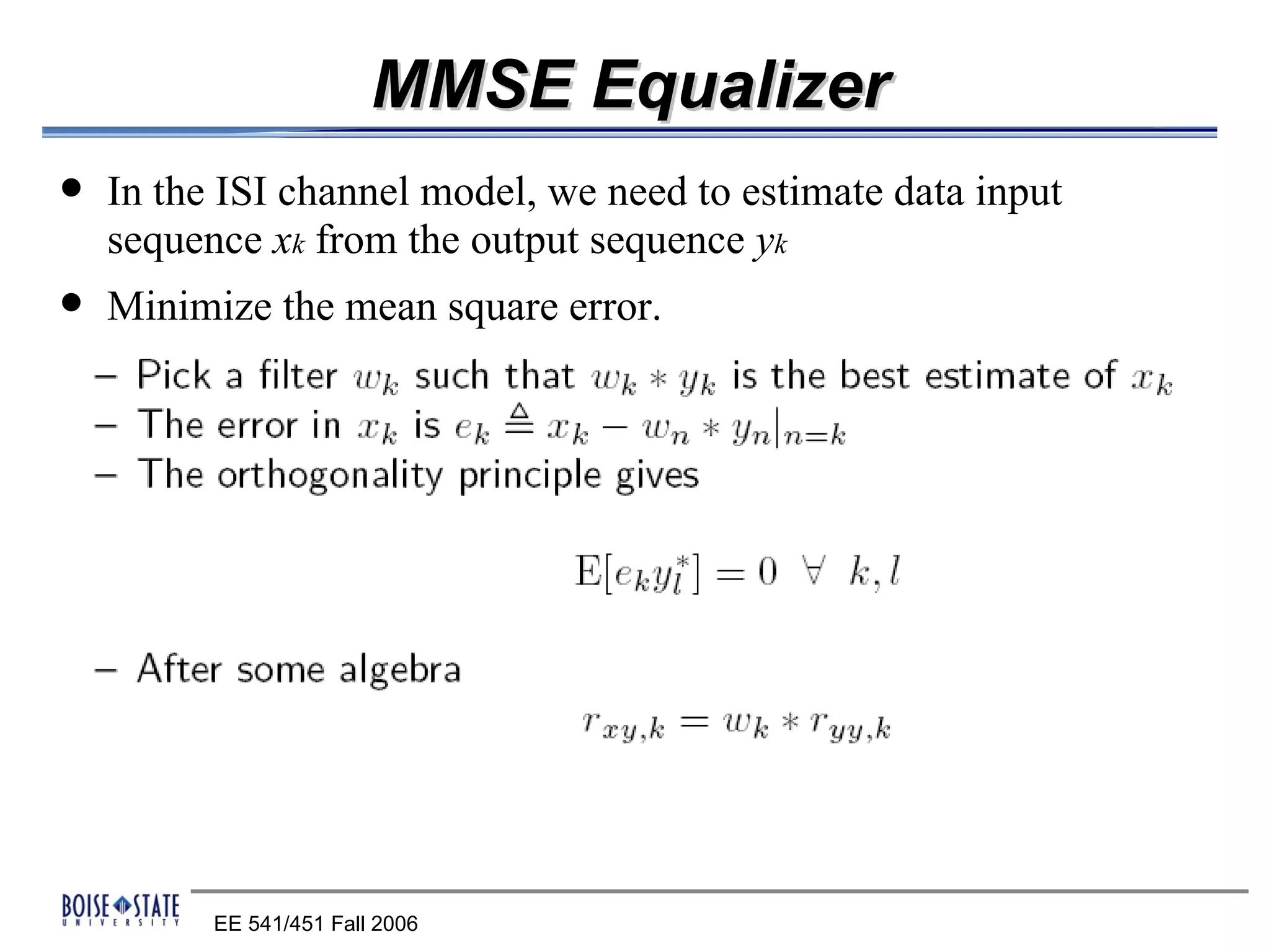
MMSE Equalizer
   In the ISI channel model, we need to estimate data input
    sequence xk from the output sequence yk
   Minimize the mean square error.


          EE 541/451 Fall 2006
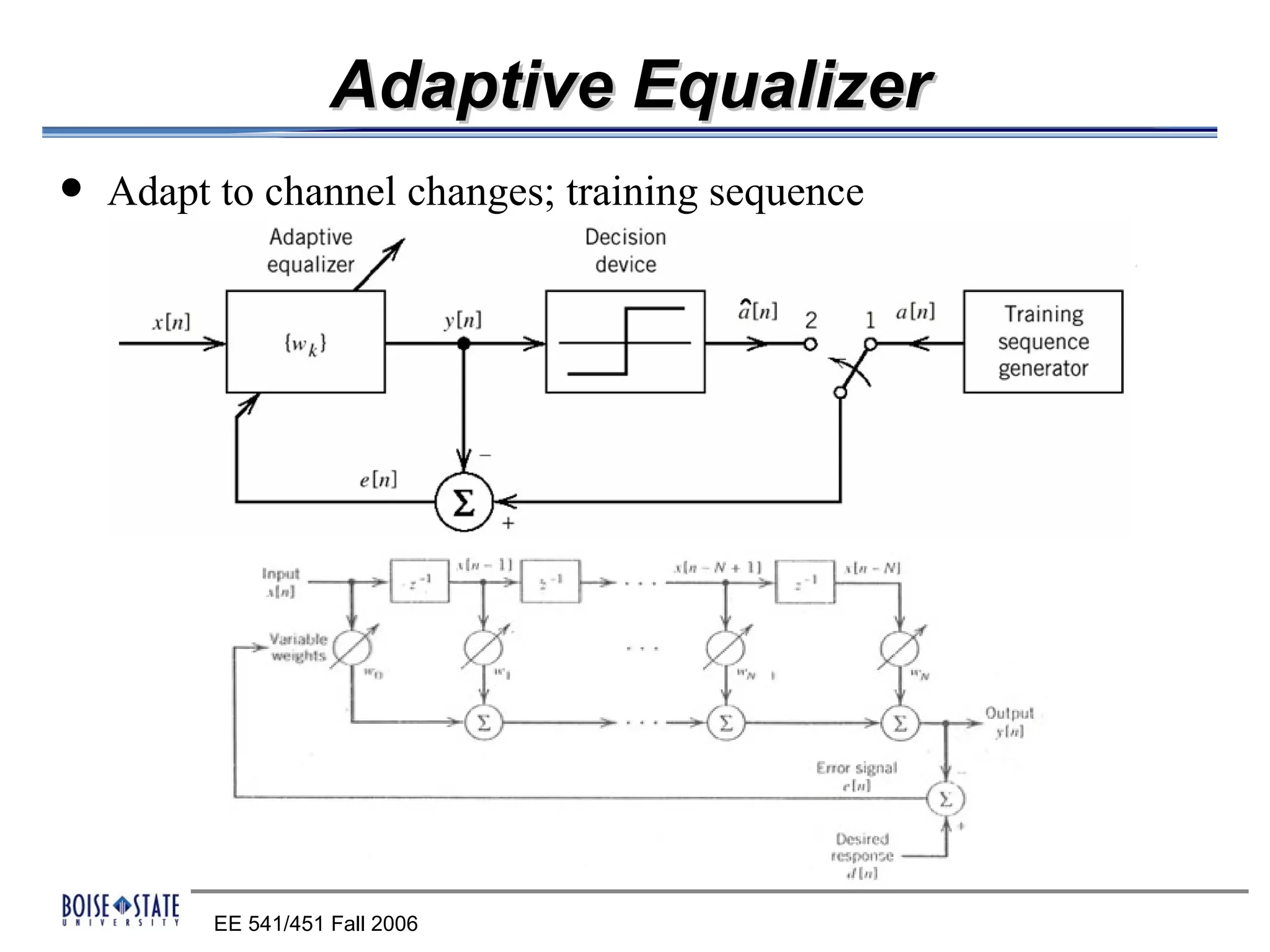
Adaptive Equalizer
   Adapt to channel changes; training sequence


          EE 541/451 Fall 2006
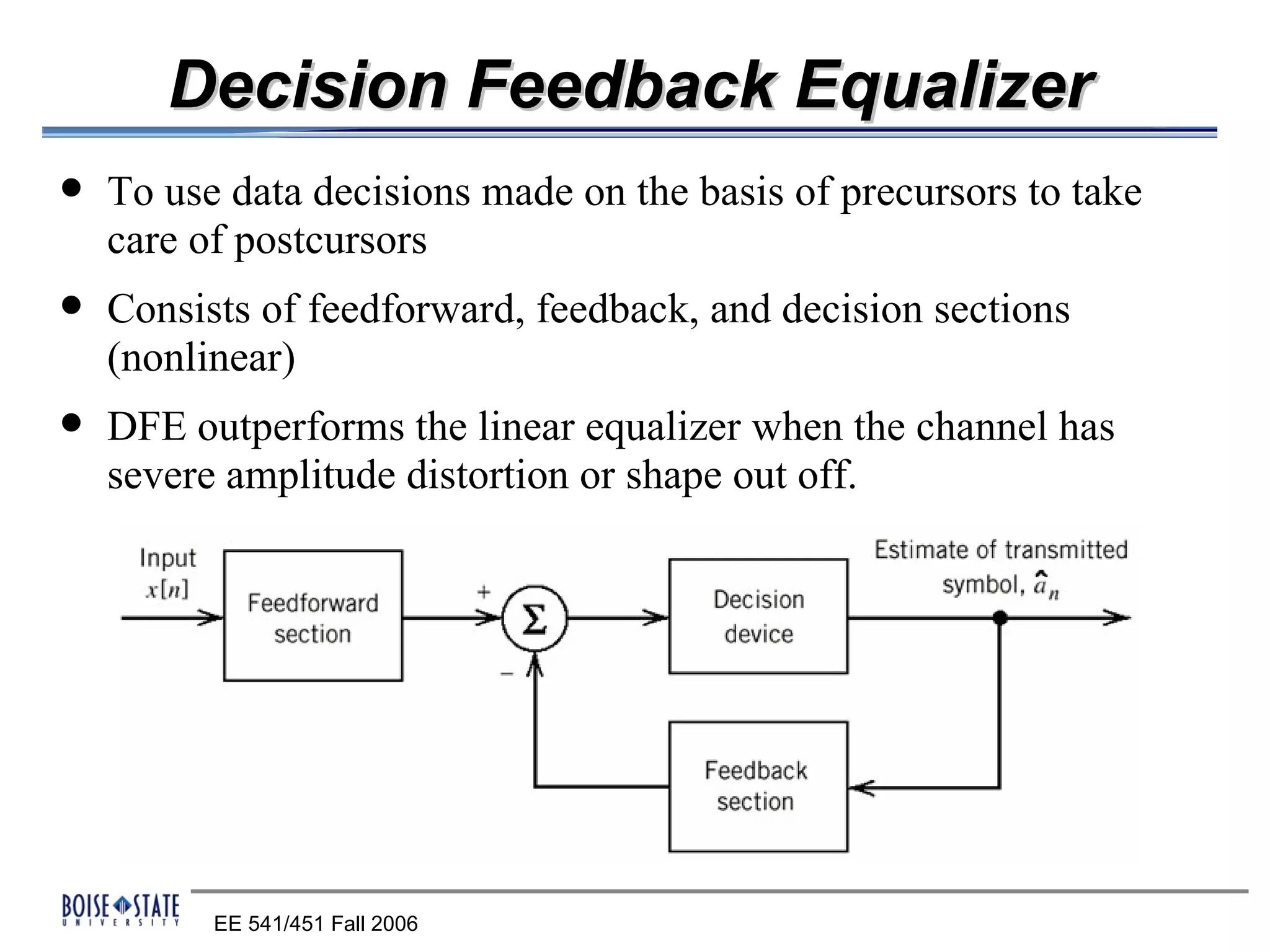
Decision Feedback Equalizer
   To use data decisions made on the basis of precursors to take
    care of postcursors
   Consists of feedforward, feedback, and decision sections
    (nonlinear)
   DFE outperforms the linear equalizer when the channel has
    severe amplitude distortion or shape out off.


          EE 541/451 Fall 2006
Different types of equalizers
   Zero-forcing equalizers ignore the additive noise and may
    significantly amplify noise for channels with spectral nulls
   Minimum-mean-square error (MMSE) equalizers minimize the mean-
    square error between the output of the equalizer and the transmitted
    symbol. They require knowledge of some auto and cross-correlation
    functions, which in practice can be estimated by transmitting a known
    signal over the channel
   Adaptive equalizers are needed for channels that are time-varying
   Blind equalizers are needed when no preamble/training sequence is
    allowed, nonlinear
   Decision-feedback equalizers (DFE’s) use tentative symbol decisions
    to eliminate ISI, nonlinear
   Ultimately, the optimum equalizer is a maximum-likelihood sequence
    estimator, nonlinear
           EE 541/451 Fall 2006
Timing Extraction
   Received digital signal needs to be sampled at precise instants.
    Otherwise, the SNR reduced. The reason, eye diagram
   Three general methods
    – Derivation from a primary or a secondary standard. GPS, atomic
      closk
        x   Tower of base station
        x   Backbone of Internet
    – Transmitting a separate synchronizing signal, (pilot clock, beacon)
        x   Satellite
    – Self-synchronization, where the timing information is extracted
      from the received signal itself
        x   Wireless
        x   Cable, Fiber

            EE 541/451 Fall 2006
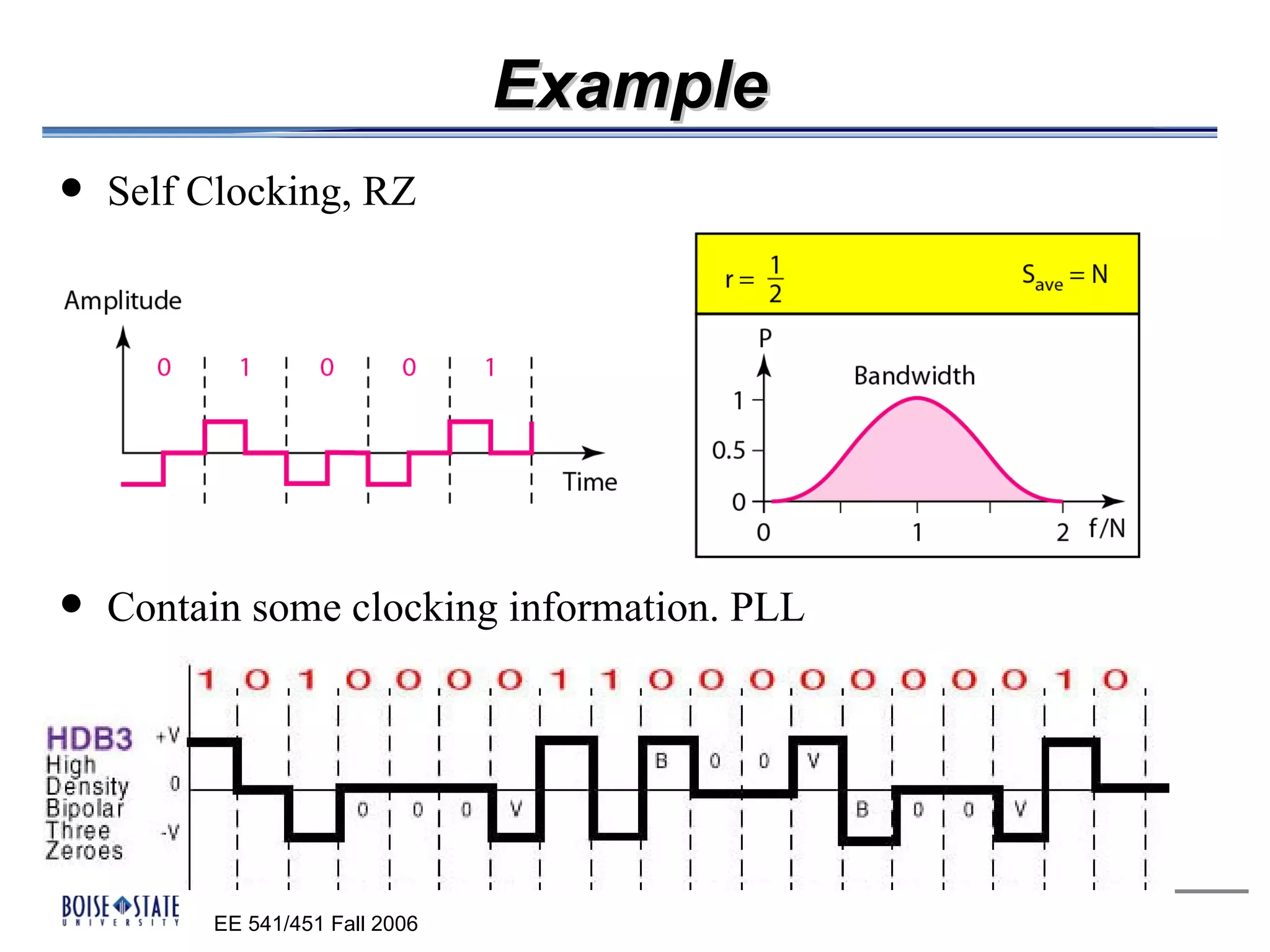
Example
   Self Clocking, RZ


   Contain some clocking information. PLL


         EE 541/451 Fall 2006
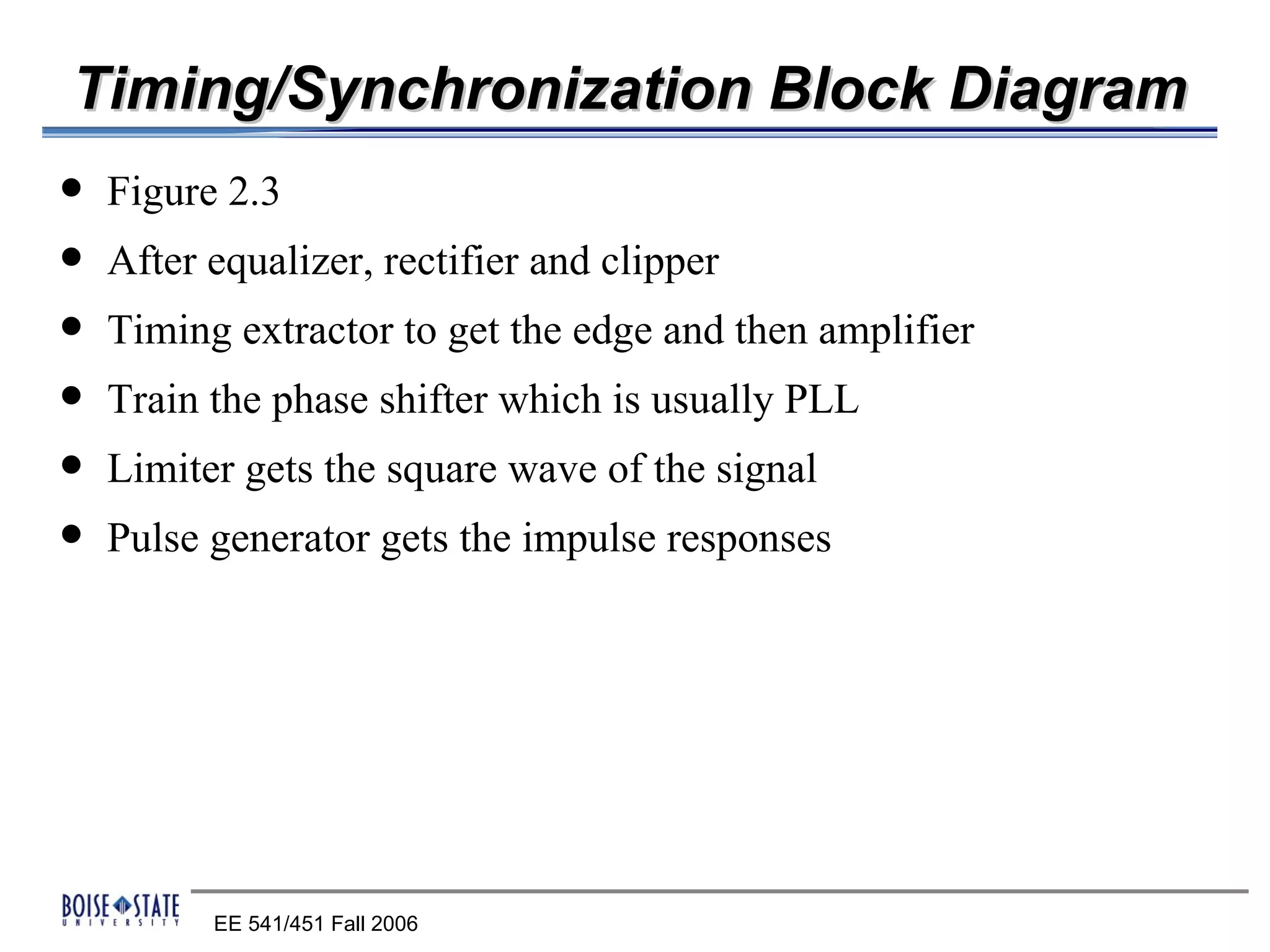
Timing/Synchronization Block Diagram
   Figure 2.3
   After equalizer, rectifier and clipper
   Timing extractor to get the edge and then amplifier
   Train the phase shifter which is usually PLL
   Limiter gets the square wave of the signal
   Pulse generator gets the impulse responses


          EE 541/451 Fall 2006
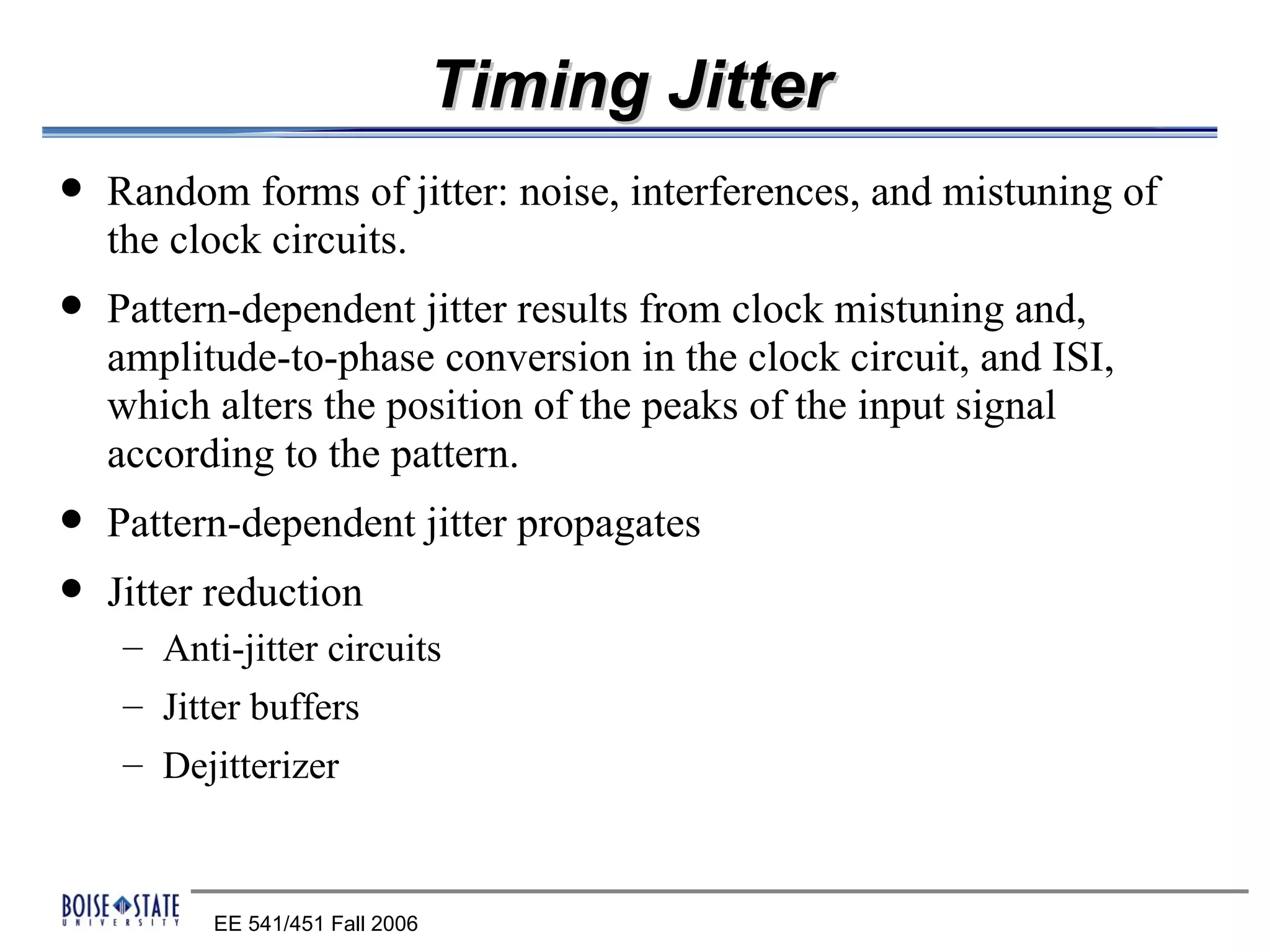
Timing Jitter
   Random forms of jitter: noise, interferences, and mistuning of
    the clock circuits.
   Pattern-dependent jitter results from clock mistuning and,
    amplitude-to-phase conversion in the clock circuit, and ISI,
    which alters the position of the peaks of the input signal
    according to the pattern.
   Pattern-dependent jitter propagates
   Jitter reduction
    – Anti-jitter circuits
    – Jitter buffers
    – Dejitterizer


          EE 541/451 Fall 2006
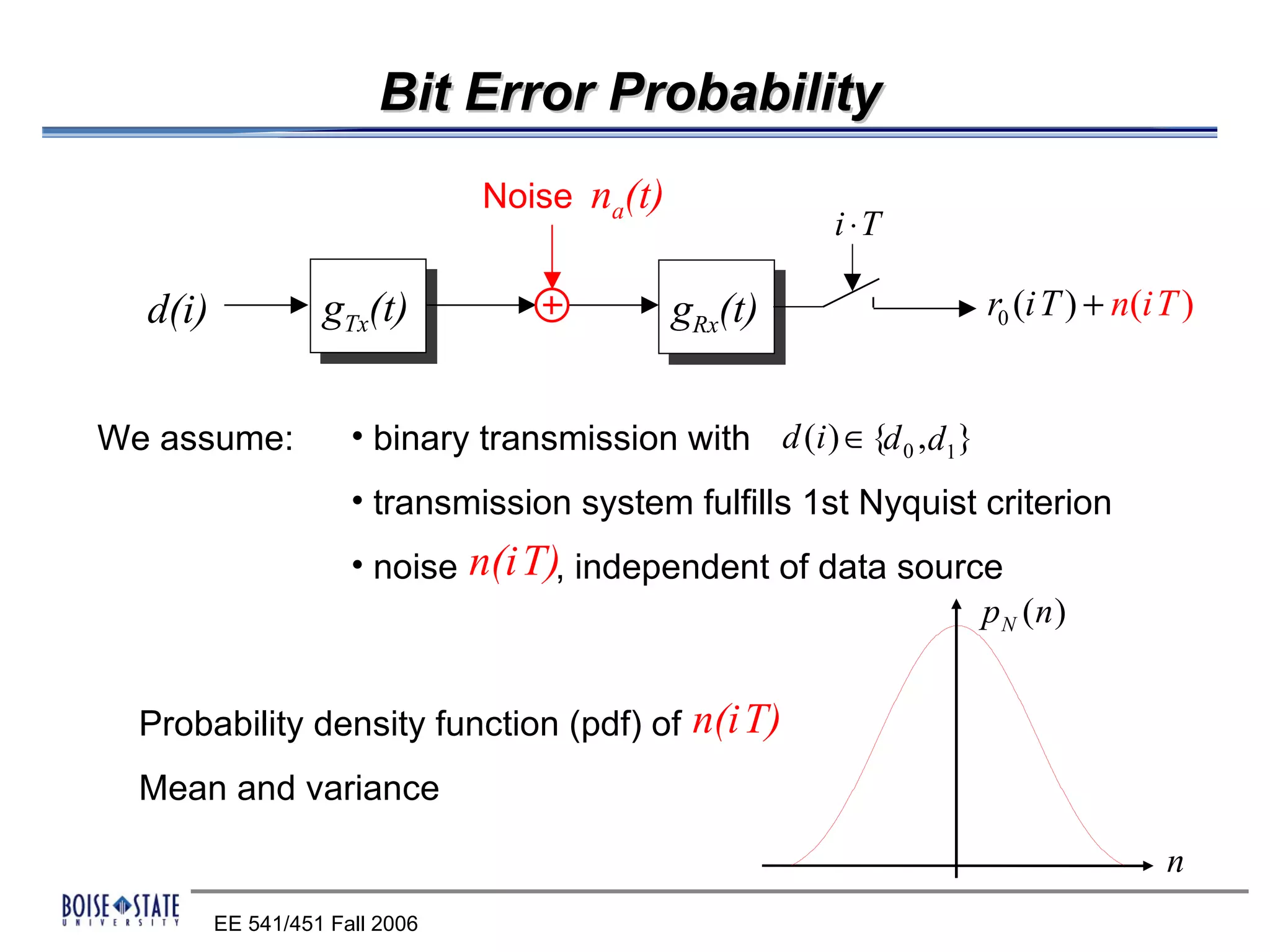
Bit Error Probability
                                Noise na(t)
                                                         i ⋅T

  d(i)             gTx(t)                     gRx(t)                   r0 (i T ) + n(iT )


We assume:            • binary transmission with d (i ) ∈ {d 0 , d1}
                      • transmission system fulfills 1st Nyquist criterion
                      • noise   n(iT), independent of data source
                                                                       p N (n )


  Probability density function (pdf) of        n(iT)
  Mean and variance

                                                                                      n
         EE 541/451 Fall 2006
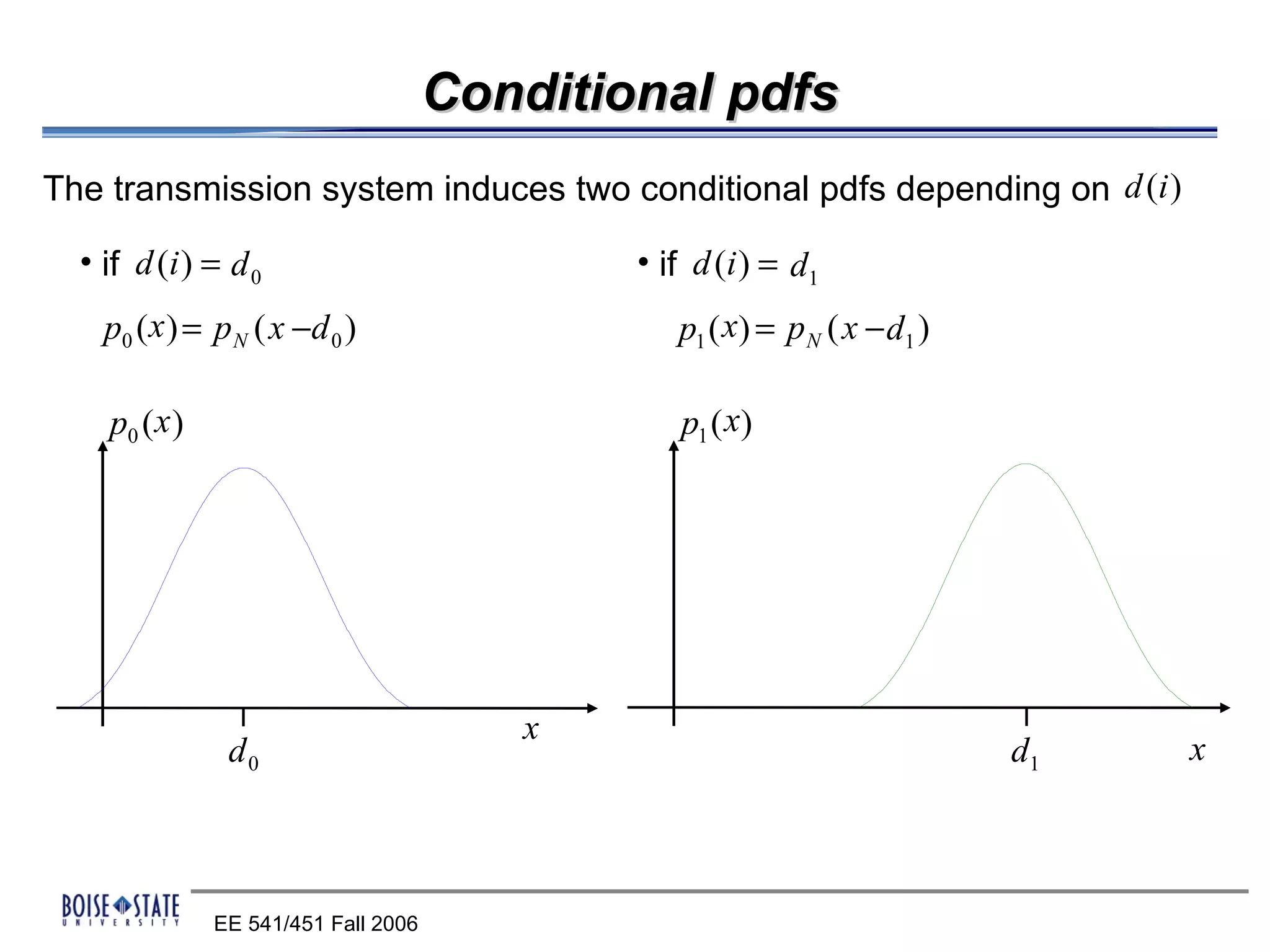
Conditional pdfs
The transmission system induces two conditional pdfs depending on d (i )

  • if d (i ) = d 0                           • if d (i ) = d1
    p0 ( x ) = p N ( x − d 0 )                   p1 ( x) = p N ( x − d1 )

    p0 ( x )                                     p1 ( x)


                                         x
                d0                                                          d1   x


               EE 541/451 Fall 2006
Probability of wrong decisions
                                                 Placing a threshold             S
         p0 ( x )                                                      p1 ( x)
                                                Probability of
                                                wrong decision


                                                                   x                                                 x
                        d0           S                                                        S       d1
                    ∞                                                                     S

          Q0 = ∫ p0 ( x) dx                                                    Q1 =
                                                                                          ∫ p ( x)dx
                                                                                              1
                    S                                                                    −∞

When we define P0 and P1 as equal a-priori probabilities of d 0 and d1
                                                          (P0 = P = 1 )
we will get the bit error probability                             1  2
                                 ∞                        S                    S
Pb = P0Q0 + P Q1 =
             1
                             1
                             2   ∫s p ( x)dx + ∫ p ( x)dx =
                                 S
                                       0
                                                      1
                                                      2
                                                          −∞
                                                               1
                                                                       1
                                                                       2   +   ∫[
                                                                               −∞
                                                                                     1
                                                                                     2   p1 ( x) − 1 p0 ( x ) ] dx
                                                                                                   2
                                 1 24
                                   4 3
                                      S
                                 1−   ∫ p0 ( x ) dx
                                      −∞


          EE 541/451 Fall 2006
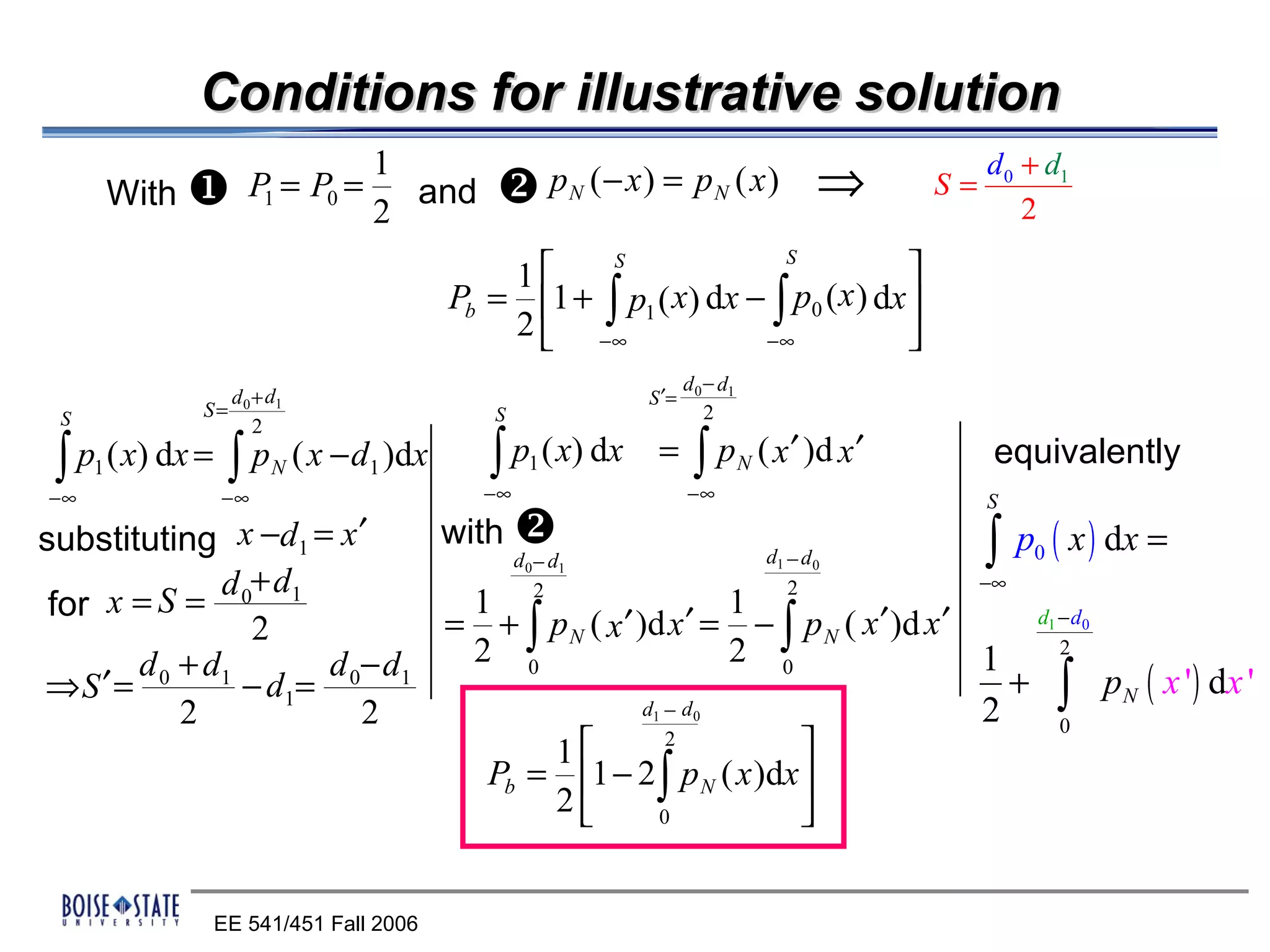
Conditions for illustrative solution
                                1                                                                  d 0 + d1
         With    P1 = P0 =       and        pN (− x) = pN ( x)                         ⇒    S=
                                                                                                       2
                                2
                                                                                     S
                                            1                                 
                                                   S

                                        Pb = 1 + ∫ p1 ( x) dx − ∫ p0 ( x ) dx 
                                            2  −∞              −∞             
                                                                d 0 − d1
               d +d                                      S ′=
 S           S= 0 1                        S                        2
                 2

 ∫ p ( x) dx = ∫ p
     1               N   ( x − d1 )dx      ∫ p ( x) dx
                                               1          =      ∫p        N   ( x ′ )d x ′        equivalently
−∞             −∞                         −∞                    −∞                                 S
                               with 
substituting x −d1 = x ′            d −d                 d −d                 ∫ p0 ( x ) dx =
              d +d
                                               0   1                             1       0
                                                           2                 −∞
 for x =S = 0 1                  1 2                   1
                2              = + ∫ p N ( x ′ )d x ′ = − ∫ p N ( x ′ )d x ′     d1 − d 0

       d 0 + d1       d 0− d 1   2 0                   2 0                   1      2
⇒S ′ =          − d1=                                                           + ∫ p N ( x ' ) dx '
           2             2                      d −d     1       0           2      0
                                        1         2
                                                             
                                  Pb = 1 − 2 ∫ p N ( x )dx 
                                        2        0          


              EE 541/451 Fall 2006
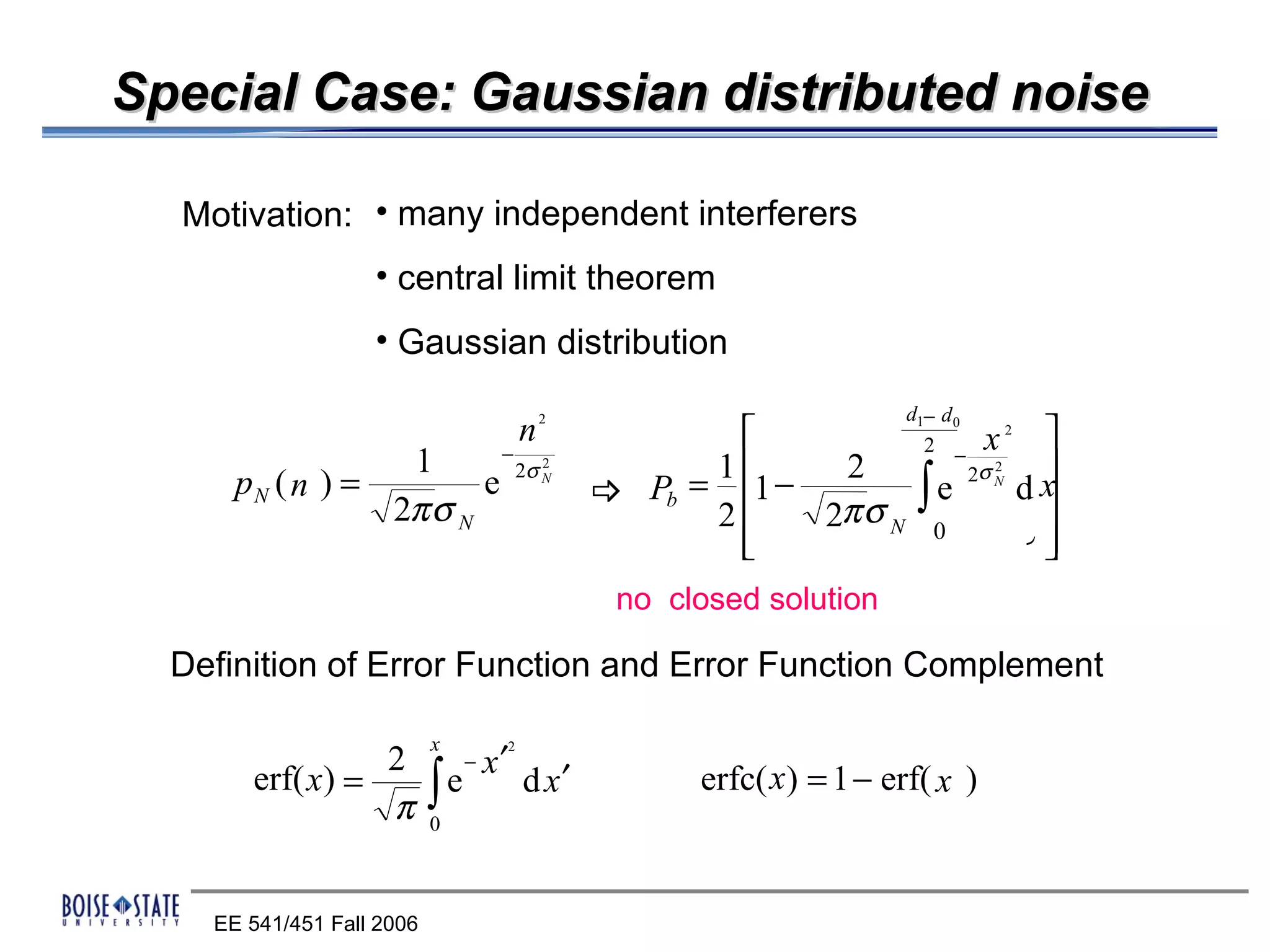
Special Case: Gaussian distributed noise

  Motivation: • many independent interferers
                   • central limit theorem
                   • Gaussian distribution
                                                                  d1− d 0
                                   n   2
                                                                  x 
                                                                    2 −
                                                                                2
                         −
                  1                              1     2             
                        e 2σ                                  ∫
                                       2
                                                                  2σ
      pN ( n ) =
                                                                            2
                                       N
                                            Pb = 1 −          e    dx
                                                                      
                                                                            N

                 2π σ N                          2     2π σ N 0 0
                                                   
                                                             1 24 
                                                                4 3
                                            no closed solution

  Definition of Error Function and Error Function Complement

                           x
                 2    − x′
                               2

       erf( x) =   ∫ e d x′
                 π 0
                                                 erfc( x) = 1 − erf( x )


    EE 541/451 Fall 2006
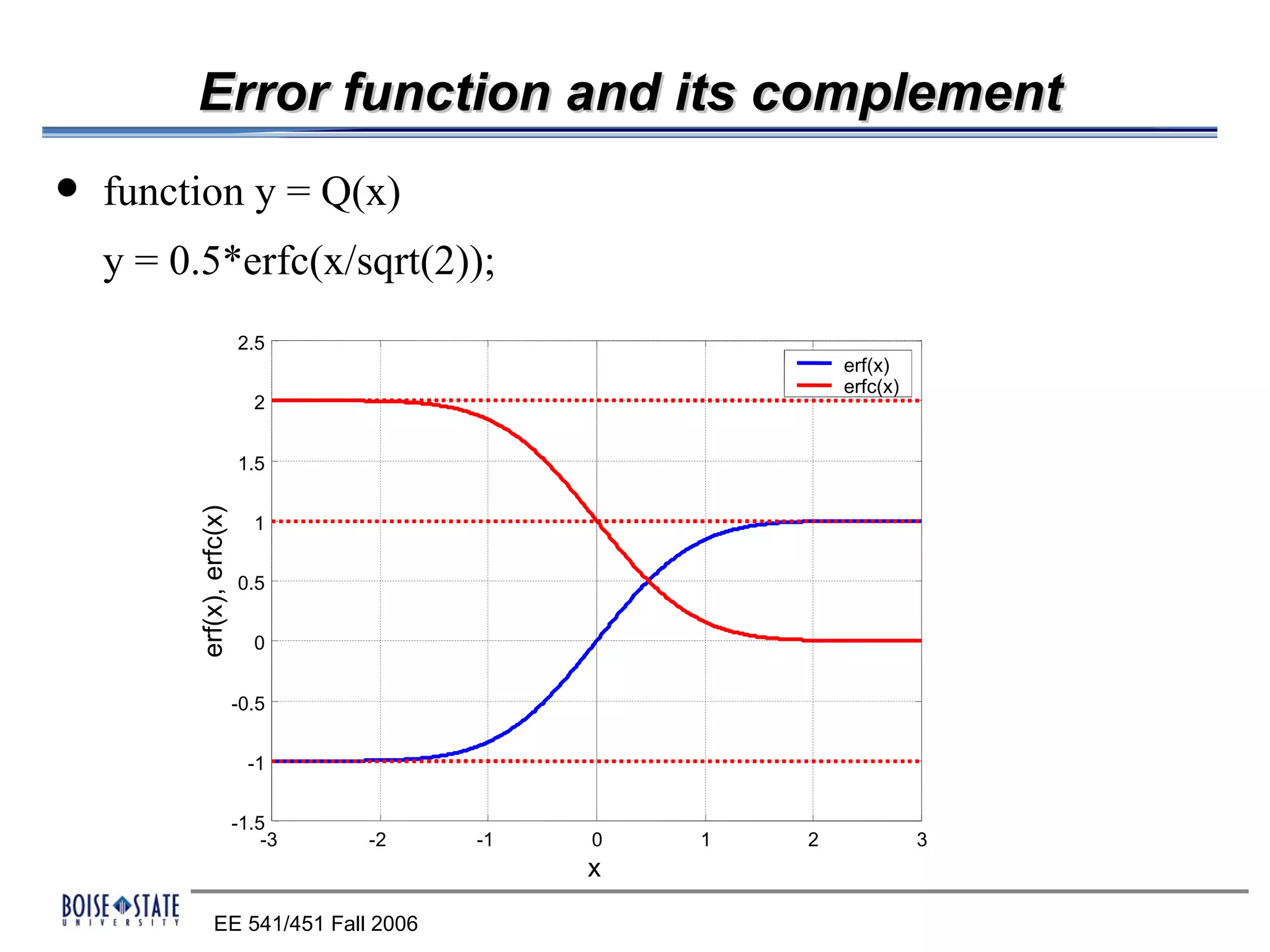
Error function and its complement
   function y = Q(x)
    y = 0.5*erfc(x/sqrt(2));
                            2.5
                                                           erf(x)
                                                           erfc(x)
                              2


                            1.5
          erf(x), erfc(x)


                              1


                            0.5


                              0


                            -0.5


                              -1


                            -1.5
                                -3   -2   -1   0   1   2             3
                                               x

                EE 541/451 Fall 2006
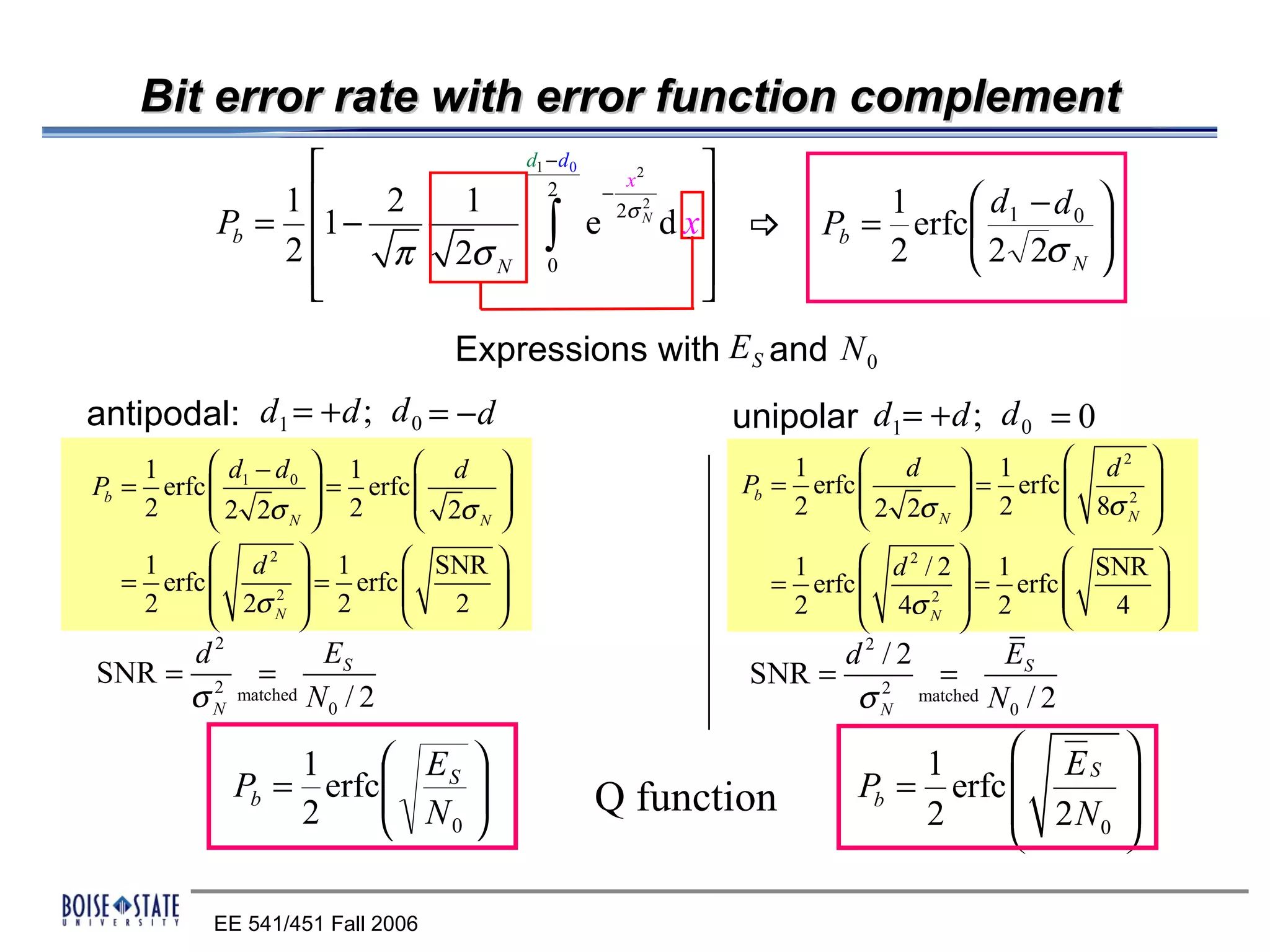
Bit error rate with error function complement
                                          d1 − d 0
                                                               x2       
              1    2             1           2           −
                                                                                  1     d − d0 
                                              ∫
                                                                 2
                                                              2σ N
          Pb = 1 −                                   e              d x     Pb = erfc 1      
              2
                
                    π            2σ N         0                         
                                                                                   2     2 2σ N 
                                                                       
                                 Expressions with E S and N 0
antipodal: d1 = + d ; d 0 = − d                                         unipolar d1= + d ; d 0 = 0
    1      d −d      1       d                                           1      d         1       d2     
Pb = erfc  1 0       = erfc                                          Pb = erfc 
                                                                                    2 2σ      = erfc 
                                                                                               2               
    2      2 2σ      2       2σ                                          2                          8σ N
                                                                                                            2   
                N               N                                                    N                   
   1      d2      1       SNR                                           1      d2 / 2  1       SNR 
  = erfc          = erfc 
                                                                         = erfc          = erfc      
   2      2σ N
         
              2    2
                            2                                           2      4σ N  2
                                                                                        2           
                                                                                                      4 
                                                                                          
     d2              ES                                                       d2 / 2        ES
SNR = 2       =                                                          SNR = 2     =
     σN     matched N / 2
                     0                                                         σ N matched N 0 / 2

                1     ES                                                             1      ES          
            Pb = erfc
                      N                            Q function                   Pb = erfc              
                2      0                                                             2      2 N0        
                                                                                                          

          EE 541/451 Fall 2006
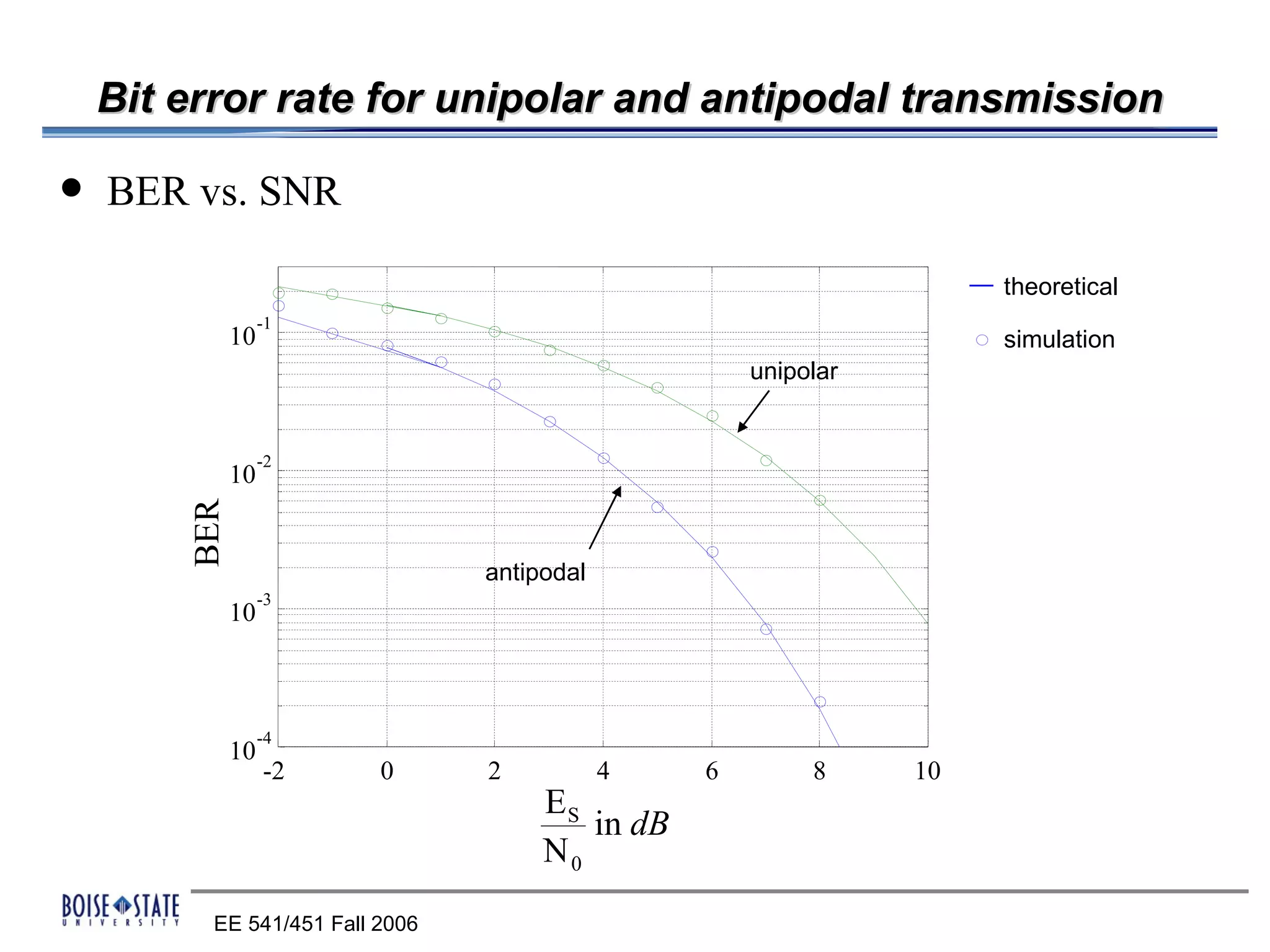
Bit error rate for unipolar and antipodal transmission

   BER vs. SNR

                                                                     theoretical
                   -1
              10                                                     simulation
                                                     unipolar


                   -2
              10
        BER


                                 antipodal
                   -3
              10


                   -4
              10
                   -2     0      2           4   6        8     10
                                      ES
                                         in dB
                                      N0
          EE 541/451 Fall 2006

Matched filter

  • 1.
    Receiver Structure  Matched filter: match source impulse and maximize SNR – grx to maximize the SNR at the sampling time/output  Equalizer: remove ISI  Timing – When to sample. Eye diagram  Decision – d(i) is 0 or 1 Figure 7.20 Noise na(t) i ⋅T d(i) gTx(t) gRx(t) r (iT ) = r0 (iT ) + n(iT ) S → max ? N EE 541/451 Fall 2006
  • 2.
    Matched Filter  Input signal s(t)+n(t)  Maximize the sampled SNR=s(T0)/n(T0) at time T0 EE 541/451 Fall 2006
  • 3.
    Matched filter example  Received SNR is maximized at time T0 S Matched Filter: optimal receive filter for maximized N example: gTx (t ) gTx (−t ) gTx (T0 − t ) = g Rx (t ) T0 t T0 t T0 t transmit filter receive filter (matched) EE 541/451 Fall 2006
  • 4.
    Equalizer  When the channel is not ideal, or when signaling is not Nyquist, There is ISI at the receiver side.  In time domain, equalizer removes ISR.  In frequency domain, equalizer flat the overall responses.  In practice, we equalize the channel response using an equalizer EE 541/451 Fall 2006
  • 5.
    Zero-Forcing Equalizer  The overall response at the detector input must satisfy Nyquist’s criterion for no ISI:  The noise variance at the output of the equalizer is: – If the channel has spectral nulls, there may be significant noise enhancement. EE 541/451 Fall 2006
  • 6.
    Transversal Transversal Zero-ForcingEqualizer  If Ts<T, we have a fractionally-spaced equalizer  For no ISI, let: EE 541/451 Fall 2006
  • 7.
    Zero-Forcing Equalizer continue  Zero-forcing equalizer, figure 7.21 and example 7.3  Example: Consider a baud-rate sampled equalizer for a system for which  Design a zero-forcing equalizer having 5 taps. EE 541/451 Fall 2006
  • 8.
    MMSE Equalizer  In the ISI channel model, we need to estimate data input sequence xk from the output sequence yk  Minimize the mean square error. EE 541/451 Fall 2006
  • 9.
    Adaptive Equalizer  Adapt to channel changes; training sequence EE 541/451 Fall 2006
  • 10.
    Decision Feedback Equalizer  To use data decisions made on the basis of precursors to take care of postcursors  Consists of feedforward, feedback, and decision sections (nonlinear)  DFE outperforms the linear equalizer when the channel has severe amplitude distortion or shape out off. EE 541/451 Fall 2006
  • 11.
    Different types ofequalizers  Zero-forcing equalizers ignore the additive noise and may significantly amplify noise for channels with spectral nulls  Minimum-mean-square error (MMSE) equalizers minimize the mean- square error between the output of the equalizer and the transmitted symbol. They require knowledge of some auto and cross-correlation functions, which in practice can be estimated by transmitting a known signal over the channel  Adaptive equalizers are needed for channels that are time-varying  Blind equalizers are needed when no preamble/training sequence is allowed, nonlinear  Decision-feedback equalizers (DFE’s) use tentative symbol decisions to eliminate ISI, nonlinear  Ultimately, the optimum equalizer is a maximum-likelihood sequence estimator, nonlinear EE 541/451 Fall 2006
  • 12.
    Timing Extraction  Received digital signal needs to be sampled at precise instants. Otherwise, the SNR reduced. The reason, eye diagram  Three general methods – Derivation from a primary or a secondary standard. GPS, atomic closk x Tower of base station x Backbone of Internet – Transmitting a separate synchronizing signal, (pilot clock, beacon) x Satellite – Self-synchronization, where the timing information is extracted from the received signal itself x Wireless x Cable, Fiber EE 541/451 Fall 2006
  • 13.
    Example  Self Clocking, RZ  Contain some clocking information. PLL EE 541/451 Fall 2006
  • 14.
    Timing/Synchronization Block Diagram  Figure 2.3  After equalizer, rectifier and clipper  Timing extractor to get the edge and then amplifier  Train the phase shifter which is usually PLL  Limiter gets the square wave of the signal  Pulse generator gets the impulse responses EE 541/451 Fall 2006
  • 15.
    Timing Jitter  Random forms of jitter: noise, interferences, and mistuning of the clock circuits.  Pattern-dependent jitter results from clock mistuning and, amplitude-to-phase conversion in the clock circuit, and ISI, which alters the position of the peaks of the input signal according to the pattern.  Pattern-dependent jitter propagates  Jitter reduction – Anti-jitter circuits – Jitter buffers – Dejitterizer EE 541/451 Fall 2006
  • 16.
    Bit Error Probability Noise na(t) i ⋅T d(i) gTx(t) gRx(t) r0 (i T ) + n(iT ) We assume: • binary transmission with d (i ) ∈ {d 0 , d1} • transmission system fulfills 1st Nyquist criterion • noise n(iT), independent of data source p N (n ) Probability density function (pdf) of n(iT) Mean and variance n EE 541/451 Fall 2006
  • 17.
    Conditional pdfs The transmissionsystem induces two conditional pdfs depending on d (i ) • if d (i ) = d 0 • if d (i ) = d1 p0 ( x ) = p N ( x − d 0 ) p1 ( x) = p N ( x − d1 ) p0 ( x ) p1 ( x) x d0 d1 x EE 541/451 Fall 2006
  • 18.
    Probability of wrongdecisions Placing a threshold S p0 ( x ) p1 ( x) Probability of wrong decision x x d0 S S d1 ∞ S Q0 = ∫ p0 ( x) dx Q1 = ∫ p ( x)dx 1 S −∞ When we define P0 and P1 as equal a-priori probabilities of d 0 and d1 (P0 = P = 1 ) we will get the bit error probability 1 2 ∞ S S Pb = P0Q0 + P Q1 = 1 1 2 ∫s p ( x)dx + ∫ p ( x)dx = S 0 1 2 −∞ 1 1 2 + ∫[ −∞ 1 2 p1 ( x) − 1 p0 ( x ) ] dx 2 1 24 4 3 S 1− ∫ p0 ( x ) dx −∞ EE 541/451 Fall 2006
  • 19.
    Conditions for illustrativesolution 1 d 0 + d1 With  P1 = P0 = and  pN (− x) = pN ( x) ⇒ S= 2 2 S 1  S Pb = 1 + ∫ p1 ( x) dx − ∫ p0 ( x ) dx  2  −∞ −∞  d 0 − d1 d +d S ′= S S= 0 1 S 2 2 ∫ p ( x) dx = ∫ p 1 N ( x − d1 )dx ∫ p ( x) dx 1 = ∫p N ( x ′ )d x ′ equivalently −∞ −∞ −∞ −∞ S with  substituting x −d1 = x ′ d −d d −d ∫ p0 ( x ) dx = d +d 0 1 1 0 2 −∞ for x =S = 0 1 1 2 1 2 = + ∫ p N ( x ′ )d x ′ = − ∫ p N ( x ′ )d x ′ d1 − d 0 d 0 + d1 d 0− d 1 2 0 2 0 1 2 ⇒S ′ = − d1= + ∫ p N ( x ' ) dx ' 2 2 d −d 1 0 2 0 1 2  Pb = 1 − 2 ∫ p N ( x )dx  2 0  EE 541/451 Fall 2006
  • 20.
    Special Case: Gaussiandistributed noise Motivation: • many independent interferers • central limit theorem • Gaussian distribution d1− d 0 n 2  x  2 − 2 − 1 1 2  e 2σ ∫ 2 2σ pN ( n ) = 2 N  Pb = 1 − e dx  N 2π σ N 2 2π σ N 0 0   1 24  4 3 no closed solution Definition of Error Function and Error Function Complement x 2 − x′ 2 erf( x) = ∫ e d x′ π 0 erfc( x) = 1 − erf( x ) EE 541/451 Fall 2006
  • 21.
    Error function andits complement  function y = Q(x) y = 0.5*erfc(x/sqrt(2)); 2.5 erf(x) erfc(x) 2 1.5 erf(x), erfc(x) 1 0.5 0 -0.5 -1 -1.5 -3 -2 -1 0 1 2 3 x EE 541/451 Fall 2006
  • 22.
    Bit error ratewith error function complement  d1 − d 0 x2  1 2 1 2 −  1  d − d0  ∫ 2 2σ N Pb = 1 − e d x  Pb = erfc 1  2  π 2σ N 0  2  2 2σ N    Expressions with E S and N 0 antipodal: d1 = + d ; d 0 = − d unipolar d1= + d ; d 0 = 0 1  d −d  1  d  1  d  1  d2  Pb = erfc  1 0  = erfc   Pb = erfc   2 2σ  = erfc   2  2  2 2σ  2  2σ  2  8σ N 2   N   N   N    1  d2  1  SNR  1  d2 / 2  1  SNR  = erfc   = erfc    = erfc   = erfc   2  2σ N  2  2   2  2  4σ N  2 2   4    d2 ES d2 / 2 ES SNR = 2 = SNR = 2 = σN matched N / 2 0 σ N matched N 0 / 2 1  ES  1  ES  Pb = erfc  N  Q function Pb = erfc   2  0  2  2 N0    EE 541/451 Fall 2006
  • 23.
    Bit error ratefor unipolar and antipodal transmission  BER vs. SNR theoretical -1 10 simulation unipolar -2 10 BER antipodal -3 10 -4 10 -2 0 2 4 6 8 10 ES in dB N0 EE 541/451 Fall 2006