
TOPIC: 2. BASIC TERMINOLOGIES,
ACCOUNTING PRINCIPLES, CONCEPTS
AND CONVENTIONS
By Srinivas Methuku.
TOPIC OBJECTIVES:
After completion of this topic student should be
conversant with the following:
1. Basic terminologies of accounting
2. Basis of Accounting
3. Accounting principles
4. Accounting concepts and conventions
BASIC TERMINOLOGIES OF ACCOUNTING:
 Business Transaction: Any exchange of money or
money’s worth as goods and services between two
parties is called a business transaction
 Cash transactions: A transaction that is settled
with cash on the same day as the trade.
 Credit transaction: Where payment of receipt of
money is postponed to a future date.
 Non-monetary: The transaction does not involve
an exchange of money or money’s worth directly or
indirectly
 Goods: The commodities or articles in which the
trader deals with.
 Profit: Income over expenditure during a particular
period
 Operating profit: it is the excess of gross profit
over operating expenses.
 Non-operating profit: The excess of non-operating
revenues over non-operating expenses.
 Normal gain
 Abnormal gain
 Income: It is a revenue arising as result of
business transactions.
 Assets: Property or any kind owned by a business.
 Fixed assets / Tangible assets
 Current assets
 Fictitious assets / Intangible assets
 Liabilities: The amount payable by the business to
others.
 Fixed liabilities / Long term liabilities
 Current liabilities
 Contingent Liabilities:
 Net worth: excess of assets over liabilities
 Capital: The total amount invested by the owner
into the business.
Capital = Assets - Liabilities
 Drawings: If the owner withdraws any money or
goods or assets from the business for personal use.
 Debtor: A person who owes money.
 Creditor: A person to whom money is owning or
payable.
 Expenditure: An amount paid for any consideration
received by business is called expenditure.
 Capital expenditure
 Revenue expenditure
 Deferred revenue expenditure
 Discount: discount is basically a concession is
given by a seller to the buyer.
 Cash discount
 Trade discount
 Solvent: A person who is in a position to pay off all
his debts.
 Insolvent: A person who is not in a position to pay
off
 Accounting year
 Trading concern
 Not for profit concern
 Good will
BASIS OF ACCOUNTING:
 Cash basis
 Accrual basis
 Mixed
GENERALLY ACCEPTED ACCOUNTING
PRINCIPLES
 GAAPs are common set of accounting principles,
standards and procedures that companies use
while preparing their financial statements.
 Sources of Indian GAAPs:
i. Company Law
ii. Accounting standards and related documents of ICAI
iii. SEBI requirements
iv. Established conventions
ACCOUNTING PRINCIPLES
 The term ‘Principle’ refers to fundamental belief or a
general truth which once established doesn’t
change.
 AICPA defines the term ‘Principle’ “as a guide to
action, a settled ground or basis of conduct or
practice.”
 Accounting principles are the guidelines to establish
standards for sound accounting practices and
procedures in reporting the financial status and
periodic performance of a business.
 Accounting principles are categorized as
accounting concepts and conventions
ACCOUNTING CONCEPTS AND CONVENTIONS
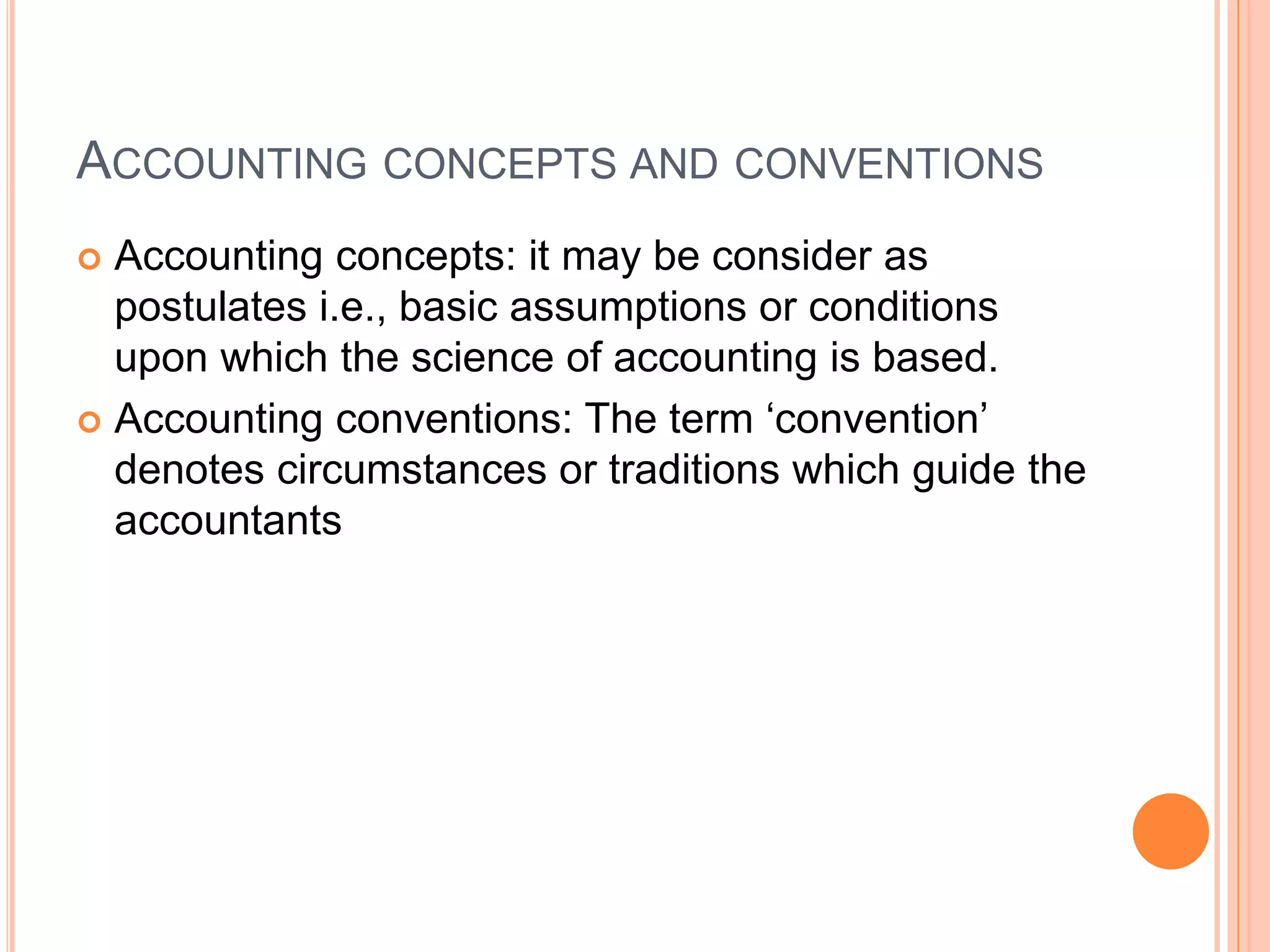
 Accounting concepts: it may be consider as
postulates i.e., basic assumptions or conditions
upon which the science of accounting is based.
 Accounting conventions: The term ‘convention’
denotes circumstances or traditions which guide the
accountants
ACCOUNTING PRINCIPLES
Accounting Concepts
• Business entity
• Money measurement
• Going concern
• Cost
• Dual aspect
• Accounting period
• Matching
• Realization
• Objective of evidence
• Accrual
Accounting
Conventions
• Consistency
• Full disclosure
• conservatism
• Materiality
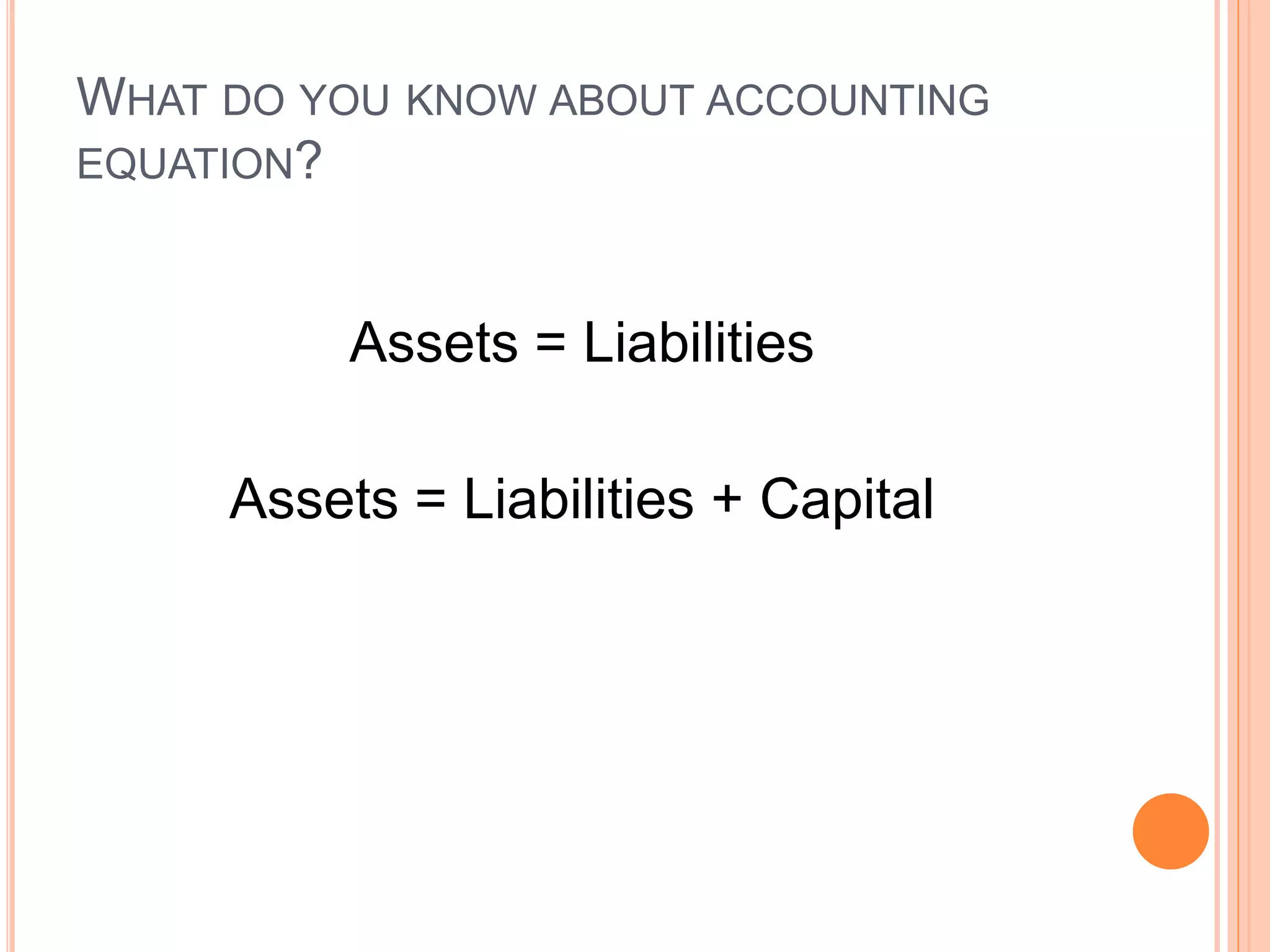
WHAT DO YOU KNOW ABOUT ACCOUNTING
EQUATION?
Assets = Liabilities
Assets = Liabilities + Capital
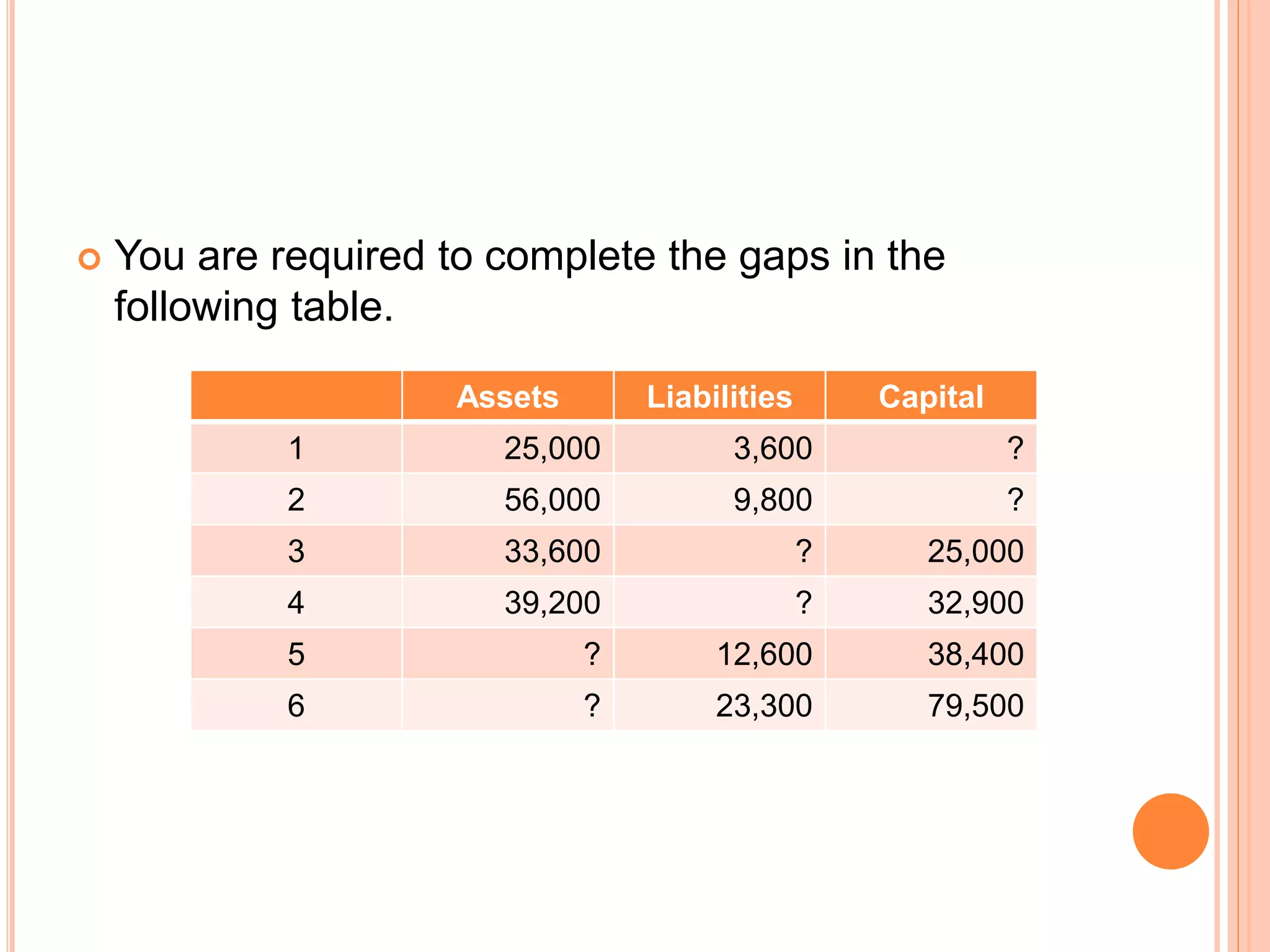
 You are required to complete the gaps in the
following table.
Assets Liabilities Capital
1 25,000 3,600 ?
2 56,000 9,800 ?
3 33,600 ? 25,000
4 39,200 ? 32,900
5 ? 12,600 38,400
6 ? 23,300 79,500
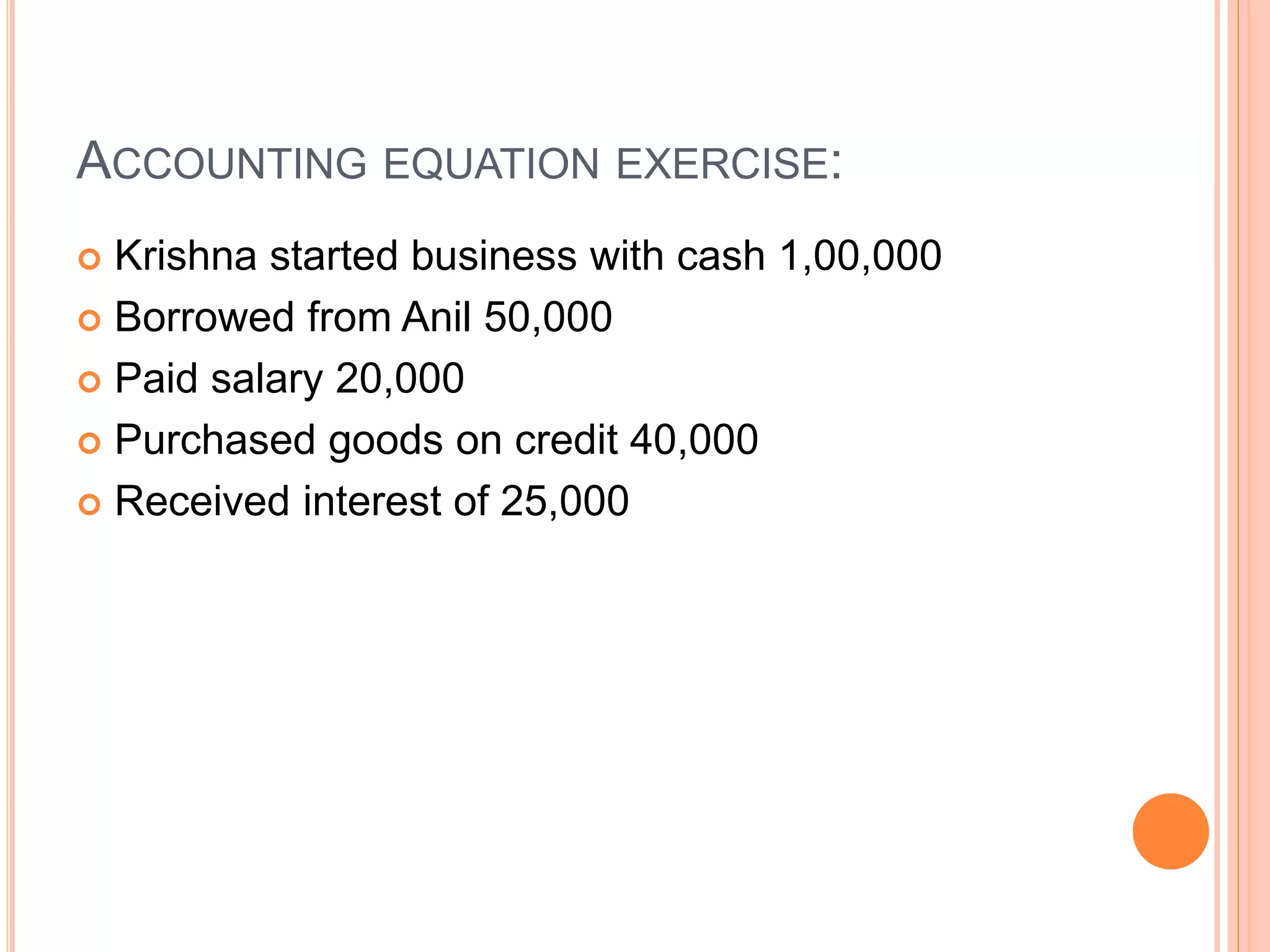
ACCOUNTING EQUATION EXERCISE:
 Krishna started business with cash 1,00,000
 Borrowed from Anil 50,000
 Paid salary 20,000
 Purchased goods on credit 40,000
 Received interest of 25,000
ACCOUNTING EQUATION EXERCISE:
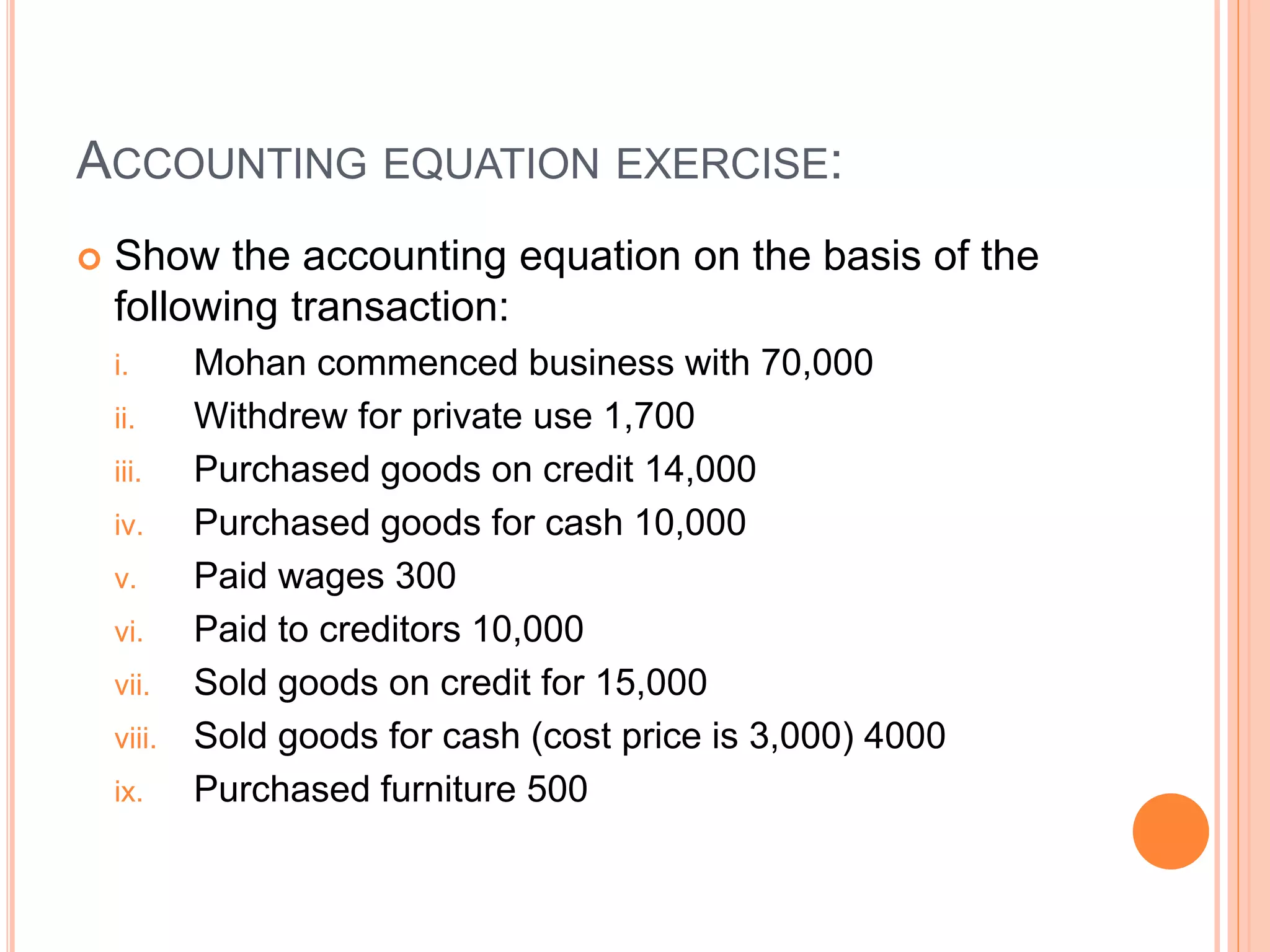
 Show the accounting equation on the basis of the
following transaction:
i. Mohan commenced business with 70,000
ii. Withdrew for private use 1,700
iii. Purchased goods on credit 14,000
iv. Purchased goods for cash 10,000
v. Paid wages 300
vi. Paid to creditors 10,000
vii. Sold goods on credit for 15,000
viii. Sold goods for cash (cost price is 3,000) 4000
ix. Purchased furniture 500
ACCOUNTING EQUATION EXERCISE:
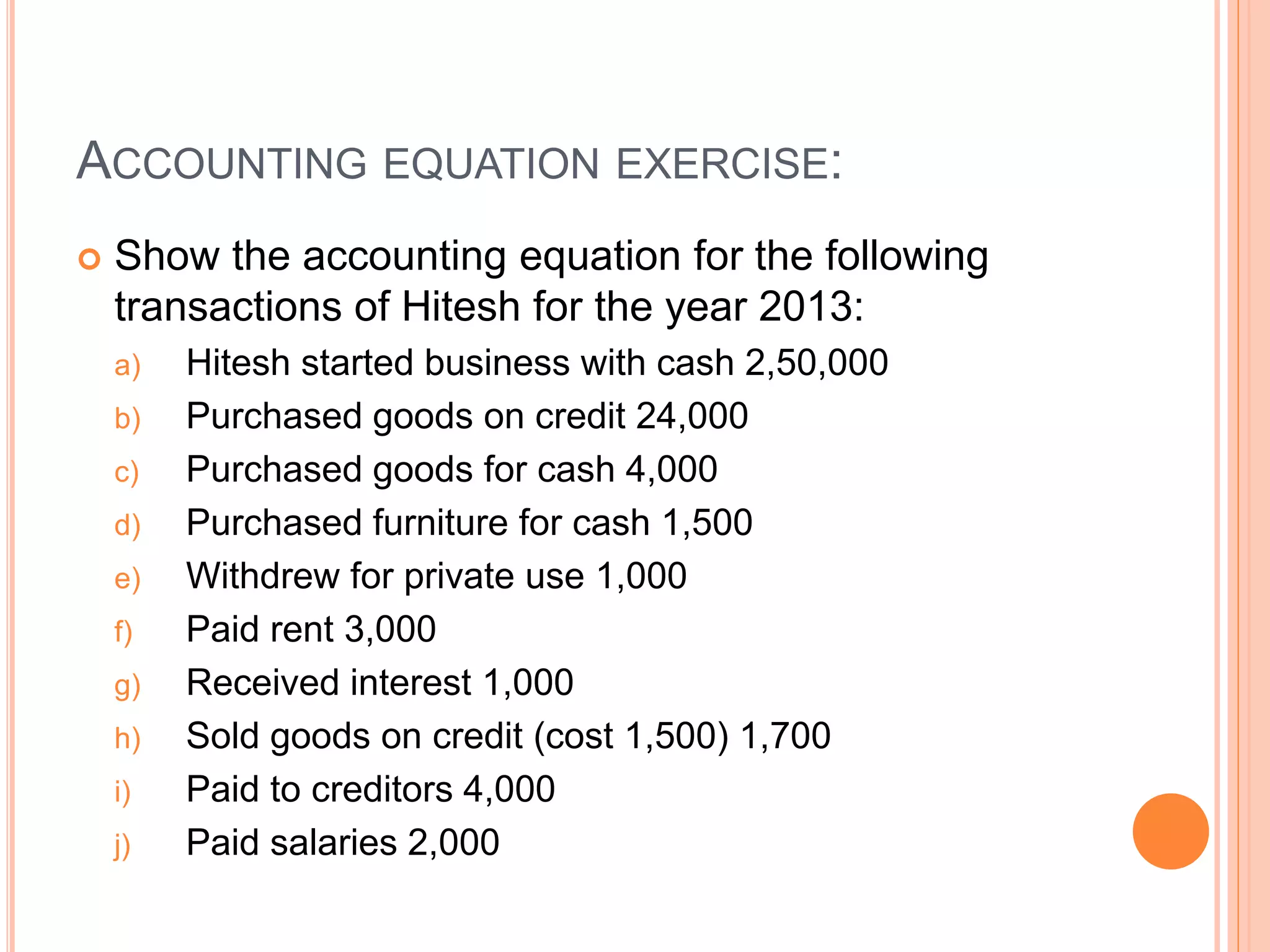
 Show the accounting equation for the following
transactions of Hitesh for the year 2013:
a) Hitesh started business with cash 2,50,000
b) Purchased goods on credit 24,000
c) Purchased goods for cash 4,000
d) Purchased furniture for cash 1,500
e) Withdrew for private use 1,000
f) Paid rent 3,000
g) Received interest 1,000
h) Sold goods on credit (cost 1,500) 1,700
i) Paid to creditors 4,000
j) Paid salaries 2,000
THANKS FOR LISTENING!!!

Accounting concepts and conventions

  • 1.
    TOPIC: 2. BASICTERMINOLOGIES, ACCOUNTING PRINCIPLES, CONCEPTS AND CONVENTIONS By Srinivas Methuku.
  • 2.
    TOPIC OBJECTIVES: After completionof this topic student should be conversant with the following: 1. Basic terminologies of accounting 2. Basis of Accounting 3. Accounting principles 4. Accounting concepts and conventions
  • 3.
    BASIC TERMINOLOGIES OFACCOUNTING:  Business Transaction: Any exchange of money or money’s worth as goods and services between two parties is called a business transaction  Cash transactions: A transaction that is settled with cash on the same day as the trade.  Credit transaction: Where payment of receipt of money is postponed to a future date.  Non-monetary: The transaction does not involve an exchange of money or money’s worth directly or indirectly
  • 4.
     Goods: Thecommodities or articles in which the trader deals with.  Profit: Income over expenditure during a particular period  Operating profit: it is the excess of gross profit over operating expenses.  Non-operating profit: The excess of non-operating revenues over non-operating expenses.  Normal gain  Abnormal gain  Income: It is a revenue arising as result of business transactions.
  • 5.
     Assets: Propertyor any kind owned by a business.  Fixed assets / Tangible assets  Current assets  Fictitious assets / Intangible assets  Liabilities: The amount payable by the business to others.  Fixed liabilities / Long term liabilities  Current liabilities  Contingent Liabilities:
  • 6.
     Net worth:excess of assets over liabilities  Capital: The total amount invested by the owner into the business. Capital = Assets - Liabilities  Drawings: If the owner withdraws any money or goods or assets from the business for personal use.  Debtor: A person who owes money.  Creditor: A person to whom money is owning or payable.
  • 7.
     Expenditure: Anamount paid for any consideration received by business is called expenditure.  Capital expenditure  Revenue expenditure  Deferred revenue expenditure  Discount: discount is basically a concession is given by a seller to the buyer.  Cash discount  Trade discount
  • 8.
     Solvent: Aperson who is in a position to pay off all his debts.  Insolvent: A person who is not in a position to pay off  Accounting year  Trading concern  Not for profit concern  Good will
  • 9.
    BASIS OF ACCOUNTING: Cash basis  Accrual basis  Mixed
  • 10.
    GENERALLY ACCEPTED ACCOUNTING PRINCIPLES GAAPs are common set of accounting principles, standards and procedures that companies use while preparing their financial statements.  Sources of Indian GAAPs: i. Company Law ii. Accounting standards and related documents of ICAI iii. SEBI requirements iv. Established conventions
  • 11.
    ACCOUNTING PRINCIPLES  Theterm ‘Principle’ refers to fundamental belief or a general truth which once established doesn’t change.  AICPA defines the term ‘Principle’ “as a guide to action, a settled ground or basis of conduct or practice.”  Accounting principles are the guidelines to establish standards for sound accounting practices and procedures in reporting the financial status and periodic performance of a business.  Accounting principles are categorized as accounting concepts and conventions
  • 12.
    ACCOUNTING CONCEPTS ANDCONVENTIONS  Accounting concepts: it may be consider as postulates i.e., basic assumptions or conditions upon which the science of accounting is based.  Accounting conventions: The term ‘convention’ denotes circumstances or traditions which guide the accountants
  • 13.
    ACCOUNTING PRINCIPLES Accounting Concepts •Business entity • Money measurement • Going concern • Cost • Dual aspect • Accounting period • Matching • Realization • Objective of evidence • Accrual Accounting Conventions • Consistency • Full disclosure • conservatism • Materiality
  • 14.
    WHAT DO YOUKNOW ABOUT ACCOUNTING EQUATION? Assets = Liabilities Assets = Liabilities + Capital
  • 15.
     You arerequired to complete the gaps in the following table. Assets Liabilities Capital 1 25,000 3,600 ? 2 56,000 9,800 ? 3 33,600 ? 25,000 4 39,200 ? 32,900 5 ? 12,600 38,400 6 ? 23,300 79,500
  • 16.
    ACCOUNTING EQUATION EXERCISE: Krishna started business with cash 1,00,000  Borrowed from Anil 50,000  Paid salary 20,000  Purchased goods on credit 40,000  Received interest of 25,000
  • 17.
    ACCOUNTING EQUATION EXERCISE: Show the accounting equation on the basis of the following transaction: i. Mohan commenced business with 70,000 ii. Withdrew for private use 1,700 iii. Purchased goods on credit 14,000 iv. Purchased goods for cash 10,000 v. Paid wages 300 vi. Paid to creditors 10,000 vii. Sold goods on credit for 15,000 viii. Sold goods for cash (cost price is 3,000) 4000 ix. Purchased furniture 500
  • 18.
    ACCOUNTING EQUATION EXERCISE: Show the accounting equation for the following transactions of Hitesh for the year 2013: a) Hitesh started business with cash 2,50,000 b) Purchased goods on credit 24,000 c) Purchased goods for cash 4,000 d) Purchased furniture for cash 1,500 e) Withdrew for private use 1,000 f) Paid rent 3,000 g) Received interest 1,000 h) Sold goods on credit (cost 1,500) 1,700 i) Paid to creditors 4,000 j) Paid salaries 2,000
  • 19.