UNIT 1:ACCOUNTING THEORY
BC 1121 FINANCIAL ACCOUNTING
Unit 1 FUNDAMENTALS OF ACCOUNTING 04 Hours
Accounting: Nature, Objectives and functions of Financial Accounting. Accounting Principles, Concepts & Conventions - GAAP (Concept only).
Accounting standards: Concept – importance – Introduction to IASB, IFRS and Ind AS – Standard setting in India.
Unit 2 ROYALTY ACCOUNTS 12 Hours
Technical Terms – Royalty – Landlord – Tenant – Minimum Rent – Short Workings – Recoupment of Short Working under restrictive (Fixed Period) and non-
restrictive (Floating Period) - Recoupment within the Life of the Lease – Treatment of Strike and Stoppage of work – Accounting Treatment in the books of
Lessee and lessor – Journal entries and Ledger Accounts including Minimum Rent Account.
Unit 3 HIRE PURCHASE SYSTEM 12 Hours
Difference between Hire Purchase and Installment Purchase system–Theoretical concepts–Hire Purchase Agreement – Hire Purchase Price – Cash Price
– Hire Purchase Charges – Net Hire Purchase Price – Net Cash Price – Calculation of Interest – Calculation of Cash Price – Journal Entries and Ledger
Accounts in the books of Hire Purchaser and Hire Vendor (Asset Accrual Method only).
Unit 4 CONSIGNMENT ACCOUNTS 12 Hours
Introduction – Consignor – Consignee – Goods Invoiced at Cost Price – Goods Invoiced at Selling Price – Normal Loss – Abnormal Loss – Valuation of
Stock – Stock Reserve – Journal Entries – Ledger Accounts in the books of Consignor and Consignee.
Unit 5 CONVERSION OF SINGLE ENTRY INTO DOUBLE ENTRY 12 Hours
Steps in conversion of single entry into double entry - ascertainment of sales, purchases, stocks, cash and bank balances, capital etc. - preparation of
final accounts.
Module 1: Accounting Theory
 Accounting: Nature
 Objectives and functions of Financial
Accounting.
 Accounting Principles, Concepts &
Conventions
 GAAP (Concept only)
 Accounting standards:
 Definition
 Importance
 Standard setting in India
Accounting -Definition
Accounting is the art of recording, classifying and
summarising in a significant manner in terms of
money, transactions and events which are, in part at
least, of a financial character and interpret the
results thereof.
AICPA (1941)
Accounting is a process of identifying, measuring
and communicating economic information to permit
informed decisions by users of the information.
AAA (1966)
FEATURES OF ACCOUNTING
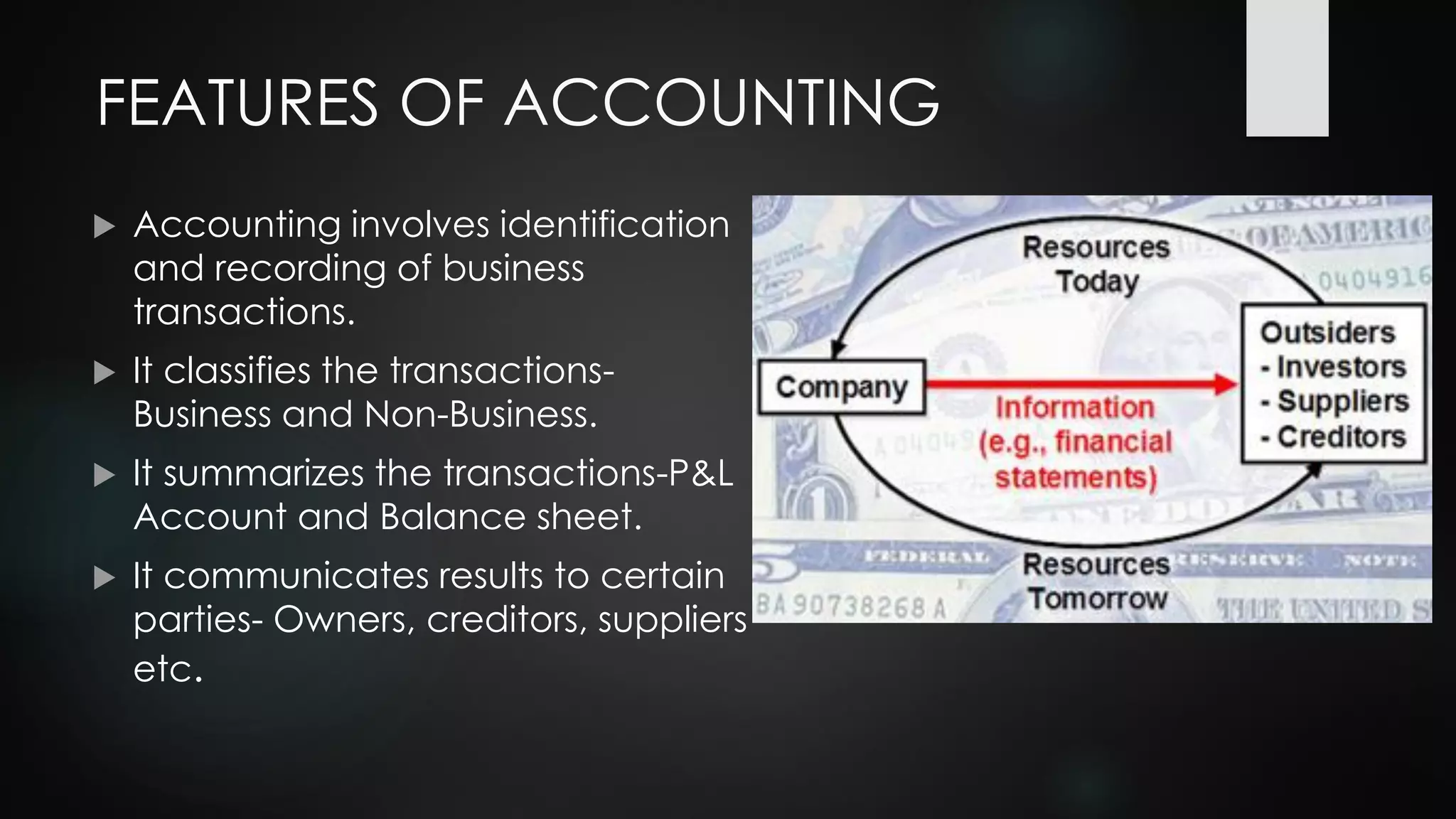
 Accounting involves identification
and recording of business
transactions.
 It classifies the transactions-
Business and Non-Business.
 It summarizes the transactions-P&L
Account and Balance sheet.
 It communicates results to certain
parties- Owners, creditors, suppliers
etc.
NATURE OF ACCOUNTING
 Accounting is a process.
 Accounting as science and art.
 Accounting is means and not an
end.
 Accounting as a service activity.
 Accounting is an information
system.
 Accounting as a language.
 Accounting as a profession.
 Accounting as a social force.
OBJECTIVES OF ACCOUNTING
 Systematic recording of transactions
 Ascertainment of results.
 Ascertainment of financial position of the business
 Providing information to the users for rational decision-
making.
 To know the solvency position.
 Decision making functions become easy.
FUNCTIONS OF FINANCIAL
ACCOUNTING
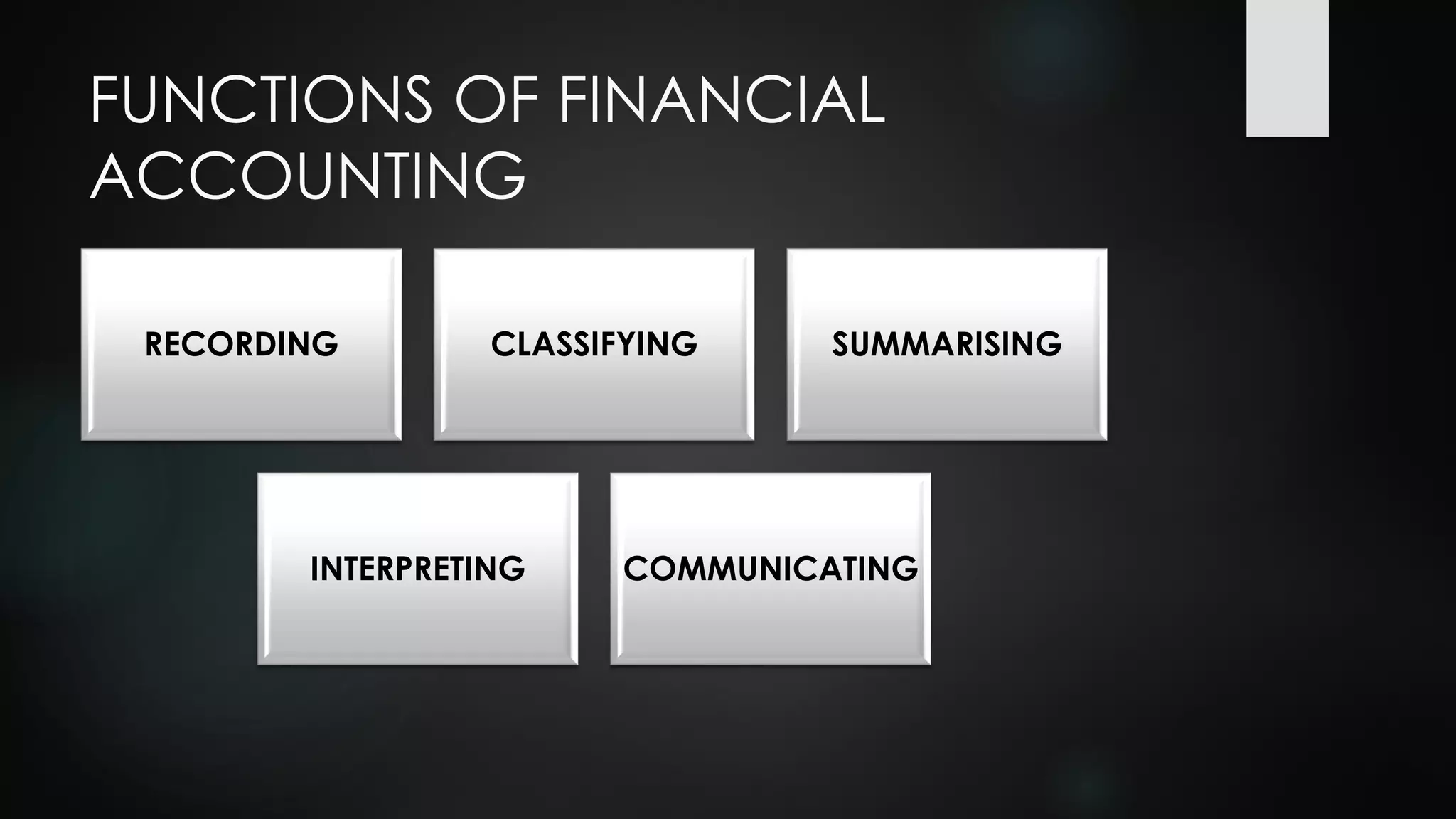
RECORDING CLASSIFYING SUMMARISING
INTERPRETING COMMUNICATING
ACCOUNTING PRINCIPLES- GAAP
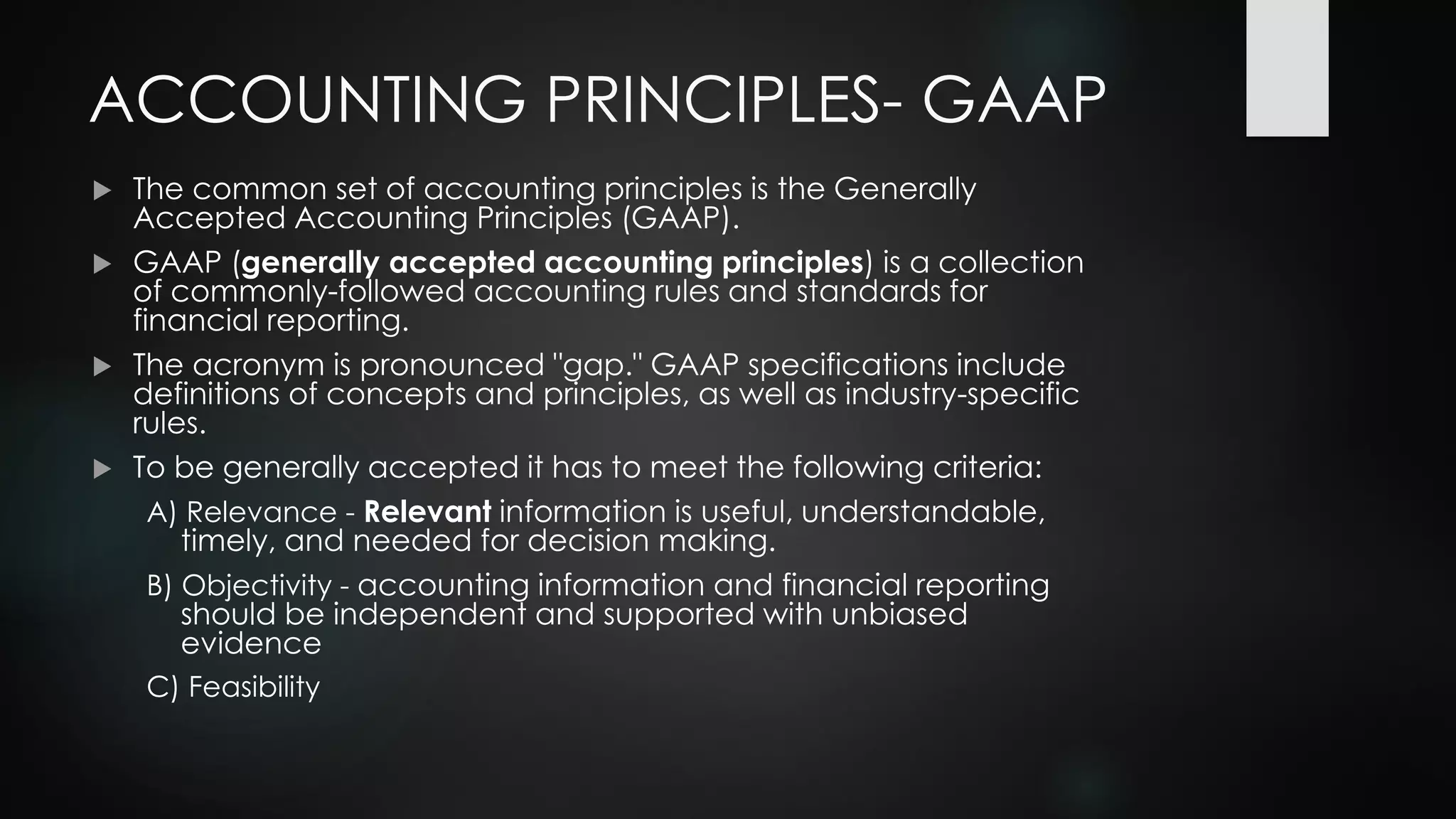
 The common set of accounting principles is the Generally
Accepted Accounting Principles (GAAP).
 GAAP (generally accepted accounting principles) is a collection
of commonly-followed accounting rules and standards for
financial reporting.
 The acronym is pronounced "gap." GAAP specifications include
definitions of concepts and principles, as well as industry-specific
rules.
 To be generally accepted it has to meet the following criteria:
A) Relevance - Relevant information is useful, understandable,
timely, and needed for decision making.
B) Objectivity - accounting information and financial reporting
should be independent and supported with unbiased
evidence
C) Feasibility
ACCOUNTING CONCEPTS
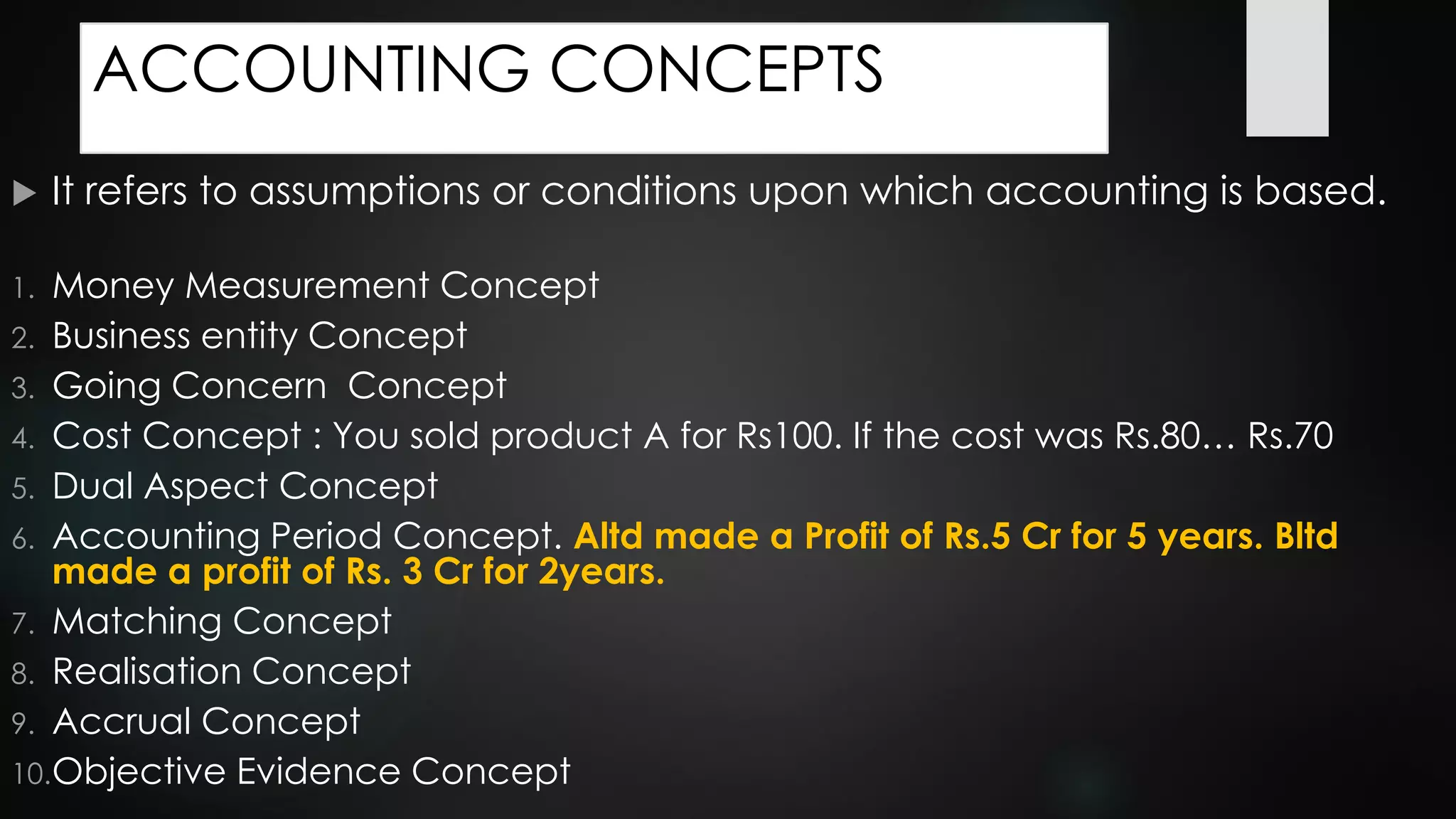
 It refers to assumptions or conditions upon which accounting is based.
1. Money Measurement Concept
2. Business entity Concept
3. Going Concern Concept
4. Cost Concept : You sold product A for Rs100. If the cost was Rs.80… Rs.70
5. Dual Aspect Concept
6. Accounting Period Concept. Altd made a Profit of Rs.5 Cr for 5 years. Bltd
made a profit of Rs. 3 Cr for 2years.
7. Matching Concept
8. Realisation Concept
9. Accrual Concept
10.Objective Evidence Concept
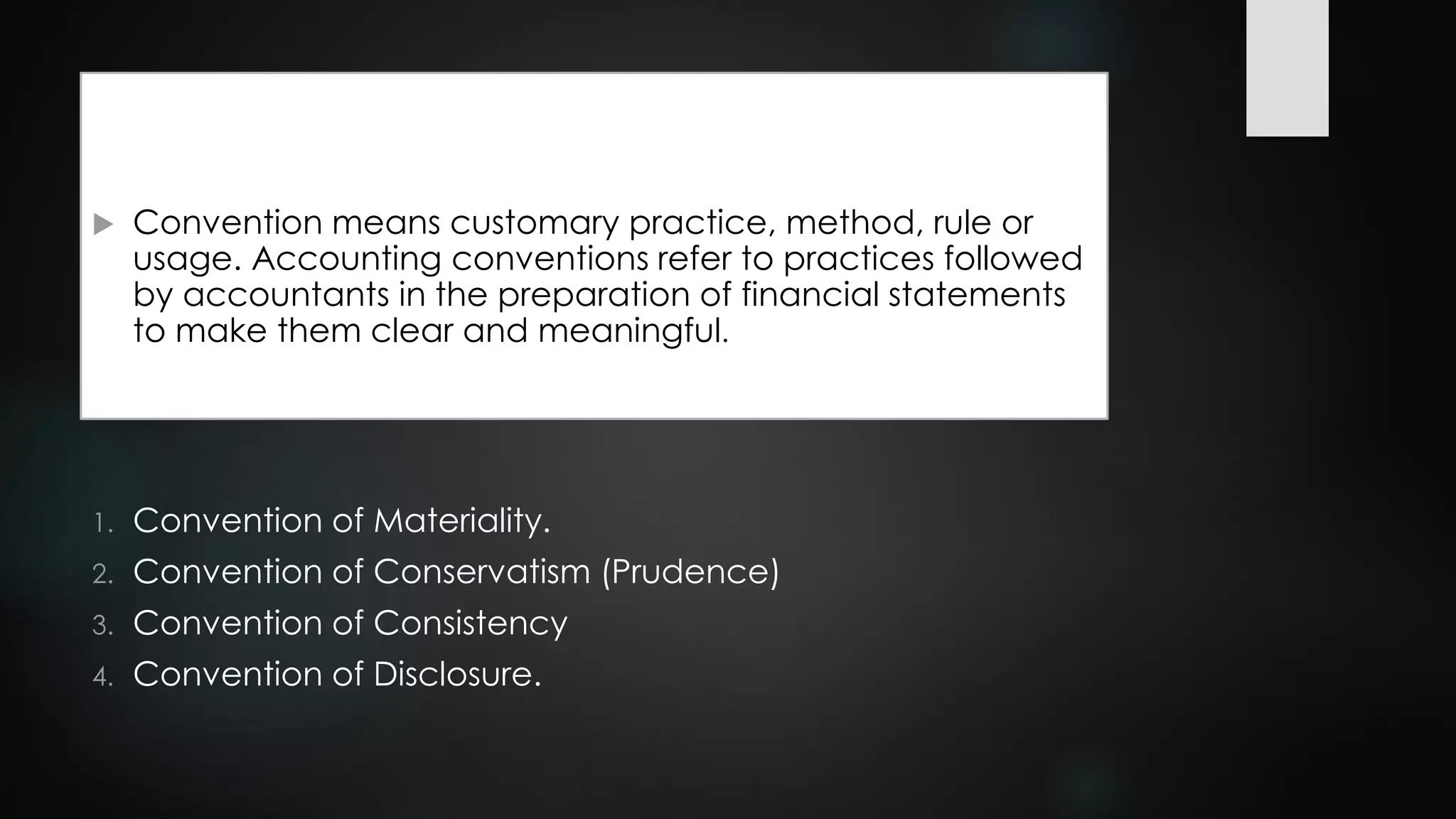
 Convention means customary practice, method, rule or
usage. Accounting conventions refer to practices followed
by accountants in the preparation of financial statements
to make them clear and meaningful.
1. Convention of Materiality.
2. Convention of Conservatism (Prudence)
3. Convention of Consistency
4. Convention of Disclosure.
A Ltd B Ltd
Machi 1,00,000 1,00,000
10 % Dep Fixed 10,000 10,000
1st year 90,000 90,000
- Dep A (Fix), B (Dimi) 10,000 9,000
80,000 81,000
10,000 8100
70,000 73,000
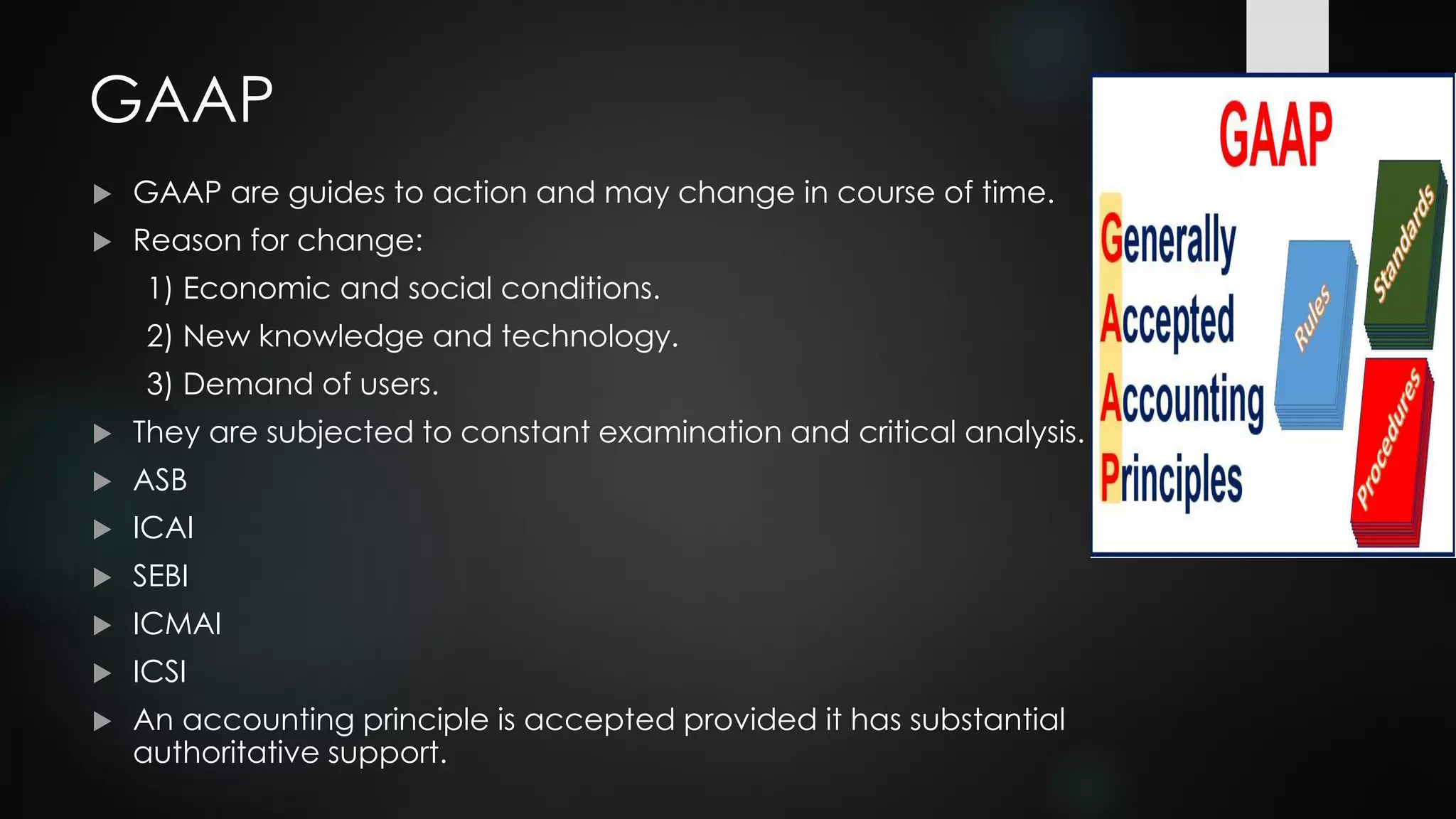
GAAP
 GAAP are guides to action and may change in course of time.
 Reason for change:
1) Economic and social conditions.
2) New knowledge and technology.
3) Demand of users.
 They are subjected to constant examination and critical analysis.
 ASB
 ICAI
 SEBI
 ICMAI
 ICSI
 An accounting principle is accepted provided it has substantial
authoritative support.
SELECTION OF ACCOUNTING
PRINCIPLES
 Accurate Presentation
 Conservatism
 Profit Maximisation
 Income Smoothing
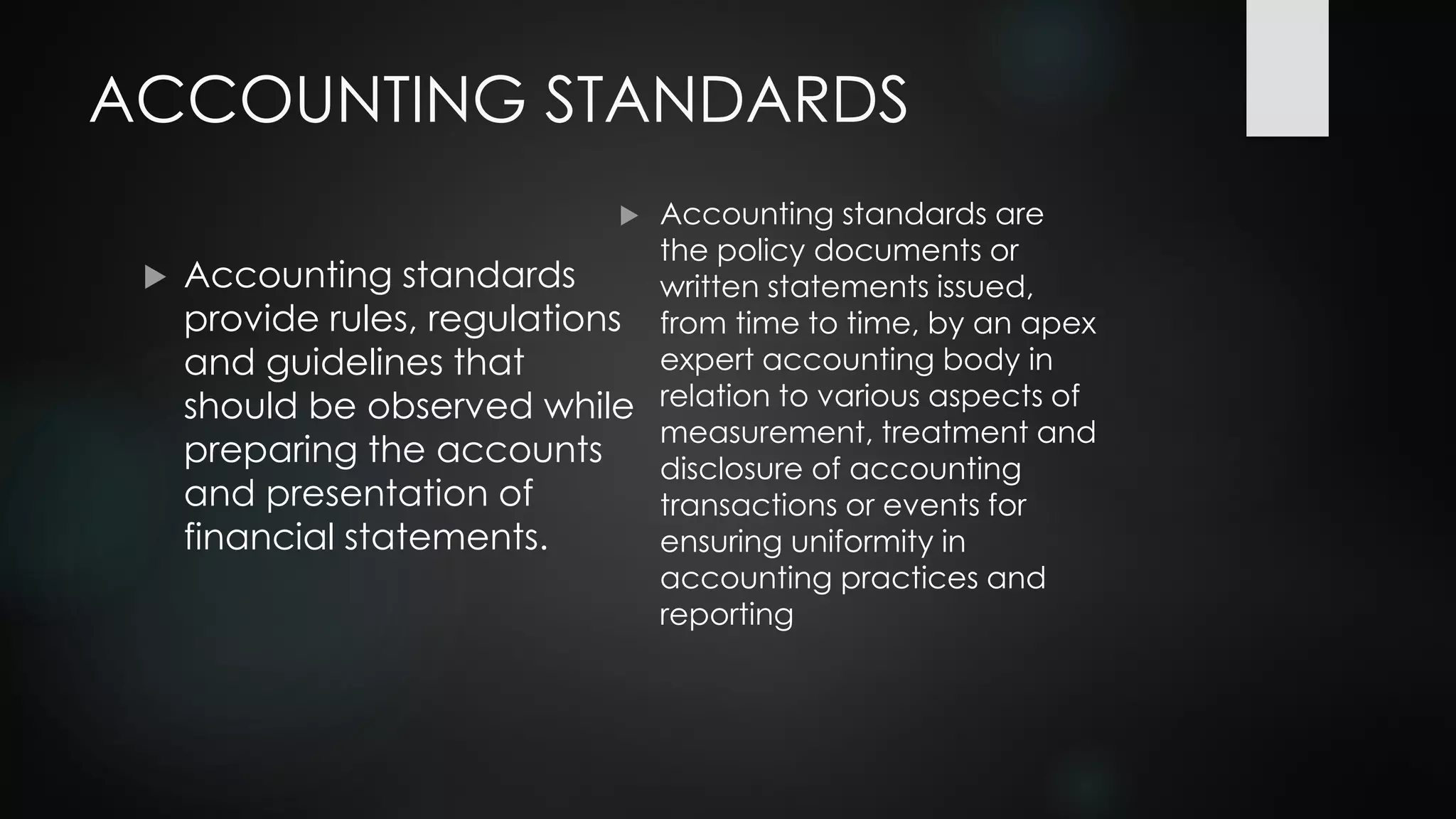
ACCOUNTING STANDARDS
 Accounting standards
provide rules, regulations
and guidelines that
should be observed while
preparing the accounts
and presentation of
financial statements.
 Accounting standards are
the policy documents or
written statements issued,
from time to time, by an apex
expert accounting body in
relation to various aspects of
measurement, treatment and
disclosure of accounting
transactions or events for
ensuring uniformity in
accounting practices and
reporting
IMPORTANCE OF AS
❑ Uniform accounting policies.
❑ Easy comparability of Financial statements.
❑ Accuracy and Reliability.
❑ Scientific and Rational.
❑ Flexibility.
❑ Helps investors to judge the yield and risk involved
before investing.
❑ Accepted by Government officials and Income tax
authorities.
ASB (ACCOUNTING STANDARD
BOARD)
 ICAI constituted the ASB on 21st April 1977.
 To harmonise the diverse accounting policies and practices.
 Composition is board based and ensures participation of all interest groups.
Standard setting in India:
 Broad areas are identified and prioritised.
 Study groups are formed.
 Dialogue with representatives of Government, PSU’s, Industries etc.
is held.
 A draft of the proposed standard will be prepared and issued for
comments.
 After taking the comments into consideration, the draft will be
finalised by ASB and submitted to the Council of the Institute.
 If found necessary the Council can modify the draft. Later the
Accounting standard will be issued by the Authority.
The draft includes:
1. A statement of concepts and fundamental
accounting principles relating to the Standard.
2. Definitions of the terms used in the standard.
3. The manner in which accounting principles have
been applied for formulating the standard.
4. The presentation and disclosure requirements.
5. Class of enterprises to which the standard will apply.
6. Date from which the standard will be effective.

Module 1 accounting theory.pdf

  • 1.
    UNIT 1:ACCOUNTING THEORY BC1121 FINANCIAL ACCOUNTING
  • 2.
    Unit 1 FUNDAMENTALSOF ACCOUNTING 04 Hours Accounting: Nature, Objectives and functions of Financial Accounting. Accounting Principles, Concepts & Conventions - GAAP (Concept only). Accounting standards: Concept – importance – Introduction to IASB, IFRS and Ind AS – Standard setting in India. Unit 2 ROYALTY ACCOUNTS 12 Hours Technical Terms – Royalty – Landlord – Tenant – Minimum Rent – Short Workings – Recoupment of Short Working under restrictive (Fixed Period) and non- restrictive (Floating Period) - Recoupment within the Life of the Lease – Treatment of Strike and Stoppage of work – Accounting Treatment in the books of Lessee and lessor – Journal entries and Ledger Accounts including Minimum Rent Account. Unit 3 HIRE PURCHASE SYSTEM 12 Hours Difference between Hire Purchase and Installment Purchase system–Theoretical concepts–Hire Purchase Agreement – Hire Purchase Price – Cash Price – Hire Purchase Charges – Net Hire Purchase Price – Net Cash Price – Calculation of Interest – Calculation of Cash Price – Journal Entries and Ledger Accounts in the books of Hire Purchaser and Hire Vendor (Asset Accrual Method only). Unit 4 CONSIGNMENT ACCOUNTS 12 Hours Introduction – Consignor – Consignee – Goods Invoiced at Cost Price – Goods Invoiced at Selling Price – Normal Loss – Abnormal Loss – Valuation of Stock – Stock Reserve – Journal Entries – Ledger Accounts in the books of Consignor and Consignee. Unit 5 CONVERSION OF SINGLE ENTRY INTO DOUBLE ENTRY 12 Hours Steps in conversion of single entry into double entry - ascertainment of sales, purchases, stocks, cash and bank balances, capital etc. - preparation of final accounts.
  • 3.
    Module 1: AccountingTheory  Accounting: Nature  Objectives and functions of Financial Accounting.  Accounting Principles, Concepts & Conventions  GAAP (Concept only)  Accounting standards:  Definition  Importance  Standard setting in India
  • 4.
    Accounting -Definition Accounting isthe art of recording, classifying and summarising in a significant manner in terms of money, transactions and events which are, in part at least, of a financial character and interpret the results thereof. AICPA (1941) Accounting is a process of identifying, measuring and communicating economic information to permit informed decisions by users of the information. AAA (1966)
  • 5.
    FEATURES OF ACCOUNTING Accounting involves identification and recording of business transactions.  It classifies the transactions- Business and Non-Business.  It summarizes the transactions-P&L Account and Balance sheet.  It communicates results to certain parties- Owners, creditors, suppliers etc.
  • 6.
    NATURE OF ACCOUNTING Accounting is a process.  Accounting as science and art.  Accounting is means and not an end.  Accounting as a service activity.  Accounting is an information system.  Accounting as a language.  Accounting as a profession.  Accounting as a social force.
  • 7.
    OBJECTIVES OF ACCOUNTING Systematic recording of transactions  Ascertainment of results.  Ascertainment of financial position of the business  Providing information to the users for rational decision- making.  To know the solvency position.  Decision making functions become easy.
  • 8.
    FUNCTIONS OF FINANCIAL ACCOUNTING RECORDINGCLASSIFYING SUMMARISING INTERPRETING COMMUNICATING
  • 9.
    ACCOUNTING PRINCIPLES- GAAP The common set of accounting principles is the Generally Accepted Accounting Principles (GAAP).  GAAP (generally accepted accounting principles) is a collection of commonly-followed accounting rules and standards for financial reporting.  The acronym is pronounced "gap." GAAP specifications include definitions of concepts and principles, as well as industry-specific rules.  To be generally accepted it has to meet the following criteria: A) Relevance - Relevant information is useful, understandable, timely, and needed for decision making. B) Objectivity - accounting information and financial reporting should be independent and supported with unbiased evidence C) Feasibility
  • 10.
    ACCOUNTING CONCEPTS  Itrefers to assumptions or conditions upon which accounting is based. 1. Money Measurement Concept 2. Business entity Concept 3. Going Concern Concept 4. Cost Concept : You sold product A for Rs100. If the cost was Rs.80… Rs.70 5. Dual Aspect Concept 6. Accounting Period Concept. Altd made a Profit of Rs.5 Cr for 5 years. Bltd made a profit of Rs. 3 Cr for 2years. 7. Matching Concept 8. Realisation Concept 9. Accrual Concept 10.Objective Evidence Concept
  • 11.
     Convention meanscustomary practice, method, rule or usage. Accounting conventions refer to practices followed by accountants in the preparation of financial statements to make them clear and meaningful. 1. Convention of Materiality. 2. Convention of Conservatism (Prudence) 3. Convention of Consistency 4. Convention of Disclosure.
  • 12.
    A Ltd BLtd Machi 1,00,000 1,00,000 10 % Dep Fixed 10,000 10,000 1st year 90,000 90,000 - Dep A (Fix), B (Dimi) 10,000 9,000 80,000 81,000 10,000 8100 70,000 73,000
  • 13.
    GAAP  GAAP areguides to action and may change in course of time.  Reason for change: 1) Economic and social conditions. 2) New knowledge and technology. 3) Demand of users.  They are subjected to constant examination and critical analysis.  ASB  ICAI  SEBI  ICMAI  ICSI  An accounting principle is accepted provided it has substantial authoritative support.
  • 14.
    SELECTION OF ACCOUNTING PRINCIPLES Accurate Presentation  Conservatism  Profit Maximisation  Income Smoothing
  • 15.
    ACCOUNTING STANDARDS  Accountingstandards provide rules, regulations and guidelines that should be observed while preparing the accounts and presentation of financial statements.  Accounting standards are the policy documents or written statements issued, from time to time, by an apex expert accounting body in relation to various aspects of measurement, treatment and disclosure of accounting transactions or events for ensuring uniformity in accounting practices and reporting
  • 16.
    IMPORTANCE OF AS ❑Uniform accounting policies. ❑ Easy comparability of Financial statements. ❑ Accuracy and Reliability. ❑ Scientific and Rational. ❑ Flexibility. ❑ Helps investors to judge the yield and risk involved before investing. ❑ Accepted by Government officials and Income tax authorities.
  • 17.
    ASB (ACCOUNTING STANDARD BOARD) ICAI constituted the ASB on 21st April 1977.  To harmonise the diverse accounting policies and practices.  Composition is board based and ensures participation of all interest groups.
  • 18.
    Standard setting inIndia:  Broad areas are identified and prioritised.  Study groups are formed.  Dialogue with representatives of Government, PSU’s, Industries etc. is held.  A draft of the proposed standard will be prepared and issued for comments.  After taking the comments into consideration, the draft will be finalised by ASB and submitted to the Council of the Institute.  If found necessary the Council can modify the draft. Later the Accounting standard will be issued by the Authority.
  • 19.
    The draft includes: 1.A statement of concepts and fundamental accounting principles relating to the Standard. 2. Definitions of the terms used in the standard. 3. The manner in which accounting principles have been applied for formulating the standard. 4. The presentation and disclosure requirements. 5. Class of enterprises to which the standard will apply. 6. Date from which the standard will be effective.