ACCOUNTING FOR
BUDDING MANAGERS
Dr. P. MATHURASWAMY
B.Com, MBA, M.Phil, M.Com, PhD, UGC-NET
Accounting
n It is concerned with the use of which the
records are put, their analysis and
interpretation.
n It is the process of recording business
activities that make changes to
accounts.
n Sales of products, Revenue from
services earned, Buying products
and/or services and so on.
Attributes of Accounting
It is the art of recording business
transactions.
It is the art of classifying business
transactions.
The transactions or events of a business
must be recorded in monetary terms.
It is the art of summarizing financial
transactions.
The results should be communicated to
users.
Functions
n Systematic record of business
transactions.
n Protecting the property of business.
n Communicating results to users.
n Compliance with legal requirements.
Users of Accounting Information
• Owners
• Creditors (Suppliers)
• Investors
• Employees
• Government
• Public
• Research Scholars / Agencies
• Managers
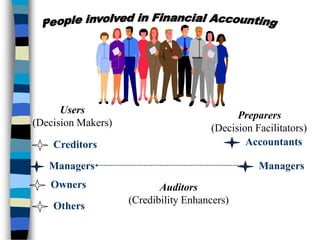
Preparers
(Decision Facilitators)
Accountants
Managers
Users
(Decision Makers)
Creditors
Owners
Others
Auditors
(Credibility Enhancers)
Managers
Branches of Accounting
Financial Accounting (Record keeping)
Cost Accounting (Price fixation &
Operating efficiency)
Management Accounting (Analysis for
decision making)
Advantages of Accounting
n Replacement of Memory
n Evidence in court
n Tax purpose
n Comparative study
n Sale of business
n Assistance to the insolvent
n For various parties
Limitations
• Records only monetary transactions
• Effect of price level changes not
considered
• No realistic information
• Personal bias of accountant affects the
accounting statements
• Permits alternative treatments (LIFO,
FIFO)
• No real test for managerial performance
• Historical in nature
Accounting Terminology
• Business: An organization created with the objective of
making a profit from the sale of goods or services.
• Book keeping: The act of systematically recording the
financial transactions affecting a business.
• Book Value: The net amount (original value plus or minus
any adjustments such as depreciation) showed in the
accounts for an asset, liability, or owners' equity item.
• Calendar Year: An entity's reporting year, covering 12
months.
• Transactions: Exchange of goods or services between
businesses or individuals. Can also be other events having an
economic impact on a business.
Accounting Terminology
• Journal: A book or original entry in a double-entry
bookkeeping system. The journal lists all transactions and
indicates the accounts to which they are posted.
• Journal Entry: A recording of a transaction where debits
equal credits.
• Ledger: A summary statement of all the transactions relating
to a person, asset, expense or income which have taken
place during a given period of time and show their net effect.
• Trial Balance: A listing of all account balances that provides
a test of whether total debits equals total credits.
• Revenues: Increases in a company's resources from the sale
of goods or services.
Accounting Terminology
• Balance sheet: A balance sheet is an itemized
statement which lists the total assets and the total
liabilities of a given business to show its net worth at a
given moment in time (like a snapshot).
• Capital: Property or money used and owned by a
business and used to acquire future income or
benefits.
• Debtor: A debtor is a person who owes money. The
amount due from his is called debt.
• Creditor: A person to whom money is owing or
payable is called a creditor.
• Credit: An entry on the right side of a ledger account.
Accounting Terminology
• Goods: This includes all articles, commodities or
merchandise in which the business deals. Thus, cloth would
be goods for a dealer in cloth; furniture would be goods for a
dealer in furniture and so on.
• Assets: Economic resources owned or controlled by a person
or company.
• Net Assets: The difference between assets and liabilities.
• Liquidity: The availability of cash or ability to obtain it quickly.
Also used to determine debt repayment ability.
• Goodwill: An intangible asset that exists when a business is
valued at more than the fair market value of its net assets.
• Interest: The cost of the use of money.
Accounting Terminology
• Current Assets: Current assets are those assets of a
company that are expected to be converted to cash, sold, or
consumed during the normal operating cycle of the business
(usually one year). Examples are cash, accounts receivable,
short-term investments, US government bonds, inventories,
and prepaid expenses.
• Current Liabilities: Liabilities to be paid within one year of
the balance sheet date.
• Drawings: Any amount or goods withdrawn by the owner of
a business for personal use is called drawings.
• Bad Debt: An uncollectible Account Receivable.
• Loss: A loss is expenditure without any benefit to the
concern. On the other hand, expense is incurred to result in
some benefit. Thus, amount spent on lighting is an expense
but loss due to fire is loss.
Accounting Terminology
• Income: It is an inflow of assets which results in an increase
in the owner’s equity.
• Expenditure: Expenditure takes place when an asset or
service is acquired. Expenditure will include both payment of
a sum immediately and a promise to pay it at a future date.
• Expense: An expenditure whose benefit is finished or enjoyed
immediately such as salaries, rent, etc.
• Turnover: It means total trading income from cash sales and
credit sales.
• Net worth: It means assets minus outside liabilities. Profits of
a business increase net worth whereas losses reduce the net
worth of a business.
• GAAP - Refer to Generally Accepted Accounting Principles.
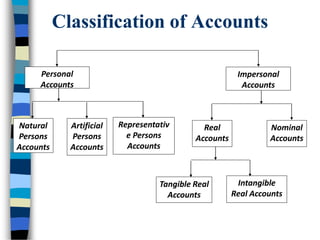
Classification of Accounts
Natural
Persons
Accounts
Personal
Accounts
Impersonal
Accounts
Artificial
Persons
Accounts
Representativ
e Persons
Accounts
Real
Accounts
Nominal
Accounts
Tangible Real
Accounts
Intangible
Real Accounts
Types of Accounts
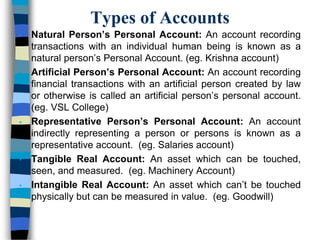
• Natural Person’s Personal Account: An account recording
transactions with an individual human being is known as a
natural person’s Personal Account. (eg. Krishna account)
• Artificial Person’s Personal Account: An account recording
financial transactions with an artificial person created by law
or otherwise is called an artificial person’s personal account.
(eg. VSL College)
• Representative Person’s Personal Account: An account
indirectly representing a person or persons is known as a
representative account. (eg. Salaries account)
• Tangible Real Account: An asset which can be touched,
seen, and measured. (eg. Machinery Account)
• Intangible Real Account: An asset which can’t be touched
physically but can be measured in value. (eg. Goodwill)
Rules of Double Entry System
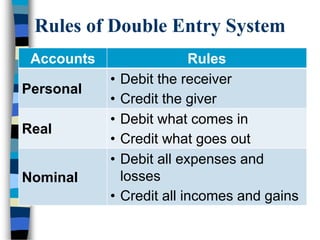
Accounts Rules
Personal
• Debit the receiver
• Credit the giver
Real
• Debit what comes in
• Credit what goes out
Nominal
• Debit all expenses and
losses
• Credit all incomes and gains
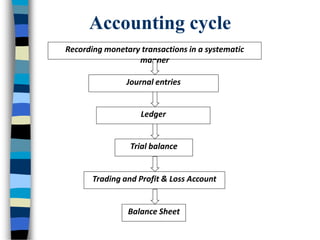
Accounting cycle
Recording monetary transactions in a systematic
manner
Journal entries
Ledger
Trial balance
Trading and Profit & Loss Account
Balance Sheet
Accounting
Concepts
The term ‘concept’ is used to
connote accounting postulates, that
is necessary assumptions and
conditions upon which accounting
is based.
These are the theories on how and
why certain categories of transactions
should be treated in a particular
manner.
Business Entity
Concept
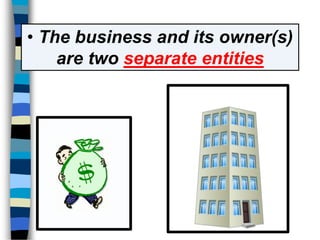
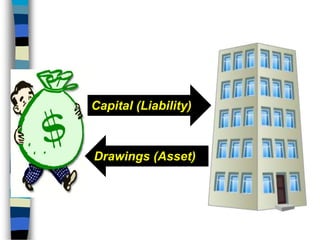
• The business and its owner(s)
are two separate entities
Hence…
The Books Of Accounts
are prepared from the
point of view of the
business
Capital (Liability)
Drawings (Asset)
The Personal Transactions of the
Owner are not recorded.
For Example:
A Car purchased by the owner for
personal use is not Recorded in the
Books Of Account Of the Business.
Going Concern
Concept
It is assumed that the entity is a
going concern, i.e., it will continue to
operate for an indefinitely long
period in future and transactions are
recorded from this point of view.
Money
Measurement
Concept
In accounting, a record is made
only of those transactions or
events which can be measured
and expressed in terms of
money.
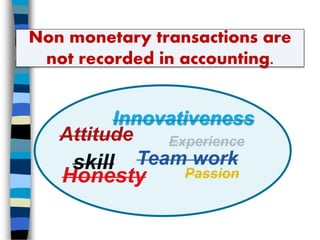
Non monetary transactions are
not recorded in accounting.
Attitude Experience
Innovativeness
Honesty
Team work
Passion
skill
Accounting
Period
Concept
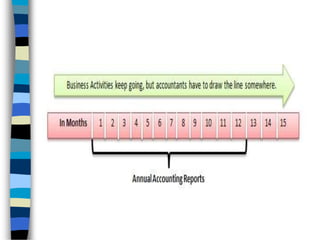
For measuring the financial
results of a business
periodically, the working life of
an undertaking is split into
convenient short periods called
accounting period.
Cost Concept
An asset acquired by a concern
is recorded in the books of
accounts at historical cost (i.e.,
at the price actually paid for
acquiring the asset). The
market price of the asset is
ignored.
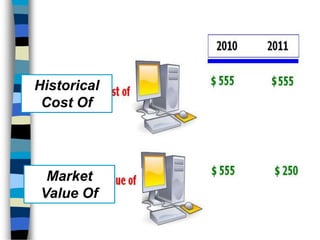
Historical
Cost Of
Market
Value Of
Dual - Aspect
Concept
For Every Debit,
there is a Credit
Every transaction should
have a two- sided effect to
the extent of same amount
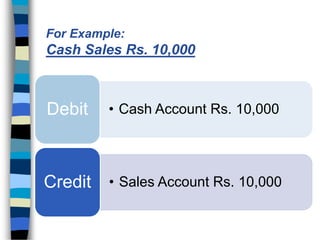
• Cash Account Rs. 10,000
Debit
• Sales Account Rs. 10,000
Credit
For Example:
Cash Sales Rs. 10,000
• Purchases Account Rs.
20,000
Debit
• Ram’s Account Rs. 18,000
• Discount Recd. Account
2,000
Credit
For Example:
Purchased From Ram goods worth Rs. 20,000
and discount received Rs. 2,000.
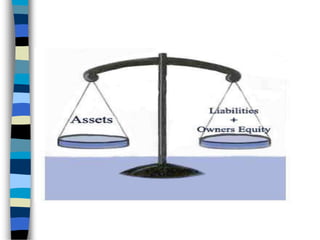
This Concept has resulted in
THE
ACCOUNTING
EQUATION
Realisation
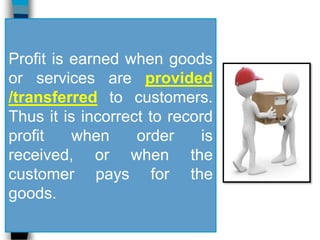
Concept
Profit is earned when goods
or services are provided
/transferred to customers.
Thus it is incorrect to record
profit when order is
received, or when the
customer pays for the
goods.
Matching
Concept
The matching principle ensures that
revenues and all their associated
expenses are recorded in the same
accounting period.
The matching principle is the basis on
which the accrual accounting method
of book- keeping is built.
For Example
Salary paid in 2012-13 relating to
2011-12
Such salary is treated as Expenditure
for 2011-12 under Outstanding
Salaries Account, not for the year
2012-13
Accounting
Conventions
Accounting Conventions are the
common practices which are
universally followed in
recording and presenting
accounting information of
business. It helps in comparing
accounting data of different
business or of same units for
different periods.
Materiality
Only those transactions,
important facts and items
are shown which are
useful and material for the
business. The firm need
not record immaterial
and insignificant items.
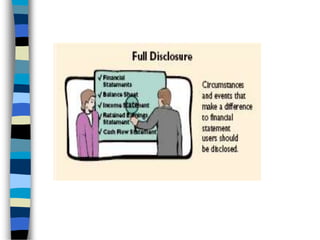
Full
Disclosure
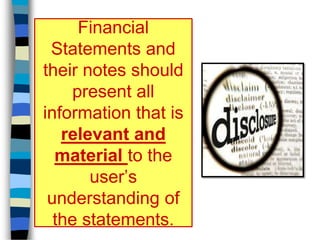
Financial
Statements and
their notes should
present all
information that is
relevant and
material to the
user’s
understanding of
the statements.

Conservatism
Anticipate No Profits
but
Provide for all Losses
Accountant should
always be on side of
safety.
For Example
• Making Provision for Bad and Doubtful
Debts
• Showing Depreciation on Fixed Assets,
but not appreciation
Consistency
The accounting practices and
methods should remain
consistent from one accounting
period to another.
Whatever accounting practice is
followed by the business
enterprise, should be followed on
a consistent basis from year to
year.
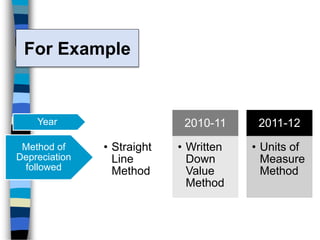
For Example
2009-10
• Straight
Line
Method
2010-11
• Written
Down
Value
Method
2011-12
• Units of
Measure
Method
Year
Method of
Depreciation
followed
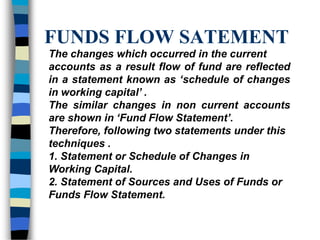
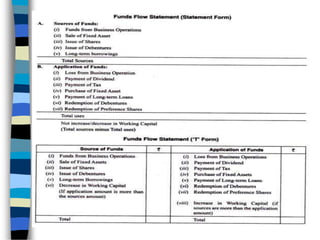
FUNDS FLOW SATEMENT
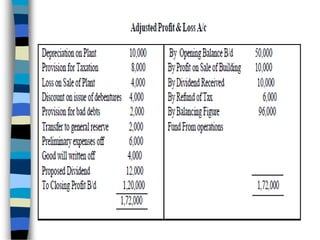
The changes which occurred in the current
accounts as a result flow of fund are reflected
in a statement known as ‘schedule of changes
in working capital’ .
The similar changes in non current accounts
are shown in ‘Fund Flow Statement’.
Therefore, following two statements under this
techniques .
1. Statement or Schedule of Changes in
Working Capital.
2. Statement of Sources and Uses of Funds or
Funds Flow Statement.
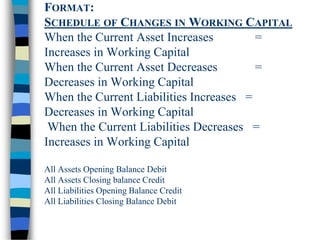
FORMAT:
SCHEDULE OF CHANGES IN WORKING CAPITAL
When the Current Asset Increases =
Increases in Working Capital
When the Current Asset Decreases =
Decreases in Working Capital
When the Current Liabilities Increases =
Decreases in Working Capital
When the Current Liabilities Decreases =
Increases in Working Capital
All Assets Opening Balance Debit
All Assets Closing balance Credit
All Liabilities Opening Balance Credit
All Liabilities Closing Balance Debit
HSB_AFM_PPT-1.ppt
HSB_AFM_PPT-1.ppt
HSB_AFM_PPT-1.ppt

HSB_AFM_PPT-1.ppt

  • 1.
    ACCOUNTING FOR BUDDING MANAGERS Dr.P. MATHURASWAMY B.Com, MBA, M.Phil, M.Com, PhD, UGC-NET
  • 2.
    Accounting n It isconcerned with the use of which the records are put, their analysis and interpretation. n It is the process of recording business activities that make changes to accounts. n Sales of products, Revenue from services earned, Buying products and/or services and so on.
  • 3.
    Attributes of Accounting Itis the art of recording business transactions. It is the art of classifying business transactions. The transactions or events of a business must be recorded in monetary terms. It is the art of summarizing financial transactions. The results should be communicated to users.
  • 4.
    Functions n Systematic recordof business transactions. n Protecting the property of business. n Communicating results to users. n Compliance with legal requirements.
  • 5.
    Users of AccountingInformation • Owners • Creditors (Suppliers) • Investors • Employees • Government • Public • Research Scholars / Agencies • Managers
  • 6.
  • 7.
    Branches of Accounting FinancialAccounting (Record keeping) Cost Accounting (Price fixation & Operating efficiency) Management Accounting (Analysis for decision making)
  • 8.
    Advantages of Accounting nReplacement of Memory n Evidence in court n Tax purpose n Comparative study n Sale of business n Assistance to the insolvent n For various parties
  • 9.
    Limitations • Records onlymonetary transactions • Effect of price level changes not considered • No realistic information • Personal bias of accountant affects the accounting statements • Permits alternative treatments (LIFO, FIFO) • No real test for managerial performance • Historical in nature
  • 10.
    Accounting Terminology • Business:An organization created with the objective of making a profit from the sale of goods or services. • Book keeping: The act of systematically recording the financial transactions affecting a business. • Book Value: The net amount (original value plus or minus any adjustments such as depreciation) showed in the accounts for an asset, liability, or owners' equity item. • Calendar Year: An entity's reporting year, covering 12 months. • Transactions: Exchange of goods or services between businesses or individuals. Can also be other events having an economic impact on a business.
  • 11.
    Accounting Terminology • Journal:A book or original entry in a double-entry bookkeeping system. The journal lists all transactions and indicates the accounts to which they are posted. • Journal Entry: A recording of a transaction where debits equal credits. • Ledger: A summary statement of all the transactions relating to a person, asset, expense or income which have taken place during a given period of time and show their net effect. • Trial Balance: A listing of all account balances that provides a test of whether total debits equals total credits. • Revenues: Increases in a company's resources from the sale of goods or services.
  • 12.
    Accounting Terminology • Balancesheet: A balance sheet is an itemized statement which lists the total assets and the total liabilities of a given business to show its net worth at a given moment in time (like a snapshot). • Capital: Property or money used and owned by a business and used to acquire future income or benefits. • Debtor: A debtor is a person who owes money. The amount due from his is called debt. • Creditor: A person to whom money is owing or payable is called a creditor. • Credit: An entry on the right side of a ledger account.
  • 13.
    Accounting Terminology • Goods:This includes all articles, commodities or merchandise in which the business deals. Thus, cloth would be goods for a dealer in cloth; furniture would be goods for a dealer in furniture and so on. • Assets: Economic resources owned or controlled by a person or company. • Net Assets: The difference between assets and liabilities. • Liquidity: The availability of cash or ability to obtain it quickly. Also used to determine debt repayment ability. • Goodwill: An intangible asset that exists when a business is valued at more than the fair market value of its net assets. • Interest: The cost of the use of money.
  • 14.
    Accounting Terminology • CurrentAssets: Current assets are those assets of a company that are expected to be converted to cash, sold, or consumed during the normal operating cycle of the business (usually one year). Examples are cash, accounts receivable, short-term investments, US government bonds, inventories, and prepaid expenses. • Current Liabilities: Liabilities to be paid within one year of the balance sheet date. • Drawings: Any amount or goods withdrawn by the owner of a business for personal use is called drawings. • Bad Debt: An uncollectible Account Receivable. • Loss: A loss is expenditure without any benefit to the concern. On the other hand, expense is incurred to result in some benefit. Thus, amount spent on lighting is an expense but loss due to fire is loss.
  • 15.
    Accounting Terminology • Income:It is an inflow of assets which results in an increase in the owner’s equity. • Expenditure: Expenditure takes place when an asset or service is acquired. Expenditure will include both payment of a sum immediately and a promise to pay it at a future date. • Expense: An expenditure whose benefit is finished or enjoyed immediately such as salaries, rent, etc. • Turnover: It means total trading income from cash sales and credit sales. • Net worth: It means assets minus outside liabilities. Profits of a business increase net worth whereas losses reduce the net worth of a business. • GAAP - Refer to Generally Accepted Accounting Principles.
  • 16.
    Classification of Accounts Natural Persons Accounts Personal Accounts Impersonal Accounts Artificial Persons Accounts Representativ ePersons Accounts Real Accounts Nominal Accounts Tangible Real Accounts Intangible Real Accounts
  • 17.
    Types of Accounts •Natural Person’s Personal Account: An account recording transactions with an individual human being is known as a natural person’s Personal Account. (eg. Krishna account) • Artificial Person’s Personal Account: An account recording financial transactions with an artificial person created by law or otherwise is called an artificial person’s personal account. (eg. VSL College) • Representative Person’s Personal Account: An account indirectly representing a person or persons is known as a representative account. (eg. Salaries account) • Tangible Real Account: An asset which can be touched, seen, and measured. (eg. Machinery Account) • Intangible Real Account: An asset which can’t be touched physically but can be measured in value. (eg. Goodwill)
  • 18.
    Rules of DoubleEntry System Accounts Rules Personal • Debit the receiver • Credit the giver Real • Debit what comes in • Credit what goes out Nominal • Debit all expenses and losses • Credit all incomes and gains
  • 19.
    Accounting cycle Recording monetarytransactions in a systematic manner Journal entries Ledger Trial balance Trading and Profit & Loss Account Balance Sheet
  • 20.
  • 21.
    The term ‘concept’is used to connote accounting postulates, that is necessary assumptions and conditions upon which accounting is based. These are the theories on how and why certain categories of transactions should be treated in a particular manner.
  • 22.
  • 23.
    • The businessand its owner(s) are two separate entities
  • 24.
    Hence… The Books OfAccounts are prepared from the point of view of the business
  • 25.
  • 26.
    The Personal Transactionsof the Owner are not recorded. For Example: A Car purchased by the owner for personal use is not Recorded in the Books Of Account Of the Business.
  • 27.
  • 28.
    It is assumedthat the entity is a going concern, i.e., it will continue to operate for an indefinitely long period in future and transactions are recorded from this point of view.
  • 29.
  • 30.
    In accounting, arecord is made only of those transactions or events which can be measured and expressed in terms of money.
  • 31.
    Non monetary transactionsare not recorded in accounting. Attitude Experience Innovativeness Honesty Team work Passion skill
  • 32.
  • 33.
    For measuring thefinancial results of a business periodically, the working life of an undertaking is split into convenient short periods called accounting period.
  • 35.
  • 36.
    An asset acquiredby a concern is recorded in the books of accounts at historical cost (i.e., at the price actually paid for acquiring the asset). The market price of the asset is ignored.
  • 37.
  • 38.
  • 39.
    For Every Debit, thereis a Credit Every transaction should have a two- sided effect to the extent of same amount
  • 40.
    • Cash AccountRs. 10,000 Debit • Sales Account Rs. 10,000 Credit For Example: Cash Sales Rs. 10,000
  • 41.
    • Purchases AccountRs. 20,000 Debit • Ram’s Account Rs. 18,000 • Discount Recd. Account 2,000 Credit For Example: Purchased From Ram goods worth Rs. 20,000 and discount received Rs. 2,000.
  • 42.
    This Concept hasresulted in THE ACCOUNTING EQUATION
  • 44.
  • 45.
    Profit is earnedwhen goods or services are provided /transferred to customers. Thus it is incorrect to record profit when order is received, or when the customer pays for the goods.
  • 46.
  • 47.
    The matching principleensures that revenues and all their associated expenses are recorded in the same accounting period. The matching principle is the basis on which the accrual accounting method of book- keeping is built.
  • 48.
    For Example Salary paidin 2012-13 relating to 2011-12 Such salary is treated as Expenditure for 2011-12 under Outstanding Salaries Account, not for the year 2012-13
  • 49.
  • 50.
    Accounting Conventions arethe common practices which are universally followed in recording and presenting accounting information of business. It helps in comparing accounting data of different business or of same units for different periods.
  • 51.
  • 52.
    Only those transactions, importantfacts and items are shown which are useful and material for the business. The firm need not record immaterial and insignificant items.
  • 53.
  • 54.
    Financial Statements and their notesshould present all information that is relevant and material to the user’s understanding of the statements.
  • 56.
  • 57.
    Anticipate No Profits but Providefor all Losses Accountant should always be on side of safety.
  • 58.
    For Example • MakingProvision for Bad and Doubtful Debts • Showing Depreciation on Fixed Assets, but not appreciation
  • 59.
  • 60.
    The accounting practicesand methods should remain consistent from one accounting period to another. Whatever accounting practice is followed by the business enterprise, should be followed on a consistent basis from year to year.
  • 61.
    For Example 2009-10 • Straight Line Method 2010-11 •Written Down Value Method 2011-12 • Units of Measure Method Year Method of Depreciation followed
  • 62.
    FUNDS FLOW SATEMENT Thechanges which occurred in the current accounts as a result flow of fund are reflected in a statement known as ‘schedule of changes in working capital’ . The similar changes in non current accounts are shown in ‘Fund Flow Statement’. Therefore, following two statements under this techniques . 1. Statement or Schedule of Changes in Working Capital. 2. Statement of Sources and Uses of Funds or Funds Flow Statement.
  • 63.
    FORMAT: SCHEDULE OF CHANGESIN WORKING CAPITAL When the Current Asset Increases = Increases in Working Capital When the Current Asset Decreases = Decreases in Working Capital When the Current Liabilities Increases = Decreases in Working Capital When the Current Liabilities Decreases = Increases in Working Capital All Assets Opening Balance Debit All Assets Closing balance Credit All Liabilities Opening Balance Credit All Liabilities Closing Balance Debit