Payment
Goods or Services
WHATIS A BUSINESS TRANSACTION?
• The economic activity of exchange of goods or services in exchange for
money or moneys worth is called as transaction.
• The entity that carries out transaction is called as a Business.
Buyer
Seller
3.
IMPORTANT TERMINOLOGIES
• Proprietor/Owner: The person who commences a business and undertakes
the risk of carrying out the various business transaction.
• Capital: The initial money contributed the owner or proprietor to start a
business.
• Drawings: The money withdrawn by the owner for personal use.
• Assets: The resources needed by a business to function effectively.
• Liability: The obligations of a business are called as liabilities.
• Sales:The exchange of a product or service for money.
• Purchase: The acquisition of a product or service for money.
4.
IMPORTANT TERMINOLOGIES
• Revenue:The income received by a firm from its business activities are called
as revenue.
• Expenses: The cost incurred by a firm due to its business activities is called as
expenses.
• Profit: When revenue is more than a firm's expenses, the condition is called as
profit.
• Loss: When expenses of a firm is more than its income, the condition is called
as loss.
5.
ACCOUNTING - DEFINITION
Accountsis the art & science of recording, classifying and
summarizing transactions in a business
• Art – Presentation matters in accounts
• Science – Has definite laws & principles
6.
ACCOUNTING - DEFINITION
Theart of recording, classifying, and summarizing in a significant manner
and in terms of money, transactions and events which are, in part at least,
of financial character, and interpreting the results thereof’.
- American Institute of Certified Public Accountants (AICPA)
'The process of identifying, measuring and communicating
economic information to permit informed judgments and
decisions by users of information’.
- American Accounting Association (AAA)
7.
ACCOUNTING - OBJECTIVES
Whydoes a business need accounting?
• Systematic record of transactions.
• Determine profitability based on incomes and expenses.
• Determine financial position in terms of assets and liabilities.
8.
ACCOUNTING - HISTORY
•Evolution traced 7,000 yeas back to Mesopotamia civilization.
• In India, Chanakya wrote ‘Arthashasthra’ with details of books of account.
• Roman Empire developed account audit systems.
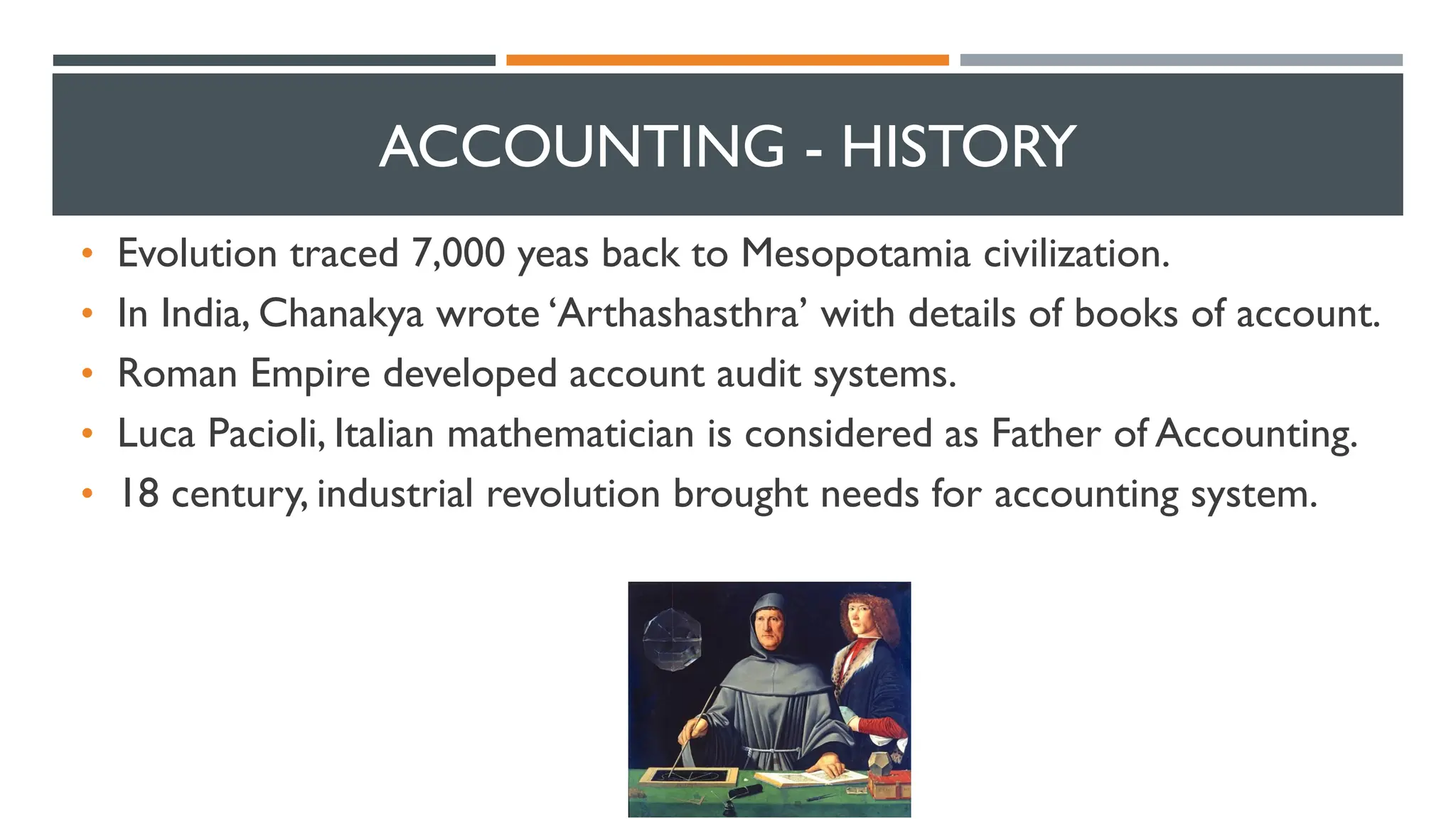
• Luca Pacioli, Italian mathematician is considered as Father of Accounting.
• 18 century, industrial revolution brought needs for accounting system.
9.
ACCOUNTING – BRANCHESOF ACCOUNTING
• Deals with preparing books of Accounts
• Chartered Accountant
Financial Accounting
• Study of cost & methods to reduce them
• Cost Accountant
Cost Accounting
• Analyzing account information to take meaningful business decisions
• Management Accountant
Management Accounting
USERS OF ACCOUNTINGINFORMATION
• Located within an organization
• Have access to extensive information
• Employees, directors, top management etc.
Internal Users
• Located outside an organization
• Have access to limited information
• E.g. Government, creditors etc.
External Users
12.
LIMITATIONS OF ACCOUNTING
•Records only monetary transactions.
• Historical in nature.
• No global practices or policies in place.
• Limited scope for future assessments.
• Requires a qualified professional.
13.
ACCOUNTING SYSTEMS
Single EntrySystem Double Entry System
Considers only one effect of the transaction Considers both effects of the transactions
Unscientific system of accounting Scientific system of accounting
Incomplete system of accounting Complete system of accounting
Used by small traders and firms Used by large firms
Does not need a qualified, dedicated
resource
Need a qualified and dedicated resources
14.
ACCOUNTING EQUATION
• Basicprinciple of accounting.
• Foundation of double-entry system of accounting.
• Forms the fundamental element of the balance sheet.
Total Assets = Capital +Total Liabilities
For a company, it can be rewritten as:
Total Assets = Share holders' equity +Total Liabilities
ACCOUNTING EQUATION –TOTAL LIABILITIES
• Total of all the obligations of the business.
Total Liabilities = LongTerm Liabilities + Current Liabilities
• Long term Liabilities :
– Obligations of a company that are due more than one year in the future.
– Obligation amount is higher.
– Example: Debenture, Loan etc.
• Current Liabilities:
– Short-term liabilities of a business which are expected to be settled
within a timer period less than 12 months.
– Example: Bank overdraft, short term loan etc.
17.
ACCOUNTING EQUATION –CAPITAL
• Total of all the resources of the business used for carrying out its activities.
Shareholders Equity = Share Capital + Retained Earnings
• Share Capital:
– Resources contributed in return for the ownership of business.
• Retained Earnings:
– Portion of the profit kept aside for reinvestment into business.
18.
• Total resourcesowned by a company used for carrying out its activity and
could be converted into cash.
• Fixed Assets:
– Assets that are likely to be used for long period of time.
– Cannot be converted into cash quickly.
– Example: Land, Machinery etc.
• Current Assets:
– Assets that are consumed within a short period of time.
– Can be converted to cash quickly.
– Example: Stock, Debtors etc.
ACCOUNTING EQUATION – ASSETS
Total Assets = Fixed Assets + Current Assets
19.
ACCOUNTING EQUATION
• Mr.ABC started a business by contributing Rs 1,20,000. The business now
has a total assets of Rs 5,50,000. Calculate the liabilities of the firm.
• If the assets of a firm is Rs 3,40,000 and the liabilities are Rs 2,10,000 how
much would the capital amount be?
20.
ACCOUNTING PROCESS
The systematicprocess of Recording, Classifying and Summarizing
transactions in a business
Transaction
• Journals
Recording
• Ledgers
Classifying
• Final Accounts
Summarizing
21.
ACCOUNTING EQUATION –RECORDING
• First step in the accounting process.
• Recorded irrespective of the nature or type.
• Transactions are recorded chronologically.
• Recorded into books of accounts called as Journals.
• Journals are ‘Primary books of Accounts’.
• Process of writing transaction into journals is called as
Journalizing.
22.
ACCOUNTING EQUATION –CLASSIFYING
• Second step in the accounting process.
• Transactions are grouped based on its nature and type.
• Similar transactions are grouped and rewritten.
• Rewritten into books of accounts called as Ledgers.
• Ledgers are Secondary books of Accounts.
• Process of transferring transactions from Journals to Ledgers is
called as Posting.
23.
ACCOUNTING EQUATION –SUMMARISING
• Final step in the accounting process.
• Outcome of the transactions are determined.
• Profit position and Financial position of the business is estimated.
• Estimated by preparing the Final accounts of business.
ACCOUNTING PRINCIPLES
• Accountingprinciples are the rules and guidelines that companies
must follow when reporting financial data.
• Financial Accounting Standards Board (FASB) issues a
standardized set of accounting principles is referred to as
generally accepted accounting principles (GAAP).
26.
GENERALLY ACCEPTED ACCOUNTINGPRINCIPLES
• Common set of accounting principles, standards and procedures.
• Companies must follow while preparing books of accounts &
financial statements.
• Indian Accounting Standard is referred to as Ind-AS.
• Issued by Accounting Standards Board (ASB) of Institute of
Chartered Accountants of India (ICAI).
• Comprises of ‘Accounting Concepts’ and ‘Accounting
Conventions’.
ACCOUNTING CONCEPTS
• Accountingconcepts are the fundamental accounting
assumptions.
• Provides a foundation for preparation of books of accounts.
29.
ACCOUNTING CONCEPTS
• BusinessEntity Concept: The concept assumes that the business
enterprise is independent of its owners.
• Money Measurement Concept: As per this concept, only those
transaction which can be expressed in monetary terms are
recorded in the books of accounts.
• Cost concept: This concept holds that all the assets of the
enterprise are recorded in the accounts at their purchase price
30.
ACCOUNTING CONCEPTS
• GoingConcern Concept: The concept assumes that the business
will have a perpetual existence, i.e. it will continue its operations
for an indefinite period.
• Dual Aspect Concept: It is the primary rule of accounting, which
states that every transaction has two effects, and both need to be
accounted.
• Realization Concept: As per this concept, revenue should be
recorded by the firm only when it is realized.
31.
ACCOUNTING CONCEPTS
• AccrualConcept: Expenses should be recognized when they
become due for payment.
• Accounting Period Concept: The concept says that financial
statement should be prepared for every period, i.e. at the end of
the financial year.
• Matching Concept: The concept holds that, the revenue for the
period, should match the expenses.
ACCOUNTING CONVENTIONS
• Accountingconventions are the methods and procedures which
have universal acceptance.
• To be followed by the firm during the preparation of financial
statement.
34.
ACCOUNTING CONVENTIONS
• Consistency:Financial statements can be compared only when
the accounting policies are followed consistently by the firm over
the period. However, changes can be made only in special
circumstances.
• Disclosure: This principle state that the financial statement should
be prepared in such a way that it fairly discloses all the material
information to the users, to help them in taking a rational
decision.
35.
ACCOUNTING CONVENTIONS
• Materiality:This concept is an exception to the full disclosure
convention which states that only those items to be disclosed in
the financial statement which has a significant economic effect.
• Conservatism: This convention states that the firm should not
anticipate incomes and gains but provide for all expenses and
losses.
36.
GENERALLY ACCEPTED ACCOUNTINGPRINCIPLES
• Common set of accounting principles, standards and procedures.
• Companies must follow while preparing books of accounts &
financial statements.
• Indian Accounting Standard is referred to as Ind-AS.
• Issued by Accounting Standards Board (ASB) of Institute of
Chartered Accountants of India (ICAI).
• Comprises of ‘Accounting Concepts’ and ‘Accounting
Conventions’.
DOCUMENTS IN ACCOUNTING
•Cash Memo
• Invoice and Bill
• Receipt
• Pay in Slip
• Cheque
• Debit Note
• Credit Note
• Vouchers
39.
CASH MEMO
• Cashmemo is a source document in which all transactions pertaining
to cash sales or purchases are to be recorded.
• When goods are purchased by a business enterprise on cash basis
then the firm receives cash memo and when a business enterprise
sells goods, it gives cash memo, in which all details of the transaction
relating to the purchase or sales viz. number or quantity
purchased/sold, price, discount received or allowed and sales tax
collected or deposited are provided.
• On the basis of cash memos, these transactions are then recorded in
the book of accounts.
INVOICE AND BILL
•Invoice or bill records the credit transactions related to sale or purchase.
This is prepared when a firm purchases or sells the goods on credit.
• At the time, when the goods are sold by the business enterprise on credit,
sales invoice is prepared in which all details of the credit sales viz. the
quantity, rate and total amount etc. are mentioned.
• Similarly, when goods are purchased on credit, the supplier prepares the
invoice in duplicate. When the main copy is received by the purchaser, it
becomes a bill.
• Usually, invoices are made in duplicate, the main copy (original) is sent to
the purchaser and the another is kept by the business enterprise for
record and future reference.
RECEIPT
Receipt isan evidence of making the payment on account of any
business transaction. This source document is prepared for showing
the proof of giving any cash to the party (who receives the cash) on
account of any business transaction. At least two copies are made of
any receipt.
The original copy is prepared for giving it to the party who makes the
payment and another copy is kept for record.
The details about the business transaction on account of which the
cash is received viz. date, amount, name of the party and the nature of
payment etc. are given in this source document.
PAY IN SLIP
•This document serves the purpose of providing an evidence that on
particular date, a specific amount has been deposited in the bank.
• When a depositor deposits money in the bank account, he fills up a form
provided by the bank containing the information about the date, amount
to be deposited and the name of the depositor etc.
• The bank clerk signs, stamps the counterfoil of the pay in slip and returns
it to the depositor.
• The counterfoil of the pay in slip becomes a source document, which acts
as an evidence for the customer to record this transaction in the books
of accounts.
CHEQUE
• A chequeis an unconditional order, drawn upon a specified banker, signed
by the maker, directing the banker to pay on demand a certain sum of
money only to the order of a person or the bearer of the instrument. -
Negotiable Instruments Act, 1881
• A cheque is an instrument drawn upon a banker and payable on demand.
The bank issues a booklet containing cheque forms to its account holders.
Digits mentioned on the bottom of the cheques denote code of ‘State’,
‘Bank’,‘Branch’,‘Cheque’ and ‘Type of Account’ respectively
DEBIT NOTE
• Adebit note is a document which shows that the business
enterprise has raised debit against the party to whom this
document is sent in respect of any business transaction other
than the credit sale.
• Business enterprise may make a debit note against the supplier
for an amount which is to be recovered from him, when the
business enterprise returns some goods which are defective in
nature or not as per specifications.
CREDIT NOTE
• Acredit note is a document which shows that the business
enterprise has given the credit to the party to whom this document
is sent in respect of any business transaction other than credit
purchase.
• When a business enterprise receives back the goods sold earlier
then it makes a credit note in favour of the purchaser showing that
his account has been credited in the books of business enterprise.
VOUCHERS
The documentsprepared for the purpose of recording business
transactions in the books of accounts are known as vouchers. Voucher is
prepared on the basis of source documents.
For recording business transactions in the books of accounts, source
documents are further analyzed and conclusion is drawn as to which
account is to be debited and which account is to be credited. The
document on which this conclusion is written is known as voucher or
accounting voucher.
54.
VOUCHERS
A. Cash Vouchers:Cash Vouchers are vouchers that are prepared at the time of receipt or
payment of cash. It also includes receipt and payment through cheque. Cash Vouchers are of two
types:
(i) Credit Vouchers: Credit Vouchers are vouchers that are prepared at the time when cash is
received. Cash may be received when:
Goods are sold
Sale of assets or investments etc.
(ii) Debit Vouchers: Debit Vouchers are vouchers that are prepared when payment is made.
Payment may be on account of expenses, purchases, drawing of the proprietor, payment to
creditor etc.
B. Non-CashVouchers (Transfer Vouchers): Non-cash Vouchers are
vouchers prepared for the transitions that do not involve in flow or out
flow of cash.
For example, Debit Note, Credit Note, Bills etc. These are prepares when
transitions such as credit sales, credit purchase etc are to be recorded.