Visual Acuity
By :
Ritwan Bin Tapeng
MA Berpengalaman
Sept/12
DEFINITON
• The resolving power of the eye used to
assess and quantify the eye’s ability to
resolve varying letter sizes
• Visual acuity is dependent on:
– The refractive error of the eye
– The health and the integrity of the eye
– The test targets used
– The test conditions
• The measurement of VA is done to monitor change in vision
with disease progression of disease and/or treatment plan
• It is a way to measure “blur” vision
• Visual acuity must be measured on every patient at every
visit!
Measurement
• Distance visual acuity (DVA)
• 20ft or 6M is equivalent to optical infinity
• Near visual acuity (NVA)
• 40cm
Standard Test Distances
Optotypes for measuring visual
acuity
In a clinical practice it is common to
use Optotype cards
An optotype card is formed by rows of optotypes
of progressively smaller sizes.
They are designed to be presented at a fixed
distance and on one side they usually show the
visual acuity value belonging to each row.
Optotypes for measuring visual
acuity
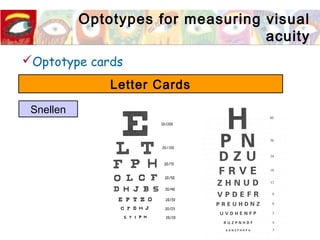
Optotype cards
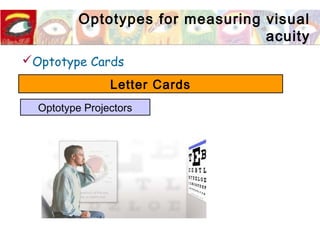
Letter Cards
Snellen
Optotypes for measuring visual
acuity
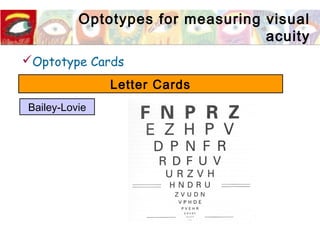
Optotype Cards
Letter Cards
Bailey-Lovie
Optotype Cards
Letter Cards
Optotype Projectors
Optotypes for measuring visual
acuity
Optotype Cards
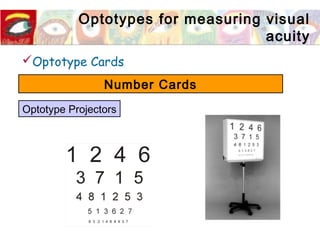
Number Cards
Optotype Projectors
Optotypes for measuring visual
acuity
Optotypes for measuring visual
acuity
Optotype Cards
One Character Optotype Cards
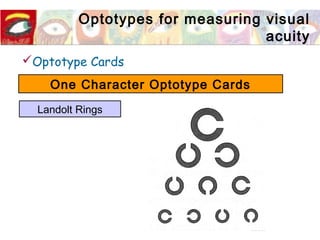
Landolt Rings
Optotypes for measuring visual
acuity
Optotype Cards
One Character Optotype Cards
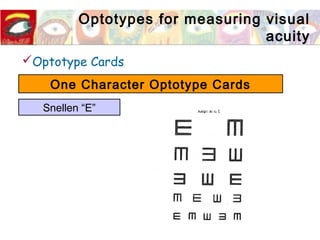
Snellen “E”
Optotypes for measuring visual
acuity
Optotype Cards
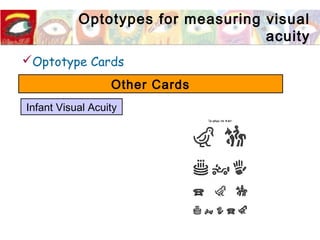
Other Cards
Infant Visual Acuity
Factors that affect Visual Acuity
 Refractive error
 Size of the pupil
 Illumination
 Time exposure of target
 Area of retina stimulated
 State of adaptation of the eye
 Eye movements

Visual acuity

  • 1.
    Visual Acuity By : RitwanBin Tapeng MA Berpengalaman Sept/12
  • 2.
    DEFINITON • The resolvingpower of the eye used to assess and quantify the eye’s ability to resolve varying letter sizes • Visual acuity is dependent on: – The refractive error of the eye – The health and the integrity of the eye – The test targets used – The test conditions
  • 3.
    • The measurementof VA is done to monitor change in vision with disease progression of disease and/or treatment plan • It is a way to measure “blur” vision • Visual acuity must be measured on every patient at every visit! Measurement
  • 4.
    • Distance visualacuity (DVA) • 20ft or 6M is equivalent to optical infinity • Near visual acuity (NVA) • 40cm Standard Test Distances
  • 5.
    Optotypes for measuringvisual acuity In a clinical practice it is common to use Optotype cards An optotype card is formed by rows of optotypes of progressively smaller sizes. They are designed to be presented at a fixed distance and on one side they usually show the visual acuity value belonging to each row.
  • 6.
    Optotypes for measuringvisual acuity Optotype cards Letter Cards Snellen
  • 7.
    Optotypes for measuringvisual acuity Optotype Cards Letter Cards Bailey-Lovie
  • 8.
    Optotype Cards Letter Cards OptotypeProjectors Optotypes for measuring visual acuity
  • 9.
    Optotype Cards Number Cards OptotypeProjectors Optotypes for measuring visual acuity
  • 10.
    Optotypes for measuringvisual acuity Optotype Cards One Character Optotype Cards Landolt Rings
  • 11.
    Optotypes for measuringvisual acuity Optotype Cards One Character Optotype Cards Snellen “E”
  • 12.
    Optotypes for measuringvisual acuity Optotype Cards Other Cards Infant Visual Acuity
  • 13.
    Factors that affectVisual Acuity  Refractive error  Size of the pupil  Illumination  Time exposure of target  Area of retina stimulated  State of adaptation of the eye  Eye movements

Editor's Notes

  • #2 In this theme we introduce the concept of visual acuity. Then we go on to look at the different tasks of visual discrimination which cause the different kinds of visual acuity that exist. Then we will examine the different scales of visual acuity and the different optotypes used to measure visual acuity. We end by looking at the factors that affect visual acuity.
  • #6 In optometric and ophthalmic practices standardized optotype cards are used in order to measure the visual acuity of the patients. In reality one optotype, made up of only one letter would be sufficient to measure the visual acuity of the observer, if the letter was progressively moved away from the observer. In this way the angle of the minimum detail would change. However, this method is not comfortable or efficient in a clinic and as a result, optotype cards formed by lines of optotypes or letters of progressively smaller sizes, which represent various concrete values of angles to resolve, or the visual acuity. These cards are designed to be observed from a fixed distance. Each line presents a visual acuity that corresponds to it whether in decimal, Snellen or LogMAR notation.
  • #7 In this and subsequent slides we show the most commonly used optotype cards in daily clinical practices. Among these, the most frequent are those containing black letters as optotypes, represented on a white background. In addition, it is important to remember that depending on the type of letter used, the acuity measurements may slightly change. Also, the separation between the letters can be an influence and this must be kept in mind during design. In 1862 Snellen designed an optotype card with letter sizes of 5 minutes of arc and details of 1 minute. The different rows of the card are calculated so that they also subtend 5 minutes but at progressively smaller distances (60, 36, 24, 18, 12, 9, 6, 5 m etc…). In general, one more letter appears in each subsequent row, keeping a constant separation between rows. The letters used in these optotypes have a simple stroke. In the slide there are two cards of this type formed by letters and on them the Snellen Acuity is used. On the left, the notation corresponding to an observation distance of 20 feet is used, while on the right the distance is in meters and the rows subtend angles of 5’. In this case the numeric value that appears on the card correspond to the distance d in Snellen notation and the distance d’ is 6.
  • #8 In 1976 Bailey and Lovie developed the LogMAR Visual Acuity (Logarithm of the minimum angle of resolution). In this card, the spaces between the lines are proportional to the size of the letters, and the number of letters that there are in each row is the same. The space from one row to the other is proportional to the size of the letters, and the number of letters that appear in each row are the same. The space from one row to the other is of one logarithmic unit, which is to say, the increments are 0.1 (VA MAR =LogMAR).
  • #9 The optotypes that we have talked about up to now have to be well lighted in order to provide an adequate measurement of visual acuity. Normally halogen lights are used. An alternative to using this type of optotype is using self illuminated optotypes, which are mounted on an illuminated platform that already provides a sufficient level of lighting which means they do not need an external lamp (see figure) or optotype projectors where, as implied by the name, the optotypes are projected
  • #10 Other than the letter cards that were previously mentioned, there are also cards with numbers, as can be seen in this slide.
  • #11 In this kind of card only one type of optotype with different orientations is represented. In this case the rows also have a different size, as in the Snellen test. In the current slide we can see an optotype formed by Landolt rings, which was designed in 1889 by Landolt. The rings have an opening with different orientations, which the observer should be able to detect.
  • #12 Snellen E’s are also used as optotypes. In this case the letter E is used in four possible orientations, up, down, left and right.
  • #13 Finally, there are also optotypes that use drawings, which are necessary and useful for measuring visual acuity in infants. They are able to get the childrens attention besides being useful for anyone who doesn’t know how to read.
  • #14 Factors that influence the measurement of visual acuity can be classified into two basic groups: Physical factors (related with the observation conditions used to measure visual acuity) and internal factors (related to the ocular optics of the observer).