Content Centric Networking
SOK Phearin
MBC Laboratory,
Konkuk University, Seoul
Content
   Overview of CCN

   CCN Architecture

   CCN Operation

   References
Content Centric Networking
   A new approach to networking that

       enables networks to self-organize and push relevant
        content where needed at anywhere, anytime, and
        with any devices

       makes the name and attributes of content the
        principle objects upon which the network acts

       Focus on dissemination of information, not on the
        maintenance of network connections
Content Centric Networking
   Confidentiality, Availability, and Integrity (CIA)
    of data

   CCN stores mappings between names and
    data items

   Data replication and movement throughout the
    CCN to increase efficiency and provide
    resiliency to network failures and attacks
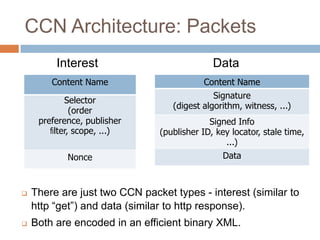
CCN Architecture: Packets
         Interest                            Data
        Content Name                      Content Name
                                             Signature
             Selector
                                  (digest algorithm, witness, ...)
               (order
     preference, publisher                  Signed Info
        filter, scope, ...)    (publisher ID, key locator, stale time,
                                                ...)
            Nonce                               Data


   There are just two CCN packet types - interest (similar to
    http “get”) and data (similar to http response).
   Both are encoded in an efficient binary XML.
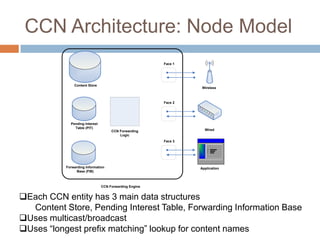
CCN Architecture: Node Model
                                                        Face 1


               Content Store
                                                                  Wireless


                                                        Face 2


             Pending Interest
               Table (PIT)
                                     CCN Forwarding                Wired
                                         Logic
                                                        Face 3


           Forwarding Information                                Application
                Base (FIB)


                                CCN Forwarding Engine


Each CCN entity has 3 main data structures
  Content Store, Pending Interest Table, Forwarding Information Base
Uses multicast/broadcast
Uses “longest prefix matching” lookup for content names
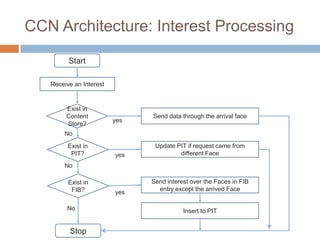
CCN Architecture: Interest Processing

         Start

   Receive an Interest


        Exist in
        Content                Send data through the arrival face
                         yes
        Store?
       No
         Exist in               Update PIT if request came from
          PIT?           yes            different Face
       No

         Exist in              Send interest over the Faces in FIB
          FIB?                   entry except the arrived Face
                         yes

        No                                Insert to PIT


         Stop
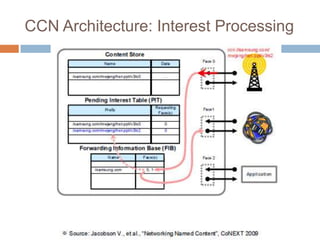
CCN Architecture: Interest Processing
CCN Operation
CCN Operation
CCN Operation
CCN Operation
CCN Operation
CCN Operation
CCN Operation
CCN Operation

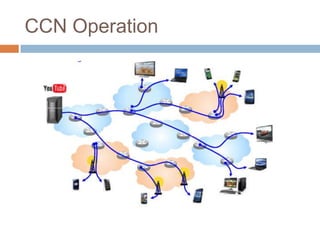
             Content goes only where there’s
              interest.

             It takes at most one trip across
              any link.


             Average latency is minimized.

             Total bandwidth is minimized.

             There’s no routing or control traffic
              associated with the replicas.
Reference
   http://www.ccnx.org

   http://www.named-data.net
Thank You!

Content centric networking

  • 1.
    Content Centric Networking SOKPhearin MBC Laboratory, Konkuk University, Seoul
  • 2.
    Content  Overview of CCN  CCN Architecture  CCN Operation  References
  • 3.
    Content Centric Networking  A new approach to networking that  enables networks to self-organize and push relevant content where needed at anywhere, anytime, and with any devices  makes the name and attributes of content the principle objects upon which the network acts  Focus on dissemination of information, not on the maintenance of network connections
  • 4.
    Content Centric Networking  Confidentiality, Availability, and Integrity (CIA) of data  CCN stores mappings between names and data items  Data replication and movement throughout the CCN to increase efficiency and provide resiliency to network failures and attacks
  • 5.
    CCN Architecture: Packets Interest Data Content Name Content Name Signature Selector (digest algorithm, witness, ...) (order preference, publisher Signed Info filter, scope, ...) (publisher ID, key locator, stale time, ...) Nonce Data  There are just two CCN packet types - interest (similar to http “get”) and data (similar to http response).  Both are encoded in an efficient binary XML.
  • 6.
    CCN Architecture: NodeModel Face 1 Content Store Wireless Face 2 Pending Interest Table (PIT) CCN Forwarding Wired Logic Face 3 Forwarding Information Application Base (FIB) CCN Forwarding Engine Each CCN entity has 3 main data structures Content Store, Pending Interest Table, Forwarding Information Base Uses multicast/broadcast Uses “longest prefix matching” lookup for content names
  • 7.
    CCN Architecture: InterestProcessing Start Receive an Interest Exist in Content Send data through the arrival face yes Store? No Exist in Update PIT if request came from PIT? yes different Face No Exist in Send interest over the Faces in FIB FIB? entry except the arrived Face yes No Insert to PIT Stop
  • 8.
  • 9.
  • 10.
  • 11.
  • 12.
  • 13.
  • 14.
  • 15.
  • 16.
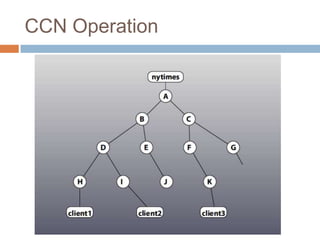
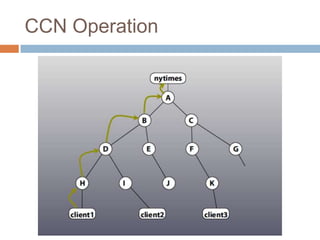
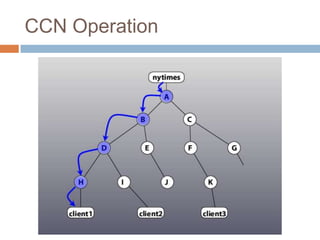
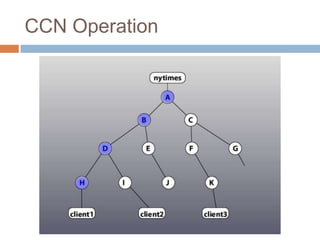
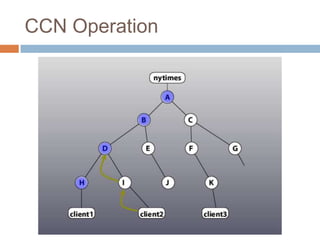
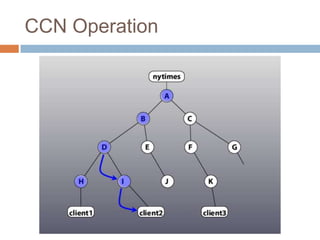
    CCN Operation  Content goes only where there’s interest.  It takes at most one trip across any link.  Average latency is minimized.  Total bandwidth is minimized.  There’s no routing or control traffic associated with the replicas.
  • 17.
    Reference  http://www.ccnx.org  http://www.named-data.net
  • 18.

Editor's Notes

  • #4 Self-organize: *Self-configuration - 'plug-and-play' paradigm - new base stations shall automatically be configured and integrated into the network - both connectivity establishment, and download of configuration parameters and software. *Self-optimization – BS parameters can be regularly adjusted, based on both base station and mobile station observations. - establishes neighbor relations (ANR) automatically*Self-healing - When some nodes becomes inoperative, self-healing mechanisms aims at reducing the impacts from the failure - by adjusting parameters and algorithms in adjacent cells so that other nodes can support the users that were supported by the failing node