Centralized Application Configuration 
with Spring and Apache ZooKeeper 
By Ryan Gardner, Dealer.com 
© 2014 SpringOne 2GX. All rights reserved. Do not distribute without permission.
How do you configure your applications? 
2 
http://b.socrative.com/login/student/ 
config2gx
Who is Dealer.com? 
We make software that car dealers use 
to fulfill their digital marketing vision. 
3
The Remote Configuration Project 
4
Some ways we had configured our applications 
• Hardcoded values in code 
• Properties file – per environment or merged 
• Host files for database 
• JNDI context files 
5
Motivating factors 
• Developer Efficiency 
• Redeploying an application just to change a configuration is a drag 
• Having to edit N config files whenever a single application changed is a 
hassle 
• Security Compliance 
• Limit access to production databases 
• Auditing and approval process for configuration changes 
• Systems Engineering 
• Can’t make certain changes without involving developers 
6
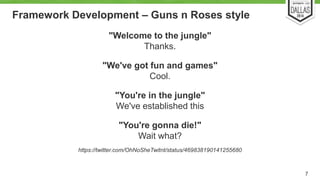
Framework Development – Guns n Roses style 
"Welcome to the jungle" 
Thanks. 
"We've got fun and games" 
Cool. 
"You're in the jungle" 
We've established this 
"You're gonna die!" 
Wait what? 
https://twitter.com/OhNoSheTwitnt/status/469838190141255680 
7
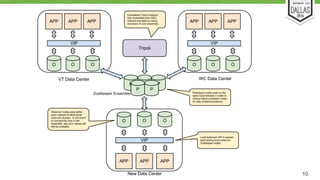
High Level Overview 
8
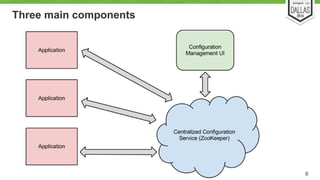
Three main components 
9
10
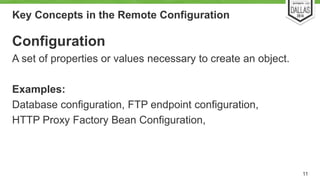
Key Concepts in the Remote Configuration 
Configuration 
A set of properties or values necessary to create an object. 
Examples: 
Database configuration, FTP endpoint configuration, 
HTTP Proxy Factory Bean Configuration, 
11
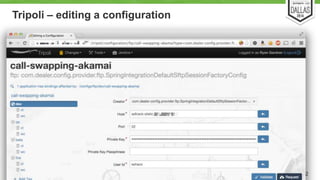
Tripoli – editing a configuration 
12
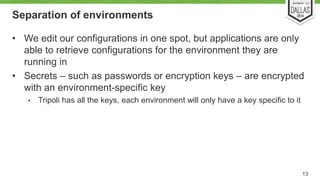
Separation of environments 
• We edit our configurations in one spot, but applications are only 
able to retrieve configurations for the environment they are 
running in 
• Secrets – such as passwords or encryption keys – are encrypted 
with an environment-specific key 
• Tripoli has all the keys, each environment will only have a key specific to it 
13
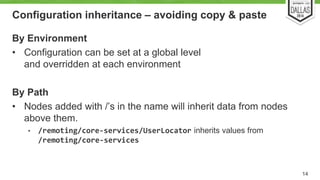
Configuration inheritance – avoiding copy & paste 
By Environment 
• Configuration can be set at a global level 
and overridden at each environment 
By Path 
• Nodes added with /’s in the name will inherit data from nodes 
above them. 
• /remoting/core-services/UserLocator inherits values from 
/remoting/core-services 
14
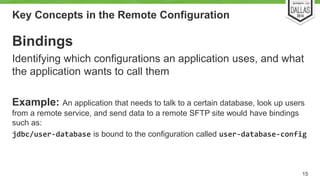
Key Concepts in the Remote Configuration 
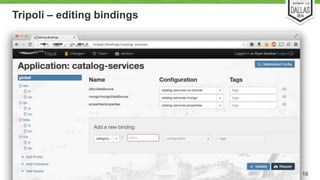
Bindings 
Identifying which configurations an application uses, and what 
the application wants to call them 
Example: An application that needs to talk to a certain database, look up users 
from a remote service, and send data to a remote SFTP site would have bindings 
such as: 
jdbc/user-database is bound to the configuration called user-database-config 
15
Tripoli – editing bindings 
16
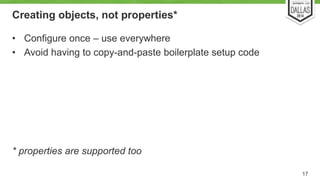
Creating objects, not properties* 
• Configure once – use everywhere 
• Avoid having to copy-and-paste boilerplate setup code 
* properties are supported too 
17
Behind the Scenes 
18
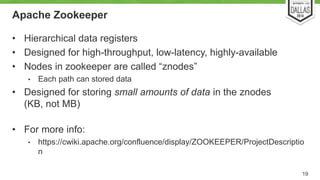
Apache Zookeeper 
• Hierarchical data registers 
• Designed for high-throughput, low-latency, highly-available 
• Nodes in zookeeper are called “znodes” 
• Each path can stored data 
• Designed for storing small amounts of data in the znodes 
(KB, not MB) 
• For more info: 
• https://cwiki.apache.org/confluence/display/ZOOKEEPER/ProjectDescriptio 
n 
19
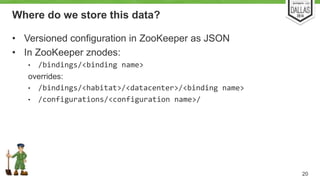
Where do we store this data? 
20 
• Versioned configuration in ZooKeeper as JSON 
• In ZooKeeper znodes: 
• /bindings/<binding name> 
overrides: 
• /bindings/<habitat>/<datacenter>/<binding name> 
• /configurations/<configuration name>/
Talking to ZooKeeper 
• Use Curator framework 
• We use ACLs in ZooKeeper ensure apps can’t read data for 
other environments 
• We use a SASL config file on the machines to provide the 
ZooKeeper credentials 
21
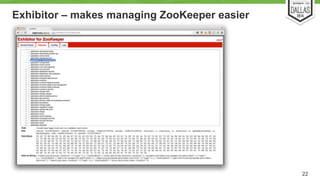
Exhibitor – makes managing ZooKeeper easier 
22
How do the objects get created? 
• Two classes for each remotely-configurable object, 
the config and the creator 
• Configs use bean-validation annotations and a special annotation 
on the config-field to explain what the config field does. 
• This populates the tool-tips in the browser window and is used to ensure 
that only valid entries are put into the fields 
23
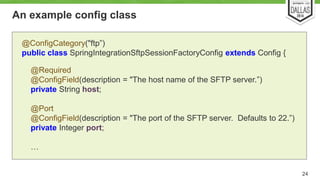
An example config class 
24 
@ConfigCategory("ftp”) 
public class SpringIntegrationSftpSessionFactoryConfig extends Config { 
@Required 
@ConfigField(description = "The host name of the SFTP server.”) 
private String host; 
@Port 
@ConfigField(description = "The port of the SFTP server. Defaults to 22.”) 
private Integer port; 
…
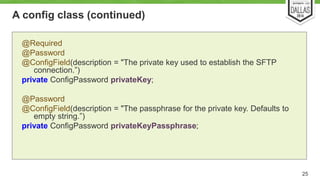
A config class (continued) 
25 
@Required 
@Password 
@ConfigField(description = "The private key used to establish the SFTP 
connection.”) 
private ConfigPassword privateKey; 
@Password 
@ConfigField(description = "The passphrase for the private key. Defaults to 
empty string.”) 
private ConfigPassword privateKeyPassphrase;
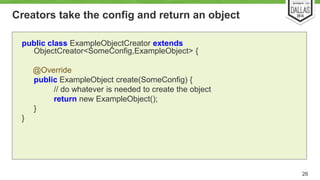
Creators take the config and return an object 
26 
public class ExampleObjectCreator extends 
ObjectCreator<SomeConfig,ExampleObject> { 
@Override 
public ExampleObject create(SomeConfig) { 
// do whatever is needed to create the object 
return new ExampleObject(); 
} 
}
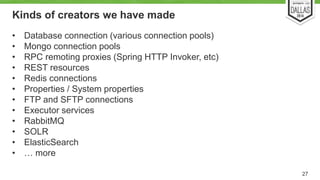
Kinds of creators we have made 
• Database connection (various connection pools) 
• Mongo connection pools 
• RPC remoting proxies (Spring HTTP Invoker, etc) 
• REST resources 
• Redis connections 
• Properties / System properties 
• FTP and SFTP connections 
• Executor services 
• RabbitMQ 
• SOLR 
• ElasticSearch 
• … more 
27
How do apps use this? 
28
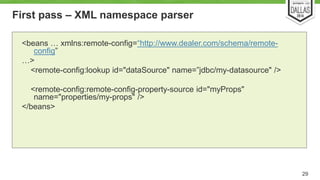
First pass – XML namespace parser 
29 
<beans … xmlns:remote-config=“http://www.dealer.com/schema/remote-config” 
…> 
<remote-config:lookup id="dataSource" name=”jdbc/my-datasource" /> 
<remote-config:remote-config-property-source id="myProps" 
name="properties/my-props" /> 
</beans>
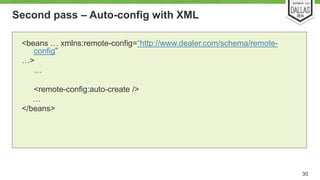
Second pass – Auto-config with XML 
30 
<beans … xmlns:remote-config=“http://www.dealer.com/schema/remote-config” 
…> 
… 
<remote-config:auto-create /> 
… 
</beans>
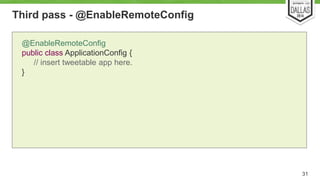
Third pass - @EnableRemoteConfig 
31 
@EnableRemoteConfig 
public class ApplicationConfig { 
// insert tweetable app here. 
}
Accessing properties 
32
Integrating remote properties into spring 
• We create a PropertySource 
• And we create a PropertySourcesPlaceholderConfigurer 
33
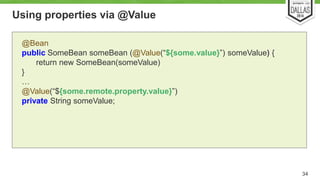
Using properties via @Value 
34 
@Bean 
public SomeBean someBean (@Value(“${some.value}”) someValue) { 
return new SomeBean(someValue) 
} 
… 
@Value(“${some.remote.property.value}”) 
private String someValue;
Deeper dive – demo & 
look at some of the code 
35
Future plans & extensions for this 
36
Questions? 
37
38 
Learn More. Stay Connected 
Tweet: “#s2gx talk about zookeeper blew my mind! 
Thanks @ryebrye and @springcentral” 
@springcentral | spring.io/video

Centralized Application Configuration with Spring and Apache Zookeeper

  • 1.
    Centralized Application Configuration with Spring and Apache ZooKeeper By Ryan Gardner, Dealer.com © 2014 SpringOne 2GX. All rights reserved. Do not distribute without permission.
  • 2.
    How do youconfigure your applications? 2 http://b.socrative.com/login/student/ config2gx
  • 3.
    Who is Dealer.com? We make software that car dealers use to fulfill their digital marketing vision. 3
  • 4.
  • 5.
    Some ways wehad configured our applications • Hardcoded values in code • Properties file – per environment or merged • Host files for database • JNDI context files 5
  • 6.
    Motivating factors •Developer Efficiency • Redeploying an application just to change a configuration is a drag • Having to edit N config files whenever a single application changed is a hassle • Security Compliance • Limit access to production databases • Auditing and approval process for configuration changes • Systems Engineering • Can’t make certain changes without involving developers 6
  • 7.
    Framework Development –Guns n Roses style "Welcome to the jungle" Thanks. "We've got fun and games" Cool. "You're in the jungle" We've established this "You're gonna die!" Wait what? https://twitter.com/OhNoSheTwitnt/status/469838190141255680 7
  • 8.
  • 9.
  • 10.
  • 11.
    Key Concepts inthe Remote Configuration Configuration A set of properties or values necessary to create an object. Examples: Database configuration, FTP endpoint configuration, HTTP Proxy Factory Bean Configuration, 11
  • 12.
    Tripoli – editinga configuration 12
  • 13.
    Separation of environments • We edit our configurations in one spot, but applications are only able to retrieve configurations for the environment they are running in • Secrets – such as passwords or encryption keys – are encrypted with an environment-specific key • Tripoli has all the keys, each environment will only have a key specific to it 13
  • 14.
    Configuration inheritance –avoiding copy & paste By Environment • Configuration can be set at a global level and overridden at each environment By Path • Nodes added with /’s in the name will inherit data from nodes above them. • /remoting/core-services/UserLocator inherits values from /remoting/core-services 14
  • 15.
    Key Concepts inthe Remote Configuration Bindings Identifying which configurations an application uses, and what the application wants to call them Example: An application that needs to talk to a certain database, look up users from a remote service, and send data to a remote SFTP site would have bindings such as: jdbc/user-database is bound to the configuration called user-database-config 15
  • 16.
  • 17.
    Creating objects, notproperties* • Configure once – use everywhere • Avoid having to copy-and-paste boilerplate setup code * properties are supported too 17
  • 18.
  • 19.
    Apache Zookeeper •Hierarchical data registers • Designed for high-throughput, low-latency, highly-available • Nodes in zookeeper are called “znodes” • Each path can stored data • Designed for storing small amounts of data in the znodes (KB, not MB) • For more info: • https://cwiki.apache.org/confluence/display/ZOOKEEPER/ProjectDescriptio n 19
  • 20.
    Where do westore this data? 20 • Versioned configuration in ZooKeeper as JSON • In ZooKeeper znodes: • /bindings/<binding name> overrides: • /bindings/<habitat>/<datacenter>/<binding name> • /configurations/<configuration name>/
  • 21.
    Talking to ZooKeeper • Use Curator framework • We use ACLs in ZooKeeper ensure apps can’t read data for other environments • We use a SASL config file on the machines to provide the ZooKeeper credentials 21
  • 22.
    Exhibitor – makesmanaging ZooKeeper easier 22
  • 23.
    How do theobjects get created? • Two classes for each remotely-configurable object, the config and the creator • Configs use bean-validation annotations and a special annotation on the config-field to explain what the config field does. • This populates the tool-tips in the browser window and is used to ensure that only valid entries are put into the fields 23
  • 24.
    An example configclass 24 @ConfigCategory("ftp”) public class SpringIntegrationSftpSessionFactoryConfig extends Config { @Required @ConfigField(description = "The host name of the SFTP server.”) private String host; @Port @ConfigField(description = "The port of the SFTP server. Defaults to 22.”) private Integer port; …
  • 25.
    A config class(continued) 25 @Required @Password @ConfigField(description = "The private key used to establish the SFTP connection.”) private ConfigPassword privateKey; @Password @ConfigField(description = "The passphrase for the private key. Defaults to empty string.”) private ConfigPassword privateKeyPassphrase;
  • 26.
    Creators take theconfig and return an object 26 public class ExampleObjectCreator extends ObjectCreator<SomeConfig,ExampleObject> { @Override public ExampleObject create(SomeConfig) { // do whatever is needed to create the object return new ExampleObject(); } }
  • 27.
    Kinds of creatorswe have made • Database connection (various connection pools) • Mongo connection pools • RPC remoting proxies (Spring HTTP Invoker, etc) • REST resources • Redis connections • Properties / System properties • FTP and SFTP connections • Executor services • RabbitMQ • SOLR • ElasticSearch • … more 27
  • 28.
    How do appsuse this? 28
  • 29.
    First pass –XML namespace parser 29 <beans … xmlns:remote-config=“http://www.dealer.com/schema/remote-config” …> <remote-config:lookup id="dataSource" name=”jdbc/my-datasource" /> <remote-config:remote-config-property-source id="myProps" name="properties/my-props" /> </beans>
  • 30.
    Second pass –Auto-config with XML 30 <beans … xmlns:remote-config=“http://www.dealer.com/schema/remote-config” …> … <remote-config:auto-create /> … </beans>
  • 31.
    Third pass -@EnableRemoteConfig 31 @EnableRemoteConfig public class ApplicationConfig { // insert tweetable app here. }
  • 32.
  • 33.
    Integrating remote propertiesinto spring • We create a PropertySource • And we create a PropertySourcesPlaceholderConfigurer 33
  • 34.
    Using properties via@Value 34 @Bean public SomeBean someBean (@Value(“${some.value}”) someValue) { return new SomeBean(someValue) } … @Value(“${some.remote.property.value}”) private String someValue;
  • 35.
    Deeper dive –demo & look at some of the code 35
  • 36.
    Future plans &extensions for this 36
  • 37.
  • 38.
    38 Learn More.Stay Connected Tweet: “#s2gx talk about zookeeper blew my mind! Thanks @ryebrye and @springcentral” @springcentral | spring.io/video

Editor's Notes

  • #4 Websites Advertising Inventory management Analytics CRM (and more)
  • #5 There is a slide shown at the keynotes -
  • #8 There are often surprises as you develop things – you think you are on the right path but then… wooops.
  • #18 How many people have ever started a project, realized they needed a certain data source – so they went to another project that they had opened and then copied the configuration out of it and pasted it into the new one.
  • #21 Apache Zookeeper. Good project. Horible logo. “ZooKeeper is a centralized service for maintaining configuration information, naming, providing distributed synchronization, and providing group services. “
  • #31 Simplify cruft – eliminate duplicate entry… but… still XML
  • #32 We can now create tweetable apps that run in any of our environments and use the proper datasources or service endpoints for that environment.
  • #34 Transparently use @Value annotated properties in your classes.
  • #36 Look at property sources configurer. Point out bean definitions vs beans. Look at a creator or two.