Developing distributed applications
with Akka and Akka Cluster
Presented by K.Tsykulenko
Introduction
Agenda
• What is Akka?
• Concurrency paradigms overview.
• Actors and actor model.
• Live demo #1.
• Akka remoting and clustering.
• Live demo #2.
• CRDTs and Akka Distributed Data.
• Live demo #3.
• Summary.
• Q&A.
What is Akka?
http://akka.io
Akka is a toolkit and runtime for building highly
concurrent, distributed, and fault tolerant event-driven
applications on the JVM.
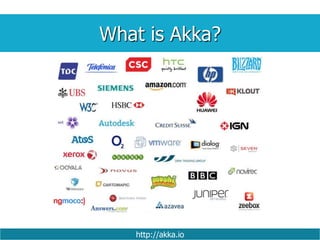
What is Akka?
http://akka.io
Concurrency paradigms
• Shared state and locks
• Software Transactional Memory (STM)
• Message-Passing Concurrency (Actors)
• Dataflow Concurrency
• and more…
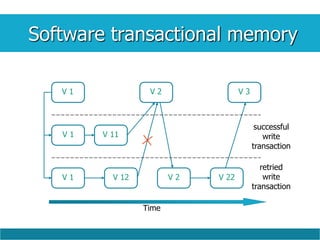
Software transactional memory
V 1 V 2
V 1 V 12
V 11
V 3
V 2 V 22
successful
write
transaction
retried
write
transaction
V 1
Time
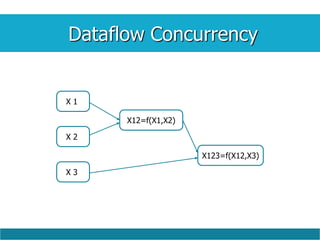
Dataflow Concurrency
X 1
X12=f(X1,X2)
X123=f(X12,X3)
X 2
X 3
Actors
Actors
• Originate in a 1973 paper by Carl Hewitt
• Implemented in Erlang
• Encapsulate state and behavior
• Closer to the definition of OO than classes
Actors
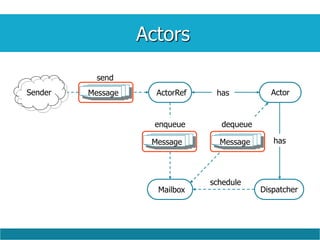
Sender ActorRef Actor
Dispatcher
hasMessageMessage
Message
Mailbox
has
enqueue dequeue
schedule
send
Actors
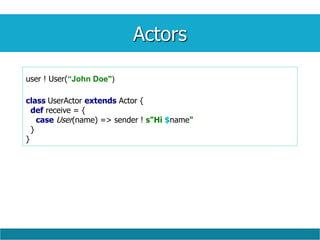
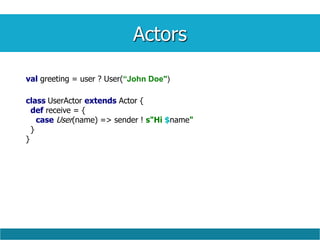
user ! User(“John Doe")
class UserActor extends Actor {
def receive = {
case User(name) => sender ! s"Hi $name"
}
}
Actors
val greeting = user ? User(“John Doe")
class UserActor extends Actor {
def receive = {
case User(name) => sender ! s"Hi $name"
}
}
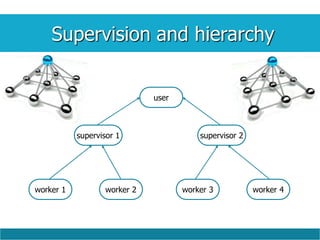
Supervision and hierarchy
worker 1 worker 2 worker 3 worker 4
supervisor 1 supervisor 2
user
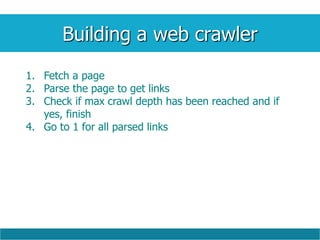
Building a web crawler
1. Fetch a page
2. Parse the page to get links
3. Check if max crawl depth has been reached and if
yes, finish
4. Go to 1 for all parsed links
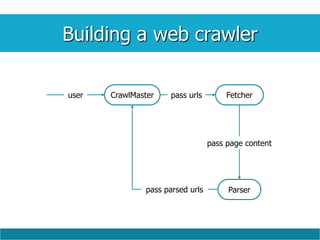
Building a web crawler
Parser
CrawlMasteruser Fetcherpass urls
pass page content
pass parsed urls
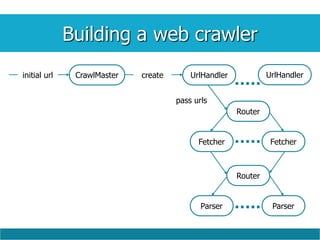
Building a web crawler
Router
pass urls
CrawlMasterinitial url UrlHandlercreate UrlHandler
Fetcher Fetcher
Router
Parser Parser
Building a web crawler
class FetcherActor(val parser: ActorRef) extends Actor with ActorLogging {
import context.dispatcher
val pipeline: HttpRequest => Future[HttpResponse] = sendReceive
override def receive: Receive = {
case Url(link, depth) => pipeline(Get(link)).map(…).pipeTo(parser)
}
}
Building a web crawler
class ParserActor extends Actor with ActorLogging with HtmlParser {
override def receive: Receive = {
case UrlContents(Url(link, depth), resp, requester) =>
val links = parseHtml(resp)
.map(l => if (l.matches("^[/#].*")) link + l else l)
.filter(l => Try(new Url(l)).isSuccess
links.foreach(requester ! Url(_, depth + 1))
}
}
Building a web crawler
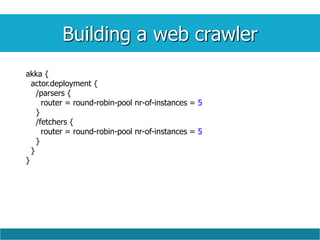
akka {
actor.deployment {
/parsers {
router = round-robin-pool nr-of-instances = 5
}
/fetchers {
router = round-robin-pool nr-of-instances = 5
}
}
}
Live demo #1
Going remote
• Everything works using asynchronous message
passing which is good for remoting
• Akka-remoting allows working with remote actors
just as if they were in the same JVM
• Still need to handle additional issues like
serialization and handling potential networking
problems
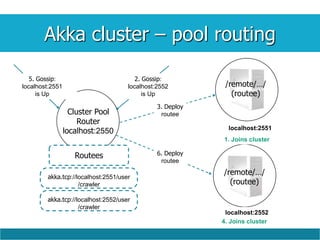
Akka cluster – pool routing
akka.tcp://localhost:2551/user
/crawler
Routees
akka.tcp://localhost:2552/user
/crawler
Cluster Pool
Router
localhost:2550
5. Gossip:
localhost:2551
is Up
2. Gossip:
localhost:2552
is Up
6. Deploy
routee
3. Deploy
routee
localhost:2551
localhost:2552
1. Joins cluster
4. Joins cluster
/remote/…/
(routee)
/remote/…/
(routee)
1. Joins cluster
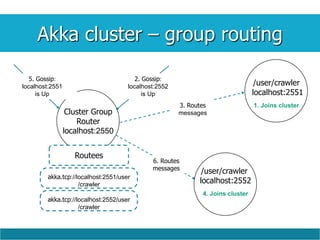
Akka cluster – group routing
akka.tcp://localhost:2551/user
/crawler
Routees
akka.tcp://localhost:2552/user
/crawler
Cluster Group
Router
localhost:2550
5. Gossip:
localhost:2551
is Up
2. Gossip:
localhost:2552
is Up
6. Routes
messages
3. Routes
messages
/user/crawler
localhost:2551
4. Joins cluster
/user/crawler
localhost:2552
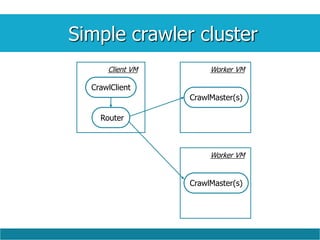
Simple crawler cluster
Client VM
CrawlClient
Router
Worker VM
CrawlMaster(s)
Worker VM
CrawlMaster(s)
Going remote
cluster {
seed-nodes = [
"akka.tcp://CrawlerSystem@127.0.0.1:2551",
"akka.tcp://CrawlerSystem@127.0.0.1:2552"]
auto-down-unreachable-after = 10s
role {
client.min-nr-of-members = 1
backend.min-nr-of-members = 2
}
}
Going remote
actor {
deployment {
/workerRouter {
router = consistent-hashing-group
nr-of-instances = 100
routees.paths = ["/user/master"]
cluster {
enabled = on
allow-local-routees = on
use-role = backend
}
}
}
provider = "akka.cluster.ClusterActorRefProvider“
}
Live demo #2
Distributed state
Distributed state
But what if we need to?
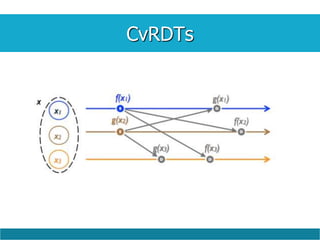
CRDTs
• Good performance and scalability, the cost is
eventual consistency
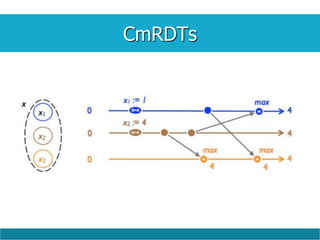
• Two main classes: operation based and state based
CmRDTs
CvRDTs
Live demo #3
Summary
• Actor model provides a concurrency paradigm that
is easier to reason about than traditional Java
concurrency
• Designing actor systems is a lot like OO
• You can easily make your actor systems distributed
and have referential transparency… to an extent
• Akka has many useful modules, like Akka
distributed data, which allows to manage
distributed state
• Try to build your own application and see how it
works for you
References
• http://akka.io/
• http://www.allthingsdistributed.com/files/amazon-
dynamo-sosp2007.pdf
• https://vimeo.com/43903960
Q&A
Thank you!
Konstantin Tsykulenko
@Tsykulenko_K

Developing distributed applications with Akka and Akka Cluster

  • 1.
    Developing distributed applications withAkka and Akka Cluster Presented by K.Tsykulenko
  • 2.
  • 3.
    Agenda • What isAkka? • Concurrency paradigms overview. • Actors and actor model. • Live demo #1. • Akka remoting and clustering. • Live demo #2. • CRDTs and Akka Distributed Data. • Live demo #3. • Summary. • Q&A.
  • 4.
    What is Akka? http://akka.io Akkais a toolkit and runtime for building highly concurrent, distributed, and fault tolerant event-driven applications on the JVM.
  • 5.
  • 6.
  • 7.
    Concurrency paradigms • Sharedstate and locks • Software Transactional Memory (STM) • Message-Passing Concurrency (Actors) • Dataflow Concurrency • and more…
  • 8.
    Software transactional memory V1 V 2 V 1 V 12 V 11 V 3 V 2 V 22 successful write transaction retried write transaction V 1 Time
  • 9.
  • 10.
  • 11.
    Actors • Originate ina 1973 paper by Carl Hewitt • Implemented in Erlang • Encapsulate state and behavior • Closer to the definition of OO than classes
  • 12.
  • 13.
    Actors user ! User(“JohnDoe") class UserActor extends Actor { def receive = { case User(name) => sender ! s"Hi $name" } }
  • 14.
    Actors val greeting =user ? User(“John Doe") class UserActor extends Actor { def receive = { case User(name) => sender ! s"Hi $name" } }
  • 15.
    Supervision and hierarchy worker1 worker 2 worker 3 worker 4 supervisor 1 supervisor 2 user
  • 16.
    Building a webcrawler 1. Fetch a page 2. Parse the page to get links 3. Check if max crawl depth has been reached and if yes, finish 4. Go to 1 for all parsed links
  • 17.
    Building a webcrawler Parser CrawlMasteruser Fetcherpass urls pass page content pass parsed urls
  • 18.
    Building a webcrawler Router pass urls CrawlMasterinitial url UrlHandlercreate UrlHandler Fetcher Fetcher Router Parser Parser
  • 19.
    Building a webcrawler class FetcherActor(val parser: ActorRef) extends Actor with ActorLogging { import context.dispatcher val pipeline: HttpRequest => Future[HttpResponse] = sendReceive override def receive: Receive = { case Url(link, depth) => pipeline(Get(link)).map(…).pipeTo(parser) } }
  • 20.
    Building a webcrawler class ParserActor extends Actor with ActorLogging with HtmlParser { override def receive: Receive = { case UrlContents(Url(link, depth), resp, requester) => val links = parseHtml(resp) .map(l => if (l.matches("^[/#].*")) link + l else l) .filter(l => Try(new Url(l)).isSuccess links.foreach(requester ! Url(_, depth + 1)) } }
  • 21.
    Building a webcrawler akka { actor.deployment { /parsers { router = round-robin-pool nr-of-instances = 5 } /fetchers { router = round-robin-pool nr-of-instances = 5 } } }
  • 22.
  • 23.
    Going remote • Everythingworks using asynchronous message passing which is good for remoting • Akka-remoting allows working with remote actors just as if they were in the same JVM • Still need to handle additional issues like serialization and handling potential networking problems
  • 24.
    Akka cluster –pool routing akka.tcp://localhost:2551/user /crawler Routees akka.tcp://localhost:2552/user /crawler Cluster Pool Router localhost:2550 5. Gossip: localhost:2551 is Up 2. Gossip: localhost:2552 is Up 6. Deploy routee 3. Deploy routee localhost:2551 localhost:2552 1. Joins cluster 4. Joins cluster /remote/…/ (routee) /remote/…/ (routee)
  • 25.
    1. Joins cluster Akkacluster – group routing akka.tcp://localhost:2551/user /crawler Routees akka.tcp://localhost:2552/user /crawler Cluster Group Router localhost:2550 5. Gossip: localhost:2551 is Up 2. Gossip: localhost:2552 is Up 6. Routes messages 3. Routes messages /user/crawler localhost:2551 4. Joins cluster /user/crawler localhost:2552
  • 26.
    Simple crawler cluster ClientVM CrawlClient Router Worker VM CrawlMaster(s) Worker VM CrawlMaster(s)
  • 27.
    Going remote cluster { seed-nodes= [ "akka.tcp://CrawlerSystem@127.0.0.1:2551", "akka.tcp://CrawlerSystem@127.0.0.1:2552"] auto-down-unreachable-after = 10s role { client.min-nr-of-members = 1 backend.min-nr-of-members = 2 } }
  • 28.
    Going remote actor { deployment{ /workerRouter { router = consistent-hashing-group nr-of-instances = 100 routees.paths = ["/user/master"] cluster { enabled = on allow-local-routees = on use-role = backend } } } provider = "akka.cluster.ClusterActorRefProvider“ }
  • 29.
  • 30.
  • 31.
  • 32.
    But what ifwe need to?
  • 33.
    CRDTs • Good performanceand scalability, the cost is eventual consistency • Two main classes: operation based and state based
  • 34.
  • 35.
  • 36.
  • 37.
    Summary • Actor modelprovides a concurrency paradigm that is easier to reason about than traditional Java concurrency • Designing actor systems is a lot like OO • You can easily make your actor systems distributed and have referential transparency… to an extent • Akka has many useful modules, like Akka distributed data, which allows to manage distributed state • Try to build your own application and see how it works for you
  • 38.
  • 39.
  • 40.