APACHE ZOOKEEPER
Viet-Dung TRINH (Bill), 03/2016
Saltlux – Vietnam Development Center
Agenda
•  Overview
•  The ZooKeeper Service
•  The ZooKeeper Data Model
•  Recipes
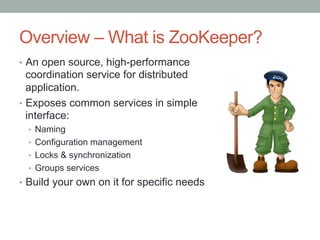
Overview – What is ZooKeeper?
•  An open source, high-performance
coordination service for distributed
application.
•  Exposes common services in simple
interface:
•  Naming
•  Configuration management
•  Locks & synchronization
•  Groups services
•  Build your own on it for specific needs
Overview – Who uses ZooKeeper?
•  Companies:
•  Yahoo!
•  Zynga
•  Rackspace
•  Linkedlin
•  Netflix, and many more…
•  Projects:
•  Apache Map/Reduce (Yarn)
•  Apache HBase
•  Apache Kafka
•  Apache Storm
•  Neo4j, and many more…
Overview – ZooKeeper Use Cases
•  Configuration Management
•  Cluster member nodes bootstrapping configuration from a
centralized source in unattended way
•  Distributed Cluster Management
•  Node join / leave
•  Node statuses in real time
•  Naming service – e.g. DNS
•  Distributed synchronization – locks, barriers, queues
•  Leader election in a distributed system
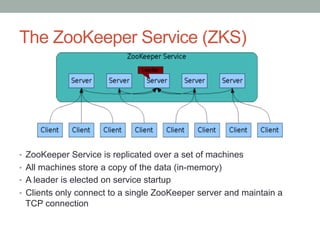
The ZooKeeper Service (ZKS)
•  ZooKeeper Service is replicated over a set of machines
•  All machines store a copy of the data (in-memory)
•  A leader is elected on service startup
•  Clients only connect to a single ZooKeeper server and maintain a
TCP connection
The ZKS - Sessions
•  Before executing any request, client must establish a
session with service
•  All operations client summits to service are associated to
a session
•  Client initially connects to any server in ensemble, and
only to single server.
•  Session offer order guarantees – requests in session are
executed in FIFO order
The ZKS – Session States and Lifetime
•  Main possible states: CONNECTING, CONNECTED,
CLOSED, NOT_CONNECTED
The ZooKeeper Data Model (ZDM)
•  Hierarchal name space
•  Each node is called as a ZNode
•  Every ZNode has data (given as byte[])
and can optionally have children
•  ZNode paths:
•  Canonical, absolute, slash-separated
•  No relative references
•  Names can have Unicode characters
•  ZNode maintain stat structure
ZDM - Versions
•  Eash Znode has version number, is incremented every
time its data changes
•  setData and delete take version as input, operation
succeeds only if client’s version is equal to server’s one
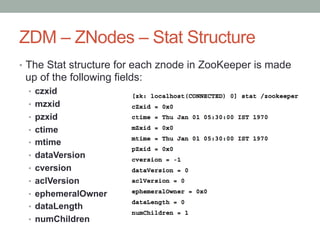
ZDM – ZNodes – Stat Structure
•  The Stat structure for each znode in ZooKeeper is made
up of the following fields:
•  czxid
•  mzxid
•  pzxid
•  ctime
•  mtime
•  dataVersion
•  cversion
•  aclVersion
•  ephemeralOwner
•  dataLength
•  numChildren
ZDM – Types of ZNode
•  Persistent ZNode
•  Have lifetime in ZooKeeper’s namespace until they’re explicitly
deleted (can be deleted by delete API call)
•  Ephemeral ZNode
•  Is deleted by ZooKeeper service when the creating client’s session
ends
•  Can also be explicitly deleted
•  Are not allowed to have children
•  Sequential Znode
•  Is assigned a sequence number by ZooKeeper as a part of name
during creation
•  Sequence number is integer (4bytes) with format of 10 digits with 0
padding. E.g. /path/to/znode-0000000001
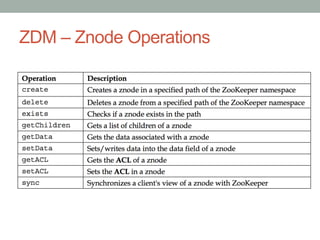
ZDM – Znode Operations
ZDM – Znode – Reads & Writes
•  Read requests are processed locally at the ZooKeeper
server to which client is currently connected
•  Write requests are forwarded to leader and go through
majority consensus before a response is generated
ZDM – Consistency Guarantees
•  Sequential Consistency
•  Atomicity
•  Single System Image
•  Reliability
•  Timeliness (Eventual Consistency)
ZDM - Watches
•  A watch event is one-time trigger, sent to client that set
watch, which occurs when data for which watch was set
changes.
•  Watches allow clients to get notifications when a znode
changes in any way (NodeChildrenChanged,
NodeCreated, NodeDataChanged,NodeDeleted)
•  All of read operations – getData(), getChildren(), exists()
– have option of setting watch
•  ZooKeeper Guarantees about Watches:
•  Watches are ordered, order of watch events corresponds to the
order of the updates
•  A client will see a watch event for znode it is watching before
seeing the new data that corresponds to that znode
ZDM – Watches (cont)
ZDM – Access Control List
•  ZooKeeper uses ACLs to control access to its znodes
•  ACLs are made up of pairs of (scheme:id, permission)
•  Build-in ACL schemes
•  world: has single id, anyone
•  auth: doesn’t use any id, represents any authenticated user
•  digest: use a username:password
•  host: use the client host name as ACL id identity
•  ip: use the client host IP as ACL id identity
•  ACL Permissions:
•  CREATE
•  READ
•  WRITE
•  DELETE
•  ADMIN
•  E.g. (ip:192.168.0.0/16, READ)
Recipe #1: Queue
•  A distributed queue is very common data structure used in
distributed systems.
•  Producer: generate / create new items and put them into
queue
•  Consumer: remove items from queue and process them
•  Addition and removal of items follow ordering of FIFO
Recipe #1: Queue (cont)
•  A ZNode will be designated to hold a queue instance,
queue-znode
•  All queue items are stored as znodes under queue-znode
•  Producers add an item to queue by creating znode under
queue-znode
•  Consumers retrieve items by getting and then deleting a
child from queue-znode
QUEUE-ZNODE : “queue instance”
|-- QUEUE-0000000001 : “item1”
|-- QUEUE-0000000002 : “item2”
|-- QUEUE-0000000003 : “item3”
Recipe #1: Queue (cont)
•  Let /_QUEUE_ represent top-level znode, is called queue-
znode
•  Producer put something into queue by creating a
SEQUENCE_EPHEMERAL znode with name “queue-N”,
N is monotonically increasing number
create (“queue-”, SEQUENCE_EPHEMARAL)
•  Consumer process getChildren() call on queue-znode with
watch event set to true
M = getChildren(/_QUEUE_, true)
•  Client picks up items from list and continues processing
until reaching the end of the list, and then check again
•  The algorithm continues until get_children() returns
empty list
Recipe #2: Group Membership
•  A persistent Znode /membership represent the root of the
group in ZooKeeper tree
•  Any client that joins the cluster creates ephemeral znode
under /membership to locate memberships in tree and set
a watch on /membership
•  When another node joins or leaves the cluster, this node
gets a notification and becomes aware of the change in
group membership
Recipe #2: Group Membership (cont)
•  Let /_MEMBERSHIP_ represent root of group membership
•  Client joining the group create ephemeral nodes under root
•  All members of group will register for watch events on /
_MEMBERSHIP, thereby being aware of other members in
group
L = getChildren(“/_MEMBERSHIP”, true)
•  When new client joins group, all other members are notified
•  Similarly, a client leaves due to failure or otherwise,
ZooKeeper automatically delete node, trigger event
•  Live members know which node joined or left by looking at
the list of children L
References
[1]. Apache ZooKeeper, http://zookeeper.apache.org
[2]. Introduction to Apache ZooKeeper,
http://www.slideshare.net/sauravhaloi
[3]. Saurav Haloi, Apache Zookeeper Essentials, 2015
Questions?
Thank You!

Apache Zookeeper

  • 1.
    APACHE ZOOKEEPER Viet-Dung TRINH(Bill), 03/2016 Saltlux – Vietnam Development Center
  • 2.
    Agenda •  Overview •  TheZooKeeper Service •  The ZooKeeper Data Model •  Recipes
  • 3.
    Overview – Whatis ZooKeeper? •  An open source, high-performance coordination service for distributed application. •  Exposes common services in simple interface: •  Naming •  Configuration management •  Locks & synchronization •  Groups services •  Build your own on it for specific needs
  • 4.
    Overview – Whouses ZooKeeper? •  Companies: •  Yahoo! •  Zynga •  Rackspace •  Linkedlin •  Netflix, and many more… •  Projects: •  Apache Map/Reduce (Yarn) •  Apache HBase •  Apache Kafka •  Apache Storm •  Neo4j, and many more…
  • 5.
    Overview – ZooKeeperUse Cases •  Configuration Management •  Cluster member nodes bootstrapping configuration from a centralized source in unattended way •  Distributed Cluster Management •  Node join / leave •  Node statuses in real time •  Naming service – e.g. DNS •  Distributed synchronization – locks, barriers, queues •  Leader election in a distributed system
  • 6.
    The ZooKeeper Service(ZKS) •  ZooKeeper Service is replicated over a set of machines •  All machines store a copy of the data (in-memory) •  A leader is elected on service startup •  Clients only connect to a single ZooKeeper server and maintain a TCP connection
  • 7.
    The ZKS -Sessions •  Before executing any request, client must establish a session with service •  All operations client summits to service are associated to a session •  Client initially connects to any server in ensemble, and only to single server. •  Session offer order guarantees – requests in session are executed in FIFO order
  • 8.
    The ZKS –Session States and Lifetime •  Main possible states: CONNECTING, CONNECTED, CLOSED, NOT_CONNECTED
  • 9.
    The ZooKeeper DataModel (ZDM) •  Hierarchal name space •  Each node is called as a ZNode •  Every ZNode has data (given as byte[]) and can optionally have children •  ZNode paths: •  Canonical, absolute, slash-separated •  No relative references •  Names can have Unicode characters •  ZNode maintain stat structure
  • 10.
    ZDM - Versions • Eash Znode has version number, is incremented every time its data changes •  setData and delete take version as input, operation succeeds only if client’s version is equal to server’s one
  • 11.
    ZDM – ZNodes– Stat Structure •  The Stat structure for each znode in ZooKeeper is made up of the following fields: •  czxid •  mzxid •  pzxid •  ctime •  mtime •  dataVersion •  cversion •  aclVersion •  ephemeralOwner •  dataLength •  numChildren
  • 12.
    ZDM – Typesof ZNode •  Persistent ZNode •  Have lifetime in ZooKeeper’s namespace until they’re explicitly deleted (can be deleted by delete API call) •  Ephemeral ZNode •  Is deleted by ZooKeeper service when the creating client’s session ends •  Can also be explicitly deleted •  Are not allowed to have children •  Sequential Znode •  Is assigned a sequence number by ZooKeeper as a part of name during creation •  Sequence number is integer (4bytes) with format of 10 digits with 0 padding. E.g. /path/to/znode-0000000001
  • 13.
    ZDM – ZnodeOperations
  • 14.
    ZDM – Znode– Reads & Writes •  Read requests are processed locally at the ZooKeeper server to which client is currently connected •  Write requests are forwarded to leader and go through majority consensus before a response is generated
  • 15.
    ZDM – ConsistencyGuarantees •  Sequential Consistency •  Atomicity •  Single System Image •  Reliability •  Timeliness (Eventual Consistency)
  • 16.
    ZDM - Watches • A watch event is one-time trigger, sent to client that set watch, which occurs when data for which watch was set changes. •  Watches allow clients to get notifications when a znode changes in any way (NodeChildrenChanged, NodeCreated, NodeDataChanged,NodeDeleted) •  All of read operations – getData(), getChildren(), exists() – have option of setting watch •  ZooKeeper Guarantees about Watches: •  Watches are ordered, order of watch events corresponds to the order of the updates •  A client will see a watch event for znode it is watching before seeing the new data that corresponds to that znode
  • 17.
  • 18.
    ZDM – AccessControl List •  ZooKeeper uses ACLs to control access to its znodes •  ACLs are made up of pairs of (scheme:id, permission) •  Build-in ACL schemes •  world: has single id, anyone •  auth: doesn’t use any id, represents any authenticated user •  digest: use a username:password •  host: use the client host name as ACL id identity •  ip: use the client host IP as ACL id identity •  ACL Permissions: •  CREATE •  READ •  WRITE •  DELETE •  ADMIN •  E.g. (ip:192.168.0.0/16, READ)
  • 19.
    Recipe #1: Queue • A distributed queue is very common data structure used in distributed systems. •  Producer: generate / create new items and put them into queue •  Consumer: remove items from queue and process them •  Addition and removal of items follow ordering of FIFO
  • 20.
    Recipe #1: Queue(cont) •  A ZNode will be designated to hold a queue instance, queue-znode •  All queue items are stored as znodes under queue-znode •  Producers add an item to queue by creating znode under queue-znode •  Consumers retrieve items by getting and then deleting a child from queue-znode QUEUE-ZNODE : “queue instance” |-- QUEUE-0000000001 : “item1” |-- QUEUE-0000000002 : “item2” |-- QUEUE-0000000003 : “item3”
  • 21.
    Recipe #1: Queue(cont) •  Let /_QUEUE_ represent top-level znode, is called queue- znode •  Producer put something into queue by creating a SEQUENCE_EPHEMERAL znode with name “queue-N”, N is monotonically increasing number create (“queue-”, SEQUENCE_EPHEMARAL) •  Consumer process getChildren() call on queue-znode with watch event set to true M = getChildren(/_QUEUE_, true) •  Client picks up items from list and continues processing until reaching the end of the list, and then check again •  The algorithm continues until get_children() returns empty list
  • 22.
    Recipe #2: GroupMembership •  A persistent Znode /membership represent the root of the group in ZooKeeper tree •  Any client that joins the cluster creates ephemeral znode under /membership to locate memberships in tree and set a watch on /membership •  When another node joins or leaves the cluster, this node gets a notification and becomes aware of the change in group membership
  • 23.
    Recipe #2: GroupMembership (cont) •  Let /_MEMBERSHIP_ represent root of group membership •  Client joining the group create ephemeral nodes under root •  All members of group will register for watch events on / _MEMBERSHIP, thereby being aware of other members in group L = getChildren(“/_MEMBERSHIP”, true) •  When new client joins group, all other members are notified •  Similarly, a client leaves due to failure or otherwise, ZooKeeper automatically delete node, trigger event •  Live members know which node joined or left by looking at the list of children L
  • 24.
    References [1]. Apache ZooKeeper,http://zookeeper.apache.org [2]. Introduction to Apache ZooKeeper, http://www.slideshare.net/sauravhaloi [3]. Saurav Haloi, Apache Zookeeper Essentials, 2015
  • 25.
  • 26.