by: Lev Vygotsky
JUSTINE ANN C. EUPEÑA
Reporter
Who is
Lev Vygotsky?
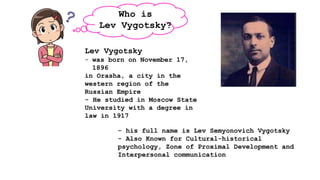
Lev Vygotsky
- was born on November 17,
1896
in Orasha, a city in the
western region of the
Russian Empire
- He studied in Moscow State
University with a degree in
law in 1917
- his full name is Lev Semyonovich Vygotsky
- Also Known for Cultural-historical
psychology, Zone of Proximal Development and
Interpersonal communication
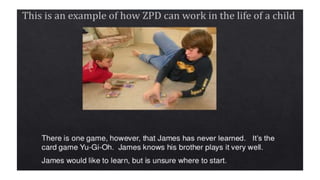
 Is the difference between what a
learner can do without help and
what he or she can do with help.
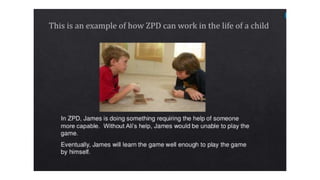
 an area of learning that occurs
when a person is assisted by a
teacher or peer with a higher skill
set of the subject. The person
learning skill set cannot complete
it without the assistance of the
teacher or peer.
 was originally developed by Vygotsky
to argue against the use of academic,
knowledge -based tests as a means to
gauge students’ intelligence.
 Vygotsky (1978) believed that learning
results in mental development and sets
into motion a variety of development
processes that would not occur without
the process of learning.
 First, it suggests that developmental
processes do not coincide with learing
process, but instead developmental
processes lags behind learning, resulting
in zones of proximal development
 Second features suggests that although
learning directly relates to child
development, the two are never
accomplished at the same time, as there
are highly complex dynamic relations
between development and learning.
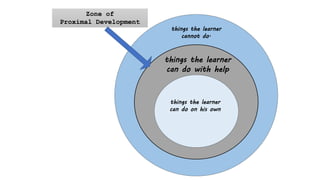
Zone of
Proximal Development
things the learner
cannot do.
things the learner
can do with help
things the learner
can do on his own
ZONE OF PROXIMAL DEVELOPMENT.pptx

ZONE OF PROXIMAL DEVELOPMENT.pptx

  • 1.
    by: Lev Vygotsky JUSTINEANN C. EUPEÑA Reporter
  • 2.
    Who is Lev Vygotsky? LevVygotsky - was born on November 17, 1896 in Orasha, a city in the western region of the Russian Empire - He studied in Moscow State University with a degree in law in 1917 - his full name is Lev Semyonovich Vygotsky - Also Known for Cultural-historical psychology, Zone of Proximal Development and Interpersonal communication
  • 3.
     Is thedifference between what a learner can do without help and what he or she can do with help.  an area of learning that occurs when a person is assisted by a teacher or peer with a higher skill set of the subject. The person learning skill set cannot complete it without the assistance of the teacher or peer.
  • 5.
     was originallydeveloped by Vygotsky to argue against the use of academic, knowledge -based tests as a means to gauge students’ intelligence.  Vygotsky (1978) believed that learning results in mental development and sets into motion a variety of development processes that would not occur without the process of learning.
  • 6.
     First, itsuggests that developmental processes do not coincide with learing process, but instead developmental processes lags behind learning, resulting in zones of proximal development  Second features suggests that although learning directly relates to child development, the two are never accomplished at the same time, as there are highly complex dynamic relations between development and learning.
  • 7.
    Zone of Proximal Development thingsthe learner cannot do. things the learner can do with help things the learner can do on his own