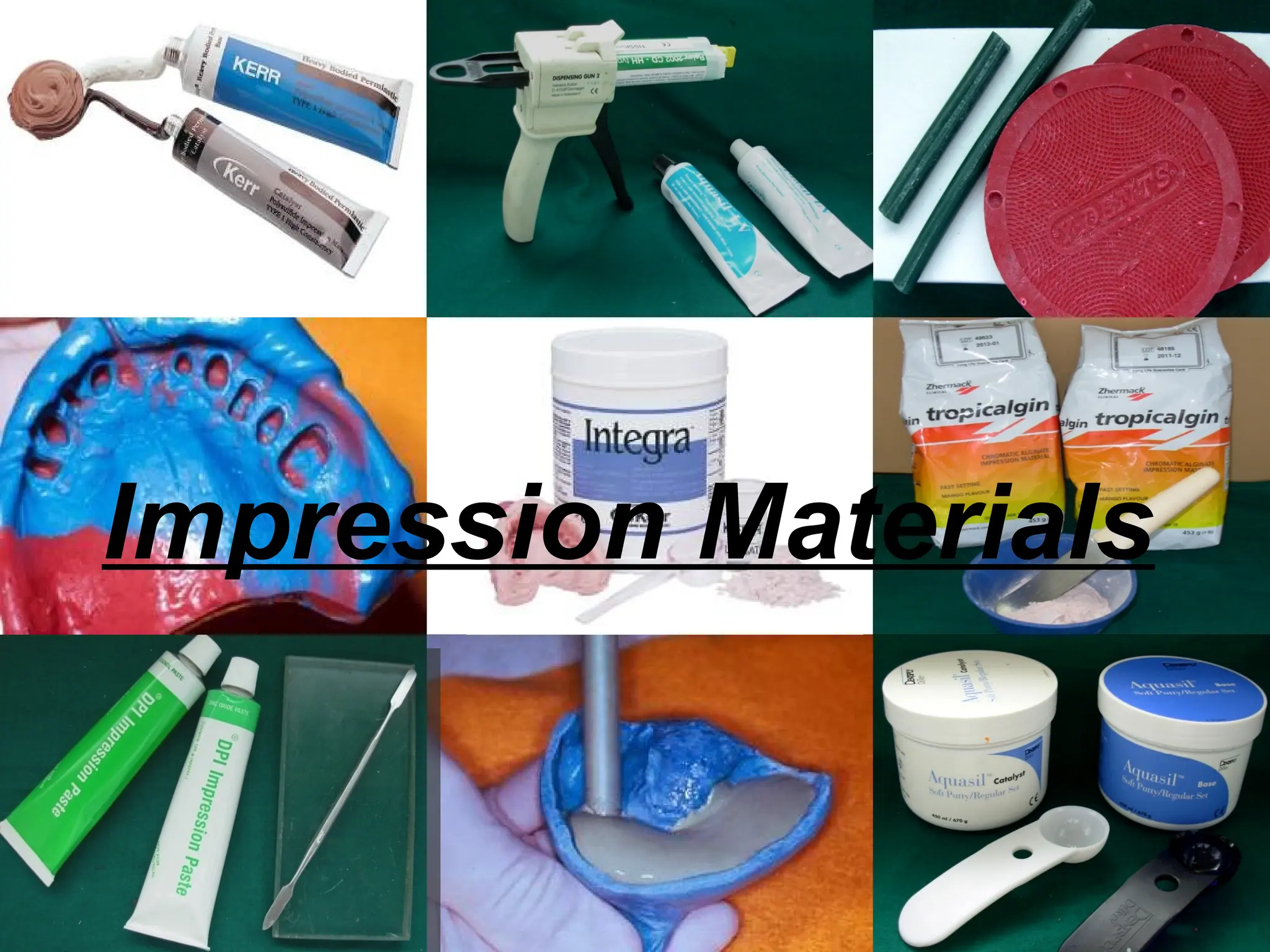
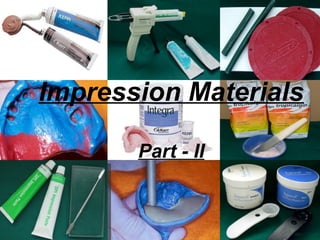
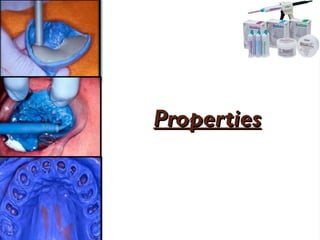
Impression Materials
Contents:
Contents:
 Introduction
 Classification
 Requirements
 Rigid impression materials
Impression Compound
Zinc oxide-Eugenol Impression paste
Impression Plaster
Impression waxes
 Hydrocolloid Impression materials
Reversible Hydrocolloid - Agar
Irreversible Hydrocolloid – Alginate
 Nonaqueous Elastomeric Impression materials
 Conclusion
 Bibliography
Introduction
Introduction
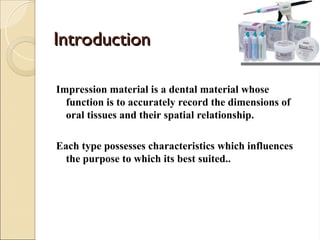
Impression material is a dental material whose
function is to accurately record the dimensions of
oral tissues and their spatial relationship.
Each type possesses characteristics which influences
the purpose to which its best suited..
Classification:
Classification:
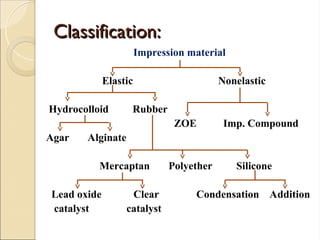
Impression material
Elastic Nonelastic
Hydrocolloid Rubber
ZOE Imp. Compound
Agar Alginate
Mercaptan Polyether Silicone
Lead oxide Clear Condensation Addition
catalyst catalyst
1.
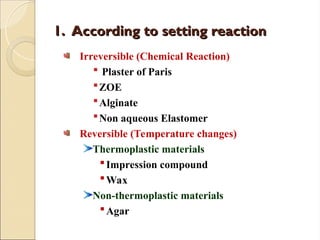
1. According to setting reaction
According to setting reaction
Irreversible (Chemical Reaction)
 Plaster of Paris
ZOE
Alginate
Non aqueous Elastomer
Reversible (Temperature changes)
Thermoplastic materials
Impression compound
Wax
Non-thermoplastic materials
Agar
II.
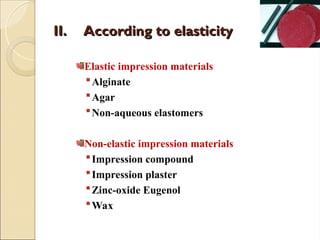
II. According to elasticity
According to elasticity
Elastic impression materials
Alginate
Agar
Non-aqueous elastomers
Non-elastic impression materials
Impression compound
Impression plaster
Zinc-oxide Eugenol
Wax
III.
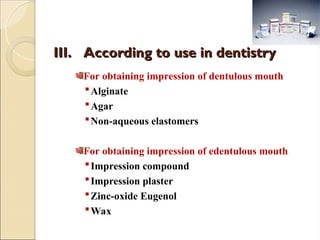
III. According to use in dentistry
According to use in dentistry
For obtaining impression of dentulous mouth
Alginate
Agar
Non-aqueous elastomers
For obtaining impression of edentulous mouth
Impression compound
Impression plaster
Zinc-oxide Eugenol
Wax
IV.
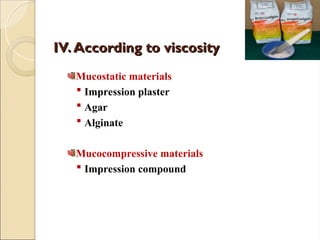
IV. According to viscosity
According to viscosity
Mucostatic materials
 Impression plaster
 Agar
 Alginate
Mucocompressive materials
 Impression compound
Requirements:
Requirements:
 Fluid enough to adapt to oral tissues.
 Viscous enough to be contained in the tray.
 Should set into a rubbery or rigid solid in mouth.
 Set impression should not distort or tear when
removed from the mouth.
 Adequate setting characteristics that meet clinical
requirements.
 Adequate strength.
 Should possess elastic properties.
 Dimensional stablity.
 Compatible with die and cast materials.
 Easy to use with minimum equipment
 Pleasant taste, odour, and esthetic color.
 Non toxic or irritating.
 Adequate shelf life.
 Economical.
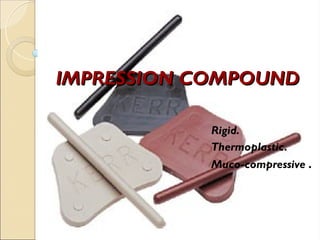
IMPRESSION COMPOUND
IMPRESSION COMPOUND
Rigid.
Thermoplastic.
Muco-compressive .
Composition:
Composition:
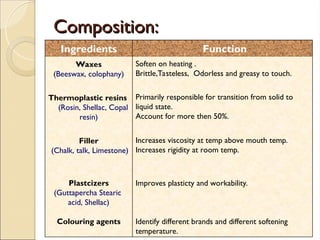
Ingredients Function
Waxes
(Beeswax, colophany)
Soften on heating .
Brittle,Tasteless, Odorless and greasy to touch.
Thermoplastic resins
(Rosin, Shellac, Copal
resin)
Primarily responsible for transition from solid to
liquid state.
Account for more then 50%.
Filler
(Chalk, talk, Limestone)
Increases viscosity at temp above mouth temp.
Increases rigidity at room temp.
Plastcizers
(Guttapercha Stearic
acid, Shellac)
Colouring agents
Improves plasticty and workability.
Identify different brands and different softening
temperature.
Types:
Types:
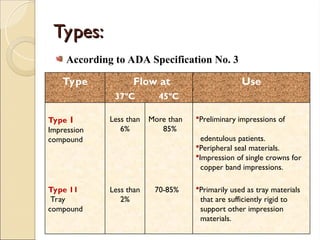
According to ADA Specification No. 3
Type Flow at Use
37ºC 45ºC
Type 1
Impression
compound
Less than
6%
More than
85%
Preliminary impressions of
edentulous patients.
Peripheral seal materials.
Impression of single crowns for
copper band impressions.
Type 11
Tray
compound
Less than
2%
70-85% Primarily used as tray materials
that are sufficiently rigid to
support other impression
materials.
Mode of supply:
Mode of supply:
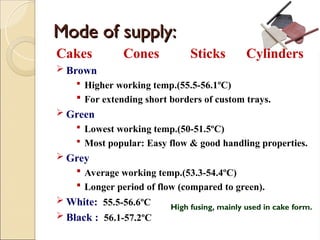
Cakes Cones Sticks Cylinders
 Brown
 Higher working temp.(55.5-56.1ºC)
 For extending short borders of custom trays.
 Green
 Lowest working temp.(50-51.5ºC)
 Most popular: Easy flow & good handling properties.
 Grey
 Average working temp.(53.3-54.4ºC)
 Longer period of flow (compared to green).
 White: 55.5-56.6ºC
 Black : 56.1-57.2ºC
High fusing, mainly used in cake form.
Properties:
Properties:
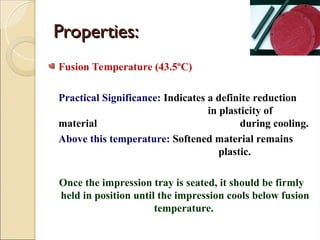
Fusion Temperature (43.5ºC)
Practical Significance: Indicates a definite reduction
in plasticity of
material during cooling.
Above this temperature: Softened material remains
plastic.
Once the impression tray is seated, it should be firmly
held in position until the impression cools below fusion
temperature.
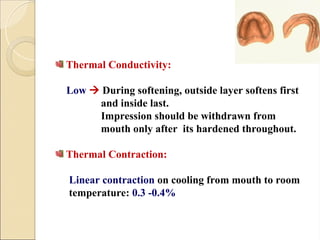
Thermal Conductivity:
Low  During softening, outside layer softens first
and inside last.
Impression should be withdrawn from
mouth only after its hardened throughout.
Thermal Contraction:
Linear contraction on cooling from mouth to room
temperature: 0.3 -0.4%
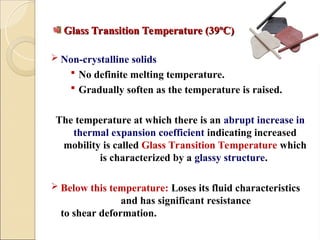
Glass Transition Temperature (39ºC)
 Non-crystalline solids
 No definite melting temperature.
 Gradually soften as the temperature is raised.
The temperature at which there is an abrupt increase in
thermal expansion coefficient indicating increased
mobility is called Glass Transition Temperature which
is characterized by a glassy structure.
 Below this temperature: Loses its fluid characteristics
and has significant resistance
to shear deformation.
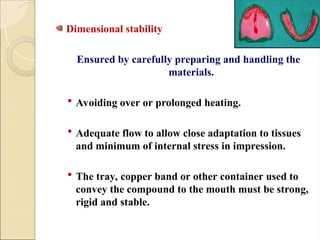
Dimensional stability
Ensured by carefully preparing and handling the
materials.
 Avoiding over or prolonged heating.
 Adequate flow to allow close adaptation to tissues
and minimum of internal stress in impression.
 The tray, copper band or other container used to
convey the compound to the mouth must be strong,
rigid and stable.
 Impression should be withdrawn from mouth only
after its hardened throughout.
 Cast or die should be made as soon as possible to
avoid inaccuracies caused by release of stress.
 Causes of internal stress :
High Coefficient of thermal expansion.
Poor thermal conductivity.
Relatively large temp. drop from softening to room
temp.
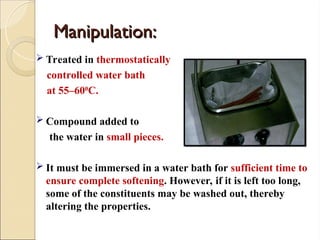
Manipulation:
Manipulation:
 Treated in thermostatically
controlled water bath
at 55–600
C.
 Compound added to
the water in small pieces.
 It must be immersed in a water bath for sufficient time to
ensure complete softening. However, if it is left too long,
some of the constituents may be washed out, thereby
altering the properties.
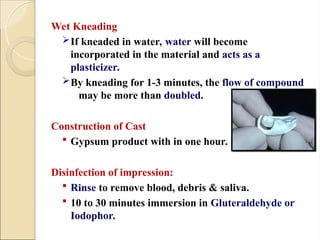
Wet Kneading
If kneaded in water, water will become
incorporated in the material and acts as a
plasticizer.
By kneading for 1-3 minutes, the flow of compound
may be more than doubled.
Construction of Cast
 Gypsum product with in one hour.
Disinfection of impression:
 Rinse to remove blood, debris & saliva.
 10 to 30 minutes immersion in Gluteraldehyde or
Iodophor.
Advantages
 Rigid when set.
 Inexpensive.
 Non toxic.
Disadvantages
 Due to pressure while making impression, tissues will
be compressed.
 Distorts easily leading to poor dimensional stability.
 Cannot be removed from undercuts.
 High thermal expansion.
 Does not reproduce fine surface details.
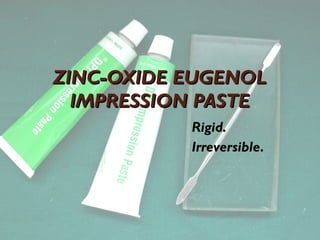
ZINC-OXIDE EUGENOL
ZINC-OXIDE EUGENOL
IMPRESSION PASTE
IMPRESSION PASTE
Rigid.
Irreversible.
Composition:
Composition:
Component % Function
Zinc oxide 80-87
Reactive ingredient, takes part in setting reaction.
Finely divided, with very slight amount of water.
Vegetable or
mineral oil
13-15 Acts as plasticizers.
Masks the action of eugenol as irritant.
Component % Function
Eugenol/Oil of
clove
12-15 Reactive ingredient.
Oil of clove contains 70-85% of eugenol.
Gum or
Polymerised
rosin
50
Gives body & coherence to mixed material.
Imparts thermoplastic property to set impression.
Facilitates speed of reaction and more homogenous
product .
Filler 16-20
Inert material to form paste with suitable
consisitency.
Resinous
balsam
10
Increases flow and improve mixing properties.
Accelerator,
moisture 4-5
Accelerators like zinc acetate, glacial acetic acid,
metallic salts of hydrochloric and nitric acids,
primary alcohols.
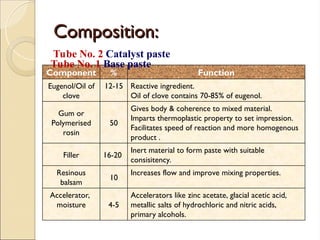
Tube No. 1 Base paste
Tube No. 2 Catalyst paste
Classification
Classification
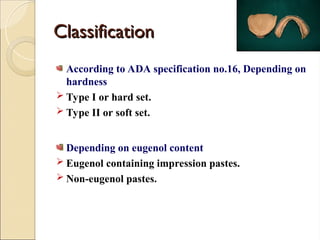
According to ADA specification no.16, Depending on
hardness
 Type I or hard set.
 Type II or soft set.
Depending on eugenol content
 Eugenol containing impression pastes.
 Non-eugenol pastes.
Setting reaction:
Setting reaction:
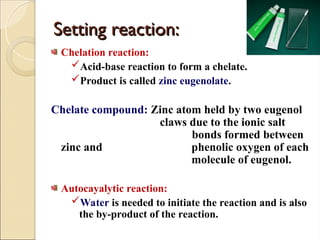
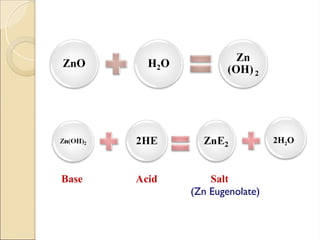
Chelation reaction:
Acid-base reaction to form a chelate.
Product is called zinc eugenolate.
Chelate compound: Zinc atom held by two eugenol
claws due to the ionic salt
bonds formed between
zinc and phenolic oxygen of each
molecule of eugenol.
Autocayalytic reaction:
Water is needed to initiate the reaction and is also
the by-product of the reaction.
2H2O
Base Acid Salt
(Zn Eugenolate)
Setting time:
Setting time:
Initial setting time:
 Period from beginning of mixing until the material
ceases to pull away or string out when it surface is
touched with the metal rod of specified dimensions.
 Impression should be seated in the mouth before the
initial set.
Final setting time:
 Rod fails to penetrate the surface of the specimen
more than 0.2 mm under the load of 50 gms.
At 23 + 2 0
C and at 50% relative humidity
Type Initial setting time Final setting time
Type 1 3-6 minutes 10 minutes
Type 11 3-6 minutes 15 minutes
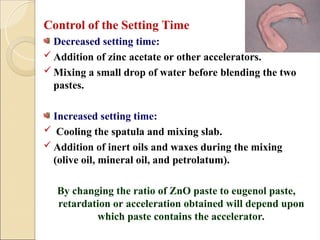
Control of the Setting Time
Decreased setting time:
 Addition of zinc acetate or other accelerators.
 Mixing a small drop of water before blending the two
pastes.
Increased setting time:
 Cooling the spatula and mixing slab.
 Addition of inert oils and waxes during the mixing
(olive oil, mineral oil, and petrolatum).
By changing the ratio of ZnO paste to eugenol paste,
retardation or acceleration obtained will depend upon
which paste contains the accelerator.
Properties:
Properties:
Consistency & Flow
Should be homogenous and flow uniformly against the
tissues while the impression is being obtained.
 Thick consistency: Compress the tissues.
 Thin consistency : Impression of the tissues in a
relaxed condition with
little or no compression.
Materials with decreased flow at various time interval
have shorter setting times and a shorter time interval
between initial and final set.
Rigidity & Strength
Should be unyielding when it is removed from the
mouth and should resist fracture.
Dimensional Stability
 Shrinks 0.1% or less at the end of 30 minutes after
mixing.
Can be preserved indefinitely without change in shape
due to relaxation, warpage or other causes.
Warpage of thick base plate tray on standing may
result in distortion of ZOE impression.
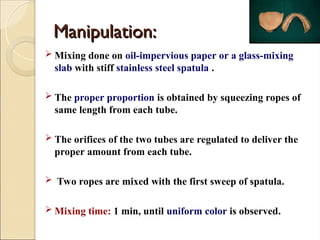
Manipulation:
Manipulation:
 Mixing done on oil-impervious paper or a glass-mixing
slab with stiff stainless steel spatula .
 The proper proportion is obtained by squeezing ropes of
same length from each tube.
 The orifices of the two tubes are regulated to deliver the
proper amount from each tube.
 Two ropes are mixed with the first sweep of spatula.
 Mixing time: 1 min, until uniform color is observed.
Impression
Impression making:
making:
 Mix is spread in a thin layer over tissue bearing
surface of the custom tray and carried to mouth.
 Should be held firmly in position until it is
thoroughly hardened.
 The accelerating action of the heat of mouth and
saliva on the surface of tissues causes adjacent
surface of impression to harden first. Disturbance of
impression at this stage will result in warpage.
Non-Eugenol Impression pastes:
Disadvantages of ZOE pastes
Stinging or burning sensation.
Free eugenol present may leach out causing
disagreeable taste.
Chronic gastric disturbance may result in cases
where surgical pack is worn for several weeks.
Thus to solve these problems, non-eugenol pastes are
developed.
 A material similar to ZOE reaction product can be
formed by saponification reaction to produce an
insoluble “ soap “.
 Zinc oxide reacted with carboxylic acid,
Orthoethoxybenzoic acid.
Disadvantage: Disagreeable odour and taste.
Advantages
Relatively rigid material, thus impression can be
removed from mouth without any deformation.
Allows sufficient working time.
Registers surface detail accurately.
Dimensionally stable.
Minor defects can be corrected locally by adding a
fresh mix to the area and carefully reseating
impression in mouth.
Disadvantages
Requires special trays.
Sticky in nature and adheres to tissues, cleaning is
difficult.
Presence of eugenol causes tissue irritation and
burning sensation, some patients are allergic to
eugenol.
Cannot be used for making impressions of teeth
and undercut area, as it is inelastic in nature.
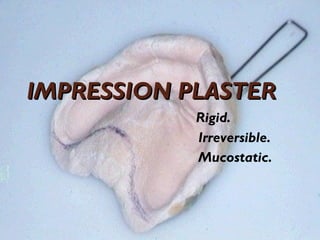
IMPRESSION PLASTER
IMPRESSION PLASTER
Rigid.
Irreversible.
Mucostatic.
Composition:
Composition: Similar to dental plaster.
Similar to dental plaster.
 Calcined beta calcium sulfate hemihydrate: When
mixed with water forms calcium sulfate dihydrate.
 Potassium sulfate (0.6%): Anti-expansion agents.
Accelerator.
 Borax : Retarder
 Pigment such as alizaran red makes a clear
distinction between the impression and model.
 Natural gum like Tragacanth gives cohesion to the
mass and facilitate border molding of the impression.
AE or Anti- Expansion solution
 Sometimes the additives are supplied as an aqueous
solution which is to be mixed with plaster.
Potassium Sulphate 4% (2.5%)
Borax 0.4-1% (0.25%)
Alizarin red 0.04%
Soluble Impression Plaster
 Potato starch is incorporated so that the set plaster
will disintegrate due to swelling of starch and make it
soluble.
 After the cast has hardened, the impression and cast
are immersed in hot water, thus facilitating rapid
removal of impression from the cast model.
Added advantages of starch:
 Produces very smooth mix.
 Produces slightly sticky mix that adheres to tray
even when in thin wafers.
 Serves as inert filler and reduces temperature rise.
Setting time and setting expansion
 Water-Powder ratio: Higher the ratio, slower the
setting, lower the expansion.
 Spatulation time : Longer the mixing, lesser the
setting time and greater is the
expansion.
 Temperature : Increased temp, faster is the
setting. Hence it will set more quickly
in the mouth then in bowl.
Properties:
Properties:
Main differences between Impression plaster
and Model plasters:
 More rapid setting in impression plaster in order
to avoid discomfort to both patient and dentist.
 Smaller setting expansion for greater accuracy in
impression plaster
 Much lower strength so that fracture can occur
easily if material engages undercut.
Accuracy
Very accurate impression due to:
 Initial fluidity of material allowing to record soft
tissues in uncompressed state.
 Absorption of moisture from surface of oral soft
tissues, facilitating intimate contact between the
impression material and tissues.
 Minimal dimensional change on setting.
Manipulation:
Manipulation:
 Water-Powder ratio: 0.06 i.e 100gm of powder in 60ml
water.
 Mixed in rubber bowl using wide, stiff bladed spatula to get
fluid mix.
 Mixing time: 30-45 seconds.
Impression making:
1. In custom tray with 1-1.5mm spacer.
2. Wash plaster impression in preliminary compound
impression.
3. Recording impression of undercut area in fractured
pieces which is then secured in correct position by sticky
wax or cyno-acrylate glue.
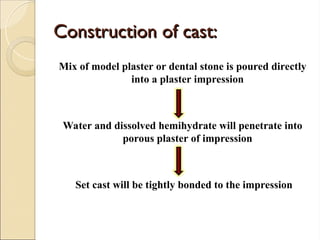
Construction of cast:
Mix of model plaster or dental stone is poured directly
into a plaster impression
Water and dissolved hemihydrate will penetrate into
porous plaster of impression
Set cast will be tightly bonded to the impression
Separating media: Facilitates easy separation of
impression from the
cast .
Types
1. Produces thin film over impression plaster resulting
in some loss of surface detail and accuracy.
Eg: Varnishes like sandrac, colloidan and alginate
solution.
2. Reacts with the surface of Plaster itself ,making it
impervious with very little loss of surface details .
Eg: Soap solutions or water glass solution (60% sol
of sodium silicate in water).
Advantages:
 Dimensionally accurate with good surface details.
 Absorbs palatal secretions during setting.
 Speedy handling and easy manipulation.
 Produces minimum tissue displacement.
Disadvantages:
 Cannot be used to compress tissues.
 In very wet mouth, surface of plaster tends to be
washed away spoiling the surface details.
 Exothermic setting reaction.
 Separating media used may obliterate some details.
 Cannot be removed from undercuts without breaking.
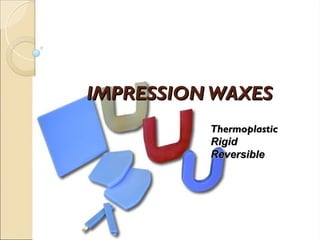
IMPRESSION WAXES
IMPRESSION WAXES
Thermoplastic
Thermoplastic
Rigid
Rigid
Reversible
Reversible
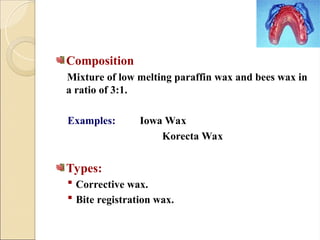
Composition
Mixture of low melting paraffin wax and bees wax in
a ratio of 3:1.
Examples: Iowa Wax
Korecta Wax
Types:
 Corrective wax.
 Bite registration wax.
Characteristics and uses of the
Korecta Wax/ fluid–wax series
No. I Wax
Properties
 Congeals rapidly with slight amount of shrinkage.
 Tissue-pink in colour.
 Hard with practically no flow at body
temperature.
 Brittle.
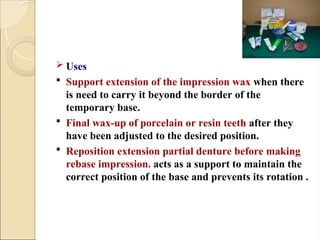
 Uses
 Support extension of the impression wax when there
is need to carry it beyond the border of the
temporary base.
 Final wax-up of porcelain or resin teeth after they
have been adjusted to the desired position.
 Reposition extension partial denture before making
rebase impression. acts as a support to maintain the
correct position of the base and prevents its rotation .
No. II Wax
Yellow in colour.
Has slight flow at body temperature.
Ability to adapt very slowly to the ridge structures
makes it useful as a temporary lining of a base,
which should be worn for a short time.
Can be placed as a lining when a posterior stop of
the No. 1 wax has been used to prevent the rotation
of an unstable denture.
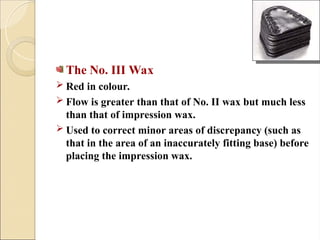
The No. III Wax
 Red in colour.
 Flow is greater than that of No. II wax but much less
than that of impression wax.
 Used to correct minor areas of discrepancy (such as
that in the area of an inaccurately fitting base) before
placing the impression wax.
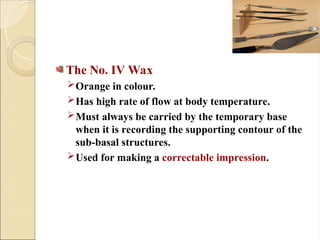
The No. IV Wax
Orange in colour.
Has high rate of flow at body temperature.
Must always be carried by the temporary base
when it is recording the supporting contour of the
sub-basal structures.
Used for making a correctable impression.
Corrective Impression Wax
 Used as wax veneer over an original impression to
register the details of soft tissues.
 Records the mucous membrane and underlying
tissues in functional state.
 Flow: 100% at 37ºC.
 Disadvantage: Distortion during removal from
mouth.
Bite Registration Wax
 Used to articulate accurately certain models of
opposing quadrants.
 Flow: 2.5 to 22% at 37ºC.
 Disadvantage: Distortion during removal from
mouth.
Manipulation and usage
 Applied with short bristle brush in small quantities to
fill areas of impressions with insufficient material.
 Undersurface of tray is covered first with a
continuous layer to prevent moisture from getting
under the wax to loosen it.
 Surplus of impression wax (No. IV) is added then just
inside the border.
 Tilt the tray to prevent wax from running toward the
center.
 Achievement of relationships of impression is
determined by glossy appearance.
Disadvantages
Disadvantages
 Easy deformation under stress.
 Minimal surface hardness.
 Poor dimensional stability.
 More time consuming.
 Extreme skill and care necessary to prevent
distortion .
HYDROCOLLOID
HYDROCOLLOID
IMPRESSION MATERIALS
REVERSIBLE
REVERSIBLE
HYDROCOLLOIDS
HYDROCOLLOIDS
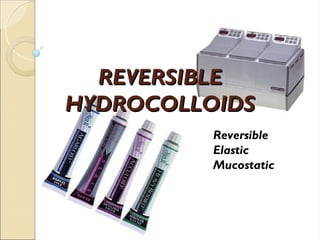
Reversible
Elastic
Mucostatic
Composition:
Composition:
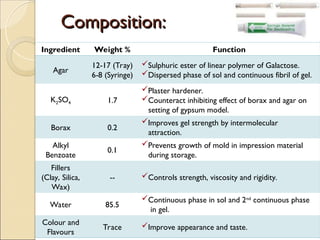
Ingredient Weight % Function
Agar
12-17 (Tray)
6-8 (Syringe)
Sulphuric ester of linear polymer of Galactose.
Dispersed phase of sol and continuous fibril of gel.
K2SO4 1.7
Plaster hardener.
Counteract inhibiting effect of borax and agar on
setting of gypsum model.
Borax 0.2
Improves gel strength by intermolecular
attraction.
Alkyl
Benzoate
0.1
Prevents growth of mold in impression material
during storage.
Fillers
(Clay, Silica,
Wax)
-- Controls strength, viscosity and rigidity.
Water 85.5
Continuous phase in sol and 2nd
continuous phase
in gel.
Colour and
Flavours
Trace Improve appearance and taste.
Properties:
Properties:
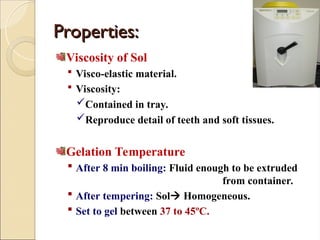
Viscosity of Sol
 Visco-elastic material.
 Viscosity:
Contained in tray.
Reproduce detail of teeth and soft tissues.
Gelation Temperature
 After 8 min boiling: Fluid enough to be extruded
from container.
 After tempering: Sol Homogeneous.
 Set to gel between 37 to 45ºC.
Strength
 Time dependent.
 Greater at higher rate of loading. (Impression to be
removed with a Snap.)
 Directly related to Brush heap density (Conc. of
agar)
 Inversely related to temperature.
 Compressive strength: 8000 gm/cm2
 Tear strength: 700 gm/cm2
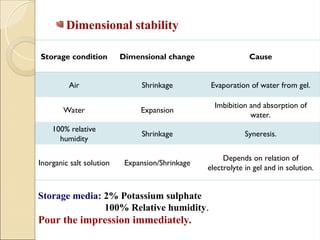
Dimensional stability
Storage condition Dimensional change Cause
Air Shrinkage Evaporation of water from gel.
Water Expansion
Imbibition and absorption of
water.
100% relative
humidity
Shrinkage Syneresis.
Inorganic salt solution Expansion/Shrinkage
Depends on relation of
electrolyte in gel and in solution.
Storage media: 2% Potassium sulphate
100% Relative humidity.
Pour the impression immediately.
Flexibility
 4 to 15% under 14.2 psi stress.
Permanent Deformation (1%)
 Material is adequately gelled.
 Removed with sharp thurst.
 Minimal undercuts in prepared cavity.
Compatibility with Gypsum
 More compatible then alginate.
 Stored in humidor  rinse to remove exudate formed
from syneresis.
Manipulation:
Manipulation:
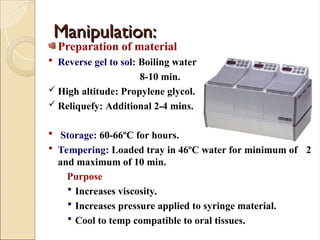
Preparation of material
 Reverse gel to sol: Boiling water
8-10 min.
 High altitude: Propylene glycol.
 Reliquefy: Additional 2-4 mins.
 Storage: 60-66ºC for hours.
 Tempering: Loaded tray in 46ºC water for minimum of 2
and maximum of 10 min.
Purpose
 Increases viscosity.
 Increases pressure applied to syringe material.
 Cool to temp compatible to oral tissues.
Impression procedure:
Water cooled impression trays
 Temp of circulating water18-21ºC.
 Circulated for minimum of 5 min.
Syringe material: Ejected on prepared teeth.
Tray material: Water soaked outer layer soaked with
dry gauze sponge.
Seated with passive pressure.
Wet field technique:
 Tooth surface and tissues are flooded with warm
water.
 Syringe material :Only on incisal and occlusal
surface.
 Tray material seated while syringe material is still
liquid.
 Hydraulic pressure of tray material forces the fluid
syringe material down to the areas to be restored.
Construction of cast:
 Hardening solutions: 2% K2SO4 , Potash alum,
ZnSO4 , MnSO4 .
Accelerates setting of gypsum.
Reacts with gel Prevents syneresis.
 After poured in stone, placed in humidor or 2%
K2SO4.
 Should be kept in contact with impression for
30-60min.
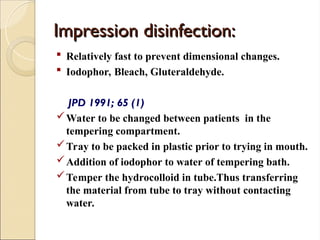
Impression disinfection:
 Relatively fast to prevent dimensional changes.
 Iodophor, Bleach, Gluteraldehyde.
JPD 1991; 65 (1)
Water to be changed between patients in the
tempering compartment.
Tray to be packed in plastic prior to trying in mouth.
Addition of iodophor to water of tempering bath.
Temper the hydrocolloid in tube.Thus transferring
the material from tube to tray without contacting
water.
IRREVERSIBLE
IRREVERSIBLE
HYDROCOLLOIDS
HYDROCOLLOIDS
Elastic
Elastic
Mucostatic
Mucostatic
Irreversible
Irreversible
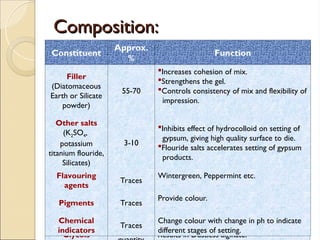
Composition:
Composition:
Constituent
Approx.
%
Function
Soluble salt of
Alginic acid
12-20
Polysaccharide prepared from marine kelp.
Linear polymer of Anhydro-ß-D-Mannuronic
acid.
K+
Na+
NH4
+
makes them soluble.
Reacts with Ca2+
dissolving in water.
Calcium
Sulphate
Dihydrate
12-20
Releases Ca2+
which reacts with salts of
alginic acid.
Trisodium
Phosphate
2-5
Retarder.
Reacts with Ca2+
from Calcium Sulphate
Dihydrate to form insoluble Ca3(PO4)2
Glycols
Small
Results in Dustless alginate.
Constituent
Approx.
%
Function
Filler
(Diatomaceous
Earth or Silicate
powder)
55-70
Increases cohesion of mix.
Strengthens the gel.
Controls consistency of mix and flexibility of
impression.
Other salts
(K2SO4,
potassium
titanium flouride,
Silicates)
3-10
Inhibits effect of hydrocolloid on setting of
gypsum, giving high quality surface to die.
Flouride salts accelerates setting of gypsum
products.
Flavouring
agents
Traces
Wintergreen, Peppermint etc.
Pigments Traces
Provide colour.
Chemical
indicators
Traces
Change colour with change in ph to indicate
different stages of setting.
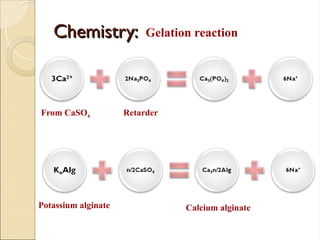
Chemistry:
Chemistry: Gelation reaction
Retarder
From CaSO4
Potassium alginate Calcium alginate
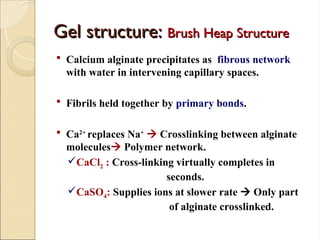
Gel structure:
Gel structure: Brush Heap Structure
Brush Heap Structure
 Calcium alginate precipitates as fibrous network
with water in intervening capillary spaces.
 Fibrils held together by primary bonds.
 Ca2+
replaces Na+
 Crosslinking between alginate
molecules Polymer network.
CaCl2 : Cross-linking virtually completes in
seconds.
CaSO4: Supplies ions at slower rate  Only part
of alginate crosslinked.
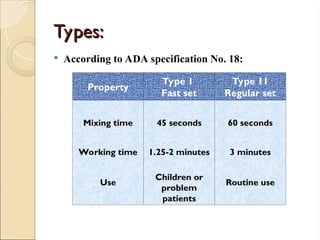
Types:
Types:
 According to ADA specification No. 18:
Property
Type 1
Fast set
Type 11
Regular set
Mixing time 45 seconds 60 seconds
Working time 1.25-2 minutes 3 minutes
Use
Children or
problem
patients
Routine use
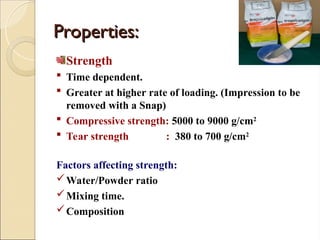
Properties:
Properties:
Strength
 Time dependent.
 Greater at higher rate of loading. (Impression to be
removed with a Snap)
 Compressive strength: 5000 to 9000 g/cm2
 Tear strength : 380 to 700 g/cm2
Factors affecting strength:
Water/Powder ratio
Mixing time.
Composition
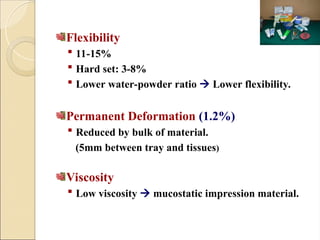
Flexibility
 11-15%
 Hard set: 3-8%
 Lower water-powder ratio  Lower flexibility.
Permanent Deformation (1.2%)
 Reduced by bulk of material.
(5mm between tray and tissues)
Viscosity
 Low viscosity  mucostatic impression material.
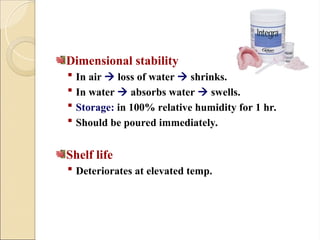
Dimensional stability
 In air  loss of water  shrinks.
 In water  absorbs water  swells.
 Storage: in 100% relative humidity for 1 hr.
 Should be poured immediately.
Shelf life
 Deteriorates at elevated temp.
Compatibility with gypsum products
Australian Dental J. 1981 Vol 26(1)
 Surface compatibilty of gypsum with alginate can be
improved..
If calcium sulphate reactor is replaced.
In place of sodium alginate, triethanolamine
alginate to be used..
 By this exudate sodium sulphate is not formed.
Disinfection
Tobias, Browne, Wilson (1989)
 Development of alginate impregnated with
antimicrobial compound..
“Didecyldimethyl ammonium chloride”
 Self sterilizing impression material.
 Not effective against Pseudomonas Aeruginosa.
Robert W.Schutt (1989)
 Effective bactericidal effect of dental gypsum
containing 0.25% Chloramine-T on Alginate
impression and Dental cast..
Manipulation:
Manipulation:
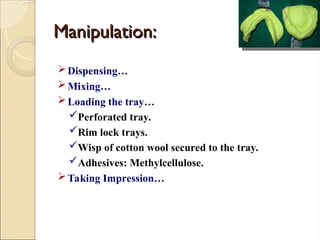
Dispensing…
Mixing…
Loading the tray…
Perforated tray.
Rim lock trays.
Wisp of cotton wool secured to the tray.
Adhesives: Methylcellulose.
Taking Impression…
Laminate technique:
Laminate technique:
Agar- Alginate combination impression
 Syringe agar : Injected around preparation.
 Chilled Alginate mix: In tray, promptly seated on the
top of agar.
Advantages:
More accurate surface reproduction by agar.
Agar more compatible with gypsum.
Elimination of water-cooled impression trays.
Developments:
Developments:
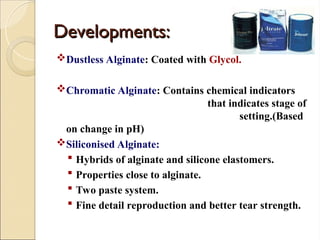
Dustless Alginate: Coated with Glycol.
Chromatic Alginate: Contains chemical indicators
that indicates stage of
setting.(Based
on change in pH)
Siliconised Alginate:
 Hybrids of alginate and silicone elastomers.
 Properties close to alginate.
 Two paste system.
 Fine detail reproduction and better tear strength.
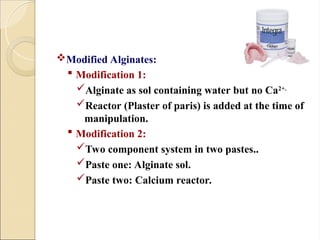
Modified Alginates:
 Modification 1:
Alginate as sol containing water but no Ca2+.
Reactor (Plaster of paris) is added at the time of
manipulation.
 Modification 2:
Two component system in two pastes..
Paste one: Alginate sol.
Paste two: Calcium reactor.
Impression Materials
Part - II
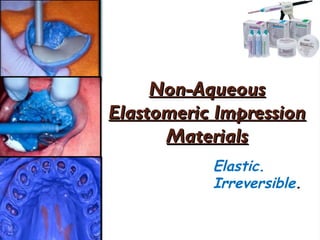
Non-Aqueous
Non-Aqueous
Elastomeric Impression
Materials
Materials
Elastic.
Irreversible.
Contents:
Contents:
 Introduction
 History
 Classification
 Composition and chemistry
 Properties
 Advantages and disadvantages
 Clinical presentation
 Recent developments
 Manipulation
 Disinfection
 Effects of mishandling
 Applications
 Summary
 Bibliography.
Introduction:
Introduction:
 Group of rubbery polymers.
 CHEMICALLY or PHYSICALLY cross linked .
 Easily stretched and rapidly recover their original
dimensions when the applied stress is released.
History:
History:
 Introduced in 1950s.
 In 1955 Pearson reported on “ A new elastic
impression material”… Polysulphide.
 Silicone base material introduced there after.
 In late 1960s Polyethers introduced in Germany.
 In 1980s A visible light-cure Impression material was
introduced.
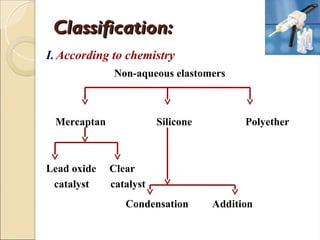
Classification:
Classification:
I. According to chemistry
Non-aqueous elastomers
Mercaptan Silicone Polyether
Lead oxide Clear
catalyst catalyst
Condensation Addition
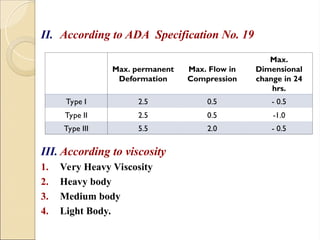
II. According to ADA Specification No. 19
III. According to viscosity
1. Very Heavy Viscosity
2. Heavy body
3. Medium body
4. Light Body.
Max. permanent
Deformation
Max. Flow in
Compression
Max.
Dimensional
change in 24
hrs.
Type I 2.5 0.5 - 0.5
Type II 2.5 0.5 -1.0
Type III 5.5 2.0 - 0.5
Chemistry And
Chemistry And
Composition
Composition
1.
1. Polysulphide
Polysulphide
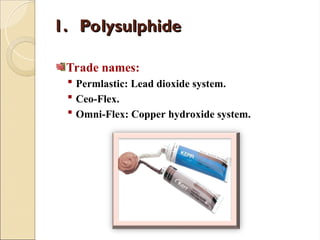
Trade names:
 Permlastic: Lead dioxide system.
 Ceo-Flex.
 Omni-Flex: Copper hydroxide system.
COMPOSITION:
COMPOSITION:
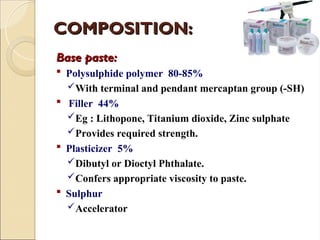
Base paste:
Base paste:
 Polysulphide polymer 80-85%
With terminal and pendant mercaptan group (-SH)
 Filler 44%
Eg : Lithopone, Titanium dioxide, Zinc sulphate
Provides required strength.
 Plasticizer 5%
Dibutyl or Dioctyl Phthalate.
Confers appropriate viscosity to paste.
 Sulphur
Accelerator
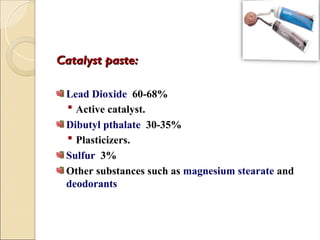
Catalyst paste:
Catalyst paste:
Lead Dioxide 60-68%
 Active catalyst.
Dibutyl pthalate 30-35%
 Plasticizers.
Sulfur 3%
Other substances such as magnesium stearate and
deodorants
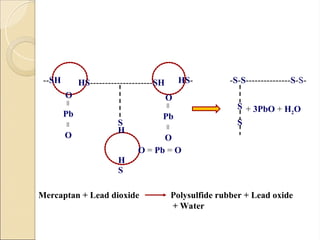
Chemistry
Chemistry
Oxidizing agent, Lead dioxide Initiates polmerization.
First Chain lengthening between terminal –SH groups
occurs  Increases viscosity.
Subsequent Cross linking between pendant –SH
groups  Elasticity.
 Condensation polymerization: Reaction byproduct
water is formed.
 Exothermic reaction: 3-4ºC rise in temp.
O
=
Pb
=
O
HS---------------------SH
O
=
Pb
=
O
H
S
S
H
O = Pb = O
--SH HS- -S-S---------------S-S-
S
S
S
S
S
+ 3PbO + H2O
Mercaptan + Lead dioxide Polysulfide rubber + Lead oxide
+ Water
II.
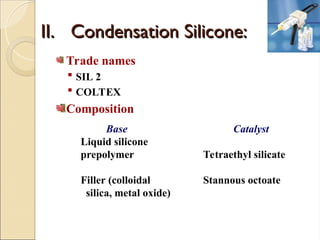
II. Condensation Silicone:
Condensation Silicone:
Trade names
 SIL 2
 COLTEX
Composition
Base
Liquid silicone
prepolymer
Filler (colloidal
silica, metal oxide)
Catalyst
Tetraethyl silicate
Stannous octoate
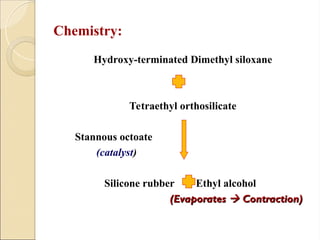
Chemistry:
Hydroxy-terminated Dimethyl siloxane
Tetraethyl orthosilicate
Stannous octoate
(catalyst)
Silicone rubber Ethyl alcohol
(Evaporates
(Evaporates 
 Contraction)
Contraction)
III.
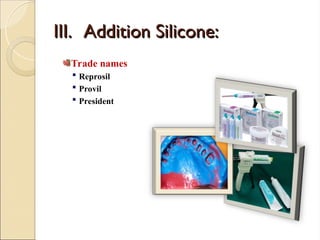
III. Addition Silicone:
Addition Silicone:
Trade names
 Reprosil
 Provil
 President
Composition:
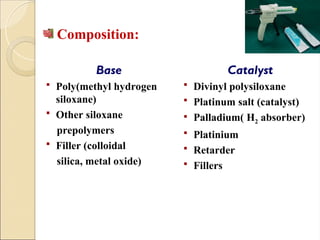
Base
 Poly(methyl hydrogen
siloxane)
 Other siloxane
prepolymers
 Filler (colloidal
silica, metal oxide)
Catalyst
 Divinyl polysiloxane
 Platinum salt (catalyst)
 Palladium( H2 absorber)
 Platinium
 Retarder
 Fillers
Chemistry:
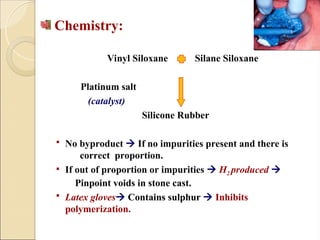
Vinyl Siloxane Silane Siloxane
Platinum salt
(catalyst)
Silicone Rubber
 No byproduct  If no impurities present and there is
correct proportion.
 If out of proportion or impurities  H2 produced 
Pinpoint voids in stone cast.
 Latex gloves Contains sulphur  Inhibits
polymerization.
IV.
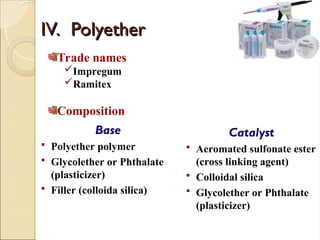
IV. Polyether
Polyether
Base
 Polyether polymer
 Glycolether or Phthalate
(plasticizer)
 Filler (colloida silica)
Catalyst
 Aeromated sulfonate ester
(cross linking agent)
 Colloidal silica
 Glycolether or Phthalate
(plasticizer)
Trade names
Impregum
Ramitex
Composition
Chemistry:
Chemistry:
Polyether Sulphonic ester Crossed linked
rubber
 Reaction is brought about by Aziridine rings
(present at the end of branched polyether molecule).
Main chain is copolymer of ETHYLENE OXIDE and
TETRAHYDROFURAN
Properties
Properties
Rheological Properties
Important for accuracy impression materials.
VISCOUS PASTE VISCOELASTIC SOLIDS
(Introduced in mouth) (Set impression)
The viscosity and flow behaviour of the unmixed
components control the ease of mixing.
 Silicones: More fluid  Easier to mix than polysulfides.
Shorter setting time  Flow present for
shorter period.
 Polyether: Viscosity can be reduced by using a thinner.
Shear thinning:
 Decrease in viscosity with increasing shear rate.
 Important for single viscosity materials.
Polyether
Polysulfide with Cu(OH)2 accelerator.
 Single mix can be used in syringe-tray technique.
Lower viscosity during injection with a syringe.
Higher viscosity when inserted in a tray during
mixing.
Working and setting time
Polysulfides Silicones Polyethers
 Chilling material,
mixing on cool slab
 Altering base:catalyst Alters working time
Setting time and Curing time: Not same.
 Condensation silicone: Polymerization continues for 2
or more weeks after mixing.
 Addition silicone : Little residual polymerization
after material is clinically set.
Increases working time
Dimensional stability
Souces of dimensional changes:
1. Polymerization shrinkage
2. Loss of by-products
 Water: Polysulphides.
 Alcohol: Condensation silicone.
3. Thermal contraction from oral temperature to room
temperature.
4. Imbibition when exposed to water, disinfectant or high
humidity environment over a period of time.
5. Incomplete recovery of deformation because of
viscoelastic behavior.
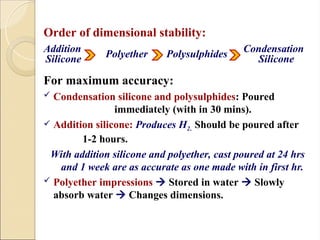
Order of dimensional stability:
Addition Condensation
For maximum accuracy:
 Condensation silicone and polysulphides: Poured
immediately (with in 30 mins).
 Addition silicone: Produces H2. Should be poured after
1-2 hours.
With addition silicone and polyether, cast poured at 24 hrs
and 1 week are as accurate as one made with in first hr.
 Polyether impressions  Stored in water  Slowly
absorb water  Changes dimensions.
Silicone Polyether Polysulphides Silicone
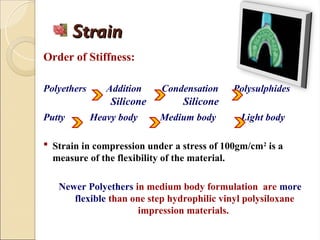
Strain
Strain
Order of Stiffness:
Polyethers Addition Condensation Polysulphides
Putty Heavy body Medium body Light body
 Strain in compression under a stress of 100gm/cm2
is a
measure of the flexibility of the material.
Newer Polyethers in medium body formulation are more
flexible than one step hydrophilic vinyl polysiloxane
impression materials.
Silicone Silicone
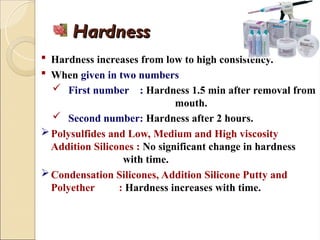
Hardness
Hardness
 Hardness increases from low to high consistency.
 When given in two numbers
 First number : Hardness 1.5 min after removal from
mouth.
 Second number: Hardness after 2 hours.
Polysulfides and Low, Medium and High viscosity
Addition Silicones : No significant change in hardness
with time.
Condensation Silicones, Addition Silicone Putty and
Polyether : Hardness increases with time.
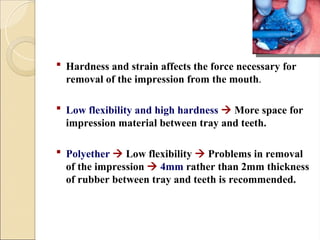
 Hardness and strain affects the force necessary for
removal of the impression from the mouth.
 Low flexibility and high hardness  More space for
impression material between tray and teeth.
 Polyether  Low flexibility  Problems in removal
of the impression  4mm rather than 2mm thickness
of rubber between tray and teeth is recommended.
Tear strength
Tear strength
 Indicates the ability of material to withstand tearing in thin
interproximal and subgingival areas.
 Tear strength is a measure of the force needed to initiate
and continue tearing a specimen of unit thickness.
Order of tear strength:
Polysulphides Polyether Silicones Hydrocolloids
Factors affecting tear strength
 Increase in consistency  Increases tear strength.
 Addition of thinner  Decreases tear strength.
 Rapid rate of force application  Increases tear strength.
Detail reproduction
Detail reproduction
 Silicones and polyethers registers detail better than
polysulfides.
 Except for very high viscosity products, they all
should reproduce a v-shaped groove and a 0.020mm
wide line in the rubber.
 It should be compatible with gypsum products so
that the 0.020mm line is transferred to gypsum die
materials.
They are capable of reproducing detail more
accurately than can be transferred to stone cast.
Wettability
Wettability
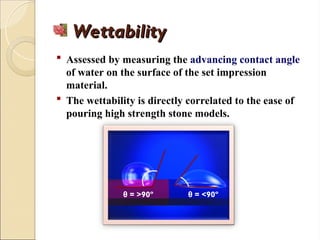
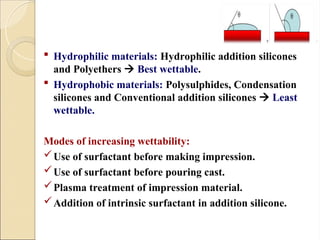
 Assessed by measuring the advancing contact angle
of water on the surface of the set impression
material.
 The wettability is directly correlated to the ease of
pouring high strength stone models.
θ = <90º
θ = >90º
 Hydrophilic materials: Hydrophilic addition silicones
and Polyethers  Best wettable.
 Hydrophobic materials: Polysulphides, Condensation
silicones and Conventional addition silicones  Least
wettable.
Modes of increasing wettability:
Use of surfactant before making impression.
Use of surfactant before pouring cast.
Plasma treatment of impression material.
Addition of intrinsic surfactant in addition silicone.
Shelf life
Shelf life
 Longer for Polysulphide and Polyether then Silicones of
approximately 2 years.
Should be stored in
 Tightly closed container/tubes.
 Cool environment.
According to ADA specification No. 19
The material should meet the test of permanent
deformation after the base and accelerator are stored
for 7 days at 60±2°C (140±3.6°F).
Biological properties
Polysulphides
Toxic effect of lead  Questioned the use of lead
compounds in polysulfide.
Reasons for unlikely harmful effect of lead in
material:
 Material is in patient’s mouth for only a few
minutes.
 It is hydrophobic, reducing the chances of washing
out of lead compounds by saliva.
Polysulphides results in lowest cell death count.
Condensation silicone
Non-toxic, although direct contact of skin with the
accelerator is to be avoided since allergic reactions
have been noted.
Addition silicone
Causes less tissue reaction than the condensation
silicones.
Polyether
 The aromatic sulfonic acid ester can cause contact
dermatitis, hypersensitivity reactions.
 Shows highest cell cytotoxicity scores.
 No cytotoxic effects on exposure to polyether with
imine catalyst.
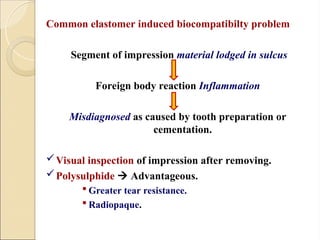
Common elastomer induced biocompatibilty problem
Segment of impression material lodged in sulcus
Foreign body reaction Inflammation
Misdiagnosed as caused by tooth preparation or
cementation.
Visual inspection of impression after removing.
Polysulphide  Advantageous.
 Greater tear resistance.
 Radiopaque.
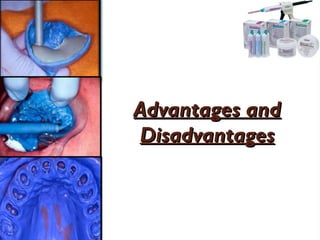
Advantages and
Advantages and
Disadvantages
Disadvantages
Advantages
Advantages
Excellent surface detail.
Dimensional accuracy.
No separator required before pouring casts.
Record undercuts but polysulfides may suffer from
permanent deformation on removal.
Polysulfides have good tear resistance.
Additon silicones have excellent dimensional
stability, even in cold sterilizing solutions.
Wide range of different viscosities available to match
different clinical situations.
Low viscosity silicones suitable for wash techniques.
Putty silicones are useful as space-filling materials.
Pleasant appearance and feel in the mouth.
Can be electroformed to give metal die, an advantage
over stone dies because of greater abrasion
resistance.
More easily prepared for use.
More dimensionally stable over a period of time than
hydrocolloids.
Do not affect hardness of the surface of stone.
Disadvantages
Disadvantages
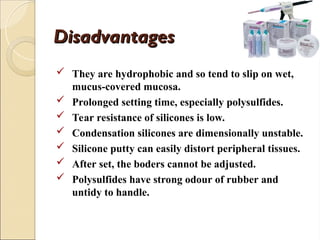
 They are hydrophobic and so tend to slip on wet,
mucus-covered mucosa.
 Prolonged setting time, especially polysulfides.
 Tear resistance of silicones is low.
 Condensation silicones are dimensionally unstable.
 Silicone putty can easily distort peripheral tissues.
 After set, the boders cannot be adjusted.
 Polysulfides have strong odour of rubber and
untidy to handle.
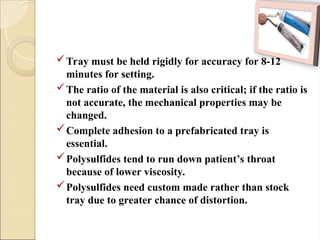
Tray must be held rigidly for accuracy for 8-12
minutes for setting.
The ratio of the material is also critical; if the ratio is
not accurate, the mechanical properties may be
changed.
Complete adhesion to a prefabricated tray is
essential.
Polysulfides tend to run down patient’s throat
because of lower viscosity.
Polysulfides need custom made rather than stock
tray due to greater chance of distortion.
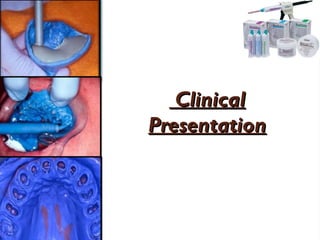
Clinical
Clinical
Presentation
Presentation
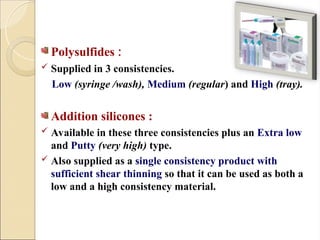
Polysulfides :
 Supplied in 3 consistencies.
Low (syringe /wash), Medium (regular) and High (tray).
Addition silicones :
 Available in these three consistencies plus an Extra low
and Putty (very high) type.
 Also supplied as a single consistency product with
sufficient shear thinning so that it can be used as both a
low and a high consistency material.
Condensation silicones :
 Supplied in a low and putty like consistency.
Polyethers :
 Supplied as a medium consistency type plus a thinner
or as a low and a high consistency.
Mode of supply:
 Two pastes in collapsible tubes: Low, Medium and
High consistencies.
 In two jars: Very high consistency.
 Catalyst of condensation silicones can be supplied as a
liquid or a paste.
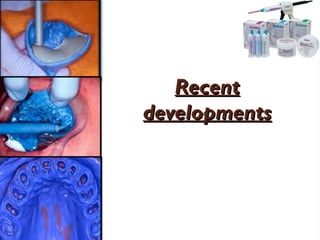
Recent
Recent
developments
developments
Modifications in polysulphides:
Lead dioxide replaced by
 Organic reactor like Cumene hydroperoxide or t-Butyl
hydroperoxide: Volatile constituent evaporates,
leading to shrinkage of set mass.
 Inorganic hydroxides such as Hydrated Copper Oxides:
Hydrated copper oxide produces a
green mix.
Modifications in addition silicone:
1. Addition silicone with Palladium - Hydrogen absorber.
Adv: Impressions can be poured immediately.
2. Fast Setting Addition Silicone: Aquasil Ultra Fast Set
3. Hydrophilized Addition Silicone
Adv: Reduced contact angle with water  Improved
wettability.
Have intrinsic surfactants
Nonylphenoxyetanol homologues.
Consist of : A hydrophilic part.
A silicone compatible hydrophobic part.
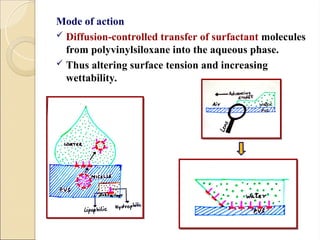
Mode of action
 Diffusion-controlled transfer of surfactant molecules
from polyvinylsiloxane into the aqueous phase.
 Thus altering surface tension and increasing
wettability.
Modifications in polyether:
1. Soft Polyether: Penta soft, Impregum soft.
 Supplied as heavy and light body.
 Soft Technology makes it less rigid for easier removal from
the mouth.
2. Fast Setting Polyether: Impregum quick set
Penta soft Quick Set
3. Visible light cure impression material:
Composition:
 Polyurethane dimethacrylate resin
 SiO2 filler
 Constituents to enable the resin to polymerized in the
presence of light of around 480nm.
Mode of supply:
 Light body : Disposable syringes.
 Heavy-body : Tubes.
Properties:
 Very low dimensional shrinkage upon storage.
 Can be poured immediately or upto 2 weeks later.
 Rigid Severe undercuts should be blocked out to
ease removal of the impression.
 Highest resistance to tearing – 6,000 to 7,500 g/cm.
Advantages:
 Dentist has complete control over working time.
 Curing time is relatively short (3 minutes).
 Excellent physical, mechanical and clinical properties
Disadvantages:
 Need for special transparent trays.
 If a delay occurs before placement, the material
should be stored in a dark place away from light.
Manipulation:
 The light body material is syringed into the sulcus
around and over the preparations and portions of the
adjacent teeth.
 A clear tray is loaded to the fill line with the heavy
body material.
 After the tray is seated in the mouth, both viscosities
are cured simultaneously using a visible light curing
unit having an 8mm or larger diameter probe.
Bite registration materials:
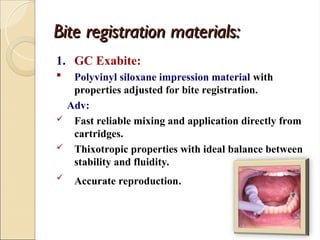
1. GC Exabite:
 Polyvinyl siloxane impression material with
properties adjusted for bite registration.
Adv:
 Fast reliable mixing and application directly from
cartridges.
 Thixotropic properties with ideal balance between
stability and fluidity.
 Accurate reproduction.
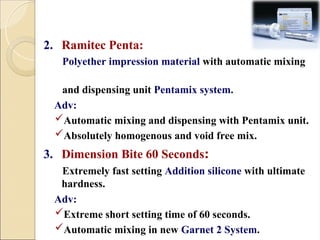
2. Ramitec Penta:
Polyether impression material with automatic mixing
and dispensing unit Pentamix system.
Adv:
Automatic mixing and dispensing with Pentamix unit.
Absolutely homogenous and void free mix.
3. Dimension Bite 60 Seconds:
Extremely fast setting Addition silicone with ultimate
hardness.
Adv:
Extreme short setting time of 60 seconds.
Automatic mixing in new Garnet 2 System.
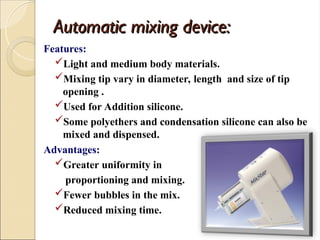
Automatic mixing device:
Features:
Light and medium body materials.
Mixing tip vary in diameter, length and size of tip
opening .
Used for Addition silicone.
Some polyethers and condensation silicone can also be
mixed and dispensed.
Advantages:
Greater uniformity in
proportioning and mixing.
Fewer bubbles in the mix.
Reduced mixing time.
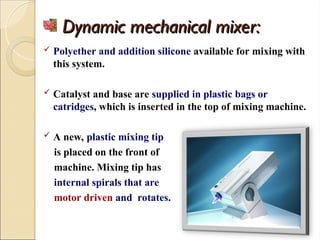
Dynamic mechanical mixer:
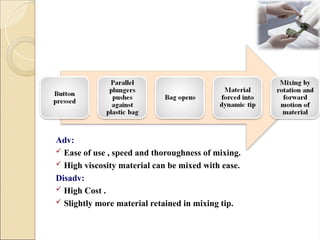
 Polyether and addition silicone available for mixing with
this system.
 Catalyst and base are supplied in plastic bags or
catridges, which is inserted in the top of mixing machine.
 A new, plastic mixing tip
is placed on the front of
machine. Mixing tip has
internal spirals that are
motor driven and rotates.
Adv:
 Ease of use , speed and thoroughness of mixing.
 High viscosity material can be mixed with ease.
Disadv:
 High Cost .
 Slightly more material retained in mixing tip.
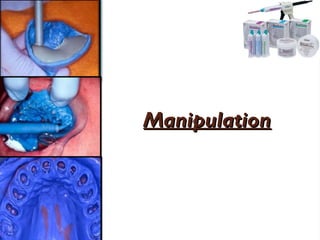
Manipulation
Manipulation
Impression procedures:
STEPS:
1 . Preparation of material.
2 . Preparation of tray.
3 .Making an impression.
4 . Removing an impression.
5 .Preparation of stone dies and cast.
Preparation of material:
 Two Paste System :
Equal length of base & catalyst paste dispensed on
mixing pad.
Mixed with stainless steel mixing spatula to get streak
free mix.
Polyether: Thinner is added to get required
viscosity.
 Putty:
Addition silicone: Equal scoop of base and acclerator
kneaded with fingers (using vinyl glove).
Condensation silicone: Required no. of scoop of base
kneaded with proportionate liquid or paste
acclerator.
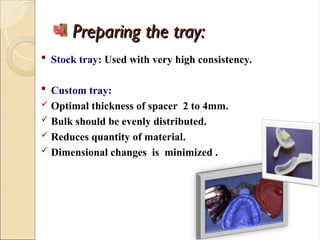
Preparing the tray:
Preparing the tray:
 Stock tray: Used with very high consistency.
 Custom tray:
 Optimal thickness of spacer 2 to 4mm.
 Bulk should be evenly distributed.
 Reduces quantity of material.
 Dimensional changes is minimized .
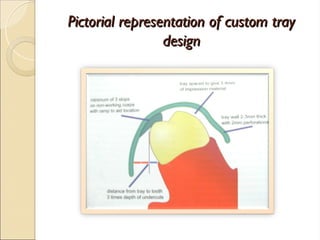
Pictorial representation of custom tray
design
design
Tray Adhesives:
Bonds the impression material to the tray.
For Polysulphides : Butyl rubber and Acrylonitrile in
organic solvent.
For Addition silicone: Polydimethyl siloxane and
ethylsilicate.
Two types:
Paint on adhesives Eg Coltene, Kerr
Universal VPS.
Spray adhesives Eg Sili spray.
Applied for 10-15mins before making impression.
Making an impression
Making an impression:
:
1.LIGHT BODY:
 Used with syringe.
 Placed directly on hard and soft tissues.
2.HEAVY BODY:
 Placed in the tray to support the light body material.
3. PUTTY :
 Exhibits least significant polymerization shrinkage.
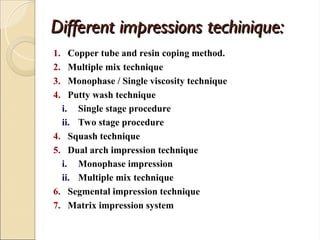
Different impressions techinique:
1. Copper tube and resin coping method.
2. Multiple mix technique
3. Monophase / Single viscosity technique
4. Putty wash technique
i. Single stage procedure
ii. Two stage procedure
4. Squash technique
5. Dual arch impression technique
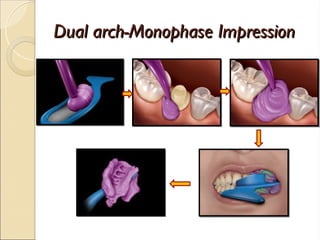
i. Monophase impression
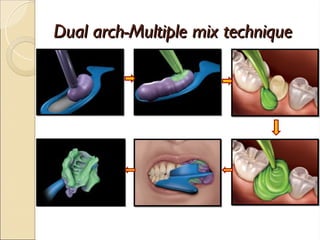
ii. Multiple mix technique
6. Segmental impression technique
7. Matrix impression system
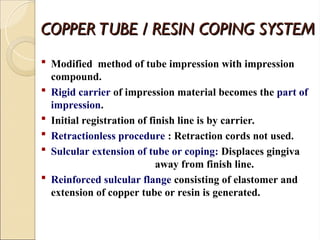
COPPER TUBE / RESIN COPING SYSTEM
 Modified method of tube impression with impression
compound.
 Rigid carrier of impression material becomes the part of
impression.
 Initial registration of finish line is by carrier.
 Retractionless procedure : Retraction cords not used.
 Sulcular extension of tube or coping: Displaces gingiva
away from finish line.
 Reinforced sulcular flange consisting of elastomer and
extension of copper tube or resin is generated.
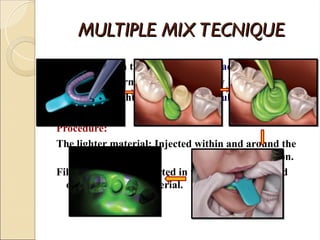
MULTIPLE MIX TECNIQUE
 Resin custom tray with 2-4 mm spacing.
 Tray : Uniform thickness of Heavy Body material .
 Syringe : Light Body material simultaneously.
Procedure:
The lighter material: Injected within and around the
tooth preparation.
Filled tray is then inserted in the mouth and seated
over the syringe material.
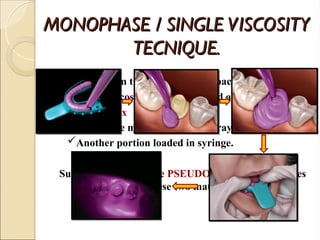
MONOPHASE / SINGLE VISCOSITY
TECNIQUE
TECNIQUE.
.
 Resin custom tray with 2-4 mm spacing.
 Medium viscosity of polyether and addition silicone .
 Only one mix
Part of the material loaded in tray.
Another portion loaded in syringe.
Success depends on the PSEUDOPLASTIC properties
of these two materials.
PUTTY-WASH TECHNIQUE
RELINE TECHNIQUE
TWO STAGE PROCEDURE:
 Putty material
Stock tray.
Preliminary impression.
Results in intraoral custom made tray formed by
the putty.
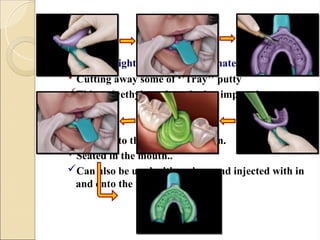
 Space for light body ‘’WASH’’ material
Cutting away some of ‘’Tray’’ putty
Thin polyethylene sheet during impression.
 Light body
Placed into the putty impression.
Seated in the mouth..
Can also be used with syringe and injected with in
and onto the preparations.
SINGLE STAGE PROCEDURE
 Wash material: Syringed into place.
 Unset putty : Seated over the unset light body
material.
Disadvantage:
Putty may displace wash material.
Critical areas of the preparation reproduced in putty.
Occlusal stops : Avoids pushing through syringe
material when seating plastic putty
mass.
SQUASH TECNIQUE
SQUASH TECNIQUE
 Stock tray is loaded with putty material.
 Syringe material is injected around the prepared
tooth or teeth.
 The tray is squashed over the syringe material.
 Hydraulic pressure of putty pushes the syringe
material in critical areas.
 Impression is made with the putty material and the
syringe material setting simultaneously.
DUAL ARCH IMPRESSION
TECNIQUE
TECNIQUE
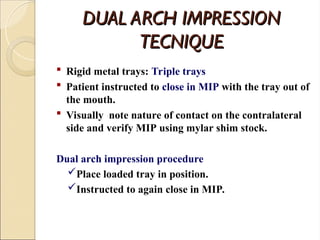
 Rigid metal trays: Triple trays
 Patient instructed to close in MIP with the tray out of
the mouth.
 Visually note nature of contact on the contralateral
side and verify MIP using mylar shim stock.
Dual arch impression procedure
Place loaded tray in position.
Instructed to again close in MIP.
Dual arch-Monophase Impression
Dual arch-Multiple mix technique
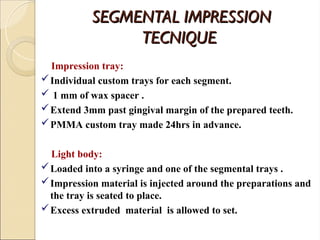
SEGMENTAL IMPRESSION
TECNIQUE
TECNIQUE
Impression tray:
Individual custom trays for each segment.
 1 mm of wax spacer .
Extend 3mm past gingival margin of the prepared teeth.
PMMA custom tray made 24hrs in advance.
Light body:
Loaded into a syringe and one of the segmental trays .
Impression material is injected around the preparations and
the tray is seated to place.
Excess extruded material is allowed to set.
MATRIX IMPRESSION SYSTEM
Series of impressions using three different viscosity of
impression material.
 Step I :Matrix is made in Occlusal registration
elastomeric impression material over the prepared
teeth.
 Step II: Definitive impression is made with high
viscosity impression material in matrix.
 Step III:
Matrix impression(s) are seated in position.
 Impression of entire arch is made with medium
viscosity impression material in stock tray ( seated
over matrix and remaining teeth)
Removing an impression
 Removed after curing has progressed sufficiently to
provide adequate elasticity.
 The impression should be removed
After at least 10 min from the time of mixing
Allow 6-8 min for the impression to remain in the
mouth.
QUICK SNAP:
To minimize plastic deformation.
To increase tear resistance.
Disinfection:
Disinfection:
Condensation silicone ,addition silicone and polysulfides:
2% GLUTARALDEHYDE is satisfactory
disinfectant.
Longer time immersion
Not recommended as it leach out and render impression
less hydrophillic.
Polyethers: Susceptable to dimensional changes if
immersed for long time(more than 10 min) because of
their hydrophilic nature.
Chlorine compounds or idophores , phenols
Preparation of stone cast and die
 Compatible with all gypsum products.
 Possible to construct two or three casts or dies from
these impressions.
NOTE:
Successive die will not be as accurate as the first
die constructed from the material.
Time interval between impression pours should
not be greater than 30 min.
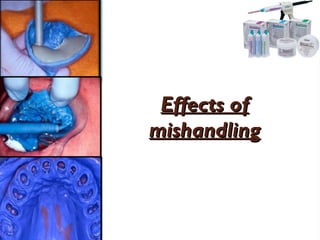
Effects of
Effects of
mishandling
mishandling
ROUGH OR UNEVEN SURFACE ON IMPRESSION:
 Incomplete polymerization
Premature removal from the mouth .
Improper ratio or mixing of components.
Presence of oil or other organisms on teeth.
 For addition silicone ,agents that contaminate the
material and inhibit polymerization.
 Too rapid polymerization.
BUBBLES:
 Too rapid polymerization , preventing flow.
 Air incorporated during mixing.
IRREGULAR SHAPED VOIDS:
 Moisture or debris on surface of teeth.
ROUGH CHALKY STONE CAST:
 Inadequate cleaning of impression .
 Excess water left on surface of the impression.
 Excess wetting agent left on impression .
 Premature removal of cast, improper manipulation
of stone.
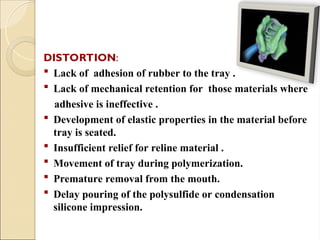
DISTORTION:
 Lack of adhesion of rubber to the tray .
 Lack of mechanical retention for those materials where
adhesive is ineffective .
 Development of elastic properties in the material before
tray is seated.
 Insufficient relief for reline material .
 Movement of tray during polymerization.
 Premature removal from the mouth.
 Delay pouring of the polysulfide or condensation
silicone impression.
Application:
Application:
 FPD: Impression of prepared teeth.
 Impression of dentulous mouth for RPD.
 Impression of edentulous mouths for complete
dentures.
 Polyether is used for border moulding of special
trays.
 As maxillofacial material.
 In implant dentistry for making impressions.
 Also used as castable material.
Summary:
Summary:
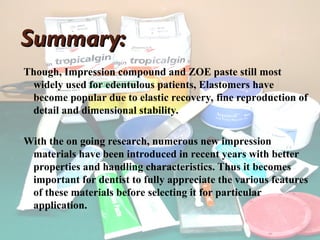
Though, Impression compound and ZOE paste still most
widely used for edentulous patients, Elastomers have
become popular due to elastic recovery, fine reproduction of
detail and dimensional stability.
With the on going research, numerous new impression
materials have been introduced in recent years with better
properties and handling characteristics. Thus it becomes
important for dentist to fully appreciate the various features
of these materials before selecting it for particular
application.
Bibliography
Bibliography
 Phillips’ Science of dental materials 11th
edition.
 Phillips’ Science of dental materials 10th
edition.
 Craig R. :Restorative dental materials, 11th
edition
 DCNA April 2004:48;2
 McCabe J. and Walls W. : Applied dental materials 8th
edition
 O’Brien: Dental materials and their selection, 2nd
edition.
 Rosenstiel: Contemporary Fixed prosthodontics, 3rd
edition.
 Bernard Levin. Impressions for complate denture.
 Van Noort R. : Introduction to dental materials, 2nd
edition.
 Polyvinyl siloxane impression materials: an update on clinical
use. Australian dental Journal 1998:43;6
 Comparision of new matrix system with traditional fixed
prosthodontic impression procedures. JPD 1998;79:200-7
 Polyvinyl siloxane impression materials: A review of properties
and techniques. JPD1992;68:728-32
 Trends in Indirect Dentistry: 5. Impression materials and
techniques. Dental Update 2005;32:374-393
 Effect of different adhesives on vinyl polysiloxane bond strength to
two tray materials. JPD 2005;94:3
 Mechanical properties of 3 hydrophilic addition silicone and
polyether elastomeric impression material.
 Effect of plasma treatment on wettability of elastomeric
impression materials. JPD 1993;70:1
 Comparision of impression materials for complete-arch fixed
partial dentures.JPD 1991;65:165-9
 Effect of different surface wetting agent on void formation in
impressions. JPD 1997;77:54-6
 Clinical study comparing marginal and occlusal accuracy of crowns
fabricated from double arch and complete arch impressions.
 Dimensional accuracy of dental casts: influence of tray material,
impression material and time. J Prosthodont 2002;11:98-108
 Properties of new polyether urethane dimethacrylate photo
initiated elastomeric impression material.JPD;1990;63:16-20
 An invitro study of the antibacterial and antifungal properties of an
irreversible hydrocolloid impression impregnated with
disinfectant.JPD 1989;62:601
 Bond strength and accuracy of combined reversible irreversible
hydrocolloid impression mession systems.JPD;67:621-27
 Australian dental journal 1981;26:12-7
 Reversible agar agar hydrocolloid. Quintessence Int 1990;21:225-
229
 www.pubmed.com
 www.google.com
Impression Materials.....bajaj seminar.ppt

Impression Materials.....bajaj seminar.ppt

  • 1.
  • 2.
    Contents: Contents:  Introduction  Classification Requirements  Rigid impression materials Impression Compound Zinc oxide-Eugenol Impression paste Impression Plaster Impression waxes  Hydrocolloid Impression materials Reversible Hydrocolloid - Agar Irreversible Hydrocolloid – Alginate  Nonaqueous Elastomeric Impression materials  Conclusion  Bibliography
  • 3.
    Introduction Introduction Impression material isa dental material whose function is to accurately record the dimensions of oral tissues and their spatial relationship. Each type possesses characteristics which influences the purpose to which its best suited..
  • 4.
    Classification: Classification: Impression material Elastic Nonelastic HydrocolloidRubber ZOE Imp. Compound Agar Alginate Mercaptan Polyether Silicone Lead oxide Clear Condensation Addition catalyst catalyst
  • 5.
    1. 1. According tosetting reaction According to setting reaction Irreversible (Chemical Reaction)  Plaster of Paris ZOE Alginate Non aqueous Elastomer Reversible (Temperature changes) Thermoplastic materials Impression compound Wax Non-thermoplastic materials Agar
  • 6.
    II. II. According toelasticity According to elasticity Elastic impression materials Alginate Agar Non-aqueous elastomers Non-elastic impression materials Impression compound Impression plaster Zinc-oxide Eugenol Wax
  • 7.
    III. III. According touse in dentistry According to use in dentistry For obtaining impression of dentulous mouth Alginate Agar Non-aqueous elastomers For obtaining impression of edentulous mouth Impression compound Impression plaster Zinc-oxide Eugenol Wax
  • 8.
    IV. IV. According toviscosity According to viscosity Mucostatic materials  Impression plaster  Agar  Alginate Mucocompressive materials  Impression compound
  • 9.
    Requirements: Requirements:  Fluid enoughto adapt to oral tissues.  Viscous enough to be contained in the tray.  Should set into a rubbery or rigid solid in mouth.  Set impression should not distort or tear when removed from the mouth.  Adequate setting characteristics that meet clinical requirements.  Adequate strength.
  • 10.
     Should possesselastic properties.  Dimensional stablity.  Compatible with die and cast materials.  Easy to use with minimum equipment  Pleasant taste, odour, and esthetic color.  Non toxic or irritating.  Adequate shelf life.  Economical.
  • 11.
  • 12.
    Composition: Composition: Ingredients Function Waxes (Beeswax, colophany) Softenon heating . Brittle,Tasteless, Odorless and greasy to touch. Thermoplastic resins (Rosin, Shellac, Copal resin) Primarily responsible for transition from solid to liquid state. Account for more then 50%. Filler (Chalk, talk, Limestone) Increases viscosity at temp above mouth temp. Increases rigidity at room temp. Plastcizers (Guttapercha Stearic acid, Shellac) Colouring agents Improves plasticty and workability. Identify different brands and different softening temperature.
  • 13.
    Types: Types: According to ADASpecification No. 3 Type Flow at Use 37ºC 45ºC Type 1 Impression compound Less than 6% More than 85% Preliminary impressions of edentulous patients. Peripheral seal materials. Impression of single crowns for copper band impressions. Type 11 Tray compound Less than 2% 70-85% Primarily used as tray materials that are sufficiently rigid to support other impression materials.
  • 14.
    Mode of supply: Modeof supply: Cakes Cones Sticks Cylinders  Brown  Higher working temp.(55.5-56.1ºC)  For extending short borders of custom trays.  Green  Lowest working temp.(50-51.5ºC)  Most popular: Easy flow & good handling properties.  Grey  Average working temp.(53.3-54.4ºC)  Longer period of flow (compared to green).  White: 55.5-56.6ºC  Black : 56.1-57.2ºC High fusing, mainly used in cake form.
  • 15.
    Properties: Properties: Fusion Temperature (43.5ºC) PracticalSignificance: Indicates a definite reduction in plasticity of material during cooling. Above this temperature: Softened material remains plastic. Once the impression tray is seated, it should be firmly held in position until the impression cools below fusion temperature.
  • 16.
    Thermal Conductivity: Low During softening, outside layer softens first and inside last. Impression should be withdrawn from mouth only after its hardened throughout. Thermal Contraction: Linear contraction on cooling from mouth to room temperature: 0.3 -0.4%
  • 17.
    Glass Transition Temperature(39ºC) Glass Transition Temperature (39ºC)  Non-crystalline solids  No definite melting temperature.  Gradually soften as the temperature is raised. The temperature at which there is an abrupt increase in thermal expansion coefficient indicating increased mobility is called Glass Transition Temperature which is characterized by a glassy structure.  Below this temperature: Loses its fluid characteristics and has significant resistance to shear deformation.
  • 18.
    Dimensional stability Ensured bycarefully preparing and handling the materials.  Avoiding over or prolonged heating.  Adequate flow to allow close adaptation to tissues and minimum of internal stress in impression.  The tray, copper band or other container used to convey the compound to the mouth must be strong, rigid and stable.
  • 19.
     Impression shouldbe withdrawn from mouth only after its hardened throughout.  Cast or die should be made as soon as possible to avoid inaccuracies caused by release of stress.  Causes of internal stress : High Coefficient of thermal expansion. Poor thermal conductivity. Relatively large temp. drop from softening to room temp.
  • 20.
    Manipulation: Manipulation:  Treated inthermostatically controlled water bath at 55–600 C.  Compound added to the water in small pieces.  It must be immersed in a water bath for sufficient time to ensure complete softening. However, if it is left too long, some of the constituents may be washed out, thereby altering the properties.
  • 21.
    Wet Kneading If kneadedin water, water will become incorporated in the material and acts as a plasticizer. By kneading for 1-3 minutes, the flow of compound may be more than doubled. Construction of Cast  Gypsum product with in one hour. Disinfection of impression:  Rinse to remove blood, debris & saliva.  10 to 30 minutes immersion in Gluteraldehyde or Iodophor.
  • 22.
    Advantages  Rigid whenset.  Inexpensive.  Non toxic. Disadvantages  Due to pressure while making impression, tissues will be compressed.  Distorts easily leading to poor dimensional stability.  Cannot be removed from undercuts.  High thermal expansion.  Does not reproduce fine surface details.
  • 23.
    ZINC-OXIDE EUGENOL ZINC-OXIDE EUGENOL IMPRESSIONPASTE IMPRESSION PASTE Rigid. Irreversible.
  • 24.
    Composition: Composition: Component % Function Zincoxide 80-87 Reactive ingredient, takes part in setting reaction. Finely divided, with very slight amount of water. Vegetable or mineral oil 13-15 Acts as plasticizers. Masks the action of eugenol as irritant. Component % Function Eugenol/Oil of clove 12-15 Reactive ingredient. Oil of clove contains 70-85% of eugenol. Gum or Polymerised rosin 50 Gives body & coherence to mixed material. Imparts thermoplastic property to set impression. Facilitates speed of reaction and more homogenous product . Filler 16-20 Inert material to form paste with suitable consisitency. Resinous balsam 10 Increases flow and improve mixing properties. Accelerator, moisture 4-5 Accelerators like zinc acetate, glacial acetic acid, metallic salts of hydrochloric and nitric acids, primary alcohols. Tube No. 1 Base paste Tube No. 2 Catalyst paste
  • 25.
    Classification Classification According to ADAspecification no.16, Depending on hardness  Type I or hard set.  Type II or soft set. Depending on eugenol content  Eugenol containing impression pastes.  Non-eugenol pastes.
  • 26.
    Setting reaction: Setting reaction: Chelationreaction: Acid-base reaction to form a chelate. Product is called zinc eugenolate. Chelate compound: Zinc atom held by two eugenol claws due to the ionic salt bonds formed between zinc and phenolic oxygen of each molecule of eugenol. Autocayalytic reaction: Water is needed to initiate the reaction and is also the by-product of the reaction.
  • 27.
  • 28.
    Setting time: Setting time: Initialsetting time:  Period from beginning of mixing until the material ceases to pull away or string out when it surface is touched with the metal rod of specified dimensions.  Impression should be seated in the mouth before the initial set. Final setting time:  Rod fails to penetrate the surface of the specimen more than 0.2 mm under the load of 50 gms. At 23 + 2 0 C and at 50% relative humidity Type Initial setting time Final setting time Type 1 3-6 minutes 10 minutes Type 11 3-6 minutes 15 minutes
  • 29.
    Control of theSetting Time Decreased setting time:  Addition of zinc acetate or other accelerators.  Mixing a small drop of water before blending the two pastes. Increased setting time:  Cooling the spatula and mixing slab.  Addition of inert oils and waxes during the mixing (olive oil, mineral oil, and petrolatum). By changing the ratio of ZnO paste to eugenol paste, retardation or acceleration obtained will depend upon which paste contains the accelerator.
  • 30.
    Properties: Properties: Consistency & Flow Shouldbe homogenous and flow uniformly against the tissues while the impression is being obtained.  Thick consistency: Compress the tissues.  Thin consistency : Impression of the tissues in a relaxed condition with little or no compression. Materials with decreased flow at various time interval have shorter setting times and a shorter time interval between initial and final set.
  • 31.
    Rigidity & Strength Shouldbe unyielding when it is removed from the mouth and should resist fracture. Dimensional Stability  Shrinks 0.1% or less at the end of 30 minutes after mixing. Can be preserved indefinitely without change in shape due to relaxation, warpage or other causes. Warpage of thick base plate tray on standing may result in distortion of ZOE impression.
  • 32.
    Manipulation: Manipulation:  Mixing doneon oil-impervious paper or a glass-mixing slab with stiff stainless steel spatula .  The proper proportion is obtained by squeezing ropes of same length from each tube.  The orifices of the two tubes are regulated to deliver the proper amount from each tube.  Two ropes are mixed with the first sweep of spatula.  Mixing time: 1 min, until uniform color is observed.
  • 33.
    Impression Impression making: making:  Mixis spread in a thin layer over tissue bearing surface of the custom tray and carried to mouth.  Should be held firmly in position until it is thoroughly hardened.  The accelerating action of the heat of mouth and saliva on the surface of tissues causes adjacent surface of impression to harden first. Disturbance of impression at this stage will result in warpage.
  • 34.
    Non-Eugenol Impression pastes: Non-EugenolImpression pastes: Disadvantages of ZOE pastes Stinging or burning sensation. Free eugenol present may leach out causing disagreeable taste. Chronic gastric disturbance may result in cases where surgical pack is worn for several weeks. Thus to solve these problems, non-eugenol pastes are developed.
  • 35.
     A materialsimilar to ZOE reaction product can be formed by saponification reaction to produce an insoluble “ soap “.  Zinc oxide reacted with carboxylic acid, Orthoethoxybenzoic acid. Disadvantage: Disagreeable odour and taste.
  • 36.
    Advantages Relatively rigid material,thus impression can be removed from mouth without any deformation. Allows sufficient working time. Registers surface detail accurately. Dimensionally stable. Minor defects can be corrected locally by adding a fresh mix to the area and carefully reseating impression in mouth.
  • 37.
    Disadvantages Requires special trays. Stickyin nature and adheres to tissues, cleaning is difficult. Presence of eugenol causes tissue irritation and burning sensation, some patients are allergic to eugenol. Cannot be used for making impressions of teeth and undercut area, as it is inelastic in nature.
  • 38.
  • 39.
    Composition: Composition: Similar todental plaster. Similar to dental plaster.  Calcined beta calcium sulfate hemihydrate: When mixed with water forms calcium sulfate dihydrate.  Potassium sulfate (0.6%): Anti-expansion agents. Accelerator.  Borax : Retarder  Pigment such as alizaran red makes a clear distinction between the impression and model.  Natural gum like Tragacanth gives cohesion to the mass and facilitate border molding of the impression.
  • 40.
    AE or Anti-Expansion solution  Sometimes the additives are supplied as an aqueous solution which is to be mixed with plaster. Potassium Sulphate 4% (2.5%) Borax 0.4-1% (0.25%) Alizarin red 0.04%
  • 41.
    Soluble Impression Plaster SolubleImpression Plaster  Potato starch is incorporated so that the set plaster will disintegrate due to swelling of starch and make it soluble.  After the cast has hardened, the impression and cast are immersed in hot water, thus facilitating rapid removal of impression from the cast model. Added advantages of starch:  Produces very smooth mix.  Produces slightly sticky mix that adheres to tray even when in thin wafers.  Serves as inert filler and reduces temperature rise.
  • 42.
    Setting time andsetting expansion  Water-Powder ratio: Higher the ratio, slower the setting, lower the expansion.  Spatulation time : Longer the mixing, lesser the setting time and greater is the expansion.  Temperature : Increased temp, faster is the setting. Hence it will set more quickly in the mouth then in bowl.
  • 43.
    Properties: Properties: Main differences betweenImpression plaster and Model plasters:  More rapid setting in impression plaster in order to avoid discomfort to both patient and dentist.  Smaller setting expansion for greater accuracy in impression plaster  Much lower strength so that fracture can occur easily if material engages undercut.
  • 44.
    Accuracy Very accurate impressiondue to:  Initial fluidity of material allowing to record soft tissues in uncompressed state.  Absorption of moisture from surface of oral soft tissues, facilitating intimate contact between the impression material and tissues.  Minimal dimensional change on setting.
  • 45.
    Manipulation: Manipulation:  Water-Powder ratio:0.06 i.e 100gm of powder in 60ml water.  Mixed in rubber bowl using wide, stiff bladed spatula to get fluid mix.  Mixing time: 30-45 seconds. Impression making: 1. In custom tray with 1-1.5mm spacer. 2. Wash plaster impression in preliminary compound impression. 3. Recording impression of undercut area in fractured pieces which is then secured in correct position by sticky wax or cyno-acrylate glue.
  • 46.
    Construction of cast: Constructionof cast: Mix of model plaster or dental stone is poured directly into a plaster impression Water and dissolved hemihydrate will penetrate into porous plaster of impression Set cast will be tightly bonded to the impression
  • 47.
    Separating media: Facilitateseasy separation of impression from the cast . Types 1. Produces thin film over impression plaster resulting in some loss of surface detail and accuracy. Eg: Varnishes like sandrac, colloidan and alginate solution. 2. Reacts with the surface of Plaster itself ,making it impervious with very little loss of surface details . Eg: Soap solutions or water glass solution (60% sol of sodium silicate in water).
  • 48.
    Advantages:  Dimensionally accuratewith good surface details.  Absorbs palatal secretions during setting.  Speedy handling and easy manipulation.  Produces minimum tissue displacement. Disadvantages:  Cannot be used to compress tissues.  In very wet mouth, surface of plaster tends to be washed away spoiling the surface details.  Exothermic setting reaction.  Separating media used may obliterate some details.  Cannot be removed from undercuts without breaking.
  • 49.
  • 50.
    Composition Mixture of lowmelting paraffin wax and bees wax in a ratio of 3:1. Examples: Iowa Wax Korecta Wax Types:  Corrective wax.  Bite registration wax.
  • 51.
    Characteristics and usesof the Characteristics and uses of the Korecta Wax/ fluid–wax series Korecta Wax/ fluid–wax series No. I Wax Properties  Congeals rapidly with slight amount of shrinkage.  Tissue-pink in colour.  Hard with practically no flow at body temperature.  Brittle.
  • 52.
     Uses  Supportextension of the impression wax when there is need to carry it beyond the border of the temporary base.  Final wax-up of porcelain or resin teeth after they have been adjusted to the desired position.  Reposition extension partial denture before making rebase impression. acts as a support to maintain the correct position of the base and prevents its rotation .
  • 53.
    No. II Wax Yellowin colour. Has slight flow at body temperature. Ability to adapt very slowly to the ridge structures makes it useful as a temporary lining of a base, which should be worn for a short time. Can be placed as a lining when a posterior stop of the No. 1 wax has been used to prevent the rotation of an unstable denture.
  • 54.
    The No. IIIWax  Red in colour.  Flow is greater than that of No. II wax but much less than that of impression wax.  Used to correct minor areas of discrepancy (such as that in the area of an inaccurately fitting base) before placing the impression wax.
  • 55.
    The No. IVWax Orange in colour. Has high rate of flow at body temperature. Must always be carried by the temporary base when it is recording the supporting contour of the sub-basal structures. Used for making a correctable impression.
  • 56.
    Corrective Impression Wax CorrectiveImpression Wax  Used as wax veneer over an original impression to register the details of soft tissues.  Records the mucous membrane and underlying tissues in functional state.  Flow: 100% at 37ºC.  Disadvantage: Distortion during removal from mouth.
  • 57.
    Bite Registration Wax BiteRegistration Wax  Used to articulate accurately certain models of opposing quadrants.  Flow: 2.5 to 22% at 37ºC.  Disadvantage: Distortion during removal from mouth.
  • 58.
    Manipulation and usage Manipulationand usage  Applied with short bristle brush in small quantities to fill areas of impressions with insufficient material.  Undersurface of tray is covered first with a continuous layer to prevent moisture from getting under the wax to loosen it.  Surplus of impression wax (No. IV) is added then just inside the border.  Tilt the tray to prevent wax from running toward the center.  Achievement of relationships of impression is determined by glossy appearance.
  • 59.
    Disadvantages Disadvantages  Easy deformationunder stress.  Minimal surface hardness.  Poor dimensional stability.  More time consuming.  Extreme skill and care necessary to prevent distortion .
  • 60.
  • 61.
  • 62.
    Composition: Composition: Ingredient Weight %Function Agar 12-17 (Tray) 6-8 (Syringe) Sulphuric ester of linear polymer of Galactose. Dispersed phase of sol and continuous fibril of gel. K2SO4 1.7 Plaster hardener. Counteract inhibiting effect of borax and agar on setting of gypsum model. Borax 0.2 Improves gel strength by intermolecular attraction. Alkyl Benzoate 0.1 Prevents growth of mold in impression material during storage. Fillers (Clay, Silica, Wax) -- Controls strength, viscosity and rigidity. Water 85.5 Continuous phase in sol and 2nd continuous phase in gel. Colour and Flavours Trace Improve appearance and taste.
  • 63.
    Properties: Properties: Viscosity of Sol Visco-elastic material.  Viscosity: Contained in tray. Reproduce detail of teeth and soft tissues. Gelation Temperature  After 8 min boiling: Fluid enough to be extruded from container.  After tempering: Sol Homogeneous.  Set to gel between 37 to 45ºC.
  • 64.
    Strength  Time dependent. Greater at higher rate of loading. (Impression to be removed with a Snap.)  Directly related to Brush heap density (Conc. of agar)  Inversely related to temperature.  Compressive strength: 8000 gm/cm2  Tear strength: 700 gm/cm2
  • 65.
    Dimensional stability Storage conditionDimensional change Cause Air Shrinkage Evaporation of water from gel. Water Expansion Imbibition and absorption of water. 100% relative humidity Shrinkage Syneresis. Inorganic salt solution Expansion/Shrinkage Depends on relation of electrolyte in gel and in solution. Storage media: 2% Potassium sulphate 100% Relative humidity. Pour the impression immediately.
  • 66.
    Flexibility  4 to15% under 14.2 psi stress. Permanent Deformation (1%)  Material is adequately gelled.  Removed with sharp thurst.  Minimal undercuts in prepared cavity. Compatibility with Gypsum  More compatible then alginate.  Stored in humidor  rinse to remove exudate formed from syneresis.
  • 67.
    Manipulation: Manipulation: Preparation of material Reverse gel to sol: Boiling water 8-10 min.  High altitude: Propylene glycol.  Reliquefy: Additional 2-4 mins.  Storage: 60-66ºC for hours.  Tempering: Loaded tray in 46ºC water for minimum of 2 and maximum of 10 min. Purpose  Increases viscosity.  Increases pressure applied to syringe material.  Cool to temp compatible to oral tissues.
  • 68.
    Impression procedure: Impression procedure: Watercooled impression trays  Temp of circulating water18-21ºC.  Circulated for minimum of 5 min. Syringe material: Ejected on prepared teeth. Tray material: Water soaked outer layer soaked with dry gauze sponge. Seated with passive pressure.
  • 69.
    Wet field technique: Wetfield technique:  Tooth surface and tissues are flooded with warm water.  Syringe material :Only on incisal and occlusal surface.  Tray material seated while syringe material is still liquid.  Hydraulic pressure of tray material forces the fluid syringe material down to the areas to be restored.
  • 70.
    Construction of cast: Constructionof cast:  Hardening solutions: 2% K2SO4 , Potash alum, ZnSO4 , MnSO4 . Accelerates setting of gypsum. Reacts with gel Prevents syneresis.  After poured in stone, placed in humidor or 2% K2SO4.  Should be kept in contact with impression for 30-60min.
  • 71.
    Impression disinfection: Impression disinfection: Relatively fast to prevent dimensional changes.  Iodophor, Bleach, Gluteraldehyde. JPD 1991; 65 (1) Water to be changed between patients in the tempering compartment. Tray to be packed in plastic prior to trying in mouth. Addition of iodophor to water of tempering bath. Temper the hydrocolloid in tube.Thus transferring the material from tube to tray without contacting water.
  • 72.
  • 73.
    Composition: Composition: Constituent Approx. % Function Soluble salt of Alginicacid 12-20 Polysaccharide prepared from marine kelp. Linear polymer of Anhydro-ß-D-Mannuronic acid. K+ Na+ NH4 + makes them soluble. Reacts with Ca2+ dissolving in water. Calcium Sulphate Dihydrate 12-20 Releases Ca2+ which reacts with salts of alginic acid. Trisodium Phosphate 2-5 Retarder. Reacts with Ca2+ from Calcium Sulphate Dihydrate to form insoluble Ca3(PO4)2 Glycols Small Results in Dustless alginate. Constituent Approx. % Function Filler (Diatomaceous Earth or Silicate powder) 55-70 Increases cohesion of mix. Strengthens the gel. Controls consistency of mix and flexibility of impression. Other salts (K2SO4, potassium titanium flouride, Silicates) 3-10 Inhibits effect of hydrocolloid on setting of gypsum, giving high quality surface to die. Flouride salts accelerates setting of gypsum products. Flavouring agents Traces Wintergreen, Peppermint etc. Pigments Traces Provide colour. Chemical indicators Traces Change colour with change in ph to indicate different stages of setting.
  • 74.
    Chemistry: Chemistry: Gelation reaction Retarder FromCaSO4 Potassium alginate Calcium alginate
  • 75.
    Gel structure: Gel structure:Brush Heap Structure Brush Heap Structure  Calcium alginate precipitates as fibrous network with water in intervening capillary spaces.  Fibrils held together by primary bonds.  Ca2+ replaces Na+  Crosslinking between alginate molecules Polymer network. CaCl2 : Cross-linking virtually completes in seconds. CaSO4: Supplies ions at slower rate  Only part of alginate crosslinked.
  • 76.
    Types: Types:  According toADA specification No. 18: Property Type 1 Fast set Type 11 Regular set Mixing time 45 seconds 60 seconds Working time 1.25-2 minutes 3 minutes Use Children or problem patients Routine use
  • 77.
    Properties: Properties: Strength  Time dependent. Greater at higher rate of loading. (Impression to be removed with a Snap)  Compressive strength: 5000 to 9000 g/cm2  Tear strength : 380 to 700 g/cm2 Factors affecting strength: Water/Powder ratio Mixing time. Composition
  • 78.
    Flexibility  11-15%  Hardset: 3-8%  Lower water-powder ratio  Lower flexibility. Permanent Deformation (1.2%)  Reduced by bulk of material. (5mm between tray and tissues) Viscosity  Low viscosity  mucostatic impression material.
  • 79.
    Dimensional stability  Inair  loss of water  shrinks.  In water  absorbs water  swells.  Storage: in 100% relative humidity for 1 hr.  Should be poured immediately. Shelf life  Deteriorates at elevated temp.
  • 80.
    Compatibility with gypsumproducts Australian Dental J. 1981 Vol 26(1)  Surface compatibilty of gypsum with alginate can be improved.. If calcium sulphate reactor is replaced. In place of sodium alginate, triethanolamine alginate to be used..  By this exudate sodium sulphate is not formed.
  • 81.
    Disinfection Tobias, Browne, Wilson(1989)  Development of alginate impregnated with antimicrobial compound.. “Didecyldimethyl ammonium chloride”  Self sterilizing impression material.  Not effective against Pseudomonas Aeruginosa. Robert W.Schutt (1989)  Effective bactericidal effect of dental gypsum containing 0.25% Chloramine-T on Alginate impression and Dental cast..
  • 82.
    Manipulation: Manipulation: Dispensing… Mixing… Loading the tray… Perforatedtray. Rim lock trays. Wisp of cotton wool secured to the tray. Adhesives: Methylcellulose. Taking Impression…
  • 83.
    Laminate technique: Laminate technique: Agar-Alginate combination impression  Syringe agar : Injected around preparation.  Chilled Alginate mix: In tray, promptly seated on the top of agar. Advantages: More accurate surface reproduction by agar. Agar more compatible with gypsum. Elimination of water-cooled impression trays.
  • 84.
    Developments: Developments: Dustless Alginate: Coatedwith Glycol. Chromatic Alginate: Contains chemical indicators that indicates stage of setting.(Based on change in pH) Siliconised Alginate:  Hybrids of alginate and silicone elastomers.  Properties close to alginate.  Two paste system.  Fine detail reproduction and better tear strength.
  • 85.
    Modified Alginates:  Modification1: Alginate as sol containing water but no Ca2+. Reactor (Plaster of paris) is added at the time of manipulation.  Modification 2: Two component system in two pastes.. Paste one: Alginate sol. Paste two: Calcium reactor.
  • 88.
  • 89.
  • 90.
    Contents: Contents:  Introduction  History Classification  Composition and chemistry  Properties  Advantages and disadvantages  Clinical presentation  Recent developments  Manipulation  Disinfection  Effects of mishandling  Applications  Summary  Bibliography.
  • 91.
    Introduction: Introduction:  Group ofrubbery polymers.  CHEMICALLY or PHYSICALLY cross linked .  Easily stretched and rapidly recover their original dimensions when the applied stress is released.
  • 92.
    History: History:  Introduced in1950s.  In 1955 Pearson reported on “ A new elastic impression material”… Polysulphide.  Silicone base material introduced there after.  In late 1960s Polyethers introduced in Germany.  In 1980s A visible light-cure Impression material was introduced.
  • 93.
    Classification: Classification: I. According tochemistry Non-aqueous elastomers Mercaptan Silicone Polyether Lead oxide Clear catalyst catalyst Condensation Addition
  • 94.
    II. According toADA Specification No. 19 III. According to viscosity 1. Very Heavy Viscosity 2. Heavy body 3. Medium body 4. Light Body. Max. permanent Deformation Max. Flow in Compression Max. Dimensional change in 24 hrs. Type I 2.5 0.5 - 0.5 Type II 2.5 0.5 -1.0 Type III 5.5 2.0 - 0.5
  • 95.
  • 96.
    1. 1. Polysulphide Polysulphide Trade names: Permlastic: Lead dioxide system.  Ceo-Flex.  Omni-Flex: Copper hydroxide system.
  • 97.
    COMPOSITION: COMPOSITION: Base paste: Base paste: Polysulphide polymer 80-85% With terminal and pendant mercaptan group (-SH)  Filler 44% Eg : Lithopone, Titanium dioxide, Zinc sulphate Provides required strength.  Plasticizer 5% Dibutyl or Dioctyl Phthalate. Confers appropriate viscosity to paste.  Sulphur Accelerator
  • 98.
    Catalyst paste: Catalyst paste: LeadDioxide 60-68%  Active catalyst. Dibutyl pthalate 30-35%  Plasticizers. Sulfur 3% Other substances such as magnesium stearate and deodorants
  • 99.
    Chemistry Chemistry Oxidizing agent, Leaddioxide Initiates polmerization. First Chain lengthening between terminal –SH groups occurs  Increases viscosity. Subsequent Cross linking between pendant –SH groups  Elasticity.  Condensation polymerization: Reaction byproduct water is formed.  Exothermic reaction: 3-4ºC rise in temp.
  • 100.
    O = Pb = O HS---------------------SH O = Pb = O H S S H O = Pb= O --SH HS- -S-S---------------S-S- S S S S S + 3PbO + H2O Mercaptan + Lead dioxide Polysulfide rubber + Lead oxide + Water
  • 101.
    II. II. Condensation Silicone: CondensationSilicone: Trade names  SIL 2  COLTEX Composition Base Liquid silicone prepolymer Filler (colloidal silica, metal oxide) Catalyst Tetraethyl silicate Stannous octoate
  • 102.
    Chemistry: Hydroxy-terminated Dimethyl siloxane Tetraethylorthosilicate Stannous octoate (catalyst) Silicone rubber Ethyl alcohol (Evaporates (Evaporates   Contraction) Contraction)
  • 103.
    III. III. Addition Silicone: AdditionSilicone: Trade names  Reprosil  Provil  President
  • 104.
    Composition: Base  Poly(methyl hydrogen siloxane) Other siloxane prepolymers  Filler (colloidal silica, metal oxide) Catalyst  Divinyl polysiloxane  Platinum salt (catalyst)  Palladium( H2 absorber)  Platinium  Retarder  Fillers
  • 105.
    Chemistry: Vinyl Siloxane SilaneSiloxane Platinum salt (catalyst) Silicone Rubber  No byproduct  If no impurities present and there is correct proportion.  If out of proportion or impurities  H2 produced  Pinpoint voids in stone cast.  Latex gloves Contains sulphur  Inhibits polymerization.
  • 106.
    IV. IV. Polyether Polyether Base  Polyetherpolymer  Glycolether or Phthalate (plasticizer)  Filler (colloida silica) Catalyst  Aeromated sulfonate ester (cross linking agent)  Colloidal silica  Glycolether or Phthalate (plasticizer) Trade names Impregum Ramitex Composition
  • 107.
    Chemistry: Chemistry: Polyether Sulphonic esterCrossed linked rubber  Reaction is brought about by Aziridine rings (present at the end of branched polyether molecule). Main chain is copolymer of ETHYLENE OXIDE and TETRAHYDROFURAN
  • 108.
  • 109.
    Rheological Properties Rheological Properties Importantfor accuracy impression materials. VISCOUS PASTE VISCOELASTIC SOLIDS (Introduced in mouth) (Set impression) The viscosity and flow behaviour of the unmixed components control the ease of mixing.  Silicones: More fluid  Easier to mix than polysulfides. Shorter setting time  Flow present for shorter period.  Polyether: Viscosity can be reduced by using a thinner.
  • 110.
    Shear thinning:  Decreasein viscosity with increasing shear rate.  Important for single viscosity materials. Polyether Polysulfide with Cu(OH)2 accelerator.  Single mix can be used in syringe-tray technique. Lower viscosity during injection with a syringe. Higher viscosity when inserted in a tray during mixing.
  • 111.
    Working and settingtime Working and setting time Polysulfides Silicones Polyethers  Chilling material, mixing on cool slab  Altering base:catalyst Alters working time Setting time and Curing time: Not same.  Condensation silicone: Polymerization continues for 2 or more weeks after mixing.  Addition silicone : Little residual polymerization after material is clinically set. Increases working time
  • 112.
    Dimensional stability Dimensional stability Soucesof dimensional changes: 1. Polymerization shrinkage 2. Loss of by-products  Water: Polysulphides.  Alcohol: Condensation silicone. 3. Thermal contraction from oral temperature to room temperature. 4. Imbibition when exposed to water, disinfectant or high humidity environment over a period of time. 5. Incomplete recovery of deformation because of viscoelastic behavior.
  • 113.
    Order of dimensionalstability: Addition Condensation For maximum accuracy:  Condensation silicone and polysulphides: Poured immediately (with in 30 mins).  Addition silicone: Produces H2. Should be poured after 1-2 hours. With addition silicone and polyether, cast poured at 24 hrs and 1 week are as accurate as one made with in first hr.  Polyether impressions  Stored in water  Slowly absorb water  Changes dimensions. Silicone Polyether Polysulphides Silicone
  • 114.
    Strain Strain Order of Stiffness: PolyethersAddition Condensation Polysulphides Putty Heavy body Medium body Light body  Strain in compression under a stress of 100gm/cm2 is a measure of the flexibility of the material. Newer Polyethers in medium body formulation are more flexible than one step hydrophilic vinyl polysiloxane impression materials. Silicone Silicone
  • 115.
    Hardness Hardness  Hardness increasesfrom low to high consistency.  When given in two numbers  First number : Hardness 1.5 min after removal from mouth.  Second number: Hardness after 2 hours. Polysulfides and Low, Medium and High viscosity Addition Silicones : No significant change in hardness with time. Condensation Silicones, Addition Silicone Putty and Polyether : Hardness increases with time.
  • 116.
     Hardness andstrain affects the force necessary for removal of the impression from the mouth.  Low flexibility and high hardness  More space for impression material between tray and teeth.  Polyether  Low flexibility  Problems in removal of the impression  4mm rather than 2mm thickness of rubber between tray and teeth is recommended.
  • 117.
    Tear strength Tear strength Indicates the ability of material to withstand tearing in thin interproximal and subgingival areas.  Tear strength is a measure of the force needed to initiate and continue tearing a specimen of unit thickness. Order of tear strength: Polysulphides Polyether Silicones Hydrocolloids Factors affecting tear strength  Increase in consistency  Increases tear strength.  Addition of thinner  Decreases tear strength.  Rapid rate of force application  Increases tear strength.
  • 118.
    Detail reproduction Detail reproduction Silicones and polyethers registers detail better than polysulfides.  Except for very high viscosity products, they all should reproduce a v-shaped groove and a 0.020mm wide line in the rubber.  It should be compatible with gypsum products so that the 0.020mm line is transferred to gypsum die materials. They are capable of reproducing detail more accurately than can be transferred to stone cast.
  • 119.
    Wettability Wettability  Assessed bymeasuring the advancing contact angle of water on the surface of the set impression material.  The wettability is directly correlated to the ease of pouring high strength stone models. θ = <90º θ = >90º
  • 120.
     Hydrophilic materials:Hydrophilic addition silicones and Polyethers  Best wettable.  Hydrophobic materials: Polysulphides, Condensation silicones and Conventional addition silicones  Least wettable. Modes of increasing wettability: Use of surfactant before making impression. Use of surfactant before pouring cast. Plasma treatment of impression material. Addition of intrinsic surfactant in addition silicone.
  • 121.
    Shelf life Shelf life Longer for Polysulphide and Polyether then Silicones of approximately 2 years. Should be stored in  Tightly closed container/tubes.  Cool environment. According to ADA specification No. 19 The material should meet the test of permanent deformation after the base and accelerator are stored for 7 days at 60±2°C (140±3.6°F).
  • 122.
    Biological properties Biological properties Polysulphides Toxiceffect of lead  Questioned the use of lead compounds in polysulfide. Reasons for unlikely harmful effect of lead in material:  Material is in patient’s mouth for only a few minutes.  It is hydrophobic, reducing the chances of washing out of lead compounds by saliva. Polysulphides results in lowest cell death count.
  • 123.
    Condensation silicone Non-toxic, althoughdirect contact of skin with the accelerator is to be avoided since allergic reactions have been noted. Addition silicone Causes less tissue reaction than the condensation silicones. Polyether  The aromatic sulfonic acid ester can cause contact dermatitis, hypersensitivity reactions.  Shows highest cell cytotoxicity scores.  No cytotoxic effects on exposure to polyether with imine catalyst.
  • 124.
    Common elastomer inducedbiocompatibilty problem Segment of impression material lodged in sulcus Foreign body reaction Inflammation Misdiagnosed as caused by tooth preparation or cementation. Visual inspection of impression after removing. Polysulphide  Advantageous.  Greater tear resistance.  Radiopaque.
  • 125.
  • 126.
    Advantages Advantages Excellent surface detail. Dimensionalaccuracy. No separator required before pouring casts. Record undercuts but polysulfides may suffer from permanent deformation on removal. Polysulfides have good tear resistance. Additon silicones have excellent dimensional stability, even in cold sterilizing solutions. Wide range of different viscosities available to match different clinical situations.
  • 127.
    Low viscosity siliconessuitable for wash techniques. Putty silicones are useful as space-filling materials. Pleasant appearance and feel in the mouth. Can be electroformed to give metal die, an advantage over stone dies because of greater abrasion resistance. More easily prepared for use. More dimensionally stable over a period of time than hydrocolloids. Do not affect hardness of the surface of stone.
  • 128.
    Disadvantages Disadvantages  They arehydrophobic and so tend to slip on wet, mucus-covered mucosa.  Prolonged setting time, especially polysulfides.  Tear resistance of silicones is low.  Condensation silicones are dimensionally unstable.  Silicone putty can easily distort peripheral tissues.  After set, the boders cannot be adjusted.  Polysulfides have strong odour of rubber and untidy to handle.
  • 129.
    Tray must beheld rigidly for accuracy for 8-12 minutes for setting. The ratio of the material is also critical; if the ratio is not accurate, the mechanical properties may be changed. Complete adhesion to a prefabricated tray is essential. Polysulfides tend to run down patient’s throat because of lower viscosity. Polysulfides need custom made rather than stock tray due to greater chance of distortion.
  • 130.
  • 131.
    Polysulfides :  Suppliedin 3 consistencies. Low (syringe /wash), Medium (regular) and High (tray). Addition silicones :  Available in these three consistencies plus an Extra low and Putty (very high) type.  Also supplied as a single consistency product with sufficient shear thinning so that it can be used as both a low and a high consistency material.
  • 132.
    Condensation silicones : Supplied in a low and putty like consistency. Polyethers :  Supplied as a medium consistency type plus a thinner or as a low and a high consistency. Mode of supply:  Two pastes in collapsible tubes: Low, Medium and High consistencies.  In two jars: Very high consistency.  Catalyst of condensation silicones can be supplied as a liquid or a paste.
  • 133.
  • 134.
    Modifications in polysulphides: Modificationsin polysulphides: Lead dioxide replaced by  Organic reactor like Cumene hydroperoxide or t-Butyl hydroperoxide: Volatile constituent evaporates, leading to shrinkage of set mass.  Inorganic hydroxides such as Hydrated Copper Oxides: Hydrated copper oxide produces a green mix.
  • 135.
    Modifications in additionsilicone: Modifications in addition silicone: 1. Addition silicone with Palladium - Hydrogen absorber. Adv: Impressions can be poured immediately. 2. Fast Setting Addition Silicone: Aquasil Ultra Fast Set 3. Hydrophilized Addition Silicone Adv: Reduced contact angle with water  Improved wettability. Have intrinsic surfactants Nonylphenoxyetanol homologues. Consist of : A hydrophilic part. A silicone compatible hydrophobic part.
  • 136.
    Mode of action Diffusion-controlled transfer of surfactant molecules from polyvinylsiloxane into the aqueous phase.  Thus altering surface tension and increasing wettability.
  • 137.
    Modifications in polyether: Modificationsin polyether: 1. Soft Polyether: Penta soft, Impregum soft.  Supplied as heavy and light body.  Soft Technology makes it less rigid for easier removal from the mouth. 2. Fast Setting Polyether: Impregum quick set Penta soft Quick Set 3. Visible light cure impression material: Composition:  Polyurethane dimethacrylate resin  SiO2 filler  Constituents to enable the resin to polymerized in the presence of light of around 480nm.
  • 138.
    Mode of supply: Light body : Disposable syringes.  Heavy-body : Tubes. Properties:  Very low dimensional shrinkage upon storage.  Can be poured immediately or upto 2 weeks later.  Rigid Severe undercuts should be blocked out to ease removal of the impression.  Highest resistance to tearing – 6,000 to 7,500 g/cm. Advantages:  Dentist has complete control over working time.  Curing time is relatively short (3 minutes).  Excellent physical, mechanical and clinical properties
  • 139.
    Disadvantages:  Need forspecial transparent trays.  If a delay occurs before placement, the material should be stored in a dark place away from light. Manipulation:  The light body material is syringed into the sulcus around and over the preparations and portions of the adjacent teeth.  A clear tray is loaded to the fill line with the heavy body material.  After the tray is seated in the mouth, both viscosities are cured simultaneously using a visible light curing unit having an 8mm or larger diameter probe.
  • 140.
    Bite registration materials: Biteregistration materials: 1. GC Exabite:  Polyvinyl siloxane impression material with properties adjusted for bite registration. Adv:  Fast reliable mixing and application directly from cartridges.  Thixotropic properties with ideal balance between stability and fluidity.  Accurate reproduction.
  • 141.
    2. Ramitec Penta: Polyetherimpression material with automatic mixing and dispensing unit Pentamix system. Adv: Automatic mixing and dispensing with Pentamix unit. Absolutely homogenous and void free mix. 3. Dimension Bite 60 Seconds: Extremely fast setting Addition silicone with ultimate hardness. Adv: Extreme short setting time of 60 seconds. Automatic mixing in new Garnet 2 System.
  • 142.
    Automatic mixing device: Automaticmixing device: Features: Light and medium body materials. Mixing tip vary in diameter, length and size of tip opening . Used for Addition silicone. Some polyethers and condensation silicone can also be mixed and dispensed. Advantages: Greater uniformity in proportioning and mixing. Fewer bubbles in the mix. Reduced mixing time.
  • 143.
    Dynamic mechanical mixer: Dynamicmechanical mixer:  Polyether and addition silicone available for mixing with this system.  Catalyst and base are supplied in plastic bags or catridges, which is inserted in the top of mixing machine.  A new, plastic mixing tip is placed on the front of machine. Mixing tip has internal spirals that are motor driven and rotates.
  • 144.
    Adv:  Ease ofuse , speed and thoroughness of mixing.  High viscosity material can be mixed with ease. Disadv:  High Cost .  Slightly more material retained in mixing tip.
  • 145.
  • 146.
    Impression procedures: Impression procedures: STEPS: 1. Preparation of material. 2 . Preparation of tray. 3 .Making an impression. 4 . Removing an impression. 5 .Preparation of stone dies and cast.
  • 147.
    Preparation of material: Preparationof material:  Two Paste System : Equal length of base & catalyst paste dispensed on mixing pad. Mixed with stainless steel mixing spatula to get streak free mix. Polyether: Thinner is added to get required viscosity.  Putty: Addition silicone: Equal scoop of base and acclerator kneaded with fingers (using vinyl glove). Condensation silicone: Required no. of scoop of base kneaded with proportionate liquid or paste acclerator.
  • 148.
    Preparing the tray: Preparingthe tray:  Stock tray: Used with very high consistency.  Custom tray:  Optimal thickness of spacer 2 to 4mm.  Bulk should be evenly distributed.  Reduces quantity of material.  Dimensional changes is minimized .
  • 149.
    Pictorial representation ofcustom tray Pictorial representation of custom tray design design
  • 150.
    Tray Adhesives: Bonds theimpression material to the tray. For Polysulphides : Butyl rubber and Acrylonitrile in organic solvent. For Addition silicone: Polydimethyl siloxane and ethylsilicate. Two types: Paint on adhesives Eg Coltene, Kerr Universal VPS. Spray adhesives Eg Sili spray. Applied for 10-15mins before making impression.
  • 151.
    Making an impression Makingan impression: : 1.LIGHT BODY:  Used with syringe.  Placed directly on hard and soft tissues. 2.HEAVY BODY:  Placed in the tray to support the light body material. 3. PUTTY :  Exhibits least significant polymerization shrinkage.
  • 152.
    Different impressions techinique: Differentimpressions techinique: 1. Copper tube and resin coping method. 2. Multiple mix technique 3. Monophase / Single viscosity technique 4. Putty wash technique i. Single stage procedure ii. Two stage procedure 4. Squash technique 5. Dual arch impression technique i. Monophase impression ii. Multiple mix technique 6. Segmental impression technique 7. Matrix impression system
  • 153.
    COPPER TUBE /RESIN COPING SYSTEM COPPER TUBE / RESIN COPING SYSTEM  Modified method of tube impression with impression compound.  Rigid carrier of impression material becomes the part of impression.  Initial registration of finish line is by carrier.  Retractionless procedure : Retraction cords not used.  Sulcular extension of tube or coping: Displaces gingiva away from finish line.  Reinforced sulcular flange consisting of elastomer and extension of copper tube or resin is generated.
  • 154.
    MULTIPLE MIX TECNIQUE MULTIPLEMIX TECNIQUE  Resin custom tray with 2-4 mm spacing.  Tray : Uniform thickness of Heavy Body material .  Syringe : Light Body material simultaneously. Procedure: The lighter material: Injected within and around the tooth preparation. Filled tray is then inserted in the mouth and seated over the syringe material.
  • 155.
    MONOPHASE / SINGLEVISCOSITY MONOPHASE / SINGLE VISCOSITY TECNIQUE TECNIQUE. .  Resin custom tray with 2-4 mm spacing.  Medium viscosity of polyether and addition silicone .  Only one mix Part of the material loaded in tray. Another portion loaded in syringe. Success depends on the PSEUDOPLASTIC properties of these two materials.
  • 156.
    PUTTY-WASH TECHNIQUE PUTTY-WASH TECHNIQUE RELINETECHNIQUE TWO STAGE PROCEDURE:  Putty material Stock tray. Preliminary impression. Results in intraoral custom made tray formed by the putty.
  • 157.
     Space forlight body ‘’WASH’’ material Cutting away some of ‘’Tray’’ putty Thin polyethylene sheet during impression.  Light body Placed into the putty impression. Seated in the mouth.. Can also be used with syringe and injected with in and onto the preparations.
  • 158.
    SINGLE STAGE PROCEDURE Wash material: Syringed into place.  Unset putty : Seated over the unset light body material. Disadvantage: Putty may displace wash material. Critical areas of the preparation reproduced in putty. Occlusal stops : Avoids pushing through syringe material when seating plastic putty mass.
  • 159.
    SQUASH TECNIQUE SQUASH TECNIQUE Stock tray is loaded with putty material.  Syringe material is injected around the prepared tooth or teeth.  The tray is squashed over the syringe material.  Hydraulic pressure of putty pushes the syringe material in critical areas.  Impression is made with the putty material and the syringe material setting simultaneously.
  • 160.
    DUAL ARCH IMPRESSION DUALARCH IMPRESSION TECNIQUE TECNIQUE  Rigid metal trays: Triple trays  Patient instructed to close in MIP with the tray out of the mouth.  Visually note nature of contact on the contralateral side and verify MIP using mylar shim stock. Dual arch impression procedure Place loaded tray in position. Instructed to again close in MIP.
  • 161.
    Dual arch-Monophase Impression Dualarch-Monophase Impression
  • 162.
    Dual arch-Multiple mixtechnique Dual arch-Multiple mix technique
  • 163.
    SEGMENTAL IMPRESSION SEGMENTAL IMPRESSION TECNIQUE TECNIQUE Impressiontray: Individual custom trays for each segment.  1 mm of wax spacer . Extend 3mm past gingival margin of the prepared teeth. PMMA custom tray made 24hrs in advance. Light body: Loaded into a syringe and one of the segmental trays . Impression material is injected around the preparations and the tray is seated to place. Excess extruded material is allowed to set.
  • 164.
    MATRIX IMPRESSION SYSTEM MATRIXIMPRESSION SYSTEM Series of impressions using three different viscosity of impression material.  Step I :Matrix is made in Occlusal registration elastomeric impression material over the prepared teeth.  Step II: Definitive impression is made with high viscosity impression material in matrix.  Step III: Matrix impression(s) are seated in position.  Impression of entire arch is made with medium viscosity impression material in stock tray ( seated over matrix and remaining teeth)
  • 165.
    Removing an impression Removingan impression  Removed after curing has progressed sufficiently to provide adequate elasticity.  The impression should be removed After at least 10 min from the time of mixing Allow 6-8 min for the impression to remain in the mouth. QUICK SNAP: To minimize plastic deformation. To increase tear resistance.
  • 166.
    Disinfection: Disinfection: Condensation silicone ,additionsilicone and polysulfides: 2% GLUTARALDEHYDE is satisfactory disinfectant. Longer time immersion Not recommended as it leach out and render impression less hydrophillic. Polyethers: Susceptable to dimensional changes if immersed for long time(more than 10 min) because of their hydrophilic nature. Chlorine compounds or idophores , phenols
  • 167.
    Preparation of stonecast and die Preparation of stone cast and die  Compatible with all gypsum products.  Possible to construct two or three casts or dies from these impressions. NOTE: Successive die will not be as accurate as the first die constructed from the material. Time interval between impression pours should not be greater than 30 min.
  • 168.
  • 169.
    ROUGH OR UNEVENSURFACE ON IMPRESSION:  Incomplete polymerization Premature removal from the mouth . Improper ratio or mixing of components. Presence of oil or other organisms on teeth.  For addition silicone ,agents that contaminate the material and inhibit polymerization.  Too rapid polymerization. BUBBLES:  Too rapid polymerization , preventing flow.  Air incorporated during mixing.
  • 170.
    IRREGULAR SHAPED VOIDS: Moisture or debris on surface of teeth. ROUGH CHALKY STONE CAST:  Inadequate cleaning of impression .  Excess water left on surface of the impression.  Excess wetting agent left on impression .  Premature removal of cast, improper manipulation of stone.
  • 171.
    DISTORTION:  Lack ofadhesion of rubber to the tray .  Lack of mechanical retention for those materials where adhesive is ineffective .  Development of elastic properties in the material before tray is seated.  Insufficient relief for reline material .  Movement of tray during polymerization.  Premature removal from the mouth.  Delay pouring of the polysulfide or condensation silicone impression.
  • 172.
    Application: Application:  FPD: Impressionof prepared teeth.  Impression of dentulous mouth for RPD.  Impression of edentulous mouths for complete dentures.  Polyether is used for border moulding of special trays.  As maxillofacial material.  In implant dentistry for making impressions.  Also used as castable material.
  • 173.
    Summary: Summary: Though, Impression compoundand ZOE paste still most widely used for edentulous patients, Elastomers have become popular due to elastic recovery, fine reproduction of detail and dimensional stability. With the on going research, numerous new impression materials have been introduced in recent years with better properties and handling characteristics. Thus it becomes important for dentist to fully appreciate the various features of these materials before selecting it for particular application.
  • 174.
    Bibliography Bibliography  Phillips’ Scienceof dental materials 11th edition.  Phillips’ Science of dental materials 10th edition.  Craig R. :Restorative dental materials, 11th edition  DCNA April 2004:48;2  McCabe J. and Walls W. : Applied dental materials 8th edition  O’Brien: Dental materials and their selection, 2nd edition.  Rosenstiel: Contemporary Fixed prosthodontics, 3rd edition.  Bernard Levin. Impressions for complate denture.  Van Noort R. : Introduction to dental materials, 2nd edition.  Polyvinyl siloxane impression materials: an update on clinical use. Australian dental Journal 1998:43;6  Comparision of new matrix system with traditional fixed prosthodontic impression procedures. JPD 1998;79:200-7
  • 175.
     Polyvinyl siloxaneimpression materials: A review of properties and techniques. JPD1992;68:728-32  Trends in Indirect Dentistry: 5. Impression materials and techniques. Dental Update 2005;32:374-393  Effect of different adhesives on vinyl polysiloxane bond strength to two tray materials. JPD 2005;94:3  Mechanical properties of 3 hydrophilic addition silicone and polyether elastomeric impression material.  Effect of plasma treatment on wettability of elastomeric impression materials. JPD 1993;70:1  Comparision of impression materials for complete-arch fixed partial dentures.JPD 1991;65:165-9  Effect of different surface wetting agent on void formation in impressions. JPD 1997;77:54-6  Clinical study comparing marginal and occlusal accuracy of crowns fabricated from double arch and complete arch impressions.
  • 176.
     Dimensional accuracyof dental casts: influence of tray material, impression material and time. J Prosthodont 2002;11:98-108  Properties of new polyether urethane dimethacrylate photo initiated elastomeric impression material.JPD;1990;63:16-20  An invitro study of the antibacterial and antifungal properties of an irreversible hydrocolloid impression impregnated with disinfectant.JPD 1989;62:601  Bond strength and accuracy of combined reversible irreversible hydrocolloid impression mession systems.JPD;67:621-27  Australian dental journal 1981;26:12-7  Reversible agar agar hydrocolloid. Quintessence Int 1990;21:225- 229  www.pubmed.com  www.google.com