INELASTIC IMPRESSION
MATERIALS - I
ASWATI SOMAN
Ist YR PG
PCDS
CONTENTS
 Introduction
 Classification
 ZOE impression paste
 Impression compound
 Impression plaster
 Impression waxes
 Related articles
 Conclusion
 Reference
INTRODUCTION
 Material lack the property of flexibility
 Rigid
 Undergo permanent distortion when subjected to tensile stress
 Cannot be used in undercut areas as they eithr fracture or distort o removal
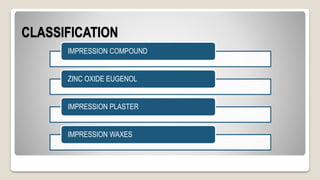
CLASSIFICATION
IMPRESSION COMPOUND
ZINC OXIDE EUGENOL
IMPRESSION PLASTER
IMPRESSION WAXES
ZINC OXIDE EUGENOL IMPRESSION PASTE
 Inelastic
 Mucostatic
 Chemically setting impression material
 Metallic oxide paste
 Has both medicinal and dental benefit
CLASSIFICATION
 According to ADA specification no 16
Type I – hard set, fast set, thinner consistency
Type II – soft set, slow set, thicker consistency
SUPPLIED AS
Paste form
 Base paste
 Catalyst paste
Trade name
 DPI paste
 Denzomix
 Neogenate
 Cavex outline
 SS white impression paste
USES
 For secondary or definitive impression of completely edentulous arches
 As a denture relining material
 Used for inter occlusal bite registration
 As a surgical pack after periodontal wound healing
PROPERTIES
 Non toxic
 Adherence to tissue
 Good surface detail in thin section due to its flow
 Good dimensional stability on setting
 Stablee on storage and has good shelf life
 Biocompatible
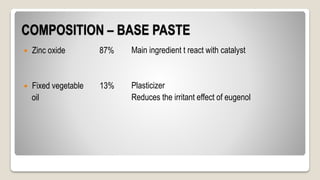
COMPOSITION – BASE PASTE
 Zinc oxide 87%
 Fixed vegetable 13%
oil
Main ingredient t react with catalyst
Plasticizer
Reduces the irritant effect of eugenol
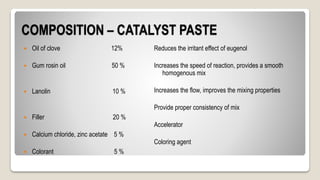
COMPOSITION – CATALYST PASTE
 Oil of clove 12%
 Gum rosin oil 50 %
 Lanolin 10 %
 Filler 20 %
 Calcium chloride, zinc acetate 5 %
 Colorant 5 %
Reduces the irritant effect of eugenol
Increases the speed of reaction, provides a smooth
homogenous mix
Increases the flow, improves the mixing properties
Provide proper consistency of mix
Accelerator
Coloring agent
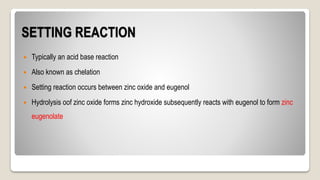
SETTING REACTION
 Typically an acid base reaction
 Also known as chelation
 Setting reaction occurs between zinc oxide and eugenol
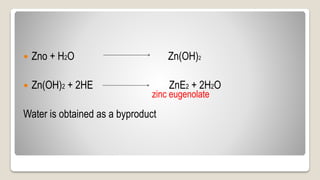
 Hydrolysis oof zinc oxide forms zinc hydroxide subsequently reacts with eugenol to form zinc
eugenolate
 Zno + H2O Zn(OH)2
 Zn(OH)2 + 2HE ZnE2 + 2H2O
Water is obtained as a byproduct
zinc eugenolate
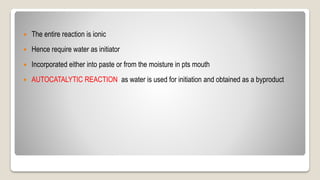
 The entire reaction is ionic
 Hence require water as initiator
 Incorporated either into paste or from the moisture in pts mouth
 AUTOCATALYTIC REACTION as water is used for initiation and obtained as a byproduct
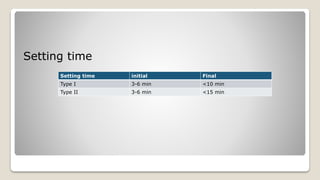
Setting time
Setting time initial Final
Type I 3-6 min <10 min
Type II 3-6 min <15 min
MANUPULATION
 Done on an oil imprevious paper or clean glass slab
 Proper volume of the two paste is dispensed by squeezing strips of paste of same length
 Flexible stainless spatula is used
 Paste combined by sweeping of the spatula and mixing is done for app 1 min
 Uniform mix
 A paste of thick consistence can compress the tissue
 Thin fluid material capture impression of tissue in relaxed condition
Factors affecting setting time
To increase setting time
 By using cool spatula and mixing slab
 More zoe paste
 Retarders – inert oil, glycerin
 Slower or short mixing time
To decease setting time
 Higher temperature, humidy
 More eugenol paste
 Drop of water
 Accelerator - cacl2, mgcl2
FACTORS AFFECTING THE SETTING TIME OF ZOE IMP MATERIAL – THE
INFLUENCE OF HUMIDITY AND TEMPERATURE TO THE REACTION
 Published by Kumagai et al
 A higher temperature and humidity shortens the initial setting time of all paste
 A higher temperature and humidity shortens the interval between initial and final setting time
ADVANTAGES
 Dimensionally stable
 Good surface details
 Can be reinforced with wax or compound for bite registration
 Easy to manipulate
 Not very expensive
 Doesnot require an separating media as it does nt stick to cast
DISADVANTAGES
 Highly inelastic in nature - Cannot be used in undercut areas
 Eugenol allergy
 Instruments are difficult to clean
 Requires spl tray for impression making
 Sticky in nature and adhere to tissue
A RARE CASE REPORT OF A PATIENT WITH ALLERGIC REACTIN FOLLOWING
USE OF A DENTALIMPRESSION MATRIAL
 A 50yr pts underwent routine sec imp procedure in Indira Gandhi institute of dental sciences
 Material used is ZOE
 Developed allergic reactions and subsided by administration of antihistamines
 After examining and proper case taking, it was concluded that eugenol in ZOE imp paste causes
the allergy
HARDNESS
 Resistance of a material to plastic deformation measure under an indebtation load
 Kreb’s penetrometer is used
 Penetrometer is equipped with a needle of 50.8 mm in leength, 1.02 mm diameter and the total
weight of the needle is 100 gms
 30min after start of mix the loades needle is applied to specimen surface for 10 sec and enetration
is recorded to the neearest 0.1mm
RIGIDITY
 7 Mpa after 2hrs from start of mixing
DIMENSIONAL STABILITY
 Negligible dimensional change during setting(<0.1%)
DISINFECTION
 Gluteraldehyde
 iodophore
A comparative study on efficacy of various disinfectant system in dental impression
surfaces: an invivo study
 Journal of dental specialities
 Dalta Durga
 PVS, ZOE, Impession compund, Alginate
 Disinfecton method – 2% gluteraldehyde, UV light chamber, Dimenol
 Significant reduction in bacterial count
 2% gluteraldehyde shows higher efficency and complete removal of MO with microwave
radiation
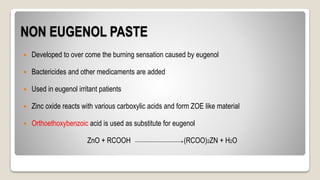
NON EUGENOL PASTE
 Developed to over come the burning sensation caused by eugenol
 Bactericides and other medicaments are added
 Used in eugenol irritant patients
 Zinc oxide reacts with various carboxylic acids and form ZOE like material
 Orthoethoxybenzoic acid is used as substitute for eugenol
ZnO + RCOOH (RCOO)2ZN + H2O
BITE REGISTRATION PASTE
 ZOE paste is used as a recording material in construction of CD and FPD
 It offers almost n resistance to closing of mandible thus allowing a more accurate interocclusal
relationship records
 The composition is similar to conventional ZOE paste
SURGICAL PASTE
 After periodntal surgeries, ZOE packs are given
 ZOE paste are placed over the wound
 To aid in retention of medicament
 To protect the wound
 To promote healing
 Slower and softer in setting reaction
CLINICAL IMPLICATION OF
ZOE PASTE
AN ALTERNATE PRESSURE FREE FUNCTIONAL IMPRESSION TECHNIQUE FOR IMPLANT
RETAINED OVERDENTURES
 For implant-retained overdentures to be successful, functional loads must be distributed optimally
to the mucosa and the abutments.
 For this purpose, impressions must record the soft tissue supporting areas simultaneously with
accurate registration of the implant components.
 Usually, finger pressure is used to make functional impressions.
 This article describes an alternate pressure-free functional impression technique
The step-by-step procedure for this alternative functional impression technique
 Replace healing caps on the osseointegrated dental implants with ball abutments.
 Place ball abutment transfers on the ball abutments.
 Obtain a preliminary impression of the mandibular arch with irreversible hydrocolloid with a
stock tray
 Pour the mandibular cast with dental stone

 Place cap attachments parallel on ball abutments

 Take the cast metal framework and combine cap attachments with a self-curing acrylic resin
 Place 1-mm-thick dental wax on the mandibular model
 Fabricate an acrylic custom tray and place the custom tray on the ball abutments in the mouth
 check the relationship of soft tissues.
 Border mold this impression tray with plastic impression compound
 Take the impression of the alveolar mucosa with a ZOE impression paste without finger
pressure.
 Place ball abutment analogues into cap attachments
 Pour the impression with Type IV stone
INVITRO EFFECT OF VENT SIZE AND SPACER THICKNESS ON MAXILLARY
EDENTULOUS IMPRESSON MAKING BY DIFFEENT IMPESSIN MATERIALS
 Inappropriate transfer of pressure during final impression making in fabrication of complete denture
can result in ridge resorption.
 This study aimed to assess the effect of vent size and spacer thickness on pressure produced
during maxillary edentulous impression making by different impression materials
 Impression pressure changes significantly by change in tray design or impression material.
 For making impressions of an edentulous maxilla, using a tray with a 1.0 mm or larger vent hole or
1.5 mm spacer thickness is recommended.
AN ALTERED CAST PROCEDURE TO IMPROVE TISSUE SUPPORT FOR RPD
 Cast partial denture made using the altered cast impression technique helps create an
environment in which the teeth and the edentulous tissues support the base as compatibly
as possible.
• The result is a potentially more stable RPD that improves the support for the occlusal
relationship of the opposing dentition and the RPD restoration
COMPARISON OF ACCURACY AND DIMENSIONAL STABIITY OF
INTEROCCLUSAL MATERIALS AN INVITRO STUDY
 International Journal of Scientific and Research Publications
 Sandeep Vivek Gurav et al
 The zinc oxide eugenol is more accurate interocclusal recording material and which is followed
by polyether, silicon and Aluwax respectively
 Poly ether, zinc oxide eugenol and silicone possess good dimensional stability.
 No correlation exists between accuracy and dimensional stability of interocclusal recording
materials.
EVALUATION AND COMPARISON OF RESISTANCE TO COMPRESSION OF
VARIOUS INTEROCCLUSAL RECORDING MEDIA: AN VITRO STUDY
 Journal of International Oral Health
 G S Chandu
 Polyvinylsiloxane interocclusal registration material had the greatest resistance to compression.
 The least resistance to compression was noticed with zinc oxide-eugenol paste
EVALUATION OF FUNCTIONAL IMPRESSION TECHNIQUE WITH VARIOUS IMPRESSION
MATERIAL ON THE SURFACE TOPOGRAPHY OF DENTAL STONE CAST AND THEIR
EFFECT ON RETENTION
 The success of complete dentures depends on selecting the impression materials,
 The accuracy of the impression and the impression technique
 Impression making in total edentulism is important, not only for denture retention and stability
but also for the mucosa status, which should be maintained without any distortions
 Tissue conditioner, zinc oxide and poly vinyl siloxane
 Using a tissue conditioner as a functional impression material led to a high level of surface
roughness and good retention, it could not produce the same smooth surface quality of PVS or
ZOE
 Complete dentures made using functional impression technique with PVC as a final impression
material are more comfortable, retentive and stable
AN INVITRO STUDY TO EVALUATE AND COMPARE THE FLOW PROPERTY OF
DIFFERENT COMMERCIALLY AVAILABLE ZOE IMP MATERIALS
 Contemporary clinical dentistry
 Anuj Harish et al
 Flow f denzomix and cavex was minimum both at room temperature and at 37c in saliva
 The flow of cavex was not in accordance with ADA specification
 Max flow was seen only upto 30 sec of load application not much increase in flow after 1min and 1o
min of load application
 Presence of saliva and increase in temp reduces flow
EFFECT OF STORAGE TIME AND TEMPERATURE ON DIMENSIONAL STABILITY
OF IMPRESSION MADE WITH ZOE IMPRESSION PASTE
 Journal of dentistry
 Sareh et al
 Assess the dimensional stability of cavex outline zoe imp paste
 Storage in refrigerator and at room temp for 0 - 7 hrs – no significant effect
 24 hrs of storage in refrigerator and at room temp decreases the dimensional stability
 Significant association found between dimensional changes following 24hrs of storage in
refrigerator(4 ) and at room temperature(23 )0
0
1) Factors affecting the setting time of zoe imp material – the influence of humidity and
temperature to the reaction
2) A rare case report of a patient with allergic reactin following use of a dentalimpression matrial
3) A comparative study on efficacy of various disinfectant system in dental impression surfaces:
an invivo study
4) An alternate pressure free functional impression technique for implant retained overdentures
5) Invitro effect of vent size and spacer thickness on maxillary edentulous impresson making by
diffeent impessin materials
 An altered cast procedure to improve tissue support for rpd
 Comparison of accuracy and dimensional stabiity of interocclusal materials an invitro study
 Evaluation and comparison of resistance to compression of various interocclusal recording
media: an vitro study
 Evaluation of functional impression technique with various impression material on the surface
topography of dental stone cast and their effect on retention
 An invitro study to evaluate and compare the flow property of different commercially available
zoe imp materials
 Effect of storage time and temperature on dimensional stability of impression made with zoe
impression paste
Inelastic impression materials

Inelastic impression materials

  • 1.
    INELASTIC IMPRESSION MATERIALS -I ASWATI SOMAN Ist YR PG PCDS
  • 2.
    CONTENTS  Introduction  Classification ZOE impression paste  Impression compound  Impression plaster  Impression waxes  Related articles  Conclusion  Reference
  • 3.
    INTRODUCTION  Material lackthe property of flexibility  Rigid  Undergo permanent distortion when subjected to tensile stress  Cannot be used in undercut areas as they eithr fracture or distort o removal
  • 4.
    CLASSIFICATION IMPRESSION COMPOUND ZINC OXIDEEUGENOL IMPRESSION PLASTER IMPRESSION WAXES
  • 5.
    ZINC OXIDE EUGENOLIMPRESSION PASTE  Inelastic  Mucostatic  Chemically setting impression material  Metallic oxide paste  Has both medicinal and dental benefit
  • 6.
    CLASSIFICATION  According toADA specification no 16 Type I – hard set, fast set, thinner consistency Type II – soft set, slow set, thicker consistency
  • 7.
    SUPPLIED AS Paste form Base paste  Catalyst paste
  • 8.
    Trade name  DPIpaste  Denzomix  Neogenate  Cavex outline  SS white impression paste
  • 9.
    USES  For secondaryor definitive impression of completely edentulous arches  As a denture relining material  Used for inter occlusal bite registration  As a surgical pack after periodontal wound healing
  • 10.
    PROPERTIES  Non toxic Adherence to tissue  Good surface detail in thin section due to its flow  Good dimensional stability on setting  Stablee on storage and has good shelf life  Biocompatible
  • 11.
    COMPOSITION – BASEPASTE  Zinc oxide 87%  Fixed vegetable 13% oil Main ingredient t react with catalyst Plasticizer Reduces the irritant effect of eugenol
  • 12.
    COMPOSITION – CATALYSTPASTE  Oil of clove 12%  Gum rosin oil 50 %  Lanolin 10 %  Filler 20 %  Calcium chloride, zinc acetate 5 %  Colorant 5 % Reduces the irritant effect of eugenol Increases the speed of reaction, provides a smooth homogenous mix Increases the flow, improves the mixing properties Provide proper consistency of mix Accelerator Coloring agent
  • 13.
    SETTING REACTION  Typicallyan acid base reaction  Also known as chelation  Setting reaction occurs between zinc oxide and eugenol  Hydrolysis oof zinc oxide forms zinc hydroxide subsequently reacts with eugenol to form zinc eugenolate
  • 14.
     Zno +H2O Zn(OH)2  Zn(OH)2 + 2HE ZnE2 + 2H2O Water is obtained as a byproduct zinc eugenolate
  • 15.
     The entirereaction is ionic  Hence require water as initiator  Incorporated either into paste or from the moisture in pts mouth  AUTOCATALYTIC REACTION as water is used for initiation and obtained as a byproduct
  • 16.
    Setting time Setting timeinitial Final Type I 3-6 min <10 min Type II 3-6 min <15 min
  • 17.
    MANUPULATION  Done onan oil imprevious paper or clean glass slab  Proper volume of the two paste is dispensed by squeezing strips of paste of same length  Flexible stainless spatula is used  Paste combined by sweeping of the spatula and mixing is done for app 1 min  Uniform mix
  • 18.
     A pasteof thick consistence can compress the tissue  Thin fluid material capture impression of tissue in relaxed condition
  • 19.
    Factors affecting settingtime To increase setting time  By using cool spatula and mixing slab  More zoe paste  Retarders – inert oil, glycerin  Slower or short mixing time
  • 20.
    To decease settingtime  Higher temperature, humidy  More eugenol paste  Drop of water  Accelerator - cacl2, mgcl2
  • 21.
    FACTORS AFFECTING THESETTING TIME OF ZOE IMP MATERIAL – THE INFLUENCE OF HUMIDITY AND TEMPERATURE TO THE REACTION  Published by Kumagai et al  A higher temperature and humidity shortens the initial setting time of all paste  A higher temperature and humidity shortens the interval between initial and final setting time
  • 22.
    ADVANTAGES  Dimensionally stable Good surface details  Can be reinforced with wax or compound for bite registration  Easy to manipulate  Not very expensive  Doesnot require an separating media as it does nt stick to cast
  • 23.
    DISADVANTAGES  Highly inelasticin nature - Cannot be used in undercut areas  Eugenol allergy  Instruments are difficult to clean  Requires spl tray for impression making  Sticky in nature and adhere to tissue
  • 24.
    A RARE CASEREPORT OF A PATIENT WITH ALLERGIC REACTIN FOLLOWING USE OF A DENTALIMPRESSION MATRIAL  A 50yr pts underwent routine sec imp procedure in Indira Gandhi institute of dental sciences  Material used is ZOE  Developed allergic reactions and subsided by administration of antihistamines  After examining and proper case taking, it was concluded that eugenol in ZOE imp paste causes the allergy
  • 25.
    HARDNESS  Resistance ofa material to plastic deformation measure under an indebtation load  Kreb’s penetrometer is used  Penetrometer is equipped with a needle of 50.8 mm in leength, 1.02 mm diameter and the total weight of the needle is 100 gms  30min after start of mix the loades needle is applied to specimen surface for 10 sec and enetration is recorded to the neearest 0.1mm
  • 26.
    RIGIDITY  7 Mpaafter 2hrs from start of mixing DIMENSIONAL STABILITY  Negligible dimensional change during setting(<0.1%)
  • 27.
  • 28.
    A comparative studyon efficacy of various disinfectant system in dental impression surfaces: an invivo study  Journal of dental specialities  Dalta Durga  PVS, ZOE, Impession compund, Alginate  Disinfecton method – 2% gluteraldehyde, UV light chamber, Dimenol  Significant reduction in bacterial count  2% gluteraldehyde shows higher efficency and complete removal of MO with microwave radiation
  • 29.
    NON EUGENOL PASTE Developed to over come the burning sensation caused by eugenol  Bactericides and other medicaments are added  Used in eugenol irritant patients  Zinc oxide reacts with various carboxylic acids and form ZOE like material  Orthoethoxybenzoic acid is used as substitute for eugenol ZnO + RCOOH (RCOO)2ZN + H2O
  • 30.
    BITE REGISTRATION PASTE ZOE paste is used as a recording material in construction of CD and FPD  It offers almost n resistance to closing of mandible thus allowing a more accurate interocclusal relationship records  The composition is similar to conventional ZOE paste
  • 31.
    SURGICAL PASTE  Afterperiodntal surgeries, ZOE packs are given  ZOE paste are placed over the wound  To aid in retention of medicament  To protect the wound  To promote healing  Slower and softer in setting reaction
  • 32.
  • 33.
    AN ALTERNATE PRESSUREFREE FUNCTIONAL IMPRESSION TECHNIQUE FOR IMPLANT RETAINED OVERDENTURES  For implant-retained overdentures to be successful, functional loads must be distributed optimally to the mucosa and the abutments.  For this purpose, impressions must record the soft tissue supporting areas simultaneously with accurate registration of the implant components.  Usually, finger pressure is used to make functional impressions.  This article describes an alternate pressure-free functional impression technique
  • 34.
    The step-by-step procedurefor this alternative functional impression technique  Replace healing caps on the osseointegrated dental implants with ball abutments.  Place ball abutment transfers on the ball abutments.  Obtain a preliminary impression of the mandibular arch with irreversible hydrocolloid with a stock tray  Pour the mandibular cast with dental stone  Place cap attachments parallel on ball abutments  Take the cast metal framework and combine cap attachments with a self-curing acrylic resin  Place 1-mm-thick dental wax on the mandibular model
  • 35.
     Fabricate anacrylic custom tray and place the custom tray on the ball abutments in the mouth  check the relationship of soft tissues.  Border mold this impression tray with plastic impression compound  Take the impression of the alveolar mucosa with a ZOE impression paste without finger pressure.  Place ball abutment analogues into cap attachments  Pour the impression with Type IV stone
  • 36.
    INVITRO EFFECT OFVENT SIZE AND SPACER THICKNESS ON MAXILLARY EDENTULOUS IMPRESSON MAKING BY DIFFEENT IMPESSIN MATERIALS  Inappropriate transfer of pressure during final impression making in fabrication of complete denture can result in ridge resorption.  This study aimed to assess the effect of vent size and spacer thickness on pressure produced during maxillary edentulous impression making by different impression materials  Impression pressure changes significantly by change in tray design or impression material.  For making impressions of an edentulous maxilla, using a tray with a 1.0 mm or larger vent hole or 1.5 mm spacer thickness is recommended.
  • 37.
    AN ALTERED CASTPROCEDURE TO IMPROVE TISSUE SUPPORT FOR RPD  Cast partial denture made using the altered cast impression technique helps create an environment in which the teeth and the edentulous tissues support the base as compatibly as possible. • The result is a potentially more stable RPD that improves the support for the occlusal relationship of the opposing dentition and the RPD restoration
  • 42.
    COMPARISON OF ACCURACYAND DIMENSIONAL STABIITY OF INTEROCCLUSAL MATERIALS AN INVITRO STUDY  International Journal of Scientific and Research Publications  Sandeep Vivek Gurav et al  The zinc oxide eugenol is more accurate interocclusal recording material and which is followed by polyether, silicon and Aluwax respectively  Poly ether, zinc oxide eugenol and silicone possess good dimensional stability.  No correlation exists between accuracy and dimensional stability of interocclusal recording materials.
  • 43.
    EVALUATION AND COMPARISONOF RESISTANCE TO COMPRESSION OF VARIOUS INTEROCCLUSAL RECORDING MEDIA: AN VITRO STUDY  Journal of International Oral Health  G S Chandu  Polyvinylsiloxane interocclusal registration material had the greatest resistance to compression.  The least resistance to compression was noticed with zinc oxide-eugenol paste
  • 44.
    EVALUATION OF FUNCTIONALIMPRESSION TECHNIQUE WITH VARIOUS IMPRESSION MATERIAL ON THE SURFACE TOPOGRAPHY OF DENTAL STONE CAST AND THEIR EFFECT ON RETENTION  The success of complete dentures depends on selecting the impression materials,  The accuracy of the impression and the impression technique  Impression making in total edentulism is important, not only for denture retention and stability but also for the mucosa status, which should be maintained without any distortions  Tissue conditioner, zinc oxide and poly vinyl siloxane
  • 45.
     Using atissue conditioner as a functional impression material led to a high level of surface roughness and good retention, it could not produce the same smooth surface quality of PVS or ZOE  Complete dentures made using functional impression technique with PVC as a final impression material are more comfortable, retentive and stable
  • 46.
    AN INVITRO STUDYTO EVALUATE AND COMPARE THE FLOW PROPERTY OF DIFFERENT COMMERCIALLY AVAILABLE ZOE IMP MATERIALS  Contemporary clinical dentistry  Anuj Harish et al  Flow f denzomix and cavex was minimum both at room temperature and at 37c in saliva  The flow of cavex was not in accordance with ADA specification  Max flow was seen only upto 30 sec of load application not much increase in flow after 1min and 1o min of load application  Presence of saliva and increase in temp reduces flow
  • 47.
    EFFECT OF STORAGETIME AND TEMPERATURE ON DIMENSIONAL STABILITY OF IMPRESSION MADE WITH ZOE IMPRESSION PASTE  Journal of dentistry  Sareh et al  Assess the dimensional stability of cavex outline zoe imp paste  Storage in refrigerator and at room temp for 0 - 7 hrs – no significant effect  24 hrs of storage in refrigerator and at room temp decreases the dimensional stability  Significant association found between dimensional changes following 24hrs of storage in refrigerator(4 ) and at room temperature(23 )0 0
  • 48.
    1) Factors affectingthe setting time of zoe imp material – the influence of humidity and temperature to the reaction 2) A rare case report of a patient with allergic reactin following use of a dentalimpression matrial 3) A comparative study on efficacy of various disinfectant system in dental impression surfaces: an invivo study 4) An alternate pressure free functional impression technique for implant retained overdentures 5) Invitro effect of vent size and spacer thickness on maxillary edentulous impresson making by diffeent impessin materials
  • 49.
     An alteredcast procedure to improve tissue support for rpd  Comparison of accuracy and dimensional stabiity of interocclusal materials an invitro study  Evaluation and comparison of resistance to compression of various interocclusal recording media: an vitro study  Evaluation of functional impression technique with various impression material on the surface topography of dental stone cast and their effect on retention
  • 50.
     An invitrostudy to evaluate and compare the flow property of different commercially available zoe imp materials  Effect of storage time and temperature on dimensional stability of impression made with zoe impression paste