Presented by-
Shilpi Varshney
12LEB032
Anand Agrawal
12LEB111
Project Supervisor- Prof. Athar Ali Moinuddin
INDEX
• Problem Statement
• Prototype
• Basic Terminology
• About ZigBee and WSN
• Why this??
• Modular classification
• Hardware and software
• Modular description
• Work done
• Future Scope
• Conclusion
• References
“To implement a wireless sensor
node and the coordinator based
on ZigBee technology, which
could further be deployed in a
security & monitoring
application”
Problem statement
3
Basic Terminology [2]
“A wireless sensor network (WSN) consist of spatially distributed
autonomous sensors to monitor physical or environmental
conditions, such as temperature, sound, pressure etc.to
cooperatively pass their data through the network to a main
location”
4
Prototype Idea
Data
collecting
sensor node
Data
collecting
sensor
node
WSN
Coordinato
r node
Microcontroll
er
GSM
Mode
m
ALERT
MESSAG
E
5
About ZigBee [3]
• ZigBee is a wireless protocol that works on RF Communication and
allows small, low-cost devices to quickly transmit small amounts of data.
• Dedicated for use in WPAN and WSN.
• Low cost and low power solution that can be used in various devices what
has been called Internet of Things (IOT).
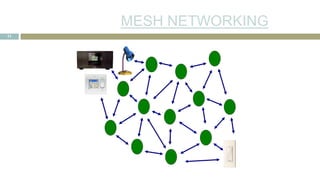
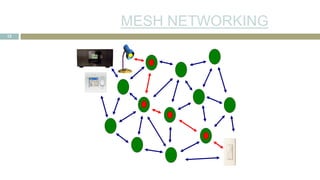
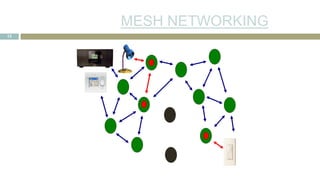
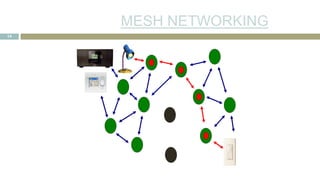
• Unlike other wireless technologies, ZigBee supports and allows multiple
network topologies .
6
ZIGBEE DEVICE TYPE [5]
 ZigBee Coordinator (ZC):
 Root of the network tree
 Acts as a bridge to other
networks.
 ZigBee Router (ZR):
 Acts as an intermediate
router.
 ZigBee End Devices
(ZED):
 functionality to talk to the
parent node.
 cannot relay data from other
devices
 allows the node to be asleep
ZigBee Coordinator
ZigBee Router/FFD
ZigBee RFD
7
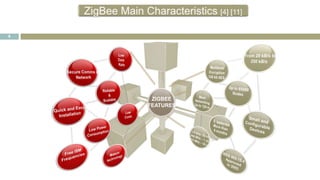
ZIGBEE
FEATURES
8
WHY ZigBee ?? [4]
15 seconds
54 Mbps
9
MESH NETWORKING
10
MESH NETWORKING
11
MESH NETWORKING
12
MESH NETWORKING
13
MESH NETWORKING
14
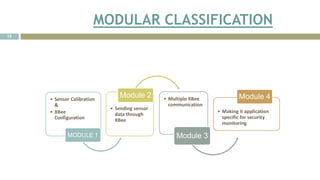
MODULAR CLASSIFICATION
• Sensor Calibration
&
• XBee
Configuration
MODULE 1
• Sending sensor
data through
XBee
Module 2 • Multiple XBee
communication
Module 3
• Making it application
specific for security
monitoring
Module 4
15
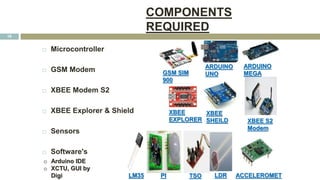
 Microcontroller
 GSM Modem
 XBEE Modem S2
 XBEE Explorer & Shield
 Sensors
 Software's
GSM SIM
900
ARDUINO
MEGA
ARDUINO
UNO
XBEE S2
Modem
XBEE
SHEILD
XBEE
EXPLORER
PI TSO LDR ACCELEROMETLM35
COMPONENTS
REQUIRED
o Arduino IDE
o XCTU, GUI by
Digi
16
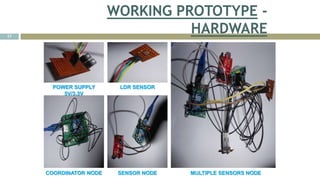
WORKING PROTOTYPE -
HARDWARE
POWER SUPPLY
5V/3.3V
LDR SENSOR
SENSOR NODECOORDINATOR NODE MULTIPLE SENSORS NODE
17
SENSOR CHARACTERISTI
CS
PURPOSE EXAMPLE
PIR Sensitivity Range:
20feet
Motion Detecting motion in
secured (or unauthorized)
area.
LM35 Temperature
Range:
55 to 150 *C
Temperature Fire alarm.
TSOP 3 meters Object
Detection
Door opening/Closing
LDR Linear Resistance
with Light Intensity
Light Detection Automatic Lighting Control
Acceleromet
er
Sensitivity: 3g Position Prevent theft or tampering
with sensor node
About Sensors [6] [7] [8] [9] [10]
18
XBEE API Frame Received
[11]FRAME RECEIVED AT COORDINATOR CORRESPONDING TO VARIATION
DETECTED BY TSOP SENSOR CONNECTED TO SENSOR NODE
Start
delimiter
(Byte 1)
Length
(Byte 2-3)
Checksum
(Byte N)
0x7E MS
B
API Specific
Structure
1 ByteLS
B
SENSOR NODE WITH
TSOP
FRAME FORMAT
19
20
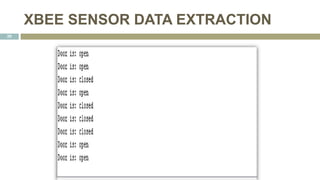
XBEE SENSOR DATA EXTRACTION
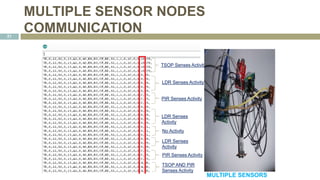
TSOP Senses Activity
PIR Senses Activity
TSOP AND PIR
Senses Activity
PIR Senses Activity
LDR Senses
Activity
No Activity
LDR Senses
Activity
LDR Senses Activity
MULTIPLE SENSORS
21
MULTIPLE SENSOR NODES
COMMUNICATION
22
MULTIPLE XBEEs COMMUNICATION
TERMINAL-TERA TERM
23
Fig 2 Terminal
Connection
Fig 4 GSM CallFig 3 GSM
Fig 1 GSM SIM900
Modem
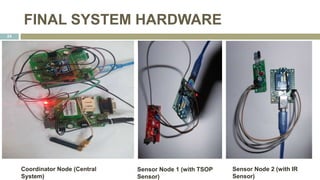
FINAL SYSTEM HARDWARE
24
Coordinator Node (Central
System)
Sensor Node 1 (with TSOP
Sensor)
Sensor Node 2 (with IR
Sensor)
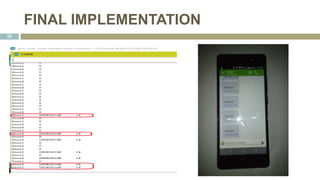
FINAL IMPLEMENTATION
25
26
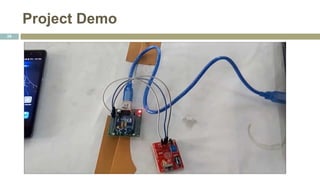
Project Demo
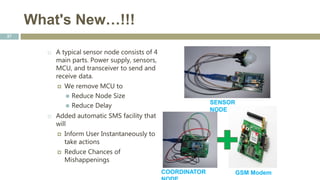
 A typical sensor node consists of 4
main parts. Power supply, sensors,
MCU, and transceiver to send and
receive data.
 We remove MCU to
 Reduce Node Size
 Reduce Delay
 Added automatic SMS facility that
will
 Inform User Instantaneously to
take actions
 Reduce Chances of
Mishappenings
SENSOR
NODE
COORDINATOR GSM Modem
27
What's New…!!!
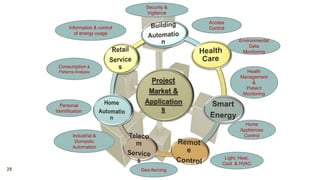
Access
Control
Personal
Identification
Light, Heat,
Cool & HVAC
Information & control
of energy usage
Security &
Vigilance
Health
Management
&
Patient
Monitoring
Consumption &
Patterns Analysis
Home
Appliances
Control
Geo-fencing
Environmental
Data
Monitoring
Industrial &
Domestic
Automation
28
Future Scope
 Installation in Mobile phones
 Use of alternative energy sources or
Rechargeable Batteries
 Use of ASICs to minimize cost and design effort
used in circuit
 Battery Aware task scheduling
 IOT based System Monitoring.
29
CONCLUSION
30
1) Dae-Man Han and Jae-Hyun Lim, “ Design and Implementation of Smart Home
Energy Management Systems based on ZigBee”, IEEE Transactions on Consumer
Electronics, Vol. 56, No. 3, August 2010
2) Shizhuang Lin, Jingyu Liu and Yanjun Fang, “ZigBee Based Wireless Sensor
Networks and Its Applications in Industrial”, Proceedings of the IEEE
International Conference on Automation and Logistics, August 18 - 21, 2007
3) Jun Hou, Chengdong Wu, Zhongjia Yuan, Jiyuan Tan, Qiaoqiao Wang, Yun
Zhou- “Research of Intelligent Home Security Surveillance System Based on
ZigBee”, International Symposium on Intelligent Information Technology
Application Workshops, 2008 IEEE
4) Mohd Adib B. Sarijari ,Rozeha A. Rashid, Mohd Rozaini Abd Rahim, Nur Hija
Mahalin, “Wireless Home Security and Automation System Utilizing ZigBee
based Multi-hop Communication”, Proceedings of IEEE 2008 6th National
Conference on Telecommunication Technologies and IEEE 2008 2nd Malaysia
Conference on Photonics, 26-27 August 2008
REFERENCES
31
5) Khusvinder Gill, Shuang-Hua Yang, Fang Yao, and Xin Lu, “A ZigBee-Based Home
Automation System”, IEEE Transactions on Consumer Electronics, Vol. 55, No. 2, MAY
2009.
6) Datasheet: PIR Sensor, Parallax, Inc., v1.2 Revised 02/2007
7) Datasheet: LM35 Precision Centigrade Temperature Sensors Datasheet, Texas
Instruments, AUGUST 1999–REVISED JANUARY 2015
8) Datasheet: CDS Light Dependent Photoresistors, TOKEN, version 2010
9) Datasheet: Photo Modules for PCM Remote Control Systems Datasheet TSOP 17xx,
Vishay Telefunken
10) Manual: PIR Motion Sensor, Adrafruit Learning System, Revised 01/2014
11) Manual: XBee Series 2 OEM RF Modules – Digi International, Product Manual v1.x.1x -
ZigBee Protocol, Revised 06/2007
REFERENCES -Continued
32

ZigBee Based Wireless Sensor Network

  • 1.
    Presented by- Shilpi Varshney 12LEB032 AnandAgrawal 12LEB111 Project Supervisor- Prof. Athar Ali Moinuddin
  • 2.
    INDEX • Problem Statement •Prototype • Basic Terminology • About ZigBee and WSN • Why this?? • Modular classification • Hardware and software • Modular description • Work done • Future Scope • Conclusion • References
  • 3.
    “To implement awireless sensor node and the coordinator based on ZigBee technology, which could further be deployed in a security & monitoring application” Problem statement 3
  • 4.
    Basic Terminology [2] “Awireless sensor network (WSN) consist of spatially distributed autonomous sensors to monitor physical or environmental conditions, such as temperature, sound, pressure etc.to cooperatively pass their data through the network to a main location” 4
  • 5.
  • 6.
    About ZigBee [3] •ZigBee is a wireless protocol that works on RF Communication and allows small, low-cost devices to quickly transmit small amounts of data. • Dedicated for use in WPAN and WSN. • Low cost and low power solution that can be used in various devices what has been called Internet of Things (IOT). • Unlike other wireless technologies, ZigBee supports and allows multiple network topologies . 6
  • 7.
    ZIGBEE DEVICE TYPE[5]  ZigBee Coordinator (ZC):  Root of the network tree  Acts as a bridge to other networks.  ZigBee Router (ZR):  Acts as an intermediate router.  ZigBee End Devices (ZED):  functionality to talk to the parent node.  cannot relay data from other devices  allows the node to be asleep ZigBee Coordinator ZigBee Router/FFD ZigBee RFD 7
  • 8.
  • 9.
    WHY ZigBee ??[4] 15 seconds 54 Mbps 9
  • 10.
  • 11.
  • 12.
  • 13.
  • 14.
  • 15.
    MODULAR CLASSIFICATION • SensorCalibration & • XBee Configuration MODULE 1 • Sending sensor data through XBee Module 2 • Multiple XBee communication Module 3 • Making it application specific for security monitoring Module 4 15
  • 16.
     Microcontroller  GSMModem  XBEE Modem S2  XBEE Explorer & Shield  Sensors  Software's GSM SIM 900 ARDUINO MEGA ARDUINO UNO XBEE S2 Modem XBEE SHEILD XBEE EXPLORER PI TSO LDR ACCELEROMETLM35 COMPONENTS REQUIRED o Arduino IDE o XCTU, GUI by Digi 16
  • 17.
    WORKING PROTOTYPE - HARDWARE POWERSUPPLY 5V/3.3V LDR SENSOR SENSOR NODECOORDINATOR NODE MULTIPLE SENSORS NODE 17
  • 18.
    SENSOR CHARACTERISTI CS PURPOSE EXAMPLE PIRSensitivity Range: 20feet Motion Detecting motion in secured (or unauthorized) area. LM35 Temperature Range: 55 to 150 *C Temperature Fire alarm. TSOP 3 meters Object Detection Door opening/Closing LDR Linear Resistance with Light Intensity Light Detection Automatic Lighting Control Acceleromet er Sensitivity: 3g Position Prevent theft or tampering with sensor node About Sensors [6] [7] [8] [9] [10] 18
  • 19.
    XBEE API FrameReceived [11]FRAME RECEIVED AT COORDINATOR CORRESPONDING TO VARIATION DETECTED BY TSOP SENSOR CONNECTED TO SENSOR NODE Start delimiter (Byte 1) Length (Byte 2-3) Checksum (Byte N) 0x7E MS B API Specific Structure 1 ByteLS B SENSOR NODE WITH TSOP FRAME FORMAT 19
  • 20.
  • 21.
    TSOP Senses Activity PIRSenses Activity TSOP AND PIR Senses Activity PIR Senses Activity LDR Senses Activity No Activity LDR Senses Activity LDR Senses Activity MULTIPLE SENSORS 21 MULTIPLE SENSOR NODES COMMUNICATION
  • 22.
  • 23.
    TERMINAL-TERA TERM 23 Fig 2Terminal Connection Fig 4 GSM CallFig 3 GSM Fig 1 GSM SIM900 Modem
  • 24.
    FINAL SYSTEM HARDWARE 24 CoordinatorNode (Central System) Sensor Node 1 (with TSOP Sensor) Sensor Node 2 (with IR Sensor)
  • 25.
  • 26.
  • 27.
     A typicalsensor node consists of 4 main parts. Power supply, sensors, MCU, and transceiver to send and receive data.  We remove MCU to  Reduce Node Size  Reduce Delay  Added automatic SMS facility that will  Inform User Instantaneously to take actions  Reduce Chances of Mishappenings SENSOR NODE COORDINATOR GSM Modem 27 What's New…!!!
  • 28.
    Access Control Personal Identification Light, Heat, Cool &HVAC Information & control of energy usage Security & Vigilance Health Management & Patient Monitoring Consumption & Patterns Analysis Home Appliances Control Geo-fencing Environmental Data Monitoring Industrial & Domestic Automation 28
  • 29.
    Future Scope  Installationin Mobile phones  Use of alternative energy sources or Rechargeable Batteries  Use of ASICs to minimize cost and design effort used in circuit  Battery Aware task scheduling  IOT based System Monitoring. 29
  • 30.
  • 31.
    1) Dae-Man Hanand Jae-Hyun Lim, “ Design and Implementation of Smart Home Energy Management Systems based on ZigBee”, IEEE Transactions on Consumer Electronics, Vol. 56, No. 3, August 2010 2) Shizhuang Lin, Jingyu Liu and Yanjun Fang, “ZigBee Based Wireless Sensor Networks and Its Applications in Industrial”, Proceedings of the IEEE International Conference on Automation and Logistics, August 18 - 21, 2007 3) Jun Hou, Chengdong Wu, Zhongjia Yuan, Jiyuan Tan, Qiaoqiao Wang, Yun Zhou- “Research of Intelligent Home Security Surveillance System Based on ZigBee”, International Symposium on Intelligent Information Technology Application Workshops, 2008 IEEE 4) Mohd Adib B. Sarijari ,Rozeha A. Rashid, Mohd Rozaini Abd Rahim, Nur Hija Mahalin, “Wireless Home Security and Automation System Utilizing ZigBee based Multi-hop Communication”, Proceedings of IEEE 2008 6th National Conference on Telecommunication Technologies and IEEE 2008 2nd Malaysia Conference on Photonics, 26-27 August 2008 REFERENCES 31
  • 32.
    5) Khusvinder Gill,Shuang-Hua Yang, Fang Yao, and Xin Lu, “A ZigBee-Based Home Automation System”, IEEE Transactions on Consumer Electronics, Vol. 55, No. 2, MAY 2009. 6) Datasheet: PIR Sensor, Parallax, Inc., v1.2 Revised 02/2007 7) Datasheet: LM35 Precision Centigrade Temperature Sensors Datasheet, Texas Instruments, AUGUST 1999–REVISED JANUARY 2015 8) Datasheet: CDS Light Dependent Photoresistors, TOKEN, version 2010 9) Datasheet: Photo Modules for PCM Remote Control Systems Datasheet TSOP 17xx, Vishay Telefunken 10) Manual: PIR Motion Sensor, Adrafruit Learning System, Revised 01/2014 11) Manual: XBee Series 2 OEM RF Modules – Digi International, Product Manual v1.x.1x - ZigBee Protocol, Revised 06/2007 REFERENCES -Continued 32

Editor's Notes

  • #2 Good after noon everyone. I am shilpi varshney and we are going to give a presentation on our topic zigbee based wireless sensor network.
  • #3 As the time proceeds we’ll be covering the following points starting with the problem statement,going through the basic terms that are being used ,modular classification, modular description followed by the conclusion.
  • #4 Now the problem is To design and implement a wireless sensor node and the coordinator based on ZigBee technology, which could further be deployed in a security & monitoring application”
  • #5 A Wireless Sensor Network (WSN) is an ad-hoc network involving a spatially distributed autonomous system that are capable with the help of sensors to monitor physical or environmental situations, such as current, temperature, pressure, and they cooperatively transmit the data to the main location of the application. These types of sensors have both data processing and communication capabilities and are deployed both in outdoors and indoors applications like; security and battlefield surveillance, industrial monitoring and controls, machine health monitoring, traffic control and personal health monitoring.
  • #6 Now to properly implement a robust system, it is important to know the basic components of the system. Since we are implementing it for a home security application, we have different kinds of sensors like IR, Tsop and temp sensor installed on doors, windows etc and their values being continously transmitted to the co-ordinator node via zigbee. Now if any security breach or any intrusion occurs, ie the sensor values exceeds the threshold value which is being set in the co-ordinator node , an alert message would reach the user via GSM modem.
  • #7 Unlike other prevailing wireless technologies,zigbee is the recent technology which offers ubiquitous advantages over other prevailing technologies especially for low-data rate applications. They are low cost, low power digital radios for energy efficient and cost effective intelligent devices. ZigBee operates in the Industrial, Scientific and Medical (ISM) radio bands. Data transmission ranges from 20kb/s to 250kb/s in the 868MHZ to 2.4GHZ frequency band
  • #8 Zigbee can be configured as co-ordinator,router and an end device.  It stores and maintain network information  Selects a personal area network identifier (PAN ID) and a channel to run the network.  Permits both the routers and end devices access to join the network [11]
  • #10 Now the question arises why use zigbee? If we look at the tabular differentiation b/w different wireless technologies we can see zigbee outweighing in almost all the features of selecting the wireless technology.Like zigbee module can go for years as compared to wifi and bluetooth.Also we can have various no. of nodes because of the mesh networking of zigbee nodes.Range is high.Also they are scalable.latency?