VISVESVARAYA TECHNOLOGICAL
UNIVERSITY
“JNANA SANGAMA”, BELAGAVI-590018
PRESENTAION ON
“zigbee Technology”
Carried out by
ABHISHEKA MASALAVADADA 4GH19EC400
Under the Guidance of
Prof.Pallavi Bembli
Assistance Professor
Dept of ECE
Government Engineering College Hassan-573201
Content
• Introduction
• History
• Device Types
• Zigbee Home Automation Example
• How Zigbee Works
• Why does Zigbee Do
• Layer of Zigbee Networks
• Topologies
• Uses
• Future
• Conclusion
Introduction
1. When you hold the TV remote and wish to use it you have to necessarily point your control at
the device.
2. This one-way, line-of-sight, short-range communication uses infrared (IR) sensors to enable
communication and control and it is possible to operate the TV remotely only with its control
unit.
3. Add other home theatre modules, an air- conditioner and remotely enabled fans and lights to
your room, and you become a juggler who has to handle not only these remotes, but also more
numbers that will accompany other home appliances you are likely to use.
4. Some remotes do serve to control more than one device after „memorizing' access codes, but
this interoperability is restricted to LOS, that too only for a set of related equipment, like the
different units of a home entertainment system
5. Now picture a home with entertainment units, security systems including fire alarm, smoke
detector and burglar alarm, air-conditioners and kitchen appliances all within whispering
distance from each other and imagine a single unit that talks with all the devices, no longer
depending on line-of-sight, and traffic no longer being one-way.
6. This means that the devices and the control unit would all need a common standard to enable
intelligible communication. ZigBee is such a standard for embedded application software.
Device types
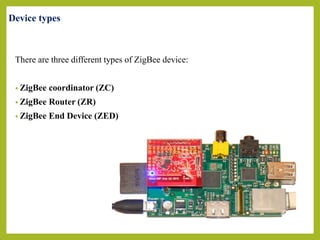
There are three different types of ZigBee device:
• ZigBee coordinator (ZC)
• ZigBee Router (ZR)
• ZigBee End Device (ZED)
Types Explained…
ZigBee coordinator (ZC): The most capable device, the coordinator forms
the root of the network tree and might bridge to other networks.
 There is exactly one ZigBee coordinator in each network. It is able to store
information about the network, including acting as the repository for security
keys.
ZigBee Router (ZR): Routers can act as an intermediate router, passing data
from other devices.
ZigBee End Device (ZED): Contains just enough functionality to talk to its
parent node (either the coordinator or a router); it cannot relay data from other
devices. It requires the least amount of memory, and therefore can be less
expensive to manufacture than a ZR or ZC.
ZigBee Home Automation Example
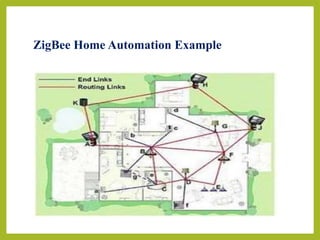
 The practical example shown is a home with a ZigBee network controlling lights,
security system, fire system, and the heating and air conditioning.The diagram shows a
number of devices -- red marks a "router to router" link, and blue link an "end node to
router" link.
 Here, lighting fixture B (which might also be the "coordinator") has identified and
established routes via routers embedded in lighting fixtures A and F, mains-
powered (with battery backup) smoke detector C, and table lamp D.
 All the routers are mains-powered devices (lamps, heat pump, lighting fixtures,
smoke alarms) and the "end" devices are battery-powered (switches, thermostats,
motion detectors). Sensors are bound to actuators sometimes through user
choices, otherwise because of bindings specified by the manufacturers
Why does Zigbee Do
 Operates in Personal Area Networks (PAN?s) and device-to-device networks
 Connectivity between small packet devices
 Control of lights, switches, thermostats, appliances, etc.
 Designed for wireless controls and sensors
How Zigbee Works
• Topology
Star
Cluster Tree
Mesh
•Network coordinator, routers, end devices
Layers of zigbee network:
Network and Application Support layer
Physical (PHY) layer
Media access control (MAC) layer
Network and Application Support layer :The network layer permits growth of
network sans high power transmitters. This layer can handle huge numbers of nodes.
This level in the ZigBee architecture includes the ZigBee Device Object (ZDO), user-
defined application profile(s) and the Application Support (APS) sub-layer.
Physical (PHY) layer :physical layer accommodates high levels of integration by
using direct sequence to permit simplicity in the analog circuitry and enable cheaper
implementations.
Media access control (MAC) layer :media access control layer permits use of several
topologies without introducing complexity and is meant to work with large numbers of
devices. There are three different ZigBee device types that operate on these layers in
any self-organizing application network. These devices have 64-bit IEEE addresses,
with option to enable shorter addresses to reduce packet size, and work in either of two
addressing modes – star and peer-to-peer.
Topologies
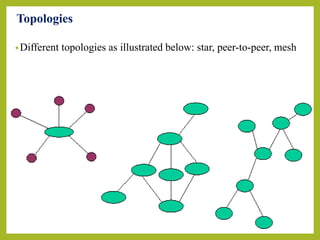
•Different topologies as illustrated below: star, peer-to-peer, mesh
 ZigBee employs either of two modes, beacon or non-beacon to enable the to-
and-fro data traffic. Beacon mode is used when the coordinator runs on batteries
and thus offers maximum power savings, whereas the non-beacon mode finds
favor when the coordinator is mains-powered.
 In the beacon mode, a device watches out for the coordinator's beacon that gets
transmitted at periodically, locks on and looks for messages addressed to it. If
message transmission is complete, the coordinator dictates a schedule for the
next beacon so that the device „goes to sleep'; in fact, the coordinator itself
switches to sleep mode.
 The non-beacon mode will be included in a system where devices are „asleep'
nearly always, as in smoke detectors and burglar alarms. The devices wake up
and confirm their continued presence in the network at random intervals.
 Automation: In production and manufacturing industries, a link called communication
link is used to monitor continuously in various parameters and critical equipment. And
hence the cost of this ZigBee communication is reduced and as well as the control
process is optimized for greater reliability.
 Home Automation: Home appliances are used remotely which is suited for ZigBee
perfectly as lighting control system, control appliance, cooling and heating control
system, safety equipment control and surveillance and etc…
 Smart Metering: Some smart metering of ZigBee remote operations includes response
of energy consumption, support pricing and power theft over security.
 Smart Grid Monitoring: Some smart grid monitoring in ZigBee operations that
involve temperature
 monitoring remote like reactive power management and fault locator and so on.
Applications
RESULT AND DISCUSSION
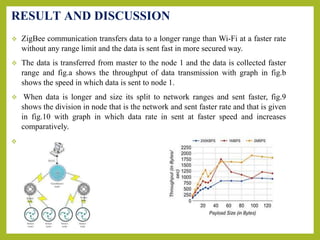
 ZigBee communication transfers data to a longer range than Wi-Fi at a faster rate
without any range limit and the data is sent fast in more secured way.
 The data is transferred from master to the node 1 and the data is collected faster
range and fig.a shows the throughput of data transmission with graph in fig.b
shows the speed in which data is sent to node 1.
 When data is longer and size its split to network ranges and sent faster, fig.9
shows the division in node that is the network and sent faster rate and that is given
in fig.10 with graph in which data rate in sent at faster speed and increases
comparatively.

Uses
In all of its uses, zigbee offers four inherent, beneficial
characteristics:
•Low cost:
•Range and obstruction issue avoidance:
•Multisource products:
•Low power consumption:
Future of ZigBee:
 A recent analyst report issued by West Technology Research Solutions
estimates that by the year 2008, "annual shipments for ZigBee chipsets into
the home automation segment alone will exceed 339 million units," and will
show up in "light switches, fire and smoke detectors, thermostats, appliances
in the kitchen, video and audio remote controls, landscaping, and security
systems."
 Futurists are sure to hold ZigBee up and say, "See, I told you so".
Conclusion
• ZigBee is one of the global standards of communication protocol
formulated by the relevant task force.
• ZigBee is the newest and provides specifications for devices that
have low data rates, consume very low power and are thus
characterized by long battery life.
• Other standards like Bluetooth and IrDA address high data rate
applications such as voice, video and LAN communications. So
with all these features ZigBee in future will surely becomes the
talk of the town.
Referances
• www.wikipedia.com
• www.studymafia.org
• www.google.com
• www.zigbee.com
THANKS..!!!

Zigbee

  • 1.
    VISVESVARAYA TECHNOLOGICAL UNIVERSITY “JNANA SANGAMA”,BELAGAVI-590018 PRESENTAION ON “zigbee Technology” Carried out by ABHISHEKA MASALAVADADA 4GH19EC400 Under the Guidance of Prof.Pallavi Bembli Assistance Professor Dept of ECE Government Engineering College Hassan-573201
  • 2.
    Content • Introduction • History •Device Types • Zigbee Home Automation Example • How Zigbee Works • Why does Zigbee Do • Layer of Zigbee Networks • Topologies • Uses • Future • Conclusion
  • 3.
    Introduction 1. When youhold the TV remote and wish to use it you have to necessarily point your control at the device. 2. This one-way, line-of-sight, short-range communication uses infrared (IR) sensors to enable communication and control and it is possible to operate the TV remotely only with its control unit. 3. Add other home theatre modules, an air- conditioner and remotely enabled fans and lights to your room, and you become a juggler who has to handle not only these remotes, but also more numbers that will accompany other home appliances you are likely to use. 4. Some remotes do serve to control more than one device after „memorizing' access codes, but this interoperability is restricted to LOS, that too only for a set of related equipment, like the different units of a home entertainment system 5. Now picture a home with entertainment units, security systems including fire alarm, smoke detector and burglar alarm, air-conditioners and kitchen appliances all within whispering distance from each other and imagine a single unit that talks with all the devices, no longer depending on line-of-sight, and traffic no longer being one-way. 6. This means that the devices and the control unit would all need a common standard to enable intelligible communication. ZigBee is such a standard for embedded application software.
  • 4.
    Device types There arethree different types of ZigBee device: • ZigBee coordinator (ZC) • ZigBee Router (ZR) • ZigBee End Device (ZED)
  • 5.
    Types Explained… ZigBee coordinator(ZC): The most capable device, the coordinator forms the root of the network tree and might bridge to other networks.  There is exactly one ZigBee coordinator in each network. It is able to store information about the network, including acting as the repository for security keys. ZigBee Router (ZR): Routers can act as an intermediate router, passing data from other devices. ZigBee End Device (ZED): Contains just enough functionality to talk to its parent node (either the coordinator or a router); it cannot relay data from other devices. It requires the least amount of memory, and therefore can be less expensive to manufacture than a ZR or ZC.
  • 6.
  • 7.
     The practicalexample shown is a home with a ZigBee network controlling lights, security system, fire system, and the heating and air conditioning.The diagram shows a number of devices -- red marks a "router to router" link, and blue link an "end node to router" link.  Here, lighting fixture B (which might also be the "coordinator") has identified and established routes via routers embedded in lighting fixtures A and F, mains- powered (with battery backup) smoke detector C, and table lamp D.  All the routers are mains-powered devices (lamps, heat pump, lighting fixtures, smoke alarms) and the "end" devices are battery-powered (switches, thermostats, motion detectors). Sensors are bound to actuators sometimes through user choices, otherwise because of bindings specified by the manufacturers
  • 8.
    Why does ZigbeeDo  Operates in Personal Area Networks (PAN?s) and device-to-device networks  Connectivity between small packet devices  Control of lights, switches, thermostats, appliances, etc.  Designed for wireless controls and sensors
  • 9.
    How Zigbee Works •Topology Star Cluster Tree Mesh •Network coordinator, routers, end devices
  • 10.
    Layers of zigbeenetwork: Network and Application Support layer Physical (PHY) layer Media access control (MAC) layer Network and Application Support layer :The network layer permits growth of network sans high power transmitters. This layer can handle huge numbers of nodes. This level in the ZigBee architecture includes the ZigBee Device Object (ZDO), user- defined application profile(s) and the Application Support (APS) sub-layer. Physical (PHY) layer :physical layer accommodates high levels of integration by using direct sequence to permit simplicity in the analog circuitry and enable cheaper implementations. Media access control (MAC) layer :media access control layer permits use of several topologies without introducing complexity and is meant to work with large numbers of devices. There are three different ZigBee device types that operate on these layers in any self-organizing application network. These devices have 64-bit IEEE addresses, with option to enable shorter addresses to reduce packet size, and work in either of two addressing modes – star and peer-to-peer.
  • 11.
    Topologies •Different topologies asillustrated below: star, peer-to-peer, mesh
  • 12.
     ZigBee employseither of two modes, beacon or non-beacon to enable the to- and-fro data traffic. Beacon mode is used when the coordinator runs on batteries and thus offers maximum power savings, whereas the non-beacon mode finds favor when the coordinator is mains-powered.  In the beacon mode, a device watches out for the coordinator's beacon that gets transmitted at periodically, locks on and looks for messages addressed to it. If message transmission is complete, the coordinator dictates a schedule for the next beacon so that the device „goes to sleep'; in fact, the coordinator itself switches to sleep mode.  The non-beacon mode will be included in a system where devices are „asleep' nearly always, as in smoke detectors and burglar alarms. The devices wake up and confirm their continued presence in the network at random intervals.
  • 13.
     Automation: Inproduction and manufacturing industries, a link called communication link is used to monitor continuously in various parameters and critical equipment. And hence the cost of this ZigBee communication is reduced and as well as the control process is optimized for greater reliability.  Home Automation: Home appliances are used remotely which is suited for ZigBee perfectly as lighting control system, control appliance, cooling and heating control system, safety equipment control and surveillance and etc…  Smart Metering: Some smart metering of ZigBee remote operations includes response of energy consumption, support pricing and power theft over security.  Smart Grid Monitoring: Some smart grid monitoring in ZigBee operations that involve temperature  monitoring remote like reactive power management and fault locator and so on. Applications
  • 14.
    RESULT AND DISCUSSION ZigBee communication transfers data to a longer range than Wi-Fi at a faster rate without any range limit and the data is sent fast in more secured way.  The data is transferred from master to the node 1 and the data is collected faster range and fig.a shows the throughput of data transmission with graph in fig.b shows the speed in which data is sent to node 1.  When data is longer and size its split to network ranges and sent faster, fig.9 shows the division in node that is the network and sent faster rate and that is given in fig.10 with graph in which data rate in sent at faster speed and increases comparatively. 
  • 15.
    Uses In all ofits uses, zigbee offers four inherent, beneficial characteristics: •Low cost: •Range and obstruction issue avoidance: •Multisource products: •Low power consumption:
  • 16.
    Future of ZigBee: A recent analyst report issued by West Technology Research Solutions estimates that by the year 2008, "annual shipments for ZigBee chipsets into the home automation segment alone will exceed 339 million units," and will show up in "light switches, fire and smoke detectors, thermostats, appliances in the kitchen, video and audio remote controls, landscaping, and security systems."  Futurists are sure to hold ZigBee up and say, "See, I told you so".
  • 17.
    Conclusion • ZigBee isone of the global standards of communication protocol formulated by the relevant task force. • ZigBee is the newest and provides specifications for devices that have low data rates, consume very low power and are thus characterized by long battery life. • Other standards like Bluetooth and IrDA address high data rate applications such as voice, video and LAN communications. So with all these features ZigBee in future will surely becomes the talk of the town.
  • 18.
  • 19.

Editor's Notes