Short Range Communication Technologies
and Protocols
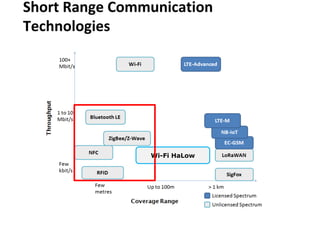
Short Range Communication
Technologies
Wi-Fi HaLow
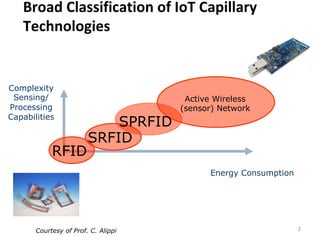
Broad Classification of IoT Capillary
Technologies
Complexity
Sensing/
Processing
Capabilities
RFID
SRFID
Active Wireless
(sensor) Network
Energy Consumption
SPRFID
Courtesy of Prof. C. Alippi 3
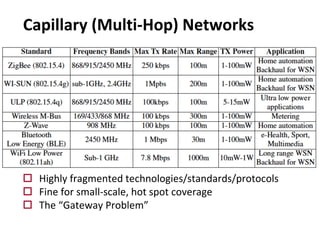
o Highly fragmented technologies/standards/protocols
o Fine for small-scale, hot spot coverage
o The “Gateway Problem”
Capillary (Multi-Hop) Networks
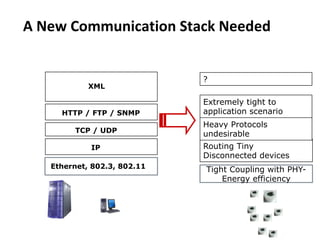
A New Communication Stack Needed
Ethernet, 802.3, 802.11
IP
TCP / UDP
HTTP / FTP / SNMP
XML
Routing Tiny
Disconnected devices
Heavy Protocols
undesirable
Extremely tight to
application scenario
?
Tight Coupling with PHY-
Energy efficiency
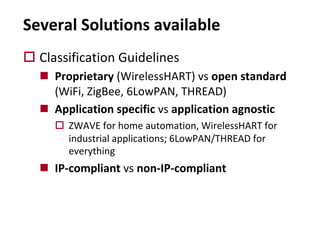
o Classification Guidelines
n Proprietary (WirelessHART) vs open standard
(WiFi, ZigBee, 6LowPAN, THREAD)
n Application specific vs application agnostic
o ZWAVE for home automation, WirelessHART for
industrial applications; 6LowPAN/THREAD for
everything
n IP-compliant vs non-IP-compliant
Several Solutions available
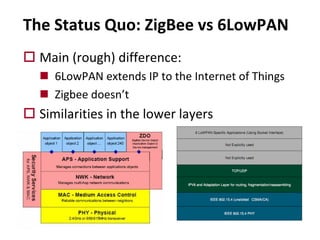
o Main (rough) difference:
n 6LowPAN extends IP to the Internet of Things
n Zigbee doesn’t
o Similarities in the lower layers
The Status Quo: ZigBee vs 6LowPAN
ZigBee
Main features
o Low-cost Hardware (2$) and software
o Limited TX range (~10m)
o Low Latency
o High Energy Efficiency!
Towards ZigBee...
o Too many proprietary solutions in the field of IoT (mid 90s)
o Dramatic compatibility/interoperability issues (and high
costs)
o WP 4 within IEEE launched in 2001 to have a reference
technology
o IEEE 802.15.4 standard published in March 2003.
o The technology is often (misleadingly) referenced as:
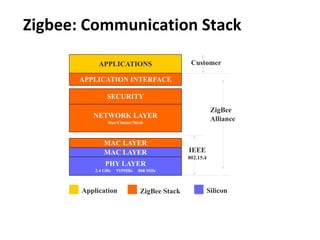
Zigbee: Communication Stack
PHY LAYER
2.4 GHz 915MHz 868 MHz
MAC LAYER
MAC LAYER
NETWORK LAYER
Star/Cluster/Mesh
APPLICATION INTERFACE
APPLICATIONS
Silicon
Application ZigBee Stack
Customer
IEEE
802.15.4
ZigBee
Alliance
SECURITY
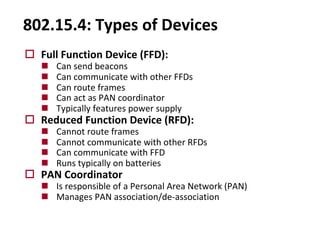
802.15.4: Types of Devices
o Full Function Device (FFD):
n Can send beacons
n Can communicate with other FFDs
n Can route frames
n Can act as PAN coordinator
n Typically features power supply
o Reduced Function Device (RFD):
n Cannot route frames
n Cannot communicate with other RFDs
n Can communicate with FFD
n Runs typically on batteries
o PAN Coordinator
n Is responsible of a Personal Area Network (PAN)
n Manages PAN association/de-association
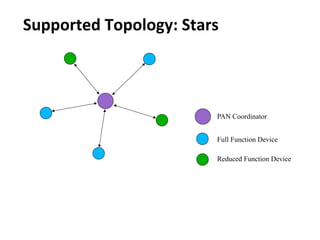
Supported Topology: Stars
PAN Coordinator
Full Function Device
Reduced Function Device
PAN Coordinator
Full Function Device
Reduced Function Device
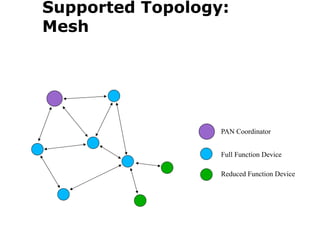
Supported Topology:
Mesh
PAN Coordinator
Full Function Device
Reduced Function Device
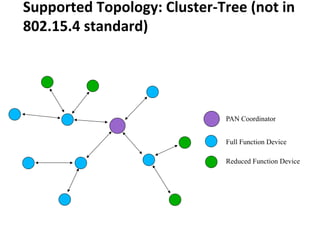
Supported Topology: Cluster-Tree (not in
802.15.4 standard)
802.15.4: PHY
o Activation and deactivation of the radio transceiver
o Energy detection (ED) within the current channel
n Detect energy level for each channel (used to
implement scanning functionalities)
o Link quality indicator (LQI) for received packets
o Clear channel assessment (CCA)
n Used to implement the carrier sense multiple access
with collision avoidance (CSMA-CA)
o Channel frequency selection
o Data transmission and reception
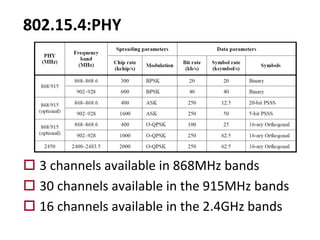
802.15.4:PHY
o 3 channels available in 868MHz bands
o 30 channels available in the 915MHz bands
o 16 channels available in the 2.4GHz bands
o Preamble: to achieve synchronization
o SFD: frame delimiter
o Frame Length: length (in octets) of the PHY
payload
n For MAC data frames in the range of [9-127]
PHY: PDU format
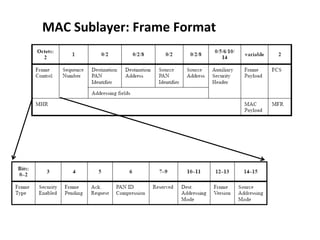
MAC Sublayer Tasks
o The features of the MAC sublayer are:
n beacon management,
n channel access management,
n GTS management,
n Frame validation,
n acknowledged frame delivery,
n association, and disassociation,
n hooks for implementing application-
appropriate security mechanisms.
MAC: Functional Description
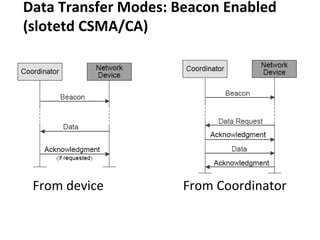
o Two operation modes are defined:
n Beacon Enabled
o PAN coordinator periodically transmits beacons
o Usually adopted in star topologies
o Slotted CSMA/CA + scheduled transmissions
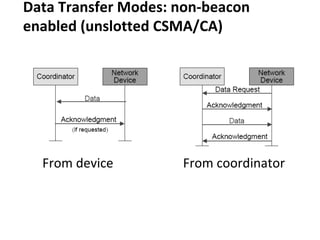
n Non Beacon Enabled
o Uncoordinated access through unslotted CSMA/CA
802.15.4 Channel Access
o The resource to be shared is time
o A Mixture of Scheduled and Random Access
o Scheduled Access implemented through
PAN Coordinator (only beacon-enabled
mode)
o Random Access allowed between RFDs and
between RFD/FFD and PAN Coordinator
(allowed in both operation modes)
Beacon Enabled: functional description
o Beacon Enabled
o Frame Length: from 15[ms] to 252[s]
(15.38ms*2n where 0 £ n £ 14)
o RFD associated to PAN coordinator are aligned with
the frame structure
o Random access through CSMA/CA in CAP
o Guranteed Time Slot statically assigned by PAN
coordinator through beacons
GTS GTS Inactive
Beacon Beacon
CAP CFP
0 1 2 3 4 5 6 7 8 9 10 11 12 13 15
14
CSMA/CA
o Each device shall maintain three variables for each transmission
attempt: NB, CW and BE.
n NB is the number of times the CSMA-CA algorithm was
required to backoff (initialized to zero before each new
transmission attempt)
n CW is the contention window length, defining the number
of backoff periods that need to be clear of channel activity
before the transmission can commence (initialized to 2, only
for slotted CSMA-CA).
n BE is the backoff exponent, which is related to how many
backoff periods a device shall wait before attempting to
assess a channel.
o Backoff period: duration of 20 symbols
CSMA Procedure at a Glance
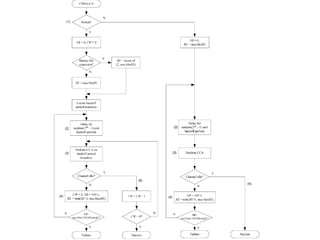
o A transmitting node delays for a random
number of backoff periods in [0, 2BE-1]
o If clear channel assessments (CCA) is idle for
CW consecutive backoff periods, the node
starts the transmission and waits for an ACK.
o If the channel is busy, the exponent BE and the
number of backoff attempts, NB, are
incremented and the procedure is repeated
o After “too many” (NBmax) failed retries, the
packet is discarded
CSMA Further Nits
o Transmission procedure (including ACK)
must end within a CAP
o Classical unslotted CSMA/CA without
synchronization
o CSMA not applied to beacons and ACKs
o In case of collision (ACK does not come
back), the procedure restarts
Data Transfer Modes: Beacon Enabled
(slotetd CSMA/CA)
From device From Coordinator
Data Transfer Modes: non-beacon
enabled (unslotted CSMA/CA)
From device From coordinator
MAC Sublayer: Frame Format
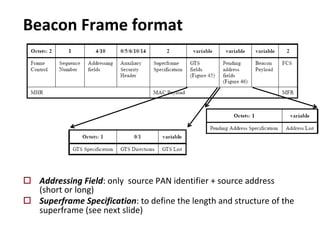
Beacon Frame format
o Addressing Field: only source PAN identifier + source address
(short or long)
o Superframe Specification: to define the length and structure of the
superframe (see next slide)
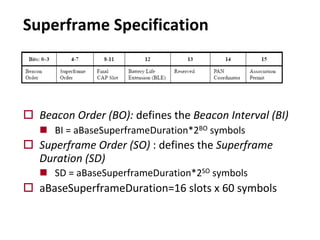
Superframe Specification
o Beacon Order (BO): defines the Beacon Interval (BI)
n BI = aBaseSuperframeDuration*2BO symbols
o Superframe Order (SO) : defines the Superframe
Duration (SD)
n SD = aBaseSuperframeDuration*2SO symbols
o aBaseSuperframeDuration=16 slots x 60 symbols
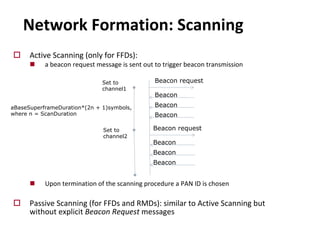
Network Formation: Scanning
o Active Scanning (only for FFDs):
n a beacon request message is sent out to trigger beacon transmission
n Upon termination of the scanning procedure a PAN ID is chosen
o Passive Scanning (for FFDs and RMDs): similar to Active Scanning but
without explicit Beacon Request messages
Beacon request
Beacon
Beacon
Beacon
Set to
channel1
Set to
channel2
aBaseSuperframeDuration*(2n + 1)symbols,
where n = ScanDuration
Beacon request
Beacon
Beacon
Beacon
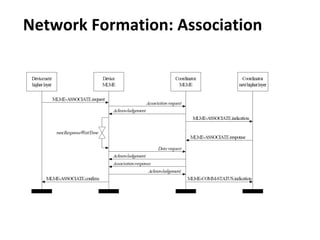
Network Formation: Association
IEEE802.15.4 Extensions
o IEEE 802.15.4e
n Slotted channel access
o IEEE 802.15.4g
n Amendement for smart utility applications
o IEEE 802.15.4k
n Amendement for critical infrastructure
monitoring
Network Layer
o Configuring a new device: this is the ability to sufficiently configure
the stack for operation as required.
o Starting a network: this is the ability to establish a new network.
o Joining, rejoining and leaving a network: this is the ability to join,
rejoin or leave a network as well as the ability of a ZigBee coordinator
or ZigBee router to request that a device leave the network.
o Addressing: this is the ability of ZigBee coordinators and routers to
assign addresses to devices joining the network.
o Neighbor discovery: this is the ability to discover, record, and report
information pertaining to the one-hop neighbors of a device.
o Route discovery: this is the ability to discover and record paths
through the network, whereby messages may be efficiently routed.
o Reception control: this is the ability for a device to control when the
receiver is activated and for how long, enabling MAC sub-layer
synchronization or direct reception.
o Routing: this is the ability to use different routing mechanisms such as
unicast, broadcast, multicast or many to one to efficiently exchange
data in the network
Network Layer Functionalities
Zigbee Routing: overview
o Zigbee Specification (7/2005)
o Three Types of Devices:
n ZB Coordinator (FFD)
n ZB Router (FFD)
n ZB End-Device (RFD o FFD)
o ZigBee Routing Integrates:
n Ad-hoc On-demand Distance Vector (AODV)
n Cluster Tree Algorithm
Cluster Tree Algorithm: Tree Formation
o A FFD kicks off the procedure:
n It scans the available channels through the proper functionalities at the lower layers
n Chooses a channel (e.g., the least interfered)
n Sets the PAN identifier
n Sets its own Network Address to 0 (Coordinator)
o Other devices may now associate to the coordinator through the lower-
layer association procedures
o Associated devices may be:
n ZB Router (only FFD): may let other devices to associate to the network
n ZB End-Device
o Address Assignment (16 bits short addresses) is performed jointly with
association
o Each parent device (PAN coordinator, ZB router) assigns groups of
addresses to its children (other ZB routers, ZB end devices)
Cluster Tree Formation: principles
o On the basis of its depth in the tree, a newly
joined router is assigned a range of
consecutive addresses (16-bit integers).
o The first integer in the range becomes the
node address while the rest will be available
for assignment to its children (routers and
end-devices).
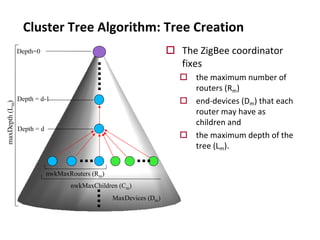
Cluster Tree Algorithm: Tree Creation
maxDepth
(L
m
)
nwkMaxRouters (Rm)
nwkMaxChildren (Cm)
Depth=0
Depth = d-1
Depth = d
o The ZigBee coordinator
fixes
o the maximum number of
routers (Rm)
o end-devices (Dm) that each
router may have as
children and
o the maximum depth of the
tree (Lm).
MaxDevices (Dm)
o The size A(d) of the range of addresses assigned to a
router node at depth d < Lm is defined by:
o Nodes at depth Lm and end-devices are assigned a
single address.
o Simple Assignment Rule:
o A mote at level d is assigned addresses in range [x,x + A(d)-1]
o It will assign
n [x+(i-1)A(d+1)+1,x+iA(d+1)] to its i-th router child (1£i
£Rm)
n x+RmA(d+1)+j to its jth end-device child (1 £j £Dm).
Address Assignment Rule
An Example
o Address allocations
for Rm = 2, Dm = 2
and Lm= 3.
n A(2)=2+2+1=5
n A(1)=1+2+2A(2)=13
n A(0)=1+2+2A(1)=29
n PAN Coordinator
can assign
addresses in the
range [0,28]
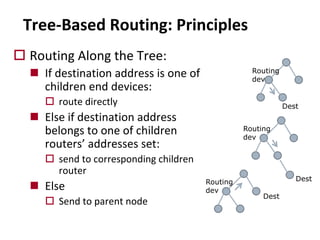
Tree-Based Routing: Principles
o Routing Along the Tree:
n If destination address is one of
children end devices:
o route directly
n Else if destination address
belongs to one of children
routers’ addresses set:
o send to corresponding children
router
n Else
o Send to parent node
Dest
Routing
dev
Dest
Routing
dev
Dest
Routing
dev
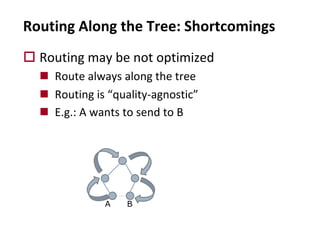
Routing Along the Tree: Shortcomings
o Routing may be not optimized
n Route always along the tree
n Routing is “quality-agnostic”
n E.g.: A wants to send to B
A B
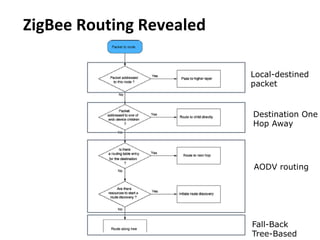
ZigBee Routing Revealed
Local-destined
packet
Destination One
Hop Away
AODV routing
Fall-Back
Tree-Based
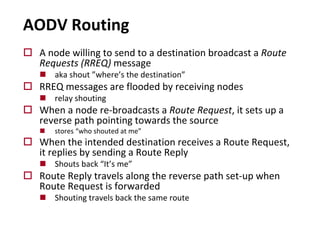
AODV Routing
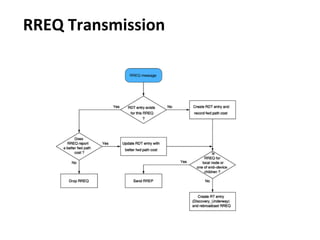
o A node willing to send to a destination broadcast a Route
Requests (RREQ) message
n aka shout ”where’s the destination”
o RREQ messages are flooded by receiving nodes
n relay shouting
o When a node re-broadcasts a Route Request, it sets up a
reverse path pointing towards the source
n stores “who shouted at me”
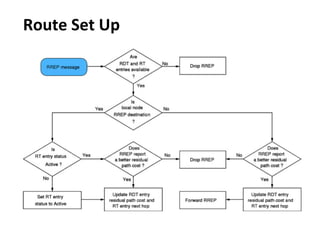
o When the intended destination receives a Route Request,
it replies by sending a Route Reply
n Shouts back “It’s me”
o Route Reply travels along the reverse path set-up when
Route Request is forwarded
n Shouting travels back the same route
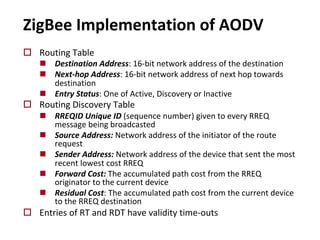
ZigBee Implementation of AODV
o Routing Table
n Destination Address: 16-bit network address of the destination
n Next-hop Address: 16-bit network address of next hop towards
destination
n Entry Status: One of Active, Discovery or Inactive
o Routing Discovery Table
n RREQID Unique ID (sequence number) given to every RREQ
message being broadcasted
n Source Address: Network address of the initiator of the route
request
n Sender Address: Network address of the device that sent the most
recent lowest cost RREQ
n Forward Cost: The accumulated path cost from the RREQ
originator to the current device
n Residual Cost: The accumulated path cost from the current device
to the RREQ destination
o Entries of RT and RDT have validity time-outs
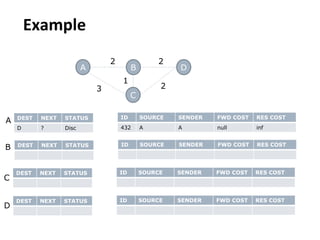
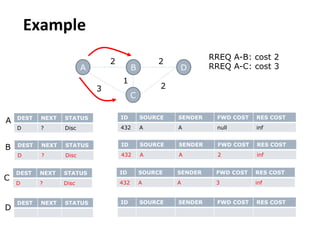
Example
DEST NEXT STATUS
D ? Disc
A B
C
D
2
1
2
2
3
ID SOURCE SENDER FWD COST RES COST
432 A A null inf
DEST NEXT STATUS ID SOURCE SENDER FWD COST RES COST
B
A
C
DEST NEXT STATUS ID SOURCE SENDER FWD COST RES COST
D
Example
DEST NEXT STATUS
D ? Disc
A B
C
D
2
1
2
2
3
ID SOURCE SENDER FWD COST RES COST
432 A A null inf
DEST NEXT STATUS
D ? Disc
ID SOURCE SENDER FWD COST RES COST
432 A A 2 inf
DEST NEXT STATUS
D ? Disc
ID SOURCE SENDER FWD COST RES COST
432 A A 3 inf
RREQ A-B: cost 2
RREQ A-C: cost 3
B
A
C
DEST NEXT STATUS ID SOURCE SENDER FWD COST RES COST
D
Example
DEST NEXT STATUS
D ? Disc
A B
C
D
2
1
2
2
3
ID SOURCE SENDER FWD COST RES COST
432 A A null inf
DEST NEXT STATUS
D ? Disc
ID SOURCE SENDER FWD COST RES COST
432 A A 2 inf
DEST NEXT STATUS
D ? Disc
ID SOURCE SENDER FWD COST RES COST
432 A A 3 inf
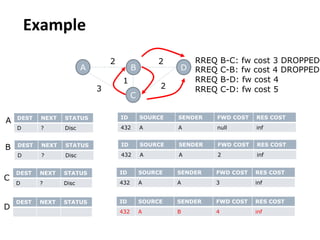
RREQ B-C: fw cost 3 DROPPED
RREQ C-B: fw cost 4 DROPPED
RREQ B-D: fw cost 4
RREQ C-D: fw cost 5
B
A
C
DEST NEXT STATUS ID SOURCE SENDER FWD COST RES COST
432 A B 4 inf
D
Example
DEST NEXT STATUS
D ? Disc
A B
C
D
2
1
2
2
3
ID SOURCE SENDER FWD COST RES COST
432 A A null inf
DEST NEXT STATUS
D D Disc
ID SOURCE SENDER FWD COST RES COST
432 A A 2 2
DEST NEXT STATUS
D D Disc
ID SOURCE SENDER FWD COST RES COST
432 A A 3 2
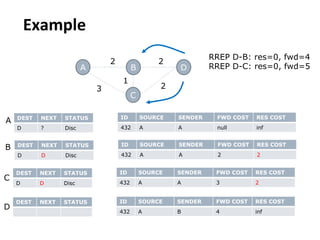
RREP D-B: res=0, fwd=4
RREP D-C: res=0, fwd=5
B
A
C
DEST NEXT STATUS ID SOURCE SENDER FWD COST RES COST
432 A B 4 inf
D
Example
DEST NEXT STATUS
D B Active
A B
C
D
2
1
2
2
3
ID SOURCE SENDER FWD COST RES COST
432 A A null 4
DEST NEXT STATUS
D D Disc
ID SOURCE SENDER FWD COST RES COST
432 A A 2 2
DEST NEXT STATUS
D D Disc
ID SOURCE SENDER FWD COST RES COST
432 A A 3 2
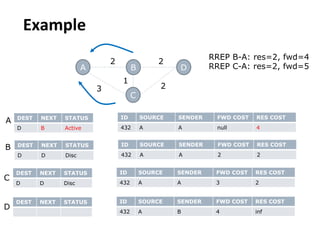
RREP B-A: res=2, fwd=4
RREP C-A: res=2, fwd=5
B
A
C
DEST NEXT STATUS ID SOURCE SENDER FWD COST RES COST
432 A B 4 inf
D
RREQ Transmission
Route Set Up
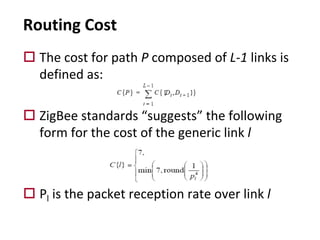
Routing Cost
o The cost for path P composed of L-1 links is
defined as:
o ZigBee standards “suggests” the following
form for the cost of the generic link l
o Pl is the packet reception rate over link l
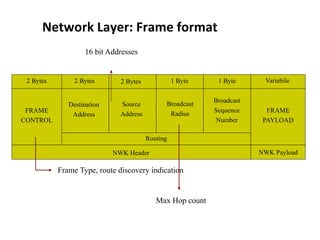
Network Layer: Frame format
2 Bytes 2 Bytes 2 Bytes 1 Byte 1 Byte Variabile
Routing
FRAME
PAYLOAD
NWK Payload
NWK Header
FRAME
CONTROL
Destination
Address
Source
Address
Broadcast
Radius
Broadcast
Sequence
Number
Frame Type, route discovery indication
Max Hop count
16 bit Addresses
ZigBee Application Profiles
o Needs:
n A common language for exchanging data
n A well defined set of processing actions
n Device interoperability across different manufacturers
n Simplicity and reliability for the end users
o Profile Definition (9 Profile Libraries Currently Specified)
n A set of devices required in the application area
n A set of clusters to implement the functionality
o A set of attributes to represent device state
o A set of commands to enable the communication
n Specification of which clusters are required by which devices
n Specific functional description for each device
Profile Components
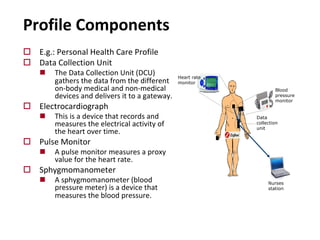
o E.g.: Personal Health Care Profile
o Data Collection Unit
n The Data Collection Unit (DCU)
gathers the data from the different
on-body medical and non-medical
devices and delivers it to a gateway.
o Electrocardiograph
n This is a device that records and
measures the electrical activity of
the heart over time.
o Pulse Monitor
n A pulse monitor measures a proxy
value for the heart rate.
o Sphygmomanometer
n A sphygmomanometer (blood
pressure meter) is a device that
measures the blood pressure.
Heart rate
monitor
Blood
pressure
monitor
Nurses
station
Data
collection
unit
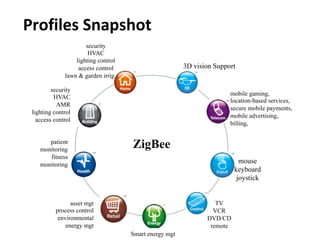
Profiles Snapshot
security
HVAC
AMR
lighting control
access control
ZigBee
TV
VCR
DVD/CD
remote
security
HVAC
lighting control
access control
lawn & garden irrigation
asset mgt
process control
environmental
energy mgt
mouse
keyboard
joystick
patient
monitoring
fitness
monitoring
mobile gaming,
location-based services,
secure mobile payments,
mobile advertising,
billing,
3D vision Support
Smart energy mgt

8-ZigBee (2).pdf

  • 1.
    Short Range CommunicationTechnologies and Protocols
  • 2.
  • 3.
    Broad Classification ofIoT Capillary Technologies Complexity Sensing/ Processing Capabilities RFID SRFID Active Wireless (sensor) Network Energy Consumption SPRFID Courtesy of Prof. C. Alippi 3
  • 4.
    o Highly fragmentedtechnologies/standards/protocols o Fine for small-scale, hot spot coverage o The “Gateway Problem” Capillary (Multi-Hop) Networks
  • 5.
    A New CommunicationStack Needed Ethernet, 802.3, 802.11 IP TCP / UDP HTTP / FTP / SNMP XML Routing Tiny Disconnected devices Heavy Protocols undesirable Extremely tight to application scenario ? Tight Coupling with PHY- Energy efficiency
  • 6.
    o Classification Guidelines nProprietary (WirelessHART) vs open standard (WiFi, ZigBee, 6LowPAN, THREAD) n Application specific vs application agnostic o ZWAVE for home automation, WirelessHART for industrial applications; 6LowPAN/THREAD for everything n IP-compliant vs non-IP-compliant Several Solutions available
  • 7.
    o Main (rough)difference: n 6LowPAN extends IP to the Internet of Things n Zigbee doesn’t o Similarities in the lower layers The Status Quo: ZigBee vs 6LowPAN
  • 8.
  • 9.
    Main features o Low-costHardware (2$) and software o Limited TX range (~10m) o Low Latency o High Energy Efficiency!
  • 10.
    Towards ZigBee... o Toomany proprietary solutions in the field of IoT (mid 90s) o Dramatic compatibility/interoperability issues (and high costs) o WP 4 within IEEE launched in 2001 to have a reference technology o IEEE 802.15.4 standard published in March 2003. o The technology is often (misleadingly) referenced as:
  • 11.
    Zigbee: Communication Stack PHYLAYER 2.4 GHz 915MHz 868 MHz MAC LAYER MAC LAYER NETWORK LAYER Star/Cluster/Mesh APPLICATION INTERFACE APPLICATIONS Silicon Application ZigBee Stack Customer IEEE 802.15.4 ZigBee Alliance SECURITY
  • 12.
    802.15.4: Types ofDevices o Full Function Device (FFD): n Can send beacons n Can communicate with other FFDs n Can route frames n Can act as PAN coordinator n Typically features power supply o Reduced Function Device (RFD): n Cannot route frames n Cannot communicate with other RFDs n Can communicate with FFD n Runs typically on batteries o PAN Coordinator n Is responsible of a Personal Area Network (PAN) n Manages PAN association/de-association
  • 13.
    Supported Topology: Stars PANCoordinator Full Function Device Reduced Function Device
  • 14.
    PAN Coordinator Full FunctionDevice Reduced Function Device Supported Topology: Mesh
  • 15.
    PAN Coordinator Full FunctionDevice Reduced Function Device Supported Topology: Cluster-Tree (not in 802.15.4 standard)
  • 16.
    802.15.4: PHY o Activationand deactivation of the radio transceiver o Energy detection (ED) within the current channel n Detect energy level for each channel (used to implement scanning functionalities) o Link quality indicator (LQI) for received packets o Clear channel assessment (CCA) n Used to implement the carrier sense multiple access with collision avoidance (CSMA-CA) o Channel frequency selection o Data transmission and reception
  • 17.
    802.15.4:PHY o 3 channelsavailable in 868MHz bands o 30 channels available in the 915MHz bands o 16 channels available in the 2.4GHz bands
  • 18.
    o Preamble: toachieve synchronization o SFD: frame delimiter o Frame Length: length (in octets) of the PHY payload n For MAC data frames in the range of [9-127] PHY: PDU format
  • 19.
    MAC Sublayer Tasks oThe features of the MAC sublayer are: n beacon management, n channel access management, n GTS management, n Frame validation, n acknowledged frame delivery, n association, and disassociation, n hooks for implementing application- appropriate security mechanisms.
  • 20.
    MAC: Functional Description oTwo operation modes are defined: n Beacon Enabled o PAN coordinator periodically transmits beacons o Usually adopted in star topologies o Slotted CSMA/CA + scheduled transmissions n Non Beacon Enabled o Uncoordinated access through unslotted CSMA/CA
  • 21.
    802.15.4 Channel Access oThe resource to be shared is time o A Mixture of Scheduled and Random Access o Scheduled Access implemented through PAN Coordinator (only beacon-enabled mode) o Random Access allowed between RFDs and between RFD/FFD and PAN Coordinator (allowed in both operation modes)
  • 22.
    Beacon Enabled: functionaldescription o Beacon Enabled o Frame Length: from 15[ms] to 252[s] (15.38ms*2n where 0 £ n £ 14) o RFD associated to PAN coordinator are aligned with the frame structure o Random access through CSMA/CA in CAP o Guranteed Time Slot statically assigned by PAN coordinator through beacons GTS GTS Inactive Beacon Beacon CAP CFP 0 1 2 3 4 5 6 7 8 9 10 11 12 13 15 14
  • 23.
    CSMA/CA o Each deviceshall maintain three variables for each transmission attempt: NB, CW and BE. n NB is the number of times the CSMA-CA algorithm was required to backoff (initialized to zero before each new transmission attempt) n CW is the contention window length, defining the number of backoff periods that need to be clear of channel activity before the transmission can commence (initialized to 2, only for slotted CSMA-CA). n BE is the backoff exponent, which is related to how many backoff periods a device shall wait before attempting to assess a channel. o Backoff period: duration of 20 symbols
  • 24.
    CSMA Procedure ata Glance o A transmitting node delays for a random number of backoff periods in [0, 2BE-1] o If clear channel assessments (CCA) is idle for CW consecutive backoff periods, the node starts the transmission and waits for an ACK. o If the channel is busy, the exponent BE and the number of backoff attempts, NB, are incremented and the procedure is repeated o After “too many” (NBmax) failed retries, the packet is discarded
  • 25.
    CSMA Further Nits oTransmission procedure (including ACK) must end within a CAP o Classical unslotted CSMA/CA without synchronization o CSMA not applied to beacons and ACKs o In case of collision (ACK does not come back), the procedure restarts
  • 27.
    Data Transfer Modes:Beacon Enabled (slotetd CSMA/CA) From device From Coordinator
  • 28.
    Data Transfer Modes:non-beacon enabled (unslotted CSMA/CA) From device From coordinator
  • 29.
  • 30.
    Beacon Frame format oAddressing Field: only source PAN identifier + source address (short or long) o Superframe Specification: to define the length and structure of the superframe (see next slide)
  • 31.
    Superframe Specification o BeaconOrder (BO): defines the Beacon Interval (BI) n BI = aBaseSuperframeDuration*2BO symbols o Superframe Order (SO) : defines the Superframe Duration (SD) n SD = aBaseSuperframeDuration*2SO symbols o aBaseSuperframeDuration=16 slots x 60 symbols
  • 32.
    Network Formation: Scanning oActive Scanning (only for FFDs): n a beacon request message is sent out to trigger beacon transmission n Upon termination of the scanning procedure a PAN ID is chosen o Passive Scanning (for FFDs and RMDs): similar to Active Scanning but without explicit Beacon Request messages Beacon request Beacon Beacon Beacon Set to channel1 Set to channel2 aBaseSuperframeDuration*(2n + 1)symbols, where n = ScanDuration Beacon request Beacon Beacon Beacon
  • 33.
  • 34.
    IEEE802.15.4 Extensions o IEEE802.15.4e n Slotted channel access o IEEE 802.15.4g n Amendement for smart utility applications o IEEE 802.15.4k n Amendement for critical infrastructure monitoring
  • 35.
  • 36.
    o Configuring anew device: this is the ability to sufficiently configure the stack for operation as required. o Starting a network: this is the ability to establish a new network. o Joining, rejoining and leaving a network: this is the ability to join, rejoin or leave a network as well as the ability of a ZigBee coordinator or ZigBee router to request that a device leave the network. o Addressing: this is the ability of ZigBee coordinators and routers to assign addresses to devices joining the network. o Neighbor discovery: this is the ability to discover, record, and report information pertaining to the one-hop neighbors of a device. o Route discovery: this is the ability to discover and record paths through the network, whereby messages may be efficiently routed. o Reception control: this is the ability for a device to control when the receiver is activated and for how long, enabling MAC sub-layer synchronization or direct reception. o Routing: this is the ability to use different routing mechanisms such as unicast, broadcast, multicast or many to one to efficiently exchange data in the network Network Layer Functionalities
  • 37.
    Zigbee Routing: overview oZigbee Specification (7/2005) o Three Types of Devices: n ZB Coordinator (FFD) n ZB Router (FFD) n ZB End-Device (RFD o FFD) o ZigBee Routing Integrates: n Ad-hoc On-demand Distance Vector (AODV) n Cluster Tree Algorithm
  • 38.
    Cluster Tree Algorithm:Tree Formation o A FFD kicks off the procedure: n It scans the available channels through the proper functionalities at the lower layers n Chooses a channel (e.g., the least interfered) n Sets the PAN identifier n Sets its own Network Address to 0 (Coordinator) o Other devices may now associate to the coordinator through the lower- layer association procedures o Associated devices may be: n ZB Router (only FFD): may let other devices to associate to the network n ZB End-Device o Address Assignment (16 bits short addresses) is performed jointly with association o Each parent device (PAN coordinator, ZB router) assigns groups of addresses to its children (other ZB routers, ZB end devices)
  • 39.
    Cluster Tree Formation:principles o On the basis of its depth in the tree, a newly joined router is assigned a range of consecutive addresses (16-bit integers). o The first integer in the range becomes the node address while the rest will be available for assignment to its children (routers and end-devices).
  • 40.
    Cluster Tree Algorithm:Tree Creation maxDepth (L m ) nwkMaxRouters (Rm) nwkMaxChildren (Cm) Depth=0 Depth = d-1 Depth = d o The ZigBee coordinator fixes o the maximum number of routers (Rm) o end-devices (Dm) that each router may have as children and o the maximum depth of the tree (Lm). MaxDevices (Dm)
  • 41.
    o The sizeA(d) of the range of addresses assigned to a router node at depth d < Lm is defined by: o Nodes at depth Lm and end-devices are assigned a single address. o Simple Assignment Rule: o A mote at level d is assigned addresses in range [x,x + A(d)-1] o It will assign n [x+(i-1)A(d+1)+1,x+iA(d+1)] to its i-th router child (1£i £Rm) n x+RmA(d+1)+j to its jth end-device child (1 £j £Dm). Address Assignment Rule
  • 42.
    An Example o Addressallocations for Rm = 2, Dm = 2 and Lm= 3. n A(2)=2+2+1=5 n A(1)=1+2+2A(2)=13 n A(0)=1+2+2A(1)=29 n PAN Coordinator can assign addresses in the range [0,28]
  • 43.
    Tree-Based Routing: Principles oRouting Along the Tree: n If destination address is one of children end devices: o route directly n Else if destination address belongs to one of children routers’ addresses set: o send to corresponding children router n Else o Send to parent node Dest Routing dev Dest Routing dev Dest Routing dev
  • 44.
    Routing Along theTree: Shortcomings o Routing may be not optimized n Route always along the tree n Routing is “quality-agnostic” n E.g.: A wants to send to B A B
  • 45.
    ZigBee Routing Revealed Local-destined packet DestinationOne Hop Away AODV routing Fall-Back Tree-Based
  • 46.
    AODV Routing o Anode willing to send to a destination broadcast a Route Requests (RREQ) message n aka shout ”where’s the destination” o RREQ messages are flooded by receiving nodes n relay shouting o When a node re-broadcasts a Route Request, it sets up a reverse path pointing towards the source n stores “who shouted at me” o When the intended destination receives a Route Request, it replies by sending a Route Reply n Shouts back “It’s me” o Route Reply travels along the reverse path set-up when Route Request is forwarded n Shouting travels back the same route
  • 47.
    ZigBee Implementation ofAODV o Routing Table n Destination Address: 16-bit network address of the destination n Next-hop Address: 16-bit network address of next hop towards destination n Entry Status: One of Active, Discovery or Inactive o Routing Discovery Table n RREQID Unique ID (sequence number) given to every RREQ message being broadcasted n Source Address: Network address of the initiator of the route request n Sender Address: Network address of the device that sent the most recent lowest cost RREQ n Forward Cost: The accumulated path cost from the RREQ originator to the current device n Residual Cost: The accumulated path cost from the current device to the RREQ destination o Entries of RT and RDT have validity time-outs
  • 48.
    Example DEST NEXT STATUS D? Disc A B C D 2 1 2 2 3 ID SOURCE SENDER FWD COST RES COST 432 A A null inf DEST NEXT STATUS ID SOURCE SENDER FWD COST RES COST DEST NEXT STATUS ID SOURCE SENDER FWD COST RES COST B A C DEST NEXT STATUS ID SOURCE SENDER FWD COST RES COST D
  • 49.
    Example DEST NEXT STATUS D? Disc A B C D 2 1 2 2 3 ID SOURCE SENDER FWD COST RES COST 432 A A null inf DEST NEXT STATUS D ? Disc ID SOURCE SENDER FWD COST RES COST 432 A A 2 inf DEST NEXT STATUS D ? Disc ID SOURCE SENDER FWD COST RES COST 432 A A 3 inf RREQ A-B: cost 2 RREQ A-C: cost 3 B A C DEST NEXT STATUS ID SOURCE SENDER FWD COST RES COST D
  • 50.
    Example DEST NEXT STATUS D? Disc A B C D 2 1 2 2 3 ID SOURCE SENDER FWD COST RES COST 432 A A null inf DEST NEXT STATUS D ? Disc ID SOURCE SENDER FWD COST RES COST 432 A A 2 inf DEST NEXT STATUS D ? Disc ID SOURCE SENDER FWD COST RES COST 432 A A 3 inf RREQ B-C: fw cost 3 DROPPED RREQ C-B: fw cost 4 DROPPED RREQ B-D: fw cost 4 RREQ C-D: fw cost 5 B A C DEST NEXT STATUS ID SOURCE SENDER FWD COST RES COST 432 A B 4 inf D
  • 51.
    Example DEST NEXT STATUS D? Disc A B C D 2 1 2 2 3 ID SOURCE SENDER FWD COST RES COST 432 A A null inf DEST NEXT STATUS D D Disc ID SOURCE SENDER FWD COST RES COST 432 A A 2 2 DEST NEXT STATUS D D Disc ID SOURCE SENDER FWD COST RES COST 432 A A 3 2 RREP D-B: res=0, fwd=4 RREP D-C: res=0, fwd=5 B A C DEST NEXT STATUS ID SOURCE SENDER FWD COST RES COST 432 A B 4 inf D
  • 52.
    Example DEST NEXT STATUS DB Active A B C D 2 1 2 2 3 ID SOURCE SENDER FWD COST RES COST 432 A A null 4 DEST NEXT STATUS D D Disc ID SOURCE SENDER FWD COST RES COST 432 A A 2 2 DEST NEXT STATUS D D Disc ID SOURCE SENDER FWD COST RES COST 432 A A 3 2 RREP B-A: res=2, fwd=4 RREP C-A: res=2, fwd=5 B A C DEST NEXT STATUS ID SOURCE SENDER FWD COST RES COST 432 A B 4 inf D
  • 53.
  • 54.
  • 55.
    Routing Cost o Thecost for path P composed of L-1 links is defined as: o ZigBee standards “suggests” the following form for the cost of the generic link l o Pl is the packet reception rate over link l
  • 56.
    Network Layer: Frameformat 2 Bytes 2 Bytes 2 Bytes 1 Byte 1 Byte Variabile Routing FRAME PAYLOAD NWK Payload NWK Header FRAME CONTROL Destination Address Source Address Broadcast Radius Broadcast Sequence Number Frame Type, route discovery indication Max Hop count 16 bit Addresses
  • 57.
    ZigBee Application Profiles oNeeds: n A common language for exchanging data n A well defined set of processing actions n Device interoperability across different manufacturers n Simplicity and reliability for the end users o Profile Definition (9 Profile Libraries Currently Specified) n A set of devices required in the application area n A set of clusters to implement the functionality o A set of attributes to represent device state o A set of commands to enable the communication n Specification of which clusters are required by which devices n Specific functional description for each device
  • 58.
    Profile Components o E.g.:Personal Health Care Profile o Data Collection Unit n The Data Collection Unit (DCU) gathers the data from the different on-body medical and non-medical devices and delivers it to a gateway. o Electrocardiograph n This is a device that records and measures the electrical activity of the heart over time. o Pulse Monitor n A pulse monitor measures a proxy value for the heart rate. o Sphygmomanometer n A sphygmomanometer (blood pressure meter) is a device that measures the blood pressure. Heart rate monitor Blood pressure monitor Nurses station Data collection unit
  • 59.
    Profiles Snapshot security HVAC AMR lighting control accesscontrol ZigBee TV VCR DVD/CD remote security HVAC lighting control access control lawn & garden irrigation asset mgt process control environmental energy mgt mouse keyboard joystick patient monitoring fitness monitoring mobile gaming, location-based services, secure mobile payments, mobile advertising, billing, 3D vision Support Smart energy mgt