5th Grade Problem Solving
           with
8 Mathematical Practices

             Laura Chambless
        St. Clair RESA Consultant
      www.protopage.com/lchambess
Pre & Post Teacher Survey


  Complete the left side
    “Before Attending
  Mathematical Practices
        Workshop”
Write Your Own Story
         Problem

1. Think of a story problem you
   would use with your students.
2. Write it down on a 3x5 card.
3. Place the card under your name
   tag.
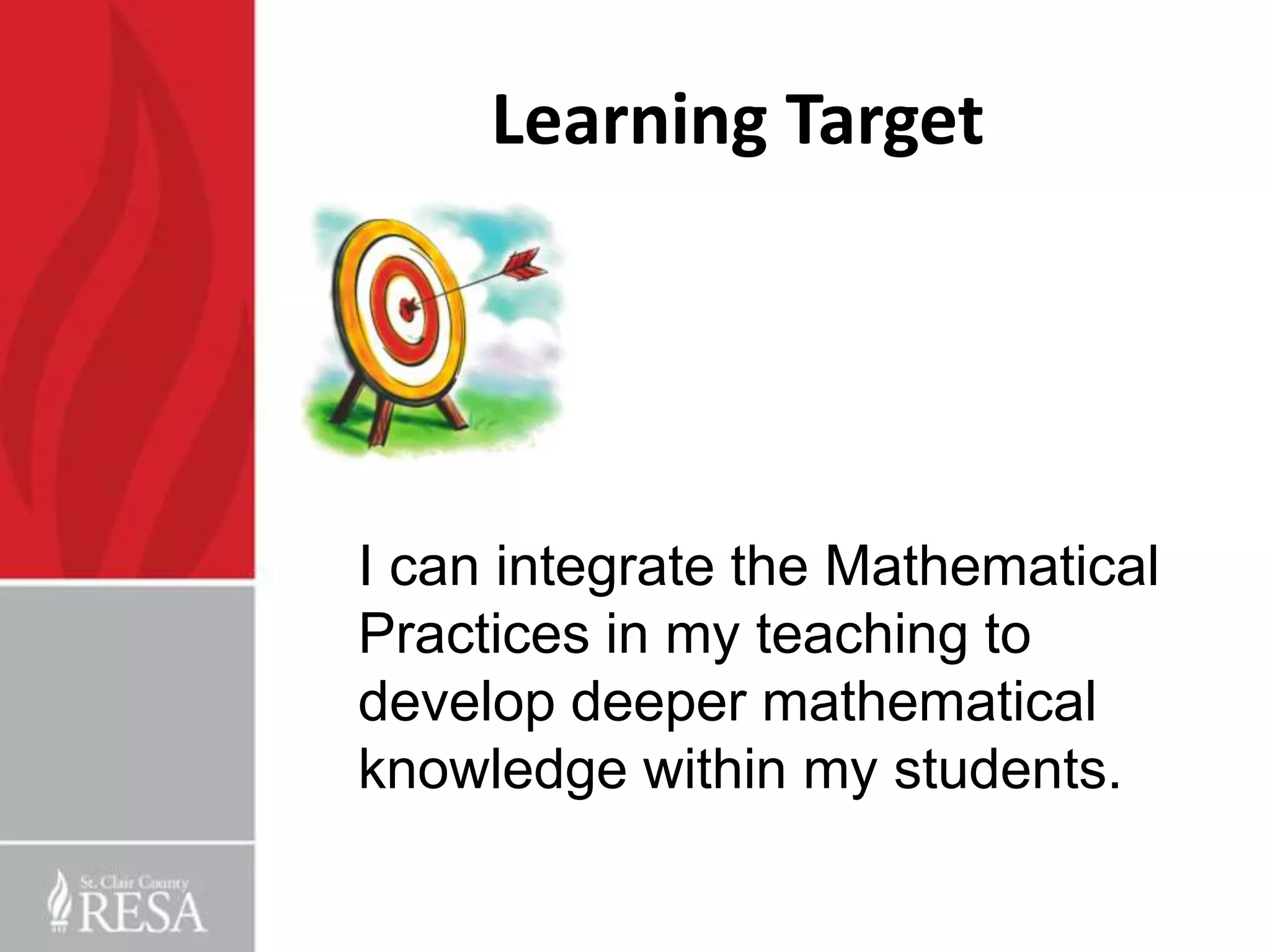
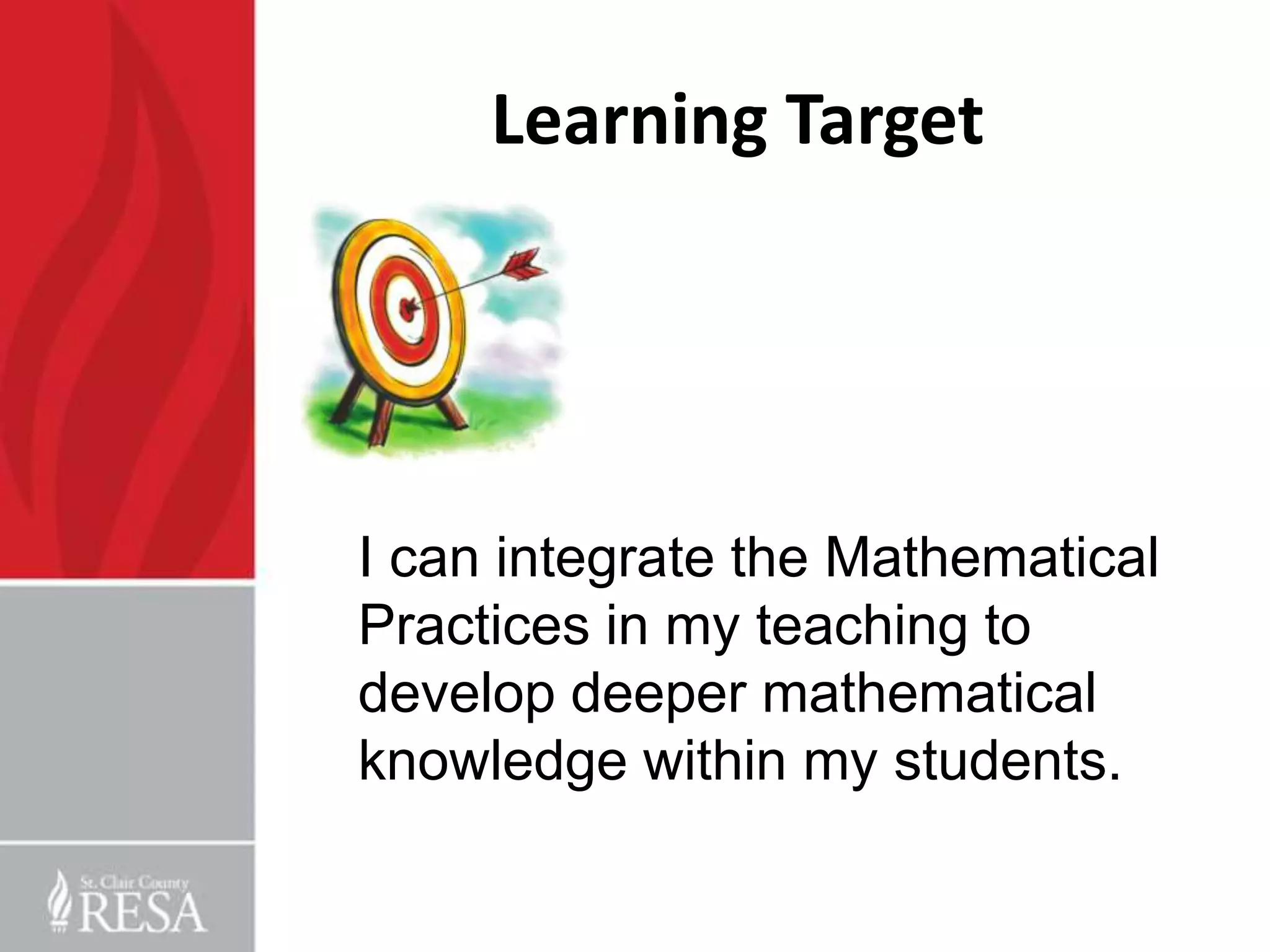
Learning Target


I can integrate the Mathematical
Practices in my teaching to
develop deeper mathematical
knowledge within my students.
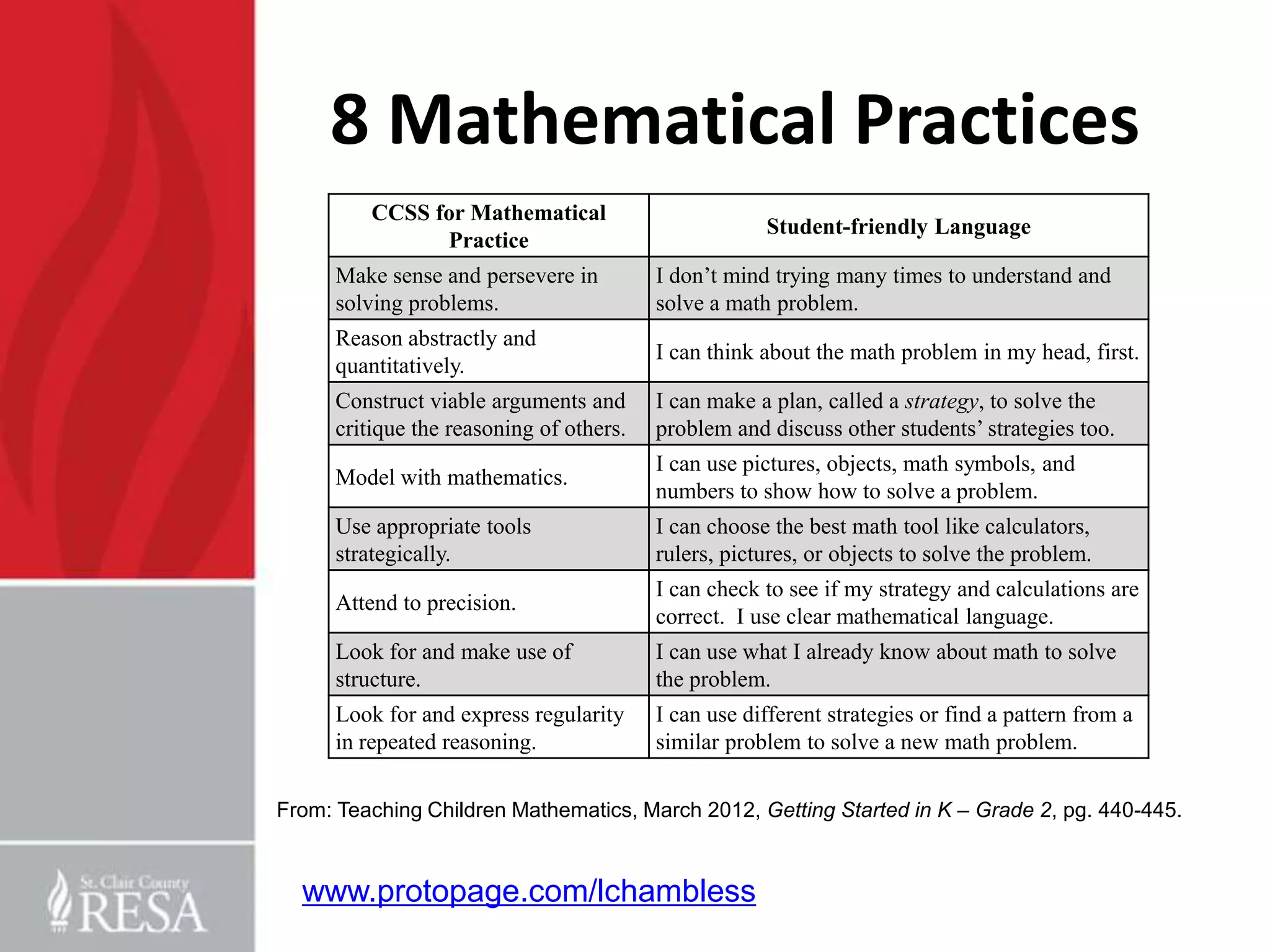
8 Mathematical Practices
          CCSS for Mathematical
                                                      Student-friendly Language
                Practice
      Make sense and persevere in         I don’t mind trying many times to understand and
      solving problems.                   solve a math problem.
      Reason abstractly and
                                          I can think about the math problem in my head, first.
      quantitatively.
      Construct viable arguments and      I can make a plan, called a strategy, to solve the
      critique the reasoning of others.   problem and discuss other students’ strategies too.
                                          I can use pictures, objects, math symbols, and
      Model with mathematics.
                                          numbers to show how to solve a problem.
      Use appropriate tools               I can choose the best math tool like calculators,
      strategically.                      rulers, pictures, or objects to solve the problem.
                                          I can check to see if my strategy and calculations are
      Attend to precision.
                                          correct. I use clear mathematical language.
      Look for and make use of            I can use what I already know about math to solve
      structure.                          the problem.
      Look for and express regularity     I can use different strategies or find a pattern from a
      in repeated reasoning.              similar problem to solve a new math problem.

From: Teaching Children Mathematics, March 2012, Getting Started in K – Grade 2, pg. 440-445.


  www.protopage.com/lchambless
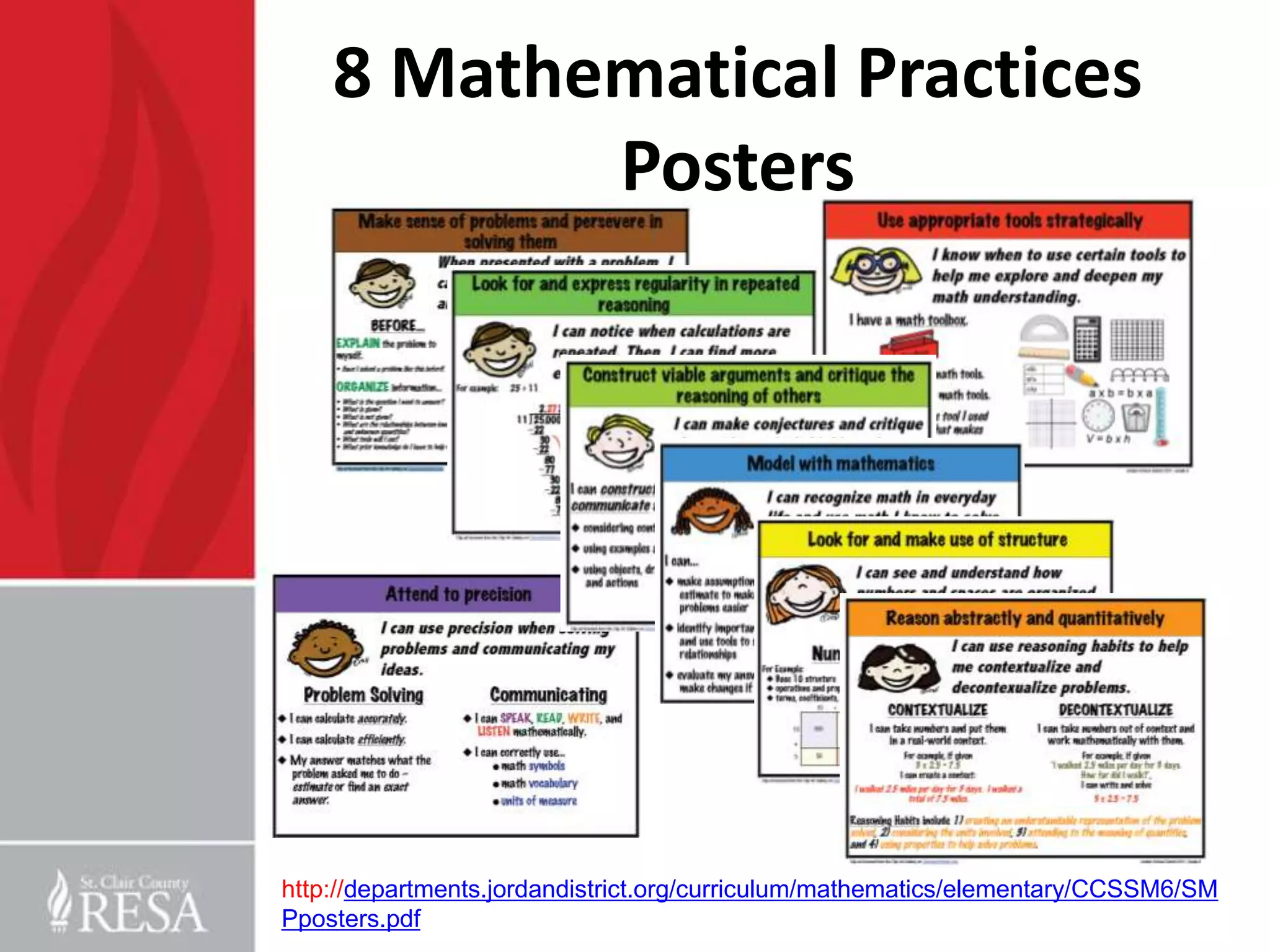
8 Mathematical Practices
           Posters


http://departments.jordandistrict.org/curriculum/mathematics/elementary/CCSSM6/SM
Pposters.pdf
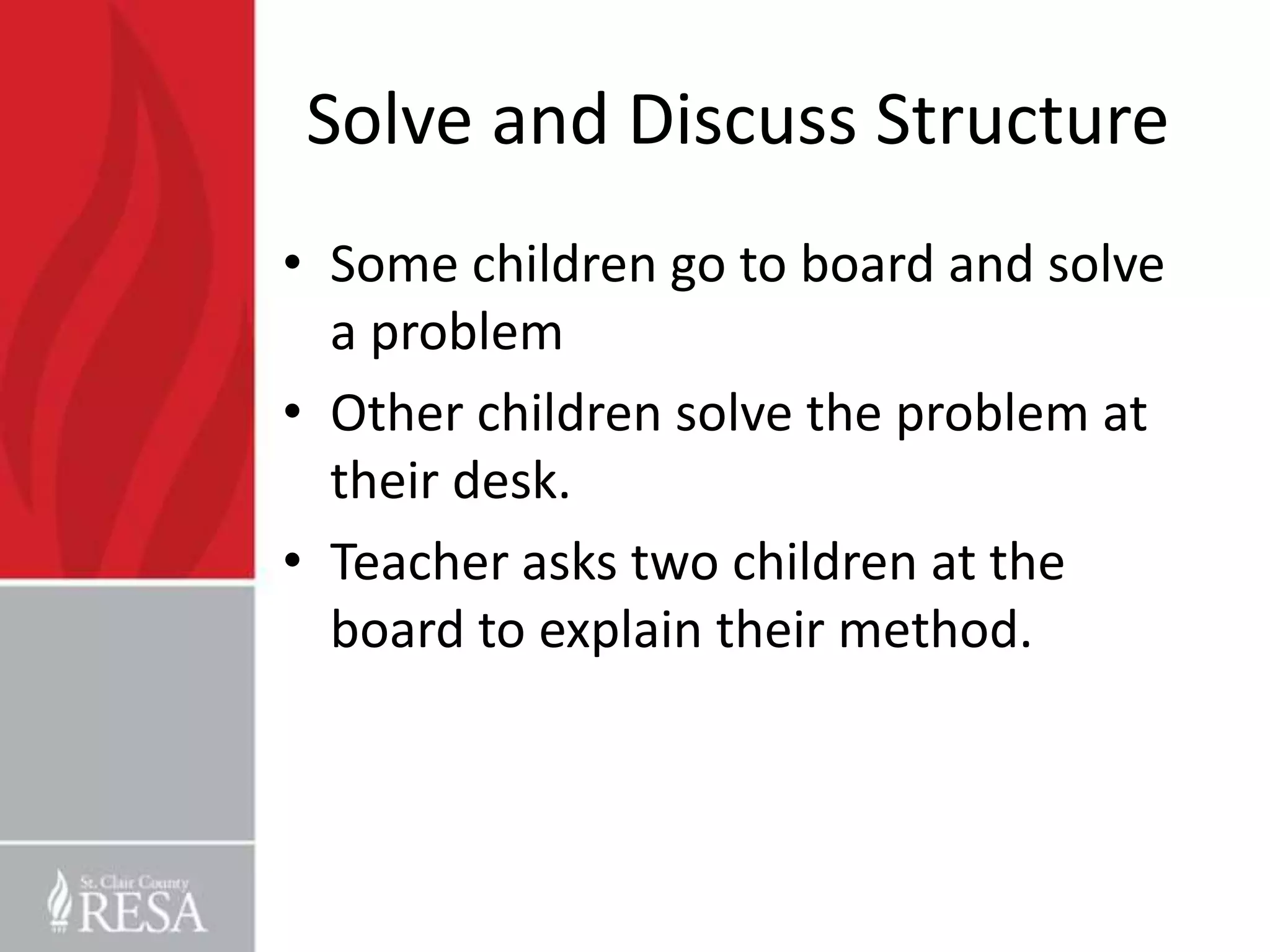
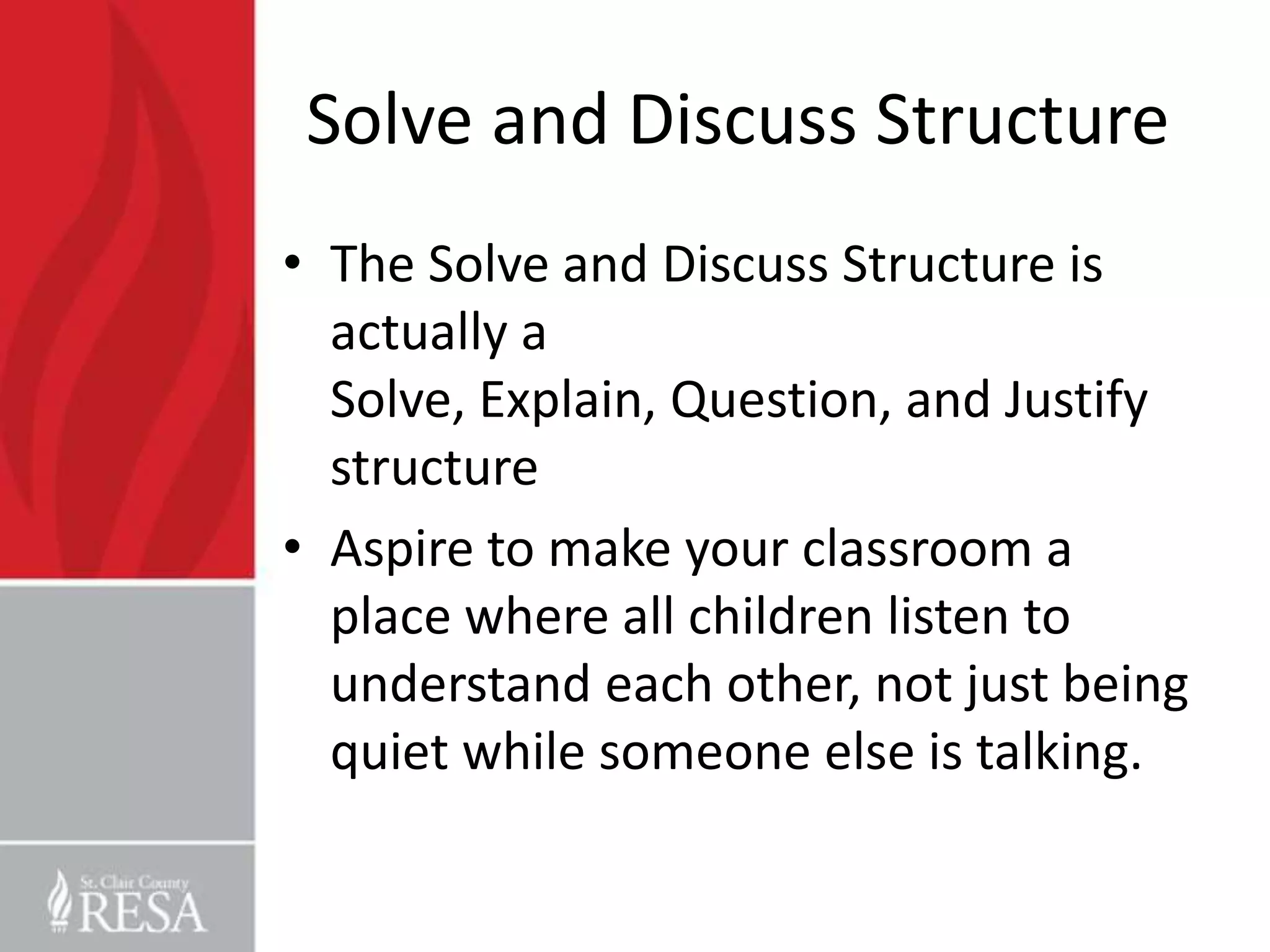
Solve and Discuss Structure
• Some children go to board and solve
  a problem
• Other children solve the problem at
  their desk.
• Teacher asks two children at the
  board to explain their method.
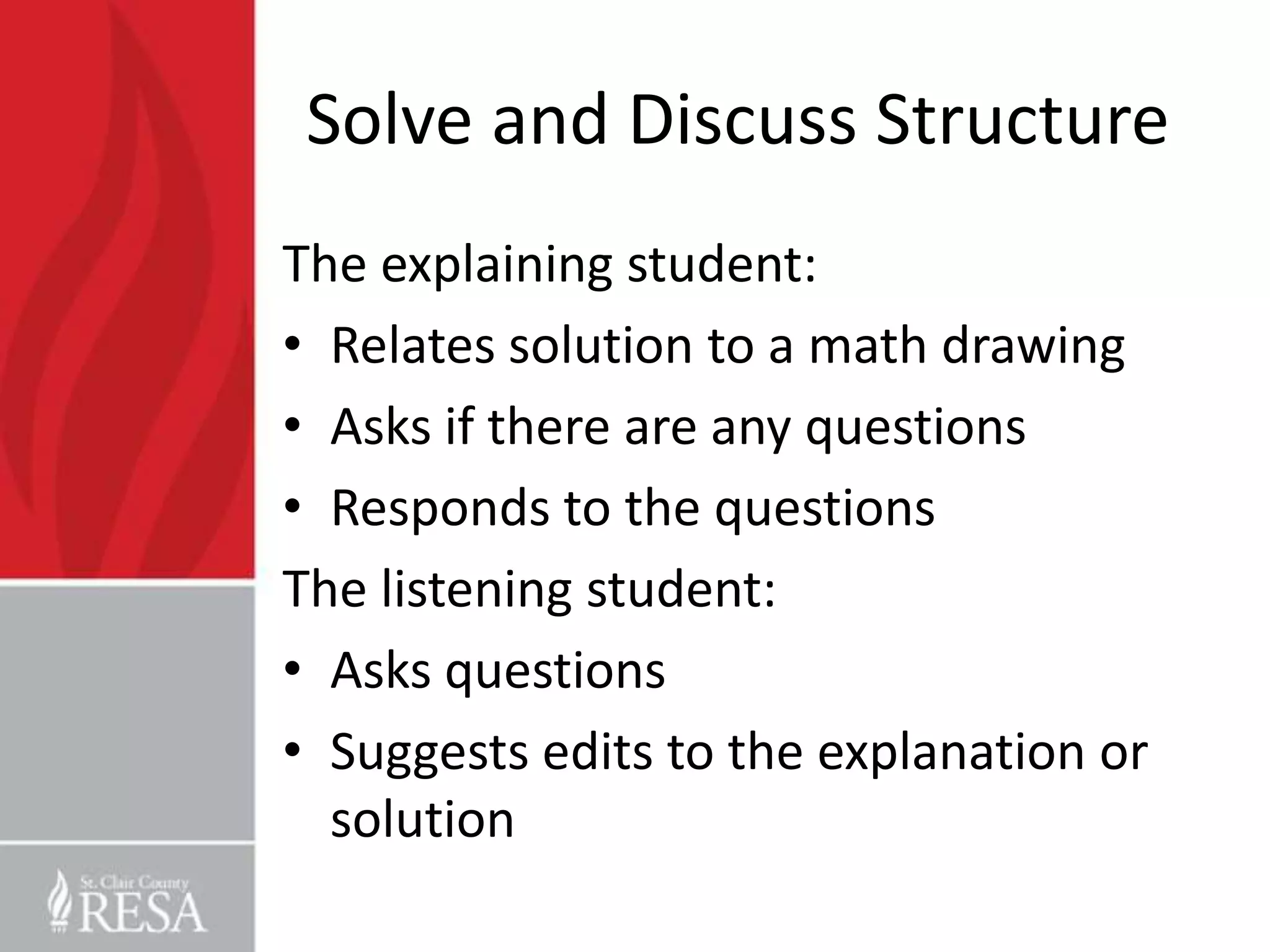
Solve and Discuss Structure
The explaining student:
• Relates solution to a math drawing
• Asks if there are any questions
• Responds to the questions
The listening student:
• Asks questions
• Suggests edits to the explanation or
  solution
Solve and Discuss Structure
• The Solve and Discuss Structure is
  actually a
  Solve, Explain, Question, and Justify
  structure
• Aspire to make your classroom a
  place where all children listen to
  understand each other, not just being
  quiet while someone else is talking.
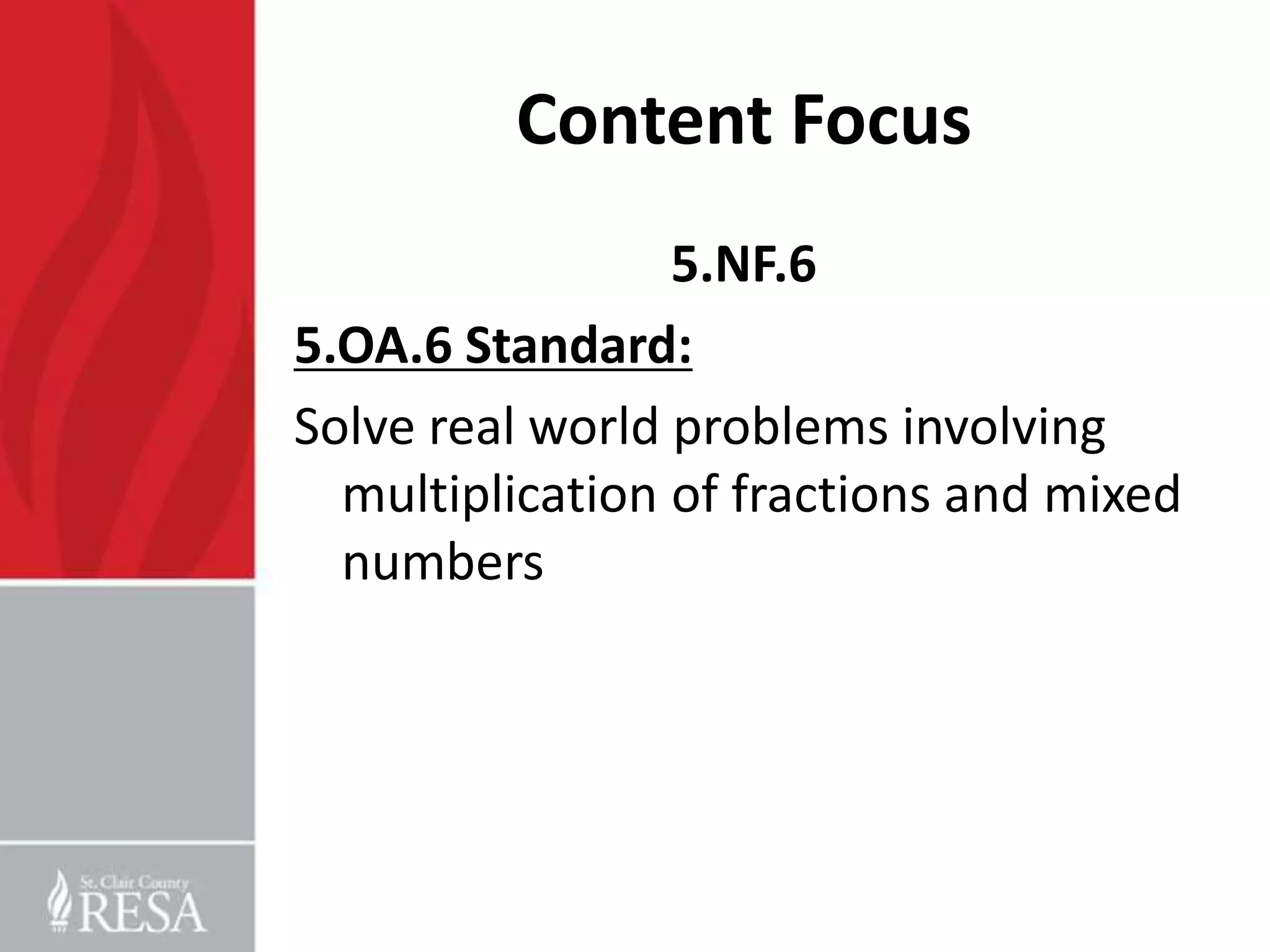
Content Focus
                 5.NF.6
5.OA.6 Standard:
Solve real world problems involving
  multiplication of fractions and mixed
  numbers
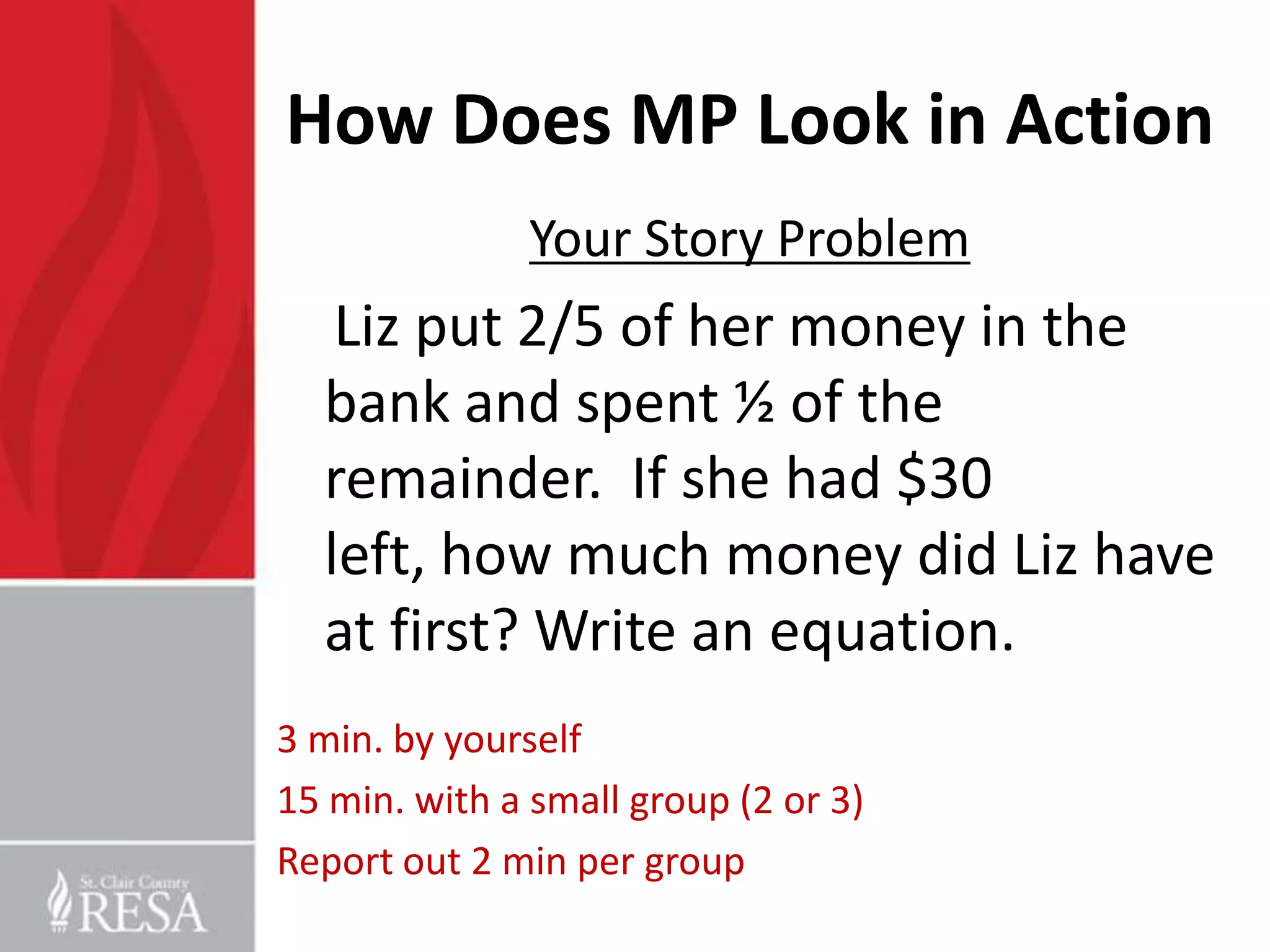
How Does MP Look in Action
               Your Story Problem
   Liz put 2/5 of her money in the
  bank and spent ½ of the
  remainder. If she had $30
  left, how much money did Liz have
  at first? Write an equation.
3 min. by yourself
15 min. with a small group (2 or 3)
Report out 2 min per group
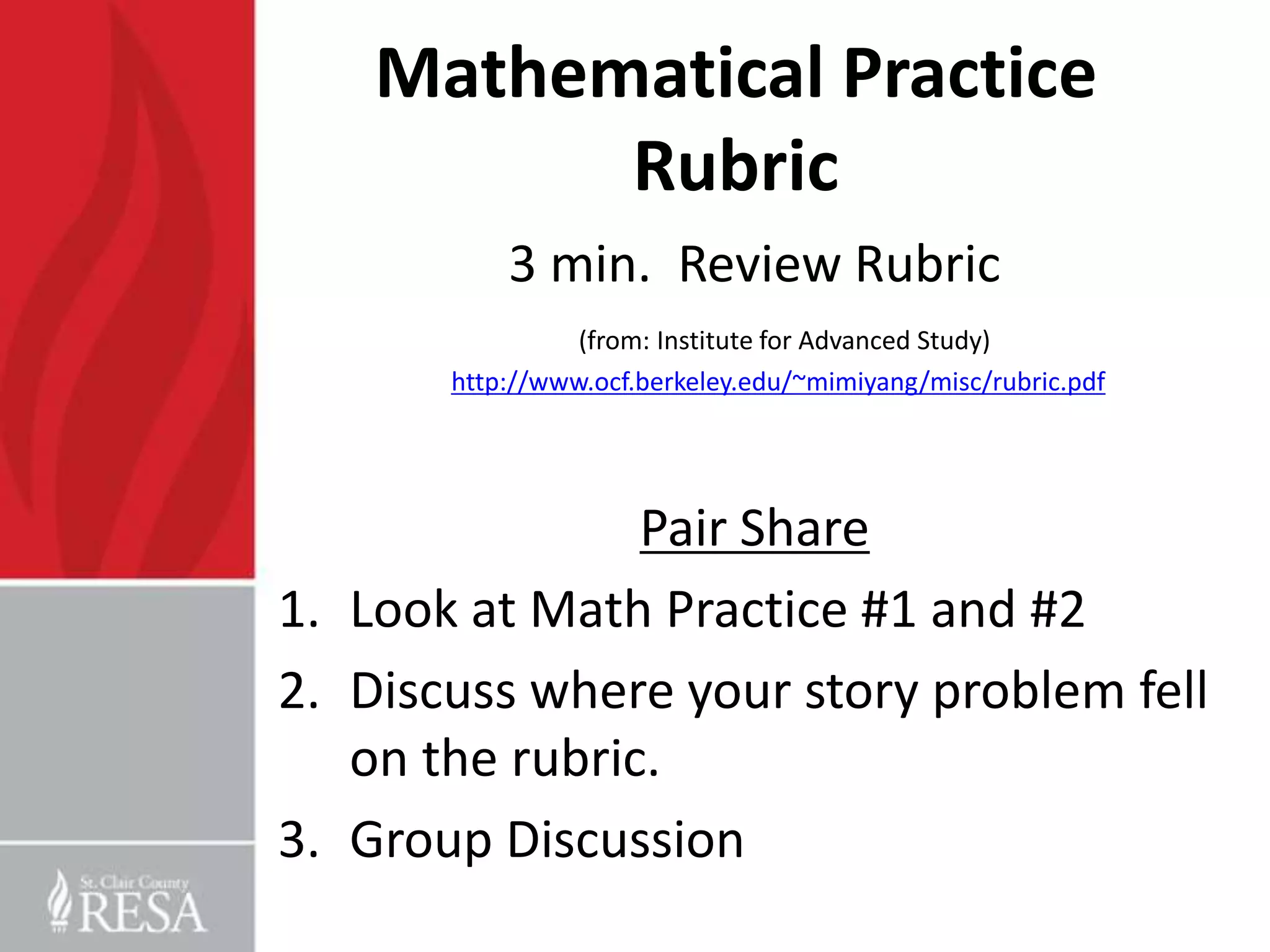
Mathematical Practice
          Rubric
           3 min. Review Rubric
                 (from: Institute for Advanced Study)
       http://www.ocf.berkeley.edu/~mimiyang/misc/rubric.pdf


                Pair Share
1. Look at Math Practice #1 and #2
2. Discuss where your story problem fell
   on the rubric.
3. Group Discussion
Remodeling Tasks
Original Problem
Liz had $100. She put 2/5 in the bank and spends ½
   of what is left. How much did she spend? Write an
   equation.

    How did I make it more
   intellectually challenging?
*** Review Level of Cognitive Demand Handout
Analysis of My Task
Part 1: Selecting and Setting up a Mathematical Task
Goals: 5.NF. 6 Standard
Solve real world problems involving multiplication of fractions

All Task Answers: $100 should see different representations

Representations Used: array drawings, fraction bars, comparison
   bars, …

Record and Report work:
Independently- 5 min. using whiteboard
Small Group– 5 to 15 min. - adding to each students whiteboard
Whole Group Report: 2 min.
Analysis of My Task
Part 2: Supporting Students’ Exploration of the Task
Questions to help get started:
1. Can you tell me what is happening in the story?
2. Is there another ways can write the equation?
3. Can you make a list of all the steps needed to solve the
   problem?
4. What representation are you thinking about using?
5. Which operation do you think you need to use?
6. What are you being asked to find?
7. How can you break apart the problem?


Look at Common Errors pg. 126 to help think of questions.
Analysis of My Task
Part 3: Sharing and Discussing the Task
What solution paths do you want shared during class
   discussion?
*How many steps are in the problem, *Where to start in the
   problem,*Once you knew how much she spent, how did you
   figure out the missing 2/5s?
Looking for different strategies and representations.
Mathematical Ideas: fractions broken into equal parts
Expand on, debate, and question the solutions
Solve and Discuss: (Solve-Explain-Question it- Justify it)
Evidence
Questions to build mathematical ideas connections
Why did you start where you did? Did anyone else start there?
Can anyone retell what that group just said?
How are _____’s pictures same/different than ____’s pictures?
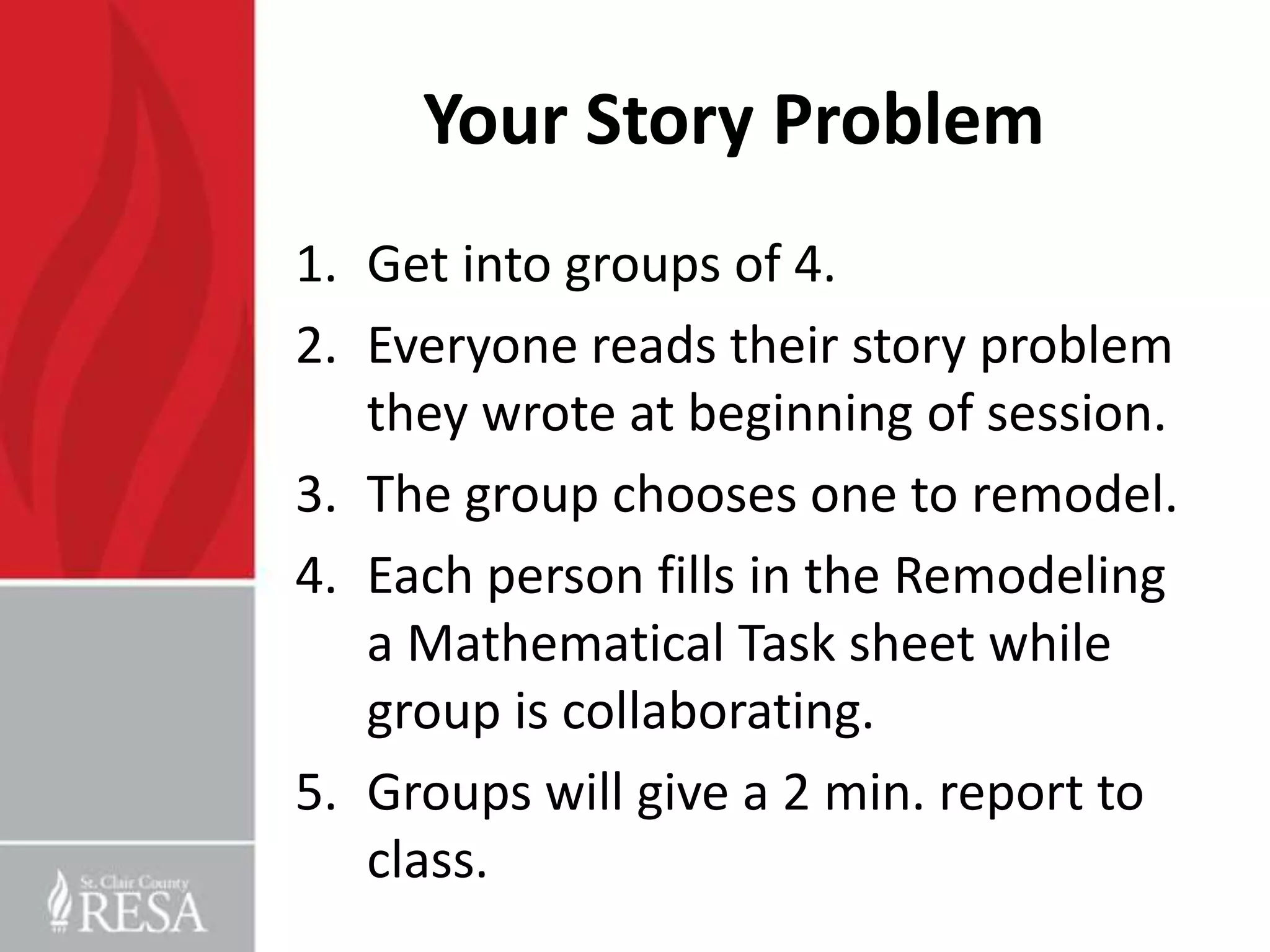
Your Story Problem
1. Get into groups of 4.
2. Everyone reads their story problem
   they wrote at beginning of session.
3. The group chooses one to remodel.
4. Each person fills in the Remodeling
   a Mathematical Task sheet while
   group is collaborating.
5. Groups will give a 2 min. report to
   class.
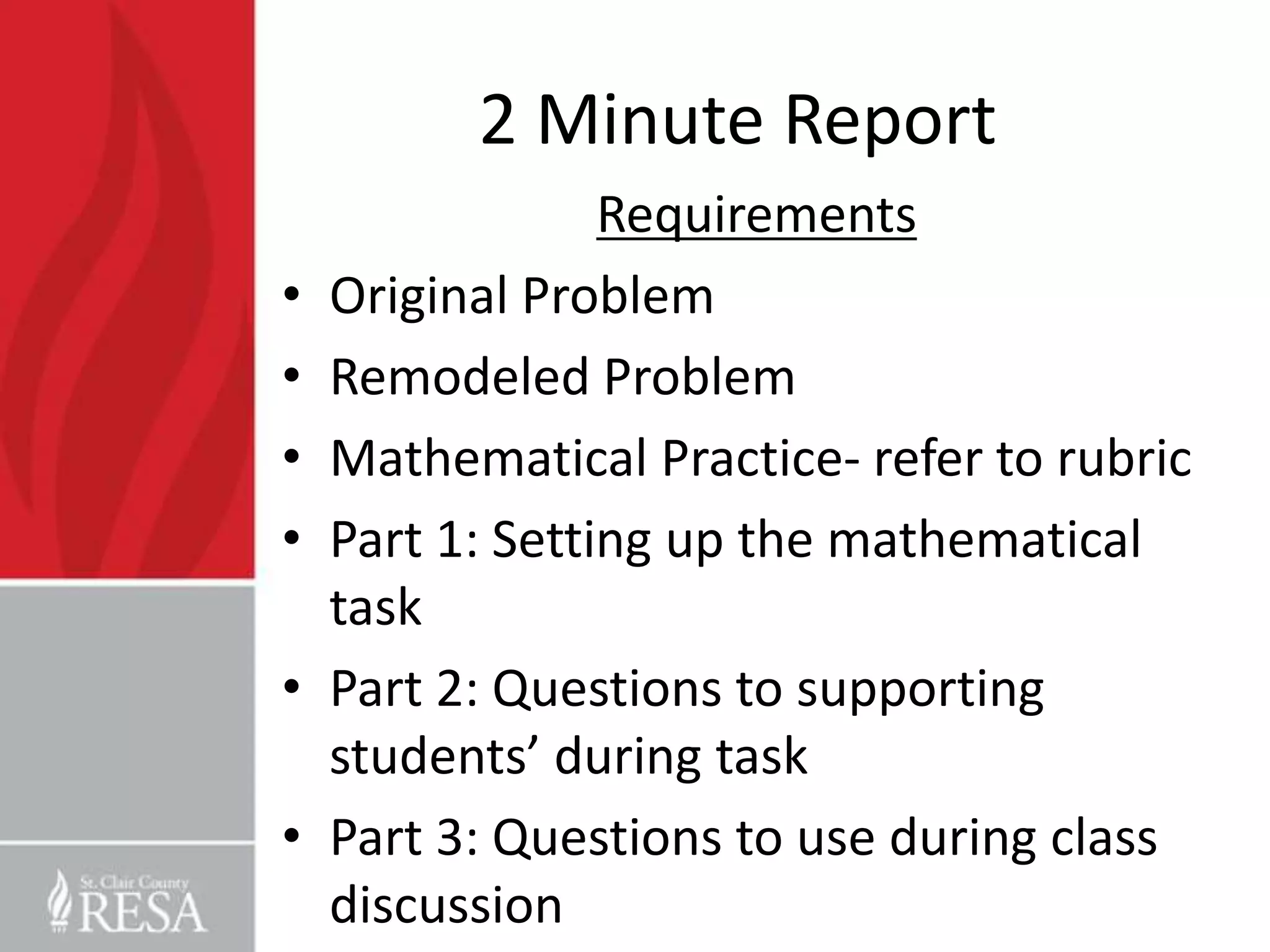
2 Minute Report
                 Requirements
•   Original Problem
•   Remodeled Problem
•   Mathematical Practice- refer to rubric
•   Part 1: Setting up the mathematical
    task
•   Part 2: Questions to supporting
    students’ during task
•   Part 3: Questions to use during class
    discussion
Setting Up Norms
What Norms do we need to have in
place?
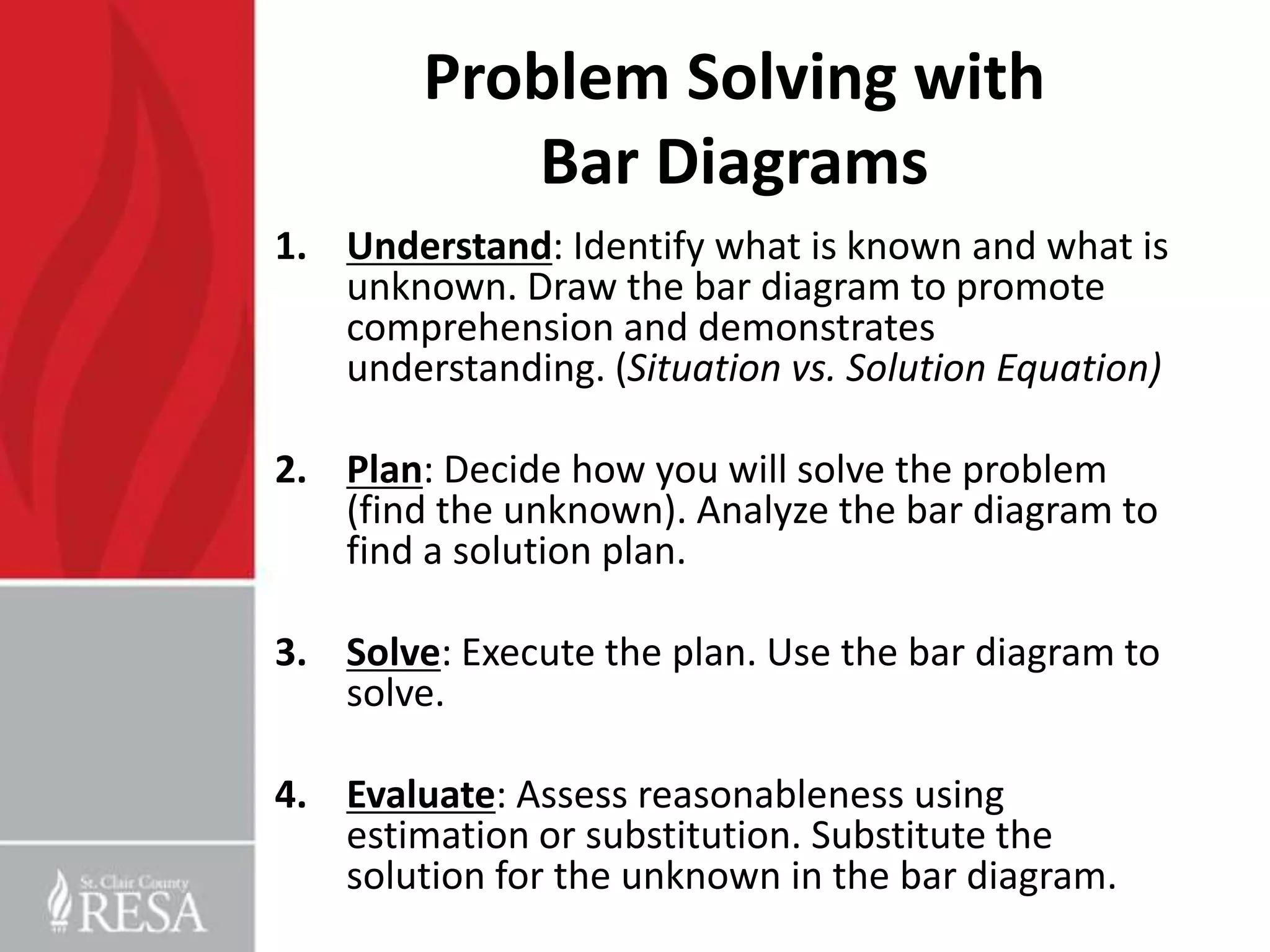
Problem Solving with
           Bar Diagrams
1. Understand: Identify what is known and what is
   unknown. Draw the bar diagram to promote
   comprehension and demonstrates
   understanding. (Situation vs. Solution Equation)
2. Plan: Decide how you will solve the problem
   (find the unknown). Analyze the bar diagram to
   find a solution plan.

3. Solve: Execute the plan. Use the bar diagram to
   solve.

4. Evaluate: Assess reasonableness using
   estimation or substitution. Substitute the
   solution for the unknown in the bar diagram.
Bar Diagrams
Watch Introduction Video
http://www.mhschool.com/math/com
   mon/pd_video/mathconnects_bardi
   agram_p1/index.html
http://www.mhschool.com/math/com
   mon/pd_video/mathconnects_bardi
   agram_p2/index.html
Thinking Blocks
http://www.mathplayground.com/think
  ingblocks.html

         Explore the site 

 When done exploring go to my
 Protopage and look at your grade
 level math tab.
Other Resources

Check out my Protopage for content
 websites. How will you use the 8
Mathematical Practices with them?

www.protopage.com/lchambless
Learning Target


I can integrate the Mathematical
Practices in my teaching to
develop deeper mathematical
knowledge within my students.
Exit Ticket
On the back of your name tent write:

What is your take-away
 from today’s session?
Pre & Post Teacher Survey


   Complete the right side
“After Attending Mathematical
      Practices Workshop”
               &
     Post Event Questions
Thanks for another great session

             Laura

5th grade mp and problem solving intro 8.28.12

  • 1.
    5th Grade ProblemSolving with 8 Mathematical Practices Laura Chambless St. Clair RESA Consultant www.protopage.com/lchambess
  • 2.
    Pre & PostTeacher Survey Complete the left side “Before Attending Mathematical Practices Workshop”
  • 3.
    Write Your OwnStory Problem 1. Think of a story problem you would use with your students. 2. Write it down on a 3x5 card. 3. Place the card under your name tag.
  • 4.
    Learning Target I canintegrate the Mathematical Practices in my teaching to develop deeper mathematical knowledge within my students.
  • 5.
    8 Mathematical Practices CCSS for Mathematical Student-friendly Language Practice Make sense and persevere in I don’t mind trying many times to understand and solving problems. solve a math problem. Reason abstractly and I can think about the math problem in my head, first. quantitatively. Construct viable arguments and I can make a plan, called a strategy, to solve the critique the reasoning of others. problem and discuss other students’ strategies too. I can use pictures, objects, math symbols, and Model with mathematics. numbers to show how to solve a problem. Use appropriate tools I can choose the best math tool like calculators, strategically. rulers, pictures, or objects to solve the problem. I can check to see if my strategy and calculations are Attend to precision. correct. I use clear mathematical language. Look for and make use of I can use what I already know about math to solve structure. the problem. Look for and express regularity I can use different strategies or find a pattern from a in repeated reasoning. similar problem to solve a new math problem. From: Teaching Children Mathematics, March 2012, Getting Started in K – Grade 2, pg. 440-445. www.protopage.com/lchambless
  • 6.
    8 Mathematical Practices Posters http://departments.jordandistrict.org/curriculum/mathematics/elementary/CCSSM6/SM Pposters.pdf
  • 7.
    Solve and DiscussStructure • Some children go to board and solve a problem • Other children solve the problem at their desk. • Teacher asks two children at the board to explain their method.
  • 8.
    Solve and DiscussStructure The explaining student: • Relates solution to a math drawing • Asks if there are any questions • Responds to the questions The listening student: • Asks questions • Suggests edits to the explanation or solution
  • 9.
    Solve and DiscussStructure • The Solve and Discuss Structure is actually a Solve, Explain, Question, and Justify structure • Aspire to make your classroom a place where all children listen to understand each other, not just being quiet while someone else is talking.
  • 10.
    Content Focus 5.NF.6 5.OA.6 Standard: Solve real world problems involving multiplication of fractions and mixed numbers
  • 11.
    How Does MPLook in Action Your Story Problem Liz put 2/5 of her money in the bank and spent ½ of the remainder. If she had $30 left, how much money did Liz have at first? Write an equation. 3 min. by yourself 15 min. with a small group (2 or 3) Report out 2 min per group
  • 12.
    Mathematical Practice Rubric 3 min. Review Rubric (from: Institute for Advanced Study) http://www.ocf.berkeley.edu/~mimiyang/misc/rubric.pdf Pair Share 1. Look at Math Practice #1 and #2 2. Discuss where your story problem fell on the rubric. 3. Group Discussion
  • 13.
    Remodeling Tasks Original Problem Lizhad $100. She put 2/5 in the bank and spends ½ of what is left. How much did she spend? Write an equation. How did I make it more intellectually challenging? *** Review Level of Cognitive Demand Handout
  • 14.
    Analysis of MyTask Part 1: Selecting and Setting up a Mathematical Task Goals: 5.NF. 6 Standard Solve real world problems involving multiplication of fractions All Task Answers: $100 should see different representations Representations Used: array drawings, fraction bars, comparison bars, … Record and Report work: Independently- 5 min. using whiteboard Small Group– 5 to 15 min. - adding to each students whiteboard Whole Group Report: 2 min.
  • 15.
    Analysis of MyTask Part 2: Supporting Students’ Exploration of the Task Questions to help get started: 1. Can you tell me what is happening in the story? 2. Is there another ways can write the equation? 3. Can you make a list of all the steps needed to solve the problem? 4. What representation are you thinking about using? 5. Which operation do you think you need to use? 6. What are you being asked to find? 7. How can you break apart the problem? Look at Common Errors pg. 126 to help think of questions.
  • 16.
    Analysis of MyTask Part 3: Sharing and Discussing the Task What solution paths do you want shared during class discussion? *How many steps are in the problem, *Where to start in the problem,*Once you knew how much she spent, how did you figure out the missing 2/5s? Looking for different strategies and representations. Mathematical Ideas: fractions broken into equal parts Expand on, debate, and question the solutions Solve and Discuss: (Solve-Explain-Question it- Justify it) Evidence Questions to build mathematical ideas connections Why did you start where you did? Did anyone else start there? Can anyone retell what that group just said? How are _____’s pictures same/different than ____’s pictures?
  • 17.
    Your Story Problem 1.Get into groups of 4. 2. Everyone reads their story problem they wrote at beginning of session. 3. The group chooses one to remodel. 4. Each person fills in the Remodeling a Mathematical Task sheet while group is collaborating. 5. Groups will give a 2 min. report to class.
  • 18.
    2 Minute Report Requirements • Original Problem • Remodeled Problem • Mathematical Practice- refer to rubric • Part 1: Setting up the mathematical task • Part 2: Questions to supporting students’ during task • Part 3: Questions to use during class discussion
  • 19.
    Setting Up Norms WhatNorms do we need to have in place?
  • 20.
    Problem Solving with Bar Diagrams 1. Understand: Identify what is known and what is unknown. Draw the bar diagram to promote comprehension and demonstrates understanding. (Situation vs. Solution Equation) 2. Plan: Decide how you will solve the problem (find the unknown). Analyze the bar diagram to find a solution plan. 3. Solve: Execute the plan. Use the bar diagram to solve. 4. Evaluate: Assess reasonableness using estimation or substitution. Substitute the solution for the unknown in the bar diagram.
  • 21.
    Bar Diagrams Watch IntroductionVideo http://www.mhschool.com/math/com mon/pd_video/mathconnects_bardi agram_p1/index.html http://www.mhschool.com/math/com mon/pd_video/mathconnects_bardi agram_p2/index.html
  • 22.
    Thinking Blocks http://www.mathplayground.com/think ingblocks.html Explore the site  When done exploring go to my Protopage and look at your grade level math tab.
  • 23.
    Other Resources Check outmy Protopage for content websites. How will you use the 8 Mathematical Practices with them? www.protopage.com/lchambless
  • 24.
    Learning Target I canintegrate the Mathematical Practices in my teaching to develop deeper mathematical knowledge within my students.
  • 25.
    Exit Ticket On theback of your name tent write: What is your take-away from today’s session?
  • 26.
    Pre & PostTeacher Survey Complete the right side “After Attending Mathematical Practices Workshop” & Post Event Questions
  • 27.
    Thanks for anothergreat session Laura