INSTITUTE for LEARNING
This module was developed by DeAnn Huinker, University of Wisconsin-Milwaukee; Victoria Bill, University of Pittsburgh
Institute for Learning; and Amy Hillen, Kennesaw State University. Video courtesy of New York City Public Schools and the
University of Pittsburgh Institute for Learning.
These materials are part of the Principles to Actions Professional Learning Toolkit: Teaching and Learning created by the
project team that includes: Margaret Smith (chair), Victoria Bill (co-chair), Melissa Boston, Fredrick Dillon, Amy Hillen, DeAnn
Huinker, Stephen Miller, Lynn Raith, and Michael Steele.
Principles to Actions
Effective Mathematics Teaching Practices
The Case of Jennifer DiBrienza
and the Addition Strings Task
Grade 1
INSTITUTE for LEARNING
Overview of the Session
• Watch a video clip of a first grade class engaged in
a whole class discussion of an addition string.
• Discuss what the teacher does to support the
students’ learning of mathematics.
• Relate teacher actions in the video to the effective
mathematics teaching practices.
INSTITUTE for LEARNING
Teaching and Learning Principle
An excellent mathematics program requires effective
teaching that engages students in meaningful
learning through individual and collaborative
experiences that promote their ability to make sense
of mathematical ideas and reason mathematically.
National Council of Teachers of Mathematics. (2014). Principles to actions:
Ensuring mathematical success for all. Reston, VA: Author. (p. 7)
INSTITUTE for LEARNING
Ms. DiBrienza’s
First Grade Classroom
“Addition Strings Task”
INSTITUTE for LEARNING
Ms. DiBrienza’s
Mathematics Learning Goals
Students will understand that
• Fluent addition strategies use number relationships
and the structure of the number system;
• Numbers can be decomposed and added on in parts,
not just by ones; and
• Noticing regularity in repeated calculations leads to
shortcuts and general methods for adding numbers.
INSTITUTE for LEARNING
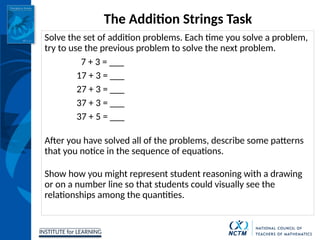
The Addition Strings Task
Solve the set of addition problems. Each time you solve a problem,
try to use the previous problem to solve the next problem.
7 + 3 = ___
17 + 3 = ___
27 + 3 = ___
37 + 3 = ___
37 + 5 = ___
After you have solved all of the problems, describe some patterns
that you notice in the sequence of equations.
Show how you might represent student reasoning with a drawing
or on a number line so that students could visually see the
relationships among the quantities.
INSTITUTE for LEARNING
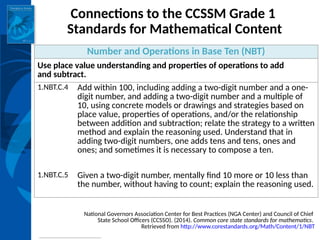
Connections to the CCSSM Grade 1
Standards for Mathematical Content
Number and Operations in Base Ten (NBT)
Use place value understanding and properties of operations to add
and subtract.
1.NBT.C.4 Add within 100, including adding a two-digit number and a one-
digit number, and adding a two-digit number and a multiple of
10, using concrete models or drawings and strategies based on
place value, properties of operations, and/or the relationship
between addition and subtraction; relate the strategy to a written
method and explain the reasoning used. Understand that in
adding two-digit numbers, one adds tens and tens, ones and
ones; and sometimes it is necessary to compose a ten.
1.NBT.C.5 Given a two-digit number, mentally find 10 more or 10 less than
the number, without having to count; explain the reasoning used.
National Governors Association Center for Best Practices (NGA Center) and Council of Chief
State School Officers (CCSSO). (2014). Common core state standards for mathematics.
Retrieved from http://www.corestandards.org/Math/Content/1/NBT
INSTITUTE for LEARNING
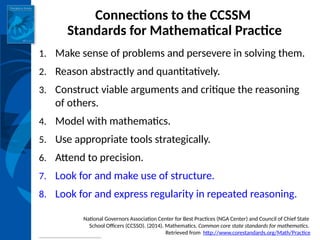
Connections to the CCSSM
Standards for Mathematical Practice
National Governors Association Center for Best Practices (NGA Center) and Council of Chief State
School Officers (CCSSO). (2014). Mathematics. Common core state standards for mathematics.
Retrieved from http://www.corestandards.org/Math/Practice
1. Make sense of problems and persevere in solving them.
2. Reason abstractly and quantitatively.
3. Construct viable arguments and critique the reasoning
of others.
4. Model with mathematics.
5. Use appropriate tools strategically.
6. Attend to precision.
7. Look for and make use of structure.
8. Look for and express regularity in repeated reasoning.
INSTITUTE for LEARNING
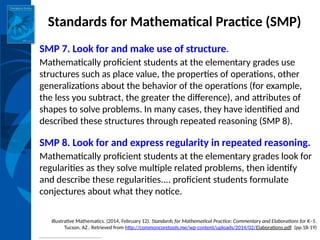
Standards for Mathematical Practice (SMP)
SMP 7. Look for and make use of structure.
Mathematically proficient students at the elementary grades use
structures such as place value, the properties of operations, other
generalizations about the behavior of the operations (for example,
the less you subtract, the greater the difference), and attributes of
shapes to solve problems. In many cases, they have identified and
described these structures through repeated reasoning (SMP 8).
SMP 8. Look for and express regularity in repeated reasoning.
Mathematically proficient students at the elementary grades look for
regularities as they solve multiple related problems, then identify
and describe these regularities.... proficient students formulate
conjectures about what they notice.
Illustrative Mathematics. (2014, February 12). Standards for Mathematical Practice: Commentary and Elaborations for K–5.
Tucson, AZ.. Retrieved from http://commoncoretools.me/wp-content/uploads/2014/02/Elaborations.pdf (pp.18-19)
INSTITUTE for LEARNING
Classroom Context for the Video Segment
Teacher: Jennifer DiBrienza
Grade: 1
School: PS 116
District: New York Community School District 2
The students are seated in a large circle on the
classroom rug. The teacher poses a sequence of
addition equations for the students to solve. The
students share their strategies and discuss “what
they notice” about the equations and the answers.
INSTITUTE for LEARNING
Lens for Watching the Video: Viewing #1
As you watch the video
• Make note of what the teacher does to support
student learning of mathematics, and
• Identify the mathematical insights that surfaced
for students.
INSTITUTE for LEARNING
Student Learning of Mathematics
In small groups, discuss the following:
1. Identify mathematical insights that surfaced
for students.
2. Summarize ways the teacher engaged students in
the mathematical practices: SMP 7 and SMP 8.
3. Summarize ways the teacher advanced student
understanding toward the content standards:
1.NBT.C.4 and 1.NBT.C.5.
INSTITUTE for LEARNING
Teacher Actions
As you reflect on the teacher actions that
supported student learning in this lesson, which
Effective Mathematics Teaching Practices did
you notice the teacher using?
INSTITUTE for LEARNING
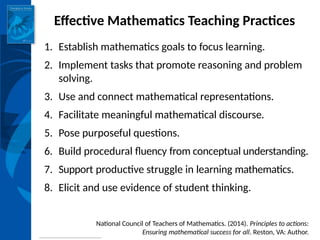
Effective Mathematics Teaching Practices
1. Establish mathematics goals to focus learning.
2. Implement tasks that promote reasoning and problem
solving.
3. Use and connect mathematical representations.
4. Facilitate meaningful mathematical discourse.
5. Pose purposeful questions.
6. Build procedural fluency from conceptual understanding.
7. Support productive struggle in learning mathematics.
8. Elicit and use evidence of student thinking.
National Council of Teachers of Mathematics. (2014). Principles to actions:
Ensuring mathematical success for all. Reston, VA: Author.
INSTITUTE for LEARNING
Effective Mathematics Teaching Practice
Build Procedural Fluency from
Conceptual Understanding
INSTITUTE for LEARNING
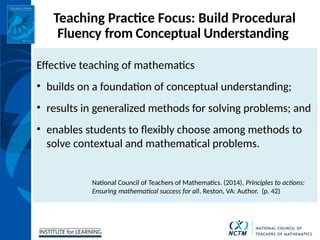
Teaching Practice Focus: Build Procedural
Fluency from Conceptual Understanding
Effective teaching of mathematics
• builds on a foundation of conceptual understanding;
• results in generalized methods for solving problems; and
• enables students to flexibly choose among methods to
solve contextual and mathematical problems.
National Council of Teachers of Mathematics. (2014). Principles to actions:
Ensuring mathematical success for all. Reston, VA: Author. (p. 42)
INSTITUTE for LEARNING
Teaching Practice Focus: Build Procedural
Fluency from Conceptual Understanding
Jot down your responses.
• What does it mean to be fluent with
computational procedures?
• Why is it important to build procedures
from conceptual understanding?
INSTITUTE for LEARNING
Fluency
Being fluent means that students are able to choose flexibly among
methods and strategies to solve contextual and mathematical
problems, they understand and are able to explain their approaches,
and they are able to produce accurate answers efficiently.
Fluency builds from initial exploration and discussion of number
concepts to using informal reasoning strategies based on meanings
and properties of the operations to the eventual use of general
methods as tools in solving problems. This sequence is beneficial
whether students are building toward fluency with single- and multi-
digit computation with whole numbers or fluency with, for example,
fraction operations, proportional relationships, measurement
formulas, or algebraic procedures.
National Council of Teachers of Mathematics. (2014). Principles to actions:
Ensuring mathematical success for all. Reston, VA: Author. (p. 42)
INSTITUTE for LEARNING
Conceptual Understanding and
Procedural Fluency
When procedures are connected with the underlying concepts,
students have better retention of the procedures and are more able
to apply them in new situations (Fuson, Kalchman, and Bransford
2005). Martin (2009, p. 165) describes some of the reasons that
fluency depends on and extends from conceptual understanding:
To use mathematics effectively, students must be able to
do much more than carry out mathematical procedures. They
must know which procedure is appropriate and most productive
in a given situation, what a procedure accomplishes, and what
kind of results to expect. Mechanical execution of procedures
without understanding their mathematical basis often leads to
bizarre results.
National Council of Teachers of Mathematics. (2014). Principles to actions: Ensuring
mathematical success for all. Reston, VA: Author. (p. 42)
INSTITUTE for LEARNING
Lens for Watching the Video: Viewing #2
As you watch the video again, attend to the
teacher actions that
build procedural fluency from conceptual
understanding.
Be prepared to give examples and to cite line
numbers from the transcript to support your
observations.
INSTITUTE for LEARNING
Video Observations
In what ways did the teacher actions support
students in building procedural fluency from
conceptual understanding?
Use the transcript to cite line numbers to
support your observations.
INSTITUTE for LEARNING
Effective Mathematics Teaching Practice
Implement Tasks that Promote
Reasoning and Problem Solving
INSTITUTE for LEARNING
Teaching Practice Focus: Implement Tasks
that Promote Reasoning and Problem Solving
Effective teaching of mathematics
• provides opportunities for students to engage in
solving and discussing tasks;
• uses tasks that promote inquiry and exploration
and are meaningfully connected to concepts;
• uses tasks that allow for multiple entry points; and
• encourages use of varied solution strategies.
National Council of Teachers of Mathematics. (2014). Principles to actions:
Ensuring mathematical success for all. Reston, VA: Author. (p. 17)
INSTITUTE for LEARNING
Teaching Practice Focus: Implement Tasks that
Promote Reasoning and Problem Solving
Mathematical tasks can range from a set of routine
exercises to a complex and challenging problem that
focuses students’ attention on a particular mathematical
ideas (p. 17).
It is important to note that not all tasks that promote
reasoning and problem solving have to be set in a context
or need to consume an entire class period or multiple
days. What is critical is that a task provide students with
the opportunity to engage actively in reasoning, sense
making, and problem solving... (p. 20).
National Council of Teachers of Mathematics. (2014). Principles to actions:
Ensuring mathematical success for all. Reston, VA: Author.
INSTITUTE for LEARNING
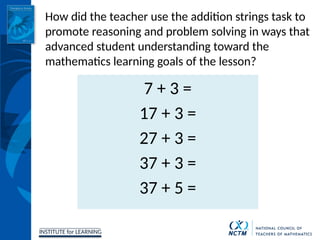
7 + 3 =
17 + 3 =
27 + 3 =
37 + 3 =
37 + 5 =
How did the teacher use the addition strings task to
promote reasoning and problem solving in ways that
advanced student understanding toward the
mathematics learning goals of the lesson?
INSTITUTE for LEARNING
Equation Strings Tasks
Work with a small group to create a string of
equations appropriate for your students.
• Select an operation and the type of numbers
(e.g., whole numbers, fractions, percents).
• Identify the mathematics learning goals which will
be supported by your equation string.
• Develop a sequence of equations that will build
toward student fluency connected to conceptual
understanding and reasoning.
INSTITUTE for LEARNING
As you reflect on the
effective mathematics teaching practices
examined in this session, summarize one or
two ideas or insights you might apply to
your own classroom instruction.
INSTITUTE for LEARNING

1-Slides-AdditionStrings-ES-DiBrienza.pptx

  • 1.
    INSTITUTE for LEARNING Thismodule was developed by DeAnn Huinker, University of Wisconsin-Milwaukee; Victoria Bill, University of Pittsburgh Institute for Learning; and Amy Hillen, Kennesaw State University. Video courtesy of New York City Public Schools and the University of Pittsburgh Institute for Learning. These materials are part of the Principles to Actions Professional Learning Toolkit: Teaching and Learning created by the project team that includes: Margaret Smith (chair), Victoria Bill (co-chair), Melissa Boston, Fredrick Dillon, Amy Hillen, DeAnn Huinker, Stephen Miller, Lynn Raith, and Michael Steele. Principles to Actions Effective Mathematics Teaching Practices The Case of Jennifer DiBrienza and the Addition Strings Task Grade 1
  • 2.
    INSTITUTE for LEARNING Overviewof the Session • Watch a video clip of a first grade class engaged in a whole class discussion of an addition string. • Discuss what the teacher does to support the students’ learning of mathematics. • Relate teacher actions in the video to the effective mathematics teaching practices.
  • 3.
    INSTITUTE for LEARNING Teachingand Learning Principle An excellent mathematics program requires effective teaching that engages students in meaningful learning through individual and collaborative experiences that promote their ability to make sense of mathematical ideas and reason mathematically. National Council of Teachers of Mathematics. (2014). Principles to actions: Ensuring mathematical success for all. Reston, VA: Author. (p. 7)
  • 4.
    INSTITUTE for LEARNING Ms.DiBrienza’s First Grade Classroom “Addition Strings Task”
  • 5.
    INSTITUTE for LEARNING Ms.DiBrienza’s Mathematics Learning Goals Students will understand that • Fluent addition strategies use number relationships and the structure of the number system; • Numbers can be decomposed and added on in parts, not just by ones; and • Noticing regularity in repeated calculations leads to shortcuts and general methods for adding numbers.
  • 6.
    INSTITUTE for LEARNING TheAddition Strings Task Solve the set of addition problems. Each time you solve a problem, try to use the previous problem to solve the next problem. 7 + 3 = ___ 17 + 3 = ___ 27 + 3 = ___ 37 + 3 = ___ 37 + 5 = ___ After you have solved all of the problems, describe some patterns that you notice in the sequence of equations. Show how you might represent student reasoning with a drawing or on a number line so that students could visually see the relationships among the quantities.
  • 7.
    INSTITUTE for LEARNING Connectionsto the CCSSM Grade 1 Standards for Mathematical Content Number and Operations in Base Ten (NBT) Use place value understanding and properties of operations to add and subtract. 1.NBT.C.4 Add within 100, including adding a two-digit number and a one- digit number, and adding a two-digit number and a multiple of 10, using concrete models or drawings and strategies based on place value, properties of operations, and/or the relationship between addition and subtraction; relate the strategy to a written method and explain the reasoning used. Understand that in adding two-digit numbers, one adds tens and tens, ones and ones; and sometimes it is necessary to compose a ten. 1.NBT.C.5 Given a two-digit number, mentally find 10 more or 10 less than the number, without having to count; explain the reasoning used. National Governors Association Center for Best Practices (NGA Center) and Council of Chief State School Officers (CCSSO). (2014). Common core state standards for mathematics. Retrieved from http://www.corestandards.org/Math/Content/1/NBT
  • 8.
    INSTITUTE for LEARNING Connectionsto the CCSSM Standards for Mathematical Practice National Governors Association Center for Best Practices (NGA Center) and Council of Chief State School Officers (CCSSO). (2014). Mathematics. Common core state standards for mathematics. Retrieved from http://www.corestandards.org/Math/Practice 1. Make sense of problems and persevere in solving them. 2. Reason abstractly and quantitatively. 3. Construct viable arguments and critique the reasoning of others. 4. Model with mathematics. 5. Use appropriate tools strategically. 6. Attend to precision. 7. Look for and make use of structure. 8. Look for and express regularity in repeated reasoning.
  • 9.
    INSTITUTE for LEARNING Standardsfor Mathematical Practice (SMP) SMP 7. Look for and make use of structure. Mathematically proficient students at the elementary grades use structures such as place value, the properties of operations, other generalizations about the behavior of the operations (for example, the less you subtract, the greater the difference), and attributes of shapes to solve problems. In many cases, they have identified and described these structures through repeated reasoning (SMP 8). SMP 8. Look for and express regularity in repeated reasoning. Mathematically proficient students at the elementary grades look for regularities as they solve multiple related problems, then identify and describe these regularities.... proficient students formulate conjectures about what they notice. Illustrative Mathematics. (2014, February 12). Standards for Mathematical Practice: Commentary and Elaborations for K–5. Tucson, AZ.. Retrieved from http://commoncoretools.me/wp-content/uploads/2014/02/Elaborations.pdf (pp.18-19)
  • 10.
    INSTITUTE for LEARNING ClassroomContext for the Video Segment Teacher: Jennifer DiBrienza Grade: 1 School: PS 116 District: New York Community School District 2 The students are seated in a large circle on the classroom rug. The teacher poses a sequence of addition equations for the students to solve. The students share their strategies and discuss “what they notice” about the equations and the answers.
  • 11.
    INSTITUTE for LEARNING Lensfor Watching the Video: Viewing #1 As you watch the video • Make note of what the teacher does to support student learning of mathematics, and • Identify the mathematical insights that surfaced for students.
  • 12.
    INSTITUTE for LEARNING StudentLearning of Mathematics In small groups, discuss the following: 1. Identify mathematical insights that surfaced for students. 2. Summarize ways the teacher engaged students in the mathematical practices: SMP 7 and SMP 8. 3. Summarize ways the teacher advanced student understanding toward the content standards: 1.NBT.C.4 and 1.NBT.C.5.
  • 13.
    INSTITUTE for LEARNING TeacherActions As you reflect on the teacher actions that supported student learning in this lesson, which Effective Mathematics Teaching Practices did you notice the teacher using?
  • 14.
    INSTITUTE for LEARNING EffectiveMathematics Teaching Practices 1. Establish mathematics goals to focus learning. 2. Implement tasks that promote reasoning and problem solving. 3. Use and connect mathematical representations. 4. Facilitate meaningful mathematical discourse. 5. Pose purposeful questions. 6. Build procedural fluency from conceptual understanding. 7. Support productive struggle in learning mathematics. 8. Elicit and use evidence of student thinking. National Council of Teachers of Mathematics. (2014). Principles to actions: Ensuring mathematical success for all. Reston, VA: Author.
  • 15.
    INSTITUTE for LEARNING EffectiveMathematics Teaching Practice Build Procedural Fluency from Conceptual Understanding
  • 16.
    INSTITUTE for LEARNING TeachingPractice Focus: Build Procedural Fluency from Conceptual Understanding Effective teaching of mathematics • builds on a foundation of conceptual understanding; • results in generalized methods for solving problems; and • enables students to flexibly choose among methods to solve contextual and mathematical problems. National Council of Teachers of Mathematics. (2014). Principles to actions: Ensuring mathematical success for all. Reston, VA: Author. (p. 42)
  • 17.
    INSTITUTE for LEARNING TeachingPractice Focus: Build Procedural Fluency from Conceptual Understanding Jot down your responses. • What does it mean to be fluent with computational procedures? • Why is it important to build procedures from conceptual understanding?
  • 18.
    INSTITUTE for LEARNING Fluency Beingfluent means that students are able to choose flexibly among methods and strategies to solve contextual and mathematical problems, they understand and are able to explain their approaches, and they are able to produce accurate answers efficiently. Fluency builds from initial exploration and discussion of number concepts to using informal reasoning strategies based on meanings and properties of the operations to the eventual use of general methods as tools in solving problems. This sequence is beneficial whether students are building toward fluency with single- and multi- digit computation with whole numbers or fluency with, for example, fraction operations, proportional relationships, measurement formulas, or algebraic procedures. National Council of Teachers of Mathematics. (2014). Principles to actions: Ensuring mathematical success for all. Reston, VA: Author. (p. 42)
  • 19.
    INSTITUTE for LEARNING ConceptualUnderstanding and Procedural Fluency When procedures are connected with the underlying concepts, students have better retention of the procedures and are more able to apply them in new situations (Fuson, Kalchman, and Bransford 2005). Martin (2009, p. 165) describes some of the reasons that fluency depends on and extends from conceptual understanding: To use mathematics effectively, students must be able to do much more than carry out mathematical procedures. They must know which procedure is appropriate and most productive in a given situation, what a procedure accomplishes, and what kind of results to expect. Mechanical execution of procedures without understanding their mathematical basis often leads to bizarre results. National Council of Teachers of Mathematics. (2014). Principles to actions: Ensuring mathematical success for all. Reston, VA: Author. (p. 42)
  • 20.
    INSTITUTE for LEARNING Lensfor Watching the Video: Viewing #2 As you watch the video again, attend to the teacher actions that build procedural fluency from conceptual understanding. Be prepared to give examples and to cite line numbers from the transcript to support your observations.
  • 21.
    INSTITUTE for LEARNING VideoObservations In what ways did the teacher actions support students in building procedural fluency from conceptual understanding? Use the transcript to cite line numbers to support your observations.
  • 22.
    INSTITUTE for LEARNING EffectiveMathematics Teaching Practice Implement Tasks that Promote Reasoning and Problem Solving
  • 23.
    INSTITUTE for LEARNING TeachingPractice Focus: Implement Tasks that Promote Reasoning and Problem Solving Effective teaching of mathematics • provides opportunities for students to engage in solving and discussing tasks; • uses tasks that promote inquiry and exploration and are meaningfully connected to concepts; • uses tasks that allow for multiple entry points; and • encourages use of varied solution strategies. National Council of Teachers of Mathematics. (2014). Principles to actions: Ensuring mathematical success for all. Reston, VA: Author. (p. 17)
  • 24.
    INSTITUTE for LEARNING TeachingPractice Focus: Implement Tasks that Promote Reasoning and Problem Solving Mathematical tasks can range from a set of routine exercises to a complex and challenging problem that focuses students’ attention on a particular mathematical ideas (p. 17). It is important to note that not all tasks that promote reasoning and problem solving have to be set in a context or need to consume an entire class period or multiple days. What is critical is that a task provide students with the opportunity to engage actively in reasoning, sense making, and problem solving... (p. 20). National Council of Teachers of Mathematics. (2014). Principles to actions: Ensuring mathematical success for all. Reston, VA: Author.
  • 25.
    INSTITUTE for LEARNING 7+ 3 = 17 + 3 = 27 + 3 = 37 + 3 = 37 + 5 = How did the teacher use the addition strings task to promote reasoning and problem solving in ways that advanced student understanding toward the mathematics learning goals of the lesson?
  • 26.
    INSTITUTE for LEARNING EquationStrings Tasks Work with a small group to create a string of equations appropriate for your students. • Select an operation and the type of numbers (e.g., whole numbers, fractions, percents). • Identify the mathematics learning goals which will be supported by your equation string. • Develop a sequence of equations that will build toward student fluency connected to conceptual understanding and reasoning.
  • 27.
    INSTITUTE for LEARNING Asyou reflect on the effective mathematics teaching practices examined in this session, summarize one or two ideas or insights you might apply to your own classroom instruction.
  • 28.

Editor's Notes

  • #1 Background It is suggested that teachers have some familiarity with the Effective Mathematics Teaching Practices prior to engaging in this focused professional learning module. NCTM developed three modules that provide an overview of the Teaching and Learning Principle and the eight effective teaching practices for mathematics: The Case of Mr. Harris and the Band Concert Task (elementary school content), The Case of Ms. Donnelly and the Candy Jar Task (middle school content), and The Case of Ms. Culver and the Pay It Forward Task (high school content). These overview modules are available on the NCTM website as part of the Principles to Actions professional learning materials: http://www.nctm.org/PrinciplestoActions/. Module Synopsis This focused professional learning module uses “The Case of Jennifer DiBrienza and the Addition Strings Task” to study two Effective Mathematics Teaching Practices: Build procedural fluency from conceptual understanding, and Implement tasks that promote reasoning and problem solving. Materials In preparation for this module, the facilitator will need the following set of materials. 1–Slides-AdditionStrings-ES-DiBrienza.pptx 2-FacilitatorVideoNotes-ES-DiBrienza.pdf 3-Task-AdditionStrings-ES-DiBrienza.pdf 4-CCSSM-ES-AdditionStrings-DiBrienza.pdf 5-Transcript-AdditionStrings-ES-DiBrienza.pdf 6-VideoClip-AdditionStrings-ES-DiBrienza.mp4 7-MathTeachingPracticesList-AdditionStrings-ES-DiBrienza.pdf 9-LessonGuide-AdditionStrings-ES-DiBrienza.pdf Participant Handouts Prepare one copy per participant of each of the following handouts. 3-Task-AddutionStrings-AdditionStrings-ES-DiBrienza.pdf 4-CCSSM-AdditionStrings-ES-DiBrienza.pdf 5-Transcript-AdditionStrings-ES-DiBrienza.pdf 7-MathTeachingPracticesList-AdditionStrings-ES-DiBrienza.pdf Optional: You may want to distribute copies of the Lesson Guide as a resource for the participants.
  • #2 Module Outline Overview of the Session – 3 minutes Relate the teacher’s mathematics learning goals to the CCSSM – 15 minutes Watch the video clip – 7 minutes Discuss student learning of the mathematics – 10 minutes Identify Effective Mathematics Teaching Practices used by the teacher – 5 minutes Teaching Practice Focus: “Build procedural fluency from conceptual understanding” – 25 minutes Reflect, study, and discuss Watch the video clip again Discuss teacher actions that support building toward fluency Teaching Practice Focus: “Implement Tasks that Promote Reasoning and Problem Solving” – 15 minutes Reflect, study, and discuss Discuss ways the task and its implementation supported student reasoning and problem solving Optional Extension: Participants create equation string tasks to use with their students to build toward fluency Reflection and closure – 5 minutes TOTAL TIME – approximately 1.5 hours
  • #3 Facilitation Suggestions Working in pairs, one person should paraphrase the essence of the Teaching and Learning Principle and then the other person should add on or elaborate further on an important point made by the Principle. Summarize by noting the strong emphasis in the Teaching and Learning Principle on promoting students’ ability to make sense of mathematical ideas and to reason mathematically. Ask them to keep this Principle in mind throughout the session and in particular, as they watch the video clip from the first grade classroom.
  • #5 Facilitation Suggestions Read Ms. DiBrienza’s mathematics learning goals to the participants. You might ask participants: As you reflect upon Ms. DiBrienza’s math goals for her students, what are some of your thoughts about her learning expectations?
  • #6 Handout: 3-Task-AdditionStrings-ES-DiBrienza.pdf Facilitation Suggestions Comment to the participants: The video featured in this session engages students in solving a sequence of equations. The hope is that students notice how to use the solution from one problem to solve the next problem in the sequence. Ask the teachers to spend a few minutes working through the sequence of equations while noticing patterns and regularity in reasoning that might emerge from a group of students, to describe the patterns in writing, and to then consider ways to visually represent students’ reasoning.
  • #7 Handout: 4-CCSSM-AdditionStrings-ES-DiBrienza.pdf Facilitation Suggestions Distribute the handout listing the selected Standards for Mathematical Content and Standards for Mathematical Practice from the Common Core State Standards for Mathematics. Ask participants to read through Standards 1.NBT.C.4 and 1.NBT.C.5. State: The math learning goals for the lesson support student progress toward these mathematics content standards. Possible Probing Questions (Anticipated Responses in Italics) When working on the Addition Strings Task: How might a task like this support students in making progress toward these standards? (Students hear, think about, and discuss different strategies, such as making a ten and adding it to the ten's place and knowing that three can easily be counted on starting at seven or 17 or 27, or 37.) Do students have opportunities to work on standard 1.NBT.C.4 when doing this task? (Students have opportunities to work on making sense of how many ones make one ten and which number changes in a two- digit number when ten more are added.) In what ways might students use place value understanding? (Students have to recognize the meaning of the ten's place and realize that once they add 7 + 3 it increases the amount in the ten's place by one ten.)
  • #8 Handout: 4-CCSSM-AdditionStrings-ES-DiBrienza.pdf Facilitation Suggestions The math learning goals for the lesson are related to developing student proficiency with several of the mathematical practice standards. We will highlight just two of them now. Take a moment to read through the elaborations of SMP 7 and SMP 7.
  • #9 Handout: 4-CCSSM-AdditionStrings-ES-DiBrienza.pdf Facilitation Suggestions As participants to pick a shoulder partner and clarify the salient features of these two mathematical practices. Possible discussion questions (Anticipated responses in italics) In what ways will students work on repeated reasoning with this task (SMP 8)? How might this help students? (Students are asked to use one problem to solve the next. Because problems are related and students can make a ten from the ones and add to the existing tens over and over they repeatedly have opportunities to share their reasoning related to this strategy.) In this task, how might students respond to the question, “What seems to be happening over and over again?” (SMP 7) Then students could be asked to describe what they notice and even formulate conjectures about what seems to always be true In what ways will students engage in looking for and making use of structure in this task (SMP 7)? (Student are supported in recognizing ideas related to base ten. They have to recognize that the number in the ten's place changes when ten ones are combined.) Summarize by stating that these two mathematical practices are important to the first grade lesson they are about to observe.
  • #10 Facilitation Suggestions Explain that an addition string or any equation string is a set of related mathematical equations that are crafted and sequenced to support students in noticing important mathematical ideas and to build toward more fluent computational strategies. Equation strings are sometimes called “number strings” or a “number talk.” Typically, a teacher presents the equations one at a time, asks the students to solve the problem mentally, and then has students share their strategies. The teacher often represents students’ strategies visually to support students in understanding each others’ reasoning. After several equations have been discussed, the teacher facilitates a conversation among students about regularities or patterns that they are noticing within and across the equations and the answers. Specific Background about Jennifer DiBrienza’s Classroom The teacher is using an open number line to visually represent student strategies. The students are just beginning to solve two-digit addition problems.
  • #11 Handout: 5-Transcript-AdditionStrings-ES-DiBrienza.pdf Materials: 6-VideoClip-AdditionStrings-ES-DiBrienza.mp4 Facilitation Suggestions Distribute the transcript for the video. In some places it is difficult to hear the students and the transcript will help to know what they are saying. Explain the lens for watching the video. The video segment lasts 5 minutes and 29 seconds.
  • #12 Handouts: 4-CCSSM-AdditionStrings-ES-DiBrienza.pdf 5-Transcript-AdditionStrings-ES-DiBrienza.pdf Facilitation Suggestions Allow about 10 minutes for participants to discuss the prompts on the slide in small groups. You might want to have the small groups count off by threes and discuss the topic associated with the number assigned to the group or allow each small group to select one topic for discussion and to move to another topic if time allows. Then engage the participants in a whole group discussion. Mathematical insights related to the NBT Standards: 1.NBT.C.4. Students are learning that they can decompose an amount and recompose it when they add 37 + 5 = 37 + 3 + 2) (Lines 85-89). Students also learn that they can count on three more from 17 to arrive at 20 (Lines 13-20). 1.NBT.C.5. Students are developing an awareness of place value when recognizing that 7 + 3 makes ten and this automatically increases the sum by ten. Ways the teacher engaged students and advanced student understanding: Teacher consistently presses students to explain how he or she got an answer. (Lines 3 and 9) The teacher asks, “Who solved 17 + 3 a different way?” This allowed additional students to share their ways of solving the problem. - A student counted on 17, 18, 19, 20 or 27, 28, 29, 30. (Lines 15 and 34) - A student added 7 + 3 = 10 and then combined the 10 + 10 = 20. (Line 22) The teacher presses students, “Why is this (pattern) happening?” (Lines 42 and 51) A student decomposes 5 into 3 + 2 adding 37 + 3 and then adding 40 + 2. (Line 75)
  • #13 Handout: 7-MathTeachingPracticesList-AdditionStrings-ES-DiBrienza.pdf Facilitation Suggestions The purpose of this slide is to shift the participants’ attention to the eight Effective Mathematics Teaching Practices and to identify which teaching practices they recall from the initial viewing of the video. Distribute the handout listing the eight effective mathematics teaching practices. Provide about a minute for the participants to review the list of teaching practices and jot down or mark those teaching practices they recall being used in the lesson.
  • #14 Handout: 7-MathTeachingPracticesList-AdditionStrings-ES-DiBrienza.pdf Facilitation Suggestions Use this slide as a reference to engage the whole group in a sharing of the teaching practices they recall being used in the video. What was a mathematics teaching practice that you noticed? What was the teacher doing that led you to identify this teaching practice?
  • #15 Facilitation Suggestions It is likely that participants mentioned building students’ procedural fluency. If not, suggest that this was also embedded in the teacher actions in the lesson. Inform the participants that we are now going to focus on this teaching practice In order to deepen our understanding of how teachers can be effective in supporting students to build fluency from a foundation of conceptual understanding.
  • #16 Facilitation Suggestions Paraphrase the bullets on the slide.
  • #17 Facilitation Suggestions Give participants 1-2 minutes to jot down their initial thoughts in response to the two questions on the slide. Then, if participants have copies of the Principles to Actions book, ask them to read pp. 42-43 (or you could make photocopies of these two pages as a handout). If you do not have access to the book, the participants can also just read the excerpts from the book on the next two slides. Participants should be looking for answers to the two questions and compare it to their own initial responses: What does it mean to be fluent with computational procedures? Why is it important to build procedures from conceptual understanding?
  • #18 Facilitation Suggestions Discuss the first question: What does it mean to be fluent with computational procedures?
  • #19 Facilitation Suggestions Discuss the second question: Why is it important to build procedures from conceptual understanding?
  • #20 Handout: 5-Transcript-AdditionStrings-ES-DiBrienza.pdf Materials: 6-VideoClip-AdditionStrings-ES-DiBrienza.mp4 Facilitator Suggestions At this point, participants have established some common understanding of this mathematics teaching practice. Now have them watch the video again and this time they should focus their viewing on the teacher actions that specifically supported building procedural fluency and developing students’ conceptual understanding.
  • #21 Handout: 5-Transcript-AdditionStrings-ES-DiBrienza.pdf Facilitator Suggestions Allow the participants time to review their transcript and identify passages that supported their observations in response to the prompt on the slide. Then ask participants to engage in a short conversation as a small group or just begin a whole group discussion. Anticipated Responses Effective teaching of mathematics: Builds on a foundation of conceptual understanding. (The teacher asked students about adding 7 + 3 and pressed students to use known information to solve a two-digit plus a one-digit amount 17 + 2, 27 + 3. The teacher also pressed students to use prior knowledge of counting on and using the hundred’s chart to solve the problems.) Results in generalized methods for solving problems. (A student added 7 + 3 to make ten and then combined tens. (Line 30.) Students are also learning to decompose an amount (5) in order to make friendly numbers to add ten. Line 75) Enables students to flexibly choose among methods to solve contextual and mathematical problems. (Students could count on, make a ten from the ones and add, or decompose making a friendly number. The teacher modeled the students’ reasoning on a number line and on the hundreds chart.)
  • #22 Facilitator Suggestions The addition strings task presents an opportunity to talk about the effective mathematics teaching practice to “implement tasks that promote reasoning and problem solving.”
  • #23 Facilitation Suggestions Facilitator Notes Summarize the key elements of effective teaching of mathematics related to this teaching practice.
  • #24 Facilitator Suggestions Ask the participants to read the two excerpts on the slide taken from the Principles to Actions book. Summarize that tasks do not always have to be situated in a real-world context or require an extend period of time for investigation and discussion, and that tasks, such as the equation strings task, can also be used to effectively to promote reasoning and problem solving.
  • #25 Facilitation Suggestions Have participants discuss the prompt in small groups. It might be helpful to distribute a copy of the teachers’ mathematics learning goals or to review them briefly with the participants before they begin their discussions. Discuss how the elements of effective teaching of mathematics for this teaching practice is evidenced in the video: Provides opportunities for students to engage in solving and discussing task. (The teacher calls on students to say how they arrived at a sum (e.g., Lines 3, 9, 13, 24). Uses tasks that promote inquiry and exploration and are meaningfully connected to concepts. (The task also requires students to use one problem 7 + 3 to solve other problems therefore highlighting for students the pattern of adding tens. The teacher pushed students further by posing 37 + 5 instead of 37 + 3 to see if students would make a ten by decomposing 5 into 3 + 2 (Line 75).). Uses tasks that allow for multiple entry points. (The addition equations can be solved in more than one way, such as counting on, make a ten, or decomposing and recomposing a quantity.) Encourages use of varied solution strategies. (The teacher models student reasoning on the open-number line and on the hundreds chart. Some students count on when solving the problems. Other students know that 7 and 3 more is 10 and use the ten-more than relationship to solve the problems using their knowledge of the structure of the number system.)
  • #26 Facilitation Suggestions Optional Extension: If time allows, have participants work in small groups to create equation strings appropriate for their students.
  • #27 Facilitation Suggestions Give participants 1-2 minutes to reflect on the prompt on the slide and to jot down one or two ideas. Then ask for volunteers to share some of their ideas or insights with the whole group.