Year 12 Media Studies
 Camera angles, movement and composition
L.O.
•   To know the different camera angles used in TV
    drama and how movement affects shots

•   To know what composition and the rule of thirds
    means

•   To be able to storyboard using shot sizes and
    angles

•   To be able to analyse a TV drama and identify
    camera shot sizes, angles and movement
The International


• Look at the camera angles and shot sizes
  and think about why they were used.
Camera angles
• Low angle - connotes superiority
• High angle - connotes inferiority
• Tilt - camera tilts up or down
• Pan - when the camera swivels from left to
  righ to right to left. Pans usually slow and
  steady
• A whip pan is a very quick pan
Camera terminology
•   Track - when the camera physically moves
    across the floor. A camera could be on
    wheels on a track - called a “tracking shot”
•   Camera can have wheels bolted onto the
    bottom of the tripod for the same effect
•   Much more often ‘steadicam’ is used, where
    the camera is fixed to the body of a camera
    operator with belts, for even smoother
    action.
Tasks


• 1. Storyboard story as listed on sheet
• 2. Watch Life on Mars and fill out table
•
Composition
•   Rule of thirds:

•   createvideonotebook.blogspot.com

•   Depth of field - is the portion of the shot or scene that
    appears acceptably sharp in the image. Its determined
    by how far the camera is to the subject, the lens focal
    length, f numbers and other factors. You can change
    the depth of field so that even though a lens can only
    focus on one area, a large or small area can be sharp.
•
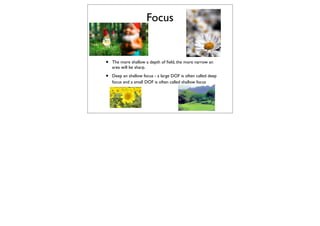
Focus


•   The more shallow a depth of field, the more narrow an
    area will be sharp.

•   Deep an shallow focus - a large DOF is often called deep
    focus and a small DOF is often called shallow focus
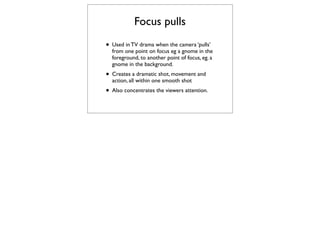
Focus pulls
• Used in TV drama when the camera ‘pulls’
  from one point on focus eg a gnome in the
  foreground, to another point of focus, eg. a
  gnome in the background.
• Creates a dramatic shot, movement and
  action, all within one smooth shot
• Also concentrates the viewers attention.

Year 12 tv drama angles, movement and composition

  • 1.
    Year 12 MediaStudies Camera angles, movement and composition
  • 2.
    L.O. • To know the different camera angles used in TV drama and how movement affects shots • To know what composition and the rule of thirds means • To be able to storyboard using shot sizes and angles • To be able to analyse a TV drama and identify camera shot sizes, angles and movement
  • 3.
    The International • Lookat the camera angles and shot sizes and think about why they were used.
  • 4.
    Camera angles • Lowangle - connotes superiority • High angle - connotes inferiority • Tilt - camera tilts up or down • Pan - when the camera swivels from left to righ to right to left. Pans usually slow and steady • A whip pan is a very quick pan
  • 5.
    Camera terminology • Track - when the camera physically moves across the floor. A camera could be on wheels on a track - called a “tracking shot” • Camera can have wheels bolted onto the bottom of the tripod for the same effect • Much more often ‘steadicam’ is used, where the camera is fixed to the body of a camera operator with belts, for even smoother action.
  • 6.
    Tasks • 1. Storyboardstory as listed on sheet • 2. Watch Life on Mars and fill out table •
  • 7.
    Composition • Rule of thirds: • createvideonotebook.blogspot.com • Depth of field - is the portion of the shot or scene that appears acceptably sharp in the image. Its determined by how far the camera is to the subject, the lens focal length, f numbers and other factors. You can change the depth of field so that even though a lens can only focus on one area, a large or small area can be sharp. •
  • 8.
    Focus • The more shallow a depth of field, the more narrow an area will be sharp. • Deep an shallow focus - a large DOF is often called deep focus and a small DOF is often called shallow focus
  • 9.
    Focus pulls • Usedin TV drama when the camera ‘pulls’ from one point on focus eg a gnome in the foreground, to another point of focus, eg. a gnome in the background. • Creates a dramatic shot, movement and action, all within one smooth shot • Also concentrates the viewers attention.