YARN STRENGTH
by
R.PASUPATHY
Why do we test textiles?
To find “HOW STRONG THEY ARE”!
This indicates that the strength of fibres
and fibrous structures is commonly
regarded as the CRITERION of
QUALITY
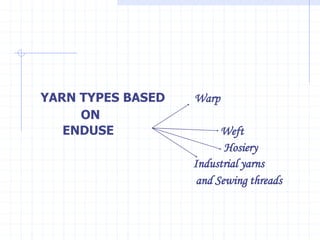
YARN TYPES BASED Warp
ON
ENDUSE Weft
Hosiery
Industrial yarns
and Sewing threads
PROPERTIES IMPORTANT FROM THE
POINT OF YARN QUALITY
 Linear density or count
 Twist
 Tensile properties
 Regularity or Evenness
 Hairiness
Yarn strength
Is an indication of the yarn quality with
reference to its end use. (warp, weft,
hosiery, industrial yarns, sewing thread,
etc
Breaking strength aids in predicting the
performance in actual use
Extensibility, elasticity etc are also
important tensile characteristics.
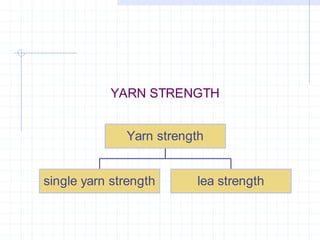
YARN STRENGTH
single yarn strength lea strength
Yarn strength
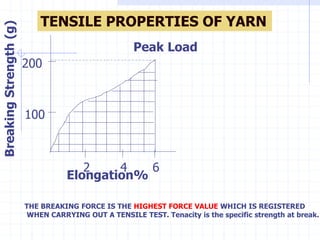
TENSILE PROPERTIES OF YARN
2 4 6
100
200
Peak Load
Elongation%
Breaking
Strength
(g)
THE BREAKING FORCE IS THE HIGHEST FORCE VALUE WHICH IS REGISTERED
WHEN CARRYING OUT A TENSILE TEST. Tenacity is the specific strength at break.
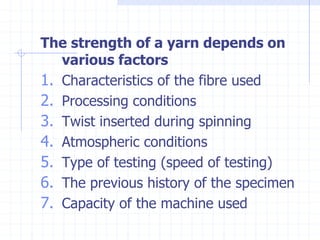
The strength of a yarn depends on
various factors
1. Characteristics of the fibre used
2. Processing conditions
3. Twist inserted during spinning
4. Atmospheric conditions
5. Type of testing (speed of testing)
6. The previous history of the specimen
7. Capacity of the machine used
YARN STRENGTH
In winding warping, sizing, weaving ,
knitting etc, the yarn is generally used
in the form of Individual Strands
Short term variations are reflected in
single strand strength test
Yarn strength
Machines available for strength evaluation
Lea strength tester
Single yarn strength tester
Yarn strength
The tensile testing of yarns has always
been an important quality control
procedure.
Tensile force & elongation values
provide indications….as to whether the
raw material is suitable
Makes possible for forecasting with
respect to subsequent processing and
the end product
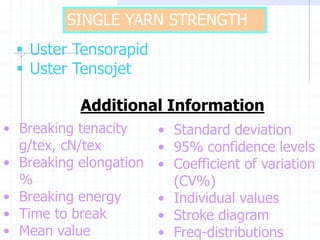
SINGLE YARN STRENGTH
 Uster Tensorapid
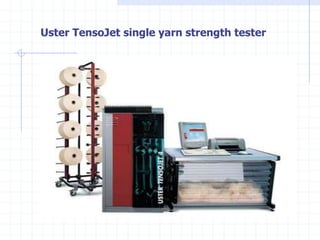
 Uster Tensojet
• Breaking tenacity
g/tex, cN/tex
• Breaking elongation
%
• Breaking energy
• Time to break
• Mean value
• Standard deviation
• 95% confidence levels
• Coefficient of variation
(CV%)
• Individual values
• Stroke diagram
• Freq-distributions
Additional Information
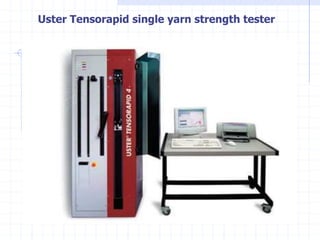
Uster Tensorapid single yarn strength tester
Uster TensoJet single yarn strength tester
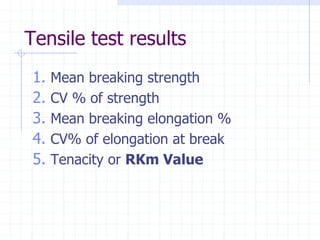
Tensile test results
1. Mean breaking strength
2. CV % of strength
3. Mean breaking elongation %
4. CV% of elongation at break
5. Tenacity or RKm Value
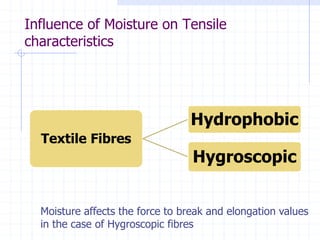
Influence of Moisture on Tensile
characteristics
Textile Fibres
Hydrophobic
Hygroscopic
Moisture affects the force to break and elongation values
in the case of Hygroscopic fibres
To obtain reproducible results Tensile
tests are to carried out at standard
testing conditions  21 +/- 1 C, 65%
RH +/- 2%
All yarns which absorb moisture exhibit a
higher elongation with increasing RH%
Ultra high speed Tensile testing
USTER Tensorapid – 300 tests/hour
USTER Tenso Jet – 30000 tests/hour
UTJ-4(ultra high speed tensile testing)-42 times faster
than the fastest test with UTR
- Fully automatic measurements at extremely high speeds
of 400m/min
- Testing of all common staple fibre yarns
- Makes possible a means of forecasting the suitability of
the yarn for subsequent processing, particularly with
respect to end breaks.
- Detection of seldom-occurring weak places
- With continuously increasing speeds of textile
machinery, the reduction of end breaks is a primary
technological problem
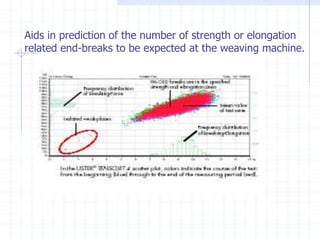
Aids in prediction of the number of strength or elongation
related end-breaks to be expected at the weaving machine.
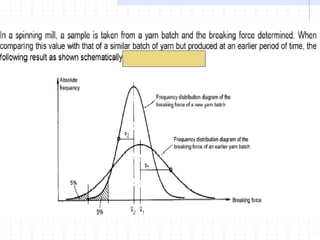
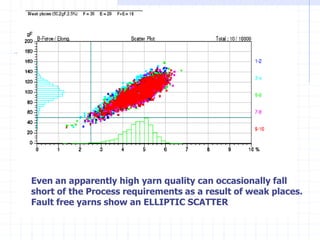
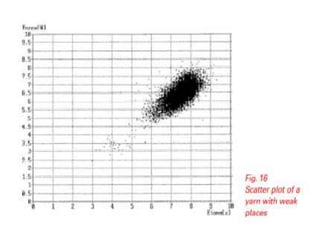
Even an apparently high yarn quality can occasionally fall
short of the Process requirements as a result of weak places.
Fault free yarns show an ELLIPTIC SCATTER
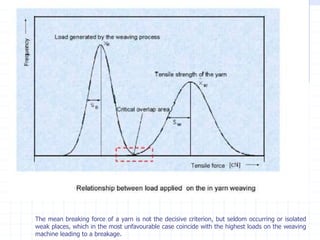
The mean breaking force of a yarn is not the decisive criterion, but seldom occurring or isolated
weak places, which in the most unfavourable case coincide with the highest loads on the weaving
machine leading to a breakage.
With the new generation tensile testing
equipments..
-detailed information and objective data is provided with respect
to the measured values
- Graphical format of the results like stroke diagrams, scatter
plots, histograms of both force and elongation are available
- With tensile testing not only the mean
value of the breaking force but the
variation is equally important
- Higher variation can mean more
extreme values
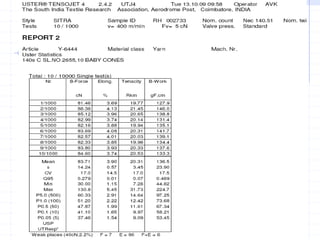
UTJ4_Yarn strength results
The number of end-breaks on a
weaving machine is proportional to the
number of isolated weak places in the
yarn. Hence, to detect isolated weak
places the number of tests has to
drastically increased, which is possible
with UTJ4
Yarn strength
Each yarn is subjected to peak loads
during weaving and knitting, which the
yarn must resist without breaking in
order that the number of end-breaks
and the number of machine stops will
be contained at a minimum

YARN strength.pptx

  • 1.
  • 2.
    Why do wetest textiles? To find “HOW STRONG THEY ARE”! This indicates that the strength of fibres and fibrous structures is commonly regarded as the CRITERION of QUALITY
  • 3.
    YARN TYPES BASEDWarp ON ENDUSE Weft Hosiery Industrial yarns and Sewing threads
  • 4.
    PROPERTIES IMPORTANT FROMTHE POINT OF YARN QUALITY  Linear density or count  Twist  Tensile properties  Regularity or Evenness  Hairiness
  • 5.
    Yarn strength Is anindication of the yarn quality with reference to its end use. (warp, weft, hosiery, industrial yarns, sewing thread, etc Breaking strength aids in predicting the performance in actual use Extensibility, elasticity etc are also important tensile characteristics.
  • 6.
    YARN STRENGTH single yarnstrength lea strength Yarn strength
  • 7.
    TENSILE PROPERTIES OFYARN 2 4 6 100 200 Peak Load Elongation% Breaking Strength (g) THE BREAKING FORCE IS THE HIGHEST FORCE VALUE WHICH IS REGISTERED WHEN CARRYING OUT A TENSILE TEST. Tenacity is the specific strength at break.
  • 8.
    The strength ofa yarn depends on various factors 1. Characteristics of the fibre used 2. Processing conditions 3. Twist inserted during spinning 4. Atmospheric conditions 5. Type of testing (speed of testing) 6. The previous history of the specimen 7. Capacity of the machine used
  • 9.
    YARN STRENGTH In windingwarping, sizing, weaving , knitting etc, the yarn is generally used in the form of Individual Strands Short term variations are reflected in single strand strength test
  • 10.
    Yarn strength Machines availablefor strength evaluation Lea strength tester Single yarn strength tester
  • 11.
    Yarn strength The tensiletesting of yarns has always been an important quality control procedure. Tensile force & elongation values provide indications….as to whether the raw material is suitable Makes possible for forecasting with respect to subsequent processing and the end product
  • 12.
    SINGLE YARN STRENGTH Uster Tensorapid  Uster Tensojet • Breaking tenacity g/tex, cN/tex • Breaking elongation % • Breaking energy • Time to break • Mean value • Standard deviation • 95% confidence levels • Coefficient of variation (CV%) • Individual values • Stroke diagram • Freq-distributions Additional Information
  • 13.
    Uster Tensorapid singleyarn strength tester
  • 14.
    Uster TensoJet singleyarn strength tester
  • 15.
    Tensile test results 1.Mean breaking strength 2. CV % of strength 3. Mean breaking elongation % 4. CV% of elongation at break 5. Tenacity or RKm Value
  • 16.
    Influence of Moistureon Tensile characteristics Textile Fibres Hydrophobic Hygroscopic Moisture affects the force to break and elongation values in the case of Hygroscopic fibres
  • 17.
    To obtain reproducibleresults Tensile tests are to carried out at standard testing conditions  21 +/- 1 C, 65% RH +/- 2% All yarns which absorb moisture exhibit a higher elongation with increasing RH%
  • 18.
    Ultra high speedTensile testing USTER Tensorapid – 300 tests/hour USTER Tenso Jet – 30000 tests/hour UTJ-4(ultra high speed tensile testing)-42 times faster than the fastest test with UTR - Fully automatic measurements at extremely high speeds of 400m/min - Testing of all common staple fibre yarns - Makes possible a means of forecasting the suitability of the yarn for subsequent processing, particularly with respect to end breaks. - Detection of seldom-occurring weak places - With continuously increasing speeds of textile machinery, the reduction of end breaks is a primary technological problem
  • 19.
    Aids in predictionof the number of strength or elongation related end-breaks to be expected at the weaving machine.
  • 22.
    Even an apparentlyhigh yarn quality can occasionally fall short of the Process requirements as a result of weak places. Fault free yarns show an ELLIPTIC SCATTER
  • 23.
    The mean breakingforce of a yarn is not the decisive criterion, but seldom occurring or isolated weak places, which in the most unfavourable case coincide with the highest loads on the weaving machine leading to a breakage.
  • 25.
    With the newgeneration tensile testing equipments.. -detailed information and objective data is provided with respect to the measured values - Graphical format of the results like stroke diagrams, scatter plots, histograms of both force and elongation are available - With tensile testing not only the mean value of the breaking force but the variation is equally important - Higher variation can mean more extreme values
  • 26.
    UTJ4_Yarn strength results Thenumber of end-breaks on a weaving machine is proportional to the number of isolated weak places in the yarn. Hence, to detect isolated weak places the number of tests has to drastically increased, which is possible with UTJ4
  • 27.
    Yarn strength Each yarnis subjected to peak loads during weaving and knitting, which the yarn must resist without breaking in order that the number of end-breaks and the number of machine stops will be contained at a minimum