A PRESENTATION ABOUT THE MECHANICAL
PROPERTIES OF FIBERS.
Subject: Textile Physics
ID: 322012
Department of Textile Science & Engineering
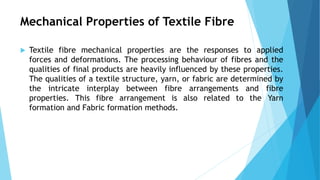
Mechanical Properties of Textile Fibre
 Textile fibre mechanical properties are the responses to applied
forces and deformations. The processing behaviour of fibres and the
qualities of final products are heavily influenced by these properties.
The qualities of a textile structure, yarn, or fabric are determined by
the intricate interplay between fibre arrangements and fibre
properties. This fibre arrangement is also related to the Yarn
formation and Fabric formation methods.
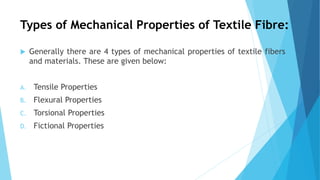
Types of Mechanical Properties of Textile Fibre:
 Generally there are 4 types of mechanical properties of textile fibers
and materials. These are given below:
A. Tensile Properties
B. Flexural Properties
C. Torsional Properties
D. Fictional Properties
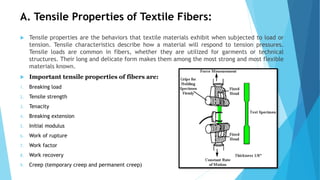
A. Tensile Properties of Textile Fibers:
 Tensile properties are the behaviors that textile materials exhibit when subjected to load or
tension. Tensile characteristics describe how a material will respond to tension pressures.
Tensile loads are common in fibers, whether they are utilized for garments or technical
structures. Their long and delicate form makes them among the most strong and most flexible
materials known.
 Important tensile properties of fibers are:
1. Breaking load
2. Tensile strength
3. Tenacity
4. Breaking extension
5. Initial modulus
6. Work of rupture
7. Work factor
8. Work recovery
9. Creep (temporary creep and permanent creep)
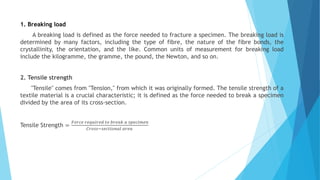
1. Breaking load
A breaking load is defined as the force needed to fracture a specimen. The breaking load is
determined by many factors, including the type of fibre, the nature of the fibre bonds, the
crystallinity, the orientation, and the like. Common units of measurement for breaking load
include the kilogramme, the gramme, the pound, the Newton, and so on.
2. Tensile strength
"Tensile" comes from "Tension," from which it was originally formed. The tensile strength of a
textile material is a crucial characteristic; it is defined as the force needed to break a specimen
divided by the area of its cross-section.
Tensile Strength =
𝐹𝑜𝑟𝑐𝑒 𝑟𝑒𝑞𝑢𝑖𝑟𝑒𝑑 𝑡𝑜 𝑏𝑟𝑒𝑎𝑘 𝑎 𝑠𝑝𝑒𝑐𝑖𝑚𝑒𝑛
𝐶𝑟𝑜𝑠𝑠−𝑠𝑒𝑐𝑡𝑖𝑜𝑛𝑎𝑙 𝑎𝑟𝑒𝑎
3. Tenacity
Tenacity can be defined as the ratio between the breaking load and the linear density of the
specimen. The tenacity of a specimen may be expressed as the units of gram/tex, gram/denier,
Newton/tex, etc.
tenacity =
𝐵𝑟𝑒𝑎𝑘𝑖𝑛𝑔 𝐿𝑜𝑎𝑑
𝐿𝑖𝑛𝑒𝑎𝑟 𝐷𝑒𝑛𝑠𝑖𝑡𝑦
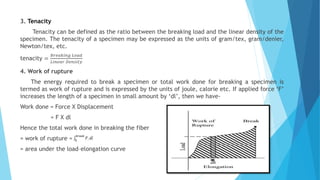
4. Work of rupture
The energy required to break a specimen or total work done for breaking a specimen is
termed as work of rupture and is expressed by the units of joule, calorie etc. If applied force ‘F’
increases the length of a specimen in small amount by ‘dl’, then we have-
Work done = Force X Displacement
= F X dl
Hence the total work done in breaking the fiber
= work of rupture =
= area under the load–elongation curve
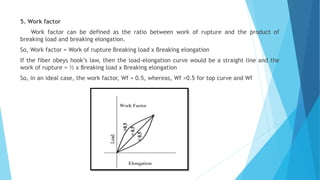
5. Work factor
Work factor can be defined as the ratio between work of rupture and the product of
breaking load and breaking elongation.
So, Work factor = Work of rupture Breaking load x Breaking elongation
If the fiber obeys hook’s law, then the load-elongation curve would be a straight line and the
work of rupture = ½ x Breaking load x Breaking elongation
So, in an ideal case, the work factor, Wf = 0.5, whereas, Wf >0.5 for top curve and Wf
B. Flexural Properties of Textile Fibers
 One of the mechanical qualities of textiles is their flexural strength. It's the way a fiber or
substance acts when bent, and it's an interesting property to study. Having a fabric with
good flexural qualities is essential for clothing. The flexural test determines how much
force is needed to cause a beam to bend when subjected to a three-point load. Information
like this is frequently used to determine which materials are best for making components
that can withstand loads without deforming. The rigidity of a material under flexure can be
measured by its flexural modulus.
 Common flexural properties are:
1. Flexural rigidity
2. Bending recovery
3. Bending modulus
C. Torsional Properties of Textile Fibers
 The torsional property of a textile describes how it responds to a torsional force. If you apply a
torsional force to a fiber or substance, it will twist. Torsional force, in this context, refers to a
twisting force exerted on the material from opposite ends.
 Torsional properties are:
1. Torsional rigidity
2. Breaking twist
3. Shear modulus
D. Fictional Properties of Textile Fibers
 Frictional properties are due to the friction between the fibers. These properties are shown
during processing. Too high friction and too low friction are not good for yarn. Therefore it
is an important property when yarn manufacturing and processing.
Thanks for Time and Cooperation

Textile Physics.pptx

  • 1.
    A PRESENTATION ABOUTTHE MECHANICAL PROPERTIES OF FIBERS. Subject: Textile Physics ID: 322012 Department of Textile Science & Engineering
  • 2.
    Mechanical Properties ofTextile Fibre  Textile fibre mechanical properties are the responses to applied forces and deformations. The processing behaviour of fibres and the qualities of final products are heavily influenced by these properties. The qualities of a textile structure, yarn, or fabric are determined by the intricate interplay between fibre arrangements and fibre properties. This fibre arrangement is also related to the Yarn formation and Fabric formation methods.
  • 3.
    Types of MechanicalProperties of Textile Fibre:  Generally there are 4 types of mechanical properties of textile fibers and materials. These are given below: A. Tensile Properties B. Flexural Properties C. Torsional Properties D. Fictional Properties
  • 4.
    A. Tensile Propertiesof Textile Fibers:  Tensile properties are the behaviors that textile materials exhibit when subjected to load or tension. Tensile characteristics describe how a material will respond to tension pressures. Tensile loads are common in fibers, whether they are utilized for garments or technical structures. Their long and delicate form makes them among the most strong and most flexible materials known.  Important tensile properties of fibers are: 1. Breaking load 2. Tensile strength 3. Tenacity 4. Breaking extension 5. Initial modulus 6. Work of rupture 7. Work factor 8. Work recovery 9. Creep (temporary creep and permanent creep)
  • 5.
    1. Breaking load Abreaking load is defined as the force needed to fracture a specimen. The breaking load is determined by many factors, including the type of fibre, the nature of the fibre bonds, the crystallinity, the orientation, and the like. Common units of measurement for breaking load include the kilogramme, the gramme, the pound, the Newton, and so on. 2. Tensile strength "Tensile" comes from "Tension," from which it was originally formed. The tensile strength of a textile material is a crucial characteristic; it is defined as the force needed to break a specimen divided by the area of its cross-section. Tensile Strength = 𝐹𝑜𝑟𝑐𝑒 𝑟𝑒𝑞𝑢𝑖𝑟𝑒𝑑 𝑡𝑜 𝑏𝑟𝑒𝑎𝑘 𝑎 𝑠𝑝𝑒𝑐𝑖𝑚𝑒𝑛 𝐶𝑟𝑜𝑠𝑠−𝑠𝑒𝑐𝑡𝑖𝑜𝑛𝑎𝑙 𝑎𝑟𝑒𝑎
  • 6.
    3. Tenacity Tenacity canbe defined as the ratio between the breaking load and the linear density of the specimen. The tenacity of a specimen may be expressed as the units of gram/tex, gram/denier, Newton/tex, etc. tenacity = 𝐵𝑟𝑒𝑎𝑘𝑖𝑛𝑔 𝐿𝑜𝑎𝑑 𝐿𝑖𝑛𝑒𝑎𝑟 𝐷𝑒𝑛𝑠𝑖𝑡𝑦 4. Work of rupture The energy required to break a specimen or total work done for breaking a specimen is termed as work of rupture and is expressed by the units of joule, calorie etc. If applied force ‘F’ increases the length of a specimen in small amount by ‘dl’, then we have- Work done = Force X Displacement = F X dl Hence the total work done in breaking the fiber = work of rupture = = area under the load–elongation curve
  • 7.
    5. Work factor Workfactor can be defined as the ratio between work of rupture and the product of breaking load and breaking elongation. So, Work factor = Work of rupture Breaking load x Breaking elongation If the fiber obeys hook’s law, then the load-elongation curve would be a straight line and the work of rupture = ½ x Breaking load x Breaking elongation So, in an ideal case, the work factor, Wf = 0.5, whereas, Wf >0.5 for top curve and Wf
  • 8.
    B. Flexural Propertiesof Textile Fibers  One of the mechanical qualities of textiles is their flexural strength. It's the way a fiber or substance acts when bent, and it's an interesting property to study. Having a fabric with good flexural qualities is essential for clothing. The flexural test determines how much force is needed to cause a beam to bend when subjected to a three-point load. Information like this is frequently used to determine which materials are best for making components that can withstand loads without deforming. The rigidity of a material under flexure can be measured by its flexural modulus.  Common flexural properties are: 1. Flexural rigidity 2. Bending recovery 3. Bending modulus
  • 9.
    C. Torsional Propertiesof Textile Fibers  The torsional property of a textile describes how it responds to a torsional force. If you apply a torsional force to a fiber or substance, it will twist. Torsional force, in this context, refers to a twisting force exerted on the material from opposite ends.  Torsional properties are: 1. Torsional rigidity 2. Breaking twist 3. Shear modulus
  • 10.
    D. Fictional Propertiesof Textile Fibers  Frictional properties are due to the friction between the fibers. These properties are shown during processing. Too high friction and too low friction are not good for yarn. Therefore it is an important property when yarn manufacturing and processing.
  • 11.
    Thanks for Timeand Cooperation