the xxi century Organization Solar Management System - the Fractal Organization in PracticeWojtek LuciejewskiWarszawa, Osnabrück, Poznań, Ostercappeln (2001 – 2010)
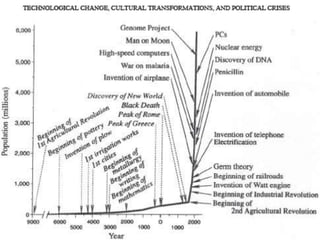
Several years ago, when I published the first time in Internet "Primumnon Prodigere" I foresaw the necessity of wider look at organization of XXI Century and inclusion of the nature examples (e.g., new knowledge about Fractals).The present practice is proving this thesis.The acceleration of changes, which complicate our lives more and more, is shown on the next picture.
Is Organization a Machine?The central most aspect of the scientific foundation upon which Taylor built his theory of management was a metaphor popularized by the 17th century French philosopher and mathematician Rene Descartes who looked at his world as a "clockwork universe.„Taylor, as a devout Cartesian and as the best of his contemporaries, thus instilled in the mindsets of Western management the powerful and recalcitrant image of the machine.
Is Organization a Machine?The idea has become entrenched that the organizations we're supposed to be managing are physical instruments of production that humans engineered in the first place and are now being "re-engineered" in a misguided effort to solve their problems.The term alone attests to the depth to which mechanistic thinking has become embedded in our corporate psyches.
Is Organization a Machine?The robustness and endurance of the machine as the predominant metaphor of 20th century management practice is nothing short of amazing given the mounting evidence that it simply does not work.
„Machine” organizationstillingoodshape„We are products of the culture that we grew up in. When we live in machine organizations, we become part of them. Our organizations are not human or natural. They are machines.Machines are not designed to learn or accept feedback. They are inherently not responsive. When we are in them we treat each other like parts or things….Some of us are so encultured by the old that we simply cannot imagine, or see, the reality of the new”.
„Machine” organizationstillingoodshapeOur operational culture has a series of rules, incentives and punishments that reinforce the old metaphor.It is not easy for anyone inside a traditional organization to make the changes to the new metaphor as all these forces will come into play against them.
„Machine” organizationstillingoodshapeAll the rules of the old culture are based on the assumptions that the most important activity is control. The extension of this assumption is that if only we tried hard enough, we could control everything.This illusion seemed to work when we did not operate in a global society…..As we talk about being more responsive, more customer-focused and more flexible, let’s look at the real rules that govern most of our organizations. They work against these objectives.”According to „What is wrong with our concept of organization? Shifting our organizational metaphor from Machine to Nature” by Rob Paterson
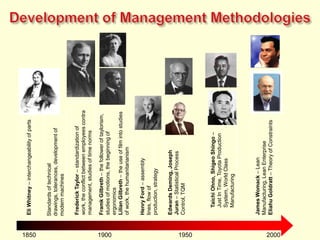
Development of ManagementMethodologiesFramkGilbreth– the follower of taylorism, studies of motions, the beginning of ergonomicsLilianGilbreth– the use of film into studies of work, the humanitarianismFrederick Taylor – standardization of work, the conflict between employees contra management, studies of time normsTaichiOhno, Shigeo Shingo – Just In Time, Toyota Production System, World Class ManufacturingJames Womack – Lean Manufacturing, Lean EnterpriseEliahuGoldratt– Theory of ConstraintsStandards of technical drawings, tolerances, development of modern machines Eli Whitney – interchangeability of partsEdwards Deming, Joseph Juran– Statistical Process Control, TQMHenry Ford – assembly lines, flow of production, strategy1850190019502000
Some latestinitiativesLean Management,TOC – Theory of Constraints,BMS – Bionic Management System,HMS – Holonic Manufacturing System,Chaordic Organization,Fractal Enterprise,Network Economy.
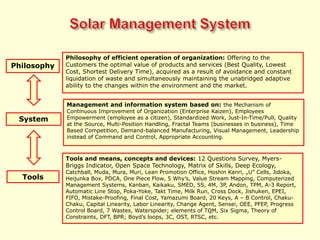
Lean Managementin shortLean Management proves to be the complete management methodology. It includes the basic idea (philosophy of efficient operation), systems of management and information as well as the set of tools for their construction.
Lean Managementin shortThe outstanding advantage of Lean Management is, that it shows the direction for improvements provided by the definition of Valueand Waste.Another distinctive advantage is the flexibility in operations resulting from the feedback mechanism incorporated into management system –EnterpriseKaizen(if properly implemented).
Lean DefinitionsValue– the potential delivered to the customer at the right time and for an appropriate prize, to be defined each time by the customer. Value is defined by the features of a product or service, their availability, cost and performance parameters. Waste – each single action which uses resources but does not create Value;or everything that increases the cost of a product without adding Value to it.EnterpriseKaizen – continuous improvement of all business activities.
Program KaizenProgram Kaizenshould be used to guide improvements (by announced contests and other initiatives) into more flexibility in production lines and shorter production cycles.
Weaknesses of Lean ManagementCompanies whichimplement Lean Management very often suffer defeats. The reason seems to be the Japanese culture and its automotive roots.Western culture favor individualism and doesn’t endorse excessive rigor or genetic obedience.Lean Management tools are strongly oriented on highly mechanized processes and only to some extend can be used for service processesThe trend of world economy indicates quite clearly, that manufacturing is loosing its significance for the benefit of serviceAn attempt of an orthodox or forced implementation can only generate more damages then benefits.We shouldn’t however turn down Lean Management entirely. It is still the most comprehensive management philosophy and definitions of Value and Waste are universal.
Theory of ConstraintsTheory of Constraints is based on the premise that the rate of goal achievement is limited by at least one constraining process. Only by increasing flow through the constraint can overall throughput be increased.The five focusing steps aim to ensure ongoing improvement efforts are centered around the organization's constraints.
Theory of ConstraintsThe steps are:Identify the constraint (the resource or policy that prevents the organization from obtaining more of the goal)Decide how to exploit the constraint (get the most capacity out of the constrained process)Subordinate all other processes to above decision (align the whole system or organization to support the decision made above)Elevate the constraint (make other major changes needed to break the constraint)If, as a result of these steps, the constraint has moved, return to Step 1. Don't let inertia become the constraint.
Bionic Management SystemOn basis of patterns of biological organisms the Japanese experts propose the bionic system in which be realized the features of natural pattern:Spontaneity,
Motility,
Harmony.Bionic Management SystemIt is proposed to imitate the features of biological organisms:The integration of functional elements and the hierarchy,
The organizing the information in DNA, carrier of genetic information,
Use of natural intelligence,
Dynamic structure and social harmony.Holonic Manufacturing SystemHolonic Manufacturing Systems (HMS) was first proposed as a new manufacturing paradigm at the beginning of 1990.In an HMS, key elements such as machines, work centers, plants, parts, products, persons, departments, or divisions have autonomous and cooperative properties.
Holonic Manufacturing SystemThese elements are called "holons," a word coined by combining "holos" (the whole) and "on" (a particle) following A. Koestler. In an HMS, each holon's activities are determined through the cooperation with other holons, as opposed to being determined by a centralized mechanism.
Holonic Manufacturing SystemLuckily for us this proposal was created for artificial organizational creatures such as fully automated production and in such case the use of an example of human behaviors makes sense. Because robots can be programmed only according to the better side the human being.
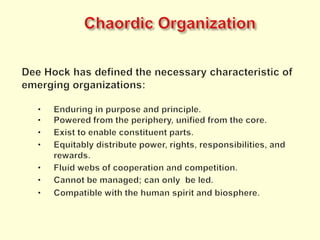
ChaordicOrganizationDee Hock has defined the necessary characteristic of emerging organizations:Enduring in purpose and principle.
Powered from the periphery, unified from the core.
Exist to enable constituent parts.
Equitably distribute power, rights, responsibilities, and rewards.
Fluid webs of cooperation and competition.
Cannot be managed; can only  be led.
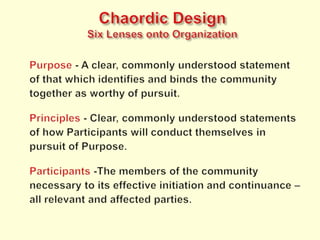
Compatible with the human spirit and biosphere.Chaordic Design Six Lenses onto OrganizationPurpose - A clear, commonly understood statement of that which identifies and binds the community together as worthy of pursuit.Principles -Clear, commonly understood statements of how Participants will conduct themselves in pursuit of Purpose.Participants -The members of the community necessary to its effective initiation and continuance – all relevant and affected parties.
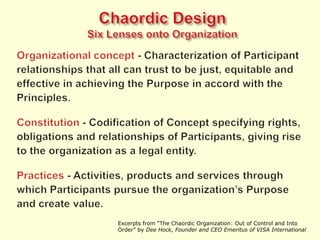
Chaordic Design Six Lenses onto OrganizationOrganizational concept - Characterization of Participant relationships that all can trust to be just, equitable and effective in achieving the Purpose in accord with the Principles.Constitution - Codification of Concept specifying rights, obligations and relationships of Participants, giving rise to the organization as a legal entity.Practices - Activities, products and services through which Participants pursue the organization’s Purpose and create value.Excerpts from “The Chaordic Organization: Out of Control and Into Order” by Dee Hock, Founder and CEO Emeritus of VISA International  
Centralized control is archaic and self-limiting.Diversity and innovation thrive where power and information are highly distributed.
Competition and collaboration, freedom and governance, individuality and community are not irreconcilable opposites.The greatest benefit comes when they are harmoniously blended without losing the distinctive strength of each.
True communities are held together by ethics–not forceand by the power of their shared beliefs, purposes, and identity.
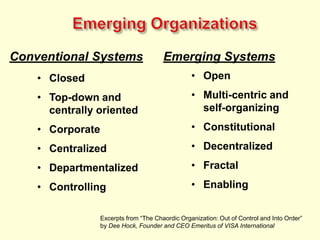
Emerging OrganizationsConventional SystemsEmerging SystemsOpen
Multi-centric and self-organizing
Constitutional
Decentralized
Fractal
Enabling
Closed
Top-down and centrally oriented
Corporate
Centralized
Departmentalized
ControllingExcerpts from “The Chaordic Organization: Out of Control and Into Order” by Dee Hock, Founder and CEO Emeritus of VISA International 
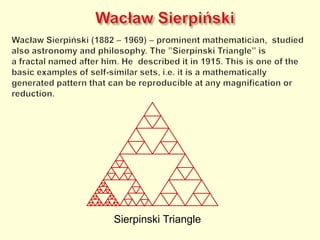
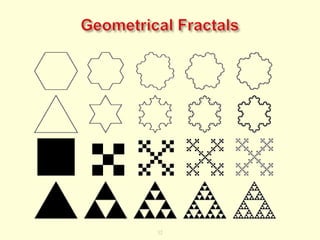
Wacław SierpińskiWacławSierpiński (1882 – 1969) – prominent mathematician,  studied also astronomy and philosophy. The ”Sierpinski Triangle” is a fractal named after him. He  described it in 1915. This is one of the basic examples of self-similar sets, i.e. it is a mathematically generated pattern that can be reproducible at any magnification or reduction.Sierpinski Triangle
GeometricalFractals32
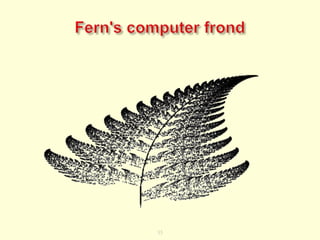
Fern's computer frond33
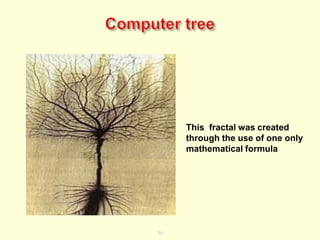
Computer treeThis  fractal was created through the use of one only mathematical formula 34
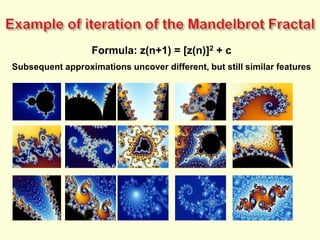
Example of iteration of the Mandelbrot FractalFormula: z(n+1) = [z(n)]2 + cSubsequent approximations uncover different, but still similar features
IstheNaturefractal?Fractal geometry permits us to understand, how nature creates all its forms, which we can observe. The mountain formations, rivers, shores, the mammal's lung, vegetation and the blood circulation system, but and the surfaces of breakthroughs of metals as well as the growths and the falls of stock are fractals copying on many smaller levels of scale the main pattern.Fractals in effect behave like genetic algorithms permitting different species to reconstruct effectively essential functions.Let's take the example of a cloud - it constitute doubtless one the whole, but it is "full of holes" like a sponge, because it consists of countless quantity of microscopic drops of water and steam. It is separate the whole, but folded with many smaller the wholes, also separate. If "we will cut out" small piece of cloud, then we will receive something very similar to it.Development and the strength of computers permits us at present to see and better understand the law of evolution and what follows it laws of nature.36
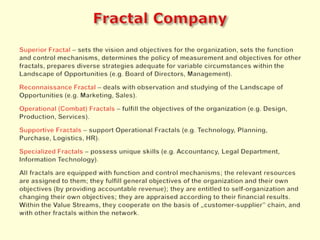
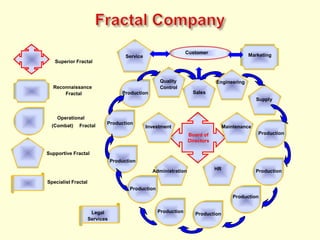
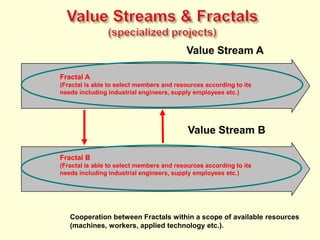
Fractal EnterpriseHans-JürgenWarnecke advanced the hypothesis of fractal enterprises as the near future of development of organization, where independent teams co-operate in network on principle customer - supplier so inside as  outside the organization.The leading thought for fractal organization is the creation (in range of its competence) of the self - regulating organizational working groups. The superior computer informative and communication system should serve for tuning of the size of inputs and outputs.
Fractal EnterpriseFractal enterprise creates businesses within business, but also businessmen in enterprise. This corresponds better with the Western culture, which prefers the individuality.Prof. Warnecke did not propose practical solutions. We should remember however, that he wrote it in early 90s, when theWorld really started experiencing the influence of Internet and Globalization.
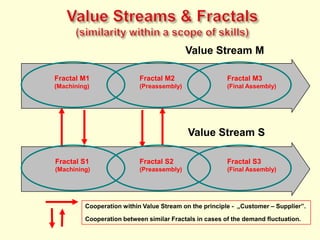
FractalOrganizationFractals are the independently functioning units which objectives and expected productivity can be explicitly described.Fractals are self-similar – each provides services.
Fractals are self-organizing.Fractals identify and formulate their objectives as well as the internal and external relations.
FractalOrganizationFractals reorganize (restructure) themselves, reemerge and fall into decomposition.The overall system of objectives which results from the fractals objectives is no contradictory and must serve for achieving the objectives of the whole enterprise.
Fractals are connected into a network by an efficient system of information and communication. Fractals themselves determine the kind and scope of their access to the available data.
Fractals productivity is continuously measured and valued.Fractals have the attributes of the intelligent systems and react in an adaptive manner to every environment's influence.
New Rulesforthe NewEconomy1)Embrace the Swarm. As power flows away from the center, the competitive advantage belongs to those who learn how to embrace decentralized points of control.2) Increasing Returns. As the number of connections between people and things add up, the consequences of those connections multiply out even faster, so that initial successes aren’t self-limiting, but self-feeding.3)Plentitude, Not Scarcity. As manufacturing techniques perfect the art of making copies plentiful, value is carried by abundance, rather than scarcity, inverting traditional business propositions.4)Follow the Free. As resource scarcity gives way to abundance, generosity begets wealth. Following the free rehearses the inevitable fall of prices, and takes advantage of the only true scarcity: human attention.5)Feed the Web First. As networks entangle all commerce, a firm’s primary focus shifts from maximizing the firm’s value to maximizing the network’s value. Unless the net survives, the firm perishes.
New Rulesforthe NewEconomy6)Let Go at the Top. As innovation accelerates, abandoning the highly successful in order to escape from its eventual obsolescence becomes the most difficult and yet most essential task.7)From Places to Spaces. As physical proximity (place) is replaced by multiple interactions with anything, anytime, anywhere (space), the opportunities for intermediaries, middlemen, and mid-size niches expand greatly.8)No Harmony, All Flux. As turbulence and instability become the norm in business, the most effective survival stance is a constant but highly selective disruption that we call innovation.9) Relationship Tech. As the soft trumps the hard, the most powerful technologies are those that enhance, amplify, extend, augment, distill, recall, expand, and develop soft relationships of all types.10) Opportunities Before Efficiencies. As fortunes are made by training machines to be ever more efficient, there is yet far greater wealth to be had by unleashing the inefficient discovery and creation of new opportunities.Kevin Kelly, „New Rules for the New Economy, 10 Radical Strategies for a Connected World
Science accomplishments - new ”order”Logical-rational approach (determinism).Philosophers:Platon (427-347 B.C.)
Aristotle (384-322 B.C.)
Rene Descartes (1596-1650)
Pierre Laplace (1749-1827)Mathematics and physics till the 19th centuryFrederic Winslow Taylor – theory of industrialefficiency
Science accomplishments - new ”order”New Approach – Sustained DisequilibriumGiving up the thinking in ways of the linear extrapolation type or cause-and-effect chainsJules Henri Poincaré (1854-1912)
Theory of Relativity
Quantum Mechanics
Theory on Infinite Sets  – Georg Cantor
Fractal geometry – Benoit Mandelbrot
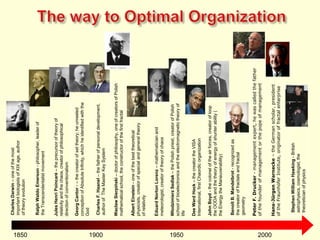
Complex Adaptive Systems The way to Optimal OrganizationPeter F. Drucker - management expert, he was called the father of the founder of management or the pope of management Hans-Jürgen Warnecke – the German scholar, president of the Fraunhofer Institute, originator of fractal enterpriseWacław Sierpiński – doctor of philosophy, one of creators of Polish mathematical school, the constructor of the first fractal Georg Cantor - – the creator of set theory; he unreeled conception of Absolute Infinity, which he identified with the God Włodzimierz Sedlak – the Polish priest, creator of Polish school of bioelectronics and the electromagnetic theory of life John Boyd - the colonel of the air forces, creator of loop the OODA and the theory of energy of shunter ability ( the Energy the Maneuverability)Jules Henri Poincaré– the precursor of theory of relativity and the chaos, creator of philosophical direction of conventionalismEduard Norton Lorenz – mathematician and meteorologist, creator of theory of chaos Ralph Waldo Emerson- philosopher, leader of the Transcendentalist movement Stephen William Hawking - British astrophysics, cosmologist, the theoretician of physicsCharles F. Haanel– the father of personal development, author of  The Master Key SystemAlbert Einstein - one of the best theoretical physicists, creator of special and general theory of relativityDee Ward Hock – the creator the VISA International, first Chaordic organization Charles Darwin – one of the most important biologists of XIX age, author of theory evolutionBenoît B. Mandelbrot - recognized as the creator of fractals and fractal geometry1850190019502000
ComplexAdaptiveSystemsThe subject of Complex Adaptive Systems has been studied for a long time in fields such as biology, cardiology, chemistry, computer science, demography, economics, mathematics, physics, game theory or meteorology.
ComplexAdaptiveSystemsIn the 70’s of the previous century, scientists from various fields discovered that different Complex Adaptive Systems share common features and may be effectively analyzed and examined as a group, despite their diverse origins.
ComplexAdaptiveSystemsThese systems include: biological species,  cardiovascular systems, economy, human societies, neural systems, stock exchange or weather systems, to name just a few.
ComplexAdaptiveSystemsDecentralized, competitive market – a classic example of the Complex Adaptive System - Adam Smith’s (1776) „invisible hand” manifests itself when the market participants reach the critical mass of self-organization.
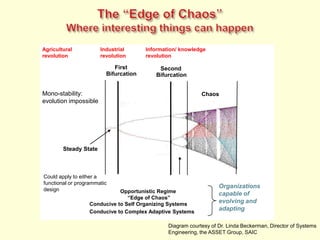
The “Edge of Chaos”Where interesting things canhappenAgricultural revolutionIndustrial revolutionInformation/knowledge revolutionFirst Second BifurcationBifurcationMono-stability: evolution impossibleChaosSteady StateCould apply to either a functional or programmatic designOrganizations capable of evolving and adaptingOpportunistic Regime“Edge of Chaos”Conducive to Self Organizing SystemsConducive to Complex Adaptive SystemsDiagram courtesy of Dr. Linda Beckerman, Director of Systems Engineering, the ASSET Group, SAIC
Market – Sustained Disequilibrium?According to the neoclassical theory, the market naturally moves towards equilibrium by anticipating its participants’ logical behaviors.This kind of deductive thinking may be only justified for the certain market segments at a given time, because the current market have no one, but many equilibrium points.
Market – Sustained Disequilibrium?The observed contemporary complexity of problems enforce us to straying away from the deductive thinking.Inductive thinking – the market participants try to identify trends, interrelations and groups of phenomenon and then, through analogy to the past experiences, they try to anticipate the situation’s progress and search for optimal solutions.Process of co-evolution – system changes <–> the participants modify their behaviors what in consequence influences the changes of a system.
Market – Sustained Disequilibrium?In reality it is unreasonable to expect from the market participants the logical and rational behaviors.So different models of actions are created on the market and continuous evolution of the system is taking place.Market should be seen as the Complex Adaptive System and as such can not be considered to be the stable system (striving for equilibrium) but it is rather the vibrating equilibrium (periods of stability mixed with periods of chaos – sustained disequilibrium).According to „Organizacjanakrawędzichaosu”,PiotrNestorowicz, 2001
Landscape of opportunitiesThis landscape is changing itself with the function of time – the peaks get lower, disappear and new ones emerge. The practice shows that to be able to climb onto another peak it is necessary first to get down into the valley.Tim Mannon, the President of the Hewlett Packard Printer Department, once said: „The biggest single danger to our business is remaining for one year too long in the previous business which brought us success.”
Be chaotic or deathAt first glance chaotic behavior appears to be the antithesis of organizational behavior, that necessitates order, regularity and predictability so as to ensure coordination, planning and control.A second look will remind us that variety and irregularity allow the resilience and creativity which are a necessity for learning, which is a condition to be able to survive.
The Goal - Survival on own termsStudies of human behavior reveal that the actions we undertake as individuals are closely related to survival, more importantly, survival on our own terms.Naturally, such a notion implies that we should be able to act relatively free or independent of any debilitating external influences--otherwise that very survival might be in jeopardy.
The Goal - Survival on own termsIn viewing the instinct for survival in this manner we imply that a basic aim or goal, as individuals, is to improve our capacity for independent action.The degree to which we cooperate, or compete, with others is driven by the need to satisfy this basic goal.If we believe that it is not possible to satisfy it alone, without help from others, history shows us that we will agree to constraints upon our independent actionin order to collectively pool skills and talents in the form of nations, corporations, labor unions, mafias, etc.--so that obstacles standing in the way of the basic goal can either be removed or overcome.
The Goal - Survival on own termsOn the other hand, if the group cannot or does not attempt to overcome obstacles deemed important to many (or possibly any) of its individual members, the group must risk losing these alienated members.Under these circumstances, the alienated members may dissolve their relationship and remain independent, form a group of their own, or join another collective body in order to improve their capacity for independent action.John R. Boyd
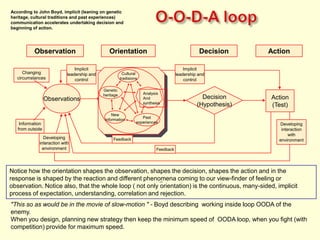
O-O-D-AloopActionDecisionDecision(Hypothesis)Action(Test)According to John Boyd, implicit (leaning on genetic heritage, cultural traditions and past experiences) communication accelerates undertaking decision and beginning of action. ObservationOrientationImplicit leadership and control Implicit leadership and control Changing circumstancesCulturaltradisionsObservationsGeneticheritageAnalysisAndsynthesisNewinformationPastexperiencesInformation from outside Developing interaction with environmentDeveloping interaction with environmentFeedbackFeedbackNotice how the orientation shapes the observation, shapes the decision, shapes the action and in the response is shaped by the reaction and different phenomena coming to our view-finder of feeling or observation. Notice also, that the whole loop ( not only orientation) is the continuous, many-sided, implicit process of expectation, understanding, correlation and rejection."This so as would be in the movie of slow-motion " - Boyd describing  working inside loop OODA of the enemy.When you design, planning new strategy then keep the minimum speed of  OODA loop, when you fight (with competition) provide for maximum speed.
Some wisequotationsAny fool can make things bigger and more complex.  It takes a touch of genius - and a lot of courage - to move in the opposite direction.Albert EinsteinImagination is more important than knowledge. Knowledge is limited. Imagination encircles the world.-Albert EinsteinBeauty of style and harmony and grace and good rhythm depend on simplicity.- PlatoMaking the simply complicated is commonplace; making the complicated simple, awesomely simple, that's creativity.- Charles MingusEmbrace simplicity.- Lao Tzu 
New classdivisionsThey who think and the others who accept their thoughts.They who know and the others, who agree to be only consumers of knowledge of those first.
Back to the rootsMankind looks for the way out from situation in which drove into.Return to historical experiences and knowledge e.g., The Acupuncture, Herbal Medicine, Folk Wisdoms.
Mankind comes back to the state of one unified civilization - global village.
Science and religions find common roots and agreement.
One skill does not suffice even at present, we have to learn the whole life for adjust to very quick changes.
The more and more stronger signals about inter-civilizations of co-operation, but also the frictions.
Mankind tries to arrange the one`s puzzle from the beginning.
This process is disturbed by the trials of clipping puzzles, and looking for skeleton-keys instead of using of suitable keys, made by many so in private life, professional as and in politics.Learning from NatureOur brain is the ultimate example of a complex, decentralized organization.And because we (usually) behave coherently, smoothly integrating new circumstances as they arise, the brain is also the epitome of an adaptive organization, a learning organization, a shared-vision organization -- in short, the ideal modern company.There is no hierarchy, everything works perfectly without our conscious intervention.
Learning from NatureThe sophisticated system of decentralized interdependence exhibited by termites invites a lesson on how to respond to emergencies, while the chemical-based communications among African ants helped officials at Southwest Airlines define their seating policy.Insects, birds, and fish variously demonstrate the plausibility and success of disorganization leading to self-organization and leaderless processes.
Wehave already startedThen along comes the Internet, a communications medium that radically drops transaction and collaboration costs.Work can be organized on new project models, where the genius of human capital can be unleashed from its old command-and-control constraints.Employees can forge their own self-organized interconnections and form cross-functional teams capable of interacting as a global, real-time workforce.Loosening organizational hierarchies and giving more power to employees can lead to faster innovation, lower cost structures, greater agility, improved responsiveness to customers, and more authenticity and respect in the marketplace.
Fractals features inreal lifeJazz band has leader, plays composed work, but never plays it the same. Individual members' improvisations, in dependence from their skill and moods in given moment, are not only permissible, but outright waited (this playing solo takes over leadership in frames of its specialization). The members of team help the soloist to execute his task adjusting to him as well as to environment (atmosphere in the audience).Sport team has the aim - to reach competitive victory and to satisfy customers (own fans). Doing this the team has to observe the rules of game. The leader (in fact elected by team members) characterizes oneself with experience and suitable skills to this aim. The individual players' tasks change often in the course of duration of performance.
Fractals features inreal lifeMarines team in modern war has appointed aim, designated resources, and when trying to foresee enemy's movements applies the technique of OODA loop and takes own decisions of operations.In the segment of time of 4 - 5 hours the participants of the trip from Warsaw to Poznan are taking a deadly game and in this way temporarily made up the team. We can observe then the self-similarity of their behaviors - overtaking themselves dangerously on two lines road as the third or fourth - they warn each other about radars and the self-organization is visible in retreating from road these freer (usually the small FIAT).Is winter and a lot of snow. Small car wanting to take the turn at side street he had to drive by strongly snow-covered tram tracks, so he hung on chassis. Other cars, wanting to take the same turn, blocked main street completely. Often, in such cases, unreasonable drivers blow the trumpet while sitting in warm cars. This time they went out and pushed out the unfortunate car on the even road and in this way removed traffic jam helping him and oneself.
Fractals features inreal lifeTill March 2010 we survived 3 earthquakes (Haiti, Chile, Turkey). People got words of sympathy and the promises of help from the governments, but the true help was born itself. Men knew what they should do to help the others, leaders appeared spontaneously.In several cities in Europe (in Poland also) on primary road crossings all traffic signs were removed leaving only the rule of right side. The quantity of bumps and dangerous accidents fell down considerably. What it proves, that we need little controls to exist and to develop as communities.
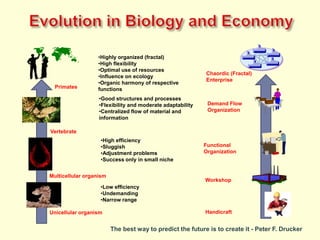
PrimatesVertebrateFunctionalOrganizationWorkshopEvolutionin Biology and EconomyHighly organized (fractal)
High flexibility
Optimal use of resources
Influence on ecology
Organic harmony of respective functionsChaordic (Fractal)EnterpriseGood structures and processes
Flexibility and moderate adaptability
Centralized flow of material and informationDemand FlowOrganizationHigh efficiency

XXI Century Organization

  • 1.
    the xxi centuryOrganization Solar Management System - the Fractal Organization in PracticeWojtek LuciejewskiWarszawa, Osnabrück, Poznań, Ostercappeln (2001 – 2010)
  • 2.
    Several years ago,when I published the first time in Internet "Primumnon Prodigere" I foresaw the necessity of wider look at organization of XXI Century and inclusion of the nature examples (e.g., new knowledge about Fractals).The present practice is proving this thesis.The acceleration of changes, which complicate our lives more and more, is shown on the next picture.
  • 4.
    Is Organization aMachine?The central most aspect of the scientific foundation upon which Taylor built his theory of management was a metaphor popularized by the 17th century French philosopher and mathematician Rene Descartes who looked at his world as a "clockwork universe.„Taylor, as a devout Cartesian and as the best of his contemporaries, thus instilled in the mindsets of Western management the powerful and recalcitrant image of the machine.
  • 5.
    Is Organization aMachine?The idea has become entrenched that the organizations we're supposed to be managing are physical instruments of production that humans engineered in the first place and are now being "re-engineered" in a misguided effort to solve their problems.The term alone attests to the depth to which mechanistic thinking has become embedded in our corporate psyches.
  • 6.
    Is Organization aMachine?The robustness and endurance of the machine as the predominant metaphor of 20th century management practice is nothing short of amazing given the mounting evidence that it simply does not work.
  • 7.
    „Machine” organizationstillingoodshape„We areproducts of the culture that we grew up in. When we live in machine organizations, we become part of them. Our organizations are not human or natural. They are machines.Machines are not designed to learn or accept feedback. They are inherently not responsive. When we are in them we treat each other like parts or things….Some of us are so encultured by the old that we simply cannot imagine, or see, the reality of the new”.
  • 8.
    „Machine” organizationstillingoodshapeOur operationalculture has a series of rules, incentives and punishments that reinforce the old metaphor.It is not easy for anyone inside a traditional organization to make the changes to the new metaphor as all these forces will come into play against them.
  • 9.
    „Machine” organizationstillingoodshapeAll therules of the old culture are based on the assumptions that the most important activity is control. The extension of this assumption is that if only we tried hard enough, we could control everything.This illusion seemed to work when we did not operate in a global society…..As we talk about being more responsive, more customer-focused and more flexible, let’s look at the real rules that govern most of our organizations. They work against these objectives.”According to „What is wrong with our concept of organization? Shifting our organizational metaphor from Machine to Nature” by Rob Paterson
  • 10.
    Development of ManagementMethodologiesFramkGilbreth–the follower of taylorism, studies of motions, the beginning of ergonomicsLilianGilbreth– the use of film into studies of work, the humanitarianismFrederick Taylor – standardization of work, the conflict between employees contra management, studies of time normsTaichiOhno, Shigeo Shingo – Just In Time, Toyota Production System, World Class ManufacturingJames Womack – Lean Manufacturing, Lean EnterpriseEliahuGoldratt– Theory of ConstraintsStandards of technical drawings, tolerances, development of modern machines Eli Whitney – interchangeability of partsEdwards Deming, Joseph Juran– Statistical Process Control, TQMHenry Ford – assembly lines, flow of production, strategy1850190019502000
  • 11.
    Some latestinitiativesLean Management,TOC– Theory of Constraints,BMS – Bionic Management System,HMS – Holonic Manufacturing System,Chaordic Organization,Fractal Enterprise,Network Economy.
  • 12.
    Lean Managementin shortLeanManagement proves to be the complete management methodology. It includes the basic idea (philosophy of efficient operation), systems of management and information as well as the set of tools for their construction.
  • 13.
    Lean Managementin shortTheoutstanding advantage of Lean Management is, that it shows the direction for improvements provided by the definition of Valueand Waste.Another distinctive advantage is the flexibility in operations resulting from the feedback mechanism incorporated into management system –EnterpriseKaizen(if properly implemented).
  • 14.
    Lean DefinitionsValue– thepotential delivered to the customer at the right time and for an appropriate prize, to be defined each time by the customer. Value is defined by the features of a product or service, their availability, cost and performance parameters. Waste – each single action which uses resources but does not create Value;or everything that increases the cost of a product without adding Value to it.EnterpriseKaizen – continuous improvement of all business activities.
  • 15.
    Program KaizenProgram Kaizenshouldbe used to guide improvements (by announced contests and other initiatives) into more flexibility in production lines and shorter production cycles.
  • 16.
    Weaknesses of LeanManagementCompanies whichimplement Lean Management very often suffer defeats. The reason seems to be the Japanese culture and its automotive roots.Western culture favor individualism and doesn’t endorse excessive rigor or genetic obedience.Lean Management tools are strongly oriented on highly mechanized processes and only to some extend can be used for service processesThe trend of world economy indicates quite clearly, that manufacturing is loosing its significance for the benefit of serviceAn attempt of an orthodox or forced implementation can only generate more damages then benefits.We shouldn’t however turn down Lean Management entirely. It is still the most comprehensive management philosophy and definitions of Value and Waste are universal.
  • 17.
    Theory of ConstraintsTheoryof Constraints is based on the premise that the rate of goal achievement is limited by at least one constraining process. Only by increasing flow through the constraint can overall throughput be increased.The five focusing steps aim to ensure ongoing improvement efforts are centered around the organization's constraints.
  • 18.
    Theory of ConstraintsThesteps are:Identify the constraint (the resource or policy that prevents the organization from obtaining more of the goal)Decide how to exploit the constraint (get the most capacity out of the constrained process)Subordinate all other processes to above decision (align the whole system or organization to support the decision made above)Elevate the constraint (make other major changes needed to break the constraint)If, as a result of these steps, the constraint has moved, return to Step 1. Don't let inertia become the constraint.
  • 19.
    Bionic Management SystemOnbasis of patterns of biological organisms the Japanese experts propose the bionic system in which be realized the features of natural pattern:Spontaneity,
  • 20.
  • 21.
    Harmony.Bionic Management SystemItis proposed to imitate the features of biological organisms:The integration of functional elements and the hierarchy,
  • 22.
    The organizing theinformation in DNA, carrier of genetic information,
  • 23.
    Use of naturalintelligence,
  • 24.
    Dynamic structure andsocial harmony.Holonic Manufacturing SystemHolonic Manufacturing Systems (HMS) was first proposed as a new manufacturing paradigm at the beginning of 1990.In an HMS, key elements such as machines, work centers, plants, parts, products, persons, departments, or divisions have autonomous and cooperative properties.
  • 25.
    Holonic Manufacturing SystemTheseelements are called "holons," a word coined by combining "holos" (the whole) and "on" (a particle) following A. Koestler. In an HMS, each holon's activities are determined through the cooperation with other holons, as opposed to being determined by a centralized mechanism.
  • 26.
    Holonic Manufacturing SystemLuckilyfor us this proposal was created for artificial organizational creatures such as fully automated production and in such case the use of an example of human behaviors makes sense. Because robots can be programmed only according to the better side the human being.
  • 27.
    ChaordicOrganizationDee Hock hasdefined the necessary characteristic of emerging organizations:Enduring in purpose and principle.
  • 28.
    Powered from theperiphery, unified from the core.
  • 29.
    Exist to enableconstituent parts.
  • 30.
    Equitably distribute power,rights, responsibilities, and rewards.
  • 31.
    Fluid webs ofcooperation and competition.
  • 32.
    Cannot be managed;can only be led.
  • 33.
    Compatible with thehuman spirit and biosphere.Chaordic Design Six Lenses onto OrganizationPurpose - A clear, commonly understood statement of that which identifies and binds the community together as worthy of pursuit.Principles -Clear, commonly understood statements of how Participants will conduct themselves in pursuit of Purpose.Participants -The members of the community necessary to its effective initiation and continuance – all relevant and affected parties.
  • 34.
    Chaordic Design SixLenses onto OrganizationOrganizational concept - Characterization of Participant relationships that all can trust to be just, equitable and effective in achieving the Purpose in accord with the Principles.Constitution - Codification of Concept specifying rights, obligations and relationships of Participants, giving rise to the organization as a legal entity.Practices - Activities, products and services through which Participants pursue the organization’s Purpose and create value.Excerpts from “The Chaordic Organization: Out of Control and Into Order” by Dee Hock, Founder and CEO Emeritus of VISA International  
  • 35.
    Centralized control isarchaic and self-limiting.Diversity and innovation thrive where power and information are highly distributed.
  • 36.
    Competition and collaboration,freedom and governance, individuality and community are not irreconcilable opposites.The greatest benefit comes when they are harmoniously blended without losing the distinctive strength of each.
  • 37.
    True communities areheld together by ethics–not forceand by the power of their shared beliefs, purposes, and identity.
  • 38.
  • 39.
  • 40.
  • 41.
  • 42.
  • 43.
  • 44.
  • 45.
  • 46.
  • 47.
  • 48.
  • 49.
    ControllingExcerpts from “TheChaordic Organization: Out of Control and Into Order” by Dee Hock, Founder and CEO Emeritus of VISA International 
  • 50.
    Wacław SierpińskiWacławSierpiński (1882– 1969) – prominent mathematician, studied also astronomy and philosophy. The ”Sierpinski Triangle” is a fractal named after him. He described it in 1915. This is one of the basic examples of self-similar sets, i.e. it is a mathematically generated pattern that can be reproducible at any magnification or reduction.Sierpinski Triangle
  • 51.
  • 52.
  • 53.
    Computer treeThis fractal was created through the use of one only mathematical formula 34
  • 54.
    Example of iterationof the Mandelbrot FractalFormula: z(n+1) = [z(n)]2 + cSubsequent approximations uncover different, but still similar features
  • 55.
    IstheNaturefractal?Fractal geometry permitsus to understand, how nature creates all its forms, which we can observe. The mountain formations, rivers, shores, the mammal's lung, vegetation and the blood circulation system, but and the surfaces of breakthroughs of metals as well as the growths and the falls of stock are fractals copying on many smaller levels of scale the main pattern.Fractals in effect behave like genetic algorithms permitting different species to reconstruct effectively essential functions.Let's take the example of a cloud - it constitute doubtless one the whole, but it is "full of holes" like a sponge, because it consists of countless quantity of microscopic drops of water and steam. It is separate the whole, but folded with many smaller the wholes, also separate. If "we will cut out" small piece of cloud, then we will receive something very similar to it.Development and the strength of computers permits us at present to see and better understand the law of evolution and what follows it laws of nature.36
  • 56.
    Fractal EnterpriseHans-JürgenWarnecke advancedthe hypothesis of fractal enterprises as the near future of development of organization, where independent teams co-operate in network on principle customer - supplier so inside as outside the organization.The leading thought for fractal organization is the creation (in range of its competence) of the self - regulating organizational working groups. The superior computer informative and communication system should serve for tuning of the size of inputs and outputs.
  • 57.
    Fractal EnterpriseFractal enterprisecreates businesses within business, but also businessmen in enterprise. This corresponds better with the Western culture, which prefers the individuality.Prof. Warnecke did not propose practical solutions. We should remember however, that he wrote it in early 90s, when theWorld really started experiencing the influence of Internet and Globalization.
  • 58.
    FractalOrganizationFractals are theindependently functioning units which objectives and expected productivity can be explicitly described.Fractals are self-similar – each provides services.
  • 59.
    Fractals are self-organizing.Fractalsidentify and formulate their objectives as well as the internal and external relations.
  • 60.
    FractalOrganizationFractals reorganize (restructure)themselves, reemerge and fall into decomposition.The overall system of objectives which results from the fractals objectives is no contradictory and must serve for achieving the objectives of the whole enterprise.
  • 61.
    Fractals are connectedinto a network by an efficient system of information and communication. Fractals themselves determine the kind and scope of their access to the available data.
  • 62.
    Fractals productivity iscontinuously measured and valued.Fractals have the attributes of the intelligent systems and react in an adaptive manner to every environment's influence.
  • 63.
    New Rulesforthe NewEconomy1)Embracethe Swarm. As power flows away from the center, the competitive advantage belongs to those who learn how to embrace decentralized points of control.2) Increasing Returns. As the number of connections between people and things add up, the consequences of those connections multiply out even faster, so that initial successes aren’t self-limiting, but self-feeding.3)Plentitude, Not Scarcity. As manufacturing techniques perfect the art of making copies plentiful, value is carried by abundance, rather than scarcity, inverting traditional business propositions.4)Follow the Free. As resource scarcity gives way to abundance, generosity begets wealth. Following the free rehearses the inevitable fall of prices, and takes advantage of the only true scarcity: human attention.5)Feed the Web First. As networks entangle all commerce, a firm’s primary focus shifts from maximizing the firm’s value to maximizing the network’s value. Unless the net survives, the firm perishes.
  • 64.
    New Rulesforthe NewEconomy6)LetGo at the Top. As innovation accelerates, abandoning the highly successful in order to escape from its eventual obsolescence becomes the most difficult and yet most essential task.7)From Places to Spaces. As physical proximity (place) is replaced by multiple interactions with anything, anytime, anywhere (space), the opportunities for intermediaries, middlemen, and mid-size niches expand greatly.8)No Harmony, All Flux. As turbulence and instability become the norm in business, the most effective survival stance is a constant but highly selective disruption that we call innovation.9) Relationship Tech. As the soft trumps the hard, the most powerful technologies are those that enhance, amplify, extend, augment, distill, recall, expand, and develop soft relationships of all types.10) Opportunities Before Efficiencies. As fortunes are made by training machines to be ever more efficient, there is yet far greater wealth to be had by unleashing the inefficient discovery and creation of new opportunities.Kevin Kelly, „New Rules for the New Economy, 10 Radical Strategies for a Connected World
  • 65.
    Science accomplishments -new ”order”Logical-rational approach (determinism).Philosophers:Platon (427-347 B.C.)
  • 66.
  • 67.
  • 68.
    Pierre Laplace (1749-1827)Mathematicsand physics till the 19th centuryFrederic Winslow Taylor – theory of industrialefficiency
  • 69.
    Science accomplishments -new ”order”New Approach – Sustained DisequilibriumGiving up the thinking in ways of the linear extrapolation type or cause-and-effect chainsJules Henri Poincaré (1854-1912)
  • 70.
  • 71.
  • 72.
    Theory on InfiniteSets – Georg Cantor
  • 73.
    Fractal geometry –Benoit Mandelbrot
  • 74.
    Complex Adaptive SystemsThe way to Optimal OrganizationPeter F. Drucker - management expert, he was called the father of the founder of management or the pope of management Hans-Jürgen Warnecke – the German scholar, president of the Fraunhofer Institute, originator of fractal enterpriseWacław Sierpiński – doctor of philosophy, one of creators of Polish mathematical school, the constructor of the first fractal Georg Cantor - – the creator of set theory; he unreeled conception of Absolute Infinity, which he identified with the God Włodzimierz Sedlak – the Polish priest, creator of Polish school of bioelectronics and the electromagnetic theory of life John Boyd - the colonel of the air forces, creator of loop the OODA and the theory of energy of shunter ability ( the Energy the Maneuverability)Jules Henri Poincaré– the precursor of theory of relativity and the chaos, creator of philosophical direction of conventionalismEduard Norton Lorenz – mathematician and meteorologist, creator of theory of chaos Ralph Waldo Emerson- philosopher, leader of the Transcendentalist movement Stephen William Hawking - British astrophysics, cosmologist, the theoretician of physicsCharles F. Haanel– the father of personal development, author of The Master Key SystemAlbert Einstein - one of the best theoretical physicists, creator of special and general theory of relativityDee Ward Hock – the creator the VISA International, first Chaordic organization Charles Darwin – one of the most important biologists of XIX age, author of theory evolutionBenoît B. Mandelbrot - recognized as the creator of fractals and fractal geometry1850190019502000
  • 75.
    ComplexAdaptiveSystemsThe subject ofComplex Adaptive Systems has been studied for a long time in fields such as biology, cardiology, chemistry, computer science, demography, economics, mathematics, physics, game theory or meteorology.
  • 76.
    ComplexAdaptiveSystemsIn the 70’sof the previous century, scientists from various fields discovered that different Complex Adaptive Systems share common features and may be effectively analyzed and examined as a group, despite their diverse origins.
  • 77.
    ComplexAdaptiveSystemsThese systems include:biological species, cardiovascular systems, economy, human societies, neural systems, stock exchange or weather systems, to name just a few.
  • 78.
    ComplexAdaptiveSystemsDecentralized, competitive market– a classic example of the Complex Adaptive System - Adam Smith’s (1776) „invisible hand” manifests itself when the market participants reach the critical mass of self-organization.
  • 79.
    The “Edge ofChaos”Where interesting things canhappenAgricultural revolutionIndustrial revolutionInformation/knowledge revolutionFirst Second BifurcationBifurcationMono-stability: evolution impossibleChaosSteady StateCould apply to either a functional or programmatic designOrganizations capable of evolving and adaptingOpportunistic Regime“Edge of Chaos”Conducive to Self Organizing SystemsConducive to Complex Adaptive SystemsDiagram courtesy of Dr. Linda Beckerman, Director of Systems Engineering, the ASSET Group, SAIC
  • 80.
    Market – SustainedDisequilibrium?According to the neoclassical theory, the market naturally moves towards equilibrium by anticipating its participants’ logical behaviors.This kind of deductive thinking may be only justified for the certain market segments at a given time, because the current market have no one, but many equilibrium points.
  • 81.
    Market – SustainedDisequilibrium?The observed contemporary complexity of problems enforce us to straying away from the deductive thinking.Inductive thinking – the market participants try to identify trends, interrelations and groups of phenomenon and then, through analogy to the past experiences, they try to anticipate the situation’s progress and search for optimal solutions.Process of co-evolution – system changes <–> the participants modify their behaviors what in consequence influences the changes of a system.
  • 82.
    Market – SustainedDisequilibrium?In reality it is unreasonable to expect from the market participants the logical and rational behaviors.So different models of actions are created on the market and continuous evolution of the system is taking place.Market should be seen as the Complex Adaptive System and as such can not be considered to be the stable system (striving for equilibrium) but it is rather the vibrating equilibrium (periods of stability mixed with periods of chaos – sustained disequilibrium).According to „Organizacjanakrawędzichaosu”,PiotrNestorowicz, 2001
  • 83.
    Landscape of opportunitiesThislandscape is changing itself with the function of time – the peaks get lower, disappear and new ones emerge. The practice shows that to be able to climb onto another peak it is necessary first to get down into the valley.Tim Mannon, the President of the Hewlett Packard Printer Department, once said: „The biggest single danger to our business is remaining for one year too long in the previous business which brought us success.”
  • 84.
    Be chaotic ordeathAt first glance chaotic behavior appears to be the antithesis of organizational behavior, that necessitates order, regularity and predictability so as to ensure coordination, planning and control.A second look will remind us that variety and irregularity allow the resilience and creativity which are a necessity for learning, which is a condition to be able to survive.
  • 85.
    The Goal -Survival on own termsStudies of human behavior reveal that the actions we undertake as individuals are closely related to survival, more importantly, survival on our own terms.Naturally, such a notion implies that we should be able to act relatively free or independent of any debilitating external influences--otherwise that very survival might be in jeopardy.
  • 86.
    The Goal -Survival on own termsIn viewing the instinct for survival in this manner we imply that a basic aim or goal, as individuals, is to improve our capacity for independent action.The degree to which we cooperate, or compete, with others is driven by the need to satisfy this basic goal.If we believe that it is not possible to satisfy it alone, without help from others, history shows us that we will agree to constraints upon our independent actionin order to collectively pool skills and talents in the form of nations, corporations, labor unions, mafias, etc.--so that obstacles standing in the way of the basic goal can either be removed or overcome.
  • 87.
    The Goal -Survival on own termsOn the other hand, if the group cannot or does not attempt to overcome obstacles deemed important to many (or possibly any) of its individual members, the group must risk losing these alienated members.Under these circumstances, the alienated members may dissolve their relationship and remain independent, form a group of their own, or join another collective body in order to improve their capacity for independent action.John R. Boyd
  • 88.
    O-O-D-AloopActionDecisionDecision(Hypothesis)Action(Test)According to JohnBoyd, implicit (leaning on genetic heritage, cultural traditions and past experiences) communication accelerates undertaking decision and beginning of action. ObservationOrientationImplicit leadership and control Implicit leadership and control Changing circumstancesCulturaltradisionsObservationsGeneticheritageAnalysisAndsynthesisNewinformationPastexperiencesInformation from outside Developing interaction with environmentDeveloping interaction with environmentFeedbackFeedbackNotice how the orientation shapes the observation, shapes the decision, shapes the action and in the response is shaped by the reaction and different phenomena coming to our view-finder of feeling or observation. Notice also, that the whole loop ( not only orientation) is the continuous, many-sided, implicit process of expectation, understanding, correlation and rejection."This so as would be in the movie of slow-motion " - Boyd describing working inside loop OODA of the enemy.When you design, planning new strategy then keep the minimum speed of OODA loop, when you fight (with competition) provide for maximum speed.
  • 89.
    Some wisequotationsAny foolcan make things bigger and more complex.  It takes a touch of genius - and a lot of courage - to move in the opposite direction.Albert EinsteinImagination is more important than knowledge. Knowledge is limited. Imagination encircles the world.-Albert EinsteinBeauty of style and harmony and grace and good rhythm depend on simplicity.- PlatoMaking the simply complicated is commonplace; making the complicated simple, awesomely simple, that's creativity.- Charles MingusEmbrace simplicity.- Lao Tzu 
  • 90.
    New classdivisionsThey whothink and the others who accept their thoughts.They who know and the others, who agree to be only consumers of knowledge of those first.
  • 91.
    Back to therootsMankind looks for the way out from situation in which drove into.Return to historical experiences and knowledge e.g., The Acupuncture, Herbal Medicine, Folk Wisdoms.
  • 92.
    Mankind comes backto the state of one unified civilization - global village.
  • 93.
    Science and religionsfind common roots and agreement.
  • 94.
    One skill doesnot suffice even at present, we have to learn the whole life for adjust to very quick changes.
  • 95.
    The more andmore stronger signals about inter-civilizations of co-operation, but also the frictions.
  • 96.
    Mankind tries toarrange the one`s puzzle from the beginning.
  • 97.
    This process isdisturbed by the trials of clipping puzzles, and looking for skeleton-keys instead of using of suitable keys, made by many so in private life, professional as and in politics.Learning from NatureOur brain is the ultimate example of a complex, decentralized organization.And because we (usually) behave coherently, smoothly integrating new circumstances as they arise, the brain is also the epitome of an adaptive organization, a learning organization, a shared-vision organization -- in short, the ideal modern company.There is no hierarchy, everything works perfectly without our conscious intervention.
  • 98.
    Learning from NatureThesophisticated system of decentralized interdependence exhibited by termites invites a lesson on how to respond to emergencies, while the chemical-based communications among African ants helped officials at Southwest Airlines define their seating policy.Insects, birds, and fish variously demonstrate the plausibility and success of disorganization leading to self-organization and leaderless processes.
  • 99.
    Wehave already startedThenalong comes the Internet, a communications medium that radically drops transaction and collaboration costs.Work can be organized on new project models, where the genius of human capital can be unleashed from its old command-and-control constraints.Employees can forge their own self-organized interconnections and form cross-functional teams capable of interacting as a global, real-time workforce.Loosening organizational hierarchies and giving more power to employees can lead to faster innovation, lower cost structures, greater agility, improved responsiveness to customers, and more authenticity and respect in the marketplace.
  • 100.
    Fractals features inreallifeJazz band has leader, plays composed work, but never plays it the same. Individual members' improvisations, in dependence from their skill and moods in given moment, are not only permissible, but outright waited (this playing solo takes over leadership in frames of its specialization). The members of team help the soloist to execute his task adjusting to him as well as to environment (atmosphere in the audience).Sport team has the aim - to reach competitive victory and to satisfy customers (own fans). Doing this the team has to observe the rules of game. The leader (in fact elected by team members) characterizes oneself with experience and suitable skills to this aim. The individual players' tasks change often in the course of duration of performance.
  • 101.
    Fractals features inreallifeMarines team in modern war has appointed aim, designated resources, and when trying to foresee enemy's movements applies the technique of OODA loop and takes own decisions of operations.In the segment of time of 4 - 5 hours the participants of the trip from Warsaw to Poznan are taking a deadly game and in this way temporarily made up the team. We can observe then the self-similarity of their behaviors - overtaking themselves dangerously on two lines road as the third or fourth - they warn each other about radars and the self-organization is visible in retreating from road these freer (usually the small FIAT).Is winter and a lot of snow. Small car wanting to take the turn at side street he had to drive by strongly snow-covered tram tracks, so he hung on chassis. Other cars, wanting to take the same turn, blocked main street completely. Often, in such cases, unreasonable drivers blow the trumpet while sitting in warm cars. This time they went out and pushed out the unfortunate car on the even road and in this way removed traffic jam helping him and oneself.
  • 102.
    Fractals features inreallifeTill March 2010 we survived 3 earthquakes (Haiti, Chile, Turkey). People got words of sympathy and the promises of help from the governments, but the true help was born itself. Men knew what they should do to help the others, leaders appeared spontaneously.In several cities in Europe (in Poland also) on primary road crossings all traffic signs were removed leaving only the rule of right side. The quantity of bumps and dangerous accidents fell down considerably. What it proves, that we need little controls to exist and to develop as communities.
  • 103.
  • 104.
  • 105.
  • 106.
  • 107.
    Organic harmony ofrespective functionsChaordic (Fractal)EnterpriseGood structures and processes
  • 108.
  • 109.
    Centralized flow ofmaterial and informationDemand FlowOrganizationHigh efficiency