XXth century philosophy
Background and Key features.
 Theory of evolution (Charles Darvin).
 Theory of relativity (Albert Einstein).
 Psychoanalytic theories (Sigmund Freud).
 Analytical philosophy (Bertrand Russell, Alfred North Whitehead).
 Continental philosophy (Kierkegaard, Nietzsche, Kafka,
Dostoevsky).
 Existentialism - philosophy based on the experience of the
individual in a godless universe.
 Postmodernism - skepticism, irony or rejection toward grand
narratives, ideologies and various tenets of universalism.
Bertrand Russel
 Two kinds of work:
1) work aimed at “altering the position of matter at or
near the earth’s surface relative to other such matter;
2) “telling other people to alter the position of matter
relative to other such matter”.
History is littered with examples of people working
hard all their lives and being allowed to keep just
enough for themselves and their families to survive,
while any surplus they produce is appropriated by
warriors, priests, and the leisured ruling classes.
Bertrand Russel
 “Immense harm is caused by the belief that work
is virtuous”.
 “We should all simply work less”.
 Our capacity for play and light-heartedness has been
eclipsed by the cult of efficiency.
 “Hitherto we have continued to be as energetic as
we were before there were machines; in this we
have been foolish, but there is no reason to go on
being foolish forever”.
KARL POPPER
 What makes a theory scientific is that it is capable of
being falsified, or being shown to be wrong by
experience.
 Problem of induction - inability to speak with any
certainty about the future.
 Because the premise is untrue, even though the
argument
itself is valid, the conclusion is also untrue.
 “Every solution to a problem creates new unsolved
problems”.
 “Science may be described as the art of systematic
over-simplification”.
• Scientific understanding works by induction.
• This means working from particular observations (such as “every
swan
I see is white”)...
• ... and moving to general principles (such as “all swans are white”).
• But these principles can’t be proved, only disproved (such as by
the sighting of a black swan).
• In so far as a scientific statement speaks about reality, it must
be falsifiable.
JEAN-PAUL SARTRE
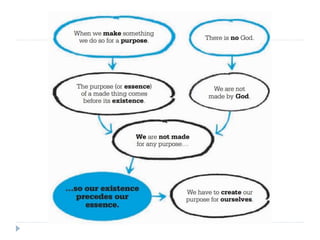
 We are not made for any particular purpose. We
exist, but not because of our purpose or essence;
our existence precedes our essence.
 There is no universal, fixed human nature, because
no God exists who could ordain such a nature.
 “First of all man exists, turns up, appears on the
scene, and only afterwards defines himself”.
ALBERT CAMUS
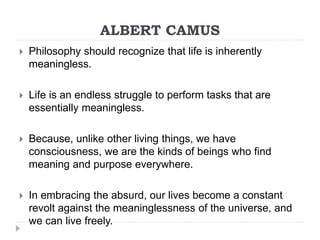
 Philosophy should recognize that life is inherently
meaningless.
 Life is an endless struggle to perform tasks that are
essentially meaningless.
 Because, unlike other living things, we have
consciousness, we are the kinds of beings who find
meaning and purpose everywhere.
 In embracing the absurd, our lives become a constant
revolt against the meaninglessness of the universe, and
we can live freely.
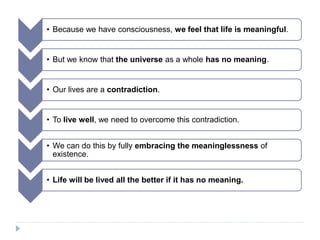
• Because we have consciousness, we feel that life is meaningful.
• But we know that the universe as a whole has no meaning.
• Our lives are a contradiction.
• To live well, we need to overcome this contradiction.
• We can do this by fully embracing the meaninglessness of
existence.
• Life will be lived all the better if it has no meaning.
MICHEL FOUCAULT
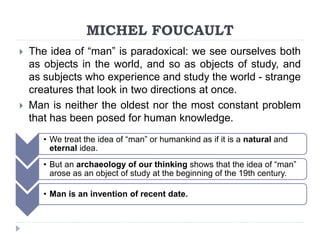
 The idea of “man” is paradoxical: we see ourselves both
as objects in the world, and so as objects of study, and
as subjects who experience and study the world - strange
creatures that look in two directions at once.
 Man is neither the oldest nor the most constant problem
that has been posed for human knowledge.
• We treat the idea of “man” or humankind as if it is a natural and
eternal idea.
• But an archaeology of our thinking shows that the idea of “man”
arose as an object of study at the beginning of the 19th century.
• Man is an invention of recent date.
RICHARD RORTY
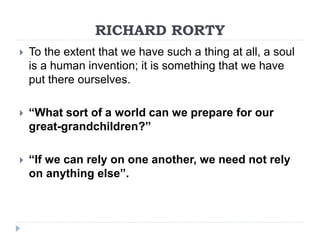
 To the extent that we have such a thing at all, a soul
is a human invention; it is something that we have
put there ourselves.
 “What sort of a world can we prepare for our
great-grandchildren?”
 “If we can rely on one another, we need not rely
on anything else”.
Xx century philosophy

Xx century philosophy

  • 1.
  • 2.
    Background and Keyfeatures.  Theory of evolution (Charles Darvin).  Theory of relativity (Albert Einstein).  Psychoanalytic theories (Sigmund Freud).  Analytical philosophy (Bertrand Russell, Alfred North Whitehead).  Continental philosophy (Kierkegaard, Nietzsche, Kafka, Dostoevsky).  Existentialism - philosophy based on the experience of the individual in a godless universe.  Postmodernism - skepticism, irony or rejection toward grand narratives, ideologies and various tenets of universalism.
  • 3.
    Bertrand Russel  Twokinds of work: 1) work aimed at “altering the position of matter at or near the earth’s surface relative to other such matter; 2) “telling other people to alter the position of matter relative to other such matter”. History is littered with examples of people working hard all their lives and being allowed to keep just enough for themselves and their families to survive, while any surplus they produce is appropriated by warriors, priests, and the leisured ruling classes.
  • 4.
    Bertrand Russel  “Immenseharm is caused by the belief that work is virtuous”.  “We should all simply work less”.  Our capacity for play and light-heartedness has been eclipsed by the cult of efficiency.  “Hitherto we have continued to be as energetic as we were before there were machines; in this we have been foolish, but there is no reason to go on being foolish forever”.
  • 5.
    KARL POPPER  Whatmakes a theory scientific is that it is capable of being falsified, or being shown to be wrong by experience.  Problem of induction - inability to speak with any certainty about the future.  Because the premise is untrue, even though the argument itself is valid, the conclusion is also untrue.  “Every solution to a problem creates new unsolved problems”.  “Science may be described as the art of systematic over-simplification”.
  • 6.
    • Scientific understandingworks by induction. • This means working from particular observations (such as “every swan I see is white”)... • ... and moving to general principles (such as “all swans are white”). • But these principles can’t be proved, only disproved (such as by the sighting of a black swan). • In so far as a scientific statement speaks about reality, it must be falsifiable.
  • 7.
    JEAN-PAUL SARTRE  Weare not made for any particular purpose. We exist, but not because of our purpose or essence; our existence precedes our essence.  There is no universal, fixed human nature, because no God exists who could ordain such a nature.  “First of all man exists, turns up, appears on the scene, and only afterwards defines himself”.
  • 9.
    ALBERT CAMUS  Philosophyshould recognize that life is inherently meaningless.  Life is an endless struggle to perform tasks that are essentially meaningless.  Because, unlike other living things, we have consciousness, we are the kinds of beings who find meaning and purpose everywhere.  In embracing the absurd, our lives become a constant revolt against the meaninglessness of the universe, and we can live freely.
  • 10.
    • Because wehave consciousness, we feel that life is meaningful. • But we know that the universe as a whole has no meaning. • Our lives are a contradiction. • To live well, we need to overcome this contradiction. • We can do this by fully embracing the meaninglessness of existence. • Life will be lived all the better if it has no meaning.
  • 11.
    MICHEL FOUCAULT  Theidea of “man” is paradoxical: we see ourselves both as objects in the world, and so as objects of study, and as subjects who experience and study the world - strange creatures that look in two directions at once.  Man is neither the oldest nor the most constant problem that has been posed for human knowledge. • We treat the idea of “man” or humankind as if it is a natural and eternal idea. • But an archaeology of our thinking shows that the idea of “man” arose as an object of study at the beginning of the 19th century. • Man is an invention of recent date.
  • 12.
    RICHARD RORTY  Tothe extent that we have such a thing at all, a soul is a human invention; it is something that we have put there ourselves.  “What sort of a world can we prepare for our great-grandchildren?”  “If we can rely on one another, we need not rely on anything else”.