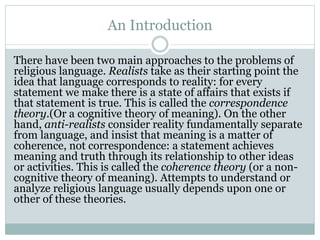
- Realists believe that language corresponds to reality, while anti-realists see language and reality as separate. Debates around religious language depend on these theories.
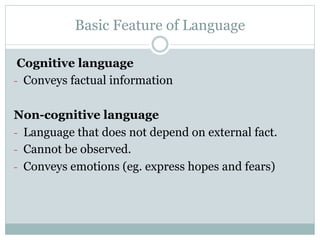
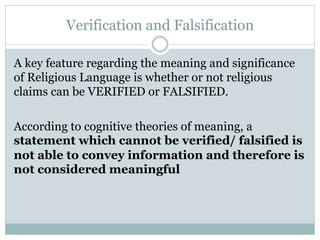
- Religious language involves both cognitive claims that can be verified, as well as non-cognitive language expressing emotion. Verificationists argue religious claims must be empirically verifiable to have meaning, while falsificationists say they must at least be falsifiable.
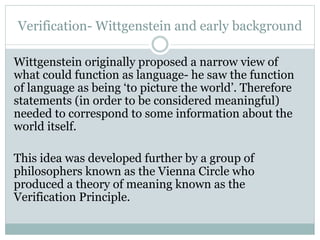
- Later thinkers like Wittgenstein argued that meaning depends on use within a language game or form of life, not verification. Religious language may have meaning for believers without needing to satisfy philosophical tests of meaning.