Environmental Science
    A Study of Interrelationships
                                   Eleventh Edition

                              Enger & Smith


                                  Chapter 5
Interactions: Environments and Organisms


     Copyright © The McGraw-Hill Companies, Inc. Permission required for reproduction or display.
Interactions: Environments and Organisms
Outline

   Ecological Concepts
   Natural Selection and Evolution
   Organism Interactions
   Community and Ecosystem Interactions
Ecological Concepts

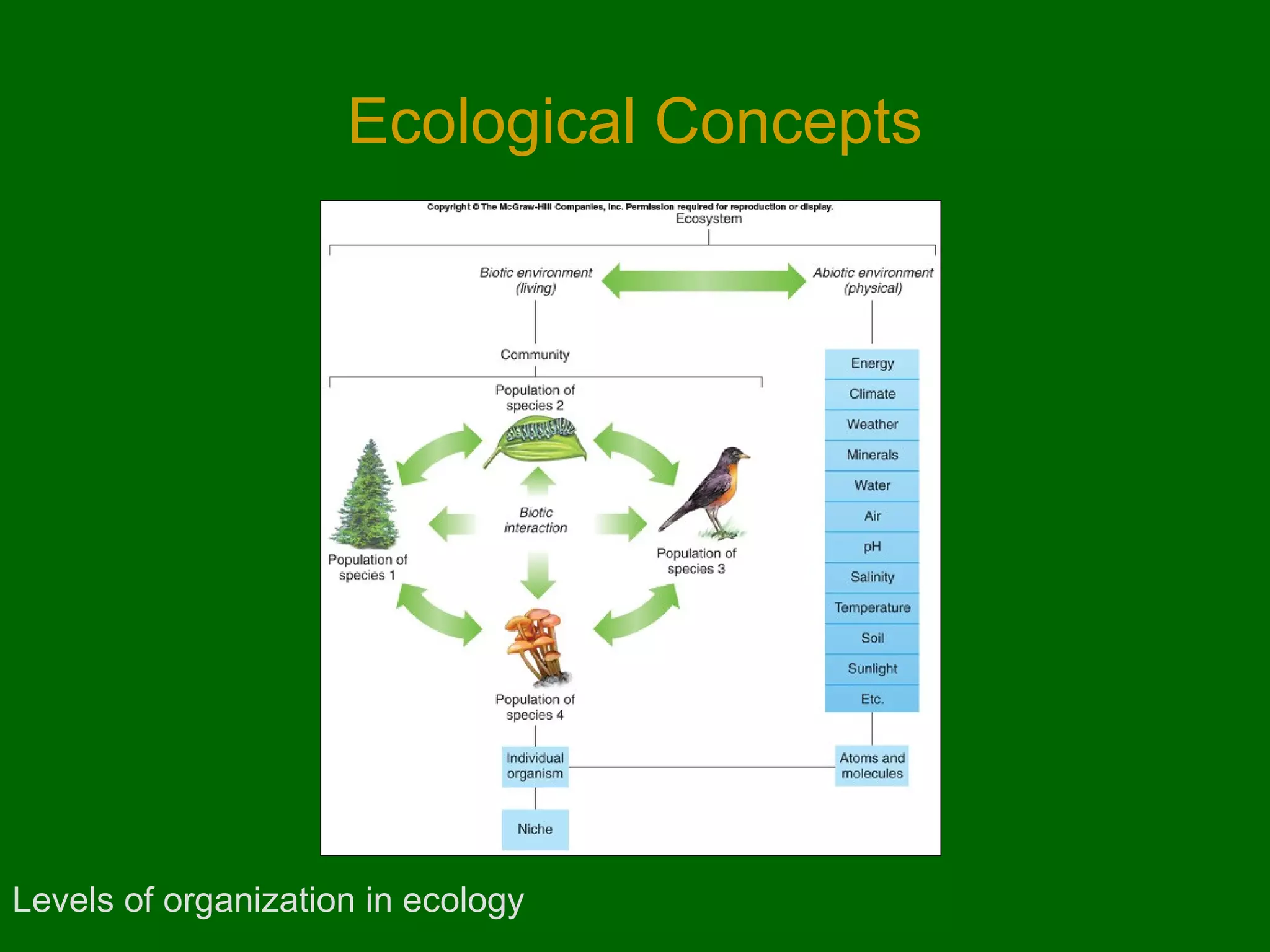
 Ecology is the study of ways organisms interact
  with each other and with their nonliving
  surroundings.
 Environment means everything that affects an
  organism during its lifetime.
  • Abiotic factors: Nonliving things that influence an
    organism, such as energy, nonliving matter, living
    space, and ecological processes.
  • Biotic factors: All forms of life with which the
    organism interacts.
Ecological Concepts


Levels of organization in ecology
Limiting Factors

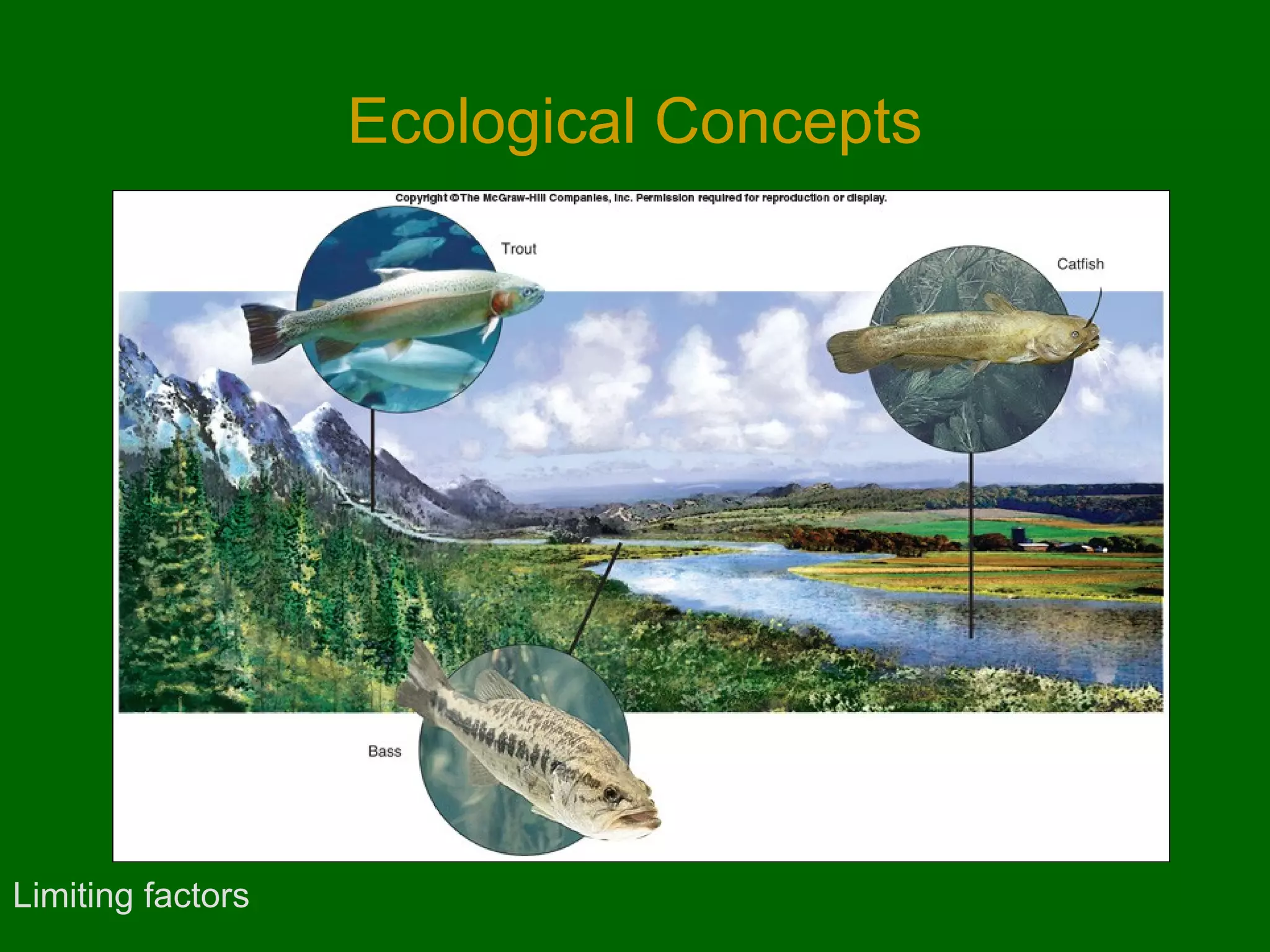
 Limiting factors are any factors whose
  shortage or absence restricts species success.
  • Scarcity of water or specific nutrients (plants)
  • Climate, availability of a specific food (animals).
 Range of tolerance indicates a range of
  conditions in which an organism can survive.
Ecological Concepts


Limiting factors
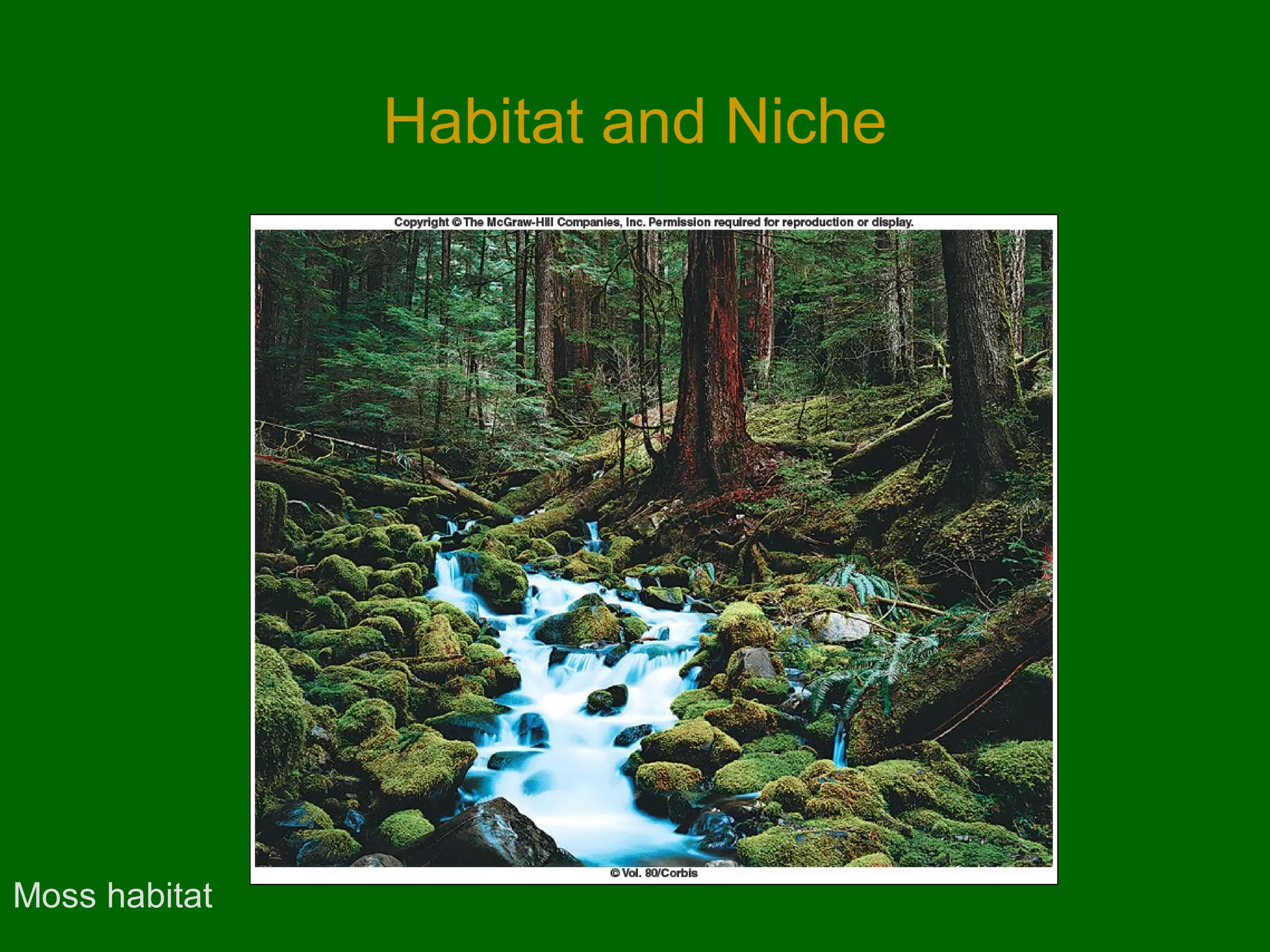
Habitat and Niche

 The habitat of an organism is the space in which
  an organism lives; it is defined by the biological
  requirements of each particular organism.
  • Usually highlighted by prominent physical or biological
    features.
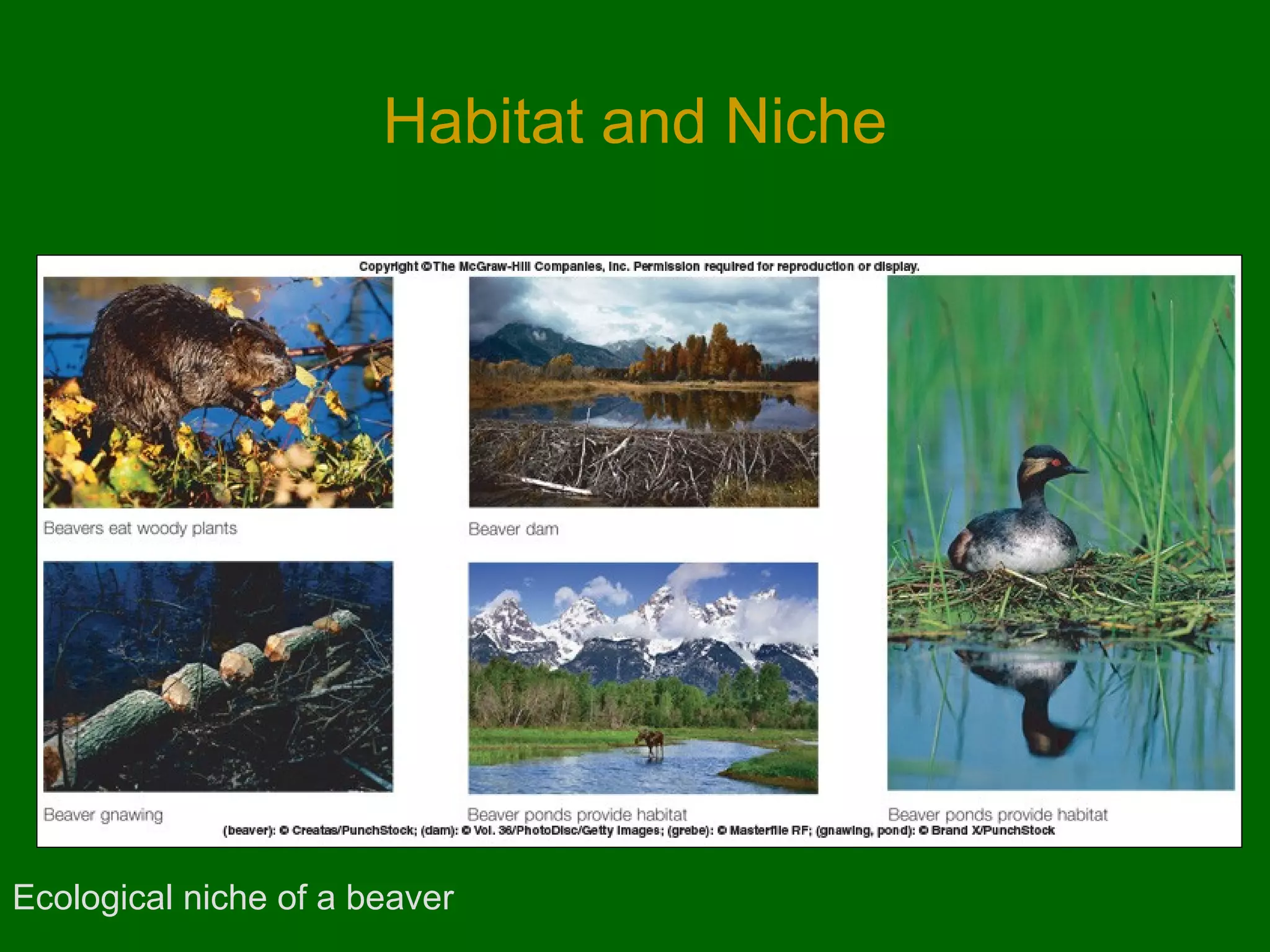
 The niche of an organism is the functional role
  (profession) the organism has in its surroundings.
  • This term includes all the ways an organism affects the
    organisms with which it interacts as well as how it
    modifies its physical surroundings.
Habitat and Niche


Moss habitat
Habitat and Niche


Ecological niche of a beaver
Genes, Populations, and Species

 Genes are distinct pieces of DNA that determine the
  characteristics an individual displays.
 A population includes all organisms of the same
  kind found within a specific geographic region.
  • A population contains more kinds of genes than any single
    individual within the population.
 A species is a population of all the organisms
  potentially capable of reproducing naturally among
  themselves and having offspring that also
  reproduce.
Natural Selection

 Natural selection is the process that
  determines which individuals within a species
  will reproduce and pass their genes to the next
  generation.
 The changes seen in the genes and
  characteristics displayed by successive
  generations of a population of organisms over
  time is known as evolution.
Natural Selection

   Several conditions and steps are involved in
    the process of natural selection:
    1. Individuals within a species show genetically
       determined variation.
    2. Organisms within a species typically produce more
       offspring than are needed to replace the parents
       when they die. Most of the offspring die.
    3. The excess number of individuals results in a
       shortage of specific resources.
Natural Selection

4. Due to individual variation, some individuals have a
   greater chance of obtaining needed resources and
   therefore have a greater likelihood of surviving and
   reproducing than others.
5. As time passes, the percentage of individuals showing
   favorable variations will increase while the percentage
   showing unfavorable variations will decrease.
Evolutionary Patterns

 Speciation is the production of new species from
  previously existing species.
  • It is thought to occur as a result of a species dividing into
    two isolated subpopulations.
 Extinction is the loss of an entire species.
  • Of the estimated 500 million species believed to have
    ever existed on Earth, 98-99% have gone extinct.
 Coevolution is the concept that two or more
  species can reciprocally influence the evolutionary
  direction of the other.
  • Grazing animals and grass species.
Kinds of Organism Interactions

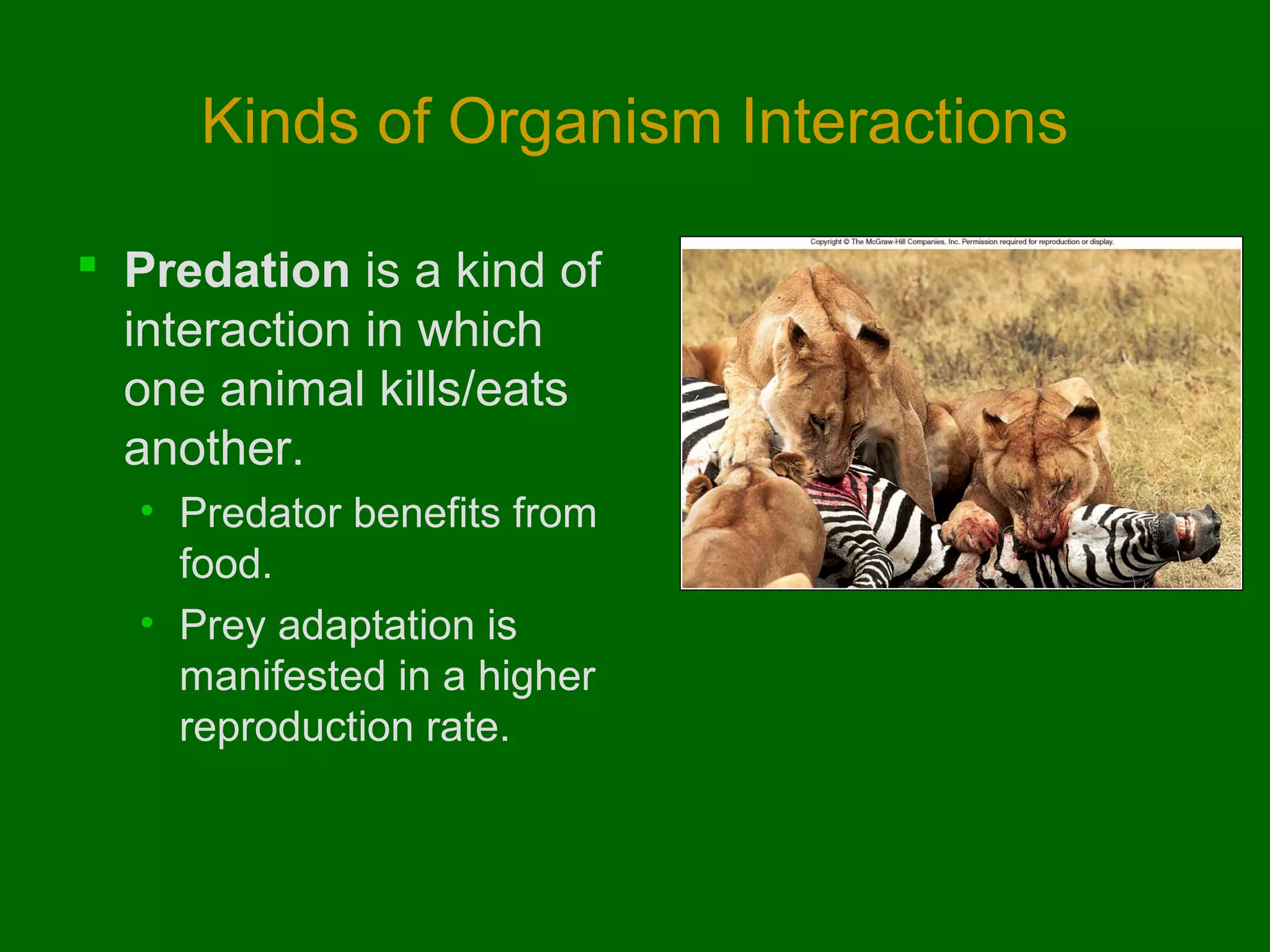
 Predation is a kind of
  interaction in which
  one animal kills/eats
  another.
  • Predator benefits from
    food.
  • Prey adaptation is
    manifested in a higher
    reproduction rate.
Competition

 Competition is a kind of interaction in which two
  organisms strive to obtain the same limited
  resource.
  • Intraspecific competition is competition between
    members of same species.
  • Interspecific competition is competition between
    members of different species.
Competition

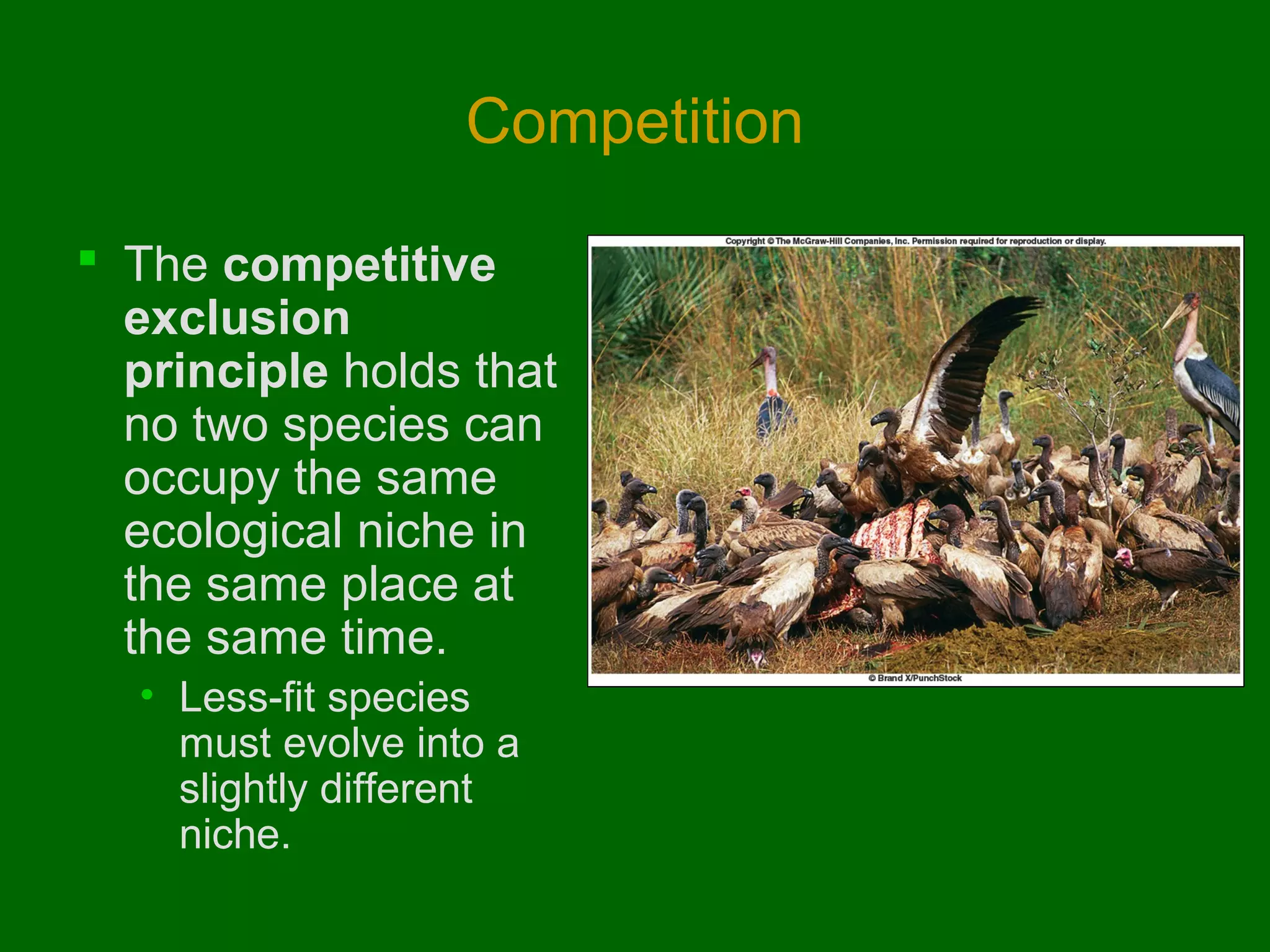
 The competitive
  exclusion
  principle holds that
  no two species can
  occupy the same
  ecological niche in
  the same place at
  the same time.
  • Less-fit species
    must evolve into a
    slightly different
    niche.
Symbiotic Relationships

 Symbiosis is a close, long-lasting, physical
  relationship between two different species. At least
  one species derives benefit from the interaction.
 There are three categories of symbiotic
  relationships:
  • Parasitism
  • Commensalism
  • Mutualism
Symbiotic Relationships

 Parasitism is a relationship in which one
  organism (parasite) lives in or on another
  organism (host), from which it derives
  nourishment.
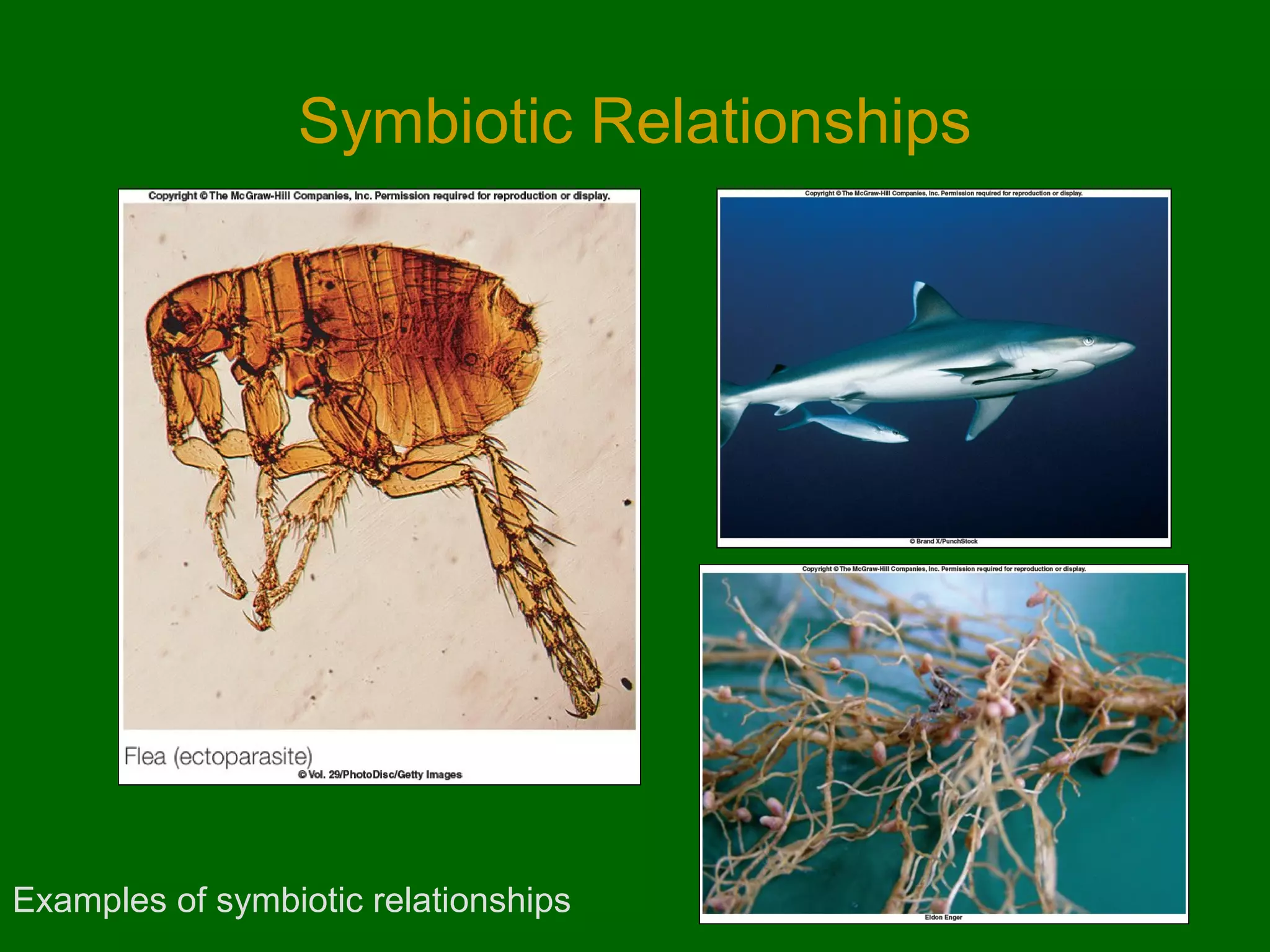
  • Ectoparasites live on the host’s surface.
     – Fleas, lice, molds, mildews
  • Endoparasites live inside the body of the host.
     – Tapeworms, malaria parasites, bacteria, fungi
Symbiotic Relationships

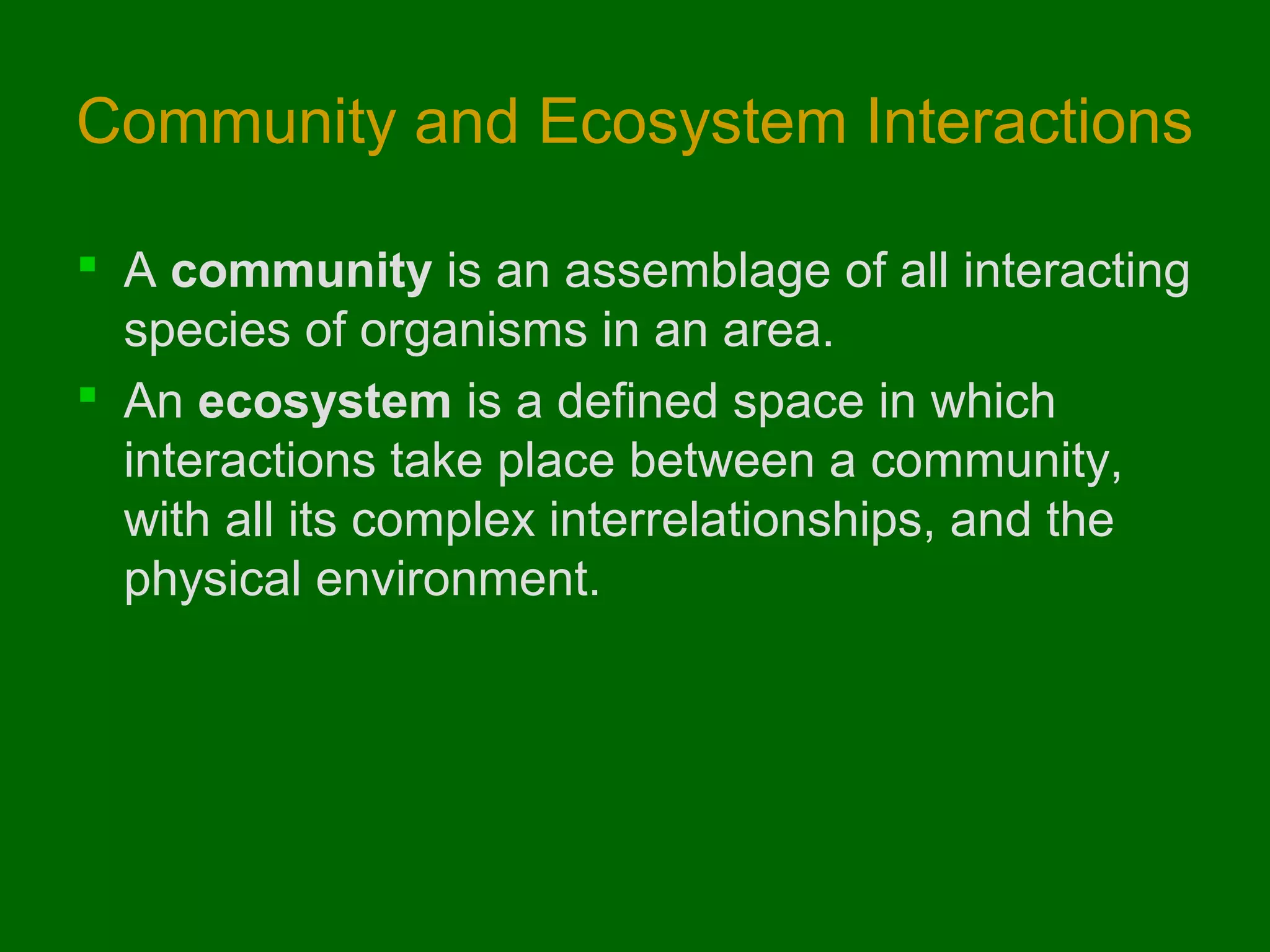
 Commensalism is a relationship in which
  one organism benefits while the other is
  not affected.
  • Remoras and sharks
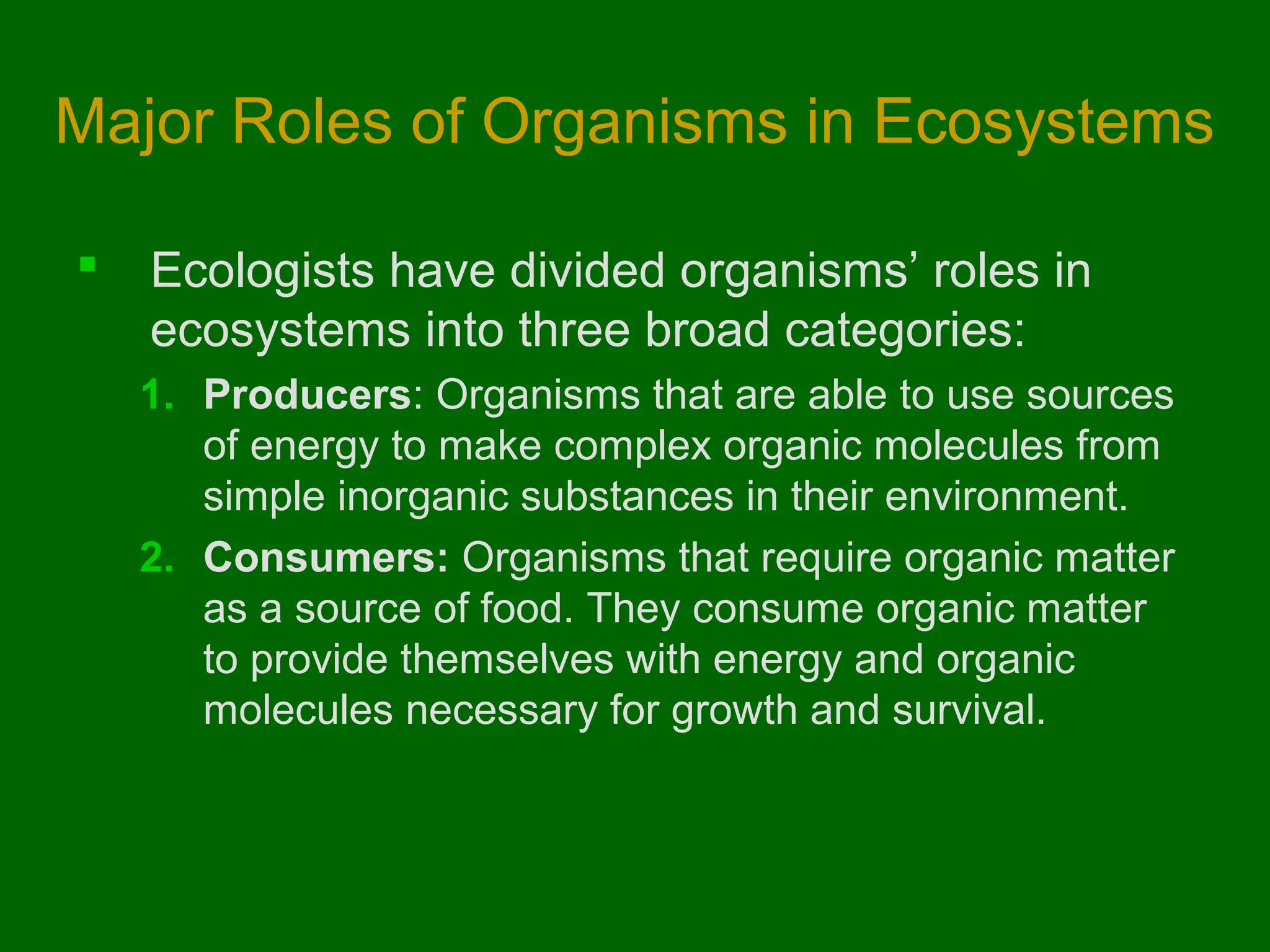
 Mutualism is a relationship in which both
  species benefit. The relationship is
  obligatory in many cases, as neither can
  exist without the other.
  • Mycorrhizae
Symbiotic Relationships


Examples of symbiotic relationships
Community and Ecosystem Interactions

 A community is an assemblage of all interacting
  species of organisms in an area.
 An ecosystem is a defined space in which
  interactions take place between a community,
  with all its complex interrelationships, and the
  physical environment.
Major Roles of Organisms in Ecosystems

   Ecologists have divided organisms’ roles in
    ecosystems into three broad categories:
    1. Producers: Organisms that are able to use sources
       of energy to make complex organic molecules from
       simple inorganic substances in their environment.
    2. Consumers: Organisms that require organic matter
       as a source of food. They consume organic matter
       to provide themselves with energy and organic
       molecules necessary for growth and survival.
Major Roles of Organisms in Ecosystems

 •  Consumers can be further divided into categories based
    on the things they eat and the way they obtain food.
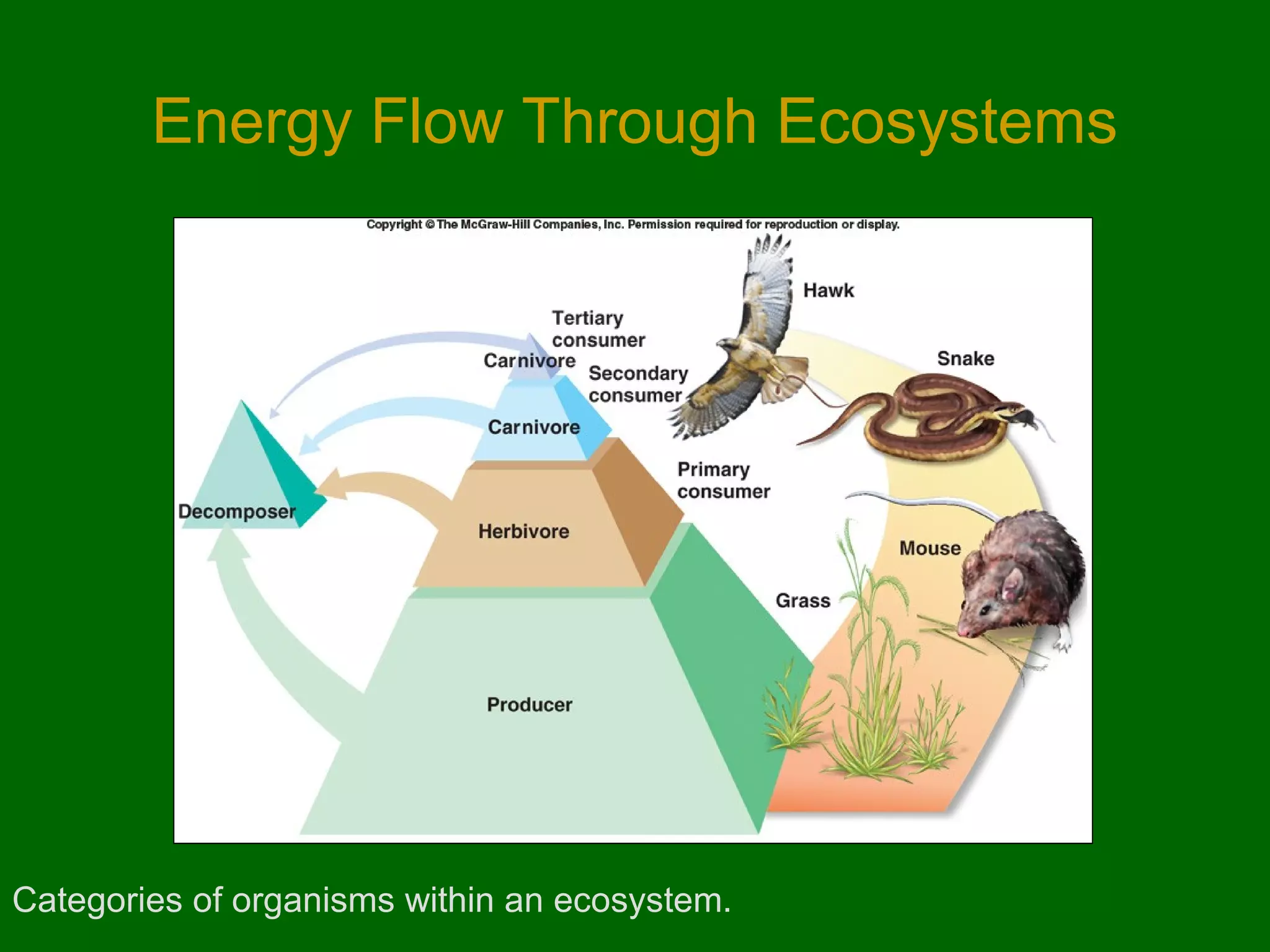
    – Primary consumers, or herbivores, eat plants as a source
        of food.
    – Secondary consumers, or carnivores, are animals that eat
        other animals.
    – Omnivores consume both plants and animals.
 3. Decomposers use nonliving organic matter as a source
    of energy and raw materials to build their bodies. Many
    small animals, bacteria, and fungi fill this niche.
Keystone Species

 A keystone species plays a critical role in the
  maintenance of specific ecosystems.
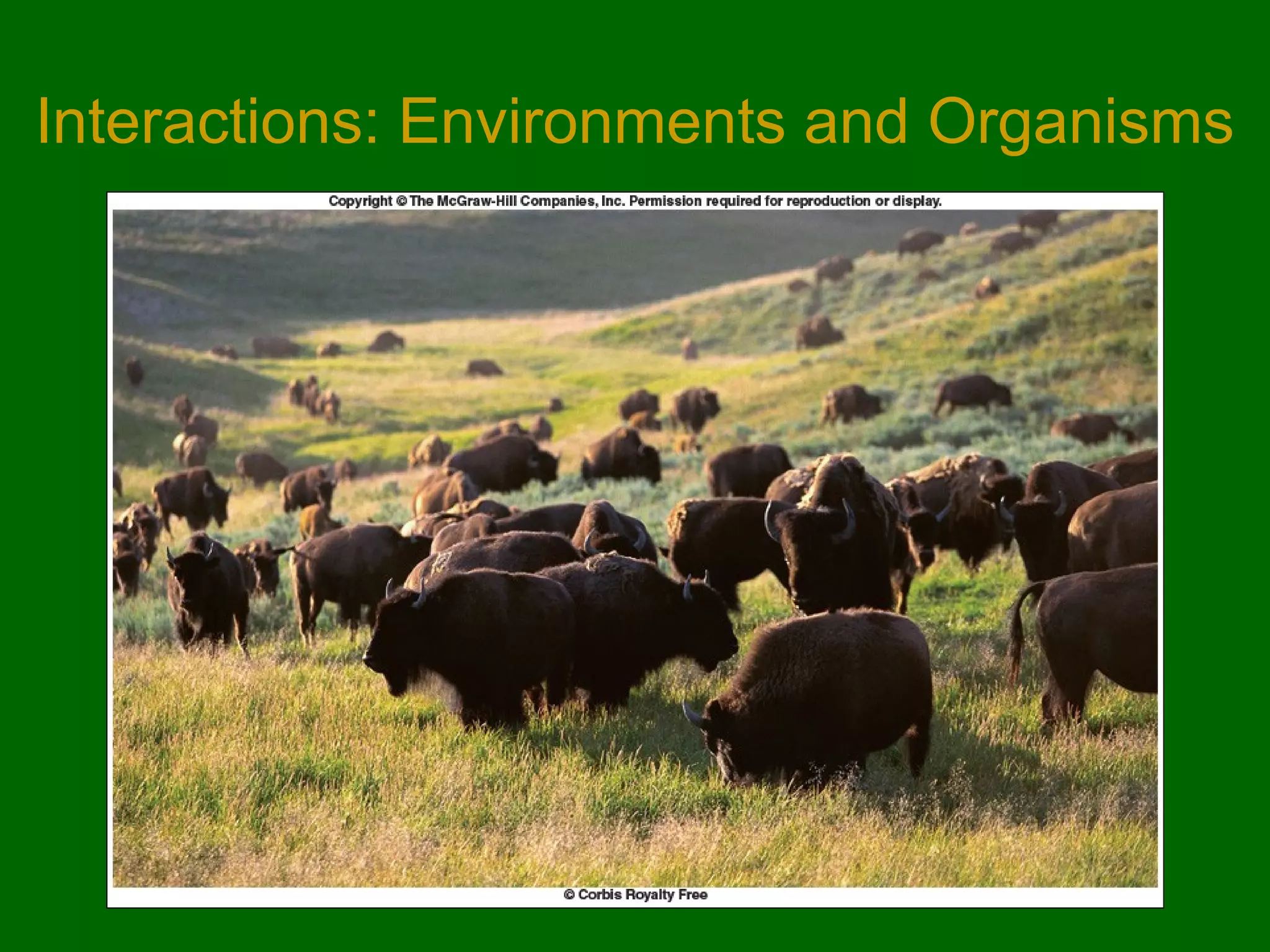
  • When bison are present in American tallgrass prairie
    ecosystems, they increase the biodiversity of the site.
     – Smaller plant species normally shaded by the tall grasses are
       allowed to be successful.
     – Bison wallows retain many species of plants that typically
       live in disturbed areas.
     – Their feeding patterns affect the extent and impact of fire.
Energy Flow Through Ecosystems

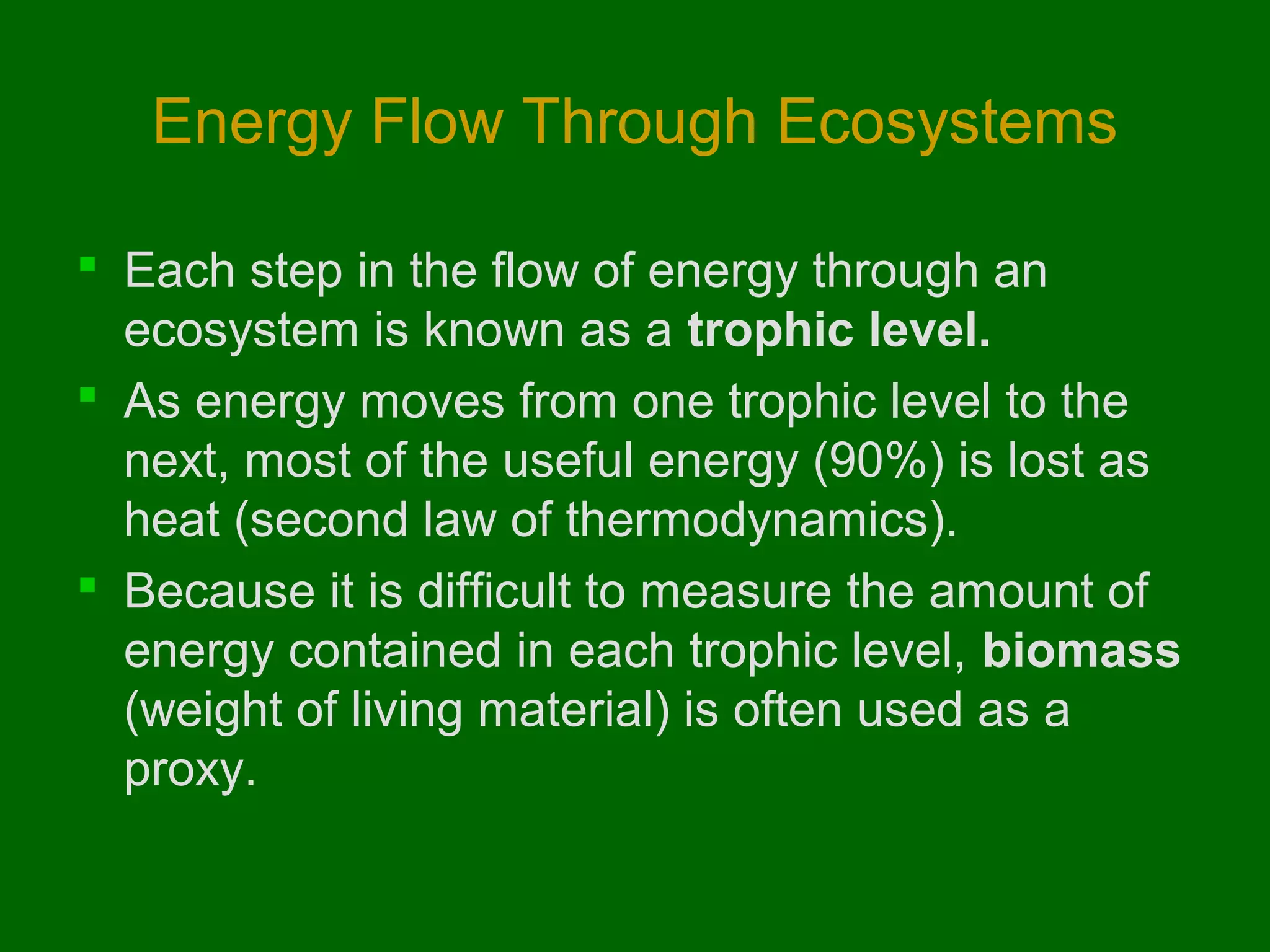
 Each step in the flow of energy through an
  ecosystem is known as a trophic level.
 As energy moves from one trophic level to the
  next, most of the useful energy (90%) is lost as
  heat (second law of thermodynamics).
 Because it is difficult to measure the amount of
  energy contained in each trophic level, biomass
  (weight of living material) is often used as a
  proxy.
Energy Flow Through Ecosystems


Categories of organisms within an ecosystem.
Food Chains and Food Webs

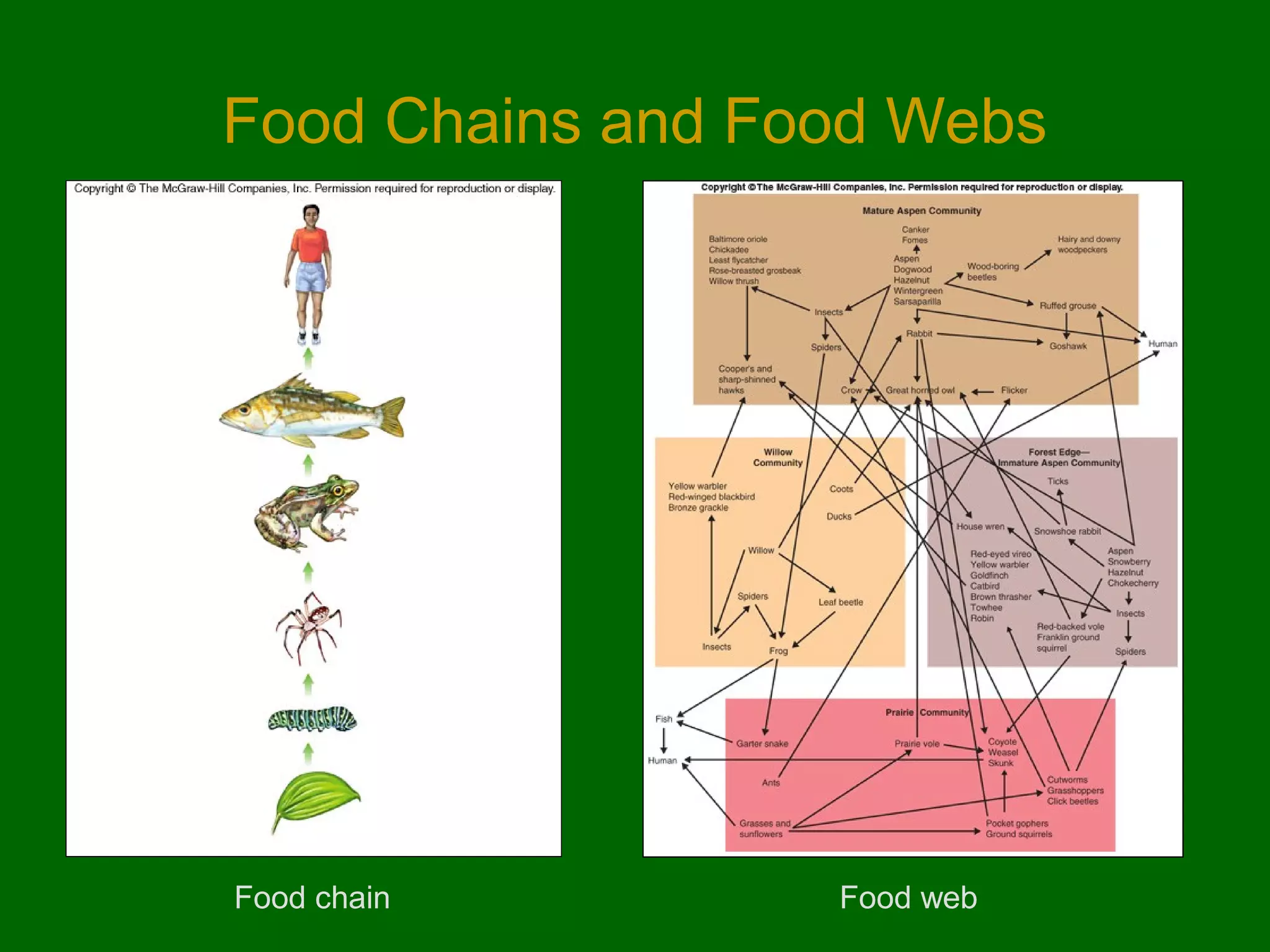
 A food chain is a series of organisms occupying
  different trophic levels through which energy
  passes as a result of one organism consuming
  another.
  • Some chains rely on detritus.
 A food web is a series of multiple, overlapping
  food chains.
  • A single predator can have multiple prey species at
    the same time.
Food Chains and Food Webs


Food chain        Food web
Nutrient Cycles in Ecosystems—
           Biogeochemical Cycles
 Organisms are composed of molecules and
  atoms that are cycled between living and non-
  living portions of an ecosystem.

 These nutrient cycles are called biogeochemical
  cycles.
Carbon Cycle

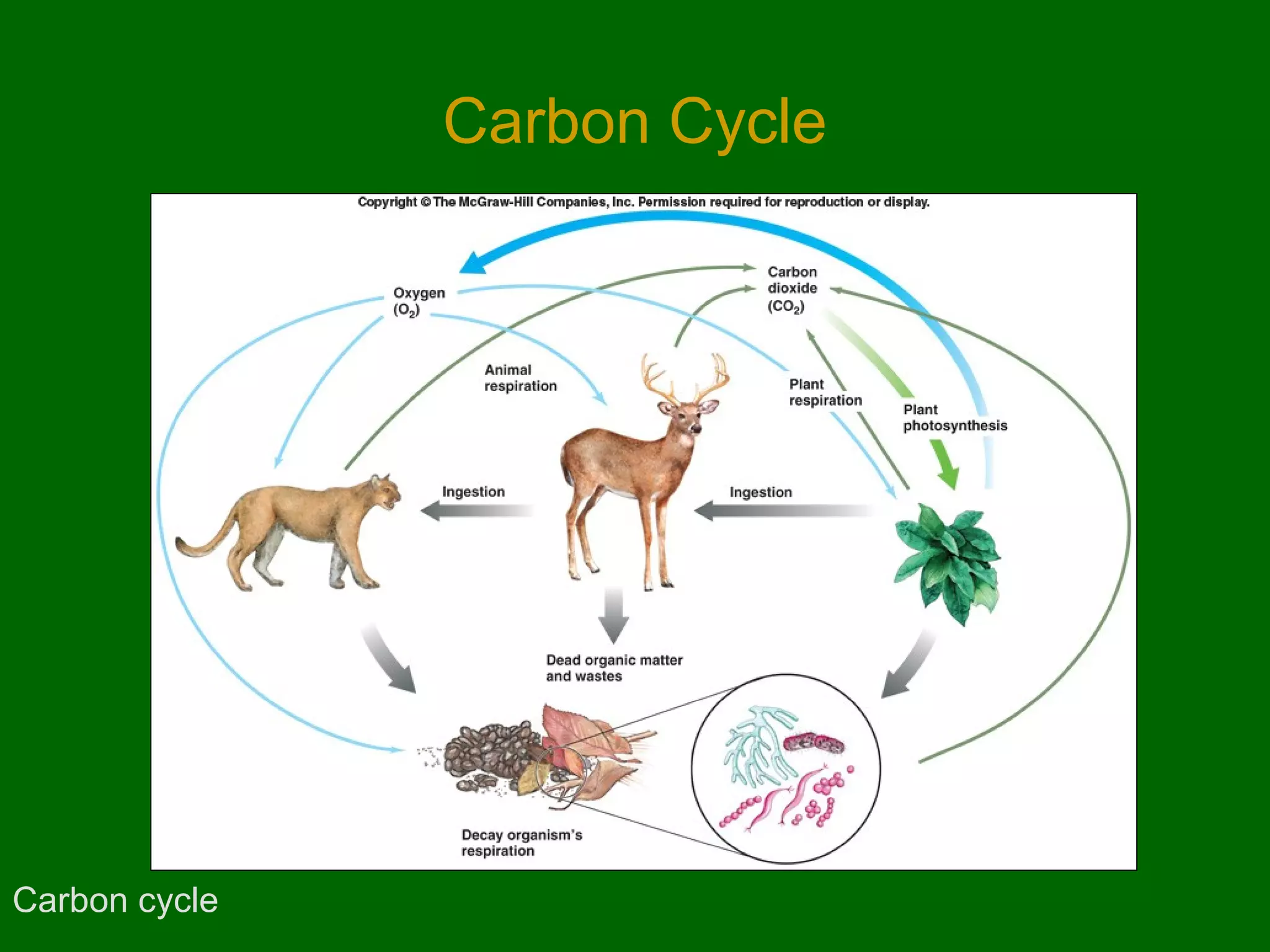
1. Carbon and oxygen combine to form carbon dioxide.
2. Plants use carbon dioxide during photosynthesis to
   produce sugars.
3. Plants use sugars for plant growth.
4. Herbivores eat plants, break down the complex organic
   molecules into simpler molecular building blocks, and
   incorporate those molecules into their structure.
5. Respiration breaks down organic molecules into CO2
   and water and releases those compounds back into the
   atmosphere.
Carbon Cycle

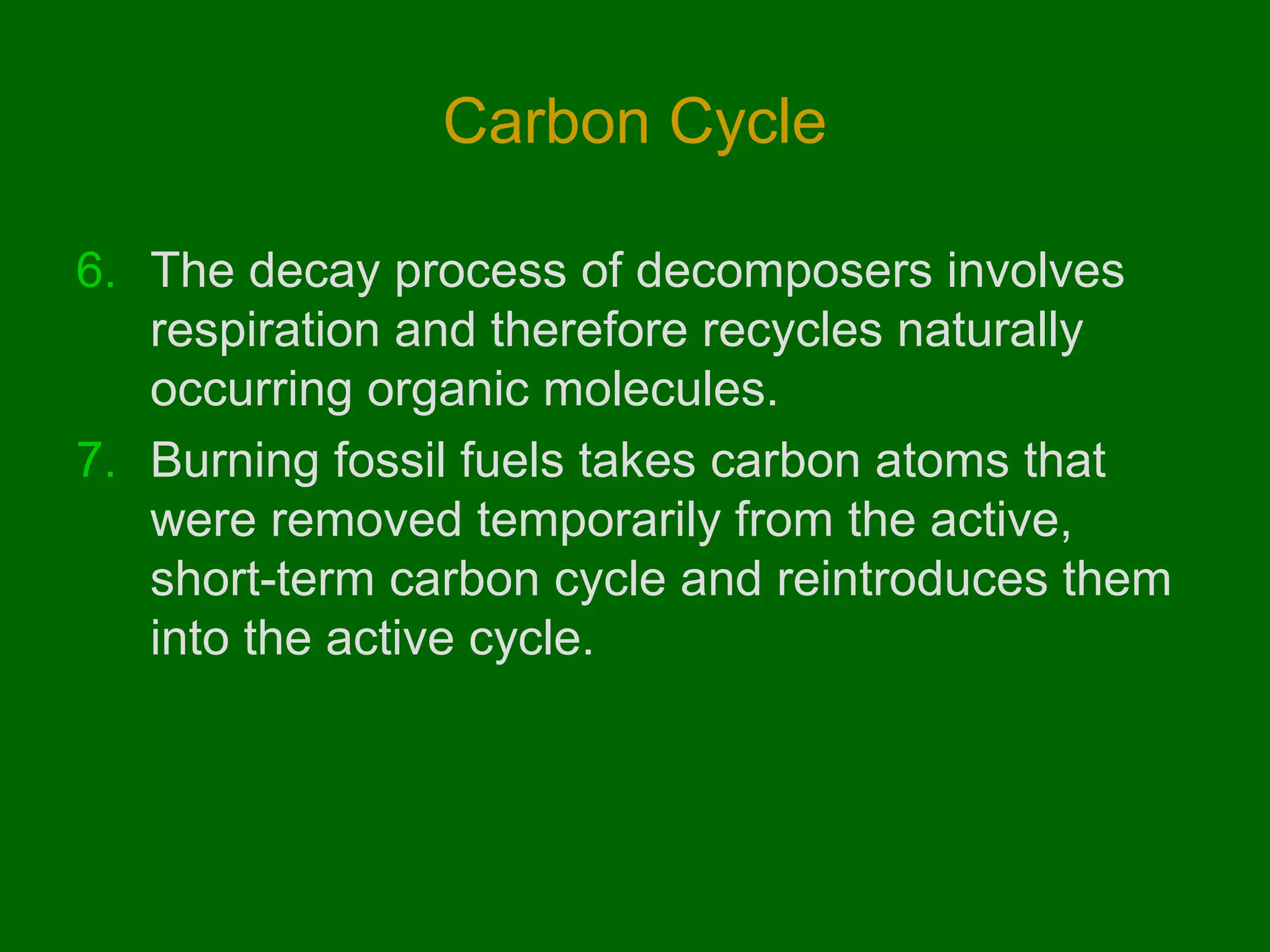
6. The decay process of decomposers involves
   respiration and therefore recycles naturally
   occurring organic molecules.
7. Burning fossil fuels takes carbon atoms that
   were removed temporarily from the active,
   short-term carbon cycle and reintroduces them
   into the active cycle.
Carbon Cycle


Carbon cycle
Nitrogen Cycle

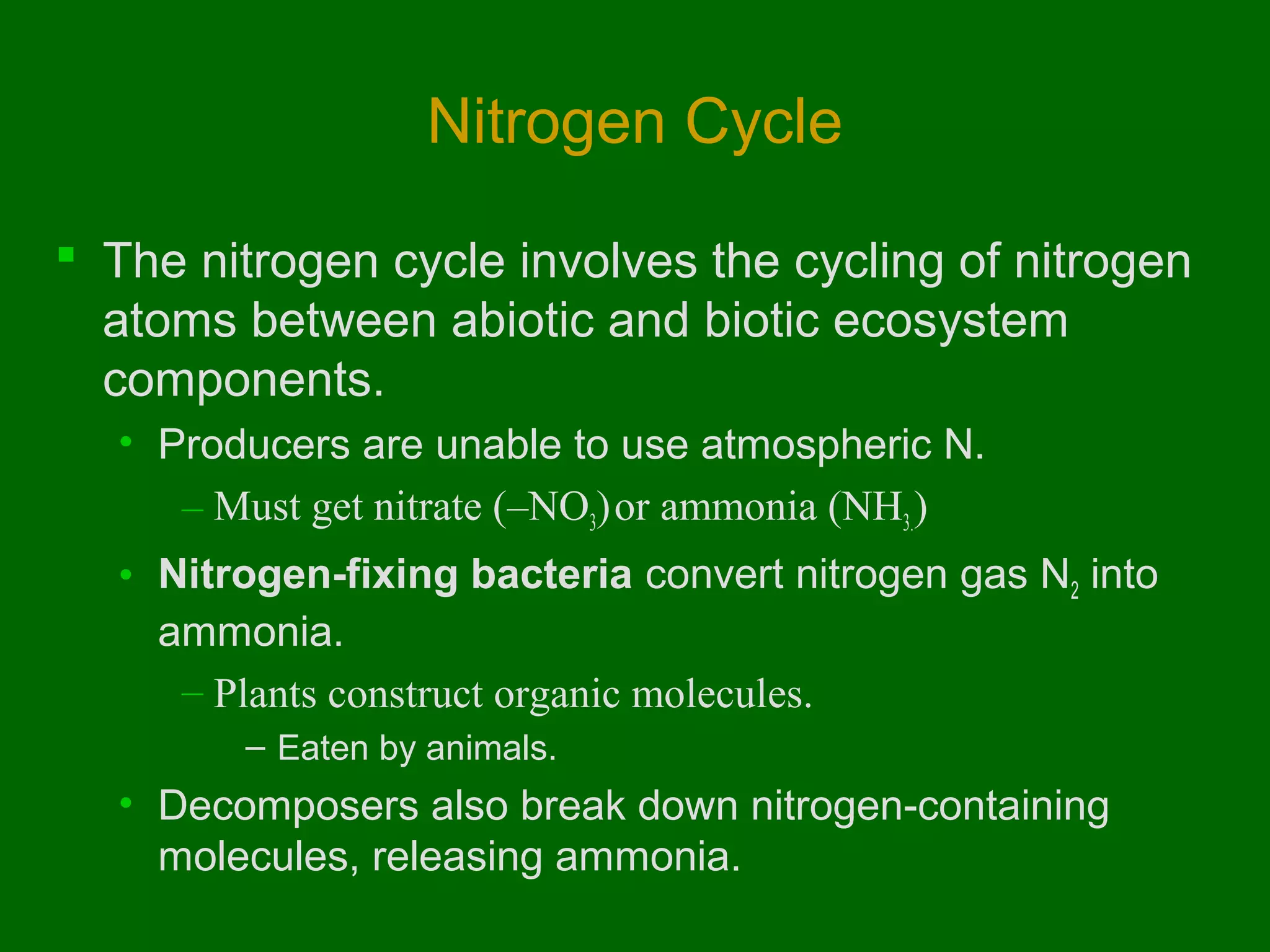
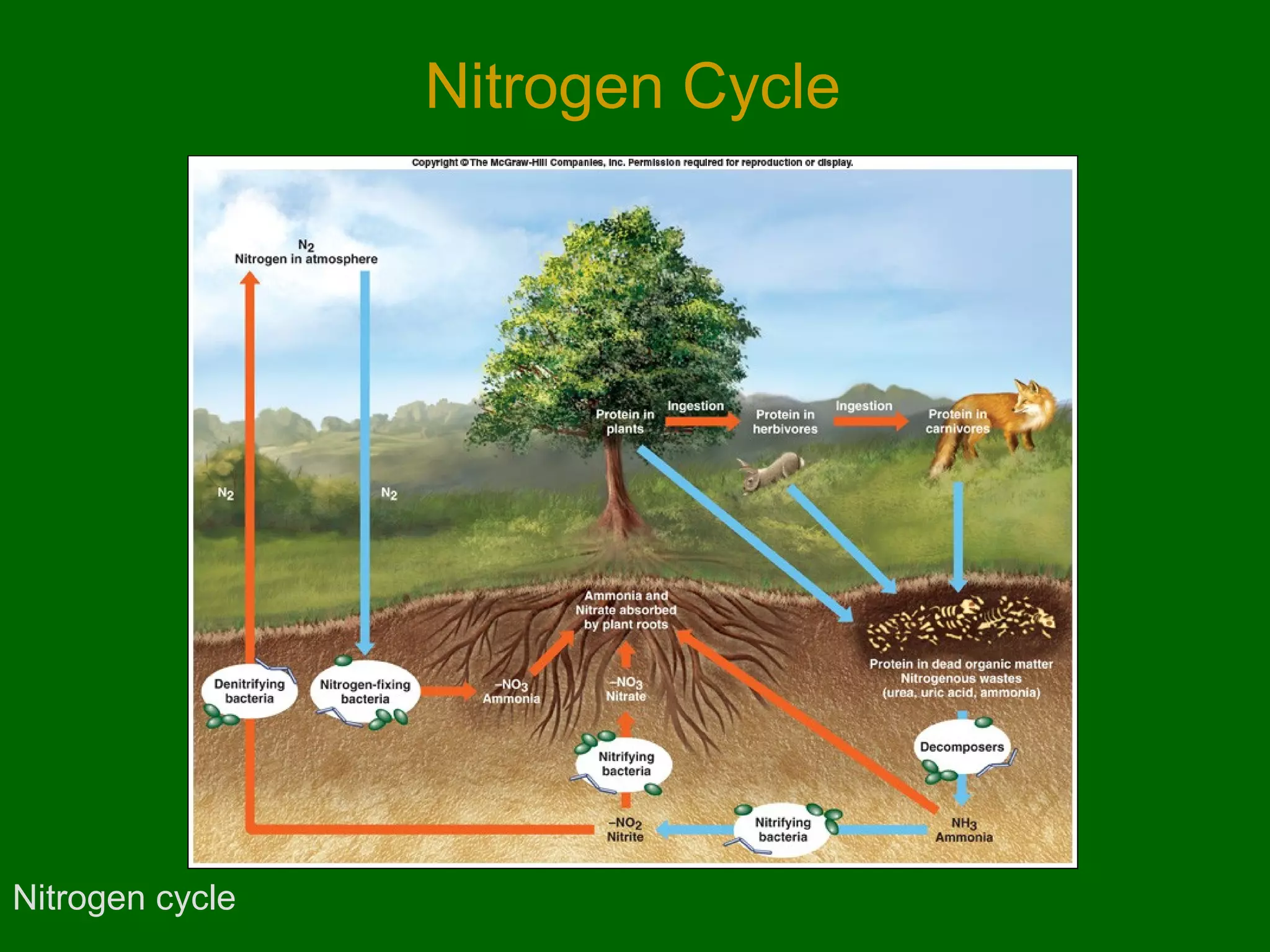
 The nitrogen cycle involves the cycling of nitrogen
  atoms between abiotic and biotic ecosystem
  components.
  • Producers are unable to use atmospheric N.
     – Must get nitrate (–NO3) or ammonia (NH3.)
  • Nitrogen-fixing bacteria convert nitrogen gas N2 into
    ammonia.
     – Plants construct organic molecules.
        – Eaten by animals.
  • Decomposers also break down nitrogen-containing
    molecules, releasing ammonia.
Nitrogen Cycle

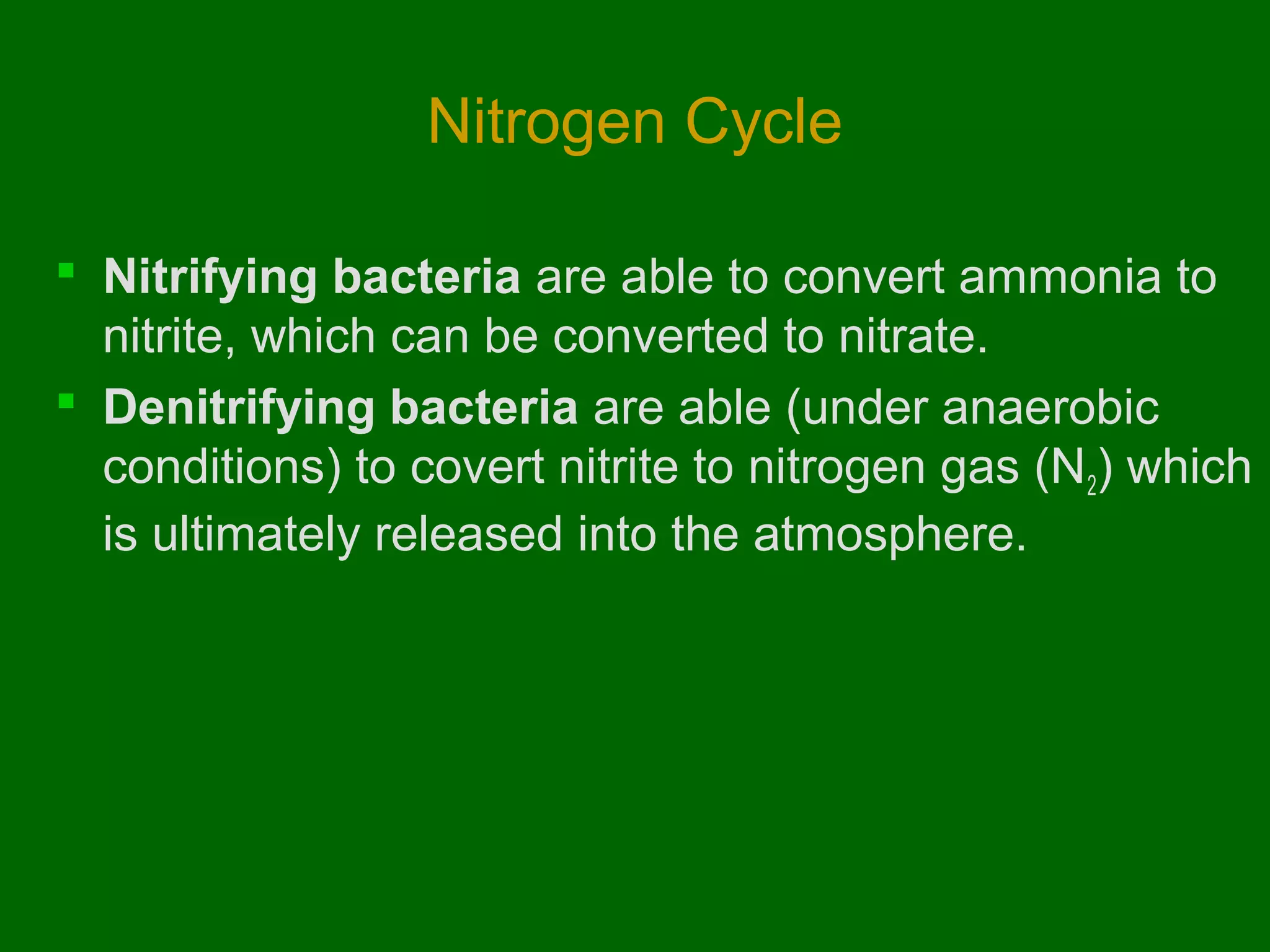
 Nitrifying bacteria are able to convert ammonia to
  nitrite, which can be converted to nitrate.
 Denitrifying bacteria are able (under anaerobic
  conditions) to covert nitrite to nitrogen gas (N2) which
  is ultimately released into the atmosphere.
Nitrogen Cycle


Nitrogen cycle
Phosphorus Cycle

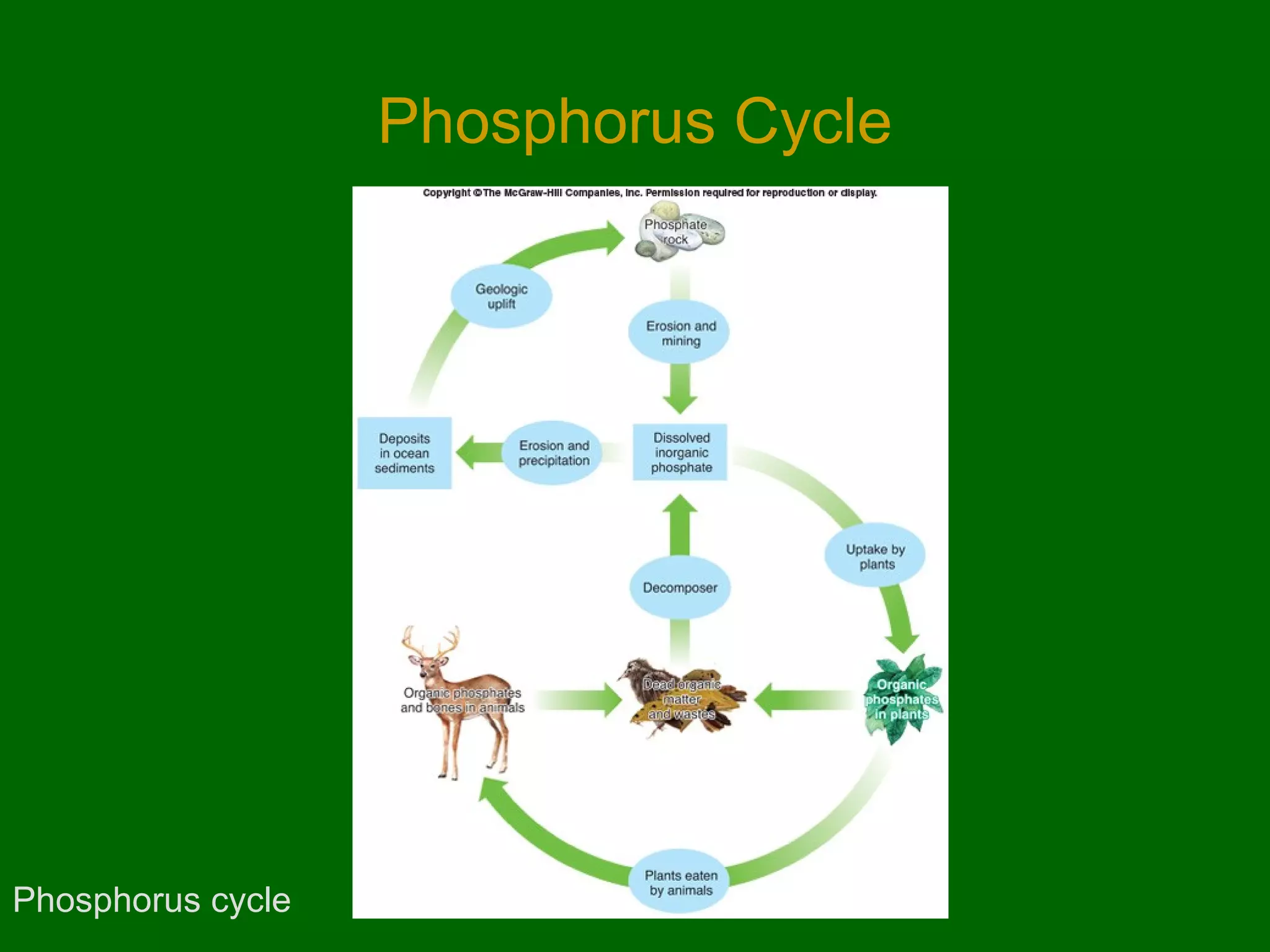
   Phosphorus is not present in the atmosphere
    as a gas. The ultimate source of phosphorus
    atoms is rock.
    1. Phosphorus compounds are released by erosion
       and become dissolved in water.
    2. Plants use phosphorus to construct necessary
       molecules.
    3. Animals gain necessary phosphorus when they
       consume plants or other animals.
    4. Decomposers recycle phosphorus compounds back
       into the soil.
Phosphorus Cycle


Phosphorus cycle
Human Impact on Nutrient Cycles

 Burning of fossil fuels releases large amounts of
  carbon dioxide into the atmosphere.
 Fossil fuel burning also increases the amount of
  nitrogen available to plants.
 Converting forests (long-term carbon storage) to
  agricultural land (short-term carbon storage) has
  increased the amount of carbon dioxide in the
  atmosphere.
Human Impact on Nutrient Cycles

 If too much nitrogen or phosphorus is applied as
  fertilizer, or if it is applied at the wrong time,
  much of the fertilizer is carried into aquatic
  ecosystems.
  • The presence of these nutrients increases the growth
    rate of bacteria, algae, and aquatic plants.
     – Toxic algae can kill fish and poison humans.
     – An increase in the number of plants and algae results in
       lowered oxygen concentrations, creating “dead zones.”
Summary

 An organism’s environment can be divided into
  biotic (living) and abiotic (nonliving) components.
 The space an organism occupies is its habitat, and
  the role it plays is its niche.
 Organisms interact with one another in a variety of
  ways. Symbiotic relationships are those in which two
  species live in physical contact and at least one
  species derives benefit from the relationship.
 In an ecosystem, energy is trapped by producers
  and flows from producers through various trophic
  levels of consumers.
Summary

 The sequence of organisms through which
  energy flows is called a food chain.
 Multiple interconnecting food chains constitute a
  food web.
 The flow of atoms through an ecosystem
  involves all the organisms in a community. The
  carbon, nitrogen, and phosphorus cycles are
  examples of how these materials are cycled in
  ecosystems.

Lecture 5 interactions

  • 1.
    Environmental Science A Study of Interrelationships Eleventh Edition Enger & Smith Chapter 5 Interactions: Environments and Organisms Copyright © The McGraw-Hill Companies, Inc. Permission required for reproduction or display.
  • 2.
  • 3.
    Outline  Ecological Concepts  Natural Selection and Evolution  Organism Interactions  Community and Ecosystem Interactions
  • 4.
    Ecological Concepts  Ecologyis the study of ways organisms interact with each other and with their nonliving surroundings.  Environment means everything that affects an organism during its lifetime. • Abiotic factors: Nonliving things that influence an organism, such as energy, nonliving matter, living space, and ecological processes. • Biotic factors: All forms of life with which the organism interacts.
  • 5.
    Ecological Concepts Levels oforganization in ecology
  • 6.
    Limiting Factors  Limitingfactors are any factors whose shortage or absence restricts species success. • Scarcity of water or specific nutrients (plants) • Climate, availability of a specific food (animals).  Range of tolerance indicates a range of conditions in which an organism can survive.
  • 7.
  • 8.
    Habitat and Niche The habitat of an organism is the space in which an organism lives; it is defined by the biological requirements of each particular organism. • Usually highlighted by prominent physical or biological features.  The niche of an organism is the functional role (profession) the organism has in its surroundings. • This term includes all the ways an organism affects the organisms with which it interacts as well as how it modifies its physical surroundings.
  • 9.
  • 10.
  • 11.
    Genes, Populations, andSpecies  Genes are distinct pieces of DNA that determine the characteristics an individual displays.  A population includes all organisms of the same kind found within a specific geographic region. • A population contains more kinds of genes than any single individual within the population.  A species is a population of all the organisms potentially capable of reproducing naturally among themselves and having offspring that also reproduce.
  • 12.
    Natural Selection  Naturalselection is the process that determines which individuals within a species will reproduce and pass their genes to the next generation.  The changes seen in the genes and characteristics displayed by successive generations of a population of organisms over time is known as evolution.
  • 13.
    Natural Selection  Several conditions and steps are involved in the process of natural selection: 1. Individuals within a species show genetically determined variation. 2. Organisms within a species typically produce more offspring than are needed to replace the parents when they die. Most of the offspring die. 3. The excess number of individuals results in a shortage of specific resources.
  • 14.
    Natural Selection 4. Dueto individual variation, some individuals have a greater chance of obtaining needed resources and therefore have a greater likelihood of surviving and reproducing than others. 5. As time passes, the percentage of individuals showing favorable variations will increase while the percentage showing unfavorable variations will decrease.
  • 15.
    Evolutionary Patterns  Speciationis the production of new species from previously existing species. • It is thought to occur as a result of a species dividing into two isolated subpopulations.  Extinction is the loss of an entire species. • Of the estimated 500 million species believed to have ever existed on Earth, 98-99% have gone extinct.  Coevolution is the concept that two or more species can reciprocally influence the evolutionary direction of the other. • Grazing animals and grass species.
  • 16.
    Kinds of OrganismInteractions  Predation is a kind of interaction in which one animal kills/eats another. • Predator benefits from food. • Prey adaptation is manifested in a higher reproduction rate.
  • 17.
    Competition  Competition isa kind of interaction in which two organisms strive to obtain the same limited resource. • Intraspecific competition is competition between members of same species. • Interspecific competition is competition between members of different species.
  • 18.
    Competition  The competitive exclusion principle holds that no two species can occupy the same ecological niche in the same place at the same time. • Less-fit species must evolve into a slightly different niche.
  • 19.
    Symbiotic Relationships  Symbiosisis a close, long-lasting, physical relationship between two different species. At least one species derives benefit from the interaction.  There are three categories of symbiotic relationships: • Parasitism • Commensalism • Mutualism
  • 20.
    Symbiotic Relationships  Parasitismis a relationship in which one organism (parasite) lives in or on another organism (host), from which it derives nourishment. • Ectoparasites live on the host’s surface. – Fleas, lice, molds, mildews • Endoparasites live inside the body of the host. – Tapeworms, malaria parasites, bacteria, fungi
  • 21.
    Symbiotic Relationships  Commensalismis a relationship in which one organism benefits while the other is not affected. • Remoras and sharks  Mutualism is a relationship in which both species benefit. The relationship is obligatory in many cases, as neither can exist without the other. • Mycorrhizae
  • 22.
    Symbiotic Relationships Examples ofsymbiotic relationships
  • 23.
    Community and EcosystemInteractions  A community is an assemblage of all interacting species of organisms in an area.  An ecosystem is a defined space in which interactions take place between a community, with all its complex interrelationships, and the physical environment.
  • 24.
    Major Roles ofOrganisms in Ecosystems  Ecologists have divided organisms’ roles in ecosystems into three broad categories: 1. Producers: Organisms that are able to use sources of energy to make complex organic molecules from simple inorganic substances in their environment. 2. Consumers: Organisms that require organic matter as a source of food. They consume organic matter to provide themselves with energy and organic molecules necessary for growth and survival.
  • 25.
    Major Roles ofOrganisms in Ecosystems • Consumers can be further divided into categories based on the things they eat and the way they obtain food. – Primary consumers, or herbivores, eat plants as a source of food. – Secondary consumers, or carnivores, are animals that eat other animals. – Omnivores consume both plants and animals. 3. Decomposers use nonliving organic matter as a source of energy and raw materials to build their bodies. Many small animals, bacteria, and fungi fill this niche.
  • 26.
    Keystone Species  Akeystone species plays a critical role in the maintenance of specific ecosystems. • When bison are present in American tallgrass prairie ecosystems, they increase the biodiversity of the site. – Smaller plant species normally shaded by the tall grasses are allowed to be successful. – Bison wallows retain many species of plants that typically live in disturbed areas. – Their feeding patterns affect the extent and impact of fire.
  • 27.
    Energy Flow ThroughEcosystems  Each step in the flow of energy through an ecosystem is known as a trophic level.  As energy moves from one trophic level to the next, most of the useful energy (90%) is lost as heat (second law of thermodynamics).  Because it is difficult to measure the amount of energy contained in each trophic level, biomass (weight of living material) is often used as a proxy.
  • 28.
    Energy Flow ThroughEcosystems Categories of organisms within an ecosystem.
  • 29.
    Food Chains andFood Webs  A food chain is a series of organisms occupying different trophic levels through which energy passes as a result of one organism consuming another. • Some chains rely on detritus.  A food web is a series of multiple, overlapping food chains. • A single predator can have multiple prey species at the same time.
  • 30.
    Food Chains andFood Webs Food chain Food web
  • 31.
    Nutrient Cycles inEcosystems— Biogeochemical Cycles  Organisms are composed of molecules and atoms that are cycled between living and non- living portions of an ecosystem.  These nutrient cycles are called biogeochemical cycles.
  • 32.
    Carbon Cycle 1. Carbonand oxygen combine to form carbon dioxide. 2. Plants use carbon dioxide during photosynthesis to produce sugars. 3. Plants use sugars for plant growth. 4. Herbivores eat plants, break down the complex organic molecules into simpler molecular building blocks, and incorporate those molecules into their structure. 5. Respiration breaks down organic molecules into CO2 and water and releases those compounds back into the atmosphere.
  • 33.
    Carbon Cycle 6. Thedecay process of decomposers involves respiration and therefore recycles naturally occurring organic molecules. 7. Burning fossil fuels takes carbon atoms that were removed temporarily from the active, short-term carbon cycle and reintroduces them into the active cycle.
  • 34.
  • 35.
    Nitrogen Cycle  Thenitrogen cycle involves the cycling of nitrogen atoms between abiotic and biotic ecosystem components. • Producers are unable to use atmospheric N. – Must get nitrate (–NO3) or ammonia (NH3.) • Nitrogen-fixing bacteria convert nitrogen gas N2 into ammonia. – Plants construct organic molecules. – Eaten by animals. • Decomposers also break down nitrogen-containing molecules, releasing ammonia.
  • 36.
    Nitrogen Cycle  Nitrifyingbacteria are able to convert ammonia to nitrite, which can be converted to nitrate.  Denitrifying bacteria are able (under anaerobic conditions) to covert nitrite to nitrogen gas (N2) which is ultimately released into the atmosphere.
  • 37.
  • 38.
    Phosphorus Cycle  Phosphorus is not present in the atmosphere as a gas. The ultimate source of phosphorus atoms is rock. 1. Phosphorus compounds are released by erosion and become dissolved in water. 2. Plants use phosphorus to construct necessary molecules. 3. Animals gain necessary phosphorus when they consume plants or other animals. 4. Decomposers recycle phosphorus compounds back into the soil.
  • 39.
  • 40.
    Human Impact onNutrient Cycles  Burning of fossil fuels releases large amounts of carbon dioxide into the atmosphere.  Fossil fuel burning also increases the amount of nitrogen available to plants.  Converting forests (long-term carbon storage) to agricultural land (short-term carbon storage) has increased the amount of carbon dioxide in the atmosphere.
  • 41.
    Human Impact onNutrient Cycles  If too much nitrogen or phosphorus is applied as fertilizer, or if it is applied at the wrong time, much of the fertilizer is carried into aquatic ecosystems. • The presence of these nutrients increases the growth rate of bacteria, algae, and aquatic plants. – Toxic algae can kill fish and poison humans. – An increase in the number of plants and algae results in lowered oxygen concentrations, creating “dead zones.”
  • 42.
    Summary  An organism’senvironment can be divided into biotic (living) and abiotic (nonliving) components.  The space an organism occupies is its habitat, and the role it plays is its niche.  Organisms interact with one another in a variety of ways. Symbiotic relationships are those in which two species live in physical contact and at least one species derives benefit from the relationship.  In an ecosystem, energy is trapped by producers and flows from producers through various trophic levels of consumers.
  • 43.
    Summary  The sequenceof organisms through which energy flows is called a food chain.  Multiple interconnecting food chains constitute a food web.  The flow of atoms through an ecosystem involves all the organisms in a community. The carbon, nitrogen, and phosphorus cycles are examples of how these materials are cycled in ecosystems.