Information Operations: 
A New War-Fighting Capability 
A Research Paper 
Presented To 
Air Force 2025 
by 
LTC William B. Osborne (USA) 
Maj Scott A. Bethel 
Maj Nolen R. Chew 
Maj Philip M. Nostrand 
Maj YuLin G. Whitehead 
August 1996
Disclaimer 
2025 is a study designed to comply with a directive from the chief of staff of the Air Force to examine the 
concepts, capabilities, and technologies the United States will require to remain the dominant air and space 
force in the future. Presented on 17 June 1996, this report was produced in the Department of Defense school 
environment of academic freedom and in the interest of advancing concepts related to national defense. The 
views expressed in this report are those of the authors and do not reflect the official policy or position of the 
United States Air Force, Department of Defense, or the United States government. 
This report contains fictional representations of future situations/scenarios. Any similarities to real people or 
events, other than those specifically cited, are unintentional and are for purposes of illustration only. 
This publication has been reviewed by security and policy review authorities, is unclassified, and is cleared 
for public release. 
ii
Contents 
Chapter Page 
Disclaimer..........................................................................................................................................ii 
Illustrations........................................................................................................................................iv 
Tables.................................................................................................................................................v 
Preface..............................................................................................................................................vii 
Executive Summary ........................................................................................................................ viii 
1 Introduction.........................................................................................................................................1 
The Challenges .............................................................................................................................1 
Assumptions..................................................................................................................................3 
The Rest of the Story.....................................................................................................................4 
2 Required Capability............................................................................................................................6 
Information Dominance.................................................................................................................6 
Speed and Accuracy of OODA Loops ..........................................................................................6 
Dross Versus Gold........................................................................................................................7 
OODA Loop “Integration”............................................................................................................7 
“Momentum Control”....................................................................................................................8 
OODA Loop Tasks and Attributes................................................................................................8 
3 Technology Investigation ..................................................................................................................11 
Collection Platforms...................................................................................................................13 
Miniature Satellites...............................................................................................................13 
Uninhabited Reconnaissance Aerospace Vehicles................................................................14 
Communication Infrastructure .....................................................................................................15 
Security.................................................................................................................................16 
Communications Wrap-Up....................................................................................................17 
Computer Power.........................................................................................................................18 
Intelligent Software.....................................................................................................................19 
Image Understanding.............................................................................................................20 
Intelligent Integration of Information.....................................................................................20 
Planning and Decision Aids..................................................................................................21 
Human Computer Interaction.................................................................................................21 
Human Systems and Biotechnology.............................................................................................22 
Charting the Brain .................................................................................................................22 
Visualization and Mental Imaging .........................................................................................25 
Bringing It Altogether--The Nexus..............................................................................................26 
4 System Description ...........................................................................................................................32 
Cyber Situation Components.......................................................................................................33 
All-Source Information Collectors........................................................................................34 
iii
Chapter Page 
Archival Databases...............................................................................................................34 
IIC ........................................................................................................................................34 
Implanted Microscopic Chip.................................................................................................35 
Lethal and Nonlethal Weapons..............................................................................................36 
Putting It Together.......................................................................................................................36 
Measures of Merit.......................................................................................................................37 
Observe Tasks ......................................................................................................................38 
Orient Tasks..........................................................................................................................39 
Decide Tasks ........................................................................................................................40 
Act Tasks ..............................................................................................................................41 
5 Vulnerabilities and Countermeasures................................................................................................43 
Vulnerabilities ............................................................................................................................43 
Countermeasures.........................................................................................................................44 
Distributed System Architecture ...........................................................................................44 
The “Small and the Many” ....................................................................................................45 
“Smart” System.....................................................................................................................46 
Optical Computing ................................................................................................................46 
Low Earth Orbit....................................................................................................................47 
Internal Deactivation.............................................................................................................47 
External Deactivation............................................................................................................47 
“Zap” Attack .........................................................................................................................47 
“Mutual Dependence”...........................................................................................................48 
Summary.....................................................................................................................................48 
6 Concept of Operations ......................................................................................................................50 
Future Conops.............................................................................................................................50 
Applications of the Cyber Situation............................................................................................51 
Command Structure.....................................................................................................................52 
Principles of War........................................................................................................................53 
A Future World...........................................................................................................................53 
7 Investigation Recommendations........................................................................................................55 
8 Conclusion ........................................................................................................................................57 
Appendix Page 
A List of Acronyms and Abbreviations.................................................................................................60 
Bibliography.....................................................................................................................................62 
iv
Illustrations 
Figure Page 
1-1. OODA Loop.......................................................................................................................................2 
3-1. Battlespace Vision Key Components................................................................................................12 
3-2. Human Information Processing Flow................................................................................................24 
3-3. Development Lines for System Elements..........................................................................................27 
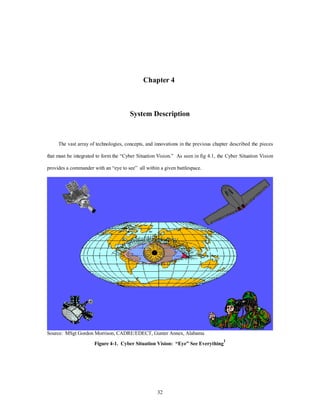
4-1. Cyber Situation Vision: “Eye” See Everything................................................................................32 
4-2. Cyber Situation Components.............................................................................................................33 
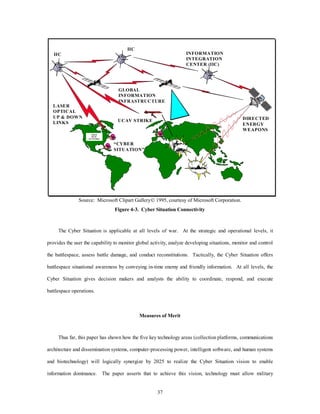
4-3. Cyber Situation Connectivity............................................................................................................37 
5-1. Information Integration Center Interconnectivity...............................................................................45 
Tables 
Table Page 
1 Observe Tasks and Attributes.............................................................................................................9 
2 Orient Tasks and Attributes ................................................................................................................9 
3 Decide Tasks and Attributes...............................................................................................................9 
4 Act Tasks and Attributes.....................................................................................................................9 
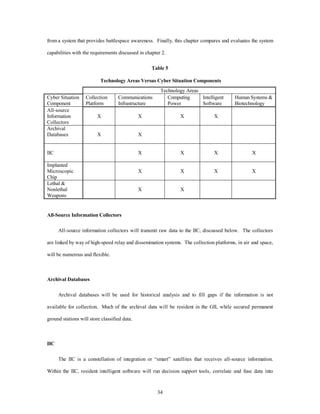
5 Technology Areas Versus Cyber Situation Components...................................................................34 
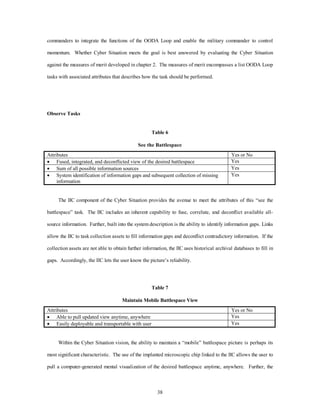
6 See the Battlespace...........................................................................................................................38 
7 Maintain Mobile Battlespace View..................................................................................................38 
8 Universal Access to Battlespace View.............................................................................................39 
v
Table Page 
9 Tailor View of the Battlespace.........................................................................................................39 
10 Comprehend the Battlespace View...................................................................................................40 
11 Decide What is Important and What May Require Action ................................................................40 
12 Determine Action Required to Rectify Undesirable Situation ..........................................................40 
13 Immediate Access to Assets to Rectify Undesirable Situation..........................................................41 
14 Feedback on Actions and Inactions Taken........................................................................................41 
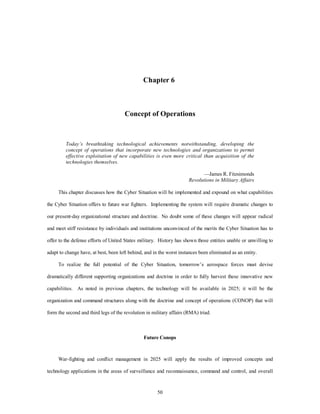
15 Countermeasures Versus Threats......................................................................................................48 
vi
Preface 
You see things; and say “Why?” But I dream of things that never were; and I say; “Why 
not?” 
vii 
—George Bernard Shaw 
Back to Methuselah, part 1, act 1 
This project envisions war-fighting capabilities that will enable military members to prosecute 
operations effectively in support of vital national strategic interests determined by US political leaders. Our 
efforts stem from a genuine concern to improve the tools to assist commanders in an age of exponential 
growth in available information. But, this vision goes beyond just giving commanders useful information; it 
aims to empower them with the ability to leverage information to conduct warfare. 
We undertook this effort knowing that some readers would find it a challenge to project their thoughts 
out into the next millennium to 2025. Nevertheless, we encourage our readers to “double leap” into 2025 and 
share our excitement in the concept’s potential to keep the US military as the best military in the world. 
We appreciate Air University’s pushing us beyond the safe envelope of thinking and planning the future. 
Without exception, we received impressive assistance from advisors, instructors, guest speakers, and peers. 
Finally, our spouses supported and encouraged us when we needed it most—when naysayers doubted our 
“out-of-box” visions. 
Never again will we say “that can’t be done.” Others may see the impossible, but we will determine 
“how?”
Executive Summary 
The affirming characteristic of Alexander the Great’s genius as a general and leader 
was “the startling rapidity with which he always acted. . . . Time was his constant ally; 
he capitalized every moment, never pondered on it, and thereby achieved his end before 
others had settled on their means.” 
viii 
—J.F.C. Fuller 
The Generalship of Alexander the Great 
In its most basic form, commanders have always performed the functions of observe, orient, decide, and 
act (OODA Loop) to prosecute military operations.1 As with Alexander the Great, history shows the military 
commander who best analyzes, decides, and controls the speed of the engagement prevails in nearly every 
conflict. To master the OODA Loop, military leaders have pushed technology to obtain more information.2 
Ironically, this situation now leads to the requirement to solve two fundamental challenges if the United 
States expects to maintain air and space dominance in 2025. First, the proliferation of unintegrated military 
war-fighting architectures gives the commander potentially conflicting perspectives of the battlespace.3 
Second, the explosion of available information creates an environment of mental overload leading to flawed 
decision making. Failure to master these challenges critically weakens the military instrument of power. 
This paper presents a solution to these challenges by confronting commanders as they employ future 
airpower forces. 
Regarding the first challenge, the large number of specialized war-fighting architectures makes 
information integration supporting overall coordination and control more important and more difficult. 
Simultaneously, the speed and the range of modern weapons drastically reduces the time commanders have 
to integrate conflicting information and decide on a course of action. 
The second challenge is to harness the information explosion to combat mental overload, thus improving 
decision making. Recent exercises reveal an alarming number of unread messages because of information 
overload.4 As the quantity of data rises, the difficulty of preparing and interpreting it for decision making 
grows. Traditionally, the military attempted to solve this problem by increasing the number of
communications nodes. These past solutions only injected additional inputs and information without 
ix 
improving decision-making capability. 
The optimum solution must integrate the functions within the OODA Loop and allow the commander to 
control the momentum of the cycle. This paper describes how a system, called the Cyber Situation, can do 
just that, thus optimizing commanders’ ability to operate air and space systems. The Cyber Situation enables 
commanders and decision makers to have in-time access to the battlespace, characterize the nature of the 
engagement, determine the calculated probabilities of success from the various authorized lethal or nonlethal 
options, decide what to do, employ the weapons chosen, and receive in-time feedback on the result of the 
engagement. 
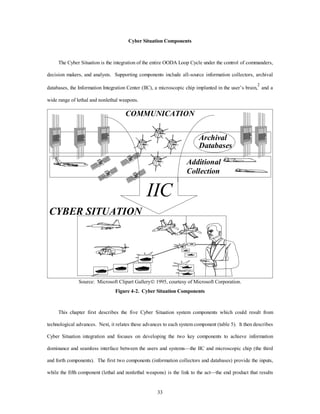
The Cyber Situation system includes five major components. First, all-source information collectors 
will transmit raw data to the Information Integration Center (IIC), as discussed below. Second, archival 
databases, linked to the IIC, will be used for historical analyses to fill information gaps if the data is not 
available for collection. Third, the IIC, an integrated and interconnected constellation of “smart” satellites 
will analyze, correlate, fuse, and deconflict all relayed data. Fourth, implanted microscopic chips link users 
to the IIC and create computer-generated mental visualizations.5 The visualization encompasses the 
individual and allows the user to place himself into the selected battlespace. Fifth, lethal and nonlethal 
weapons will be linked to the IIC, allowing authorized users to employ them from the Cyber Situation. 
Implied in the Cyber Situation are five key technologies evolving on separate paths that will synergize 
by 2025 to achieve this goal. They include collection platforms, communications infrastructure, computing 
power, intelligent software, and human systems and biotechnology. Most of these technologies will evolve 
through the commercial community, but the military must focus research and development efforts on 
biological and computational intelligent software and biotechnology breakthroughs to allow mental 
visualization. 
Once realized, these new capabilities will give commanders a new way to prosecute warfare. New 
technology alone does not revolutionize warfare. Rather, technology’s impact on systems evolution, 
operational tactics, and organizational structure is its true advantage.6 This fuels necessary and 
complementary changes in doctrine and organizational structure.
Organizations and doctrine will need to adapt to a streamlined, decentralized environment. The 
traditional emphasis on command and control will give way to an emphasis on consultation and control. This 
organizational structure permits the Cyber Situation to operate at maximum efficiency. It also allows 
commander’s at all levels to operate with a greater degree of latitude and autonomy as part of an integrated 
x 
joint operation—a truly combined arms. 
Airpower in 2025 must make optimum use of information technology to operate inside an opponent’s 
decision cycle. This requires unequivocal dominance of cyberspace. In addition to enabling all military 
pursuits, information-related activities will transcend all air and space operations. 
To be sure, the Cyber Situation proposed in this paper certainly will not eliminate all the command 
problems facing airpower forces in 2025. However, it may well shed light on the main factors involved and 
indicate the direction any reform efforts should move. The challenge now is for airpower strategists to 
develop the war-fighting doctrine to turn the vision of a true battlespace execution capability into reality. 
Notes 
1 Maj David S. Fadok, John Boyd and John Warden: Air Power’s Quest for Strategic Paralysis 
(Maxwell AFB, Ala.: Air University Press, February 1995), 16. 
2 Examples of technology push to obtain more information range from observation balloons to 
surveillance and reconnaissance aircraft and satellites. 
3 “War-fighting architectures” encompass the entire spectrum of systems (information collection, 
processing, dissemination; command and control; and offensive and defensive weapons systems) to support 
military operations. 
4 A senior US Department of Defense policymaker lecture given to the 1996 Air Command and Staff 
College under the promise of nonattribution. The individual stated that during a 1995 Joint Task Force 
exercise, three thousand of the thirty thousand messages used in the exercise were never opened nor viewed 
by anyone because of information overload. 
5 2025 Concept, No. 900702, “Implanted Tactical Information Display,” 2025 Concepts Database 
(Maxwell AFB, Ala.: Air War College/2025, 1996). 
6 Andrew F. Krepinevich, Jr., War Theory, vol. 3, The Military-Technical Revolution: A Preliminary 
Assessment (Maxwell AFB, Ala.: Air University Press, September 1995), 163-64.
Chapter 1 
Introduction 
Victory smiles upon those who anticipate the changes in the character of war, not upon 
those who wait to adapt themselves after the changes occur. 
1 
—Giulio Douhet 
The Command of the Air 
Victory smiles upon those who change the character of war to their advantage, not upon 
those who merely anticipate the change or wait to adapt themselves after the changes 
occurs. 
—Joseph A. Engelbrecht, Jr. 
AIR FORCE 2025 Research Director 
The Challenges 
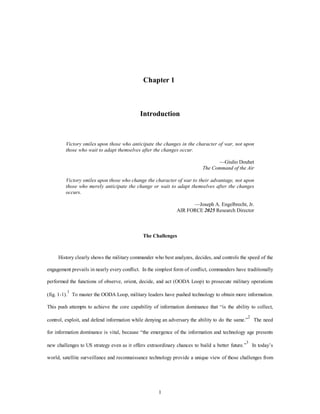
History clearly shows the military commander who best analyzes, decides, and controls the speed of the 
engagement prevails in nearly every conflict. In the simplest form of conflict, commanders have traditionally 
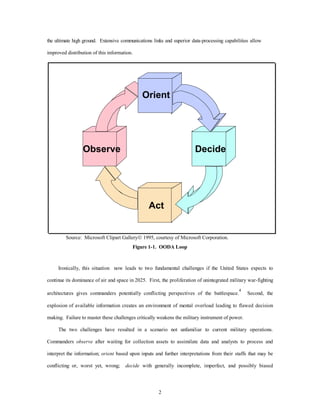
performed the functions of observe, orient, decide, and act (OODA Loop) to prosecute military operations 
(fig. 1-1).1 To master the OODA Loop, military leaders have pushed technology to obtain more information. 
This push attempts to achieve the core capability of information dominance that “is the ability to collect, 
control, exploit, and defend information while denying an adversary the ability to do the same.”2 The need 
for information dominance is vital, because “the emergence of the information and technology age presents 
new challenges to US strategy even as it offers extraordinary chances to build a better future.”3 In today’s 
world, satellite surveillance and reconnaissance technology provide a unique view of those challenges from
the ultimate high ground. Extensive communications links and superior data-processing capabilities allow 
2 
improved distribution of this information. 
Observe 
Orient 
Decide 
Act 
Source: Microsoft Clipart GalleryÓ 1995, courtesy of Microsoft Corporation. 
Figure 1-1. OODA Loop 
Ironically, this situation now leads to two fundamental challenges if the United States expects to 
continue its dominance of air and space in 2025. First, the proliferation of unintegrated military war-fighting 
architectures gives commanders potentially conflicting perspectives of the battlespace.4 Second, the 
explosion of available information creates an environment of mental overload leading to flawed decision 
making. Failure to master these challenges critically weakens the military instrument of power. 
The two challenges have resulted in a scenario not unfamiliar to current military operations. 
Commanders observe after waiting for collection assets to assimilate data and analysts to process and 
interpret the information; orient based upon inputs and further interpretations from their staffs that may be 
conflicting or, worst yet, wrong; decide with generally incomplete, imperfect, and possibly biased
information; and act without first being able to forecast the probability of success of the action or having 
direct and immediate access to employment tools. Gaps and weaknesses in each step widen and exacerbate 
3 
as each cycle begins anew. 
In 2025 operating near the speed of light will be a common feature of military engagements. Future 
architectures envision a new array of ground- and space-based sensors, uninhabited combat aerial vehicles 
(UCAV), and missile defense technology which will take advantage of developing directed energy 
capabilities. If a kill mechanism operates at the same speed as the flow of information, a defender cannot 
possess the requisite time to observe the attack, orient himself, decide how to respond, and act on that 
decision. As a result, the attacker would get inside the defender’s OODA Loop, destroying the ability to 
conduct an active defense. 
This paper proposes a solution to these challenges confronting commanders employing future airpower. 
The optimum solution should integrate the functions within the OODA Loop and allow the commander to 
control the momentum of the cycle. Further, the solution should enable commanders and decision makers to 
have in-time access to the battlespace, characterize the nature of the engagement, determine the calculated 
probabilities of success from the various lethal or nonlethal options authorized, decide what to do, employ 
the weapons chosen, and receive in-time feedback on the result of the engagement.5 Simply stated, the 
solution should go beyond just giving commanders useful information; it should empower them with the 
ability to leverage information to conduct warfare. 
Assumptions 
For planning to achieve information dominance, the following assumptions are plausible for 2025: 
1. Information is power. Hence, the high ground of the future will be information dominance.6 
2. Expect continued explosion in the proliferation of information.7 The availability of information is 
overwhelming, and the driving issue that will contribute to success is being able to sift the “gold from the 
dross.”8 Accordingly, collection assets, regardless of where they are based, will be sufficiently available in 
2025.
3. The site, size, and scope of future conflicts are unknown. The United States military must be 
prepared to fight or to conduct mobility or special operations anywhere in the world on short notice.9 
4. The military will have to fight at long distances from the United States. In particular, some 
operations may be staged directly from the continental United States. These operations may endure for weeks 
or months in weather conditions executed both during the day and night.10 
5. Adversary capabilities steadily will improve and will be difficult to forecast.11 The United States 
must assume we will fight smart enemies who have analyzed all aspects of our military doctrine, capabilities, 
and operations. Further, they will develop weapon systems to attack their perceived vulnerabilities of United 
4 
States military forces. 
6. Military personnel strength will continue to decrease, thus placing further importance on optimizing 
individual performance.12 
7. Today’s principles of war will still be applicable in 2025.13 They include the need to gain the 
offensive, achieve unity of command, maintain security, exploit surprise, use mass and maneuver while 
practicing simplicity, and employ economy of force. 
The Rest of the Story 
The remainder of this paper discusses the proposed solution and its implications. Chapter 2 explains 
the required capability by outlining the need for OODA Loop integration and momentum control. Chapters 3 
and 4 take the reader through the technology evolution that synergizes in the solution called Cyber Situation. 
Chapter 5 discusses vulnerabilities and countermeasures. Chapter 6 outlines how the Cyber Situation 
functions and its implications on doctrine, tactics, organization, and force structures. Finally, chapter 7 
recommends areas requiring additional research and chapter 8 offers a conclusion to this paper. 
Overall, this paper focuses on the conceptual fusion of information operations. Other 2025 papers deal 
specifically with various aspects of information operations.14 Furthermore, other papers focus on 
technologies this paper assumes will be available in 2025, including space lift, uninhibited aerial vehicles 
(UAV), and other lethal weapons.15 This paper serves as the integrator of future information operations
technology—a concept that enables military commanders to observe the battlespace, analyze events, and 
5 
direct forces from within a single entity. 
Notes 
1 Maj David S. Fadok, John Boyd and John Warden: Air Power’s Quest for Strategic Paralysis 
(Maxwell AFB, Ala.: Air University Press, February 1995), 16. 
2 Dr Sheila E. Widnall and Gen Ronald R. Fogelman, Air Force Executive Guidance (Washington, D. 
C.: December 1995), 2, 17. This document outlines five Air Force areas of core competency—air 
superiority, space superiority, global mobility, precision employment, and information dominance. 
3 William J. Clinton, A National Security Strategy of Engagement and Enlargement (the White House, 
February 1996), 1. 
4 “War-fighting architectures” encompass the entire spectrum of systems (information collection, 
processing, dissemination; command and control; and offensive and defensive weapons systems) to support 
military operations. 
5 The use of “in-time” as opposed to real-time or near-real time puts the focus on both timeliness and 
requirement for information. In-time access means getting information to users in time to perform a mission 
or task. 
6Widnall and Fogelman, 16. 
7 Martin C. Libicki, The Mesh and the Net: Speculation on Armed Conflict in a Time of Free 
Silicon (Washington, D. C.: National Defense University Press, 1994), 2-3. 
8 Francis Fukuyama, RAND, Electronic Mail, subject: Dross and Gold, 27 December 1995. Used by 
permission of author. This electronic mail stresses the importance of “sorting the gold from the dross” 
because of “data deluge” and the problem of “facing too much wrong information, a phenomenon often 
exacerbated by new information systems.” 
9 Air Force Scientific Advisory Board, New World Vistas, Air and Space Power for the 21st Century 
Volume, 15 December 1995, 5. 
10 Ibid. 
11 Ibid. 
12 Ibid. 
13 AFM 1-1, Basic Aerospace Doctrine of the United States Air Force, vol. 1, March 1992, 16. 
14 Other 2025 Study research papers dealing with aspects of information operations include: Maj Cindy 
Norman, et al., “Man In the Chair” (Unpublished paper, Air University, Maxwell AFB, Ala., April 1996); 
Maj Mike Tiernan et al., “In-Time Information Integration System” (Unpublished paper, Air University, 
Maxwell AFB, Ala., April 1996); and Maj Barbara Jefts et al., “Virtual Integrated Planning and Execution 
Resources System: The High Ground of 2025” (Unpublished paper, Air University, Maxwell AFB, Ala., 
April 1996). 
15 Other 2025 Study research papers dealing with spacelift, UAVs and lethal weapons include Lt Col 
Bruce Carmichael et al., “DEATHSTAR 2025” (Unpublished paper, Air University, Maxwell AFB, Ala., 
April 1996); Lt Col Henry Baird et al., “Spacelift” (Unpublished paper, Air University, Maxwell AFB, Ala., 
April 1996); and Maj Philip Simonsen et al., “On-Orbit Support” (Unpublished paper, Air University, 
Maxwell AFB, Ala., April 1996).
Chapter 2 
Required Capability 
Machines don’t fight wars. Terrain doesn’t fight wars. Humans fight wars. You must get 
into the mind of humans. That’s where the battles are won. 
6 
—Col John Boyd 
Information Dominance 
As a new millennium approaches, information dominance should become a “blue print” for continued 
success as a superpower and contribute to peace particularly by adding new dimensions to deterrence.1 
Currently, information operations focuses too narrowly on the acquisition, transmission, and storage of 
information. Today’s Cornerstones of Information Warfare defines military information functions 
(operations) as surveillance, reconnaissance, command and control, intelligence, communications, combat 
identification, precision navigation, and weather.2 In 2025 the definition will likely include tools that allow 
military leaders to integrate seamlessly the functions of the OODA Loop and the ability to control momentum. 
Speed and Accuracy of OODA Loops 
Every individual operates a OODA Loop that is unique in speed and accuracy (fig. 1-1). Speed is 
based on the individual’s mental capacity and capability to deal with information and changing environments. 
John Boyd asserts that one can paralyze an enemy by operating inside his OODA Loop, meaning that the 
individual is operating a faster cycle speed than the enemy’s.3 Accuracy is determined during the orient part
of the cycle by what information is filtered and how it is organized. Boyd considers the orientation as the 
most important part of the cycle because “it shapes the way we interact with the environment—hence 
orientation shapes the way we observe, the way we decide, the way we act.”4 
Dross Versus Gold 
Increasingly, the OODA cycle time is affected by a growing deluge of information, with much of it 
insignificant or not applicable to the task at hand. 5 The difficulty lies in filtering out exactly the nuggets of 
information that are useful. Unfortunately, during combat operations, most commanders possess limited time 
to perform specific tasks and issue orders. Further, as increased volumes of information are input into the 
OODA Loop or as the rate of input increases, natural defense mechanisms tend to try to protect people.6 A 
key mechanism is a “bounded rationality”7 that allows individuals to screen out inputs prior to being 
overloaded or inundated so they can continue to focus on a particular task. One danger lies in the 
commanders screening out “golden nuggets” because they are focused elsewhere. A second danger lies in 
failing to recognize when new data should dictate a refocus or reorientation. 
OODA Loop “Integration” 
Technology, however, can integrate functions within the OODA Loop and speed up the cycle. It does 
this by creating decision support tools to alleviate the precarious situation that exists when crucial nuggets of 
information are omitted from the individual’s OODA Loop. The tools, designed especially for commanders, 
would aid in managing military information to fit how commanders actually assess situations and issue 
orders.8 The decision support tools would assist commanders to deal with inputs from different, sometimes 
contradictory or incremental, sources. Unfortunately, the integration tools do not currently exist. This paper 
proposes the development of this capability in subsequent chapters. 
7
“Momentum Control” 
Thus far, we have assumed that technology will assist the commander by increasing the speed and 
improving the accuracy of his OODA Loop. However, it is also possible successful military operations will 
require a “loosening” of the loop.9 Specifically, technology should also allow the commander to “control 
momentum” of the OODA Loop. In other words, the commander must be able to control the cycle speed to 
allow the “modulation of both time and space” so the “impulse of strategic power is imparted at the proper 
moment to the objective at a critical position.”10 The final stage of employing or impulsing the strategic 
power must be “kept short so as to minimize the enemy’s ability to avoid the onslaught or effect 
8 
countermeasures.”11 
“Momentum control” is an unorthodox concept because the information age compels users to believe 
that faster and shorter OODA Loop cycles are the goal. However, there may be opportunities where slowing 
the cycle benefits the commander’s operations and induces friction in the enemy’s cycle. Momentum control 
includes the ability to operate within the desired time cycles, both by controlling friendly movement and by 
affecting an enemy’s movement.12 For example, a special operations soldier camouflaged to match the 
terrain will move relatively fast toward an enemy camp. Yet, once he is within viewing distance of the 
enemy, his movement slows to a minuscule rate to prevent enemy detection. The soldier has slowed his 
OODA Loop cycle by controlling momentum in both time and space. Another example is the strategic 
football coach whose team has a lead late in the fourth quarter and who employs the running game when his 
team is on offense. Like the soldier, the savvy coach wants to control the momentum of the battle, to slow the 
OODA Cycle by using time (the clock continues to tick between running plays) and space (achieving enough 
yards every three or four plays to get a first down) to defeat the opposition. The opposition, in turn, tries to 
regain momentum control by calling time outs to break the cycle of the team on the offense. 
OODA Loop Tasks and Attributes 
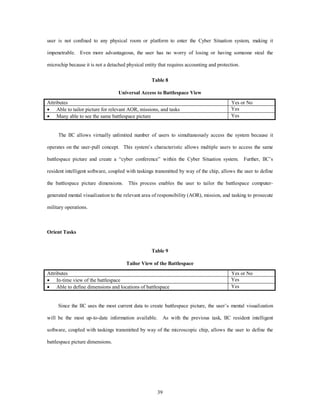
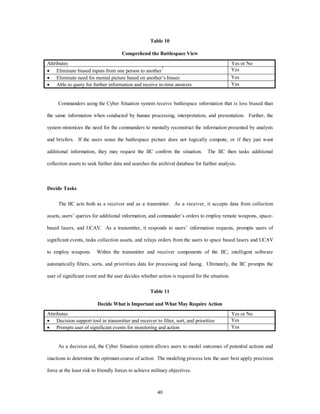
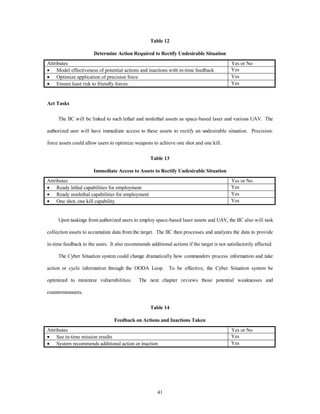
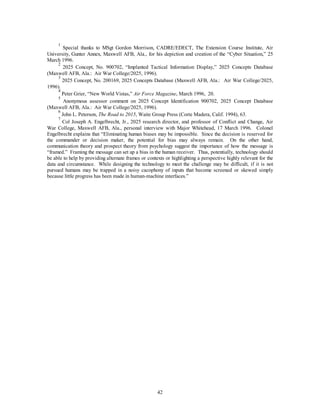
The following tables (tables 1 to 4) list tasks and attributes of each OODA Loop function to 
demonstrate what should be integrated to enable commanders to control momentum. The objective is to use
the tasks and attributes as measures for how effectively both individual functions and the integrated OODA 
Loop operates when 2025 technology is applied. Further, the tasks and how attributes serve as measures of 
merit to determine which technologies discussed in the next chapter meet the requirements to achieve OODA 
Loop integration. Ultimately, the evolving technologies that rate best seem most appropriate to pursue for 
9 
system development. 
Table 1 
Observe Tasks and Attributes 
Task Attributes 
See the battlespace ·  Fused, integrated, deconflicted view of the desired battlespace 
·  Sum of all possible information sources 
·  System identification of information gaps and subsequent collection of 
missing information 
Maintain mobile 
battlespace view 
·  Able to pull updated view anytime, anywhere 
·  Easily deployable and transportable with user 
Universal access to 
battlespace view 
·  Able to tailor picture for relevant AOR, missions, and tasks 
·  Many able to see the same battlespace picture 
Table 2 
Orient Tasks and Attributes 
Tasks Attributes 
Tailor view of the 
battlespace 
·  In-time view of the battlespace 
·  Able to define dimensions and locations of battlespace 
Comprehend the 
battlespace view 
·  Eliminate biased inputs from one person to another 
·  Eliminate need for mental picture based on another’s biases 
·  Able to query for further information; receive in-time answers 
Table 3 
Decide Tasks and Attributes 
Task Attributes 
Decide what is important 
and what may require 
action 
·  Decision support tool in transmitter and receiver to filter, sort, and 
prioritize 
·  Prompts user of significant events for monitoring and action 
Determine action required 
to rectify undesirable 
situation 
·  Model effectiveness of potential actions and inactions with in-time 
feedback 
·  Optimize application of precision force 
·  Ensure least risk to friendly forces
Table 4 
Act Tasks and Attributes 
Tasks Attributes 
10 
Immediate access to 
assets to rectify 
undesirable situation 
·  Ready lethal capabilities for employment 
·  Ready nonlethal capabilities for employment 
·  One shot, one kill capability 
Feedback on actions and 
inactions taken 
·  See in-time mission results 
·  System recommends additional action or inaction 
Notes 
1 The concept of a “blue print” has guided US Air Force modernization in the past. Gen Ronald 
Fogleman, chief of staff, US Air Force, stated in a lecture delivered to the 2025 project participants at Air 
University, Maxwell AFB, Alabama, 13 February 1996: “Force Modernization is the blue print for [today’s 
tenets of] Global Reach and Global Power. Our strategic vision remains containment through deterrence.” 
To actualize this vision, the Air Force reorganized into Air Mobility Command (Global Reach) and Air 
Combat Command (Global Power). Further, the 1990s witnessed the Air Force leadership promote the C-17 
as the key short-term solution for Global Reach, and the F-22 for Global Power. 
2 Dr Sheila E. Widnall and Gen Ronald R. Fogelman, Cornerstones of Information Warfare 
(Washington, D. C.: 1995), 3. 
3Fadok, 2. 
4 First Lieutenant Gary A. Vincent, Operational Structures, vol. 5, In the Loop: Superiority in 
Command and Control (Maxwell AFB, Ala.: Air University Press, November 1995), 291. 
5 Fukuyama. 
6 Jeffrey McKitrick et al., The Revolution in Military Affairs, Air War College Studies in National 
Security: Battlefield of the Future, no. 3 (Maxwell AFB, Ala.: Air University Press, September 1995), 65– 
97. 
7 Herbert A. Simon, Administrative Behavior: A Study of Decision-Making Processes in 
Administrative Organization (New York: The Free Press, 1976), 38–41. 
8 Lt Col Michael L. McGinnis and Maj George F. Stone III, “Decision Support Technology,” Military 
Review 74, no. 11 (November 1994): 68. 
9 Col Richard Szafranski and Col Joseph A. Engelbrecht, Jr., “The Structure of the Revolution: 
Demystifying the RMA” (Unpublished paper, March 1996), 6–7. The authors used the term momentum 
control to explain time. However, “time is more than speed. It is the attribute of controlled timing or 
modulating momentum.” See also endnote 10, this chapter. 
10 Ralph D. Sawyer, The Seven Military Classics of Ancient China (Boulder, Col.: Westview Press, 
1993), 442. The concept and description of “momentum control” was derived from the Chinese term, chieh, 
translated as “constraints,” which is commonly used to indicate constraints or measures imposed on troops. 
The term lacks a satisfactory English translation because it encompasses the concepts of “control,” “timing,” 
and “measure.” See also endnote 9, this chapter. 
11 Ibid. 
12 Szafranski and Engelbrecht, 6–7.
Chapter 3 
Technology Investigation 
What the warrior needs: a fused real-time, true representation of the warrior’s 
battlespace and the ability to order, respond, and coordinate horizontally and vertically 
to the degree necessary to prosecute his mission in that battlespace. 
11 
—Adm Richard C. Macke 
C4I for the Warrior 
In 1992 Adm Richard C. Macke understood what war fighters since Alexander the Great wanted. 
Information operations is a legitimate and increasingly important military mission that seeks to satisfy 
Admiral Macke’s requirement.1 Perfecting this capability should allow US military leaders to achieve 
information dominance and control the momentum of military operations. This vision does not merely 
provide information, but also empowers users with the ability to leverage information to conduct warfare. 
This paper refers to this vision as the Cyber Situation. The Cyber Situation is necessary for the US military 
to maintain its competitive edge against future adversaries. 
Technology will provide the means to achieve a complete battlespace picture and the ability to affect it 
instantly with the Cyber Situation concept. This chapter lays the technological foundation which could 
achieve this capability. Five broad technology areas should contribute to reaching this goal. Some solutions 
appear to be evolutionary; some will likely be wildcards—scientifically plausible achievements that will 
require a technology leap.2 While this chapter describes the technologies, the next chapter applies these 
technologies and assesses their contribution to a single system to achieve the Cyber Situation vision. 
The Cyber Situation will require five technology areas to evolve and synergize by 2025 to achieve 
OODA Loop integration. First, collection platforms should provide a detailed global awareness, giving 
decision makers a complete situational picture.3 This parallels the observe function of OODA. Second,
communications systems should advance to allow in-time access to virtually any available database. 
Communications will permit information flow around the loop. Third, computer-processing power and, 
fourth, intelligent software will provide the ability to integrate and correlate disparate types and sources of 
information and aid in decision making, contributing to the orient and decide functions. Fifth, human systems 
and biotechnology advancements will make the man-computer interface seamless. The end result should be 
an improved ability to access and direct weapons.4 Figure 3-1 illustrates these essential technologies. 
Cyber Situation Vision 
12 
Collection 
System 
Communications 
Architecture 
Human Systems 
& Biotechnology 
Intelligent 
Computer Software 
Processing 
Power 
Source: Microsoft Clipart GalleryÓ 1995, courtesy of Microsoft Corporation. 
Figure 3-1. Battlespace Vision Key Components 
The following sections address each of these broad technology areas. Within each section, the 
discussion first relates the particular technology to the required capability in terms of the OODA tasks and 
attributes (tables 1 through 4). Next, it assesses the current state of the technology and notes which are on 
evolutionary or revolutionary tracks. It then evaluates various research and development (R&D) trends, 
focusing on the time and cost needed to achieve the desired technological capability. Most of the
development will be in the commercial arena. Special recognition will be made for those developments that 
13 
require a military investment. 
Collection Platforms 
Collection is the process of capturing information from all sources to present an in-time “picture” of the 
battlespace. In this case, picture refers to more than an image. It is all surveillance and reconnaissance data, 
including imagery, signals intelligence, weather data, aircraft radar navigation equipment transmissions, 
cellular telephones and communications devices intercepts, and data in-transit between computers. The list 
is virtually endless. All information is potentially useful to the Cyber Situation. However, it is not this 
paper’s purpose to exhaustively review all collection technologies. Rather, it will focus on the platforms 
from which the data and intelligence is received. 
Presently, overhead and air-breathing assets collect information. Overhead assets refers to satellite-based 
systems. They include surveillance, reconnaissance, and target acquisition systems as well as 
environmental monitoring assets.5 While many are classified programs, civil and commercial agencies are 
increasingly able to collect more timely and detailed data. This is particularly true for such environmental 
monitoring satellites as the French SPOT satellite which can provide multispectral imagery with 10 meter 
resolution.6 Air-breathing assets are aircraft, manned or unmanned. 
By 2025 collection platforms will exploit the complete electro-optical frequency spectra. Some 
systems will be deployed for long-durations. These systems will observe such standing requirements as 
military communications traffic, logistics, and computer interfaces. Some of this capability currently exists. 
However, the military still lacks sufficiently broad coverage.7 Other systems may be used on a contingency 
basis. These systems will use two emerging technologies: miniaturized satellites and uninhibited 
reconnaissance aerial vehicles (URAV). 
Miniature Satellites 
The most compelling satellite technologies advances include miniaturization and decreased launch 
expense.8 These two complementary advances are important to the system effectiveness of the Cyber
Situation. Increased miniaturization of individual satellites allows for less costly construction per unit and 
easier deployment while at the same time making them harder to detect and track. Miniature satellite 
constellations have great applicability in terms of flexibility and deployability. 
Miniature satellites could fill coverage gaps to supplement long-duration systems. The miniature 
satellite constellations would carry payloads optimized for specific contingencies. The payloads may focus 
on specific static, mobile, or moving targets. This option offers a compelling, inexpensive, and rapidly 
deployable solution to “customize” collection efforts to meet the contingency needs.9 The satellites may be 
14 
constructed en masse and be on hot alert. 
While decreased cost for space access is forecasted, miniature satellites are unlikely to garner 
significant commercial investment. This is not to say miniature components will not be commercially 
available. Commercial technology initiatives will shrink everything from the solar panels and batteries to the 
sensors. However, the military must press forward with the R&D to package miniature satellites and make 
them available for immediate use. 
Uninhabited Reconnaissance Aerospace Vehicles 
The other emerging technology area for collection platforms is URAV. These systems would provide 
the data not accessible to either the long-duration assets or the miniature satellite constellations. URAV 
would reduce the risk inherent in manned collection platforms and allow the flexibility to maneuver rapidly 
to specific locations which may be obscured from space-based sensors.10 
The Department of Defense has operated URAV since the Vietnam conflict. Their usefulness will push 
development of less costly, more reliable, and more flexible systems.11 One area of flexibility will include 
more varied sensors that collect all-source information. This area will predominately require military R&D. 
The combination of deployed long-duration satellites, small satellites, and URAV could enable the 
military to achieve broad coverage of an area of interest virtually all of the time, thus providing the user the 
most updated Cyber Situation possible.
Communication Infrastructure 
To achieve information dominance requires high-capacity, secure, accurate, reliable, robust, and easy-to- 
use communications. Indeed, data and information movement is the track upon which the decision cycle 
runs. A highly mobile war fighter must be able to maintain an in-time “picture” of the battlespace, formed by 
vast amounts of information from multiple sources. The user must also be able to communicate with others 
who are observing the same battlespace picture. Of particular importance is the ability to access and direct 
15 
weapons at a moment’s notice. 
Communications must work anywhere and everywhere. Current limitations include narrow bandwidths 
and insufficient ground-based and satellite infrastructure. In 2025 these limitations will likely be resolved as 
bandwidth and communications capacities continue to expand.12 
Although bandwidth is a limiting factor, it has grown dramatically in the last 10 years. The key 
breakthrough was fiber-optic cabling, which geometrically increased available information flow. Economics 
drove the development of fiber-optic capability. The marketplace demanded increased throughput, and the 
private sector responded with a quantum leap over twisted pair (copper wire) technology. Demand will 
continue to push increased access throughout the country and around the world.13 Fiber-optic cable will 
likely be the predominant communication carrier for the foreseeable future, although wireless and satellite 
communications connectivity also will be required.14 
Satellite communications are tremendously important because of the need to move large amounts of the 
information from collection platforms. Current capabilities are inadequate to provide full connectivity and 
functionality to provide coverage for any given desired place and time. Here, too, technology advances will 
greatly enhance and improve the ability to move vast amounts of data quickly. 
As noted in the previous section, the most compelling satellite technologies advances include 
miniaturization and decreased launch expense. A significant amount of work has already has been done on 
the miniaturization of relay and broadcast satellites. To date, experiments have centered on deploying these 
small satellites over a location where the telecommunications infrastructure is lacking.15 
On the ground, direct broadcast satellite (DBS) technology use will release commanders and decision 
makers from the bonds of landlines. It is a fully man-portable satellite receive and transmit ground station.
DBS is commercially available at reasonable cost. DBS groundstations will be able to accommodate large 
bandwidth and be fully deployable.16 This is a distinct advantage in terms of flexibility for decision makers 
at all levels. DBS technology allows on-scene commanders to forward in-time inputs through the system and 
up the chain of command. Future DBS technology will continue to advance and miniaturize, producing 
greater capabilities in smaller packages. One challenge is to be able to provide portable power that is not a 
weight and size burden. Nevertheless, the commercial industry will produce miniaturized, low-power 
communication devices. As this type of technology improves, DBS might allow human links to satellites. 
The human body could potentially become a part of the system. “With a little digital help, people’s ears 
16 
could work just as well as ‘rabbit ears.’”17 
Mission accomplishment requires the communications architecture to accurately transmit complete 
media spectra. More important is the Cyber Situation’s need for secure communications. This is a broad 
category requiring a more detailed discussion. 
Security 
Since security affects all elements of the OODA Loop, it is best addressed under the communications 
section. Data must be secured in three different areas: storage, transmission, and dissemination. 
Because of the tremendous storage capacity required, archival databases likely will be secured much as 
they are now, in a vaulted building on shielded media (magnetic, or some evolutionary storage media not yet 
developed). Storage is discussed in the computer power section below. 
The compromise potential is much higher during data transmission, occurs during information collection 
and routing by way of communications infrastructures. Resident safeguards must protect transmissions from 
interruption and intercept. Experts expect that this should be easily attained by way of commercially 
available encryption packages that are nearly unbreakable.18 
The final security concern involves the process to retrieve, display, and use data. Dissemination 
security exists to ensure that only those with the appropriate access and need-to-know may use the most 
sensitive databases. Some promising technologies are already used in this area. Among the most viable are 
retinal scanners and fingerprint validation technologies developed by the private sector.19
Technology could plausibly lead to the use of deoxyribonucleic acid (DNA) samples to validate 
individual access requirements. The validation system will include each user’s DNA imprints, which must 
be checked before the system allows access. Today, this technology is in its infancy, but, will continue to 
evolve and likely become the fool-proof way to validate user authenticity for access and employment. 
The second type of dissemination security involves technology known as multilevel security (MLS) 
network management.20 Upon entering an information system, the system grants access based on the user’s 
authorization. Ideally, MLS allows users with various classification levels to share the same communication 
architecture and even the same sensors. The difference lies in what each user is able to access in each 
situation. Since the mid-1980s, the civilian and military communities have conducted R&D in MLS 
technology. However, the state of technology does not currently allow ideal MLS use. It is reasonable to 
17 
expect a perfected system by 2025.21 
Communications Wrap-Up 
In large measures, the commercial and military communities already have established necessary 
communications infrastructure with the National Information Infrastructure (NII) and the Military Information 
Infrastructure (MII). Both NII and MII are structured to move information in the most expeditious manner, 
taking advantage of the best of commercial and military communications links. “The MII must able to adapt 
to unforeseen circumstances, whether induced by the military or by the commercial world. . . It becomes 
more important to learn to use existing and emerging capabilities in the domain of military applications than it 
is to develop the capabilities themselves.”22 Thus, the groundwork is already laid for expansion and 
evolution. 
Nevertheless, to fully achieve the 2025 Cyber Situation, a global infrastructure must provide the user a 
desired view anywhere on earth. Therefore, the 2025 information infrastructure must incorporate both NII 
and MII—leading to a Global Information Infrastructure (GII).23 
Effective communications architectures must be robust to accommodate the considerable bandwidth 
requirements and to harness the full capability of military and civilian communications advances. This leads 
to the next topic, computer power.
Computer Power 
If communications is the track on which the OODA Loop runs, powerful computers is the engines 
pulling the train. Computers will play a key role in any decision support system to integrate the collected 
data and present it for orientation and decision making. 
Powerful computers with massive storage capacity will be essential in the Cyber Situation. 
Fortunately, the rapid increases in processing speed and storage, combined with decreased size and energy 
18 
consumption, will likely continue unabated.24 
While silicon circuit technology remains viable for the near future, eventually the number of circuits that 
can be etched will reach a limit.25 However, researchers are pursuing alternative technologies that should 
result in even more amazing improvements. They include such exotic concepts as quantum dots and 
nanomechanical gates.26 
Biological computing is another promising field which might yield a potential thousandfold 
computational improvement for one ten-millionth the energy.27 The concept includes using genetic material 
from insects to self-assemble into computing elements. House flies and grasshoppers have pattern-recognition 
abilities which could be applied directly for military and commercial purposes, including 
cryptography and navigational computation. Initial payoffs to molecular biology computing research may 
occur in five to 10 years, especially for sensor applications.28 
Increased speed requires improved data storage media. Again, research shows promise. Holographic 
memory may allow storage of 64 billion bits on a crystal the size of a compact disk. Activated by a small 
laser, a single “disk” could contain over 600 hours of music or 30 million pages of double-spaced, 
typewritten text.29 Since the data is contained in the laser, it makes it easy to transmit in optical cable as 
well.30 
Clearly, by 2025 nearly infinite computations with unlimited storage will be available on tiny machines. 
It should come with negligible military investment although the New World Vistas (NWV) Information 
Technology Panel warns that defense should continue to fund basic research to keep the “pump primed,” else 
risk less innovation as private research focuses on highly directed problems.31 However, the challenges of
storage capacity and capability are not the only areas where researchers are trying to stretch the limits. More 
importantly are increasing the cognitive abilities of the software running on these powerful machines. 
Intelligent Software 
The most important technology area is the continued advancement of intelligent software. The previous 
technologies explained how vast quantities of information will be readily available to the war fighter. 
Without some assistance in managing the load, the commander will suffer from information overload. 
Intelligent software is broadly defined as the component programs and algorithms executing on various 
computer systems. While primarily related to the human’s use of the program, it also may operate 
independently of the user. For example, the collection systems will be able to recognize and identify 
features, identify information gaps and task a sensor to “fill in the gap,” fuse multiple data sources to present 
an integrated picture, and prompt a user of significant events, all without human assistance. Other software 
agents will respond to human taskings or augment humans in decision processes.32 Attributes include the 
ability to organize and interpret information, simulate and model potential actions, weigh alternatives, and 
19 
recommend courses of action. 
The following paradigm applies for all intelligent systems (biological or computational). This 
paradigm helps identify and measure the broad intelligent software tools needed for the Cyber Situation. 
All intelligent systems continuously engage in five activities: 
. They perceive the world. 
. They interpret their perceptions in light of their knowledge of the world. 
. They make plans based on their current model of the world. 
. They act within the world in order to achieve their goals. 
. They communicate with other agents to share perceptions and collaborate on 
execution (emphasis added).33 
Note the elements of Boyd’s OODA Loop in this concept. Many of today’s experts envision 
technological advances will occur in all activities to assist the decision maker. Indeed, the Cyber Situation 
assumes double-leap improvements in the ability to observe, act, and communicate. The concept focuses on 
the interpretation and planning activities and how to make the best use of information to plan and execute a 
military operation.
Intelligent software can be broken down into four broad core technologies:34 
20 
Image Understanding 
Image understanding (IU) seeks to develop mechanisms to create a “description” of the world from 
sensor images, suitable for particular purposes. The challenge is identification “despite object occlusion, 
shadows, reflections, and other disturbances.”35 Applying contextual information may be one mechanism to 
improve the IU process. 
IU is a key technology because the Cyber Situation must generate and communicate situational 
awareness to the user. Within five years, the DOD’s Advanced Research Project Agency (ARPA) expects 
“to carry out applications-directed research on machine vision, provide a suitable IU software environment, 
and further develop IU capabilities for specific applications.” The long-term goal is to “develop 
computational theories and techniques for use in artificial vision systems whose performance matches or 
exceeds that of humans, exploiting sensing throughout the breadth of the electromagnetic spectrum, in all 
environments.”36 Commercial applications include industrial part recognition, visual inspection systems, 
and indoor robot navigation. However, because of the predominance of military applications, this is a 
technology requiring DOD investment. 
Intelligent Integration of Information 
Intelligent integration of information (I3) is the technology to “intelligently process, compile, and 
abstract useful knowledge from multiple data sources with different interfaces, query languages, data 
structures, terminology, and semantics.”37 This ability has applications throughout the Cyber Situation. I3 is 
needed to provide the fused, deconflicted view of the battlespace. 
Many valuable applications have been developed. An example is the Air Campaign Planning Tool 
where planners can now locate high-priority targets in a fraction of the time previously required.38 
However, much work remains to achieve large-scale applications which abstract data from the entire GII. 
Although commercial applications will push the technology (resulting, for example, in personal assistant
agents sorting increasing amounts of daily electronic mail), 39 the military must invest to obtain the ability to 
index and then retrieve images based on military semantics. 40 
21 
Planning and Decision Aids 
Planning and decision aids (PDA) tools develop representation and reasoning techniques to generate 
and analyze plans and schedules. These tools are necessary to help the user (or users) make correct and 
timely decisions, thus deconflicting information overload. The tools will “reduce problem solving time by 
orders of magnitude while at the same time increasing the number of options considered by orders of 
magnitude.”41 
The concept of PDAs is well understood, as it is simply an implementation of such decision theories as 
linear programming and quantitative analysis. What is new is the ability to employ these techniques on a 
high-speed computer. Many techniques already exist, both in private and military use. One example is the 
Dynamic Analysis and Replanning Tool which was used in Desert Storm.42 Commercial applications, both 
executive and group support systems, also are being adapted for military use. The military must focus on 
ensuring more than one user can use them simultaneously and that the tools capture the planning rationale.43 
Human Computer Interaction 
Human computer interaction (HCI) will “develop techniques and environments to provide informative, 
intuitive, and taskable access and control over complex software.”44 This environment is another key area 
for the Cyber Situation--being able to “interact in a natural fashion with speech, gesture, and other advanced 
interaction techniques.” Eventually, it should include brain activated control. A goal is for many users able 
to interact over computer networks. 
Initially, human language system advances will be where the most significant work is done. However, 
the NWV Information Technology Panel suggest handwriting recognition will become prevalent as well as 
speech recognition capabilities within 10 years. While the currently dominant keyboard-display-mouse 
configuration will remain, newer generations of users will become more comfortable with more natural 
interfaces. By 2025 technology will have matured such that handheld, portable “personal assistants” will be
available. Additionally, virtual and augmented reality systems and telepresence models also will be in use. 
Telepresence models allow a human access to otherwise inaccessible locations. Applications include 
microsurgery, space system repair, and microelectronic machine assembly.45 
The NWV Human Systems and Biotechnology Panel describes neuroscience as a promising research 
area. As science improves our understanding of the brain and how it functions, it makes it possible to direct 
equipment to respond to our thoughts, without any verbal or written command. Already, preliminary research 
using an 128-sensor array electroencephalograph (EEG) pressed against a subject’s skull can “influence 
information content and display designs on a computer screen.46 This concept is discussed further in the next 
section. Commercial and medical organizations will take the lead in developing this technology. 
22 
Neuroscience developments will continue. 
Human Systems and Biotechnology 
The human-computer systems integration is a vital lead-in to the final technology area. Human systems 
and biotechnology offers the potential to create a seamless flow of information between human and computer. 
By exploiting the human cognitive process, it can be tailor information to present precisely what is needed. 
This section is divided into two parts. The first is understanding information flowing to and from the 
brain. The second is how to present that data using visual-imaging techniques. Mastering these technologies 
will allow users to select information for direct input into their brains. However, regardless of how 
advanced a decision system becomes, a human will be in the loop. The best technology can only help, but in 
the end, the person, not the machine, ultimately makes the decision. 
Charting the Brain 
Thirty years ago little was known about the brain. Great advances have been made in the last 10 years, 
and much has been learned about information flow out of the brain and the way it interacts with the neural 
network.47 Understanding how information enters the brain and how it is processed will form the foundation 
for the ultimate in human-computer interface. “Success in transducing and translating brain waves allows
people to interface with specific systems, perhaps sensed through transducers in a headband or another such 
23 
brain-machine connection.”48 
Two research areas are critical to the human computer interface. The first of these is, charting and 
understanding information flow out of the brain. The second, and more applicable, is information flow into 
the brain. Understanding of human systems such will enable more rapid processing of data and more efficient 
use of the provided information. 
Charting information out of the brain is a complex effort. However, much work has been done in this 
area.49 Mechanical methods have been fielded to emulate, and in some case replicate, these complex 
processes.50 Intelligent materials, including fiber-optics and piezioelectric materials, are two techniques 
under development to try to replace damaged or destroyed neuron-actuation sensor networks in humans.51 
In principle, data flowing out of the brain is in the form of electronic impulses which actuate the 
neurostructure within humans.52 Recent research has charted the source of some basic impulses within the 
brain, identified precisely what neuron network is actuated by electric impulses, and determined what action 
is completed by the network.53 
Charting information flow into the brain and how the brain processes it once inside is even more 
difficult. This effort requires understanding how the brain formats the data to make decisions. Each human’s 
information process is unique, based on such factors as experiences, learning, intelligence, and personal 
biases.54 Science is attempting to understand the commonalities between humans.55 Some work has been 
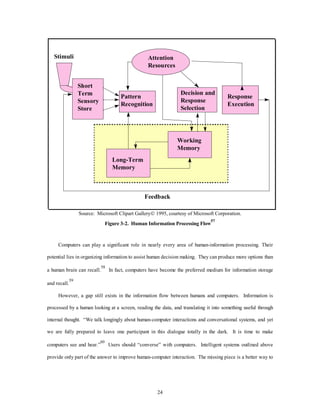
done to chart the essentials of human information processing fig. 3-2.56
Attention 
Resources 
24 
Stimuli 
Short 
Term 
Sensory 
Store 
Pattern 
Recognition 
Decision and 
Response 
Selection 
Response 
Execution 
Working 
Memory 
Long-Term 
Memory 
Feedback 
Source: Microsoft Clipart GalleryÓ 1995, courtesy of Microsoft Corporation. 
Figure 3-2. Human Information Processing Flow57 
Computers can play a significant role in nearly every area of human-information processing. Their 
potential lies in organizing information to assist human decision making. They can produce more options than 
a human brain can recall.58 In fact, computers have become the preferred medium for information storage 
and recall.59 
However, a gap still exists in the information flow between humans and computers. Information is 
processed by a human looking at a screen, reading the data, and translating it into something useful through 
internal thought. “We talk longingly about human-computer interactions and conversational systems, and yet 
we are fully prepared to leave one participant in this dialogue totally in the dark. It is time to make 
computers see and hear.”60 Users should “converse” with computers. Intelligent systems outlined above 
provide only part of the answer to improve human-computer interaction. The missing piece is a better way to
format and transmit information from the digital computer processor in the computer chip to the analog human 
25 
processor in the human brain. 
Instead of formatting a cathode ray tube (CRT) to more easily access and display data, a computer can 
be designed and programmed to bypass the CRT and format information which can be immediately processed 
by the brain. The logical extension would be to place the human computer interface directly in the brain. 
Some significant progress already has been made in this area by the Stanford University research center and 
their development of a nerve chip. 
It is an electronic interface for individual nerve cells to communicate with a computer. 
This human-machine linkage will. . . enhance human capability in many ways. If artificial 
eyes can convert video to nerve signals, won’t it be possible to use the same technique to 
superimpose computer-generated information in front of one’s field of view?61 
This capability will have extraordinary commercial applications from medical advances. These 
advances will help restore patients with damaged neural, audio, and visual systems as well as enable 
individuals to achieve the “ultimate virtual reality trip.”62 
Visualization and Mental Imaging 
This second broad category encompasses a realm of the cyberspace essential to the concept. 
Developing technologies are based around the idea of virtual projection systems that evolve into holographic 
image projection. The National Center for Supercomputing Applications Virtual Reality Laboratory “is a 
research facility engaged in the exploration of new methods of visualizing an interfacing with scientific data 
and simulations.”63 To further their objectives, they have created the CAVE a “surround-screen surround-sound, 
projection-based virtual reality system.” 64 Multiple participants can enter the CAVE and interact by 
wearing stereo glasses rather than a helmet. “The CAVE can be coupled to remote data sources, super 
computers and scientific instruments via high-speed networks.”65 The NWV Information Technology Panel 
considers significant virtual reality advancements in the next 10 to 20 years. However, the display 
mechanism will primarily involve a helmet. 
Commercial applications are easy to envision, witness the growing entertainment market for virtual 
reality games. This appears to be the next step from video teleconferencing. Another useful application will
be for training systems—especially simulations.66 This has wide commercial applications, especially as 
future systems will require such high-knowledge levels to use them as transportation and manufacturing. 
A more specific military application of this type of technology is the DOD simulation network 
(SimNet). This capability allows a simulator to emulate a battlefield precisely. Trainees sit in their own 
aircraft or tank simulator and are able to “view” the battlefield from their own perspective. “Army tankers in 
trainers in Fort Knox can look out of their sites and see the same location—only from each of their individual 
perspectives. Air Force pilots in California can ‘fly’ missions . . . at the same time.”67 
A combination of brain processes and visual imaging already has been developed in the laboratory. 
The California Institute of Technology has developed an energy efficient computer chip which emulates the 
analog thinking of the human brain. It is specifically modeled on the construction of the human brain, 
specifically the cerebral cortex.68 When this capability is fully mature, this chip could provide the baseline 
for a brain implant hooked to the all the sensory segments of the brain, not just the eye. 
Bringing It Altogether--The Nexus 
While each technology area will progress at a unique rate, the challenge is to bring them together to 
26 
reach their synergistic peak--the nexus (fig. 3-3).
Collection 
Communications 
27 
Computing 
Power 
Intelligent 
Software 
TIME 
TECHNOLOGY 
NEXUS 
Human 
Systems & 
Biotechnology 
1996 2025 
Source: Microsoft Clipart GalleryÓ 1995, courtesy of Microsoft Corporation. 
Figure 3-3. Development Lines for System Elements 
Collection. Collection capability will be complete when there is no want of information. The various 
constellations of permanent satellites complimented by the mini satellites will provide coverage of the entire 
world in every spectrum. Collection development should continue to grow until about 2015, when the 
complete link between the small satellites and the permanent constellations should be seamless, and the small 
satellite development will be commensurate with the requirements.69 
Communications. Communications capacity will peak when the entire globe is accessible at all times 
and there is absolutely no restriction on the size or type of transmission available to the customer. The web of 
commercial, government, and military networks will be seamless, and only the speed of light will delay 
information movement. There is much effort underway, both in the commercial and military sector, to 
achieve this connectivity. Development of new systems and new capabilities should reach this goal by 
2010.70
Computing power. Computing power will continue to grow in capacity, doubling every 18 months for 
the near term.71 As noted, analysts have frequently thought the silicon chip had reached its maximum 
capacity, then discovered through increased micronization that more capacity could be obtained. However, 
most analysts believe that the silicon chip will hit its peak between 2015 and 2020.72 If true, R&D efforts 
will continue to search for other media to store and process data. 
Intelligent Software. Intelligent software is increasing in its availability but has yet to fully meet the 
requirements of the Cyber Situation. More effort is required to allow full capability of intelligent systems 
and bring that technology to bear on an advanced decision tool. Current intelligent software development is 
not well articulated, and the specific capability of the software is left to systems designers and engineers 
meeting the demands of a specific program.73 Thus, much of the development of intelligent systems is linear 
and relates only to the requirements of a specific program. Such a design is not conducive to interaction and 
28 
broader application. 
Human Systems and Biotechnology. This area requires the most work to achieve the Cyber Situation. 
Work is expected to continue at a modest pace until a breakthrough in the this technology is achieved.74 Like 
many advanced research areas, work here will require one big leap over a single chasm. In this case, the 
chasm is understanding the way information is formatted in the brain and how it is used. Once this chasm is 
achieved, progress in human computer interaction will grow exponentially and quickly catch up with the 
other technology areas. 
By 2025 the five technology areas will be effectively linked to develop the Cyber Situation to enable 
commanders to achieve information dominance. The next chapter will describe the Cyber Situation system, 
its components, and how it meets the attributes of the OODA Loop tasks. 
Notes 
1 Widnall and Fogleman, Cornerstones on Information Warfare, 11. 
2 John L. Peterson, The Road to 2015: Profiles of the Future (Corte Madera, Calif.: Waite Group 
Press, 1994), 288. Peterson states, “Wild cards have a low probability of occurrence but a very high 
impact.”
3 USAF Scientific Advisory Board, New World Vistas: Air and Space Power for the 21st Century 
(unpublished draft, the information applications volume, 15 December 1995), 68. 
4 
New World Vistas, (unpublished draft, the human systems and biotechnology volume), 8. 
5 Army Space Institute, Theater Air Campaign Studies, vol. 8, Space Support in Mid-Intensity 
Conflict (Maxwell AFB, Ala.: Air University Press, 1995), 306–9. 
6 Ibid., 308. 
7 
New World Vistas, (unpublished draft, the information technology volume), 85. 
8 Nicholas Negroponte, Being Digital (New York: Vintage Books, 1995), 35–36. 
9 Lt Col Henry Baird et al., “Spacelift” (Unpublished 2025 research paper, Air University, Maxwell 
AFB, Ala., April 1996); 2025 Concept, No. 900552, “On-demand Tactical Recce Satellite Constellation,” 
2025 Concepts Database (Maxwell AFB, Ala.: Air War College/2025, 1996). 
10 Numerous 2025 Concepts dealt with this technology to include: 
2025 Concept, No. 900272, “Very High Altitude Balloon-Borne Systems,” 2025 Concepts Database 
(Maxwell AFB, Ala.: Air War College/2025, 1996); 2025 Concept, No. 900280, “Fly on the Wall,” No. 
900434, “Airborne Sound Sensors,” 2025 Concepts Database,(Maxwell AFB, Ala.: Air War College/2025, 
1996); 2025 Concept, No. 900438, “Ultraendurance High-Altitude Ocean Loitering Uninhabited 
Reconnaissance Vehicle,” 2025 Concepts Database (Maxwell AFB, Ala.: Air War College/2025, 1996); 
2025 Concept, No. 900517, “JSTARS Replacement,” 2025 Concepts Database,(Maxwell AFB, Ala.: Air 
War College/2025, 1996); and 2025 Concept, No. 900604, “UAV Constellations,” 2025 Concepts Database 
(Maxwell AFB, Ala.: Air War College/2025, 1996). 
11 Lt Col Bruce Carmichael et al., “StrikeStar 2025” (Unpublished 2025 research paper, Air 
University, Maxwell AFB, Ala., April 1996), 94-95. Particularly, the appendix describes the historical 
reliability problems with UAV. 
12 Alvin and Heidi Toffler, War and Anti War (New York: Warner Books, 1993), 90–91. 
13 Negroponte, 21–36. 
14 
New World Vistas, (unpublished draft, the information applications volume), 32–46. 
15 A senior US Air Force policymaker lecture given to the 2025 Study Group under the promise of 
29 
nonattribution 
16 
Aleksandar Kolarov and Joseph Hui, “Least Cost Routing in Multiple-Service Networks: Part II,” 
On-line, Internet, September 1995, available from 
http://www.research.att.com/hgs/infocom95/program.html. 
17 Negroponte, 211. 
18 
New World Vistas, (unpublished draft, the information technology volume), C-3. 
19 There are several different authentication technologies. The retinal (eye) scanner is currently used at 
Falcon AFB, Colorado. 
20 Makoto Takano and Katsumi Fujita, “Multilevel Network Management by Means of System 
Identification,” On-line, Internet, September 1995 available from 
http://www.research.att.com/hgs/infocom95/program.html. 
21 Charles Kalmanek and K.G. Ramakrighnan, Third International Telecommunications Symposium, 
“On-line Routing for Virtual Private Networks,” On-line, Internet, September1995, available from 
http://www.research.att.com/hgs/infocom95/program.html; Lt Col James McMillan, Air Force Liaison to 
National Security Agency, telephone interview by Maj Scott Bethel, 26 February 1996. MLS has been a 
long-standing DOD problem both in the US only (collateral versus SCI) and in releasing data to foreign 
nationals. The main problem is with data at different classification levels using the same communication 
architecture: how to prevent inadvertent or targeted database access at a higher classification level through 
lower channels. 
22 
New World Vistas, (unpublished draft, the information applications volume), 52. 
23 Institute for National Strategic Studies, Strategic Assessment 1995: US Security Challenges in 
Transition (Washington, D. C.: National Defense University Press, November 1994), 151.
24 
New World Vistas, (unpublished draft, the information technology volume), 1, 87–90. 
Peterson, 28–30. 
David A. Patterson, “Microprocessors in 2020,” Scientific American 273, no. 3 (September 1995): 
30 
48–51. 
25 
New World Vistas, (unpublished draft, the information technology volume), 87. 
26 Patterson, 51. 
27 Clarence A. Robinson, “Molecular Biology Computation Captures International Research,” Signal 
50, no. 6 (February 1996): 17–21; Thomas A. Bass, “Gene Genie,” Wired (August 95): 114–17, 164–68. 
28 Robinson, 21. 
29 Demetri Psaltis and Fai Mok, “Holographic Memories,” Scientific American 273, no. 5 (November 
1995): 70-76. 
30 
New World Vistas, (unpublished draft, the information technology volume), 24. This document 
suggests “the communications laser will replace the microprocessor as the key enabling technology shaping 
the personal computer industry.” 
31 Ibid., 29. The document also suggests battery performance may be a limiting factor. 
32 Advanced Research Program Agency, “The SISTO Solution: Intelligent Software Systems,” On-line, 
Internet, 23 July 1995, available from http://www.arpa.mil/sisto/Overview/Solution.hmtl. SISTO is the 
Software and Intelligent Systems Office of the Advanced Research Program Agency. 
33 Ibid. 
34 Advanced Research Program Agency, “Intelligent Systems,” On-line, Internet, 23 July 1995, 
available from http://www.arpa.mil/sisto/Overview/Intel_Thrust.html. 
35 Oscar Firschein and Thomas Strat, “Image Understanding Program,” On-line, Internet, 23 July 1995, 
available from http://www.arpa.mil/sisto/Overview/Image.html. 
36 Ibid. 
37 David Gunning, “Intelligent Integration of Information (I3),” On-line, Internet, 23 July 1995, 
available from http://www.arpa.mil/sisto/I3.html. 
38 Ibid. 
39 
New World Vistas, (unpublished draft, the information technology volume), 38-44. 
40 Ibid., 13. 
41 Dr Tom Garvey, “Planning and Decision Aids Program,” On-line, Internet, 23 July 1995, available 
from http://www.arpa.mil/sisto/PDA.html. 
42 Ibid. 
43 
New World Vistas, (unpublished draft, the information technology volume), 13. 
44 Allen Sears and Robert Neches, “Human Computer Interaction Program,” On-line, Internet, 23 July 
1995, available from http://www.arpa.mil/sisto/HCI.html. 
45 
New World Vistas, (unpublished draft, the information technology volume), 37. 
46 Ibid., 24. 
47 Peter Thomas, “Thought Control,” New Scientist 149, no 2020 (9 March 1996): 39. The University 
of Utah has done significant work to map the brain. Through a series of some 100 sensors implanted in the 
brain, this team effectively mapped the parts of the brain that see and hear. Their focus was to reformat 
information to restore sight to the blind. They reported limited success as some of their research subjects 
claim to “see” words in their mind while reading them in Braille. 
48 Peterson, 293. 
49 Henry Petroski, To Engineer is Human (Chicago: University of Chicago Press, 1989), 216. 
50 Craig A. Rogers, “Intelligent Materials,” Scientific American 273, no. 3 (September 1995): 123. 
51 Ibid., 124. 
52 Thomas, 38-42.
53 Ivan Amato, “Animating the Material World,” Science 225 (17 January 1996): 284–286. 
54 Thomas, 40. 
55 Petroski, 211. 
56 Thomas, 39; New World Vistas, (unpublished draft, the human systems and biotechnology volume), 
31 
F-1. 
57 
New World Vistas, (unpublished draft, the human systems and biotechnology volume), F-2. 
58 Thomas., 40. 
59 Ibid., 41. 
60 Negroponte, 128. 
61 Peterson, 63. 
62 Ibid., 41. 
63 Bill Sherman, “NCSA Virtual Reality Lab  CAVE,” On-line, Internet, 18 February 1996, available 
from http://www.ncsa.uiuc.edu/VR/VR.html. The laboratory is located at the University of Illinois at 
Urbana-Champaign. 
64 NCSA VRL, Electronic Visualization Lab, University of Illinois at Chicago, “The CAVE: A Virtual 
Reality Theater,” On-line, Internet, 18 February1996, available from 
http://www.ncsa.uiuc.edu/EVL/docs/html/CAVE.html. 
65 Ibid. 
66 
New World Vistas, (unpublished draft, the information technology volume), C-6–C-7. 
67 Peterson, 46. 
68 Ibid. 32. 
69 A senior US Air Force policymaker lecture given to the 2025 Study under the promise of 
nonattribution. 
70 George I. Zysman, “Wireless Networks,” Scientific American 273, no. 3 (September 1995): 51. 
71 Negroponte, 64. 
Rogers, 122. 
72 Negroponte, 64. 
Rogers, 124. 
73 
New World Vistas, (unpublished draft, the information technology volume), 38. 
74 Thomas, 41.
Chapter 4 
System Description 
The vast array of technologies, concepts, and innovations in the previous chapter described the pieces 
that must be integrated to form the “Cyber Situation Vision.” As seen in fig 4.1, the Cyber Situation Vision 
provides a commander with an “eye to see” all within a given battlespace. 
Source: MSgt Gordon Morrison, CADRE/EDECT, Gunter Annex, Alabama 
Figure 4-1. Cyber Situation Vision: “Eye” See Everything1 
32
Cyber Situation Components 
The Cyber Situation is the integration of the entire OODA Loop Cycle under the control of commanders, 
decision makers, and analysts. Supporting components include all-source information collectors, archival 
databases, the Information Integration Center (IIC), a microscopic chip implanted in the user’s brain,2 and a 
33 
wide range of lethal and nonlethal weapons. 
Archival 
Databases 
COMMUNICATION 
IIC 
Additional 
Collection 
CYBER SITUATION 
Source: Microsoft Clipart GalleryÓ 1995, courtesy of Microsoft Corporation. 
Figure 4-2. Cyber Situation Components 
This chapter first describes the five Cyber Situation system components which could result from 
technological advances. Next, it relates these advances to each system component (table 5). It then describes 
Cyber Situation integration and focuses on developing the two key components to achieve information 
dominance and seamless interface between the users and systems—the IIC and microscopic chip (the third 
and forth components). The first two components (information collectors and databases) provide the inputs, 
while the fifth component (lethal and nonlethal weapons) is the link to the act—the end product that results
from a system that provides battlespace awareness. Finally, this chapter compares and evaluates the system 
capabilities with the requirements discussed in chapter 2. 
Table 5 
Technology Areas Versus Cyber Situation Components 
Technology Areas 
34 
Cyber Situation 
Component 
Collection 
Platform 
Communications 
Infrastructure 
Computing 
Power 
Intelligent 
Software 
Human Systems  
Biotechnology 
All-source 
Information 
Collectors 
X X X X 
Archival 
Databases X X 
IIC X X X X 
Implanted 
Microscopic 
Chip 
X X X X 
Lethal  
Nonlethal 
Weapons 
X X 
All-Source Information Collectors 
All-source information collectors will transmit raw data to the IIC, discussed below. The collectors 
are linked by way of high-speed relay and dissemination systems. The collection platforms, in air and space, 
will be numerous and flexible. 
Archival Databases 
Archival databases will be used for historical analysis and to fill gaps if the information is not 
available for collection. Much of the archival data will be resident in the GII, while secured permanent 
ground stations will store classified data. 
IIC 
The IIC is a constellation of integration or “smart” satellites that receives all-source information. 
Within the IIC, resident intelligent software will run decision support tools, correlate and fuse data into
useful information, identify inconsistencies and information gaps, and task collectors to seek data to fill 
35 
information gaps. 
Implanted Microscopic Chip 
The implanted microscopic brain chip3 performs two functions. First, it links the individual to the IIC, 
creating a seamless interface between the user and the information resources (in-time collection data and 
archival databases). In essence, the chip relays the processed information from the IIC to the user. Second, 
the chip creates a computer-generated mental visualization based upon the user’s request. The visualization 
encompasses the individual and allows the user to place himself into the selected battlespace. 
Why the Implanted Microscopic Chip? While other methods such as specially configured rooms, 
special helmets, or sunglasses may be used to interface the user with the IIC, the microscopic chip is the most 
viable. Two real operational concerns support the use of implanted chips and argue against larger “physical” 
entities to access the Cyber Situation. 
First, future operations will demand a highly flexible and mobile force that is ready at moment’s notice 
to employ aerospace power. The chip will give these forces the ability to communicate, visualize, and 
prosecute military operations. Having to manage and deploy a “physical” platform or room hampers mobility 
and delays time-sensitive operations. US aerospace forces must be prepared to fight or to conduct mobility 
or special operations anywhere in the world on extremely short notice although some of these operations may 
be staged directly from the continental United States.4 
Second, a physical entity creates a target vulnerable to enemy attack or sabotage. A highly mobile 
information operations center created with the chip-IIC interface makes it much more elusive to enemy attack. 
These reasons argue against a larger physical entity for the Cyber Situation. 
While this is a reasonable portability rationale for the use of chip, some may wonder, “Why not use 
special sunglasses or helmets?” The answer is simple. An implanted microscopic chip does not require 
security measures to verify whether the right person is connected to the IIC, whereas a room, helmet, or 
sunglasses requires additional time-consuming access control mechanisms to verify an individual’s 
identity and level of control within the Cyber Situation.
Further, survey any group of commanders, decision makers, or other military personnel if they enjoy 
carrying a beeper or “brick” at all times. Likely, few like to carry a piece of equipment. Now, imagine 
having to maintain a critical instrument that allows an individual to access the Cyber Situation, and thus 
control the US military forces. Clearly, this is not an enviable position, since the individual may misplace or 
lose the helmet or sunglasses, or worse yet, the enemy may steal or destroy it. These are unnecessary 
36 
burdens. 
Ethical and Public Relations Issues. Implanting “things” in people raises ethical and public relations 
issues.5 While these concerns may be founded on today’s thinking, in 2025 they may not be as alarming. We 
already are evolving toward technology implanting. For example, the military currently requires its members 
to receive mandatory injections of biological organisms (i.e., the flu shot). In the civilian world, people 
receive mechanical hearts and other organs. Society has come to accept most of these implants as a fact of 
life. By 2025 it is possible medical technology will have nerve chips that allow amputees to control 
artificial limbs or eye chips that allow the blind to see.6 The civilian populace will likely accept an 
implanted microscopic chips that allow military members to defend vital national interests. Further, the US 
military will continue to be a volunteer force that will freely accept the chip because it is a tool to control 
technology and not as a tool to control the human. 
Lethal and Nonlethal Weapons 
A wide range of lethal and nonlethal weapons will be linked to the IIC, allowing authorized users to 
directly employ these weapons. A user’s authority to employ weapons will depend on the person’s position, 
responsibility, and rank. 
Putting It Together 
The Cyber Situation is not a traditional operations or command and control center. Not a physical 
infrastructure, it consists of many components geographically dispersed, redundant, and networked. When an 
authorized individual needs situational updates and analyses, the user will link to an IIC satellite by way of 
the implanted chip.
37 
UCAV STRIKE 
C4 I 
WE AP O N S S EN S OR S 
GLOBAL 
INFORMATION 
INFRASTRUCTURE 
“CYBER 
SITUATION” 
INFORMATION 
INTEGRATION 
CENTER (IIC) 
LASER 
OPTICAL 
UP  DOWN 
LINKS 
FIBER 
OPTIC 
NETWORKS 
C4 I 
WE AP O N S S EN S OR S 
C4 I 
WE AP O N S S EN S OR S 
DIRECTED 
ENERGY 
WEAPONS 
IIC 
IIC 
Source: Microsoft Clipart GalleryÓ 1995, courtesy of Microsoft Corporation. 
Figure 4-3. Cyber Situation Connectivity 
The Cyber Situation is applicable at all levels of war. At the strategic and operational levels, it 
provides the user the capability to monitor global activity, analyze developing situations, monitor and control 
the battlespace, assess battle damage, and conduct reconstitutions. Tactically, the Cyber Situation offers 
battlespace situational awareness by conveying in-time enemy and friendly information. At all levels, the 
Cyber Situation gives decision makers and analysts the ability to coordinate, respond, and execute 
battlespace operations. 
Measures of Merit 
Thus far, this paper has shown how the five key technology areas (collection platforms, communications 
architecture and dissemination systems, computer-processing power, intelligent software, and human systems 
and biotechnology) will logically synergize by 2025 to realize the Cyber Situation vision to enable 
information dominance. The paper asserts that to achieve this vision, technology must allow military
commanders to integrate the functions of the OODA Loop and enable the military commander to control 
momentum. Whether Cyber Situation meets the goal is best answered by evaluating the Cyber Situation 
against the measures of merit developed in chapter 2. The measures of merit encompasses a list OODA Loop 
tasks with associated attributes that describes how the task should be performed. 
38 
Observe Tasks 
Table 6 
See the Battlespace 
Attributes Yes or No 
·  Fused, integrated, and deconflicted view of the desired battlespace Yes 
·  Sum of all possible information sources Yes 
·  System identification of information gaps and subsequent collection of missing 
information 
Yes 
The IIC component of the Cyber Situation provides the avenue to meet the attributes of this “see the 
battlespace” task. The IIC includes an inherent capability to fuse, correlate, and deconflict available all-source 
information. Further, built into the system description is the ability to identify information gaps. Links 
allow the IIC to task collection assets to fill information gaps and deconflict contradictory information. If the 
collection assets are not able to obtain further information, the IIC uses historical archival databases to fill in 
gaps. Accordingly, the IIC lets the user know the picture’s reliability. 
Table 7 
Maintain Mobile Battlespace View 
Attributes Yes or No 
·  Able to pull updated view anytime, anywhere Yes 
·  Easily deployable and transportable with user Yes 
Within the Cyber Situation vision, the ability to maintain a “mobile” battlespace picture is perhaps its 
most significant characteristic. The use of the implanted microscopic chip linked to the IIC allows the user to 
pull a computer-generated mental visualization of the desired battlespace anytime, anywhere. Further, the
user is not confined to any physical room or platform to enter the Cyber Situation system, making it 
impenetrable. Even more advantageous, the user has no worry of losing or having someone steal the 
microchip because it is not a detached physical entity that requires accounting and protection. 
Table 8 
Universal Access to Battlespace View 
Attributes Yes or No 
·  Able to tailor picture for relevant AOR, missions, and tasks Yes 
·  Many able to see the same battlespace picture Yes 
The IIC allows virtually unlimited number of users to simultaneously access the system because it 
operates on the user-pull concept. This system’s characteristic allows multiple users to access the same 
battlespace picture and create a “cyber conference” within the Cyber Situation system. Further, IIC’s 
resident intelligent software, coupled with taskings transmitted by way of the chip, allows the user to define 
the battlespace picture dimensions. This process enables the user to tailor the battlespace computer-generated 
mental visualization to the relevant area of responsibility (AOR), mission, and tasking to prosecute 
39 
military operations. 
Orient Tasks 
Table 9 
Tailor View of the Battlespace 
Attributes Yes or No 
·  In-time view of the battlespace Yes 
·  Able to define dimensions and locations of battlespace Yes 
Since the IIC uses the most current data to create battlespace picture, the user’s mental visualization 
will be the most up-to-date information available. As with the previous task, IIC resident intelligent 
software, coupled with taskings transmitted by way of the microscopic chip, allows the user to define the 
battlespace picture dimensions.
Table 10 
Comprehend the Battlespace View 
Attributes Yes or No 
·  Eliminate biased inputs from one person to another7 Yes 
·  Eliminate need for mental picture based on another’s biases Yes 
·  Able to query for further information and receive in-time answers Yes 
Commanders using the Cyber Situation system receive battlespace information that is less biased than 
the same information when conducted by human processing, interpretation, and presentation. Further, the 
system minimizes the need for the commanders to mentally reconstruct the information presented by analysts 
and briefers. If the users sense the battlespace picture does not logically compute, or if they just want 
additional information, they may request the IIC confirm the situation. The IIC then tasks additional 
collection assets to seek further data and searches the archival database for further analysis. 
40 
Decide Tasks 
The IIC acts both as a receiver and as a transmitter. As a receiver, it accepts data from collection 
assets, users’ queries for additional information, and commander’s orders to employ remote weapons, space-based 
lasers, and UCAV. As a transmitter, it responds to users’ information requests, prompts users of 
significant events, tasks collection assets, and relays orders from the users to space based lasers and UCAV 
to employ weapons. Within the transmitter and receiver components of the IIC, intelligent software 
automatically filters, sorts, and prioritizes data for processing and fusing. Ultimately, the IIC prompts the 
user of significant event and the user decides whether action is required for the situation. 
Table 11 
Decide What is Important and What May Require Action 
Attributes Yes or No 
·  Decision support tool in transmitter and receiver to filter, sort, and prioritize Yes 
·  Prompts user of significant events for monitoring and action Yes 
As a decision aid, the Cyber Situation system allows users to model outcomes of potential actions and 
inactions to determine the optimum course of action. The modeling process lets the user best apply precision 
force at the least risk to friendly forces to achieve military objectives.
Table 12 
Determine Action Required to Rectify Undesirable Situation 
Attributes Yes or No 
·  Model effectiveness of potential actions and inactions with in-time feedback Yes 
·  Optimize application of precision force Yes 
·  Ensure least risk to friendly forces Yes 
41 
Act Tasks 
The IIC will be linked to such lethal and nonlethal assets as space-based laser and various UAV. The 
authorized user will have immediate access to these assets to rectify an undesirable situation. Precision-force 
assets could allow users to optimize weapons to achieve one shot and one kill. 
Table 13 
Immediate Access to Assets to Rectify Undesirable Situation 
Attributes Yes or No 
·  Ready lethal capabilities for employment Yes 
·  Ready nonlethal capabilities for employment Yes 
·  One shot, one kill capability Yes 
Upon taskings from authorized users to employ space-based laser assets and UAV, the IIC also will task 
collection assets to accumulate data from the target. The IIC then processes and analyzes the data to provide 
in-time feedback to the users. It also recommends additional actions if the target is not satisfactorily affected. 
The Cyber Situation system could change dramatically how commanders process information and take 
action or cycle information through the OODA Loop. To be effective, the Cyber Situation system be 
optimized to minimize vulnerabilities. The next chapter reviews those potential weaknesses and 
countermeasures. 
Table 14 
Feedback on Actions and Inactions Taken 
Attributes Yes or No 
·  See in-time mission results Yes 
·  System recommends additional action or inaction Yes
1 Special thanks to MSgt Gordon Morrison, CADRE/EDECT, The Extension Course Institute, Air 
University, Gunter Annex, Maxwell AFB, Ala., for his depiction and creation of the “Cyber Situation,” 25 
March 1996. 
2 2025 Concept, No. 900702, “Implanted Tactical Information Display,” 2025 Concepts Database 
42 
(Maxwell AFB, Ala.: Air War College/2025, 1996). 
3 2025 Concept, No. 200169, 2025 Concepts Database (Maxwell AFB, Ala.: Air War College/2025, 
1996). 
4 Peter Grier, “New World Vistas,” Air Force Magazine, March 1996, 20. 
5 Anonymous assessor comment on 2025 Concept Identification 900702, 2025 Concept Database 
(Maxwell AFB, Ala.: Air War College/2025, 1996). 
6 John L. Peterson, The Road to 2015, Waite Group Press (Corte Madera, Calif. 1994), 63. 
7 Col Joseph A. Engelbrecht, Jr., 2025 research director, and professor of Conflict and Change, Air 
War College, Maxwell AFB, Ala., personal interview with Major Whitehead, 17 March 1996. Colonel 
Engelbrecht explains that “Eliminating human biases may be impossible. Since the decision is reserved for 
the commander or decision maker, the potential for bias may always remain. On the other hand, 
communication theory and prospect theory from psychology suggest the importance of how the message is 
“framed.” Framing the message can set up a bias in the human receiver. Thus, potentially, technology should 
be able to help by providing alternate frames or contexts or highlighting a perspective highly relevant for the 
data and circumstance. While designing the technology to meet the challenge may be difficult, if it is not 
pursued humans may be trapped in a noisy cacophony of inputs that become screened or skewed simply 
because little progress has been made in human-machine interfaces.”
Chapter 5 
Vulnerabilities and Countermeasures 
Identifying vulnerabilities of the Cyber Situation and its associated components, then developing 
potential countermeasures, leads to additional features and attributes that should be integrated into the Cyber 
Situation requirement list. This chapter begins by identifying vulnerabilities of the Cyber Situation and then 
states possible countermeasures that eliminate the vulnerabilities. 
Vulnerabilities 
Numerous vulnerabilities of the Cyber Situation system and its associated components exist. The 
vulnerabilities naturally fall into three primary categories man-made threats (space debris and offensive 
weapons), environmental threats (meteors, asteroids, and radiation), and human threats (capture, defection, 
43 
and espionage). 
The first threat area, man-made, generally designed to destroy, disable, or degrade its targets. The 
effects may be either permanent or temporary and may consist of hard and soft attacks. Adversaries achieve 
“hard kills” by physical destruction of the Cyber Situation through destruction of system components. 
Specific methods of attack may include antisatellite weapons, electromagetic pulse (EMP) weapons, and 
nuclear detonation devices. Conversely, “soft kills” attack the internal logic within the operating capability. 
An example of soft attack is syntactic attacks of the operating logic inside the IIC and collection computers. 
The resultant loss or decrease in effectiveness, if not replaced in a timely manner, will have dire 
consequences on military operations.
Less obvious military vulnerabilities come from the second threat area, environmental, which includes 
solid debris that disintegrated or decomposed from celestial or man-made materials. Expert views differ as 
to whether asteroids really pose enough of a problem to develop defenses against the threat.1 Nevertheless, 
the threat results from the kinetic energy produced by the projectiles roving through space at rapid velocities. 
Even the smallest fragments pose a potential threat to IIC and satellite collectors. Other environmental 
threats include radiation and charged particles which come primarily from the sun. These “space weather” 
effects may be gradual or instantaneous. These effects are usually difficult to detect until after catastrophic 
44 
failure. 
The last threat area involves people and can be subdivided into two categories: the capture of our 
people implanted with the microscopic chip and the espionage and defection to the enemy side. All three 
categories of threats (man-made, environmental, and people) will destroy, disable, or degrade our ability to 
perform tasks that support our core capability of information dominance. 
Countermeasures 
Countermeasures include both passive and active activities that can be used against a variety of threats. 
The following paragraphs describe several activities and discusses their effect on vulnerabilities. 
Distributed System Architecture 
The defensive goal behind the use of a distributed system architecture for the IIC is to deny the enemy a 
center of gravity to attack. In other words, use of this type of architecture will deny the enemy the IIC as a 
target that if destroyed “would cause a system failure or cascading deterioration within the system,” allowing 
the enemy to achieve its objective.2 
The network of IIC satellites are interconnected using the “star” interconnectivity, which has lines 
radiating out from each satellite to other satellites (fig. 5-1). 3 Essentially, the satellite constellation forms a 
“mesh” over the earth’s atmosphere.4 The interconnected mesh allows for graceful degradation so that if the 
enemy physically destroys a percentage of the IIC, it does not lead to a total loss of effectiveness. Further,
because of the interconnectivity, the mesh knows to compensate and fill in the gaps created by the destruction. 
The mesh has no center of gravity so if the adversary wants to defeat the IIC, it must be destroyed in total.5 
Source: Microsoft Clipart GalleryÓ 1995, courtesy of Microsoft Corporation. 
Figure 5-1. Information Integration Center Interconnectivity 
45 
The “Small and the Many” 
Components that feed information and support the IIC will be composed of many inexpensive sensors, 
emitters, microsats, and miniprojectiles. Similarly, the IIC mesh also consists of many small satellites 
(minisats) that are inexpensive and easy to launch. Current minisat development and designs produced 
satellites that weigh several hundred pounds and measure about three cubic feet. Recent advancements in 
electronics and miniaturization have given impetus to smallsat concepts that weigh approximately 20 to 30 
pounds and are smaller than shoe boxes.6 
The qualities of redundancy, miniaturization, and low cost will describe future components that make up 
the IIC. The “small and the many” concept results in a system that is redundant and difficult to completely
destroy.7 Like the IIC concept, this concept allows the enemy no center of gravity to target, therefore, no 
single point of failure. Further, even if adversaries destroy a portion of the network, it will still survive and 
46 
operate. 
“Smart” System 
Inherent in the IIC system is the built-in capability to fuse, correlate, and, most importantly, deconflict 
contradictory inputs and data points. Therefore, when adversaries attempt information warfare by injecting 
false statements (syntactic attacks) into the logic tree, the computing system within the IIC will recognize the 
inconsistencies and deconflict them. The IIC consists of a body of knowledge and an “ability to learn” to 
know when a possible conclusion is invalid or simply does not make sense. 8 When the IIC detects 
inconsistencies, it will seek additional data either to validate or invalidate its own conclusions. 
If the individual attempts to enter a particular Cyber Situation when the IIC concludes there are invalid 
resolutions, it will inform the user of the potentially false inputs and its attempt to resolve the data 
confliction. If the individual desires, the IIC will show the conflicting data and why a possible conclusion is 
invalid. 
Optical Computing 
Much research continues in this area of optical networks to transmit, receive, and store information. 
The technology appears promising and at minimum would seem a plausible radiation defense.9 The use of 
optical computing in the IIC (to receive inputs from other collectors and users, to respond to users’ requests 
to develop the Cyber Situation picture, or to task lethal and nonlethal assets) would serve as protection 
against radiation threats. Radiation attacks systems that use electrons to transmit data. Since optical 
computing employs photons instead of electrons, these photons render optical computing systems safe from 
EMP threats.
47 
Low Earth Orbit 
Employing the IIC in a low earth orbit (LEO) will minimize exposure to environmental radiations. 
Compared to other orbits, the LEO naturally is exposed to lower levels of radiation. By contrast, medium 
orbits have the highest levels of radiation, primarily caused by the Van Allen Radiation Belts, while at the 
geosynchronous orbit, the radiation level is higher than the low-earth orbit but lower than the medium orbit.10 
Internal Deactivation 
If captured by the enemy, users with the implanted microscopic chip may self-deactivate the 
chip and render it useless. Further, the chip disintegrates and cannot be extracted by the enemy for reverse 
engineering or for adversarial reasons. 
External Deactivation 
When faced with the disturbing events of espionage and defections of friendly users to the enemy side, 
the IIC is engineered with the capability to deactivate and disintegrate the offender’s implanted chips. The 
highest level commanders within the US military have the authority to access the IIC and order the system to 
deactivate the defectors’ chips the next time they try to activate the Cyber Situation. 
“Zap” Attack 
“Zap” attack relies on the decision-support technology built into the IIC and its link to space-based 
laser weapons. As individual satellites within the IIC network sense an object (man-made or environmental) 
moving toward its network, the IIC will compute the object’s directional objective, velocity and 
acceleration, and Doppler shift to determine whether it is a threat. If the decision is affirmative, the IIC will 
instruct the nearest space-based laser weapon to destroy the object and eliminate the threat to the IIC system.
48 
“Mutual Dependence” 
Once implanted, the microscopic chip will operate only when the individual is alive because the chip 
creates mutual dependence on its host. In the unfortunate circumstance where a Cyber Situation user dies, the 
implanted microscopic chip becomes nonfunctional and disintegrates. This operational dependence of the 
chip upon its host prevents adversaries from using a chip from a deceased war fighter. 
Summary 
Table 15 presents a list of threat categories and associated countermeasures that will address each type 
of threat. Note that each countermeasure may be effective against more that one type of threat. 
Table 15 
Countermeasures Versus Threats 
Threat 
Countermeasure Man-made Environmental Human 
Distributed System 
Architecture 
X X ———————— 
“Small and the Many” X X ———————— 
“Smart” System X ———————— X 
Optical Computing X X ———————— 
Low Earth Orbit ———————— X 
Internal Deactivation ———————— ———————— X 
External Deactivation ———————— ———————— X 
“Zap” Attack X X ———————— 
“Mutual Dependence” X ———————— X 
Though numerous vulnerabilities exist with the Cyber Situation, by 2025 effective countermeasures 
likely will be integrated into the system. Well-developed measures to defeat these man-made, environmental, 
or human threats can make the Cyber Situation more effective to the war fighter. Chapter 6 goes beyond 
threats and countermeasures and will explore potential structure and doctrine changes required to achieve 
and take full advantage of the Cyber Situation.
1 Anonymous assessor comment on 2025 Paper Draft (Maxwell AFB, Ala.: Air War College/2025, 
49 
1996). 
2 Paul Moscarelli, Strategic Structures Course Book, vol 2, Operational Analysis: An Overview 
(Maxwell AFB, Ala.: Air University Press, 1995), 522–23. 
3 Nicholas Negroponte, Being Digital (New York: Vintage Books, 1995), 33. 
4 Martin C. Libicki, The Mesh and the Net (Washington, D. C.: National Defense University Press, 
1994), 3. Libicki defines mesh as “the term applied to military applications—points to the holes; as 
information technology places a finer mesh atop the battlefield, more objects are caught in it.” 
5 Ibid., 33. 
6 Air Force Scientific Advisory Board members, review and comments from 2025 Concept Briefings 
(Maxwell AFB, Ala.: Air War College/2025, 5 February 1996). 
7 Ibid., 19-37. 
8 Negroponte, 154–56. 
9 Vincent W. S. Chan, “All-Optical Networks,” Scientific American 273, no. 3 (September 1995): 57– 
58. 
10 Michael J. Muolo, Space Handbook: Space Analyst’s Guide, vol 2 (Maxwell AFB, Ala.: Air 
University Press, December 1993), 13–14.
Chapter 6 
Concept of Operations 
Today’s breathtaking technological achievements notwithstanding, developing the 
concept of operations that incorporate new technologies and organizations to permit 
effective exploitation of new capabilities is even more critical than acquisition of the 
technologies themselves. 
50 
—James R. Fitzsimonds 
Revolutions in Military Affairs 
This chapter discusses how the Cyber Situation will be implemented and expound on what capabilities 
the Cyber Situation offers to future war fighters. Implementing the system will require dramatic changes to 
our present-day organizational structure and doctrine. No doubt some of these changes will appear radical 
and meet stiff resistance by individuals and institutions unconvinced of the merits the Cyber Situation has to 
offer to the defense efforts of United States military. History has shown those entities unable or unwilling to 
adapt to change have, at best, been left behind, and in the worst instances been eliminated as an entity. 
To realize the full potential of the Cyber Situation, tomorrow’s aerospace forces must devise 
dramatically different supporting organizations and doctrine in order to fully harvest these innovative new 
capabilities. As noted in previous chapters, the technology will be available in 2025; it will be the 
organization and command structures along with the doctrine and concept of operations (CONOP) that will 
form the second and third legs of the revolution in military affairs (RMA) triad. 
Future Conops 
War-fighting and conflict management in 2025 will apply the results of improved concepts and 
technology applications in the areas of surveillance and reconnaissance, command and control, and overall
battlespace execution. As forecast in the 1994 SPACECAST 2020 study, “advances in surveillance and 
reconnaissance, particularly real-time ‘sensor to shooter’ to support ‘one shot, one kill’ technology, will be a 
necessity if future conflicts are to be supported by a society conditioned to ‘quick wars’ with high 
operational tempos, minimal casualties, and low collateral damage.”1 The Cyber Situation has the potential 
51 
to be the harbinger of the revolution. 
Applications of the Cyber Situation 
The Cyber Situation is ideally suited for the command, control, and execution of military operations 
across the spectrum of warfare from the selective release of nonlethal weapons to the full-scale assault of 
parallel war. In parallel war, aerospace forces simultaneously attack enemy centers of gravity across all 
levels of war (strategic, operational, and tactical) at rates faster than the enemy can react.2 
Commanders always seek to control the throttle of the OODA Loop, operating faster or slowing the 
decision cycle of their foes. In past wars, tank commanders and fighter pilots always strove to get “inside the 
enemies OODA Loop.” The difference in future conflicts will be the speed and scope of their decisions. 
Parallel war requires large numbers of highly precise weapons directed against critical nodes. 
Additionally, they require a requisite level of detail on the enemy situation necessary for precision targeting. 
For these reasons yesterday’s military commanders could not wage parallel war effectively. The Cyber 
Situation is ideal for conducting parallel war because it offers capabilities that fill both of these voids. 
The Cyber Situation offers tomorrow’s commanders an in-time view of the battlespace, exposing the 
enemy centers of gravity before his eyes. In 2025 operating at previously unheard of speeds will be a 
common feature of military engagement. Future warriors by way of the IIC will conduct Cyber Situations 
utilizing a whole new array of air and space sensors, UCAV, directed energy weapons, and highly mobile 
expeditionary forces. Operations will be controlled from Cyber Situations in continental US (CONUS) and 
instantaneously reach out and touch the enemy halfway around the globe. 
A CONUS-based joint task force commander, for example, would have well exercised connectivity 
with combat units through Cyber Situations with CONUS-based stealth bombers, UCAV, and instantaneous
access to space based precision strike weapons. Imagine the psychological effect on the adversary who will 
be unable to predict where the next blow will fall and will be powerless to defend against it 
Command Structure 
The 2025 force structure and battlespace requirements will make obsolete traditional hierarchical 
command and control arrangements. Cyber Situation capabilities require greater decentralization through 
information technology, growth of distributed systems and establishment of virtual organizations. 
New information and communications technologies are shifting power to those with the 
most powerful computers and most effective sensors . . . at the same time, the punch packed 
by the individual soldier is increasing, eroding the role of field commanders and resulting 
in flatter command and control structures.3 
The Cyber Situation allows greater emphasis to be placed on decisive decision making, precision 
engagement, high-speed and synchronized maneuver, agility, and enhanced command and control. The 
command structure will have freedom of operation within previously identified parameters much like the 
vaunted German decentralized, flexible command style known as Auftragstaktik (mission tactics). This 
method of battlefield command has enabled smaller forces to defeat much larger ones through a timely ability 
to seize the initiative and act according to “on the spot” judgment. The German breakout at Sedan, resulting 
in the fall of France in 1940 offers a familiar example of the successful employment of this flexible command 
52 
philosophy.4 
The war fighter must have access to a broad range of supporting weapons, improved mobility, 
survivability, and supportability—these changes that reflect a dramatically flattened command structure 
staffed by an extremely high caliber individual at every level. As the battlefield becomes less dense and 
more decentralized, the demands on small unit leaders increase. The flattened structure permits power to be 
defused and redistributed, often to subordinate actors. The overall impact is that the flow of information, and 
its associated awareness and knowledge, compels closed systems to open, eliminating many layers of the 
cumbersome and compartmented intelligence and analysis bureaucracy. The traditional emphasis on 
command and control will give way to an emphasis on consultation and control. This organizational structure 
permits the Cyber Situation to operate at maximum efficiency. It allows commanders at all levels to operate 
with greater latitude and autonomy as part of an integrated joint operation—a truly combined arms.
Principles of War 
The Cyber Situation will provide enormously enhanced capabilities and opportunities for the war 
fighter, but it will not alter the fundamental principles of war--objective, offensive, mass, economy of force, 
maneuver, unity of command, security, surprise, and simplicity. These nine principles guide war-fighting at 
all levels of warfare and have withstood the test of time and will endure in 2025 as the bedrock of US 
military doctrine.5 The Cyber Situation optimizes the principles of offense, mass, and maneuver, enabling the 
commander to execute a wide array of precision weapons from CONUS across the spectrum of warfare at a 
single decisive point or a parallel attack against multiple critical nodes. The following section depicts the 
Cyber Situation in action in a hypothetical 2025 scenario. 
A Future World 
(12 March, 2025--1435 EST/2045Z) The persistent flashing blue light at the 
corner of his vision alerted the CJCS that the NMCC was initiating a category II ALERT, 
the blue code for International, Domestic. As the chairman made himself comfortable, he 
double-blinked rapidly to set in motion his Cyber Situation. As his computer-generated 
mental display command center whirled into being before his eyes, his mental display-mail-- 
the message that started the ALERT--became operational. CINCSOUTH’s image 
53 
appeared and began briefing. 
The government of Argentina was asking for help in conducting a hit on a 
narcoterrorist group hidden within a room in the center of the Zircon building, a 50-story 
skyscraper building in downtown Buenos Aires. The Argentina government is worried 
because the building also contains thousands of civilians unaware of the terrorists' 
presence. A moment's thought and the topographical detail map of Buenos Aires floats into 
view. As the CJCS studied the map from all angles, zeroing in on the Zircon building, the 
other major players “stepped” one by one into the “Cyber conference.” The NCA, along 
with the unified CINCs, service chiefs, and State Department representatives all studied 
the unfolding three-dimensional schematics of the Zircon building within their own 
personal “cyberspace.” Weather reports began to come in, indicating a storm raging off the 
coast in Tierra Del Fuego with winds NNE at 35 miles per hour. Light rain was falling in 
and around Buenos Aires. Now the CJCS moved into the “Cyber Situation” of the 
intelligence analyst that had been monitoring the situation. DNA and heat-sensing probes 
of the Zircon building were built into a three-dimensional map that pin-pointed the location 
of the terrorists on the 23rd floor in the offices of the Argentina Spaceways Co. Two 
floors above, a local telecommunications company was hosting an ATT International 
conference. Local police already had sealed off the outer sectors of the building. 
After studying the situation, the CINCSOUTH then ordered the execution of 
Operation Red Ball One--Option 2, with the CJCS approval. At this point the CSAF took 
over the “Cyber Situation” and entered the “Cyber-space” of the ACC commander. 
Together, they reviewed the life-like images that appeared before them marking US
Aerospace bases. Beside each image were the unit’s designator, manning level, and 
current activity. For the execution of Red Ball One--Option 2, after consulting his crisis 
action staff, the ACC commander decided to precision drop three squads of Space Marines 
from a TC-4 Globemaster on to the roof of the Zircon building. The Cyber Situation now 
included the colonel in charge of the 3d Special Operations Group the squadron 
commander of the Space Marines at Hurlburt Field, Florida, and the Globemaster wing 
commander at Eglin AFB, Florida. Together, they reviewed the prevailing weather 
conditions, where the wind and rain could affect operations. Next, they reviewed the 
computer-generated mental display schematics of the Zircon building, deciding where best 
to precision drop the squads, mapping out the ins and outs of the stairways and speed lifts 
of the building. Each of the three squad leaders of the Space Marines entered the “Cyber 
Situation” for a detailed briefing of the Zircon building’s many exits and entries. They 
discussed the placement of portable force-field shields to isolate the floor and at what 
point the various nonlethal weapons would be used. One of the Marines suggested using an 
ultra-high frequency wave burst as the best method to subdue the terrorists with the fewest 
losses. The TAV-4 pilot and crew, already part of the Cyber Situation, once more 
reviewed the weather, adjusted for winds, and with the squadrons aboard, launched. 
The CINC and others watched the outcome of the operation in their “Cyber 
Situations,” noting the success of the precision drop and the excellent execution of the 
Space Marines in avoiding detection by the terrorists, while keeping the civilians calm. 
The success of the frequency wave burst earned the suggesting Space Marine a merit 
promotion and the entire operation the Argentine government’s heartfelt thanks. 
Notes 
1 SPACECAST 2020, “Leveraging the Infospace: Surveillance and Reconnaissance in 2020” (Maxwell 
54 
AFB, Ala.: Air University Press, June 1994), 1. 
2 Jeffrey R. Barnett, Future War: An Assessment of Aerospace Campaigns in 2010 (Maxwell AFB, 
Ala.: Air University Press, 1996), 6. 
3 Institute for National Strategic Studies, Strategic Assessment 1995: US Security Challenges in 
Transition (Washington, D. C.: National Defense University Press, November 1994), 16. 
4 Robert Allan Doughty, The Breaking Point: Sedan and the Fall of France, 1940 (Hamden, Conn.: 
Archon Books, 1990), 3. 
5 Joint War-fighting Center Doctrine Division, War-fighting Vision 2010: A Framework For Change 
(Langley AFB, Va.: 1 August 1995), 2.
Chapter 7 
Investigation Recommendations 
This chapter discusses areas of concerns requiring increased RD and time investment. First, it 
articulates specific shortfalls and identifies commercial and military solutions. Second, it identifies broader 
issues that will develop with the overall implementation of the Cyber Situation. 
Some elements of the Cyber Situation have progressed further in the development process than others. 
By 2025 the communications architecture will be sufficiently robust to support the Cyber Situation. This will 
occur because of significant commercial investment as the civilian sector’s insatiable appetite for 
increasingly rapid access to data facilitates greater profit for those who provide it. The military will likely 
be an investment partner in communications advances. 
Computer power will continue to progress, doubling about every 18 months until the turn of the century. 
Again, the commercial sector will take the lead with the military purchasing adequate computer power “off 
55 
the shelf.” 
Current development in other areas is not as advanced and will therefore require greater emphasis to 
mature at a comparable rate. Intelligent software is becoming more commonplace and its application more 
widely implemented. However, currently available intelligent software has narrow application and is 
neither very complex nor does it possess suitable capacity. To achieve the military requirements of the 
Cyber Situation, allocation of RD funding must continue to increase the pace of development in intelligent 
software applications. 
Finally, 2025 intelligence collection requires technology advances in both computer power and 
intelligent software but currently is more affected by the developmental limitations in intelligent software. 
Commercially available intelligence software is proliferating and will augment products developed and
managed by the military. However, development of small satellites, both capable of short duration 
intelligence gathering as well as the ability to cover communication gaps, will require the infusion of scarce 
military dollars to supplement private sector investment. 
The following are other, broader issues that require attention. First, the developmental technologies 
required by the Cyber Situation must have a more effective linkage. Since each of the capability areas 
required by the Cyber Situation is developing on a separate path, the synergistic effect of combining these 
areas might better achieve the goal of complete OODA integration. 
Second, research into the functions of the brain must be encouraged and accelerated. This is a new area 
for both the medical community and the military. The research effort must focus on the capacity and interface 
within the brain and how information is processed in going from raw input to final decision. 
Third, social and cultural biases to a brain implanted decision tool must be overcome. The Cyber 
Situation is designed to assist, not control each decision maker. To fully exploit growing technology, 
cumbersome hardware and software requirements must be reduced to the simplicity and seamlessness of a 
chip implant. With that technology in hand, the Cyber Situation can become a reality. 
56
Chapter 8 
Conclusion 
The Cyber Situation makes the entire OODA Loop available to the commander in one location. It 
provides observation through the collection platforms, the IIC, and the computer chip. It orients the user 
using the IIC, the archival databases, and the brain chip. These are neither new nor revolutionary capabilities 
provided to the commander. Senior decision makers throughout time have had access to the orient and 
57 
observe portion of the OODA. 
Where the Cyber Situation provides a unique orient and observe capability to the commander is the 
rapidity in which a decision maker has access to a complete picture. Before the Cyber Situation linked the 
collectors and analysis tools in one step, each event was accomplished singly. Collectors were tasked and 
controlled by one group and the analysis occurred elsewhere. The collected and analyzed information then 
had to be briefed or presented to the commander who applied his own analysis to the information and 
determine his own solution. This information could (and often did) come to the commander incomplete or 
with biases attached. The Cyber Situation cuts through the processing and provides the commander with an 
in-time picture from which he can observe and orient to an unbiased and a complete picture. 
With the commander fully informed, the Cyber Situation helps with the decision process. The Cyber 
Situation is designed to be a decision aid not a decision maker. This none-too-subtle difference confirms 
that, as conceived, the capability resident in the Cyber Situation is designed to facilitate the best possible 
decision from a human, who will always be in the loop. Options available to commanders for any situation 
will be clearly displayed and evident to them; they can select one or seek additional information from the 
Cyber Situation before proceeding.
It is in the final area of the OODA Loop, the act, where the Cyber Situation provides true added value. 
Once the commander has fully observed, oriented, and reached a decision, action can occur. The full impact 
of this full spectrum of the OODA Loop cannot be over stated. 
Prior to the full deployment of the Cyber Situation, even the best complete strategic OODA cycle will 
continue to take hours or days. Providing the commander with the information needed to reach the point of 
action meant collecting the right data, putting it in the hands of the right analyst, and providing that 
information to the commander. This is a cumbersome process at best, often overcome by events before the 
information was forwarded to the right decision maker. Since there was a time-consuming structure in place, 
information was unavoidably dated (even the freshest information is minutes old) and often incomplete. 
Thus, even under the most terrific circumstances, the commander was making a decision and perhaps 
58 
employing forces without the best information. 
Not only was the information incomplete, decision makers often contemplated as to whether the 
information their subordinates provided was reliable and credible. With the capability provided by the 
Cyber Situation, the information accuracy will be reliable and credible. Further, decision makers will have 
unobstructed access to information. In short, a decision can finally be made with a complete picture of the 
battle space. 
Once a decision had been reached, the commander transmits execution orders. These orders must be 
properly formatted and transmitted to subordinate units for action. Again, there is an unavoidable time lag 
between when the orders are transmitted and when they are acted upon. In these precious hours, the situation 
the commander desires to effect can change dramatically. 
With the capability provided by the Cyber Situation, the commander can employ forces instantly and 
flexibly. Whether the weapon of choice is a laser, UAV, or F-22, through the Cyber Situation the commander 
has instant access to it. 
What is even more compelling about the capability available through the Cyber Situation is that with the 
exception of the brain chip, the technologies required to field it are well along in development in 1996. 
Communications architectures are growing in both commercial and military applications and computer 
power is still on an exponential growth rate. Software, too, is becoming more intelligent. Indeed, the 
required capability is on the horizon.
In the end, the development of the Cyber Situation becomes a matter of priorities and trade offs. The 
question that must be asked at the highest levels in the Department of Defense is whether or not bits are as 
important as bullets and how the DOD budget dollar must be spent to satisfy the operational requirements for 
air power in 2025. If what is required is the capability to provide the commander with all the information 
and tools to act on a decision, then the Cyber Situation is the solution. 
59
Appendix A 
List of Acronyms and Abbreviations 
60 
ARPA 
ACC 
AOR 
CRT 
CJCS 
CSAF 
C4I 
CINC 
SOUTHCOM 
CONUS 
DNA 
DOD 
DSB 
EEG 
EMP 
GII 
HCI 
IU 
IIC 
I3 
JTF 
MII 
MLS 
NCA 
NII 
Advanced Research Project Agency 
Air Combat Command 
area of responsibility 
cathode ray tube 
chairman, joint chiefs of staff 
chief of staff, US Air Force 
command, control, communications, computers, and intelligence 
commander in chief 
commander in chief, Southern Command 
continental United States 
deoxyribonucleic acid 
Department of Defense 
direct satellite broadcast 
electroencephalograph 
electromagnetic pulse 
Global Information Infrastructure 
human computer interaction 
image understanding 
Information Integration Center 
intelligent integration of information 
joint task forces 
Military Information Infrastructure 
multilevel security 
National Command Authority 
National Information Infrastructure
61 
NMCC 
NWV 
OODA 
PDA 
RD 
RMA 
TAV 
UAV 
UCAV 
URAV 
National Military Command Center 
New World Vistas 
observe, orient, decide, and act 
planning and decision aids 
research and development 
revolution in military affairs 
transatomospheric vehicle 
uninhabited aerial vehicles 
uninhabited combat aerospace vehicles 
uninhabited reconnaissance aerospace vehicles
Bibliography 
Advanced Projects Research Agency. Intelligent Systems. On-line, internet, 23 July 1995, available from 
http://www.arpa.mil/sisto/Overview/Intel_Thrust.html. 
Advanced Projects Research Agency. The SISTO Solution: Intelligent Software Systems. On-line, internet, 
23 July 1995, available from http://www.arpa.mil/sisto/Overview/Solution.hmtl. 
AFM 1-1. Basic Aerospace Doctrine of the United States Air Force. 2 vols., March 1992. 
2025 Concept, No. 200169. 2025 Concept Database Maxwell AFB, Ala.: Air War College/2025, 1996. 
2025 Concept, No. 900272, “Very High Altitude Balloon-Borne Systems,. 2025 Concepts Database Maxwell 
62 
AFB, Ala.: Air War College/2025, 1996. 
2025 Concept, No. 900280, “Fly on the Wall.” No. 900434, “Airborne Sound Sensors.” 2025 Concepts 
Database Maxwell AFB, Ala.: Air War College/2025, 1996. 
2025 Concept, No. 900438, “Ultraendurance High-Altitude Ocean Loitering Uninhabited Reconnaissance 
Vehicle.” 2025 Concepts Database Maxwell AFB, Ala.: Air War College/2025, 1996. 
2025 Concept, No. 900517, “JSTARS Replacement.” 2025 Concepts Database Maxwell AFB, Ala.: Air 
War College/2025, 1996. 
2025 Concept, No. 900552, “On-demand Tactical Recce Satellite Constellation.” 2025 Concepts Database 
Maxwell AFB, Ala.: Air War College/2025, 1996. 
2025 Concept, No. 900604, “UAV Constellations,” 2025 Concepts Database Maxwell AFB, Ala.: Air War 
College/2025, 1996. 
2025 Concept, No. 900702, “Implanted Tactical Information Display.” 2025 Concepts Database Maxwell 
AFB, Ala.: Air War College/2025, 1996. 
Air Force Executive Guidance (draft), HQ USAF/XOXS, December 1995. 
Amato, Ivan. “Animating the Material World.” Science 225 (17 January 1996). 
Anonymous assessor comment on 2025 Concept, No 900702. 2025 Concept Database. Maxwell AFB, Ala.: 
Air War College/2025, 1996. 
Anonymous assessor comment on 2025 Paper Review Maxwell AFB, Ala.: Air War College/2025, 1996. 
Army Space Institute. “Space Support in Mid-Intensity Conflict.” In Theater Air Campaign Studies Course 
Book. Vol. 8. Maxwell AFB, Ala.: Air University Press, 1995. 
Baird, Lt Col Henry, et al. “Spacelift.” 2025 White Paper. Air University, Maxwell AFB, Ala., April 1996. 
Barnett, Jeffery R. Future War: An Assessment of Aerospace Campaigns in 2010. Maxwell AFB, Ala.: 
Air University Press, 1996. 
Bass, Thomas A. “Gene Genie.” Wired, August 95. 
Carmichael, Lt Col Bruce, et al. “STRIKESTAR 2025.” 2025 White Paper. Air University, Maxwell AFB, 
Ala., April 1996. 
Chan, Vincent W. S. “All-Optical Networks.” Scientific American 273, no. 3 (September 1995).
Clinton, William J. A National Security Strategy of Engagement and Enlargement. Washington, D. C.: 
63 
The White House, February 1996. 
Doughty, Robert Allan. The Breaking Point: Sedan and the Fall of France, 1940. Hamden, Conn.: 
Archon Books, 1990. 
Electronics Visualization Laboratory, University of Chicago at Illinois (No date). The CAVE: A Virtual 
Reality Theater. On-line, internet, no date, available on http://www.ncsa. 
uiuc.deu/EVL/docs/html/CAVE.html. 
Engelbrecht, Col Joseph A. 2025 Research Director, and Professor of Conflict and Change, Air War 
College. Maxwell AFB, Ala. Personal interview by Maj YuLin Whitehead, 17 April 1996. 
Firschein, Oscar, and Thomas Strat Image Understanding Program. On-line, internet, 23 July 1995, 
available on http://www.arpa.mil/sisto/Overview/Image.html. 
Fitzsimonds, James R., and Jan M. Van Tol. “Revolutions in Military Affairs.” Joint Forces Quarterly, no. 
4 (Spring 1994). 
Fogleman, Gen Ronald, lecture to 2025 participants. Air University. Maxwell AFB, Ala., 13 February 1996. 
Fukuyama, Francis. RAND Corporation, Washington D. C. Electronic mail. Subject: Dross and Gold, 27 
December 1995. Used by permission of author. 
Garvey, Dr Tom . Planning and Decision Aids Program. On-line, internet, 23 July 1995, available from on 
http://www.arpa.mil/sisto/PDA.html. 
Grier, Peter. “New World Vistas.” Air Force Magazine 79, no. 3 (March 1993). 
Gunning, David. Intelligent Integration of Information (I3). On-line, internet, 23 July 1995, available from 
on http://www.arpa.mil/sisto/I3.html. 
Institute for National Strategic Studies. Strategic Assessment 1995: US Security Challenges in Transition. 
Washington, D. C.: National Defense University Press, November 1994. 
Jefts, Maj Barbara, et al. “Virtual Integrated Planning and Execution Resources System: The High Ground of 
2025.” 2025 White Paper, Air University, Maxwell AFB, Ala., April 1996. 
Joint War-fighting Center, Doctrine Division. War-fighting Vision 2010: A Framework For Change. 
Langley AFB, Va.: 1 August 1995. 
Kalmanek, Charles, and K. G. Ramakrishnan. “On-line Routing for Virtual Private Networks” (Paper 
presented at the Third International Telecommunications Symposium, September 1995). On-line, 
internet, September 1995, available on http://www.research.att.com/hgs/infocom95/program.html. 
Kolarov, Aleksandar, and Joseph Hui. “Least Cost Routing in Multiple-Service Networks: Part II” (Paper 
presented at the Third International Telecommunications Symposium, September 1995). On-line, 
internet, September 1995, available on http://www.research.att.com/hgs/infocom95/program.html. 
Krepinevich, Andrew F., Jr. “The Military-Technical Revolution: A Preliminary Assessment.” In War 
Theory Course Book. Vol. 3. Maxwell AFB, Ala.: Air University Press, September 1995. 
Libicki, Martin C. The Mesh and the Net: Speculation on Armed Conflict in a Time of Free Silicon. 
Washington, D. C.: National Defense University Press, 1994. 
McGinnis, Lt Col Michael L., and Maj George F. Stone III, “Decision Support Technology.” Military Review 
74, no. 11 (November 1994). 
McKitrick, Jeffrey, et al., “The Revolution in Military Affairs.” In Air War College Studies in National 
Security: Battlefield of the Future. No. 3. Maxwell AFB, Ala.: Air University Press, September 
1995. 
McMillan, Lt Col James. Air Force Liaison to National Security Agency. Telephone interview by Maj Scott 
Bethel, 26 February 1996.
Moscarelli, Paul. “Operational Analysis: An Overview,” In Strategic Structures Course Book. Vol. 2. 
Maxwell AFB, Ala.: Air University Press, 1995. 
Muolo, Maj Michael J. Space Handbook; An Analyst’s Guide. Maxwell AFB: Air University Press, 1993. 
Negroponte, Nicholas. Being Digital. New York: Vintage Books, 1995. 
Norman, Maj Cindy, et al. “Man In the Chair.” 2025 White Paper, Air University, Maxwell AFB, Ala., April 
64 
1996. 
Patterson, David A. “Microprocessors in 2020.” Scientific American 273, no. 3 (September 1995). 
Petroski, Henry. To Engineer is Human. Chicago: University of Chicago Press, 1989. 
Psaltis, Demetri, and Fai Mok, “Holographic Memories,” Scientific American 273, no. 5 (November 1995). 
Robinson, Clarence A. “Molecular Biology Computation Captures International Research,” Signal 50, no. 6 
(February 1996). 
Rogers, Craig A. “Intelligent Materials.” Scientific American 273, no. 3 (September 1995). 
Sawyer, Ralph D. The Seven Military Classics of Ancient China. Boulder, Colorado: Westview Press, 
1993. 
Scientific Advisory Board members, Comments from 2025 Concept Briefings Maxwell AFB, Ala., February 
5, 1996. 
Sears, Allen, and Robert Neches. Human Computer Interaction Program. On-line, internet, 23 July 1995, 
available on http://www.arpa.mil/sisto/HCI.html. 
Sherman, Bill. NCSA Virtual Reality Lab  CAVE. On-line, internet, 18 February 1996, available on 
http://www.ncsa.uiuc.edu/VR/VR/. 
Simon, Herbert A. Administrative Behavior: A Study of Decision-Making Processes in Administrative 
Organization. 3d Ed. New York: The Free Press, 1976. 
Simonsen, Maj Philip, et al. “SPACENET: ON-ORBIT SUPPORT IN 2025.” 2025 White Paper. Air 
University, Maxwell AFB, Ala., April 1996. 
SPACECAST 2020. “Leveraging the Infospace: Surveillance and Reconnaissance in 2020,” SPACECAST 
2020. Vol. 1. Maxwell AFB, Ala.: Air University Press, June 1994. 
Szafranski, Col Richard, and Col Joseph A. Engelbrecht, Jr. “The Structure of the Revolution: Demystifying 
the RMA.” Unpublished paper, March 1996. 
Takano, Makoto, and Katsumi Fujita. “Multilevel Network Management by Means of System Identification” 
(Paper presented at the Third International Telecommunications Symposium, September 1995). On-line, 
internet, September 1995 , available on http://www.research.att.com/hgs/ infocom95/program.html. 
Thomas, Peter. “Thought Control,” New Scientist 149, no. 2020 (9 March 1996). 
Tiernan, Maj Mike, et al. “In-Time Information Integration System.” 2025 White Paper. Air University, 
Maxwell AFB, Ala., April 1996. 
Toffler, Alvin and Heidi Toffler. War and Anti War. New York: Warner Books, 1993. 
USAF Scientific Advisory Board. New World Vistas: Air and Space Power for the 21st Century. 
Unpublished draft, the Human Systems and Biotechnology Volume. 15 December 1995. 
———. New World Vistas: Air and Space Power for the 21st Century. Unpublished draft, the Information 
Applications Volume. 15 December 1995. 
———. New World Vistas: Air and Space Power for the 21st Century. Unpublished draft, the Information 
Technology Volume. 15 December 1995. 
USAF Scientific Advisory Board. New World Vistas: Air and Space Power for the 21st Century, Summary 
Volume. Washington, D.C.: USAF Scientific Advisory Board, 15 December 1995.
Vincent, 1 Lt Gary A. “In the Loop: Superiority in Command and Control.” In Operational Structures 
Course Book. Vol. 5. Maxwell AFB, Ala.: Air University Press, November 1995. 
Westenhoff, Charles M., ed., Military Air Power. Maxwell AFB, Ala.: Air University Press, 1990. 
Widnall, Dr Sheila E. and Gen Ronald R. Fogelman, Air Force Executive Guidance. Washington D.C., 
65 
December 1995. 
———Cornerstones of Information Warfare. Washington D.C., 1995. 
Zysman, George I. “Wireless Networks.” Scientific American 273, no. 3 (September 1995).

Vol3ch02

  • 1.
    Information Operations: ANew War-Fighting Capability A Research Paper Presented To Air Force 2025 by LTC William B. Osborne (USA) Maj Scott A. Bethel Maj Nolen R. Chew Maj Philip M. Nostrand Maj YuLin G. Whitehead August 1996
  • 2.
    Disclaimer 2025 isa study designed to comply with a directive from the chief of staff of the Air Force to examine the concepts, capabilities, and technologies the United States will require to remain the dominant air and space force in the future. Presented on 17 June 1996, this report was produced in the Department of Defense school environment of academic freedom and in the interest of advancing concepts related to national defense. The views expressed in this report are those of the authors and do not reflect the official policy or position of the United States Air Force, Department of Defense, or the United States government. This report contains fictional representations of future situations/scenarios. Any similarities to real people or events, other than those specifically cited, are unintentional and are for purposes of illustration only. This publication has been reviewed by security and policy review authorities, is unclassified, and is cleared for public release. ii
  • 3.
    Contents Chapter Page Disclaimer..........................................................................................................................................ii Illustrations........................................................................................................................................iv Tables.................................................................................................................................................v Preface..............................................................................................................................................vii Executive Summary ........................................................................................................................ viii 1 Introduction.........................................................................................................................................1 The Challenges .............................................................................................................................1 Assumptions..................................................................................................................................3 The Rest of the Story.....................................................................................................................4 2 Required Capability............................................................................................................................6 Information Dominance.................................................................................................................6 Speed and Accuracy of OODA Loops ..........................................................................................6 Dross Versus Gold........................................................................................................................7 OODA Loop “Integration”............................................................................................................7 “Momentum Control”....................................................................................................................8 OODA Loop Tasks and Attributes................................................................................................8 3 Technology Investigation ..................................................................................................................11 Collection Platforms...................................................................................................................13 Miniature Satellites...............................................................................................................13 Uninhabited Reconnaissance Aerospace Vehicles................................................................14 Communication Infrastructure .....................................................................................................15 Security.................................................................................................................................16 Communications Wrap-Up....................................................................................................17 Computer Power.........................................................................................................................18 Intelligent Software.....................................................................................................................19 Image Understanding.............................................................................................................20 Intelligent Integration of Information.....................................................................................20 Planning and Decision Aids..................................................................................................21 Human Computer Interaction.................................................................................................21 Human Systems and Biotechnology.............................................................................................22 Charting the Brain .................................................................................................................22 Visualization and Mental Imaging .........................................................................................25 Bringing It Altogether--The Nexus..............................................................................................26 4 System Description ...........................................................................................................................32 Cyber Situation Components.......................................................................................................33 All-Source Information Collectors........................................................................................34 iii
  • 4.
    Chapter Page ArchivalDatabases...............................................................................................................34 IIC ........................................................................................................................................34 Implanted Microscopic Chip.................................................................................................35 Lethal and Nonlethal Weapons..............................................................................................36 Putting It Together.......................................................................................................................36 Measures of Merit.......................................................................................................................37 Observe Tasks ......................................................................................................................38 Orient Tasks..........................................................................................................................39 Decide Tasks ........................................................................................................................40 Act Tasks ..............................................................................................................................41 5 Vulnerabilities and Countermeasures................................................................................................43 Vulnerabilities ............................................................................................................................43 Countermeasures.........................................................................................................................44 Distributed System Architecture ...........................................................................................44 The “Small and the Many” ....................................................................................................45 “Smart” System.....................................................................................................................46 Optical Computing ................................................................................................................46 Low Earth Orbit....................................................................................................................47 Internal Deactivation.............................................................................................................47 External Deactivation............................................................................................................47 “Zap” Attack .........................................................................................................................47 “Mutual Dependence”...........................................................................................................48 Summary.....................................................................................................................................48 6 Concept of Operations ......................................................................................................................50 Future Conops.............................................................................................................................50 Applications of the Cyber Situation............................................................................................51 Command Structure.....................................................................................................................52 Principles of War........................................................................................................................53 A Future World...........................................................................................................................53 7 Investigation Recommendations........................................................................................................55 8 Conclusion ........................................................................................................................................57 Appendix Page A List of Acronyms and Abbreviations.................................................................................................60 Bibliography.....................................................................................................................................62 iv
  • 5.
    Illustrations Figure Page 1-1. OODA Loop.......................................................................................................................................2 3-1. Battlespace Vision Key Components................................................................................................12 3-2. Human Information Processing Flow................................................................................................24 3-3. Development Lines for System Elements..........................................................................................27 4-1. Cyber Situation Vision: “Eye” See Everything................................................................................32 4-2. Cyber Situation Components.............................................................................................................33 4-3. Cyber Situation Connectivity............................................................................................................37 5-1. Information Integration Center Interconnectivity...............................................................................45 Tables Table Page 1 Observe Tasks and Attributes.............................................................................................................9 2 Orient Tasks and Attributes ................................................................................................................9 3 Decide Tasks and Attributes...............................................................................................................9 4 Act Tasks and Attributes.....................................................................................................................9 5 Technology Areas Versus Cyber Situation Components...................................................................34 6 See the Battlespace...........................................................................................................................38 7 Maintain Mobile Battlespace View..................................................................................................38 8 Universal Access to Battlespace View.............................................................................................39 v
  • 6.
    Table Page 9Tailor View of the Battlespace.........................................................................................................39 10 Comprehend the Battlespace View...................................................................................................40 11 Decide What is Important and What May Require Action ................................................................40 12 Determine Action Required to Rectify Undesirable Situation ..........................................................40 13 Immediate Access to Assets to Rectify Undesirable Situation..........................................................41 14 Feedback on Actions and Inactions Taken........................................................................................41 15 Countermeasures Versus Threats......................................................................................................48 vi
  • 7.
    Preface You seethings; and say “Why?” But I dream of things that never were; and I say; “Why not?” vii —George Bernard Shaw Back to Methuselah, part 1, act 1 This project envisions war-fighting capabilities that will enable military members to prosecute operations effectively in support of vital national strategic interests determined by US political leaders. Our efforts stem from a genuine concern to improve the tools to assist commanders in an age of exponential growth in available information. But, this vision goes beyond just giving commanders useful information; it aims to empower them with the ability to leverage information to conduct warfare. We undertook this effort knowing that some readers would find it a challenge to project their thoughts out into the next millennium to 2025. Nevertheless, we encourage our readers to “double leap” into 2025 and share our excitement in the concept’s potential to keep the US military as the best military in the world. We appreciate Air University’s pushing us beyond the safe envelope of thinking and planning the future. Without exception, we received impressive assistance from advisors, instructors, guest speakers, and peers. Finally, our spouses supported and encouraged us when we needed it most—when naysayers doubted our “out-of-box” visions. Never again will we say “that can’t be done.” Others may see the impossible, but we will determine “how?”
  • 8.
    Executive Summary Theaffirming characteristic of Alexander the Great’s genius as a general and leader was “the startling rapidity with which he always acted. . . . Time was his constant ally; he capitalized every moment, never pondered on it, and thereby achieved his end before others had settled on their means.” viii —J.F.C. Fuller The Generalship of Alexander the Great In its most basic form, commanders have always performed the functions of observe, orient, decide, and act (OODA Loop) to prosecute military operations.1 As with Alexander the Great, history shows the military commander who best analyzes, decides, and controls the speed of the engagement prevails in nearly every conflict. To master the OODA Loop, military leaders have pushed technology to obtain more information.2 Ironically, this situation now leads to the requirement to solve two fundamental challenges if the United States expects to maintain air and space dominance in 2025. First, the proliferation of unintegrated military war-fighting architectures gives the commander potentially conflicting perspectives of the battlespace.3 Second, the explosion of available information creates an environment of mental overload leading to flawed decision making. Failure to master these challenges critically weakens the military instrument of power. This paper presents a solution to these challenges by confronting commanders as they employ future airpower forces. Regarding the first challenge, the large number of specialized war-fighting architectures makes information integration supporting overall coordination and control more important and more difficult. Simultaneously, the speed and the range of modern weapons drastically reduces the time commanders have to integrate conflicting information and decide on a course of action. The second challenge is to harness the information explosion to combat mental overload, thus improving decision making. Recent exercises reveal an alarming number of unread messages because of information overload.4 As the quantity of data rises, the difficulty of preparing and interpreting it for decision making grows. Traditionally, the military attempted to solve this problem by increasing the number of
  • 9.
    communications nodes. Thesepast solutions only injected additional inputs and information without ix improving decision-making capability. The optimum solution must integrate the functions within the OODA Loop and allow the commander to control the momentum of the cycle. This paper describes how a system, called the Cyber Situation, can do just that, thus optimizing commanders’ ability to operate air and space systems. The Cyber Situation enables commanders and decision makers to have in-time access to the battlespace, characterize the nature of the engagement, determine the calculated probabilities of success from the various authorized lethal or nonlethal options, decide what to do, employ the weapons chosen, and receive in-time feedback on the result of the engagement. The Cyber Situation system includes five major components. First, all-source information collectors will transmit raw data to the Information Integration Center (IIC), as discussed below. Second, archival databases, linked to the IIC, will be used for historical analyses to fill information gaps if the data is not available for collection. Third, the IIC, an integrated and interconnected constellation of “smart” satellites will analyze, correlate, fuse, and deconflict all relayed data. Fourth, implanted microscopic chips link users to the IIC and create computer-generated mental visualizations.5 The visualization encompasses the individual and allows the user to place himself into the selected battlespace. Fifth, lethal and nonlethal weapons will be linked to the IIC, allowing authorized users to employ them from the Cyber Situation. Implied in the Cyber Situation are five key technologies evolving on separate paths that will synergize by 2025 to achieve this goal. They include collection platforms, communications infrastructure, computing power, intelligent software, and human systems and biotechnology. Most of these technologies will evolve through the commercial community, but the military must focus research and development efforts on biological and computational intelligent software and biotechnology breakthroughs to allow mental visualization. Once realized, these new capabilities will give commanders a new way to prosecute warfare. New technology alone does not revolutionize warfare. Rather, technology’s impact on systems evolution, operational tactics, and organizational structure is its true advantage.6 This fuels necessary and complementary changes in doctrine and organizational structure.
  • 10.
    Organizations and doctrinewill need to adapt to a streamlined, decentralized environment. The traditional emphasis on command and control will give way to an emphasis on consultation and control. This organizational structure permits the Cyber Situation to operate at maximum efficiency. It also allows commander’s at all levels to operate with a greater degree of latitude and autonomy as part of an integrated x joint operation—a truly combined arms. Airpower in 2025 must make optimum use of information technology to operate inside an opponent’s decision cycle. This requires unequivocal dominance of cyberspace. In addition to enabling all military pursuits, information-related activities will transcend all air and space operations. To be sure, the Cyber Situation proposed in this paper certainly will not eliminate all the command problems facing airpower forces in 2025. However, it may well shed light on the main factors involved and indicate the direction any reform efforts should move. The challenge now is for airpower strategists to develop the war-fighting doctrine to turn the vision of a true battlespace execution capability into reality. Notes 1 Maj David S. Fadok, John Boyd and John Warden: Air Power’s Quest for Strategic Paralysis (Maxwell AFB, Ala.: Air University Press, February 1995), 16. 2 Examples of technology push to obtain more information range from observation balloons to surveillance and reconnaissance aircraft and satellites. 3 “War-fighting architectures” encompass the entire spectrum of systems (information collection, processing, dissemination; command and control; and offensive and defensive weapons systems) to support military operations. 4 A senior US Department of Defense policymaker lecture given to the 1996 Air Command and Staff College under the promise of nonattribution. The individual stated that during a 1995 Joint Task Force exercise, three thousand of the thirty thousand messages used in the exercise were never opened nor viewed by anyone because of information overload. 5 2025 Concept, No. 900702, “Implanted Tactical Information Display,” 2025 Concepts Database (Maxwell AFB, Ala.: Air War College/2025, 1996). 6 Andrew F. Krepinevich, Jr., War Theory, vol. 3, The Military-Technical Revolution: A Preliminary Assessment (Maxwell AFB, Ala.: Air University Press, September 1995), 163-64.
  • 11.
    Chapter 1 Introduction Victory smiles upon those who anticipate the changes in the character of war, not upon those who wait to adapt themselves after the changes occur. 1 —Giulio Douhet The Command of the Air Victory smiles upon those who change the character of war to their advantage, not upon those who merely anticipate the change or wait to adapt themselves after the changes occurs. —Joseph A. Engelbrecht, Jr. AIR FORCE 2025 Research Director The Challenges History clearly shows the military commander who best analyzes, decides, and controls the speed of the engagement prevails in nearly every conflict. In the simplest form of conflict, commanders have traditionally performed the functions of observe, orient, decide, and act (OODA Loop) to prosecute military operations (fig. 1-1).1 To master the OODA Loop, military leaders have pushed technology to obtain more information. This push attempts to achieve the core capability of information dominance that “is the ability to collect, control, exploit, and defend information while denying an adversary the ability to do the same.”2 The need for information dominance is vital, because “the emergence of the information and technology age presents new challenges to US strategy even as it offers extraordinary chances to build a better future.”3 In today’s world, satellite surveillance and reconnaissance technology provide a unique view of those challenges from
  • 12.
    the ultimate highground. Extensive communications links and superior data-processing capabilities allow 2 improved distribution of this information. Observe Orient Decide Act Source: Microsoft Clipart GalleryÓ 1995, courtesy of Microsoft Corporation. Figure 1-1. OODA Loop Ironically, this situation now leads to two fundamental challenges if the United States expects to continue its dominance of air and space in 2025. First, the proliferation of unintegrated military war-fighting architectures gives commanders potentially conflicting perspectives of the battlespace.4 Second, the explosion of available information creates an environment of mental overload leading to flawed decision making. Failure to master these challenges critically weakens the military instrument of power. The two challenges have resulted in a scenario not unfamiliar to current military operations. Commanders observe after waiting for collection assets to assimilate data and analysts to process and interpret the information; orient based upon inputs and further interpretations from their staffs that may be conflicting or, worst yet, wrong; decide with generally incomplete, imperfect, and possibly biased
  • 13.
    information; and actwithout first being able to forecast the probability of success of the action or having direct and immediate access to employment tools. Gaps and weaknesses in each step widen and exacerbate 3 as each cycle begins anew. In 2025 operating near the speed of light will be a common feature of military engagements. Future architectures envision a new array of ground- and space-based sensors, uninhabited combat aerial vehicles (UCAV), and missile defense technology which will take advantage of developing directed energy capabilities. If a kill mechanism operates at the same speed as the flow of information, a defender cannot possess the requisite time to observe the attack, orient himself, decide how to respond, and act on that decision. As a result, the attacker would get inside the defender’s OODA Loop, destroying the ability to conduct an active defense. This paper proposes a solution to these challenges confronting commanders employing future airpower. The optimum solution should integrate the functions within the OODA Loop and allow the commander to control the momentum of the cycle. Further, the solution should enable commanders and decision makers to have in-time access to the battlespace, characterize the nature of the engagement, determine the calculated probabilities of success from the various lethal or nonlethal options authorized, decide what to do, employ the weapons chosen, and receive in-time feedback on the result of the engagement.5 Simply stated, the solution should go beyond just giving commanders useful information; it should empower them with the ability to leverage information to conduct warfare. Assumptions For planning to achieve information dominance, the following assumptions are plausible for 2025: 1. Information is power. Hence, the high ground of the future will be information dominance.6 2. Expect continued explosion in the proliferation of information.7 The availability of information is overwhelming, and the driving issue that will contribute to success is being able to sift the “gold from the dross.”8 Accordingly, collection assets, regardless of where they are based, will be sufficiently available in 2025.
  • 14.
    3. The site,size, and scope of future conflicts are unknown. The United States military must be prepared to fight or to conduct mobility or special operations anywhere in the world on short notice.9 4. The military will have to fight at long distances from the United States. In particular, some operations may be staged directly from the continental United States. These operations may endure for weeks or months in weather conditions executed both during the day and night.10 5. Adversary capabilities steadily will improve and will be difficult to forecast.11 The United States must assume we will fight smart enemies who have analyzed all aspects of our military doctrine, capabilities, and operations. Further, they will develop weapon systems to attack their perceived vulnerabilities of United 4 States military forces. 6. Military personnel strength will continue to decrease, thus placing further importance on optimizing individual performance.12 7. Today’s principles of war will still be applicable in 2025.13 They include the need to gain the offensive, achieve unity of command, maintain security, exploit surprise, use mass and maneuver while practicing simplicity, and employ economy of force. The Rest of the Story The remainder of this paper discusses the proposed solution and its implications. Chapter 2 explains the required capability by outlining the need for OODA Loop integration and momentum control. Chapters 3 and 4 take the reader through the technology evolution that synergizes in the solution called Cyber Situation. Chapter 5 discusses vulnerabilities and countermeasures. Chapter 6 outlines how the Cyber Situation functions and its implications on doctrine, tactics, organization, and force structures. Finally, chapter 7 recommends areas requiring additional research and chapter 8 offers a conclusion to this paper. Overall, this paper focuses on the conceptual fusion of information operations. Other 2025 papers deal specifically with various aspects of information operations.14 Furthermore, other papers focus on technologies this paper assumes will be available in 2025, including space lift, uninhibited aerial vehicles (UAV), and other lethal weapons.15 This paper serves as the integrator of future information operations
  • 15.
    technology—a concept thatenables military commanders to observe the battlespace, analyze events, and 5 direct forces from within a single entity. Notes 1 Maj David S. Fadok, John Boyd and John Warden: Air Power’s Quest for Strategic Paralysis (Maxwell AFB, Ala.: Air University Press, February 1995), 16. 2 Dr Sheila E. Widnall and Gen Ronald R. Fogelman, Air Force Executive Guidance (Washington, D. C.: December 1995), 2, 17. This document outlines five Air Force areas of core competency—air superiority, space superiority, global mobility, precision employment, and information dominance. 3 William J. Clinton, A National Security Strategy of Engagement and Enlargement (the White House, February 1996), 1. 4 “War-fighting architectures” encompass the entire spectrum of systems (information collection, processing, dissemination; command and control; and offensive and defensive weapons systems) to support military operations. 5 The use of “in-time” as opposed to real-time or near-real time puts the focus on both timeliness and requirement for information. In-time access means getting information to users in time to perform a mission or task. 6Widnall and Fogelman, 16. 7 Martin C. Libicki, The Mesh and the Net: Speculation on Armed Conflict in a Time of Free Silicon (Washington, D. C.: National Defense University Press, 1994), 2-3. 8 Francis Fukuyama, RAND, Electronic Mail, subject: Dross and Gold, 27 December 1995. Used by permission of author. This electronic mail stresses the importance of “sorting the gold from the dross” because of “data deluge” and the problem of “facing too much wrong information, a phenomenon often exacerbated by new information systems.” 9 Air Force Scientific Advisory Board, New World Vistas, Air and Space Power for the 21st Century Volume, 15 December 1995, 5. 10 Ibid. 11 Ibid. 12 Ibid. 13 AFM 1-1, Basic Aerospace Doctrine of the United States Air Force, vol. 1, March 1992, 16. 14 Other 2025 Study research papers dealing with aspects of information operations include: Maj Cindy Norman, et al., “Man In the Chair” (Unpublished paper, Air University, Maxwell AFB, Ala., April 1996); Maj Mike Tiernan et al., “In-Time Information Integration System” (Unpublished paper, Air University, Maxwell AFB, Ala., April 1996); and Maj Barbara Jefts et al., “Virtual Integrated Planning and Execution Resources System: The High Ground of 2025” (Unpublished paper, Air University, Maxwell AFB, Ala., April 1996). 15 Other 2025 Study research papers dealing with spacelift, UAVs and lethal weapons include Lt Col Bruce Carmichael et al., “DEATHSTAR 2025” (Unpublished paper, Air University, Maxwell AFB, Ala., April 1996); Lt Col Henry Baird et al., “Spacelift” (Unpublished paper, Air University, Maxwell AFB, Ala., April 1996); and Maj Philip Simonsen et al., “On-Orbit Support” (Unpublished paper, Air University, Maxwell AFB, Ala., April 1996).
  • 16.
    Chapter 2 RequiredCapability Machines don’t fight wars. Terrain doesn’t fight wars. Humans fight wars. You must get into the mind of humans. That’s where the battles are won. 6 —Col John Boyd Information Dominance As a new millennium approaches, information dominance should become a “blue print” for continued success as a superpower and contribute to peace particularly by adding new dimensions to deterrence.1 Currently, information operations focuses too narrowly on the acquisition, transmission, and storage of information. Today’s Cornerstones of Information Warfare defines military information functions (operations) as surveillance, reconnaissance, command and control, intelligence, communications, combat identification, precision navigation, and weather.2 In 2025 the definition will likely include tools that allow military leaders to integrate seamlessly the functions of the OODA Loop and the ability to control momentum. Speed and Accuracy of OODA Loops Every individual operates a OODA Loop that is unique in speed and accuracy (fig. 1-1). Speed is based on the individual’s mental capacity and capability to deal with information and changing environments. John Boyd asserts that one can paralyze an enemy by operating inside his OODA Loop, meaning that the individual is operating a faster cycle speed than the enemy’s.3 Accuracy is determined during the orient part
  • 17.
    of the cycleby what information is filtered and how it is organized. Boyd considers the orientation as the most important part of the cycle because “it shapes the way we interact with the environment—hence orientation shapes the way we observe, the way we decide, the way we act.”4 Dross Versus Gold Increasingly, the OODA cycle time is affected by a growing deluge of information, with much of it insignificant or not applicable to the task at hand. 5 The difficulty lies in filtering out exactly the nuggets of information that are useful. Unfortunately, during combat operations, most commanders possess limited time to perform specific tasks and issue orders. Further, as increased volumes of information are input into the OODA Loop or as the rate of input increases, natural defense mechanisms tend to try to protect people.6 A key mechanism is a “bounded rationality”7 that allows individuals to screen out inputs prior to being overloaded or inundated so they can continue to focus on a particular task. One danger lies in the commanders screening out “golden nuggets” because they are focused elsewhere. A second danger lies in failing to recognize when new data should dictate a refocus or reorientation. OODA Loop “Integration” Technology, however, can integrate functions within the OODA Loop and speed up the cycle. It does this by creating decision support tools to alleviate the precarious situation that exists when crucial nuggets of information are omitted from the individual’s OODA Loop. The tools, designed especially for commanders, would aid in managing military information to fit how commanders actually assess situations and issue orders.8 The decision support tools would assist commanders to deal with inputs from different, sometimes contradictory or incremental, sources. Unfortunately, the integration tools do not currently exist. This paper proposes the development of this capability in subsequent chapters. 7
  • 18.
    “Momentum Control” Thusfar, we have assumed that technology will assist the commander by increasing the speed and improving the accuracy of his OODA Loop. However, it is also possible successful military operations will require a “loosening” of the loop.9 Specifically, technology should also allow the commander to “control momentum” of the OODA Loop. In other words, the commander must be able to control the cycle speed to allow the “modulation of both time and space” so the “impulse of strategic power is imparted at the proper moment to the objective at a critical position.”10 The final stage of employing or impulsing the strategic power must be “kept short so as to minimize the enemy’s ability to avoid the onslaught or effect 8 countermeasures.”11 “Momentum control” is an unorthodox concept because the information age compels users to believe that faster and shorter OODA Loop cycles are the goal. However, there may be opportunities where slowing the cycle benefits the commander’s operations and induces friction in the enemy’s cycle. Momentum control includes the ability to operate within the desired time cycles, both by controlling friendly movement and by affecting an enemy’s movement.12 For example, a special operations soldier camouflaged to match the terrain will move relatively fast toward an enemy camp. Yet, once he is within viewing distance of the enemy, his movement slows to a minuscule rate to prevent enemy detection. The soldier has slowed his OODA Loop cycle by controlling momentum in both time and space. Another example is the strategic football coach whose team has a lead late in the fourth quarter and who employs the running game when his team is on offense. Like the soldier, the savvy coach wants to control the momentum of the battle, to slow the OODA Cycle by using time (the clock continues to tick between running plays) and space (achieving enough yards every three or four plays to get a first down) to defeat the opposition. The opposition, in turn, tries to regain momentum control by calling time outs to break the cycle of the team on the offense. OODA Loop Tasks and Attributes The following tables (tables 1 to 4) list tasks and attributes of each OODA Loop function to demonstrate what should be integrated to enable commanders to control momentum. The objective is to use
  • 19.
    the tasks andattributes as measures for how effectively both individual functions and the integrated OODA Loop operates when 2025 technology is applied. Further, the tasks and how attributes serve as measures of merit to determine which technologies discussed in the next chapter meet the requirements to achieve OODA Loop integration. Ultimately, the evolving technologies that rate best seem most appropriate to pursue for 9 system development. Table 1 Observe Tasks and Attributes Task Attributes See the battlespace · Fused, integrated, deconflicted view of the desired battlespace · Sum of all possible information sources · System identification of information gaps and subsequent collection of missing information Maintain mobile battlespace view · Able to pull updated view anytime, anywhere · Easily deployable and transportable with user Universal access to battlespace view · Able to tailor picture for relevant AOR, missions, and tasks · Many able to see the same battlespace picture Table 2 Orient Tasks and Attributes Tasks Attributes Tailor view of the battlespace · In-time view of the battlespace · Able to define dimensions and locations of battlespace Comprehend the battlespace view · Eliminate biased inputs from one person to another · Eliminate need for mental picture based on another’s biases · Able to query for further information; receive in-time answers Table 3 Decide Tasks and Attributes Task Attributes Decide what is important and what may require action · Decision support tool in transmitter and receiver to filter, sort, and prioritize · Prompts user of significant events for monitoring and action Determine action required to rectify undesirable situation · Model effectiveness of potential actions and inactions with in-time feedback · Optimize application of precision force · Ensure least risk to friendly forces
  • 20.
    Table 4 ActTasks and Attributes Tasks Attributes 10 Immediate access to assets to rectify undesirable situation · Ready lethal capabilities for employment · Ready nonlethal capabilities for employment · One shot, one kill capability Feedback on actions and inactions taken · See in-time mission results · System recommends additional action or inaction Notes 1 The concept of a “blue print” has guided US Air Force modernization in the past. Gen Ronald Fogleman, chief of staff, US Air Force, stated in a lecture delivered to the 2025 project participants at Air University, Maxwell AFB, Alabama, 13 February 1996: “Force Modernization is the blue print for [today’s tenets of] Global Reach and Global Power. Our strategic vision remains containment through deterrence.” To actualize this vision, the Air Force reorganized into Air Mobility Command (Global Reach) and Air Combat Command (Global Power). Further, the 1990s witnessed the Air Force leadership promote the C-17 as the key short-term solution for Global Reach, and the F-22 for Global Power. 2 Dr Sheila E. Widnall and Gen Ronald R. Fogelman, Cornerstones of Information Warfare (Washington, D. C.: 1995), 3. 3Fadok, 2. 4 First Lieutenant Gary A. Vincent, Operational Structures, vol. 5, In the Loop: Superiority in Command and Control (Maxwell AFB, Ala.: Air University Press, November 1995), 291. 5 Fukuyama. 6 Jeffrey McKitrick et al., The Revolution in Military Affairs, Air War College Studies in National Security: Battlefield of the Future, no. 3 (Maxwell AFB, Ala.: Air University Press, September 1995), 65– 97. 7 Herbert A. Simon, Administrative Behavior: A Study of Decision-Making Processes in Administrative Organization (New York: The Free Press, 1976), 38–41. 8 Lt Col Michael L. McGinnis and Maj George F. Stone III, “Decision Support Technology,” Military Review 74, no. 11 (November 1994): 68. 9 Col Richard Szafranski and Col Joseph A. Engelbrecht, Jr., “The Structure of the Revolution: Demystifying the RMA” (Unpublished paper, March 1996), 6–7. The authors used the term momentum control to explain time. However, “time is more than speed. It is the attribute of controlled timing or modulating momentum.” See also endnote 10, this chapter. 10 Ralph D. Sawyer, The Seven Military Classics of Ancient China (Boulder, Col.: Westview Press, 1993), 442. The concept and description of “momentum control” was derived from the Chinese term, chieh, translated as “constraints,” which is commonly used to indicate constraints or measures imposed on troops. The term lacks a satisfactory English translation because it encompasses the concepts of “control,” “timing,” and “measure.” See also endnote 9, this chapter. 11 Ibid. 12 Szafranski and Engelbrecht, 6–7.
  • 21.
    Chapter 3 TechnologyInvestigation What the warrior needs: a fused real-time, true representation of the warrior’s battlespace and the ability to order, respond, and coordinate horizontally and vertically to the degree necessary to prosecute his mission in that battlespace. 11 —Adm Richard C. Macke C4I for the Warrior In 1992 Adm Richard C. Macke understood what war fighters since Alexander the Great wanted. Information operations is a legitimate and increasingly important military mission that seeks to satisfy Admiral Macke’s requirement.1 Perfecting this capability should allow US military leaders to achieve information dominance and control the momentum of military operations. This vision does not merely provide information, but also empowers users with the ability to leverage information to conduct warfare. This paper refers to this vision as the Cyber Situation. The Cyber Situation is necessary for the US military to maintain its competitive edge against future adversaries. Technology will provide the means to achieve a complete battlespace picture and the ability to affect it instantly with the Cyber Situation concept. This chapter lays the technological foundation which could achieve this capability. Five broad technology areas should contribute to reaching this goal. Some solutions appear to be evolutionary; some will likely be wildcards—scientifically plausible achievements that will require a technology leap.2 While this chapter describes the technologies, the next chapter applies these technologies and assesses their contribution to a single system to achieve the Cyber Situation vision. The Cyber Situation will require five technology areas to evolve and synergize by 2025 to achieve OODA Loop integration. First, collection platforms should provide a detailed global awareness, giving decision makers a complete situational picture.3 This parallels the observe function of OODA. Second,
  • 22.
    communications systems shouldadvance to allow in-time access to virtually any available database. Communications will permit information flow around the loop. Third, computer-processing power and, fourth, intelligent software will provide the ability to integrate and correlate disparate types and sources of information and aid in decision making, contributing to the orient and decide functions. Fifth, human systems and biotechnology advancements will make the man-computer interface seamless. The end result should be an improved ability to access and direct weapons.4 Figure 3-1 illustrates these essential technologies. Cyber Situation Vision 12 Collection System Communications Architecture Human Systems & Biotechnology Intelligent Computer Software Processing Power Source: Microsoft Clipart GalleryÓ 1995, courtesy of Microsoft Corporation. Figure 3-1. Battlespace Vision Key Components The following sections address each of these broad technology areas. Within each section, the discussion first relates the particular technology to the required capability in terms of the OODA tasks and attributes (tables 1 through 4). Next, it assesses the current state of the technology and notes which are on evolutionary or revolutionary tracks. It then evaluates various research and development (R&D) trends, focusing on the time and cost needed to achieve the desired technological capability. Most of the
  • 23.
    development will bein the commercial arena. Special recognition will be made for those developments that 13 require a military investment. Collection Platforms Collection is the process of capturing information from all sources to present an in-time “picture” of the battlespace. In this case, picture refers to more than an image. It is all surveillance and reconnaissance data, including imagery, signals intelligence, weather data, aircraft radar navigation equipment transmissions, cellular telephones and communications devices intercepts, and data in-transit between computers. The list is virtually endless. All information is potentially useful to the Cyber Situation. However, it is not this paper’s purpose to exhaustively review all collection technologies. Rather, it will focus on the platforms from which the data and intelligence is received. Presently, overhead and air-breathing assets collect information. Overhead assets refers to satellite-based systems. They include surveillance, reconnaissance, and target acquisition systems as well as environmental monitoring assets.5 While many are classified programs, civil and commercial agencies are increasingly able to collect more timely and detailed data. This is particularly true for such environmental monitoring satellites as the French SPOT satellite which can provide multispectral imagery with 10 meter resolution.6 Air-breathing assets are aircraft, manned or unmanned. By 2025 collection platforms will exploit the complete electro-optical frequency spectra. Some systems will be deployed for long-durations. These systems will observe such standing requirements as military communications traffic, logistics, and computer interfaces. Some of this capability currently exists. However, the military still lacks sufficiently broad coverage.7 Other systems may be used on a contingency basis. These systems will use two emerging technologies: miniaturized satellites and uninhibited reconnaissance aerial vehicles (URAV). Miniature Satellites The most compelling satellite technologies advances include miniaturization and decreased launch expense.8 These two complementary advances are important to the system effectiveness of the Cyber
  • 24.
    Situation. Increased miniaturizationof individual satellites allows for less costly construction per unit and easier deployment while at the same time making them harder to detect and track. Miniature satellite constellations have great applicability in terms of flexibility and deployability. Miniature satellites could fill coverage gaps to supplement long-duration systems. The miniature satellite constellations would carry payloads optimized for specific contingencies. The payloads may focus on specific static, mobile, or moving targets. This option offers a compelling, inexpensive, and rapidly deployable solution to “customize” collection efforts to meet the contingency needs.9 The satellites may be 14 constructed en masse and be on hot alert. While decreased cost for space access is forecasted, miniature satellites are unlikely to garner significant commercial investment. This is not to say miniature components will not be commercially available. Commercial technology initiatives will shrink everything from the solar panels and batteries to the sensors. However, the military must press forward with the R&D to package miniature satellites and make them available for immediate use. Uninhabited Reconnaissance Aerospace Vehicles The other emerging technology area for collection platforms is URAV. These systems would provide the data not accessible to either the long-duration assets or the miniature satellite constellations. URAV would reduce the risk inherent in manned collection platforms and allow the flexibility to maneuver rapidly to specific locations which may be obscured from space-based sensors.10 The Department of Defense has operated URAV since the Vietnam conflict. Their usefulness will push development of less costly, more reliable, and more flexible systems.11 One area of flexibility will include more varied sensors that collect all-source information. This area will predominately require military R&D. The combination of deployed long-duration satellites, small satellites, and URAV could enable the military to achieve broad coverage of an area of interest virtually all of the time, thus providing the user the most updated Cyber Situation possible.
  • 25.
    Communication Infrastructure Toachieve information dominance requires high-capacity, secure, accurate, reliable, robust, and easy-to- use communications. Indeed, data and information movement is the track upon which the decision cycle runs. A highly mobile war fighter must be able to maintain an in-time “picture” of the battlespace, formed by vast amounts of information from multiple sources. The user must also be able to communicate with others who are observing the same battlespace picture. Of particular importance is the ability to access and direct 15 weapons at a moment’s notice. Communications must work anywhere and everywhere. Current limitations include narrow bandwidths and insufficient ground-based and satellite infrastructure. In 2025 these limitations will likely be resolved as bandwidth and communications capacities continue to expand.12 Although bandwidth is a limiting factor, it has grown dramatically in the last 10 years. The key breakthrough was fiber-optic cabling, which geometrically increased available information flow. Economics drove the development of fiber-optic capability. The marketplace demanded increased throughput, and the private sector responded with a quantum leap over twisted pair (copper wire) technology. Demand will continue to push increased access throughout the country and around the world.13 Fiber-optic cable will likely be the predominant communication carrier for the foreseeable future, although wireless and satellite communications connectivity also will be required.14 Satellite communications are tremendously important because of the need to move large amounts of the information from collection platforms. Current capabilities are inadequate to provide full connectivity and functionality to provide coverage for any given desired place and time. Here, too, technology advances will greatly enhance and improve the ability to move vast amounts of data quickly. As noted in the previous section, the most compelling satellite technologies advances include miniaturization and decreased launch expense. A significant amount of work has already has been done on the miniaturization of relay and broadcast satellites. To date, experiments have centered on deploying these small satellites over a location where the telecommunications infrastructure is lacking.15 On the ground, direct broadcast satellite (DBS) technology use will release commanders and decision makers from the bonds of landlines. It is a fully man-portable satellite receive and transmit ground station.
  • 26.
    DBS is commerciallyavailable at reasonable cost. DBS groundstations will be able to accommodate large bandwidth and be fully deployable.16 This is a distinct advantage in terms of flexibility for decision makers at all levels. DBS technology allows on-scene commanders to forward in-time inputs through the system and up the chain of command. Future DBS technology will continue to advance and miniaturize, producing greater capabilities in smaller packages. One challenge is to be able to provide portable power that is not a weight and size burden. Nevertheless, the commercial industry will produce miniaturized, low-power communication devices. As this type of technology improves, DBS might allow human links to satellites. The human body could potentially become a part of the system. “With a little digital help, people’s ears 16 could work just as well as ‘rabbit ears.’”17 Mission accomplishment requires the communications architecture to accurately transmit complete media spectra. More important is the Cyber Situation’s need for secure communications. This is a broad category requiring a more detailed discussion. Security Since security affects all elements of the OODA Loop, it is best addressed under the communications section. Data must be secured in three different areas: storage, transmission, and dissemination. Because of the tremendous storage capacity required, archival databases likely will be secured much as they are now, in a vaulted building on shielded media (magnetic, or some evolutionary storage media not yet developed). Storage is discussed in the computer power section below. The compromise potential is much higher during data transmission, occurs during information collection and routing by way of communications infrastructures. Resident safeguards must protect transmissions from interruption and intercept. Experts expect that this should be easily attained by way of commercially available encryption packages that are nearly unbreakable.18 The final security concern involves the process to retrieve, display, and use data. Dissemination security exists to ensure that only those with the appropriate access and need-to-know may use the most sensitive databases. Some promising technologies are already used in this area. Among the most viable are retinal scanners and fingerprint validation technologies developed by the private sector.19
  • 27.
    Technology could plausiblylead to the use of deoxyribonucleic acid (DNA) samples to validate individual access requirements. The validation system will include each user’s DNA imprints, which must be checked before the system allows access. Today, this technology is in its infancy, but, will continue to evolve and likely become the fool-proof way to validate user authenticity for access and employment. The second type of dissemination security involves technology known as multilevel security (MLS) network management.20 Upon entering an information system, the system grants access based on the user’s authorization. Ideally, MLS allows users with various classification levels to share the same communication architecture and even the same sensors. The difference lies in what each user is able to access in each situation. Since the mid-1980s, the civilian and military communities have conducted R&D in MLS technology. However, the state of technology does not currently allow ideal MLS use. It is reasonable to 17 expect a perfected system by 2025.21 Communications Wrap-Up In large measures, the commercial and military communities already have established necessary communications infrastructure with the National Information Infrastructure (NII) and the Military Information Infrastructure (MII). Both NII and MII are structured to move information in the most expeditious manner, taking advantage of the best of commercial and military communications links. “The MII must able to adapt to unforeseen circumstances, whether induced by the military or by the commercial world. . . It becomes more important to learn to use existing and emerging capabilities in the domain of military applications than it is to develop the capabilities themselves.”22 Thus, the groundwork is already laid for expansion and evolution. Nevertheless, to fully achieve the 2025 Cyber Situation, a global infrastructure must provide the user a desired view anywhere on earth. Therefore, the 2025 information infrastructure must incorporate both NII and MII—leading to a Global Information Infrastructure (GII).23 Effective communications architectures must be robust to accommodate the considerable bandwidth requirements and to harness the full capability of military and civilian communications advances. This leads to the next topic, computer power.
  • 28.
    Computer Power Ifcommunications is the track on which the OODA Loop runs, powerful computers is the engines pulling the train. Computers will play a key role in any decision support system to integrate the collected data and present it for orientation and decision making. Powerful computers with massive storage capacity will be essential in the Cyber Situation. Fortunately, the rapid increases in processing speed and storage, combined with decreased size and energy 18 consumption, will likely continue unabated.24 While silicon circuit technology remains viable for the near future, eventually the number of circuits that can be etched will reach a limit.25 However, researchers are pursuing alternative technologies that should result in even more amazing improvements. They include such exotic concepts as quantum dots and nanomechanical gates.26 Biological computing is another promising field which might yield a potential thousandfold computational improvement for one ten-millionth the energy.27 The concept includes using genetic material from insects to self-assemble into computing elements. House flies and grasshoppers have pattern-recognition abilities which could be applied directly for military and commercial purposes, including cryptography and navigational computation. Initial payoffs to molecular biology computing research may occur in five to 10 years, especially for sensor applications.28 Increased speed requires improved data storage media. Again, research shows promise. Holographic memory may allow storage of 64 billion bits on a crystal the size of a compact disk. Activated by a small laser, a single “disk” could contain over 600 hours of music or 30 million pages of double-spaced, typewritten text.29 Since the data is contained in the laser, it makes it easy to transmit in optical cable as well.30 Clearly, by 2025 nearly infinite computations with unlimited storage will be available on tiny machines. It should come with negligible military investment although the New World Vistas (NWV) Information Technology Panel warns that defense should continue to fund basic research to keep the “pump primed,” else risk less innovation as private research focuses on highly directed problems.31 However, the challenges of
  • 29.
    storage capacity andcapability are not the only areas where researchers are trying to stretch the limits. More importantly are increasing the cognitive abilities of the software running on these powerful machines. Intelligent Software The most important technology area is the continued advancement of intelligent software. The previous technologies explained how vast quantities of information will be readily available to the war fighter. Without some assistance in managing the load, the commander will suffer from information overload. Intelligent software is broadly defined as the component programs and algorithms executing on various computer systems. While primarily related to the human’s use of the program, it also may operate independently of the user. For example, the collection systems will be able to recognize and identify features, identify information gaps and task a sensor to “fill in the gap,” fuse multiple data sources to present an integrated picture, and prompt a user of significant events, all without human assistance. Other software agents will respond to human taskings or augment humans in decision processes.32 Attributes include the ability to organize and interpret information, simulate and model potential actions, weigh alternatives, and 19 recommend courses of action. The following paradigm applies for all intelligent systems (biological or computational). This paradigm helps identify and measure the broad intelligent software tools needed for the Cyber Situation. All intelligent systems continuously engage in five activities: . They perceive the world. . They interpret their perceptions in light of their knowledge of the world. . They make plans based on their current model of the world. . They act within the world in order to achieve their goals. . They communicate with other agents to share perceptions and collaborate on execution (emphasis added).33 Note the elements of Boyd’s OODA Loop in this concept. Many of today’s experts envision technological advances will occur in all activities to assist the decision maker. Indeed, the Cyber Situation assumes double-leap improvements in the ability to observe, act, and communicate. The concept focuses on the interpretation and planning activities and how to make the best use of information to plan and execute a military operation.
  • 30.
    Intelligent software canbe broken down into four broad core technologies:34 20 Image Understanding Image understanding (IU) seeks to develop mechanisms to create a “description” of the world from sensor images, suitable for particular purposes. The challenge is identification “despite object occlusion, shadows, reflections, and other disturbances.”35 Applying contextual information may be one mechanism to improve the IU process. IU is a key technology because the Cyber Situation must generate and communicate situational awareness to the user. Within five years, the DOD’s Advanced Research Project Agency (ARPA) expects “to carry out applications-directed research on machine vision, provide a suitable IU software environment, and further develop IU capabilities for specific applications.” The long-term goal is to “develop computational theories and techniques for use in artificial vision systems whose performance matches or exceeds that of humans, exploiting sensing throughout the breadth of the electromagnetic spectrum, in all environments.”36 Commercial applications include industrial part recognition, visual inspection systems, and indoor robot navigation. However, because of the predominance of military applications, this is a technology requiring DOD investment. Intelligent Integration of Information Intelligent integration of information (I3) is the technology to “intelligently process, compile, and abstract useful knowledge from multiple data sources with different interfaces, query languages, data structures, terminology, and semantics.”37 This ability has applications throughout the Cyber Situation. I3 is needed to provide the fused, deconflicted view of the battlespace. Many valuable applications have been developed. An example is the Air Campaign Planning Tool where planners can now locate high-priority targets in a fraction of the time previously required.38 However, much work remains to achieve large-scale applications which abstract data from the entire GII. Although commercial applications will push the technology (resulting, for example, in personal assistant
  • 31.
    agents sorting increasingamounts of daily electronic mail), 39 the military must invest to obtain the ability to index and then retrieve images based on military semantics. 40 21 Planning and Decision Aids Planning and decision aids (PDA) tools develop representation and reasoning techniques to generate and analyze plans and schedules. These tools are necessary to help the user (or users) make correct and timely decisions, thus deconflicting information overload. The tools will “reduce problem solving time by orders of magnitude while at the same time increasing the number of options considered by orders of magnitude.”41 The concept of PDAs is well understood, as it is simply an implementation of such decision theories as linear programming and quantitative analysis. What is new is the ability to employ these techniques on a high-speed computer. Many techniques already exist, both in private and military use. One example is the Dynamic Analysis and Replanning Tool which was used in Desert Storm.42 Commercial applications, both executive and group support systems, also are being adapted for military use. The military must focus on ensuring more than one user can use them simultaneously and that the tools capture the planning rationale.43 Human Computer Interaction Human computer interaction (HCI) will “develop techniques and environments to provide informative, intuitive, and taskable access and control over complex software.”44 This environment is another key area for the Cyber Situation--being able to “interact in a natural fashion with speech, gesture, and other advanced interaction techniques.” Eventually, it should include brain activated control. A goal is for many users able to interact over computer networks. Initially, human language system advances will be where the most significant work is done. However, the NWV Information Technology Panel suggest handwriting recognition will become prevalent as well as speech recognition capabilities within 10 years. While the currently dominant keyboard-display-mouse configuration will remain, newer generations of users will become more comfortable with more natural interfaces. By 2025 technology will have matured such that handheld, portable “personal assistants” will be
  • 32.
    available. Additionally, virtualand augmented reality systems and telepresence models also will be in use. Telepresence models allow a human access to otherwise inaccessible locations. Applications include microsurgery, space system repair, and microelectronic machine assembly.45 The NWV Human Systems and Biotechnology Panel describes neuroscience as a promising research area. As science improves our understanding of the brain and how it functions, it makes it possible to direct equipment to respond to our thoughts, without any verbal or written command. Already, preliminary research using an 128-sensor array electroencephalograph (EEG) pressed against a subject’s skull can “influence information content and display designs on a computer screen.46 This concept is discussed further in the next section. Commercial and medical organizations will take the lead in developing this technology. 22 Neuroscience developments will continue. Human Systems and Biotechnology The human-computer systems integration is a vital lead-in to the final technology area. Human systems and biotechnology offers the potential to create a seamless flow of information between human and computer. By exploiting the human cognitive process, it can be tailor information to present precisely what is needed. This section is divided into two parts. The first is understanding information flowing to and from the brain. The second is how to present that data using visual-imaging techniques. Mastering these technologies will allow users to select information for direct input into their brains. However, regardless of how advanced a decision system becomes, a human will be in the loop. The best technology can only help, but in the end, the person, not the machine, ultimately makes the decision. Charting the Brain Thirty years ago little was known about the brain. Great advances have been made in the last 10 years, and much has been learned about information flow out of the brain and the way it interacts with the neural network.47 Understanding how information enters the brain and how it is processed will form the foundation for the ultimate in human-computer interface. “Success in transducing and translating brain waves allows
  • 33.
    people to interfacewith specific systems, perhaps sensed through transducers in a headband or another such 23 brain-machine connection.”48 Two research areas are critical to the human computer interface. The first of these is, charting and understanding information flow out of the brain. The second, and more applicable, is information flow into the brain. Understanding of human systems such will enable more rapid processing of data and more efficient use of the provided information. Charting information out of the brain is a complex effort. However, much work has been done in this area.49 Mechanical methods have been fielded to emulate, and in some case replicate, these complex processes.50 Intelligent materials, including fiber-optics and piezioelectric materials, are two techniques under development to try to replace damaged or destroyed neuron-actuation sensor networks in humans.51 In principle, data flowing out of the brain is in the form of electronic impulses which actuate the neurostructure within humans.52 Recent research has charted the source of some basic impulses within the brain, identified precisely what neuron network is actuated by electric impulses, and determined what action is completed by the network.53 Charting information flow into the brain and how the brain processes it once inside is even more difficult. This effort requires understanding how the brain formats the data to make decisions. Each human’s information process is unique, based on such factors as experiences, learning, intelligence, and personal biases.54 Science is attempting to understand the commonalities between humans.55 Some work has been done to chart the essentials of human information processing fig. 3-2.56
  • 34.
    Attention Resources 24 Stimuli Short Term Sensory Store Pattern Recognition Decision and Response Selection Response Execution Working Memory Long-Term Memory Feedback Source: Microsoft Clipart GalleryÓ 1995, courtesy of Microsoft Corporation. Figure 3-2. Human Information Processing Flow57 Computers can play a significant role in nearly every area of human-information processing. Their potential lies in organizing information to assist human decision making. They can produce more options than a human brain can recall.58 In fact, computers have become the preferred medium for information storage and recall.59 However, a gap still exists in the information flow between humans and computers. Information is processed by a human looking at a screen, reading the data, and translating it into something useful through internal thought. “We talk longingly about human-computer interactions and conversational systems, and yet we are fully prepared to leave one participant in this dialogue totally in the dark. It is time to make computers see and hear.”60 Users should “converse” with computers. Intelligent systems outlined above provide only part of the answer to improve human-computer interaction. The missing piece is a better way to
  • 35.
    format and transmitinformation from the digital computer processor in the computer chip to the analog human 25 processor in the human brain. Instead of formatting a cathode ray tube (CRT) to more easily access and display data, a computer can be designed and programmed to bypass the CRT and format information which can be immediately processed by the brain. The logical extension would be to place the human computer interface directly in the brain. Some significant progress already has been made in this area by the Stanford University research center and their development of a nerve chip. It is an electronic interface for individual nerve cells to communicate with a computer. This human-machine linkage will. . . enhance human capability in many ways. If artificial eyes can convert video to nerve signals, won’t it be possible to use the same technique to superimpose computer-generated information in front of one’s field of view?61 This capability will have extraordinary commercial applications from medical advances. These advances will help restore patients with damaged neural, audio, and visual systems as well as enable individuals to achieve the “ultimate virtual reality trip.”62 Visualization and Mental Imaging This second broad category encompasses a realm of the cyberspace essential to the concept. Developing technologies are based around the idea of virtual projection systems that evolve into holographic image projection. The National Center for Supercomputing Applications Virtual Reality Laboratory “is a research facility engaged in the exploration of new methods of visualizing an interfacing with scientific data and simulations.”63 To further their objectives, they have created the CAVE a “surround-screen surround-sound, projection-based virtual reality system.” 64 Multiple participants can enter the CAVE and interact by wearing stereo glasses rather than a helmet. “The CAVE can be coupled to remote data sources, super computers and scientific instruments via high-speed networks.”65 The NWV Information Technology Panel considers significant virtual reality advancements in the next 10 to 20 years. However, the display mechanism will primarily involve a helmet. Commercial applications are easy to envision, witness the growing entertainment market for virtual reality games. This appears to be the next step from video teleconferencing. Another useful application will
  • 36.
    be for trainingsystems—especially simulations.66 This has wide commercial applications, especially as future systems will require such high-knowledge levels to use them as transportation and manufacturing. A more specific military application of this type of technology is the DOD simulation network (SimNet). This capability allows a simulator to emulate a battlefield precisely. Trainees sit in their own aircraft or tank simulator and are able to “view” the battlefield from their own perspective. “Army tankers in trainers in Fort Knox can look out of their sites and see the same location—only from each of their individual perspectives. Air Force pilots in California can ‘fly’ missions . . . at the same time.”67 A combination of brain processes and visual imaging already has been developed in the laboratory. The California Institute of Technology has developed an energy efficient computer chip which emulates the analog thinking of the human brain. It is specifically modeled on the construction of the human brain, specifically the cerebral cortex.68 When this capability is fully mature, this chip could provide the baseline for a brain implant hooked to the all the sensory segments of the brain, not just the eye. Bringing It Altogether--The Nexus While each technology area will progress at a unique rate, the challenge is to bring them together to 26 reach their synergistic peak--the nexus (fig. 3-3).
  • 37.
    Collection Communications 27 Computing Power Intelligent Software TIME TECHNOLOGY NEXUS Human Systems & Biotechnology 1996 2025 Source: Microsoft Clipart GalleryÓ 1995, courtesy of Microsoft Corporation. Figure 3-3. Development Lines for System Elements Collection. Collection capability will be complete when there is no want of information. The various constellations of permanent satellites complimented by the mini satellites will provide coverage of the entire world in every spectrum. Collection development should continue to grow until about 2015, when the complete link between the small satellites and the permanent constellations should be seamless, and the small satellite development will be commensurate with the requirements.69 Communications. Communications capacity will peak when the entire globe is accessible at all times and there is absolutely no restriction on the size or type of transmission available to the customer. The web of commercial, government, and military networks will be seamless, and only the speed of light will delay information movement. There is much effort underway, both in the commercial and military sector, to achieve this connectivity. Development of new systems and new capabilities should reach this goal by 2010.70
  • 38.
    Computing power. Computingpower will continue to grow in capacity, doubling every 18 months for the near term.71 As noted, analysts have frequently thought the silicon chip had reached its maximum capacity, then discovered through increased micronization that more capacity could be obtained. However, most analysts believe that the silicon chip will hit its peak between 2015 and 2020.72 If true, R&D efforts will continue to search for other media to store and process data. Intelligent Software. Intelligent software is increasing in its availability but has yet to fully meet the requirements of the Cyber Situation. More effort is required to allow full capability of intelligent systems and bring that technology to bear on an advanced decision tool. Current intelligent software development is not well articulated, and the specific capability of the software is left to systems designers and engineers meeting the demands of a specific program.73 Thus, much of the development of intelligent systems is linear and relates only to the requirements of a specific program. Such a design is not conducive to interaction and 28 broader application. Human Systems and Biotechnology. This area requires the most work to achieve the Cyber Situation. Work is expected to continue at a modest pace until a breakthrough in the this technology is achieved.74 Like many advanced research areas, work here will require one big leap over a single chasm. In this case, the chasm is understanding the way information is formatted in the brain and how it is used. Once this chasm is achieved, progress in human computer interaction will grow exponentially and quickly catch up with the other technology areas. By 2025 the five technology areas will be effectively linked to develop the Cyber Situation to enable commanders to achieve information dominance. The next chapter will describe the Cyber Situation system, its components, and how it meets the attributes of the OODA Loop tasks. Notes 1 Widnall and Fogleman, Cornerstones on Information Warfare, 11. 2 John L. Peterson, The Road to 2015: Profiles of the Future (Corte Madera, Calif.: Waite Group Press, 1994), 288. Peterson states, “Wild cards have a low probability of occurrence but a very high impact.”
  • 39.
    3 USAF ScientificAdvisory Board, New World Vistas: Air and Space Power for the 21st Century (unpublished draft, the information applications volume, 15 December 1995), 68. 4 New World Vistas, (unpublished draft, the human systems and biotechnology volume), 8. 5 Army Space Institute, Theater Air Campaign Studies, vol. 8, Space Support in Mid-Intensity Conflict (Maxwell AFB, Ala.: Air University Press, 1995), 306–9. 6 Ibid., 308. 7 New World Vistas, (unpublished draft, the information technology volume), 85. 8 Nicholas Negroponte, Being Digital (New York: Vintage Books, 1995), 35–36. 9 Lt Col Henry Baird et al., “Spacelift” (Unpublished 2025 research paper, Air University, Maxwell AFB, Ala., April 1996); 2025 Concept, No. 900552, “On-demand Tactical Recce Satellite Constellation,” 2025 Concepts Database (Maxwell AFB, Ala.: Air War College/2025, 1996). 10 Numerous 2025 Concepts dealt with this technology to include: 2025 Concept, No. 900272, “Very High Altitude Balloon-Borne Systems,” 2025 Concepts Database (Maxwell AFB, Ala.: Air War College/2025, 1996); 2025 Concept, No. 900280, “Fly on the Wall,” No. 900434, “Airborne Sound Sensors,” 2025 Concepts Database,(Maxwell AFB, Ala.: Air War College/2025, 1996); 2025 Concept, No. 900438, “Ultraendurance High-Altitude Ocean Loitering Uninhabited Reconnaissance Vehicle,” 2025 Concepts Database (Maxwell AFB, Ala.: Air War College/2025, 1996); 2025 Concept, No. 900517, “JSTARS Replacement,” 2025 Concepts Database,(Maxwell AFB, Ala.: Air War College/2025, 1996); and 2025 Concept, No. 900604, “UAV Constellations,” 2025 Concepts Database (Maxwell AFB, Ala.: Air War College/2025, 1996). 11 Lt Col Bruce Carmichael et al., “StrikeStar 2025” (Unpublished 2025 research paper, Air University, Maxwell AFB, Ala., April 1996), 94-95. Particularly, the appendix describes the historical reliability problems with UAV. 12 Alvin and Heidi Toffler, War and Anti War (New York: Warner Books, 1993), 90–91. 13 Negroponte, 21–36. 14 New World Vistas, (unpublished draft, the information applications volume), 32–46. 15 A senior US Air Force policymaker lecture given to the 2025 Study Group under the promise of 29 nonattribution 16 Aleksandar Kolarov and Joseph Hui, “Least Cost Routing in Multiple-Service Networks: Part II,” On-line, Internet, September 1995, available from http://www.research.att.com/hgs/infocom95/program.html. 17 Negroponte, 211. 18 New World Vistas, (unpublished draft, the information technology volume), C-3. 19 There are several different authentication technologies. The retinal (eye) scanner is currently used at Falcon AFB, Colorado. 20 Makoto Takano and Katsumi Fujita, “Multilevel Network Management by Means of System Identification,” On-line, Internet, September 1995 available from http://www.research.att.com/hgs/infocom95/program.html. 21 Charles Kalmanek and K.G. Ramakrighnan, Third International Telecommunications Symposium, “On-line Routing for Virtual Private Networks,” On-line, Internet, September1995, available from http://www.research.att.com/hgs/infocom95/program.html; Lt Col James McMillan, Air Force Liaison to National Security Agency, telephone interview by Maj Scott Bethel, 26 February 1996. MLS has been a long-standing DOD problem both in the US only (collateral versus SCI) and in releasing data to foreign nationals. The main problem is with data at different classification levels using the same communication architecture: how to prevent inadvertent or targeted database access at a higher classification level through lower channels. 22 New World Vistas, (unpublished draft, the information applications volume), 52. 23 Institute for National Strategic Studies, Strategic Assessment 1995: US Security Challenges in Transition (Washington, D. C.: National Defense University Press, November 1994), 151.
  • 40.
    24 New WorldVistas, (unpublished draft, the information technology volume), 1, 87–90. Peterson, 28–30. David A. Patterson, “Microprocessors in 2020,” Scientific American 273, no. 3 (September 1995): 30 48–51. 25 New World Vistas, (unpublished draft, the information technology volume), 87. 26 Patterson, 51. 27 Clarence A. Robinson, “Molecular Biology Computation Captures International Research,” Signal 50, no. 6 (February 1996): 17–21; Thomas A. Bass, “Gene Genie,” Wired (August 95): 114–17, 164–68. 28 Robinson, 21. 29 Demetri Psaltis and Fai Mok, “Holographic Memories,” Scientific American 273, no. 5 (November 1995): 70-76. 30 New World Vistas, (unpublished draft, the information technology volume), 24. This document suggests “the communications laser will replace the microprocessor as the key enabling technology shaping the personal computer industry.” 31 Ibid., 29. The document also suggests battery performance may be a limiting factor. 32 Advanced Research Program Agency, “The SISTO Solution: Intelligent Software Systems,” On-line, Internet, 23 July 1995, available from http://www.arpa.mil/sisto/Overview/Solution.hmtl. SISTO is the Software and Intelligent Systems Office of the Advanced Research Program Agency. 33 Ibid. 34 Advanced Research Program Agency, “Intelligent Systems,” On-line, Internet, 23 July 1995, available from http://www.arpa.mil/sisto/Overview/Intel_Thrust.html. 35 Oscar Firschein and Thomas Strat, “Image Understanding Program,” On-line, Internet, 23 July 1995, available from http://www.arpa.mil/sisto/Overview/Image.html. 36 Ibid. 37 David Gunning, “Intelligent Integration of Information (I3),” On-line, Internet, 23 July 1995, available from http://www.arpa.mil/sisto/I3.html. 38 Ibid. 39 New World Vistas, (unpublished draft, the information technology volume), 38-44. 40 Ibid., 13. 41 Dr Tom Garvey, “Planning and Decision Aids Program,” On-line, Internet, 23 July 1995, available from http://www.arpa.mil/sisto/PDA.html. 42 Ibid. 43 New World Vistas, (unpublished draft, the information technology volume), 13. 44 Allen Sears and Robert Neches, “Human Computer Interaction Program,” On-line, Internet, 23 July 1995, available from http://www.arpa.mil/sisto/HCI.html. 45 New World Vistas, (unpublished draft, the information technology volume), 37. 46 Ibid., 24. 47 Peter Thomas, “Thought Control,” New Scientist 149, no 2020 (9 March 1996): 39. The University of Utah has done significant work to map the brain. Through a series of some 100 sensors implanted in the brain, this team effectively mapped the parts of the brain that see and hear. Their focus was to reformat information to restore sight to the blind. They reported limited success as some of their research subjects claim to “see” words in their mind while reading them in Braille. 48 Peterson, 293. 49 Henry Petroski, To Engineer is Human (Chicago: University of Chicago Press, 1989), 216. 50 Craig A. Rogers, “Intelligent Materials,” Scientific American 273, no. 3 (September 1995): 123. 51 Ibid., 124. 52 Thomas, 38-42.
  • 41.
    53 Ivan Amato,“Animating the Material World,” Science 225 (17 January 1996): 284–286. 54 Thomas, 40. 55 Petroski, 211. 56 Thomas, 39; New World Vistas, (unpublished draft, the human systems and biotechnology volume), 31 F-1. 57 New World Vistas, (unpublished draft, the human systems and biotechnology volume), F-2. 58 Thomas., 40. 59 Ibid., 41. 60 Negroponte, 128. 61 Peterson, 63. 62 Ibid., 41. 63 Bill Sherman, “NCSA Virtual Reality Lab CAVE,” On-line, Internet, 18 February 1996, available from http://www.ncsa.uiuc.edu/VR/VR.html. The laboratory is located at the University of Illinois at Urbana-Champaign. 64 NCSA VRL, Electronic Visualization Lab, University of Illinois at Chicago, “The CAVE: A Virtual Reality Theater,” On-line, Internet, 18 February1996, available from http://www.ncsa.uiuc.edu/EVL/docs/html/CAVE.html. 65 Ibid. 66 New World Vistas, (unpublished draft, the information technology volume), C-6–C-7. 67 Peterson, 46. 68 Ibid. 32. 69 A senior US Air Force policymaker lecture given to the 2025 Study under the promise of nonattribution. 70 George I. Zysman, “Wireless Networks,” Scientific American 273, no. 3 (September 1995): 51. 71 Negroponte, 64. Rogers, 122. 72 Negroponte, 64. Rogers, 124. 73 New World Vistas, (unpublished draft, the information technology volume), 38. 74 Thomas, 41.
  • 42.
    Chapter 4 SystemDescription The vast array of technologies, concepts, and innovations in the previous chapter described the pieces that must be integrated to form the “Cyber Situation Vision.” As seen in fig 4.1, the Cyber Situation Vision provides a commander with an “eye to see” all within a given battlespace. Source: MSgt Gordon Morrison, CADRE/EDECT, Gunter Annex, Alabama Figure 4-1. Cyber Situation Vision: “Eye” See Everything1 32
  • 43.
    Cyber Situation Components The Cyber Situation is the integration of the entire OODA Loop Cycle under the control of commanders, decision makers, and analysts. Supporting components include all-source information collectors, archival databases, the Information Integration Center (IIC), a microscopic chip implanted in the user’s brain,2 and a 33 wide range of lethal and nonlethal weapons. Archival Databases COMMUNICATION IIC Additional Collection CYBER SITUATION Source: Microsoft Clipart GalleryÓ 1995, courtesy of Microsoft Corporation. Figure 4-2. Cyber Situation Components This chapter first describes the five Cyber Situation system components which could result from technological advances. Next, it relates these advances to each system component (table 5). It then describes Cyber Situation integration and focuses on developing the two key components to achieve information dominance and seamless interface between the users and systems—the IIC and microscopic chip (the third and forth components). The first two components (information collectors and databases) provide the inputs, while the fifth component (lethal and nonlethal weapons) is the link to the act—the end product that results
  • 44.
    from a systemthat provides battlespace awareness. Finally, this chapter compares and evaluates the system capabilities with the requirements discussed in chapter 2. Table 5 Technology Areas Versus Cyber Situation Components Technology Areas 34 Cyber Situation Component Collection Platform Communications Infrastructure Computing Power Intelligent Software Human Systems Biotechnology All-source Information Collectors X X X X Archival Databases X X IIC X X X X Implanted Microscopic Chip X X X X Lethal Nonlethal Weapons X X All-Source Information Collectors All-source information collectors will transmit raw data to the IIC, discussed below. The collectors are linked by way of high-speed relay and dissemination systems. The collection platforms, in air and space, will be numerous and flexible. Archival Databases Archival databases will be used for historical analysis and to fill gaps if the information is not available for collection. Much of the archival data will be resident in the GII, while secured permanent ground stations will store classified data. IIC The IIC is a constellation of integration or “smart” satellites that receives all-source information. Within the IIC, resident intelligent software will run decision support tools, correlate and fuse data into
  • 45.
    useful information, identifyinconsistencies and information gaps, and task collectors to seek data to fill 35 information gaps. Implanted Microscopic Chip The implanted microscopic brain chip3 performs two functions. First, it links the individual to the IIC, creating a seamless interface between the user and the information resources (in-time collection data and archival databases). In essence, the chip relays the processed information from the IIC to the user. Second, the chip creates a computer-generated mental visualization based upon the user’s request. The visualization encompasses the individual and allows the user to place himself into the selected battlespace. Why the Implanted Microscopic Chip? While other methods such as specially configured rooms, special helmets, or sunglasses may be used to interface the user with the IIC, the microscopic chip is the most viable. Two real operational concerns support the use of implanted chips and argue against larger “physical” entities to access the Cyber Situation. First, future operations will demand a highly flexible and mobile force that is ready at moment’s notice to employ aerospace power. The chip will give these forces the ability to communicate, visualize, and prosecute military operations. Having to manage and deploy a “physical” platform or room hampers mobility and delays time-sensitive operations. US aerospace forces must be prepared to fight or to conduct mobility or special operations anywhere in the world on extremely short notice although some of these operations may be staged directly from the continental United States.4 Second, a physical entity creates a target vulnerable to enemy attack or sabotage. A highly mobile information operations center created with the chip-IIC interface makes it much more elusive to enemy attack. These reasons argue against a larger physical entity for the Cyber Situation. While this is a reasonable portability rationale for the use of chip, some may wonder, “Why not use special sunglasses or helmets?” The answer is simple. An implanted microscopic chip does not require security measures to verify whether the right person is connected to the IIC, whereas a room, helmet, or sunglasses requires additional time-consuming access control mechanisms to verify an individual’s identity and level of control within the Cyber Situation.
  • 46.
    Further, survey anygroup of commanders, decision makers, or other military personnel if they enjoy carrying a beeper or “brick” at all times. Likely, few like to carry a piece of equipment. Now, imagine having to maintain a critical instrument that allows an individual to access the Cyber Situation, and thus control the US military forces. Clearly, this is not an enviable position, since the individual may misplace or lose the helmet or sunglasses, or worse yet, the enemy may steal or destroy it. These are unnecessary 36 burdens. Ethical and Public Relations Issues. Implanting “things” in people raises ethical and public relations issues.5 While these concerns may be founded on today’s thinking, in 2025 they may not be as alarming. We already are evolving toward technology implanting. For example, the military currently requires its members to receive mandatory injections of biological organisms (i.e., the flu shot). In the civilian world, people receive mechanical hearts and other organs. Society has come to accept most of these implants as a fact of life. By 2025 it is possible medical technology will have nerve chips that allow amputees to control artificial limbs or eye chips that allow the blind to see.6 The civilian populace will likely accept an implanted microscopic chips that allow military members to defend vital national interests. Further, the US military will continue to be a volunteer force that will freely accept the chip because it is a tool to control technology and not as a tool to control the human. Lethal and Nonlethal Weapons A wide range of lethal and nonlethal weapons will be linked to the IIC, allowing authorized users to directly employ these weapons. A user’s authority to employ weapons will depend on the person’s position, responsibility, and rank. Putting It Together The Cyber Situation is not a traditional operations or command and control center. Not a physical infrastructure, it consists of many components geographically dispersed, redundant, and networked. When an authorized individual needs situational updates and analyses, the user will link to an IIC satellite by way of the implanted chip.
  • 47.
    37 UCAV STRIKE C4 I WE AP O N S S EN S OR S GLOBAL INFORMATION INFRASTRUCTURE “CYBER SITUATION” INFORMATION INTEGRATION CENTER (IIC) LASER OPTICAL UP DOWN LINKS FIBER OPTIC NETWORKS C4 I WE AP O N S S EN S OR S C4 I WE AP O N S S EN S OR S DIRECTED ENERGY WEAPONS IIC IIC Source: Microsoft Clipart GalleryÓ 1995, courtesy of Microsoft Corporation. Figure 4-3. Cyber Situation Connectivity The Cyber Situation is applicable at all levels of war. At the strategic and operational levels, it provides the user the capability to monitor global activity, analyze developing situations, monitor and control the battlespace, assess battle damage, and conduct reconstitutions. Tactically, the Cyber Situation offers battlespace situational awareness by conveying in-time enemy and friendly information. At all levels, the Cyber Situation gives decision makers and analysts the ability to coordinate, respond, and execute battlespace operations. Measures of Merit Thus far, this paper has shown how the five key technology areas (collection platforms, communications architecture and dissemination systems, computer-processing power, intelligent software, and human systems and biotechnology) will logically synergize by 2025 to realize the Cyber Situation vision to enable information dominance. The paper asserts that to achieve this vision, technology must allow military
  • 48.
    commanders to integratethe functions of the OODA Loop and enable the military commander to control momentum. Whether Cyber Situation meets the goal is best answered by evaluating the Cyber Situation against the measures of merit developed in chapter 2. The measures of merit encompasses a list OODA Loop tasks with associated attributes that describes how the task should be performed. 38 Observe Tasks Table 6 See the Battlespace Attributes Yes or No · Fused, integrated, and deconflicted view of the desired battlespace Yes · Sum of all possible information sources Yes · System identification of information gaps and subsequent collection of missing information Yes The IIC component of the Cyber Situation provides the avenue to meet the attributes of this “see the battlespace” task. The IIC includes an inherent capability to fuse, correlate, and deconflict available all-source information. Further, built into the system description is the ability to identify information gaps. Links allow the IIC to task collection assets to fill information gaps and deconflict contradictory information. If the collection assets are not able to obtain further information, the IIC uses historical archival databases to fill in gaps. Accordingly, the IIC lets the user know the picture’s reliability. Table 7 Maintain Mobile Battlespace View Attributes Yes or No · Able to pull updated view anytime, anywhere Yes · Easily deployable and transportable with user Yes Within the Cyber Situation vision, the ability to maintain a “mobile” battlespace picture is perhaps its most significant characteristic. The use of the implanted microscopic chip linked to the IIC allows the user to pull a computer-generated mental visualization of the desired battlespace anytime, anywhere. Further, the
  • 49.
    user is notconfined to any physical room or platform to enter the Cyber Situation system, making it impenetrable. Even more advantageous, the user has no worry of losing or having someone steal the microchip because it is not a detached physical entity that requires accounting and protection. Table 8 Universal Access to Battlespace View Attributes Yes or No · Able to tailor picture for relevant AOR, missions, and tasks Yes · Many able to see the same battlespace picture Yes The IIC allows virtually unlimited number of users to simultaneously access the system because it operates on the user-pull concept. This system’s characteristic allows multiple users to access the same battlespace picture and create a “cyber conference” within the Cyber Situation system. Further, IIC’s resident intelligent software, coupled with taskings transmitted by way of the chip, allows the user to define the battlespace picture dimensions. This process enables the user to tailor the battlespace computer-generated mental visualization to the relevant area of responsibility (AOR), mission, and tasking to prosecute 39 military operations. Orient Tasks Table 9 Tailor View of the Battlespace Attributes Yes or No · In-time view of the battlespace Yes · Able to define dimensions and locations of battlespace Yes Since the IIC uses the most current data to create battlespace picture, the user’s mental visualization will be the most up-to-date information available. As with the previous task, IIC resident intelligent software, coupled with taskings transmitted by way of the microscopic chip, allows the user to define the battlespace picture dimensions.
  • 50.
    Table 10 Comprehendthe Battlespace View Attributes Yes or No · Eliminate biased inputs from one person to another7 Yes · Eliminate need for mental picture based on another’s biases Yes · Able to query for further information and receive in-time answers Yes Commanders using the Cyber Situation system receive battlespace information that is less biased than the same information when conducted by human processing, interpretation, and presentation. Further, the system minimizes the need for the commanders to mentally reconstruct the information presented by analysts and briefers. If the users sense the battlespace picture does not logically compute, or if they just want additional information, they may request the IIC confirm the situation. The IIC then tasks additional collection assets to seek further data and searches the archival database for further analysis. 40 Decide Tasks The IIC acts both as a receiver and as a transmitter. As a receiver, it accepts data from collection assets, users’ queries for additional information, and commander’s orders to employ remote weapons, space-based lasers, and UCAV. As a transmitter, it responds to users’ information requests, prompts users of significant events, tasks collection assets, and relays orders from the users to space based lasers and UCAV to employ weapons. Within the transmitter and receiver components of the IIC, intelligent software automatically filters, sorts, and prioritizes data for processing and fusing. Ultimately, the IIC prompts the user of significant event and the user decides whether action is required for the situation. Table 11 Decide What is Important and What May Require Action Attributes Yes or No · Decision support tool in transmitter and receiver to filter, sort, and prioritize Yes · Prompts user of significant events for monitoring and action Yes As a decision aid, the Cyber Situation system allows users to model outcomes of potential actions and inactions to determine the optimum course of action. The modeling process lets the user best apply precision force at the least risk to friendly forces to achieve military objectives.
  • 51.
    Table 12 DetermineAction Required to Rectify Undesirable Situation Attributes Yes or No · Model effectiveness of potential actions and inactions with in-time feedback Yes · Optimize application of precision force Yes · Ensure least risk to friendly forces Yes 41 Act Tasks The IIC will be linked to such lethal and nonlethal assets as space-based laser and various UAV. The authorized user will have immediate access to these assets to rectify an undesirable situation. Precision-force assets could allow users to optimize weapons to achieve one shot and one kill. Table 13 Immediate Access to Assets to Rectify Undesirable Situation Attributes Yes or No · Ready lethal capabilities for employment Yes · Ready nonlethal capabilities for employment Yes · One shot, one kill capability Yes Upon taskings from authorized users to employ space-based laser assets and UAV, the IIC also will task collection assets to accumulate data from the target. The IIC then processes and analyzes the data to provide in-time feedback to the users. It also recommends additional actions if the target is not satisfactorily affected. The Cyber Situation system could change dramatically how commanders process information and take action or cycle information through the OODA Loop. To be effective, the Cyber Situation system be optimized to minimize vulnerabilities. The next chapter reviews those potential weaknesses and countermeasures. Table 14 Feedback on Actions and Inactions Taken Attributes Yes or No · See in-time mission results Yes · System recommends additional action or inaction Yes
  • 52.
    1 Special thanksto MSgt Gordon Morrison, CADRE/EDECT, The Extension Course Institute, Air University, Gunter Annex, Maxwell AFB, Ala., for his depiction and creation of the “Cyber Situation,” 25 March 1996. 2 2025 Concept, No. 900702, “Implanted Tactical Information Display,” 2025 Concepts Database 42 (Maxwell AFB, Ala.: Air War College/2025, 1996). 3 2025 Concept, No. 200169, 2025 Concepts Database (Maxwell AFB, Ala.: Air War College/2025, 1996). 4 Peter Grier, “New World Vistas,” Air Force Magazine, March 1996, 20. 5 Anonymous assessor comment on 2025 Concept Identification 900702, 2025 Concept Database (Maxwell AFB, Ala.: Air War College/2025, 1996). 6 John L. Peterson, The Road to 2015, Waite Group Press (Corte Madera, Calif. 1994), 63. 7 Col Joseph A. Engelbrecht, Jr., 2025 research director, and professor of Conflict and Change, Air War College, Maxwell AFB, Ala., personal interview with Major Whitehead, 17 March 1996. Colonel Engelbrecht explains that “Eliminating human biases may be impossible. Since the decision is reserved for the commander or decision maker, the potential for bias may always remain. On the other hand, communication theory and prospect theory from psychology suggest the importance of how the message is “framed.” Framing the message can set up a bias in the human receiver. Thus, potentially, technology should be able to help by providing alternate frames or contexts or highlighting a perspective highly relevant for the data and circumstance. While designing the technology to meet the challenge may be difficult, if it is not pursued humans may be trapped in a noisy cacophony of inputs that become screened or skewed simply because little progress has been made in human-machine interfaces.”
  • 53.
    Chapter 5 Vulnerabilitiesand Countermeasures Identifying vulnerabilities of the Cyber Situation and its associated components, then developing potential countermeasures, leads to additional features and attributes that should be integrated into the Cyber Situation requirement list. This chapter begins by identifying vulnerabilities of the Cyber Situation and then states possible countermeasures that eliminate the vulnerabilities. Vulnerabilities Numerous vulnerabilities of the Cyber Situation system and its associated components exist. The vulnerabilities naturally fall into three primary categories man-made threats (space debris and offensive weapons), environmental threats (meteors, asteroids, and radiation), and human threats (capture, defection, 43 and espionage). The first threat area, man-made, generally designed to destroy, disable, or degrade its targets. The effects may be either permanent or temporary and may consist of hard and soft attacks. Adversaries achieve “hard kills” by physical destruction of the Cyber Situation through destruction of system components. Specific methods of attack may include antisatellite weapons, electromagetic pulse (EMP) weapons, and nuclear detonation devices. Conversely, “soft kills” attack the internal logic within the operating capability. An example of soft attack is syntactic attacks of the operating logic inside the IIC and collection computers. The resultant loss or decrease in effectiveness, if not replaced in a timely manner, will have dire consequences on military operations.
  • 54.
    Less obvious militaryvulnerabilities come from the second threat area, environmental, which includes solid debris that disintegrated or decomposed from celestial or man-made materials. Expert views differ as to whether asteroids really pose enough of a problem to develop defenses against the threat.1 Nevertheless, the threat results from the kinetic energy produced by the projectiles roving through space at rapid velocities. Even the smallest fragments pose a potential threat to IIC and satellite collectors. Other environmental threats include radiation and charged particles which come primarily from the sun. These “space weather” effects may be gradual or instantaneous. These effects are usually difficult to detect until after catastrophic 44 failure. The last threat area involves people and can be subdivided into two categories: the capture of our people implanted with the microscopic chip and the espionage and defection to the enemy side. All three categories of threats (man-made, environmental, and people) will destroy, disable, or degrade our ability to perform tasks that support our core capability of information dominance. Countermeasures Countermeasures include both passive and active activities that can be used against a variety of threats. The following paragraphs describe several activities and discusses their effect on vulnerabilities. Distributed System Architecture The defensive goal behind the use of a distributed system architecture for the IIC is to deny the enemy a center of gravity to attack. In other words, use of this type of architecture will deny the enemy the IIC as a target that if destroyed “would cause a system failure or cascading deterioration within the system,” allowing the enemy to achieve its objective.2 The network of IIC satellites are interconnected using the “star” interconnectivity, which has lines radiating out from each satellite to other satellites (fig. 5-1). 3 Essentially, the satellite constellation forms a “mesh” over the earth’s atmosphere.4 The interconnected mesh allows for graceful degradation so that if the enemy physically destroys a percentage of the IIC, it does not lead to a total loss of effectiveness. Further,
  • 55.
    because of theinterconnectivity, the mesh knows to compensate and fill in the gaps created by the destruction. The mesh has no center of gravity so if the adversary wants to defeat the IIC, it must be destroyed in total.5 Source: Microsoft Clipart GalleryÓ 1995, courtesy of Microsoft Corporation. Figure 5-1. Information Integration Center Interconnectivity 45 The “Small and the Many” Components that feed information and support the IIC will be composed of many inexpensive sensors, emitters, microsats, and miniprojectiles. Similarly, the IIC mesh also consists of many small satellites (minisats) that are inexpensive and easy to launch. Current minisat development and designs produced satellites that weigh several hundred pounds and measure about three cubic feet. Recent advancements in electronics and miniaturization have given impetus to smallsat concepts that weigh approximately 20 to 30 pounds and are smaller than shoe boxes.6 The qualities of redundancy, miniaturization, and low cost will describe future components that make up the IIC. The “small and the many” concept results in a system that is redundant and difficult to completely
  • 56.
    destroy.7 Like theIIC concept, this concept allows the enemy no center of gravity to target, therefore, no single point of failure. Further, even if adversaries destroy a portion of the network, it will still survive and 46 operate. “Smart” System Inherent in the IIC system is the built-in capability to fuse, correlate, and, most importantly, deconflict contradictory inputs and data points. Therefore, when adversaries attempt information warfare by injecting false statements (syntactic attacks) into the logic tree, the computing system within the IIC will recognize the inconsistencies and deconflict them. The IIC consists of a body of knowledge and an “ability to learn” to know when a possible conclusion is invalid or simply does not make sense. 8 When the IIC detects inconsistencies, it will seek additional data either to validate or invalidate its own conclusions. If the individual attempts to enter a particular Cyber Situation when the IIC concludes there are invalid resolutions, it will inform the user of the potentially false inputs and its attempt to resolve the data confliction. If the individual desires, the IIC will show the conflicting data and why a possible conclusion is invalid. Optical Computing Much research continues in this area of optical networks to transmit, receive, and store information. The technology appears promising and at minimum would seem a plausible radiation defense.9 The use of optical computing in the IIC (to receive inputs from other collectors and users, to respond to users’ requests to develop the Cyber Situation picture, or to task lethal and nonlethal assets) would serve as protection against radiation threats. Radiation attacks systems that use electrons to transmit data. Since optical computing employs photons instead of electrons, these photons render optical computing systems safe from EMP threats.
  • 57.
    47 Low EarthOrbit Employing the IIC in a low earth orbit (LEO) will minimize exposure to environmental radiations. Compared to other orbits, the LEO naturally is exposed to lower levels of radiation. By contrast, medium orbits have the highest levels of radiation, primarily caused by the Van Allen Radiation Belts, while at the geosynchronous orbit, the radiation level is higher than the low-earth orbit but lower than the medium orbit.10 Internal Deactivation If captured by the enemy, users with the implanted microscopic chip may self-deactivate the chip and render it useless. Further, the chip disintegrates and cannot be extracted by the enemy for reverse engineering or for adversarial reasons. External Deactivation When faced with the disturbing events of espionage and defections of friendly users to the enemy side, the IIC is engineered with the capability to deactivate and disintegrate the offender’s implanted chips. The highest level commanders within the US military have the authority to access the IIC and order the system to deactivate the defectors’ chips the next time they try to activate the Cyber Situation. “Zap” Attack “Zap” attack relies on the decision-support technology built into the IIC and its link to space-based laser weapons. As individual satellites within the IIC network sense an object (man-made or environmental) moving toward its network, the IIC will compute the object’s directional objective, velocity and acceleration, and Doppler shift to determine whether it is a threat. If the decision is affirmative, the IIC will instruct the nearest space-based laser weapon to destroy the object and eliminate the threat to the IIC system.
  • 58.
    48 “Mutual Dependence” Once implanted, the microscopic chip will operate only when the individual is alive because the chip creates mutual dependence on its host. In the unfortunate circumstance where a Cyber Situation user dies, the implanted microscopic chip becomes nonfunctional and disintegrates. This operational dependence of the chip upon its host prevents adversaries from using a chip from a deceased war fighter. Summary Table 15 presents a list of threat categories and associated countermeasures that will address each type of threat. Note that each countermeasure may be effective against more that one type of threat. Table 15 Countermeasures Versus Threats Threat Countermeasure Man-made Environmental Human Distributed System Architecture X X ———————— “Small and the Many” X X ———————— “Smart” System X ———————— X Optical Computing X X ———————— Low Earth Orbit ———————— X Internal Deactivation ———————— ———————— X External Deactivation ———————— ———————— X “Zap” Attack X X ———————— “Mutual Dependence” X ———————— X Though numerous vulnerabilities exist with the Cyber Situation, by 2025 effective countermeasures likely will be integrated into the system. Well-developed measures to defeat these man-made, environmental, or human threats can make the Cyber Situation more effective to the war fighter. Chapter 6 goes beyond threats and countermeasures and will explore potential structure and doctrine changes required to achieve and take full advantage of the Cyber Situation.
  • 59.
    1 Anonymous assessorcomment on 2025 Paper Draft (Maxwell AFB, Ala.: Air War College/2025, 49 1996). 2 Paul Moscarelli, Strategic Structures Course Book, vol 2, Operational Analysis: An Overview (Maxwell AFB, Ala.: Air University Press, 1995), 522–23. 3 Nicholas Negroponte, Being Digital (New York: Vintage Books, 1995), 33. 4 Martin C. Libicki, The Mesh and the Net (Washington, D. C.: National Defense University Press, 1994), 3. Libicki defines mesh as “the term applied to military applications—points to the holes; as information technology places a finer mesh atop the battlefield, more objects are caught in it.” 5 Ibid., 33. 6 Air Force Scientific Advisory Board members, review and comments from 2025 Concept Briefings (Maxwell AFB, Ala.: Air War College/2025, 5 February 1996). 7 Ibid., 19-37. 8 Negroponte, 154–56. 9 Vincent W. S. Chan, “All-Optical Networks,” Scientific American 273, no. 3 (September 1995): 57– 58. 10 Michael J. Muolo, Space Handbook: Space Analyst’s Guide, vol 2 (Maxwell AFB, Ala.: Air University Press, December 1993), 13–14.
  • 60.
    Chapter 6 Conceptof Operations Today’s breathtaking technological achievements notwithstanding, developing the concept of operations that incorporate new technologies and organizations to permit effective exploitation of new capabilities is even more critical than acquisition of the technologies themselves. 50 —James R. Fitzsimonds Revolutions in Military Affairs This chapter discusses how the Cyber Situation will be implemented and expound on what capabilities the Cyber Situation offers to future war fighters. Implementing the system will require dramatic changes to our present-day organizational structure and doctrine. No doubt some of these changes will appear radical and meet stiff resistance by individuals and institutions unconvinced of the merits the Cyber Situation has to offer to the defense efforts of United States military. History has shown those entities unable or unwilling to adapt to change have, at best, been left behind, and in the worst instances been eliminated as an entity. To realize the full potential of the Cyber Situation, tomorrow’s aerospace forces must devise dramatically different supporting organizations and doctrine in order to fully harvest these innovative new capabilities. As noted in previous chapters, the technology will be available in 2025; it will be the organization and command structures along with the doctrine and concept of operations (CONOP) that will form the second and third legs of the revolution in military affairs (RMA) triad. Future Conops War-fighting and conflict management in 2025 will apply the results of improved concepts and technology applications in the areas of surveillance and reconnaissance, command and control, and overall
  • 61.
    battlespace execution. Asforecast in the 1994 SPACECAST 2020 study, “advances in surveillance and reconnaissance, particularly real-time ‘sensor to shooter’ to support ‘one shot, one kill’ technology, will be a necessity if future conflicts are to be supported by a society conditioned to ‘quick wars’ with high operational tempos, minimal casualties, and low collateral damage.”1 The Cyber Situation has the potential 51 to be the harbinger of the revolution. Applications of the Cyber Situation The Cyber Situation is ideally suited for the command, control, and execution of military operations across the spectrum of warfare from the selective release of nonlethal weapons to the full-scale assault of parallel war. In parallel war, aerospace forces simultaneously attack enemy centers of gravity across all levels of war (strategic, operational, and tactical) at rates faster than the enemy can react.2 Commanders always seek to control the throttle of the OODA Loop, operating faster or slowing the decision cycle of their foes. In past wars, tank commanders and fighter pilots always strove to get “inside the enemies OODA Loop.” The difference in future conflicts will be the speed and scope of their decisions. Parallel war requires large numbers of highly precise weapons directed against critical nodes. Additionally, they require a requisite level of detail on the enemy situation necessary for precision targeting. For these reasons yesterday’s military commanders could not wage parallel war effectively. The Cyber Situation is ideal for conducting parallel war because it offers capabilities that fill both of these voids. The Cyber Situation offers tomorrow’s commanders an in-time view of the battlespace, exposing the enemy centers of gravity before his eyes. In 2025 operating at previously unheard of speeds will be a common feature of military engagement. Future warriors by way of the IIC will conduct Cyber Situations utilizing a whole new array of air and space sensors, UCAV, directed energy weapons, and highly mobile expeditionary forces. Operations will be controlled from Cyber Situations in continental US (CONUS) and instantaneously reach out and touch the enemy halfway around the globe. A CONUS-based joint task force commander, for example, would have well exercised connectivity with combat units through Cyber Situations with CONUS-based stealth bombers, UCAV, and instantaneous
  • 62.
    access to spacebased precision strike weapons. Imagine the psychological effect on the adversary who will be unable to predict where the next blow will fall and will be powerless to defend against it Command Structure The 2025 force structure and battlespace requirements will make obsolete traditional hierarchical command and control arrangements. Cyber Situation capabilities require greater decentralization through information technology, growth of distributed systems and establishment of virtual organizations. New information and communications technologies are shifting power to those with the most powerful computers and most effective sensors . . . at the same time, the punch packed by the individual soldier is increasing, eroding the role of field commanders and resulting in flatter command and control structures.3 The Cyber Situation allows greater emphasis to be placed on decisive decision making, precision engagement, high-speed and synchronized maneuver, agility, and enhanced command and control. The command structure will have freedom of operation within previously identified parameters much like the vaunted German decentralized, flexible command style known as Auftragstaktik (mission tactics). This method of battlefield command has enabled smaller forces to defeat much larger ones through a timely ability to seize the initiative and act according to “on the spot” judgment. The German breakout at Sedan, resulting in the fall of France in 1940 offers a familiar example of the successful employment of this flexible command 52 philosophy.4 The war fighter must have access to a broad range of supporting weapons, improved mobility, survivability, and supportability—these changes that reflect a dramatically flattened command structure staffed by an extremely high caliber individual at every level. As the battlefield becomes less dense and more decentralized, the demands on small unit leaders increase. The flattened structure permits power to be defused and redistributed, often to subordinate actors. The overall impact is that the flow of information, and its associated awareness and knowledge, compels closed systems to open, eliminating many layers of the cumbersome and compartmented intelligence and analysis bureaucracy. The traditional emphasis on command and control will give way to an emphasis on consultation and control. This organizational structure permits the Cyber Situation to operate at maximum efficiency. It allows commanders at all levels to operate with greater latitude and autonomy as part of an integrated joint operation—a truly combined arms.
  • 63.
    Principles of War The Cyber Situation will provide enormously enhanced capabilities and opportunities for the war fighter, but it will not alter the fundamental principles of war--objective, offensive, mass, economy of force, maneuver, unity of command, security, surprise, and simplicity. These nine principles guide war-fighting at all levels of warfare and have withstood the test of time and will endure in 2025 as the bedrock of US military doctrine.5 The Cyber Situation optimizes the principles of offense, mass, and maneuver, enabling the commander to execute a wide array of precision weapons from CONUS across the spectrum of warfare at a single decisive point or a parallel attack against multiple critical nodes. The following section depicts the Cyber Situation in action in a hypothetical 2025 scenario. A Future World (12 March, 2025--1435 EST/2045Z) The persistent flashing blue light at the corner of his vision alerted the CJCS that the NMCC was initiating a category II ALERT, the blue code for International, Domestic. As the chairman made himself comfortable, he double-blinked rapidly to set in motion his Cyber Situation. As his computer-generated mental display command center whirled into being before his eyes, his mental display-mail-- the message that started the ALERT--became operational. CINCSOUTH’s image 53 appeared and began briefing. The government of Argentina was asking for help in conducting a hit on a narcoterrorist group hidden within a room in the center of the Zircon building, a 50-story skyscraper building in downtown Buenos Aires. The Argentina government is worried because the building also contains thousands of civilians unaware of the terrorists' presence. A moment's thought and the topographical detail map of Buenos Aires floats into view. As the CJCS studied the map from all angles, zeroing in on the Zircon building, the other major players “stepped” one by one into the “Cyber conference.” The NCA, along with the unified CINCs, service chiefs, and State Department representatives all studied the unfolding three-dimensional schematics of the Zircon building within their own personal “cyberspace.” Weather reports began to come in, indicating a storm raging off the coast in Tierra Del Fuego with winds NNE at 35 miles per hour. Light rain was falling in and around Buenos Aires. Now the CJCS moved into the “Cyber Situation” of the intelligence analyst that had been monitoring the situation. DNA and heat-sensing probes of the Zircon building were built into a three-dimensional map that pin-pointed the location of the terrorists on the 23rd floor in the offices of the Argentina Spaceways Co. Two floors above, a local telecommunications company was hosting an ATT International conference. Local police already had sealed off the outer sectors of the building. After studying the situation, the CINCSOUTH then ordered the execution of Operation Red Ball One--Option 2, with the CJCS approval. At this point the CSAF took over the “Cyber Situation” and entered the “Cyber-space” of the ACC commander. Together, they reviewed the life-like images that appeared before them marking US
  • 64.
    Aerospace bases. Besideeach image were the unit’s designator, manning level, and current activity. For the execution of Red Ball One--Option 2, after consulting his crisis action staff, the ACC commander decided to precision drop three squads of Space Marines from a TC-4 Globemaster on to the roof of the Zircon building. The Cyber Situation now included the colonel in charge of the 3d Special Operations Group the squadron commander of the Space Marines at Hurlburt Field, Florida, and the Globemaster wing commander at Eglin AFB, Florida. Together, they reviewed the prevailing weather conditions, where the wind and rain could affect operations. Next, they reviewed the computer-generated mental display schematics of the Zircon building, deciding where best to precision drop the squads, mapping out the ins and outs of the stairways and speed lifts of the building. Each of the three squad leaders of the Space Marines entered the “Cyber Situation” for a detailed briefing of the Zircon building’s many exits and entries. They discussed the placement of portable force-field shields to isolate the floor and at what point the various nonlethal weapons would be used. One of the Marines suggested using an ultra-high frequency wave burst as the best method to subdue the terrorists with the fewest losses. The TAV-4 pilot and crew, already part of the Cyber Situation, once more reviewed the weather, adjusted for winds, and with the squadrons aboard, launched. The CINC and others watched the outcome of the operation in their “Cyber Situations,” noting the success of the precision drop and the excellent execution of the Space Marines in avoiding detection by the terrorists, while keeping the civilians calm. The success of the frequency wave burst earned the suggesting Space Marine a merit promotion and the entire operation the Argentine government’s heartfelt thanks. Notes 1 SPACECAST 2020, “Leveraging the Infospace: Surveillance and Reconnaissance in 2020” (Maxwell 54 AFB, Ala.: Air University Press, June 1994), 1. 2 Jeffrey R. Barnett, Future War: An Assessment of Aerospace Campaigns in 2010 (Maxwell AFB, Ala.: Air University Press, 1996), 6. 3 Institute for National Strategic Studies, Strategic Assessment 1995: US Security Challenges in Transition (Washington, D. C.: National Defense University Press, November 1994), 16. 4 Robert Allan Doughty, The Breaking Point: Sedan and the Fall of France, 1940 (Hamden, Conn.: Archon Books, 1990), 3. 5 Joint War-fighting Center Doctrine Division, War-fighting Vision 2010: A Framework For Change (Langley AFB, Va.: 1 August 1995), 2.
  • 65.
    Chapter 7 InvestigationRecommendations This chapter discusses areas of concerns requiring increased RD and time investment. First, it articulates specific shortfalls and identifies commercial and military solutions. Second, it identifies broader issues that will develop with the overall implementation of the Cyber Situation. Some elements of the Cyber Situation have progressed further in the development process than others. By 2025 the communications architecture will be sufficiently robust to support the Cyber Situation. This will occur because of significant commercial investment as the civilian sector’s insatiable appetite for increasingly rapid access to data facilitates greater profit for those who provide it. The military will likely be an investment partner in communications advances. Computer power will continue to progress, doubling about every 18 months until the turn of the century. Again, the commercial sector will take the lead with the military purchasing adequate computer power “off 55 the shelf.” Current development in other areas is not as advanced and will therefore require greater emphasis to mature at a comparable rate. Intelligent software is becoming more commonplace and its application more widely implemented. However, currently available intelligent software has narrow application and is neither very complex nor does it possess suitable capacity. To achieve the military requirements of the Cyber Situation, allocation of RD funding must continue to increase the pace of development in intelligent software applications. Finally, 2025 intelligence collection requires technology advances in both computer power and intelligent software but currently is more affected by the developmental limitations in intelligent software. Commercially available intelligence software is proliferating and will augment products developed and
  • 66.
    managed by themilitary. However, development of small satellites, both capable of short duration intelligence gathering as well as the ability to cover communication gaps, will require the infusion of scarce military dollars to supplement private sector investment. The following are other, broader issues that require attention. First, the developmental technologies required by the Cyber Situation must have a more effective linkage. Since each of the capability areas required by the Cyber Situation is developing on a separate path, the synergistic effect of combining these areas might better achieve the goal of complete OODA integration. Second, research into the functions of the brain must be encouraged and accelerated. This is a new area for both the medical community and the military. The research effort must focus on the capacity and interface within the brain and how information is processed in going from raw input to final decision. Third, social and cultural biases to a brain implanted decision tool must be overcome. The Cyber Situation is designed to assist, not control each decision maker. To fully exploit growing technology, cumbersome hardware and software requirements must be reduced to the simplicity and seamlessness of a chip implant. With that technology in hand, the Cyber Situation can become a reality. 56
  • 67.
    Chapter 8 Conclusion The Cyber Situation makes the entire OODA Loop available to the commander in one location. It provides observation through the collection platforms, the IIC, and the computer chip. It orients the user using the IIC, the archival databases, and the brain chip. These are neither new nor revolutionary capabilities provided to the commander. Senior decision makers throughout time have had access to the orient and 57 observe portion of the OODA. Where the Cyber Situation provides a unique orient and observe capability to the commander is the rapidity in which a decision maker has access to a complete picture. Before the Cyber Situation linked the collectors and analysis tools in one step, each event was accomplished singly. Collectors were tasked and controlled by one group and the analysis occurred elsewhere. The collected and analyzed information then had to be briefed or presented to the commander who applied his own analysis to the information and determine his own solution. This information could (and often did) come to the commander incomplete or with biases attached. The Cyber Situation cuts through the processing and provides the commander with an in-time picture from which he can observe and orient to an unbiased and a complete picture. With the commander fully informed, the Cyber Situation helps with the decision process. The Cyber Situation is designed to be a decision aid not a decision maker. This none-too-subtle difference confirms that, as conceived, the capability resident in the Cyber Situation is designed to facilitate the best possible decision from a human, who will always be in the loop. Options available to commanders for any situation will be clearly displayed and evident to them; they can select one or seek additional information from the Cyber Situation before proceeding.
  • 68.
    It is inthe final area of the OODA Loop, the act, where the Cyber Situation provides true added value. Once the commander has fully observed, oriented, and reached a decision, action can occur. The full impact of this full spectrum of the OODA Loop cannot be over stated. Prior to the full deployment of the Cyber Situation, even the best complete strategic OODA cycle will continue to take hours or days. Providing the commander with the information needed to reach the point of action meant collecting the right data, putting it in the hands of the right analyst, and providing that information to the commander. This is a cumbersome process at best, often overcome by events before the information was forwarded to the right decision maker. Since there was a time-consuming structure in place, information was unavoidably dated (even the freshest information is minutes old) and often incomplete. Thus, even under the most terrific circumstances, the commander was making a decision and perhaps 58 employing forces without the best information. Not only was the information incomplete, decision makers often contemplated as to whether the information their subordinates provided was reliable and credible. With the capability provided by the Cyber Situation, the information accuracy will be reliable and credible. Further, decision makers will have unobstructed access to information. In short, a decision can finally be made with a complete picture of the battle space. Once a decision had been reached, the commander transmits execution orders. These orders must be properly formatted and transmitted to subordinate units for action. Again, there is an unavoidable time lag between when the orders are transmitted and when they are acted upon. In these precious hours, the situation the commander desires to effect can change dramatically. With the capability provided by the Cyber Situation, the commander can employ forces instantly and flexibly. Whether the weapon of choice is a laser, UAV, or F-22, through the Cyber Situation the commander has instant access to it. What is even more compelling about the capability available through the Cyber Situation is that with the exception of the brain chip, the technologies required to field it are well along in development in 1996. Communications architectures are growing in both commercial and military applications and computer power is still on an exponential growth rate. Software, too, is becoming more intelligent. Indeed, the required capability is on the horizon.
  • 69.
    In the end,the development of the Cyber Situation becomes a matter of priorities and trade offs. The question that must be asked at the highest levels in the Department of Defense is whether or not bits are as important as bullets and how the DOD budget dollar must be spent to satisfy the operational requirements for air power in 2025. If what is required is the capability to provide the commander with all the information and tools to act on a decision, then the Cyber Situation is the solution. 59
  • 70.
    Appendix A Listof Acronyms and Abbreviations 60 ARPA ACC AOR CRT CJCS CSAF C4I CINC SOUTHCOM CONUS DNA DOD DSB EEG EMP GII HCI IU IIC I3 JTF MII MLS NCA NII Advanced Research Project Agency Air Combat Command area of responsibility cathode ray tube chairman, joint chiefs of staff chief of staff, US Air Force command, control, communications, computers, and intelligence commander in chief commander in chief, Southern Command continental United States deoxyribonucleic acid Department of Defense direct satellite broadcast electroencephalograph electromagnetic pulse Global Information Infrastructure human computer interaction image understanding Information Integration Center intelligent integration of information joint task forces Military Information Infrastructure multilevel security National Command Authority National Information Infrastructure
  • 71.
    61 NMCC NWV OODA PDA RD RMA TAV UAV UCAV URAV National Military Command Center New World Vistas observe, orient, decide, and act planning and decision aids research and development revolution in military affairs transatomospheric vehicle uninhabited aerial vehicles uninhabited combat aerospace vehicles uninhabited reconnaissance aerospace vehicles
  • 72.
    Bibliography Advanced ProjectsResearch Agency. Intelligent Systems. On-line, internet, 23 July 1995, available from http://www.arpa.mil/sisto/Overview/Intel_Thrust.html. Advanced Projects Research Agency. The SISTO Solution: Intelligent Software Systems. On-line, internet, 23 July 1995, available from http://www.arpa.mil/sisto/Overview/Solution.hmtl. AFM 1-1. Basic Aerospace Doctrine of the United States Air Force. 2 vols., March 1992. 2025 Concept, No. 200169. 2025 Concept Database Maxwell AFB, Ala.: Air War College/2025, 1996. 2025 Concept, No. 900272, “Very High Altitude Balloon-Borne Systems,. 2025 Concepts Database Maxwell 62 AFB, Ala.: Air War College/2025, 1996. 2025 Concept, No. 900280, “Fly on the Wall.” No. 900434, “Airborne Sound Sensors.” 2025 Concepts Database Maxwell AFB, Ala.: Air War College/2025, 1996. 2025 Concept, No. 900438, “Ultraendurance High-Altitude Ocean Loitering Uninhabited Reconnaissance Vehicle.” 2025 Concepts Database Maxwell AFB, Ala.: Air War College/2025, 1996. 2025 Concept, No. 900517, “JSTARS Replacement.” 2025 Concepts Database Maxwell AFB, Ala.: Air War College/2025, 1996. 2025 Concept, No. 900552, “On-demand Tactical Recce Satellite Constellation.” 2025 Concepts Database Maxwell AFB, Ala.: Air War College/2025, 1996. 2025 Concept, No. 900604, “UAV Constellations,” 2025 Concepts Database Maxwell AFB, Ala.: Air War College/2025, 1996. 2025 Concept, No. 900702, “Implanted Tactical Information Display.” 2025 Concepts Database Maxwell AFB, Ala.: Air War College/2025, 1996. Air Force Executive Guidance (draft), HQ USAF/XOXS, December 1995. Amato, Ivan. “Animating the Material World.” Science 225 (17 January 1996). Anonymous assessor comment on 2025 Concept, No 900702. 2025 Concept Database. Maxwell AFB, Ala.: Air War College/2025, 1996. Anonymous assessor comment on 2025 Paper Review Maxwell AFB, Ala.: Air War College/2025, 1996. Army Space Institute. “Space Support in Mid-Intensity Conflict.” In Theater Air Campaign Studies Course Book. Vol. 8. Maxwell AFB, Ala.: Air University Press, 1995. Baird, Lt Col Henry, et al. “Spacelift.” 2025 White Paper. Air University, Maxwell AFB, Ala., April 1996. Barnett, Jeffery R. Future War: An Assessment of Aerospace Campaigns in 2010. Maxwell AFB, Ala.: Air University Press, 1996. Bass, Thomas A. “Gene Genie.” Wired, August 95. Carmichael, Lt Col Bruce, et al. “STRIKESTAR 2025.” 2025 White Paper. Air University, Maxwell AFB, Ala., April 1996. Chan, Vincent W. S. “All-Optical Networks.” Scientific American 273, no. 3 (September 1995).
  • 73.
    Clinton, William J.A National Security Strategy of Engagement and Enlargement. Washington, D. C.: 63 The White House, February 1996. Doughty, Robert Allan. The Breaking Point: Sedan and the Fall of France, 1940. Hamden, Conn.: Archon Books, 1990. Electronics Visualization Laboratory, University of Chicago at Illinois (No date). The CAVE: A Virtual Reality Theater. On-line, internet, no date, available on http://www.ncsa. uiuc.deu/EVL/docs/html/CAVE.html. Engelbrecht, Col Joseph A. 2025 Research Director, and Professor of Conflict and Change, Air War College. Maxwell AFB, Ala. Personal interview by Maj YuLin Whitehead, 17 April 1996. Firschein, Oscar, and Thomas Strat Image Understanding Program. On-line, internet, 23 July 1995, available on http://www.arpa.mil/sisto/Overview/Image.html. Fitzsimonds, James R., and Jan M. Van Tol. “Revolutions in Military Affairs.” Joint Forces Quarterly, no. 4 (Spring 1994). Fogleman, Gen Ronald, lecture to 2025 participants. Air University. Maxwell AFB, Ala., 13 February 1996. Fukuyama, Francis. RAND Corporation, Washington D. C. Electronic mail. Subject: Dross and Gold, 27 December 1995. Used by permission of author. Garvey, Dr Tom . Planning and Decision Aids Program. On-line, internet, 23 July 1995, available from on http://www.arpa.mil/sisto/PDA.html. Grier, Peter. “New World Vistas.” Air Force Magazine 79, no. 3 (March 1993). Gunning, David. Intelligent Integration of Information (I3). On-line, internet, 23 July 1995, available from on http://www.arpa.mil/sisto/I3.html. Institute for National Strategic Studies. Strategic Assessment 1995: US Security Challenges in Transition. Washington, D. C.: National Defense University Press, November 1994. Jefts, Maj Barbara, et al. “Virtual Integrated Planning and Execution Resources System: The High Ground of 2025.” 2025 White Paper, Air University, Maxwell AFB, Ala., April 1996. Joint War-fighting Center, Doctrine Division. War-fighting Vision 2010: A Framework For Change. Langley AFB, Va.: 1 August 1995. Kalmanek, Charles, and K. G. Ramakrishnan. “On-line Routing for Virtual Private Networks” (Paper presented at the Third International Telecommunications Symposium, September 1995). On-line, internet, September 1995, available on http://www.research.att.com/hgs/infocom95/program.html. Kolarov, Aleksandar, and Joseph Hui. “Least Cost Routing in Multiple-Service Networks: Part II” (Paper presented at the Third International Telecommunications Symposium, September 1995). On-line, internet, September 1995, available on http://www.research.att.com/hgs/infocom95/program.html. Krepinevich, Andrew F., Jr. “The Military-Technical Revolution: A Preliminary Assessment.” In War Theory Course Book. Vol. 3. Maxwell AFB, Ala.: Air University Press, September 1995. Libicki, Martin C. The Mesh and the Net: Speculation on Armed Conflict in a Time of Free Silicon. Washington, D. C.: National Defense University Press, 1994. McGinnis, Lt Col Michael L., and Maj George F. Stone III, “Decision Support Technology.” Military Review 74, no. 11 (November 1994). McKitrick, Jeffrey, et al., “The Revolution in Military Affairs.” In Air War College Studies in National Security: Battlefield of the Future. No. 3. Maxwell AFB, Ala.: Air University Press, September 1995. McMillan, Lt Col James. Air Force Liaison to National Security Agency. Telephone interview by Maj Scott Bethel, 26 February 1996.
  • 74.
    Moscarelli, Paul. “OperationalAnalysis: An Overview,” In Strategic Structures Course Book. Vol. 2. Maxwell AFB, Ala.: Air University Press, 1995. Muolo, Maj Michael J. Space Handbook; An Analyst’s Guide. Maxwell AFB: Air University Press, 1993. Negroponte, Nicholas. Being Digital. New York: Vintage Books, 1995. Norman, Maj Cindy, et al. “Man In the Chair.” 2025 White Paper, Air University, Maxwell AFB, Ala., April 64 1996. Patterson, David A. “Microprocessors in 2020.” Scientific American 273, no. 3 (September 1995). Petroski, Henry. To Engineer is Human. Chicago: University of Chicago Press, 1989. Psaltis, Demetri, and Fai Mok, “Holographic Memories,” Scientific American 273, no. 5 (November 1995). Robinson, Clarence A. “Molecular Biology Computation Captures International Research,” Signal 50, no. 6 (February 1996). Rogers, Craig A. “Intelligent Materials.” Scientific American 273, no. 3 (September 1995). Sawyer, Ralph D. The Seven Military Classics of Ancient China. Boulder, Colorado: Westview Press, 1993. Scientific Advisory Board members, Comments from 2025 Concept Briefings Maxwell AFB, Ala., February 5, 1996. Sears, Allen, and Robert Neches. Human Computer Interaction Program. On-line, internet, 23 July 1995, available on http://www.arpa.mil/sisto/HCI.html. Sherman, Bill. NCSA Virtual Reality Lab CAVE. On-line, internet, 18 February 1996, available on http://www.ncsa.uiuc.edu/VR/VR/. Simon, Herbert A. Administrative Behavior: A Study of Decision-Making Processes in Administrative Organization. 3d Ed. New York: The Free Press, 1976. Simonsen, Maj Philip, et al. “SPACENET: ON-ORBIT SUPPORT IN 2025.” 2025 White Paper. Air University, Maxwell AFB, Ala., April 1996. SPACECAST 2020. “Leveraging the Infospace: Surveillance and Reconnaissance in 2020,” SPACECAST 2020. Vol. 1. Maxwell AFB, Ala.: Air University Press, June 1994. Szafranski, Col Richard, and Col Joseph A. Engelbrecht, Jr. “The Structure of the Revolution: Demystifying the RMA.” Unpublished paper, March 1996. Takano, Makoto, and Katsumi Fujita. “Multilevel Network Management by Means of System Identification” (Paper presented at the Third International Telecommunications Symposium, September 1995). On-line, internet, September 1995 , available on http://www.research.att.com/hgs/ infocom95/program.html. Thomas, Peter. “Thought Control,” New Scientist 149, no. 2020 (9 March 1996). Tiernan, Maj Mike, et al. “In-Time Information Integration System.” 2025 White Paper. Air University, Maxwell AFB, Ala., April 1996. Toffler, Alvin and Heidi Toffler. War and Anti War. New York: Warner Books, 1993. USAF Scientific Advisory Board. New World Vistas: Air and Space Power for the 21st Century. Unpublished draft, the Human Systems and Biotechnology Volume. 15 December 1995. ———. New World Vistas: Air and Space Power for the 21st Century. Unpublished draft, the Information Applications Volume. 15 December 1995. ———. New World Vistas: Air and Space Power for the 21st Century. Unpublished draft, the Information Technology Volume. 15 December 1995. USAF Scientific Advisory Board. New World Vistas: Air and Space Power for the 21st Century, Summary Volume. Washington, D.C.: USAF Scientific Advisory Board, 15 December 1995.
  • 75.
    Vincent, 1 LtGary A. “In the Loop: Superiority in Command and Control.” In Operational Structures Course Book. Vol. 5. Maxwell AFB, Ala.: Air University Press, November 1995. Westenhoff, Charles M., ed., Military Air Power. Maxwell AFB, Ala.: Air University Press, 1990. Widnall, Dr Sheila E. and Gen Ronald R. Fogelman, Air Force Executive Guidance. Washington D.C., 65 December 1995. ———Cornerstones of Information Warfare. Washington D.C., 1995. Zysman, George I. “Wireless Networks.” Scientific American 273, no. 3 (September 1995).