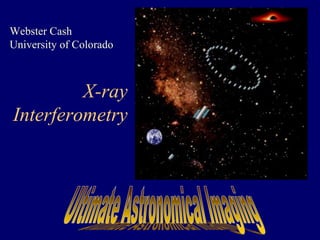
Webster Cash 
University of Colorado 
X-ray 
Interferometry
Collaborators 
• Ann Shipley, Karen Doty, Randy McEntaffer, 
& Steve Osterman at CU 
• Nick White – Goddard 
• Marshall Joy – Marshall 
• David Windt and Steve Kahn - Columbia 
• Mark Schattenburg - MIT 
• Dennis Gallagher – Ball Aerospace
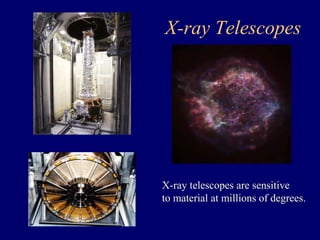
X-ray Telescopes 
X-ray telescopes are sensitive 
to material at millions of degrees.
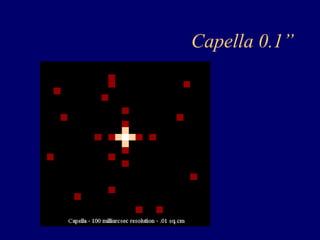
Capella 0.1”
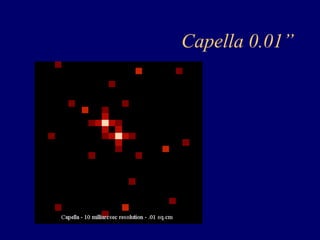
Capella 0.01”
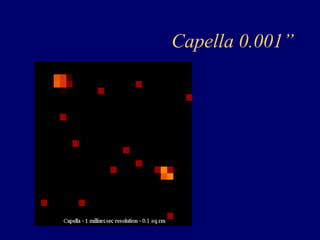
Capella 0.001”
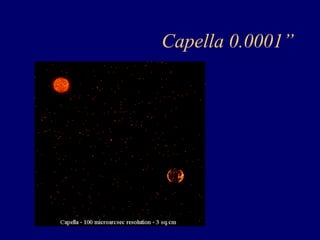
Capella 0.0001”
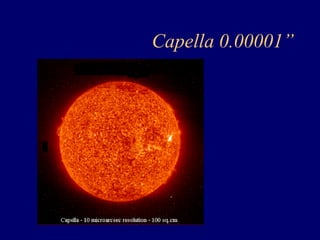
Capella 0.00001”
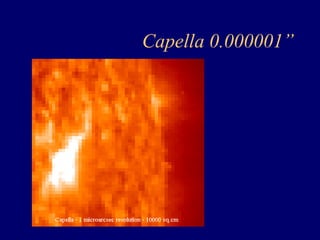
Capella 0.000001”
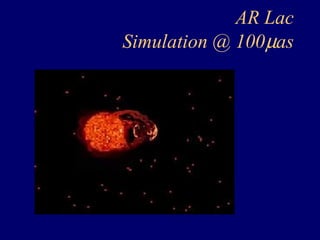
AR Lac 
Simulation @ 100μas
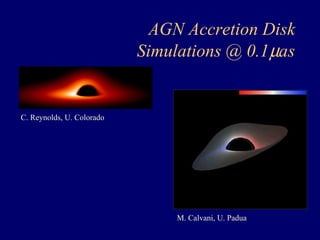
AGN Accretion Disk 
Simulations @ 0.1μas 
C. Reynolds, U. Colorado 
M. Calvani, U. Padua
Need Resolution and Signal 
If we are going to do this, we need to support 
two basic capabilities: 
• Signal 
• Resolution
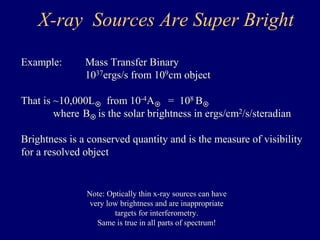
X-ray Sources Are Super Bright 
Example: Mass Transfer Binary 
1037ergs/s from 109cm object 
That is ~10,000L from 10-4A = 108 B 
where B is the solar brightness in ergs/cm2/s/steradian 
Brightness is a conserved quantity and is the measure of visibility 
for a resolved object 
Note: Optically thin x-ray sources can have 
very low brightness and are inappropriate 
targets for interferometry. 
Same is true in all parts of spectrum!
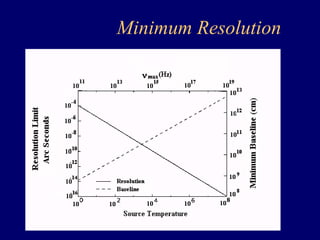
Minimum Resolution
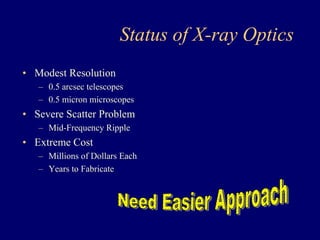
Status of X-ray Optics 
• Modest Resolution 
– 0.5 arcsec telescopes 
– 0.5 micron microscopes 
• Severe Scatter Problem 
– Mid-Frequency Ripple 
• Extreme Cost 
– Millions of Dollars Each 
– Years to Fabricate
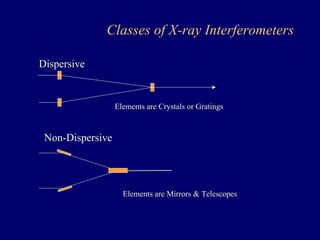
Classes of X-ray Interferometers 
Dispersive 
Non-Dispersive 
Elements are Crystals or Gratings 
Elements are Mirrors  Telescopes
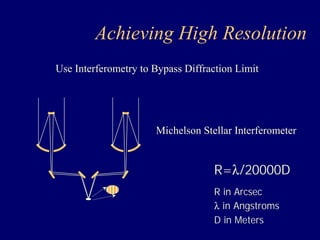
Achieving High Resolution 
Use Interferometry to Bypass Diffraction Limit 
Michelson Stellar Interferometer 
R=λ/20000D 
R in Arcsec 
λ in Angstroms 
D in Meters
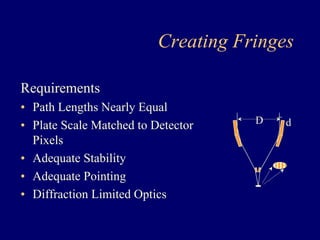
Creating Fringes 
Requirements 
• Path Lengths Nearly Equal 
• Plate Scale Matched to Detector 
Pixels 
• Adequate Stability 
• Adequate Pointing 
• Diffraction Limited Optics 
D d
δ 
sin 
B1= 
θ 
B2 = B1cos(2θ ) 
[ ( )] δ θ 
Pathlength Tolerance Analysis at Grazing Incidence 
OPD = B1− B2 = 1− cos 2 = 
δ θ 2 sin 
θ 
sin 
θ 
δ λ 
20sin 
 
θ Β2 If OPD to be  λ/10 then 
( ) 
λ 
θ θ 
20sin cos 
d Baseline  
( ) 
θ 
λ 
20sin2 
d focal  
A1 A2 
S1 
S2 
δ 
A1  A2 in Phase Here 
C 
θ 
θ 
θ 
Β1
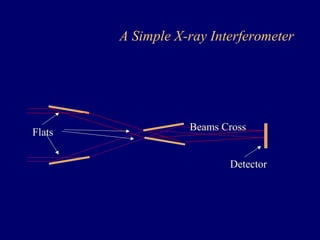
A Simple X-ray Interferometer 
Flats Beams Cross 
Detector
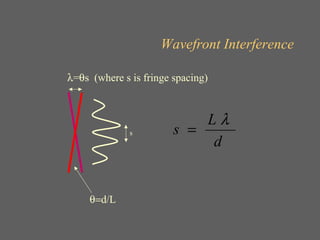
Wavefront Interference 
λ=θs (where s is fringe spacing) 
θ=d/L 
s = L λ s 
d
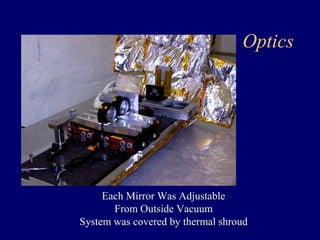
Optics 
Each Mirror Was Adjustable 
From Outside Vacuum 
System was covered by thermal shroud
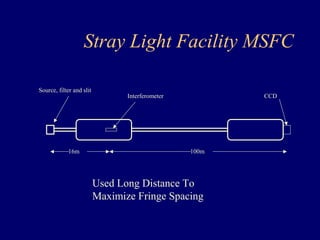
Stray Light Facility MSFC 
Source, filter and slit 
16m 
Interferometer CCD 
100m 
Used Long Distance To 
Maximize Fringe Spacing
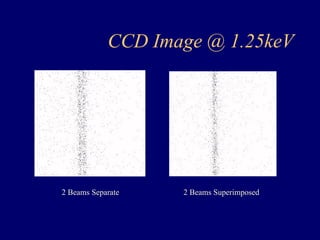
CCD Image @ 1.25keV 
2 Beams Separate 2 Beams Superimposed
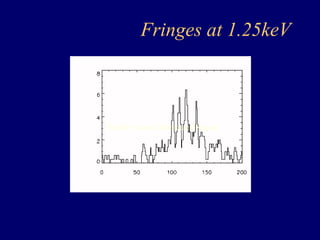
Fringes at 1.25keV 
Profile Across Illuminated Region
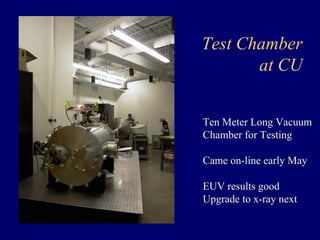
Test Chamber 
at CU 
Ten Meter Long Vacuum 
Chamber for Testing 
Came on-line early May 
EUV results good 
Upgrade to x-ray next
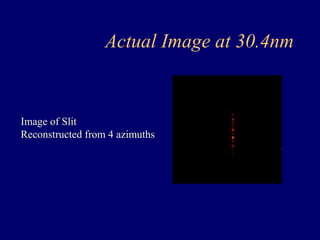
Actual Image at 30.4nm 
Image of Slit 
Reconstructed from 4 azimuths
MAXIM 
The Micro Arcsecond X-ray Imaging Mission 
Webster Cash Colorado 
Nicholas White Goddard 
Marshall Joy Marshall 
PLUS Contributions from the 
Maxim Team 
http://maxim.gsfc.nasa.gov
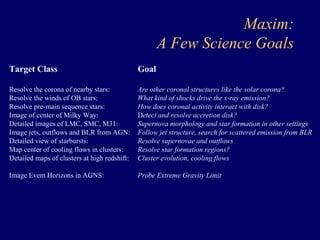
Target Class Goal 
Maxim: 
A Few Science Goals 
Resolve the corona of nearby stars: Are other coronal structures like the solar corona? 
Resolve the winds of OB stars: What kind of shocks drive the x-ray emission? 
Resolve pre-main sequence stars: How does coronal activity interact with disk? 
Image of center of Milky Way: Detect and resolve accretion disk? 
Detailed images of LMC, SMC, M31: Supernova morphology and star formation in other settings 
Image jets, outflows and BLR from AGN: Follow jet structure, search for scattered emission from BLR 
Detailed view of starbursts: Resolve supernovae and outflows 
Map center of cooling flows in clusters: Resolve star formation regions? 
Detailed maps of clusters at high redshift: Cluster evolution, cooling flows 
Image Event Horizons in AGNS: Probe Extreme Gravity Limit
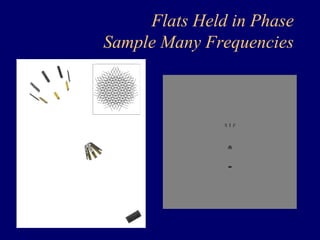
Flats Held in Phase 
Sample Many Frequencies
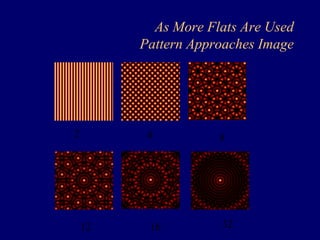
As More Flats Are Used 
Pattern Approaches Image 
2 4 8 
12 16 32
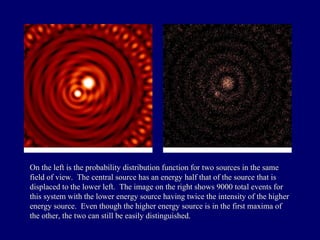
On the left is the probability distribution function for two sources in the same 
field of view. The central source has an energy half that of the source that is 
displaced to the lower left. The image on the right shows 9000 total events for 
this system with the lower energy source having twice the intensity of the higher 
energy source. Even though the higher energy source is in the first maxima of 
the other, the two can still be easily distinguished.
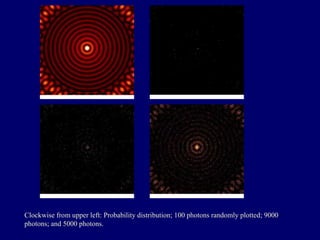
Clockwise from upper left: Probability distribution; 100 photons randomly plotted; 9000 
photons; and 5000 photons.
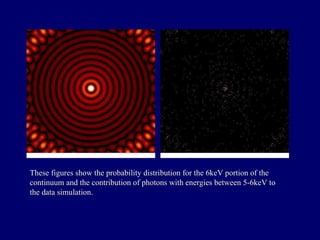
These figures show the probability distribution for the 6keV portion of the 
continuum and the contribution of photons with energies between 5-6keV to 
the data simulation.
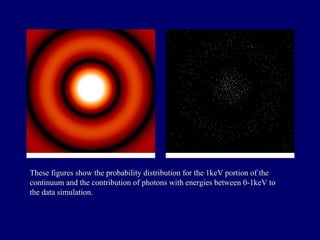
These figures show the probability distribution for the 1keV portion of the 
continuum and the contribution of photons with energies between 0-1keV to 
the data simulation.
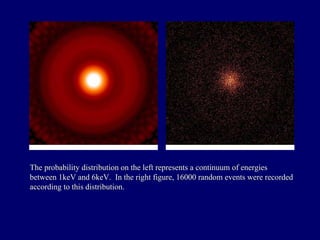
The probability distribution on the left represents a continuum of energies 
between 1keV and 6keV. In the right figure, 16000 random events were recorded 
according to this distribution.
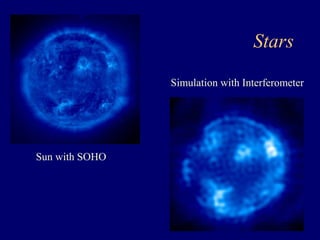
Stars 
Simulation with Interferometer 
Sun with SOHO
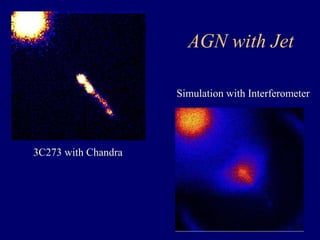
AGN with Jet 
3C273 with Chandra 
Simulation with Interferometer
Four Difficult Areas 
• Fabrication of Interferometer 
• Internal Metrology 
– Hold Mirrors Flat and In Position 
• Formation Flying 
– Hold Detector Craft in Position 
• Pointing 
– Hold Interferometer on Target
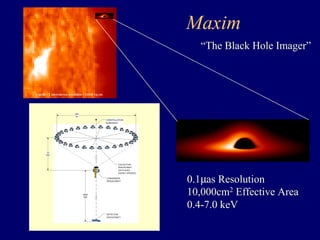
Maxim 
“The Black Hole Imager” 
0.1μas Resolution 
10,000cm2 Effective Area 
0.4-7.0 keV 
CONVERGER 
SPACECRAFT 
DETECTOR 
SPACECRAFT 
200 
M 
COLLECTOR 
SPACECRAFT 
(32 PLACES 
EVENLY SPACED) 
10 
KM 
5000 
KM 
CONSTELLATION 
BORESIGHT
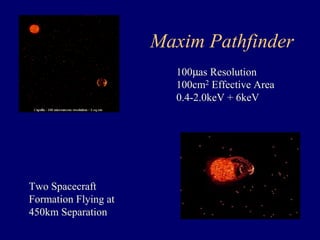
Maxim Pathfinder 
100μas Resolution 
100cm2 Effective Area 
0.4-2.0keV + 6keV 
Two Spacecraft 
Formation Flying at 
450km Separation
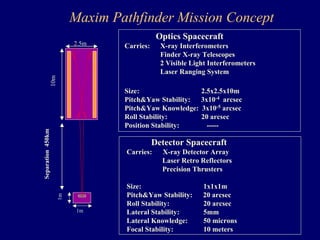
2.5m 
10m 
Optics Spacecraft 
Carries: X-ray Interferometers 
Finder X-ray Telescopes 
2 Visible Light Interferometers 
Laser Ranging System 
Size: 2.5x2.5x10m 
PitchYaw Stability: 3x10⁻⁴ arcsec 
PitchYaw Knowledge: 3x10⁻⁵ arcsec 
Roll Stability: 20 arcsec 
Position Stability: ----- 
Detector Spacecraft 
Carries: X-ray Detector Array 
Laser Retro Reflectors 
Precision Thrusters 
Size: 1x1x1m 
PitchYaw Stability: 20 arcsec 
Roll Stability: 20 arcsec 
Lateral Stability: 5mm 
Lateral Knowledge: 50 microns 
Focal Stability: 10 meters 
1m 
1m 
Separation 450km 
Maxim Pathfinder Mission Concept
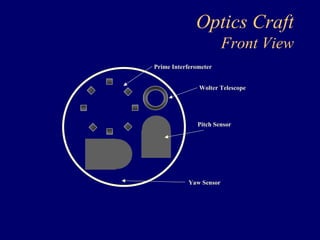
Optics Craft 
Prime Interferometer 
Wolter Telescope 
Pitch Sensor 
Yaw Sensor 
Front View
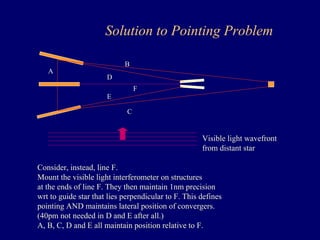
Solution to Pointing Problem 
A 
B 
C 
D 
E 
F 
Visible light wavefront 
from distant star 
Consider, instead, line F. 
Mount the visible light interferometer on structures 
at the ends of line F. They then maintain 1nm precision 
wrt to guide star that lies perpendicular to F. This defines 
pointing AND maintains lateral position of convergers. 
(40pm not needed in D and E after all.) 
A, B, C, D and E all maintain position relative to F.
Detector 
• Energy Resolution Necessary for Fringe 
Inversion 
• CCD is adequate 
• To get large field of view use imaging 
quantum calorimeter
Metrology 
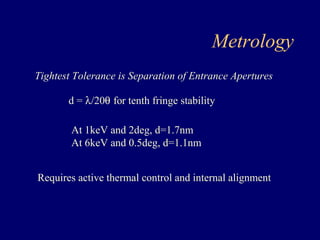
Tightest Tolerance is Separation of Entrance Apertures 
d = λ/20θ for tenth fringe stability 
At 1keV and 2deg, d=1.7nm 
At 6keV and 0.5deg, d=1.1nm 
Requires active thermal control and internal alignment
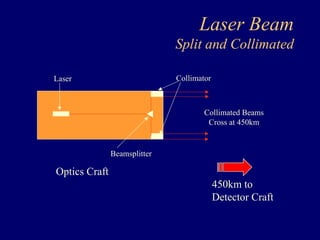
Laser 
Beamsplitter 
Laser Beam 
Split and Collimated 
Collimator 
Collimated Beams 
Cross at 450km 
Optics Craft 
450km to 
Detector Craft
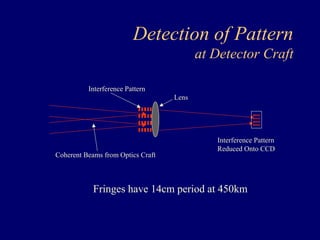
Detection of Pattern 
Interference Pattern 
Coherent Beams from Optics Craft 
Lens 
at Detector Craft 
Interference Pattern 
Reduced Onto CCD 
Fringes have 14cm period at 450km
Pointing 
Need stability and information wrt to the celestial sphere 
at level of required resolution. 
L2 or Fly-away orbit probably necessary 
Baseline design calls for two stellar interferometers. 
One each for pitch and yaw 
SIM class interferometers more than adequate
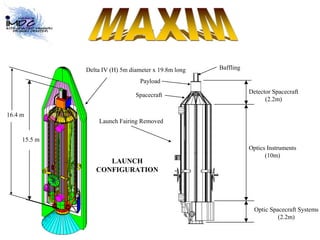
Delta IV (H) 5m diameter x 19.8m long 
Launch Fairing Removed 
Detector Spacecraft 
(2.2m) 
Optics Instruments 
(10m) 
Optic Spacecraft Systems 
(2.2m) 
Baffling 
LAUNCH 
CONFIGURATION 
16.4 m 
15.5 m 
Payload 
Spacecraft
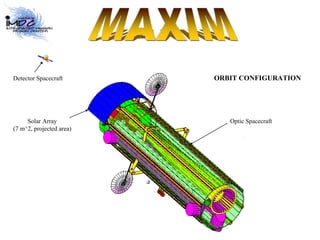
ORBIT CONFIGURATION 
Optic Spacecraft 
Detector Spacecraft 
Solar Array 
(7 m^2, projected area)
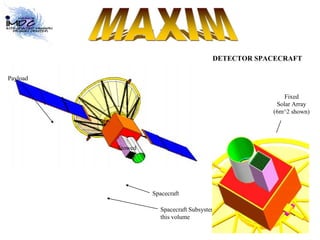
Stowed 
DETECTOR SPACECRAFT 
Orbit 
Payload 
Spacecraft 
Spacecraft Subsystems are mounted in 
this volume 
Fixed 
Solar Array 
(6m^2 shown)
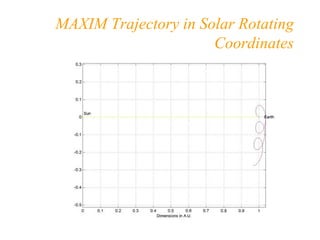
MAXIM Trajectory in Solar Rotating 
Coordinates
Maxim Pathfinder
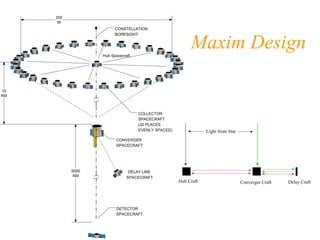
Maxim Design 
CONVERGER 
SPACECRAFT 
DELAY LINE 
DETECTOR 
SPACECRAFT 
200 
M 
COLLECTOR 
SPACECRAFT 
(32 PLACES 
EVENLY SPACED) 
10 
KM 
5000 
KM 
CONSTELLATION 
BORESIGHT 
Hub Spacecraft 
SPACECRAFT 
Light from Star 
Hub Craft Converger Craft Delay Craft
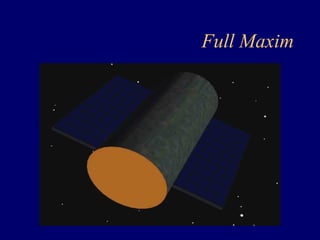
Full Maxim
Maxim Limitations 
• If primary flats are on separate spacecraft 
then they can be flown farther apart. 
Resolution increases. 
• Limited by visible light aspect from stars 
– They’re all resolved at 30nano-arcsec! 
• Find non-thermal visible sources 
• Use x-ray interferometry for aspect too. 
• Solve aspect problem and reach 10-9 arcsec
Integrated System Modeling 
Ball Aerospace Technologies Corporation 
M. Lieber 
D. Gallagher 
Will lead to single most important tool in development 
and definition of x-ray interferometry
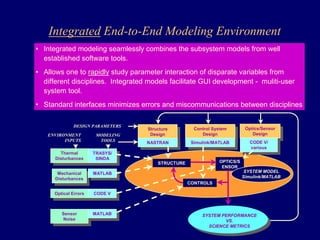
Integrated End-to-End Modeling Environment 
• Integrated modeling seamlessly combines the subsystem models from well 
established software tools. 
• Allows one to rapidly study parameter interaction of disparate variables from 
different disciplines. Integrated models facilitate GUI development - muliti-user 
system tool. 
• Standard interfaces minimizes errors and miscommunications between disciplines 
Control System 
Structure 
Design Control System 
Structure 
Design 
Optics/Sensor 
Design Optics/Sensor 
Design 
Design 
Design 
CODE V/ 
various 
NNAASSTTRRAANN SSimimuulinlink/kM/MAATTLLAABB CODE V/ 
various 
STRUCTURE OPTICS/S 
ENSOR 
DESIGN PARAMETERS 
Thermal 
Disturbances 
Thermal 
Disturbances 
Mechanical 
Disturbances 
Mechanical 
Disturbances 
OOpptitciacla El Errrororsrs 
MODELING 
TOOLS 
TRASYS/ 
SINDA 
MMAATTLLAABB 
TRASYS/ 
SINDA 
CCOODDEE V V 
ENVIRONMENT 
INPUTS 
SYSTEM PERFORMANCE 
VS. 
SCIENCE METRICS 
Sensor 
Noise MATLAB MATLAB 
Sensor 
Noise 
SYSTEM MODEL 
Simulink/MATLAB 
CONTROLS
Example of MAXIM Pathfinder 
Maxim Pathfinder IM 
2 
Wavefront  tilt 
sensor models 
1 
Signal 
processing 
Telescope mechanism 
tip/tilt and 
wavefront control 
systems 
Structural 
dynamics 
Spacecraft 
attitude 
control 
Optics 
model 
Image 
processing 
Imaging sensor 
3 models 
1 
In1 
2 
sav_psf 
Optical subsystem 
Sparse To Workspace2 
secondary mirror 
array 
Sparse 
primary mirror 
array 
Optical ray 
bundle1 
RB offsets 
Deform map 
Out3 
Offsets1 
RB offsets 
Deform map 
Out3 
Offsets 
Image 
plane 
[ttt,uuu] 
[ttt,uuu2] 
u_surf2 
u_surf1 
1 
Out1 
Sparse reflective 
{a1} mirror1 
Sparse reflective 
mirror2 
Sparse reflective 
mirror3 
Sparse reflective 
mirror4 
{b1} 
[c1] 
[c2] 
[c3] 
[c4] 
1 
Ray bundle 
{a1} {b1} 
[c1] 
[c2] 
[c3] 
[c4] 
2 
Optics 
motion 
• Structures, optics, 
controls, signal 
processing, disturbances
Optical Toolbox: 
Key Element of Optical Performance Modeling 
• Geometric ray trace 
• Diffraction analysis (PSF outputs) 
• Easy introduction of mirror distortions from thermal or 
vibration 
• Optics tied to NASTRAN structural model 
• Active control modeling of metrology system and active 
optics 
• Interfaces with imaging and detection modules 
sav_psf 
Sparse To Workspace2 
secondary mirror 
array 
Sparse 
primary mirror 
array 
Optical ray 
bundle1 
RB offsets 
Deform map 
Out3 
Offsets1 
RB offsets 
Deform map 
Out3 
Offsets 
Image 
plane 
[ttt,uuu] 
[ttt,uuu2] 
u_surf2 
u_surf1 
See 
next 
slide
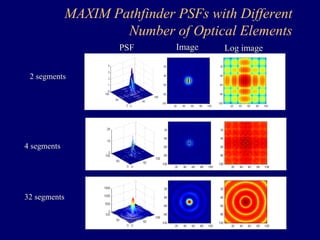
MAXIM Pathfinder PSFs with Different 
Number of Optical Elements 
2 segments 
4 segments 
32 segments 
PSF Image Log image
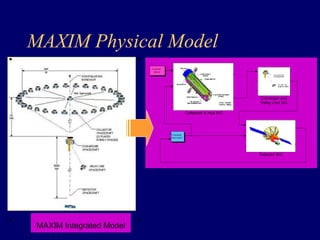
MAXIM Physical Model 
MAXIM Integrated Model 
Celestrial 
objects 
Converger and 
Delay Line S/C 
Detector S/C 
Collectors  Hub S/C 
Command 
and Control
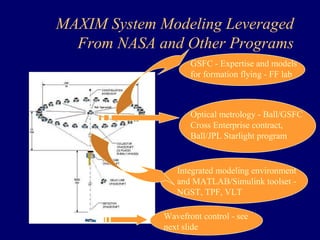
MAXIM System Modeling Leveraged 
From NASA and Other Programs 
GSFC - Expertise and models 
for formation flying - FF lab 
Optical metrology - Ball/GSFC 
Cross Enterprise contract, 
Ball/JPL Starlight program 
Integrated modeling environment 
and MATLAB/Simulink toolset - 
NGST, TPF, VLT 
Wavefront control - see 
next slide
Example Wavefront Control Modeling - 
Initial Phase Map of NGST 
• Wavefront control tools from NGST program and extensive 
work on phase retrieval by JPL 
10 20 30 40 50 60 
10 
20 
30 
40 
50 
60 
10 20 30 40 50 60 
10 
20 
30 
40 
50 
60 
Random errors for 36 segments 
• RMS random = primary 
segments [ 1e-4 1e-4 4e-5 1e-5 1e-4 0] 
[ x-decenter y-decenter piston tip tilt clocking] 
• Secondary = 
offsets 
10x 10-4 
0 2 4 6 8 
-2 
-4 1 2 3 4 5 6 
[ 1e-3 5e-4 1.5e-5 -3e-5 8e-4 
0] 
[ x-decenter y-decenter piston tip tilt clocking] 
x-decenter 
y-decenter 
piston 
tip 
tilt
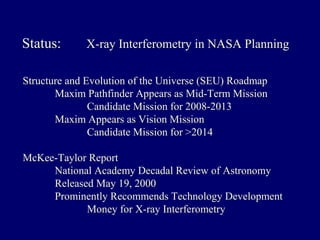
Status: X-ray Interferometry in NASA Planning 
Structure and Evolution of the Universe (SEU) Roadmap 
Maxim Pathfinder Appears as Mid-Term Mission 
Candidate Mission for 2008-2013 
Maxim Appears as Vision Mission 
Candidate Mission for 2014 
McKee-Taylor Report 
National Academy Decadal Review of Astronomy 
Released May 19, 2000 
Prominently Recommends Technology Development 
Money for X-ray Interferometry
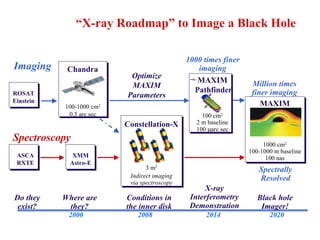
“X-ray Roadmap” to Image a Black Hole 
Imaging 
Spectroscopy 
Do they 
exist? 
X-ray 
Interferometry 
Demonstration 
Million times 
finer imaging 
Black hole 
Imager! 
Where are 
they? 
Optimize 
MAXIM 
Parameters 
Conditions in 
the inner disk 
2000 2008 2014 2020 
ROSAT 
Einstein 
ASCA 
RXTE 
1000 times finer 
imaging 
MAXIM 
Pathfinder 
100 cm2 
2 m baseline 
100 μarc sec 
MAXIM 
1000 cm2 
100-1000 m baseline 
100 nas 
Chandra 
100-1000 cm2 
0.5 arc sec 
XMM 
Astro-E 
Constellation-X 
3 m2 
Indirect imaging 
via spectroscopy 
Spectrally 
Resolved
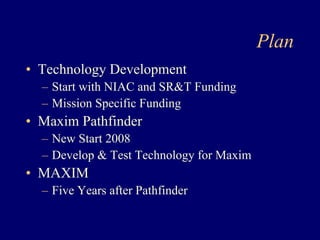
Plan 
• Technology Development 
– Start with NIAC and SRT Funding 
– Mission Specific Funding 
• Maxim Pathfinder 
– New Start 2008 
– Develop  Test Technology for Maxim 
• MAXIM 
– Five Years after Pathfinder
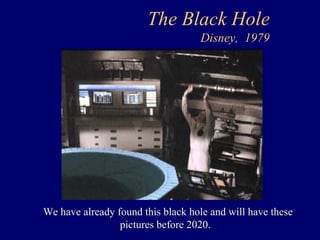
The Black Hole 
Disney, 1979 
We have already found this black hole and will have these 
pictures before 2020.

Ultimate astronomicalimaging

  • 1.
    Webster Cash Universityof Colorado X-ray Interferometry
  • 2.
    Collaborators • AnnShipley, Karen Doty, Randy McEntaffer, & Steve Osterman at CU • Nick White – Goddard • Marshall Joy – Marshall • David Windt and Steve Kahn - Columbia • Mark Schattenburg - MIT • Dennis Gallagher – Ball Aerospace
  • 3.
    X-ray Telescopes X-raytelescopes are sensitive to material at millions of degrees.
  • 4.
  • 5.
  • 6.
  • 7.
  • 8.
  • 9.
  • 10.
  • 11.
    AGN Accretion Disk Simulations @ 0.1μas C. Reynolds, U. Colorado M. Calvani, U. Padua
  • 12.
    Need Resolution andSignal If we are going to do this, we need to support two basic capabilities: • Signal • Resolution
  • 13.
    X-ray Sources AreSuper Bright Example: Mass Transfer Binary 1037ergs/s from 109cm object That is ~10,000L from 10-4A = 108 B where B is the solar brightness in ergs/cm2/s/steradian Brightness is a conserved quantity and is the measure of visibility for a resolved object Note: Optically thin x-ray sources can have very low brightness and are inappropriate targets for interferometry. Same is true in all parts of spectrum!
  • 14.
  • 15.
    Status of X-rayOptics • Modest Resolution – 0.5 arcsec telescopes – 0.5 micron microscopes • Severe Scatter Problem – Mid-Frequency Ripple • Extreme Cost – Millions of Dollars Each – Years to Fabricate
  • 16.
    Classes of X-rayInterferometers Dispersive Non-Dispersive Elements are Crystals or Gratings Elements are Mirrors Telescopes
  • 17.
    Achieving High Resolution Use Interferometry to Bypass Diffraction Limit Michelson Stellar Interferometer R=λ/20000D R in Arcsec λ in Angstroms D in Meters
  • 18.
    Creating Fringes Requirements • Path Lengths Nearly Equal • Plate Scale Matched to Detector Pixels • Adequate Stability • Adequate Pointing • Diffraction Limited Optics D d
  • 19.
    δ sin B1= θ B2 = B1cos(2θ ) [ ( )] δ θ Pathlength Tolerance Analysis at Grazing Incidence OPD = B1− B2 = 1− cos 2 = δ θ 2 sin θ sin θ δ λ 20sin θ Β2 If OPD to be λ/10 then ( ) λ θ θ 20sin cos d Baseline ( ) θ λ 20sin2 d focal A1 A2 S1 S2 δ A1 A2 in Phase Here C θ θ θ Β1
  • 20.
    A Simple X-rayInterferometer Flats Beams Cross Detector
  • 21.
    Wavefront Interference λ=θs(where s is fringe spacing) θ=d/L s = L λ s d
  • 22.
    Optics Each MirrorWas Adjustable From Outside Vacuum System was covered by thermal shroud
  • 23.
    Stray Light FacilityMSFC Source, filter and slit 16m Interferometer CCD 100m Used Long Distance To Maximize Fringe Spacing
  • 24.
    CCD Image @1.25keV 2 Beams Separate 2 Beams Superimposed
  • 25.
    Fringes at 1.25keV Profile Across Illuminated Region
  • 26.
    Test Chamber atCU Ten Meter Long Vacuum Chamber for Testing Came on-line early May EUV results good Upgrade to x-ray next
  • 27.
    Actual Image at30.4nm Image of Slit Reconstructed from 4 azimuths
  • 28.
    MAXIM The MicroArcsecond X-ray Imaging Mission Webster Cash Colorado Nicholas White Goddard Marshall Joy Marshall PLUS Contributions from the Maxim Team http://maxim.gsfc.nasa.gov
  • 29.
    Target Class Goal Maxim: A Few Science Goals Resolve the corona of nearby stars: Are other coronal structures like the solar corona? Resolve the winds of OB stars: What kind of shocks drive the x-ray emission? Resolve pre-main sequence stars: How does coronal activity interact with disk? Image of center of Milky Way: Detect and resolve accretion disk? Detailed images of LMC, SMC, M31: Supernova morphology and star formation in other settings Image jets, outflows and BLR from AGN: Follow jet structure, search for scattered emission from BLR Detailed view of starbursts: Resolve supernovae and outflows Map center of cooling flows in clusters: Resolve star formation regions? Detailed maps of clusters at high redshift: Cluster evolution, cooling flows Image Event Horizons in AGNS: Probe Extreme Gravity Limit
  • 30.
    Flats Held inPhase Sample Many Frequencies
  • 31.
    As More FlatsAre Used Pattern Approaches Image 2 4 8 12 16 32
  • 32.
    On the leftis the probability distribution function for two sources in the same field of view. The central source has an energy half that of the source that is displaced to the lower left. The image on the right shows 9000 total events for this system with the lower energy source having twice the intensity of the higher energy source. Even though the higher energy source is in the first maxima of the other, the two can still be easily distinguished.
  • 33.
    Clockwise from upperleft: Probability distribution; 100 photons randomly plotted; 9000 photons; and 5000 photons.
  • 34.
    These figures showthe probability distribution for the 6keV portion of the continuum and the contribution of photons with energies between 5-6keV to the data simulation.
  • 35.
    These figures showthe probability distribution for the 1keV portion of the continuum and the contribution of photons with energies between 0-1keV to the data simulation.
  • 36.
    The probability distributionon the left represents a continuum of energies between 1keV and 6keV. In the right figure, 16000 random events were recorded according to this distribution.
  • 37.
    Stars Simulation withInterferometer Sun with SOHO
  • 38.
    AGN with Jet 3C273 with Chandra Simulation with Interferometer
  • 39.
    Four Difficult Areas • Fabrication of Interferometer • Internal Metrology – Hold Mirrors Flat and In Position • Formation Flying – Hold Detector Craft in Position • Pointing – Hold Interferometer on Target
  • 40.
    Maxim “The BlackHole Imager” 0.1μas Resolution 10,000cm2 Effective Area 0.4-7.0 keV CONVERGER SPACECRAFT DETECTOR SPACECRAFT 200 M COLLECTOR SPACECRAFT (32 PLACES EVENLY SPACED) 10 KM 5000 KM CONSTELLATION BORESIGHT
  • 41.
    Maxim Pathfinder 100μasResolution 100cm2 Effective Area 0.4-2.0keV + 6keV Two Spacecraft Formation Flying at 450km Separation
  • 42.
    2.5m 10m OpticsSpacecraft Carries: X-ray Interferometers Finder X-ray Telescopes 2 Visible Light Interferometers Laser Ranging System Size: 2.5x2.5x10m PitchYaw Stability: 3x10⁻⁴ arcsec PitchYaw Knowledge: 3x10⁻⁵ arcsec Roll Stability: 20 arcsec Position Stability: ----- Detector Spacecraft Carries: X-ray Detector Array Laser Retro Reflectors Precision Thrusters Size: 1x1x1m PitchYaw Stability: 20 arcsec Roll Stability: 20 arcsec Lateral Stability: 5mm Lateral Knowledge: 50 microns Focal Stability: 10 meters 1m 1m Separation 450km Maxim Pathfinder Mission Concept
  • 43.
    Optics Craft PrimeInterferometer Wolter Telescope Pitch Sensor Yaw Sensor Front View
  • 44.
    Solution to PointingProblem A B C D E F Visible light wavefront from distant star Consider, instead, line F. Mount the visible light interferometer on structures at the ends of line F. They then maintain 1nm precision wrt to guide star that lies perpendicular to F. This defines pointing AND maintains lateral position of convergers. (40pm not needed in D and E after all.) A, B, C, D and E all maintain position relative to F.
  • 45.
    Detector • EnergyResolution Necessary for Fringe Inversion • CCD is adequate • To get large field of view use imaging quantum calorimeter
  • 46.
    Metrology Tightest Toleranceis Separation of Entrance Apertures d = λ/20θ for tenth fringe stability At 1keV and 2deg, d=1.7nm At 6keV and 0.5deg, d=1.1nm Requires active thermal control and internal alignment
  • 47.
    Laser Beamsplitter LaserBeam Split and Collimated Collimator Collimated Beams Cross at 450km Optics Craft 450km to Detector Craft
  • 48.
    Detection of Pattern Interference Pattern Coherent Beams from Optics Craft Lens at Detector Craft Interference Pattern Reduced Onto CCD Fringes have 14cm period at 450km
  • 49.
    Pointing Need stabilityand information wrt to the celestial sphere at level of required resolution. L2 or Fly-away orbit probably necessary Baseline design calls for two stellar interferometers. One each for pitch and yaw SIM class interferometers more than adequate
  • 50.
    Delta IV (H)5m diameter x 19.8m long Launch Fairing Removed Detector Spacecraft (2.2m) Optics Instruments (10m) Optic Spacecraft Systems (2.2m) Baffling LAUNCH CONFIGURATION 16.4 m 15.5 m Payload Spacecraft
  • 51.
    ORBIT CONFIGURATION OpticSpacecraft Detector Spacecraft Solar Array (7 m^2, projected area)
  • 52.
    Stowed DETECTOR SPACECRAFT Orbit Payload Spacecraft Spacecraft Subsystems are mounted in this volume Fixed Solar Array (6m^2 shown)
  • 53.
    MAXIM Trajectory inSolar Rotating Coordinates
  • 54.
  • 55.
    Maxim Design CONVERGER SPACECRAFT DELAY LINE DETECTOR SPACECRAFT 200 M COLLECTOR SPACECRAFT (32 PLACES EVENLY SPACED) 10 KM 5000 KM CONSTELLATION BORESIGHT Hub Spacecraft SPACECRAFT Light from Star Hub Craft Converger Craft Delay Craft
  • 56.
  • 57.
    Maxim Limitations •If primary flats are on separate spacecraft then they can be flown farther apart. Resolution increases. • Limited by visible light aspect from stars – They’re all resolved at 30nano-arcsec! • Find non-thermal visible sources • Use x-ray interferometry for aspect too. • Solve aspect problem and reach 10-9 arcsec
  • 58.
    Integrated System Modeling Ball Aerospace Technologies Corporation M. Lieber D. Gallagher Will lead to single most important tool in development and definition of x-ray interferometry
  • 59.
    Integrated End-to-End ModelingEnvironment • Integrated modeling seamlessly combines the subsystem models from well established software tools. • Allows one to rapidly study parameter interaction of disparate variables from different disciplines. Integrated models facilitate GUI development - muliti-user system tool. • Standard interfaces minimizes errors and miscommunications between disciplines Control System Structure Design Control System Structure Design Optics/Sensor Design Optics/Sensor Design Design Design CODE V/ various NNAASSTTRRAANN SSimimuulinlink/kM/MAATTLLAABB CODE V/ various STRUCTURE OPTICS/S ENSOR DESIGN PARAMETERS Thermal Disturbances Thermal Disturbances Mechanical Disturbances Mechanical Disturbances OOpptitciacla El Errrororsrs MODELING TOOLS TRASYS/ SINDA MMAATTLLAABB TRASYS/ SINDA CCOODDEE V V ENVIRONMENT INPUTS SYSTEM PERFORMANCE VS. SCIENCE METRICS Sensor Noise MATLAB MATLAB Sensor Noise SYSTEM MODEL Simulink/MATLAB CONTROLS
  • 60.
    Example of MAXIMPathfinder Maxim Pathfinder IM 2 Wavefront tilt sensor models 1 Signal processing Telescope mechanism tip/tilt and wavefront control systems Structural dynamics Spacecraft attitude control Optics model Image processing Imaging sensor 3 models 1 In1 2 sav_psf Optical subsystem Sparse To Workspace2 secondary mirror array Sparse primary mirror array Optical ray bundle1 RB offsets Deform map Out3 Offsets1 RB offsets Deform map Out3 Offsets Image plane [ttt,uuu] [ttt,uuu2] u_surf2 u_surf1 1 Out1 Sparse reflective {a1} mirror1 Sparse reflective mirror2 Sparse reflective mirror3 Sparse reflective mirror4 {b1} [c1] [c2] [c3] [c4] 1 Ray bundle {a1} {b1} [c1] [c2] [c3] [c4] 2 Optics motion • Structures, optics, controls, signal processing, disturbances
  • 61.
    Optical Toolbox: KeyElement of Optical Performance Modeling • Geometric ray trace • Diffraction analysis (PSF outputs) • Easy introduction of mirror distortions from thermal or vibration • Optics tied to NASTRAN structural model • Active control modeling of metrology system and active optics • Interfaces with imaging and detection modules sav_psf Sparse To Workspace2 secondary mirror array Sparse primary mirror array Optical ray bundle1 RB offsets Deform map Out3 Offsets1 RB offsets Deform map Out3 Offsets Image plane [ttt,uuu] [ttt,uuu2] u_surf2 u_surf1 See next slide
  • 62.
    MAXIM Pathfinder PSFswith Different Number of Optical Elements 2 segments 4 segments 32 segments PSF Image Log image
  • 63.
    MAXIM Physical Model MAXIM Integrated Model Celestrial objects Converger and Delay Line S/C Detector S/C Collectors Hub S/C Command and Control
  • 64.
    MAXIM System ModelingLeveraged From NASA and Other Programs GSFC - Expertise and models for formation flying - FF lab Optical metrology - Ball/GSFC Cross Enterprise contract, Ball/JPL Starlight program Integrated modeling environment and MATLAB/Simulink toolset - NGST, TPF, VLT Wavefront control - see next slide
  • 65.
    Example Wavefront ControlModeling - Initial Phase Map of NGST • Wavefront control tools from NGST program and extensive work on phase retrieval by JPL 10 20 30 40 50 60 10 20 30 40 50 60 10 20 30 40 50 60 10 20 30 40 50 60 Random errors for 36 segments • RMS random = primary segments [ 1e-4 1e-4 4e-5 1e-5 1e-4 0] [ x-decenter y-decenter piston tip tilt clocking] • Secondary = offsets 10x 10-4 0 2 4 6 8 -2 -4 1 2 3 4 5 6 [ 1e-3 5e-4 1.5e-5 -3e-5 8e-4 0] [ x-decenter y-decenter piston tip tilt clocking] x-decenter y-decenter piston tip tilt
  • 66.
    Status: X-ray Interferometryin NASA Planning Structure and Evolution of the Universe (SEU) Roadmap Maxim Pathfinder Appears as Mid-Term Mission Candidate Mission for 2008-2013 Maxim Appears as Vision Mission Candidate Mission for 2014 McKee-Taylor Report National Academy Decadal Review of Astronomy Released May 19, 2000 Prominently Recommends Technology Development Money for X-ray Interferometry
  • 67.
    “X-ray Roadmap” toImage a Black Hole Imaging Spectroscopy Do they exist? X-ray Interferometry Demonstration Million times finer imaging Black hole Imager! Where are they? Optimize MAXIM Parameters Conditions in the inner disk 2000 2008 2014 2020 ROSAT Einstein ASCA RXTE 1000 times finer imaging MAXIM Pathfinder 100 cm2 2 m baseline 100 μarc sec MAXIM 1000 cm2 100-1000 m baseline 100 nas Chandra 100-1000 cm2 0.5 arc sec XMM Astro-E Constellation-X 3 m2 Indirect imaging via spectroscopy Spectrally Resolved
  • 68.
    Plan • TechnologyDevelopment – Start with NIAC and SRT Funding – Mission Specific Funding • Maxim Pathfinder – New Start 2008 – Develop Test Technology for Maxim • MAXIM – Five Years after Pathfinder
  • 69.
    The Black Hole Disney, 1979 We have already found this black hole and will have these pictures before 2020.